Archive for the 'UN' Category

UN High Commissioner for Human Rights writes about Women’s Human Rights Defenders

December 8, 2014
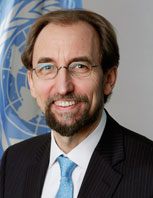
UN HCHR Al Hussein

On 5 December 2014, Zeid Ra’ad Al Hussein, United Nations High Commissioner for Human Rights, wrote a piece in the Huffington Post in which he eloquently calls on all to ‘Stand in Solidarity With Courageous Women’s Human Rights Defenders’. 

In the article he explains that his Office has decided to launch a campaign to pay tribute to women and men who defy stereotypes and fight for women’s human rights. The campaign runs from Human Rights Day, December 10 this year, to International Women’s Day, March 8, 2015. We encourage everyone to join the ranks of these strong and inspiring advocates, on social media (#reflect2protect) and on the ground. Below the text in full:


Almost two decades ago, in Beijing, 189 countries made a commitment to achieve equality for women, in practice and in law, so that all women could at last fully enjoy their rights and freedoms as equal human beings.

They adopted a comprehensive and ambitious plan to guarantee women the same rights as men to be educated and develop their potential. The same rights as men to choose their profession. The same rights to lead communities and nations and make choices about their own lives without fear of violence or reprisal. No longer would hundreds of thousands of women die every year in childbirth because of health care policies and systems that neglected their care. No longer would women earn considerably less than men. No longer would discriminatory laws govern marriage, land, property and inheritance.

In the years that followed, the world has witnessed tremendous progress: the number of women in the work force has increased; there is almost gender parity in schooling at the primary level; the maternal mortality ratio declined by almost 50 percent; and more women are in leadership positions. Importantly, governments talk about women’s rights as human rights, and women’s rights and gender equality are acknowledged as legitimate and indispensable goals.

However, the world is still far from the vision articulated in Beijing. Approximately 1 in 3 women throughout the world will experience physical and/or sexual violence in their lifetime. Less than a quarter of parliamentarians in the world are women. In over 50 countries there is no legal protection for women against domestic violence. Almost 300,000 women and girls died in 2013 from causes related to pregnancy and childbirth. Approximately 1 in 3 married women aged 20 to 24 were child brides. In many parts of the world, women and girls cannot make decisions on their most private matters — sexuality, marriage, children. Girls and women who pursue their own life choices are still murdered by their own families in the dishonorable practice of so-called honor killings. All of our societies remain affected by stereotypes based on the inferiority of women, which often denigrate, humiliate and sexualize them.

Today we have the responsibility to protect the progress made in the past 20 years and address the remaining challenges. In doing so, we must recognize the vital role of women who defend human rights, often at great risk to themselves and their families precisely because they are viewed as stepping outside socially prescriptive gender stereotypes. We must recognize the role of all people, women and men, who publicly call for gender equality and often, as a result, find themselves the victim of archaic and patriarchal, but powerful, threats to their reputations, their work and even their lives. These extraordinary individuals — women’s human rights defenders — operate in hostile environments, where arguments of cultural relativism are common and often against the background of the rise of extremist, misogynistic groups, which threaten to dismantle the gains of the past.

Attacks against women who stand up to demand their human rights and individuals who advocate for gender equality are often designed to keep women in their “place.” In some areas of the world, women who participate in public demonstrations are told to go home to take care of their children. Consider the recent example of a newspaper publishing naked photos of a woman, claiming she was a well-known activist — an attack designed to shame this defender into silence. In other places, when women claim their right to affordable modern methods of contraception, they are labelled as prostitutes in smear campaigns seeking to undermine their credibility. Online attacks against those who speak for women’s human rights and gender equality by so-called “trolls” — who threaten heinous crimes — are increasingly reported.

These attacks have a common thread — they rely on gender stereotypes and deeply entrenched discriminatory social norms in an attempt to silence those who challenge the age-old system of gender inequality. However, these defenders will not be silenced, and we must stand in solidarity with them against these cowardly attacks.

This is why my Office has decided to launch a campaign to pay tribute to women and men who defy stereotypes and fight for women’s human rights. The campaign runs from Human Rights Day, December 10 this year, to International Women’s Day, March 8, 2015. We encourage everyone to join the ranks of these strong and inspiring advocates, on social media and on the ground.

As we approach the 20-year anniversary of Beijing, discrimination and violence against women, and the stereotypes that confine them into narrowly fixed roles must end. Women have the right to make their own decisions about their lives and their bodies. Guaranteeing and implementing these rights are non-negotiable obligations of all States. Women human rights defenders were instrumental in securing the ambitious program laid out in Beijing. Their work, their activism and their courage deserve our recognition, our support and our respect.”

Stand in Solidarity With Courageous Womens Human Rights Defenders | UN Women.

Human rights and Business Forum in Geneva – a report

December 5, 2014

The 3rd UN Forum on Business and Human Rights took place in Geneva from 1-3 December. Here is the personal and very readable report from one participant, Sudeep Chakravarti, who regularly publishes on business and human rights in India.

“A decade ago a global forum such as the United Nations Forum on Business and Human Rights was inconceivable. Now it is already in its third edition. It is apt that the third United Nations Forum on Business and Human Rights took place over 1-3 December in Geneva, marking the 30th anniversary of the gas leak disaster in Bhopal. On the face of it such a gathering may appear to be a grand eyewash: little more than a self-important global talkfest for bureaucrats, businesses—and their sharp handmaidens in law and public relations. Perhaps a budget-justifying annual ball for the office of the UN High Commissioner for Human Rights, which flowed from a toothless exercise, Guiding Principles on Business and Human Rights, that was formally adopted by the UN Human Rights Council in 2011. After all, the UN’s Protect, Respect and Remedy framework that backed such guiding principles is little more than finger-wagging. The principles mention the “States’ existing obligations to respect, protect and fulfil human rights and fundamental freedoms”; the role of business enterprises “as specialized organs of society performing specialized functions, required to comply with all applicable laws and to respect human rights”; and the need for rights and obligations “to be matched to appropriate and effective remedies when breached”. It’s a re-stating of the dazzlingly obvious in the mellow tones of UN bureaucratese: there cannot be human rights in business unless businesses behave, and governments ensure they behave.

That is certainly true in the Indian context. Here complicity of business and government to ignore or dilute the rights of project-affected communities, among other malpractices, is a continuing scandal that foments unrest and has implications for internal security. Even so, the UN forum makes eminent sense. The absence of power to prosecute cannot always be equated with irrelevance. A decade ago a global forum such as this was inconceivable. Now it is already in its third edition. It’s recognition, as with the adoption of UN’s guiding principles by that global body that such issues matter, will increasingly matter. Moreover, each such gathering brings together a clutch of important people, important statements, and release of research data and trends, a reaffirmation of the religion of business and human rights; one in which ethics increasingly signal hassle-free earnings, as opposed to the time-honoured and piratical, but increasingly litiginous, endeavour of earnings over ethics. The UN forum is today a sort of Davos to discuss and disseminate matters of human rights and business, a place to be seen, yes, but more importantly, also to be heard. A virtual wagonload of useful documents in the areas of human rights, community rights, child rights, labour laws and liability, among others, were made available at the forum (accessible at ohchr.org/hrc and business-humanrights.org )—several of which I shall discuss in future. The United Nations Children’s Fund (UNICEF) and the Danish Institute for Human Rights released a useful tool to track use of child labour, Children’s Rights in Impact Assessments. UNICEF separately shared guidelines on engaging stakeholders in the area of children’s rights. The UN Environment Programme’s Finance Initiative launched the Human Rights Guidance Tool for the Financial Sector, a useful companion to the initiative of the Thun Group of banks, a multinational endeavour of some of the biggest names in investment banking to reduce liability on account of customers’ iffy human rights practices.

Activist-documentation was also unveiled, such as one by the UK-based Peace Brigades International on behalf of what it termed “human rights defenders working on land and environmental issues”. It is titled Recommendations for States and Multilateral Bodies—a response to alleged lending and oversight malpractices by multilateral agencies. For my money, the highlight was the keynote statement at the forum on 2 December by Nestlé SA’s chief executive Paul Bulcke. For the past year beset by accusations of labour wrongdoing directly or by associates in some of Nestlé’s globalized farming and procurement operations, Bulcke’s reiteration of human rights was surely as introspective as it is welcome. “It is in the actions, on the ground, where respect for human rights is visible,” he stated. “In the countries where companies operate, where they have their people working for them, where they source their raw materials and link up with societies; where they produce, where they sell their products and services. That’s where human rights are visible and lived.” If ideas of responsibility, accountability, legal and financial liability, and the danger of diminishing of corporate image remain explicitly and implicitly on the agenda of such a gathering; which aids dissemination of human rights in the spheres of business, governance, activism and judicial redress; and tunes law, it is surely work in progress. And if it is work in progress, it works.”

Read more at: http://www.livemint.com/Opinion/hHo4qgjWnNPS8qHNxvFgtO/Rootcause.html?utm_source=copy


Human rights: a forum in Geneva – Livemint.

Michel Forst on protecting defenders who work on business and human rights

December 1, 2014

At the start of the 3rd UN Forum on Business and Human Rights, today 1 December, the ISHR publishes a series of articles by key human rights defenders and experts in this field. [https://thoolen.wordpress.com/2014/11/17/register-for-the-3rd-annual-forum-on-business-and-human-rights-1-to-3-december-2014/] The Special Rapporteur on HRDs, Michel Forst, goes first:

Read the rest of this entry »

Special Rapporteur in Burundi: respect the work of Human Rights Defenders like Mbonimpa!

November 25, 2014

(Independent Expert on Human Rights Michel Forst. Photo: Jean-Marc Ferré)

On 25 November 2014 the United Nations Special Rapporteur on the situation of human rights defenders, Michel Forst, expressed regret today that defenders in Burundi are deemed to be political opponents, saying that in reality they are activists working to promote and protect human rights and civil liberties. In a press release issued by the UN Office of the High Commissioner for Human Rights, Michel Forst, emphasized that threats and defamation campaigns by certain media outlets weigh on human rights defenders, who also report a high number of cases of physical threats, anonymous phone calls, assaults, arbitrary arrest and judicial harassment.

Read the rest of this entry »

2014 Nansen Award ceremony for Butterflies – video

November 23, 2014

To my horror I see that I missed this year’s Nansen Award. Rectified with the video clip above which was published on 1 October , 2014 by UNHCR.  UN High Commissioner for Refugees, António Guterres, presented the Colombian women’s rights group, Butterflies with New Wings Building a Future, with the Nansen Refugee Award in Geneva, Switzerland, on Monday 29 September. The courageous Colombian women’s rights network received the award for its outstanding work to help victims of forced displacement and sexual abuse in Buenaventura, Colombia.

The Nansen Refugee Award marked its 60th anniversary this year. see also: http://www.brandsaviors.com/thedigest/award/nansen-medal

Learn more: www.unhcr.org/nansen

UN recognizes that Belarus violated the freedom of association of Ales Bialiatski

November 19, 2014

The UN Human Rights Committee decided on 24 September 2014 that Belarus had violated the freedom of association of Ales Bialiatski, President of Human Rights Centre “Viasna”. This groundbreaking decision is not limited to Belarus but concerns all signatory States that violate the freedom of association. The interpretation could benefit other human rights defenders who are under pressure from political and administrative measures to curtail their right to freedom of association. The text of the press release issued by FIDH (whose Director General represented the victim) on 17 November follows:

Paris-Minsk, 17 November 2014 – In a decision that will go down in history, on 24 September 2014 the UN Human Rights Committee officially recognized that the Republic of Belarus violated the rights of Ales Bialiatski, President of Human Rights Centre “Viasna” and FIDH Vice President. The Committee recognized violations of Article 9 (the right to liberty and security of the person), Article 14 (the right to justice and a fair trial), and Article 22 (freedom of association) of the International Covenant on Civil and Political Rights (ICCPR). This decision follows an individual communication from Ales Bialiatski’s spouse Natalia Pinchuk, represented by FIDH Director General Antoine Bernard. It sends a strong signal to regimes that manipulate their legislation to stifle critical voices and violate the freedom of association.

After Viasna was deprived of its state registration in 2003, its founders applied for registration at the Ministry of Justice three times between 2007 and 2009. However, the state refused registration every time. As a result, Viasna was unable to open a bank account in its name and receive funding for its activities. According to the Committee, Belarus violated the organization’s right to freedom of association when it denied Viasna registration, basing its decision solely on the argument that the documents submitted by Viasna needed minor adjustments to meet the requirements of the Ministry of Justice which could have been corrected should the Ministry had given it an opportunity to do so. The refusal to register Viasna rendered its activities illegal within Belarus and prevented its members from accessing their rights. Sentencing Ales Bialiatski to a lengthy prison term for actions associated with the receipt and expenditure of funds aimed at carrying out the legitimate activities of his organization was a direct consequence of the violation of freedom of association. The Belarusian courts rejected evidence that these funds were intended and used for these purposes and did not consider the case in a way that would aim to safeguard the freedom of association. Consequently, imposing criminal liability on Ales Bialiatski violated this freedom.

“This decision by the Human Rights Committee, based on international law, recognizes the legitimacy of Viasna’s activities and fully rehabilitates Ales Bialiatski”, rejoiced Valentin Stefanovic, Vice President of Viasna.

The Committee also found that Ales Bialiatski’s detention during the initial investigation was arbitrary, since the decision to arrest him was made by the procurator/prosecutor and not the court and was based solely on the gravity of charges and not on any evidence that this measure was needed or advisable.

The Committee found that over the course of criminal proceedings, Ales Bialiatski’s presumption of innocence was violated, as seen in treatment of the case by state media and statements by the president of Belarus. They presumed Ales Bialiatski’s guilt before the court’s verdict took effect. Also, he was wrongfully kept in a cage during the trial and brought into the courtroom in handcuffs.

The Committee’s decision states that Bialiatski is entitled to legal remedies: reconsideration of Viasna’s application for state registration, clearing of his criminal record, adequate compensation, including reimbursement of fines paid in accordance with judicial decisions. Furthermore, the Committee found that the State should review its laws on associations and bring them into accord with Article 22 of the ICCPR.

“The Committee has communicated the decision to the State, which is now obliged to provide Ales Bialiatski with legal remedies”, said Karim Lahidji, FIDH President. “This decision is crucial for Viasna, other Belarusian human rights organizations and the respect for liberty of association all over the world, as numerous regimes try to stifle critical voices”.

The decision reached by the Committee on this case sets a precedent. It clearly demonstrates that the actions of a state aimed at obstructing the activities of human rights organizations – from refusing to register an association to prosecuting its members for exercising their right to associate—are in violation of international law. No manipulation of internal legislation by individual states can hide these violations from the international community.

Our organizations consider this decision a source of expert legal arguments in the face of ever increasing pressure on human rights defenders and their organizations.

for earlier posts see https://thoolen.wordpress.com/tag/ales-bialiatski/

UN recognizes that Belarus violated the rights of Ales ….

Register for the 3rd annual Forum on Business and Human Rights: 1 to 3 December 2014

November 17, 2014

The Office of the United Nations High Commissioner for Human Rights (OHCHR) organises the third annual Forum on Business and Human Rights, from 1 to 3 December 2014 in the Palais des Nations, Geneva.humanrightslogo_Goodies_14_LogoVorlagen

The Forum will last three days and focus on trends and challenges in the implementation of the “Guiding Principles on Business and Human Rights” and in implementing the United Nations “Protect, Respect and Remedy” Framework (A/HRC/17/31) and promote dialogue and cooperation on issues linked to business and human rights. The Forum is under the guidance of the Working Group on the issue of human rights and transnational corporations and other business enterprises, and open to multi-stakeholder participation, including States, business, civil society, and affected individuals and groups. See also my earlier posts: https://thoolen.wordpress.com/tag/business/

Registration for the 2014 Forum is currently open via the online registration system:http://www.ohchr.org/EN/Issues/Business/Forum/Pages/2014FBHRParticipation.aspx.

The draft programme of the Forum is now available at:www.ohchr.org/Documents/Issues/Business/ForumSession3/DraftProgramme.pdf

For further information about the Forum, please see the Forum website:www.ohchr.org/EN/Issues/Business/Forum.


Hinah Jilani on human rights defenders: the first report of her Maastricht lecture

November 17, 2014

The 5th Theo van Boven lecture was given by Hinah Jilani on 11 November 2014 in Maastricht. As a primeur here is a report written by Daan Bronkhorst (1953) who has been at the staff of Amnesty International Netherlands since 1979. He has written on refugees, transitional justice, history and other issues, and produced a Dutch-language encyclopedia of human rights. He is now writing a PhD study on human rights defenders.

Hinah Jilani on human rights defenders

Observations on a lecture

by Daan Bronkhorst

At the law faculty of Maastricht University, the 5th Theo van Boven Lecture was presented on 11 November 2014 by Hinah Jilani. From 2000 to 2008, she was the United Nations Special Representative on Human Rights Defenders. She is in various respects an emblematic human rights defender herself. Already in 1980, with her sister Asma Jahangir she founded the Legal Aid Cell in Lahore. She was co-founder of the Human Rights Commission of Pakistan and the Women’s Action Forum. She was the target of arrests and death threats, once narrowly escaping a gunman who killed the woman she was counseling at that time.

In the lecture, she described human rights defenders as those who bring to the fore information on the abuses to be addressed by governments and organizations. They contribute to relief and protection, they provide a measure of accountability, they inform governments on possible actions and help ensure a measure of justice. In conflict situations, they have a critical role in promoting peace and peace building. They prompt recognition of participatory democracy and transparency. ‘Human rights defenders are not just making human rights violations visible, they confront states with their duty to protect’, she said. For their work, defenders are considered a threat in most parts of the world. They experience vilification, unfair trials, acts of violence, self-imposed exile and reprisals.

Jilani said that ‘time and again, I was pressured by governments to define human rights defenders. I was wondering why there was this insistence. Then I understood then that when you define, you can make it easy to exclude people.’ Among human rights defenders, Jilani includes professionals as well as peasants, workers, teachers, doctors, judges, MPs and many others. ‘Actually anyone who undertakes any activity for the promotion and protection of human rights, and is harmed becomes of that, comes under the protection of the [1998 UN] Declaration on Human Rights Defenders.’ Quoting examples from her native country, Pakistan, she described the threats that befall the defenders not just from state oppression, but also coming from the ‘lack of judicial independence, social biases, traditional and religious practices, economic interests and political privileges.’ Women are targeted and ostracized by the elders of their communities. There is a positive note as well: ‘Until not so long ago judges used to honour honour killings in Pakistan. Today that has become unthinkable.’

 Jilani pictures the defending of the defenders as ‘often a story of one step forward and two steps backwards’. Leaders of indigenous communities, representatives of migrants and refugees, trade unionists: they are all increasingly targeted. More and more reports of attacks now come from Africa. In an increasing number of countries law and policies are leading to the shrinking of civil society space. Meetings are dispersed for alleged security reasons, the defenders are called insurgents or anti-state elements, or simply terrorists. In the UN Declaration, Jilani said, civil society was explicitly given a role in safeguarding democracy and human rights. ‘The defenders initiated programs for institution building, education and the enforcement of the rule of law. But it is impossible for them to achieve those aims if civilians are not allowed to live their normal lives.’ She also cracked a nut with the media: ‘The media have been the first to attack human rights defenders. They have not taken the effort to understand their work. They hit back at the very people who stand up for them when freedom of the press and freedom of opinion are threatened.’

Jilani’s opinions and convictions can be considered as leading in the field. Her observations, I think, also give rise to a number of questions. I mention three.

         First, the concept. That the UN Declaration offers no definition has the advantage of greater inclusion, but the risk of confusion and erosion. There are conspicuous inconsistencies in the UN Declaration with later commentaries and explanations issued by the Office of the High Commissioner for Human Rights. Is the term meant to denote only those who are at risk, or also those working from safe offices in say Geneva? That the very concept of the human rights defender is still in the air even at the UN is testified by the November 2013 debate that led to a resolution on women human rights defenders. In the last-minute final text some of the draft’s references, such as to violence against women and to the refraining from invoking customs and religion, were left out, even though shortly before having been adopted in UN General Assembly resolutions.

            Second, the scope of the work of human rights defenders. It is one thing to state that human rights work contributes to processes such as that of peace building and social justice, it is another to imply that their actual work is in those fields. There is much consensus about human rights including protection from torture or equality before the law, but not on such issues as the human rights scope of poverty. What is the dividing line between what is injustice and what is a human rights violation? This ties in with a larger present-day debate on the position and foundations of human rights. Will human rights defenders get lost in this debate and become one more bone of contention? Or can a somehow limited purview of their work strengthen human rights’ position?

            And third, the empirical data that support the call for better protection and underpinning of the human rights defenders’ work. Jilani’s statement that the space for human rights defence is shrinking on a worldwide scale and that attacks on human rights defenders are increasing, is reflected in reports by international defenders organizations. Simultaneously these organizations report greatly expanding international networks, much success in training, rising awareness of the international community. Is there a discrepancy here? Is the image of increasing threats perhaps self-serving the (donor) organizations? To the perceived rise of menaces one can argue that not long ago in most non-Western countries there was no civil society space at all. Also, since so many more individuals and groups are now labeled ‘human rights defenders’, the absolute number of those victimized may grow even if their proportion decreases. If there is indeed progress, this may prompt emphasizing the effectiveness of programs and using this as leverage for work on situations where the threats persist or newly occur.

Glimmer of hope for Sotoudeh and Iran crashed by Tehran Bar Association

October 21, 2014

The glimmer of hope for Nasrin Sotoudeh and Iran which I saw in my post of 6 September [https://thoolen.wordpress.com/2014/09/06/glimmer-of-hope-in-iran-nasrin-sotoudehs-ban-to-practice-overruled/] seems to have been crushed already. Yesterday, 20 october, the Observatory for the Protection of Human Rights Defenders, the joint programme of FIDH and OMCT, has received new information that on 18 October 2014, a three-member disciplinary investigation panel of Tehran’s Bar Association has now suspended Nasrin Sotoudeh’s law license for three years, based on a complaint filed by the Islamic Revolution Court’s Prosecution Office (unlike the first disciplinary panel of the Tehran Bar Association which rejected a similar request). Read the rest of this entry »

Retaliation now reaches even Human Rights Commissioners in the Maldives: UN deeply concerned

October 19, 2014

(Ravina Shamsadani, Spokesperson for the Office of the UN High Commissioner for Human Rights. Photo: UN Multimedia)

On 17 October 2014 the United Nations High Commissioner for Human Rights felt duty bound to express deep concern about a criminal case initiated by the Supreme Court of the Maldives against members of the country’s own official Human Rights Commission!

The Office of the High Commissioner for Human Rights (OHCHR), noted that five members of the Human Rights Commission of the Maldives were now facing “serious criminal charges” following the submission of their written contribution to their country’s second Universal Periodic Review (UPR), presented to the UN Human Rights Council (the actual UPR of the Maldives is scheduled to be held between April and May 2015). “The Government has a responsibility to ensure a safe operating space for the Commission and for civil society actors in the country, so that they are able to coöperate with UN human rights mechanisms without fear of reprisals.” the spokesperson stated.

[It is not the first time the Supreme Court of the Maldives has come under rebuke from OHCHR. In 2013, former High Commissioner for Human Rights Navi Pillay called for reforms to the judiciary to safeguard the rule of law following the Supreme Court’s repeated interventions in the presidential election process in the Maldives which, she said, were undermining the country’s democracy. In that specific case, the Court had nullified the first round of the election on the basis of irregularities in the process, despite conclusions by national and international observers that the election was free and fair.]

United Nations News Centre – Maldives: UN ‘deeply concerned’ as Supreme Court prosecutes rights advocates.