In March 2026, the UN Human Rights Council (the Council) will appoint the next Special Rapporteur on the situation of Human Rights Defenders. The role of this Special Rapporteur is essential: they promote the work of those who defend human rights and they protect human rights defenders at risk. The Special Rapporteur serves in a voluntary capacity and is independent of the UN, States and non-governmental organisations. As other Special Rapporteurs, they are tasked by the UN to monitor and report on human rights situations around the world. They also provide advice and recommendations for the implementation of those rights.
The four rapporteurs until now have all been of exceptional calibre:
Mary Lawlor (Ireland)
2020-2026
She became a Board member of the Irish Section of Amnesty International in 1975, was elected Chair from 1983 -1987 and in 1988 became its Director. She founded Front Line Defenders in 2001 to focus specifically on the protection of human rights defenders at risk.
On 1 May 2020, she took up the mandate of the Special Rapporteur on the situation of human rights defenders, where she has adopted a people-centred approach to the mandate. Her mandate was renewed for another three-year term by the UN Human Rights Council in April 2023.
She is also currently an Adjunct Professor of Business and Human Rights in the Centre for Social Innovation (CSI), School of Business, Trinity College Dublin.
Mr. Michel Forst (France) was Special Rapporteur on the situation of human rights defenders from June 2014 until April 2020. From 2008 to 2013, Mr. Forst was the UN Independent Expert on the situation of human rights in Haiti, and between 2012 and 2013 he was the Chair of the Coordination Committee of the Special Procedures of the Human Rights Council.
Mrs. Margaret Sekaggya (Uganda) was the Special Rapporteur on the situation of human rights defenders from 2008 to 2014. Before her appointment as Special Rapporteur, Ms. Sekaggya was the Chairperson of the Uganda Human Rights Commission and a High Court Judge in the country.
Ms. Hina Jilani (Pakistan) was Special Rapporteur on the situation of human rights defenders from 2000 – 2008. In 1980, she and her sister founded Pakistan’s first women-only legal practise. She became an Advocate of the Supreme Court shortly after her tenure as Special Rapporteur came to an end.
We should becampaigning so the new person appointed is independent, impartial and competent and comes from a background that represents the diversity of our world.
Are you a suitable candidate? Apply! (1) Complete the online survey (2) Submit the application form in Word format. The deadline for applications is 31 August 2025, noon Geneva time (CEST).
Josef Benedict and Rajavelu Karunanithi published a piece in the Diplomat of 18 July 2025 describing how from Hong Kong to India, governments are passing and weaponizing new laws to pursue and jail whoever speaks up for human rights.
Four years ago, on the 32nd anniversary of the 1989 Tiananmen Square massacre, plain clothes police arrested human rights lawyer and pro-democracy activist Chow Hang-tung outside her office in Hong Kong. Her alleged crime? Publishing two social media posts advertising a public vigil to remember the notorious crackdown in Tiananmen Square. At the time, Chow was the vice-chair of the now defunct Hong Kong Alliance in Support of the Patriotic Democratic Movement of China, the main organizer of annual Tiananmen vigils…
Sadly, such repression is not unique to Hong Kong. Across Asia, authoritarian and democratic governments alike are passing and weaponizing new laws – in clear violation of international law and standards – to pursue and jail whoever speaks up for human rights. Today, on Nelson Mandela International Day, we call for the release of Chow Hang-tang, who is part of CIVICUS’ Stand As My Witness campaign, as well as other human rights defenders unjustly locked up in Asia around the world.
The CIVICUS Monitor, which tracks civic space conditions across the world, now rates Hong Kong’s civic space as “closed,” the worst possible ranking. Hundreds remain behind bars as police systematically use the new laws to arrest and prosecute people on trumped-up charges. Often, the process itself becomes the punishment as activists spend years in detention before they are even tried…
Meanwhile, Hong Kong authorities are trying to take their repression international, by offering bounties for activists-in-exile charged under the National Security Law and by arresting the father of a prominent U.S.-based activist, Anna Kwok.
..Hong Kong’s National Security Laws have become something of a model for other Asian governments looking to stifle dissent.
Look no further than India, often called the world’s largest democracy, where Prime Minister Narendra Modi’s government resorts to similar laws to consolidate power and silence his critics. Dozens of activists have been jailed under the Unlawful Activities Prevention Act (UAPA), a draconian anti-terror law. Under the UAPA’s provisions, activists remain in pre-trial detention for long periods and are denied bail, including human rights defender Khurram Parvez, who was arrested in November 2021. His trial has yet to start, four years on. [see also: https://www.trueheroesfilms.org/thedigest/laureates/81468931-79AA-24FF-58F7-10351638AFE3]
Meanwhile, Cambodia’s Han Manet regime has used “incitement” laws as their weapon of choice to silence activists, journalists, and members of the opposition.
With legal repression spreading across Asia, the international community must do more to push back and stand with these brave activists. Foreign governments must not only speak out when activists are convicted, but step in much earlier when these human rights defenders are arrested. Diplomats should visit wrongly arrested activists in detention, monitor their trials, and engage with their families. Foreign governments must also use international platforms like the United Nations Human Rights Council and bilateral meetings to highlight their cases and call for their release.
Activists-in-exile also need support and assistance, especially when they face transnational repression. The recent G-7 Leaders’ Statement on Transnational Repression was a good start, but strong rhetoric must now turn into serious action. Failure to undertake such actions will see a further regression of democracy and repression of civic freedoms in Asia and elsewhere.
Sixteen activists completed the 2025 Human Rights Defender Advocacy Programme in Geneva to strengthen their advocacy skills. During the programme, they called for reforms to the UN human rights system, and helped secure the renewal of the expert mandate on sexual orientation and gender identity.
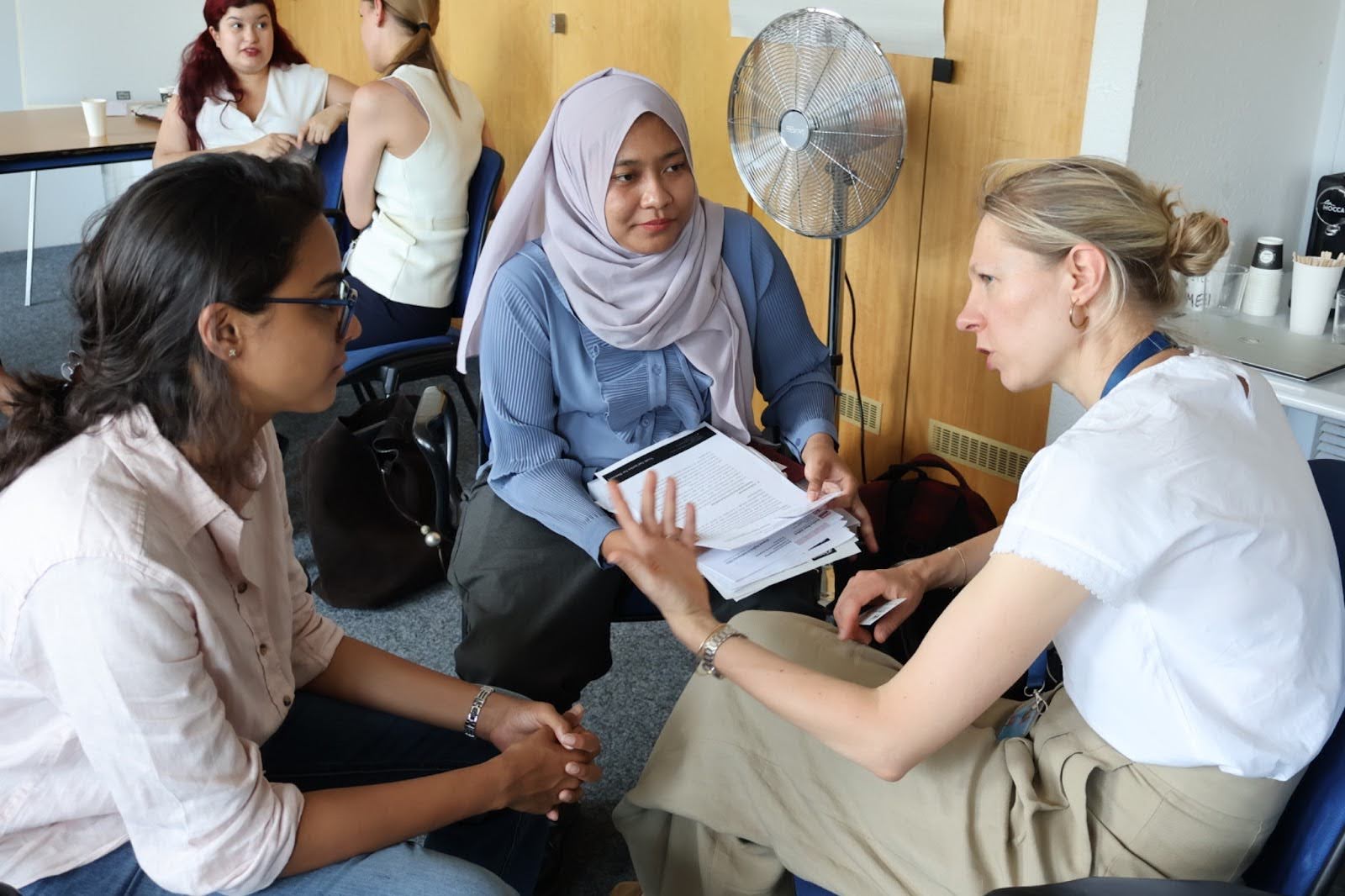
Held from 9 to 20 June 2025, the on-site part of HRDAP25 took place during the 59th session of the UN Human Rights Council. The programme blended online learning with face-to-face sessions in Geneva. Defenders explored UN human rights mechanisms such as the Human Rights Council, Special Procedures, Universal Periodic Review, and Treaty Bodies. They practiced advocacy techniques, developed strategic roadmaps, and engaged directly with mechanisms to push for real change at home.
It was intensive but very good. The platform is so user friendly, everyone can learn and take time to revisit, consult, see examples, and ask questions. The possibility to have online sessions and work in groups was very useful for me. Elena Petrovska, LGBTI Equal Rights Association for Western Balkans and Turkey, North Macedonia
Participants came from a wide range of regions and contexts, including Colombia, Guatemala, Nigeria, Indonesia, Tunisia, Lebanon, Nepal, India, Uganda, Cameroon, Syria, North Macedonia, Tibet and Sierra Leone. Their work focuses on LGBTIQ+ rights, environmental justice, transitional justice, gender equality, protection of migrants, business and human rights, and the protection of communities at risk.
Each day was filled with learning opportunities, advocacy and reflection. In April and May, the group enjoyed online training and coaching sessions which were then built upon with a packed in-person programme that gave participants the background preparation needed to engage with the various mechanisms and relevant stakeholders while in Geneva. They applied and practiced the knowledge and skills gained in a few different ways, which included: an NGO breakfast with the High Commissioner for Human Rights, where participants could ask very detailed and pertinent questions about the current situation; a brown bag lunch with experts from the Committee on Civil and Political Rights, where the group received first person tips on how to submit information and engage with Treaty Bodies; and meetings with UN Special Procedures (Business and human rights, Climate Change, Enforced Disappearances, Extreme Poverty) and their staff, were participants could start personal relationships with those experts and share their advocacy journey and plans.
Photo: ISHR
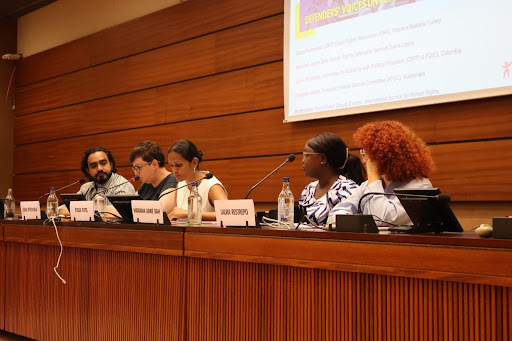
Defenders also participated in a powerful public side event about the reform of the UN human rights system. They shared lived experiences and challenges with over 30 States, calling for deeper access, stronger accountability, and genuine inclusion in the ongoing UN80 reform process. Laura Restrepo from Colombia reflected: ‘The UN must look inward and acknowledge its own colonial legacies — in who speaks, who decides, and whose knowledge counts. It must shift power toward grassroots and frontline communities.’
Throughout the programme, defenders stood up for key causes. Several participants joined the global campaign to #RenewIESOGI, advocating for the continuation of the UN mandate on Sexual Orientation and Gender Identity. Their voices contributed to a successful outcome: the Human Rights Council renewed the mandate for three more years, reaffirming its importance as a tool to combat discrimination and protect LGBTIQ+ communities.
Photo: ISHR
The sense of care and community ran deep. HRDAP helped participants’ work grounded in the values of solidarity and justice, and built their confidence to keep advocating at all levels. HRDAP25 not only provided skills and relevant exposure but also created a space for collaboration and resilience. Speaking during the public side event on UN reform, Pooja Patel, ISHR’s Deputy Executive Director, reminded States: ‘Human rights defenders are not only on the front lines of crises, they are on the front lines of solutions.’
No-one will have missed the recent media hype surrounding the opposite candidacies of US President Trump and UN rapporteur Francesca Albanese for this year’s Nobel Peace Prize. This blog with its focus on human rights defenders and their awards would be amiss in not taking note, even if the Nobel Prize is foremost a peace prize not necessarly a human rights award. [see also my piece of 2012 https://global.comminit.com/content/nobel-prize-peace-not-necessarily-human-rights]
So, it is not excluded that the ‘making peace at any cost’ considerations will prevail, but my bet is that the Peace Prize Committee will be careful in ignoring the massive support from the world’s human rights community who have massively come out against the Trump administration’s sanctions against Albanese. Human rights should trump ‘peace’ on this occasion.
Nominations for a Nobel Peace Prize for Francesca Albanese are gathering steam. See the links below:
Annual meeting of the Tripartite Partnership to Support National Human Rights Institutions UNDP
In the face of democratic backsliding, shrinking civic space and complex global crises, national human rights institutions (NHRIs) stand as vital defenders on the frontlines of human rights protection. On 18-19 June, UNDP, UN Human Rights Office (OHCHR), the Global Alliance of National Human Rights Institutions (GANHRI), NHRIs and their regional and global networks, as well as international partners convened to reflect on challenges NHRIs encounter in their daily work and to chart a strategic path forward.
“National human rights institutions are a cornerstone of any democratic system. When properly supported, they help prevent violations, close accountability gaps, and bring the voices of the most marginalized to the forefront,” said Dr. Ammar Dwaik, Director General, Independent Commission for Human Rights in Palestine.
The Tri-Partite Partnership (TPP) to Support NHRIs, a strategic collaboration between UNDP, OHCHR and GANHRI, has played a catalytic role in strengthening NHRIs in 15 countries. Through this partnership, NHRIs have enhanced their capacity, increased visibility and improved outreach to deliver services to marginalized or remote communities, as well as to support people amidst conflict, hostilities or post-crises. Compelling stories of institutional transformation were shared from the State of Palestine, Timor-Leste and Ukraine.
The TPP has also empowered NHRIs to respond more effectively to urgent challenges, including the impacts of climate change and the digital divide. Innovative practices encompass the use of a real-time Human Rights Dashboard in Nigeria and the development of a digital platform to enhance public engagement in Costa Rica. “We have seen how investments in digital systems are improving institutional quality and deepening human rights impact,” said Turhan Saleh, Deputy Director, UNDP Crisis Bureau.
Discussions on environmental rights and climate justice highlighted experiences from Ecuador, Georgia and North Macedonia, demonstrating how NHRIs supported environmental defenders and helped integrate human rights into national climate responses.
“We see a direct link between access to environmental justice and the protection of communities’ rights – especially those on the frontlines of climate impacts. Our role has been to amplify these voices and ensure that environmental policy is grounded in human rights,” said Tamar Gvaramadze, First Deputy Public Defender of Georgia.
The TPP Annual Meeting re-affirmed the UN system’s continued commitment to empowering NHRIs as independent, effective, and resilient institutions – essential for upholding human rights, democracy, peace, and sustainable development worldwide.
On 1 July 2025, Raphael Hoetmer and Sofia Jarrín in Amazon Watch report on the U.N. Permanent Forum on Indigenous Issues, staying that governments and UNODC must include Indigenous Peoples in anti-crime and environmental policies
For Indigenous communities, these expanding criminal economies mean more than environmental degradation. They are direct assaults on their lives, health, and sovereignty. Illegal activities such as logging, mining, and coca production for international markets contaminate rivers with mercury, destroy food sources, deteriorate health, and displace communities from their ancestral lands. These burgeoning criminal markets, coupled with weak or complicit state institutions, have led Indigenous leaders to warn that criminal groups are increasingly taking over local government structures and exerting territorial control.
This deepening crisis makes the Amazon one of the most dangerous places in the world for environmental defenders. Indigenous organizations often face these threats alone, without adequate support from governments or international institutions. As Indigenous Peoples themselves underscore, these violent criminal economies kill leaders, recruit their youth, and spread fear through their communities…
This year a delegation of Amazonian Indigenous leaders delivered a clear and urgent message: organized crime and illegal economies are devastating the Amazon and threatening the survival of Indigenous Peoples. They called on the Forum to include strong recommendations urging the international community and governments to step up their efforts to support Indigenous territorial governance, protect human rights defenders, and ensure Indigenous Peoples are included in shaping policies to prevent and contain organized crime.
“The Permanent Forum must formally recognize that organized crime and illegal economies such as drug trafficking and illegal mining are an existential threat to our peoples. We must be included in drafting the international protocol on environmental crimes, and protection mechanisms for Indigenous defenders must be created, along with funding for Indigenous-led economic alternatives. If these measures are not taken, ongoing military and police interventions in our territories will continue to put our lives at risk. Without dignified livelihoods, we cannot safeguard our culture or our territories.”
The Permanent Forum’s conclusions this year directly responded to these urgent appeals. Its final document, published earlier this month, presents a wide range of concerns, recommendations, and proposals related to the implementation of the United Nations Declaration on the Rights of Indigenous Peoples, with this session explicitly addressing the impacts and expansion of criminal economies.
In conclusion 87 of the document, the Forum urges governments and the United Nations Office on Drugs and Crime (UNODC) – the leading global institution on anti-crime policies – to integrate Indigenous Peoples meaningfully into the design and implementation of anti-crime and security strategies. This recommendation is particularly relevant in the ongoing process to discuss a new Protocol Against Crimes that Affect the Environment, which must include the voices of Indigenous Peoples – as the principal stewards of global biodiversity and primary victims of the violence tied to these crimes.
The Forum’s conclusions also emphasize the urgent need for the international community and governments to:
take necessary measures to ensure the rights, protection, and safety of Indigenous leaders and human rights defenders,
end impunity and prosecute those who commit violence against Indigenous Peoples,
acknowledge and protect Indigenous women and children from the disproportionate impacts of war and violence on their lives,
ensure Indigenous participation in peace negotiations and peace-building processes,
assess the impacts of mercury on the health, culture, and livelihoods of Indigenous Peoples under the Minamata Convention,
and repair the damage from toxic metals on Indigenous lands and territories, including restoring sites and water sources, with special attention to the severe impact on the health of Indigenous women and children.
Jasmin Lorch in an article of 25 June 2025 argues that European support to human rights NGOs, critical civil society and free media is not merely a “nice-to-have“. Instead, it directly serves European interests due to the important information function that these civil society actors perform.
USAID funding cuts have dealt a heavy blow to human rights defenders, critical Non-Governmental Organizations (NGOs) and independent media outlets around the globe. While the damage is hard to quantify exactly, it is clearly huge. For instance, the Centre for Human Rights and Democracy at People in Need estimates that the human rights and media organizations it supports have seen their budgets shrink by 40 to 100% because of the cuts. Based on a USAID fact sheet, meanwhile taken offline, Reporters without Borders (RSF) informed that the dismantling of USAID had affected support to 6,200 journalists, 707 non-state media outlets and 279 civil society organizations (CSOs) working to support free media. The impacts on local civil society are especially pronounced in closed authoritarian contexts where CSOs are both restricted and donor-dependent. In Cambodia, ADHOC, one of the few remaining local human rights organizations, lost 74 percent of its budget and had to close 16 out of its 22 provincial offices.
As critical CSOs and independent media outlets struggle to find alternative sources of funding, they face another threat to their survival: Major European donors, including Sweden, have cut down on foreign funding as well, citing their own national needs, including the necessity to invest more in defence. Germany, the biggest bilateral donor since the dismantling of USAID, has recently pledged to better integrate its foreign, defence, and development policy and to more closely align development cooperation with its security and economic interests. Accordingly, there is a significant risk that European donors will (further) cut down on funding for critical CSOs and free media as well.
However, European donors should consider that continuing to support human rights defenders, critical NGOs and independent media outlets is in their own interest.
Notably, these civil society actors serve an important information function. By furnishing insights into human rights abuses, governance deficits and patterns of corruption, they provide European (as well as other) governments with a better understanding of political developments, power relations and regime dynamics in their partner countries, thereby enhancing the predictability of security and economic partnerships. Authoritarian governments. in particular, restrict the free flow of information, while, concurrently, engaging in propaganda and, at times, strategic disinformation. Consequently, European foreign, economic and security policy towards these governments routinely suffers from severe information deficits, including the existence of numerous “unknown unknowns”. To compensate for this weakness, country assessments and expert opinions used by foreign, development, and defence ministries in Europe to devise policy approaches towards non-democratic partner countries often include information provided by independent media outlets, human rights or anti-corruption NGOs. Similarly, European embassies in authoritarian countries frequently draw on the reports and documentations accomplished by local human rights NGOs.
In some cases, the information provided by critical NGOs, human rights defenders and independent media outlets – both local and transnational – is highly economically and security relevant, for instance when it serves to unearth patterns of transnational crime. The Organized Crime and Corruption Reporting Project (OCCRP), an investigative journalist network, which also has a media development branch and was heavily affected by the USAID funding cuts, for instance, contributed to the Panama Papers that disclosed the secretive use of offshore tax havens. A recent report named Policies and Patterns. State-Abetted Transnational Crime in Cambodia as a Global Security Threat draws on interviews with journalists and civil society representatives. While expressing disappointment with the ineffectiveness of large parts of the aid community and big counter-trafficking NGOs in addressing the problem, it emphasizes that
“the ‘local civil society’ community — grassroots volunteer response networks, human rights defenders, and independent media —have been and remain the lynchpin of an embattled response. These heavily repressed and poorly funded groups have been and remain the primary source of available evidence on the lead perpetrators, their networks, and their modes of operation” (quote on p.3).
Last but not least, establishing partnerships with human rights defenders and critical NGOs also allows European countries to expand their social and political alliances in their partner countries, a diversification that can be highly useful in times of political uncertainty and change. ..
Support to human rights NGOs, other critical CSOs and free media constitutes an important contribution to democracy and pluralism. However, it also benefits European economic and security interests by enhancing the knowledge base on which European governments can draw when constructing their international alliances. European governments already use the information provided by these civil society actors in various ways, so they should continue providing diplomatic support, solidarity, and resources to them. Moreover, partnerships with human rights, media, and other civil society representatives provide European governments with an important possibility to diversify their international partnerships.
Against this backdrop, European support to these civil society actors is not a “nice-to-have” that can easily be dispensed with when funding gets more scarce. It is an important element in ensuring the predictability and reliability of European foreign relations.
Human Rights activist Henry Tiphagne at the press meetInstagram/peopleswatch
On 25 June 2025 Azeefa Fathima wrote how – at the release of the Global Index on Torture in Geneva, human rights defender Henri Tiphagne of India’s People’s Watch slammed India for failing to ratify the UN Convention Against Torture and for allowing systemic impunity in custodial deaths.
India’s human rights record on custodial torture came under sharp international criticism at the launch of the Global Index on Torture in Geneva on Tuesday, June 25, with prominent rights advocate Henri Tiphagne accusing the country of “zero accountability” in cases of police brutality and deaths in custody.
Drawing attention to the fifth anniversary of the custodial deaths of Jeyaraj and Benix in Tamil Nadu, Henri said, “The father and son were tortured and died in judicial custody. They were produced before a judicial magistrate after medical examination, having already changed clothes three times due to bleeding. The trial has gone on for five years, across 262 hearings, and is still ongoing, while the family continues to face reprisals.”
Henri, who is the Executive Director of People’s Watch, criticised India for being among eight countries listed in the Global Index for ongoing torture and reprisals against victims and human rights defenders. “We are yet to ratify the Convention Against Torture, despite over 41 countries having recommended it. The National Human Rights Commission (NHRC) has existed for 32 years and has not prosecuted even one police officer responsible for extrajudicial killings or torture,” he said…
He said that India must “bow down in shame” for its continued failure to ratify the UN convention and for its “zero accountability” in cases of custodial torture and deaths.
The National Human Rights Commission (NHRC), established 32 years ago, has never successfully prosecuted a single police officer involved in torture or extrajudicial killings, Henri noted, and said, “We are the only country with so many human rights institutions, and yet they are not functioning. The NHRC has even been downgraded in Geneva, and this speaks volumes”.
Watch a recording of the statement at an interactive dialogue on the annual report of the High Commissioner by ISHR Executive Director Phil Lynch
High Commissioner, this statement addresses four themes from your update.
First, the work of human rights defenders is essential for the realisation of all human rights. We deplore the criminalisation and arbitrary detention of defenders in all regions. We call for the release of Eduardo Torres in Venezuela, Ibrahim Metwally in Egypt, Mahmoud Khalil in the US, and Sophia Huang Xueqin in China, among thousands of defenders imprisoned globally for their work for freedom and justice.
Second, principled respect for international law protects us from tyranny. The failure of States with influence to end Israel’s genocide against Palestinians, and the double standards of States which fail to condemn Russia’s atrocity crimes in Ukraine, erode the foundations of peace, security and development everywhere.
Third, impunity for atrocity crimes denies justice to victims and fuels violations. This Council should mandate investigative mechanisms on Afghanistan and China. All States should respect international courts and sanction authorities – including US officials – who seek to pervert international justice.
Finally, no business, however efficient, can survive when customers don’t pay their bills. States which don’t pay their UN dues in full or on time, especially the US and China, benefit from the system while causing a liquidity crisis, with devastating human rights impacts. They should lose the right to vote at the General Assembly and the Security Council until they pay their dues. Humanity’s future depends on all States increasing their human rights investment.
This event will take place on 16 June 2025, from 1:00PM – 2:00PM CEST, in Room XXV, of the Palais des Nations in Geneva Add to calendarpdf Download event flyer
In the face of the triple planetary environmental crisis, of conflict, genocide and apartheid, of the consolidation of authoritarian ideologies and narratives around the globe, and the erosion of the rule of law as well as the closing of civic space, never have we needed a robust international human rights system so badly.
But the UN human rights system is in crisis. As essential users and actors of the system, human rights defenders’ views are valuable. The event provides a space to be hearing directly from them not only about why they need an effective, efficient, responsive UN human rights system to support their activism especially in the current context, but also about the ways in which the UN system needs to grow, evolve, adapt and reform itself to deal with the crisis of credibility and legitimacy it is currently facing.
Panelists:
Laura Restrepo, Committee for Solidarity with Political Prisoners (CSPP) & FDSS, Colombia
Mariama Jumie Bah , Human Rights Defenders Network Sierra Leone
Elena Petrovska , LGBTI Equal Rights Association (ERA), Western Balkans/Turkey
Douglas Javier Juárez Dávila, American Friends Service Committee (AFSC), Guatemala



 Hans Thoolen on Human Rights Defenders and their awards