Two journalists, one imprisoned in Belarus and the other in Georgia, have won the European Union’s top human rights honor, the Sakharov Prize, European Parliament President Roberta Metsola announced on Wednesday 22 October 2025.
Andrzej Poczobut is a correspondent for the influential Polish newspaper Gazeta Wyborcza. He was convicted of “harming Belarus’ national security” and sentenced to eight years, which he is serving in the Novopolotsk penal colony.
Mzia Amaghlobeli, a prominent journalist who founded two of Georgia’s independent media outlets, was in August convicted of slapping a police chief during an anti-government protest. She was sentenced to two years in prison in a case that was condemned by rights groups as an attempt to curb media freedom.
“Both are journalists currently in prison on trumped up charges simply for doing their work and for speaking out against injustice. Their courage has made them symbols of the struggle for freedom and democracy,” Metsola said at the parliament in Strasbourg, France.
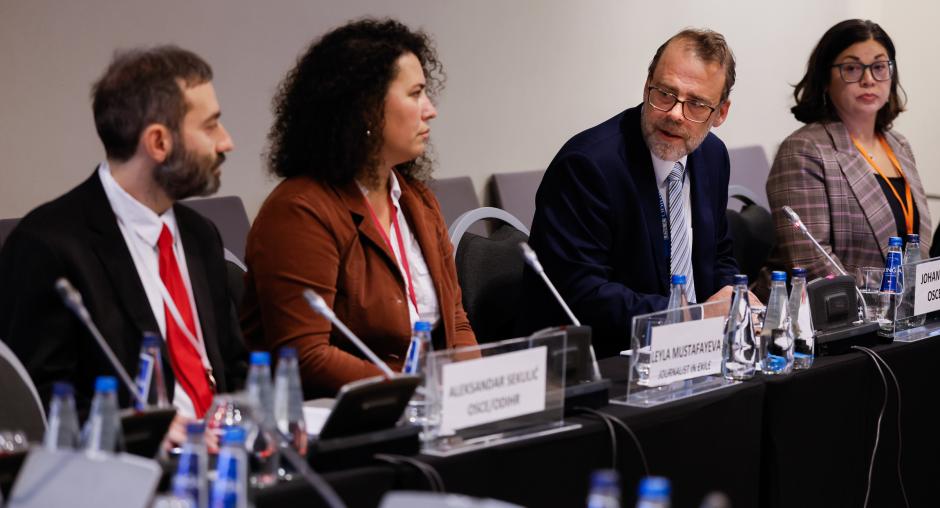
Panelists discussing the need for stronger protection for human rights defenders in exile. Warsaw, 16 October 2025 (OSCE/Piotr Dziubak) Photo details
As civil society space shrinks and attacks against activists increase in many places, a growing number of human rights defenders are being forced into exile as they seek a safe environment to continue their work freely and securely. This was the focus of an event organized by the OSCE Office for Democratic Institutions and Human Rights (ODIHR), Araminta, and the World Organisation Against Torture at the Warsaw Human Dimension Conference on 16 October 2025.
“Human rights defenders face inherent risks in their work, and relocating does not address all their needs. Adopting robust safeguarding mechanisms is essential to ensure minimum standards for mobility and a safe environment for defenders in exile,“ said Jennifer Gaspar, Araminta Managing Director.
While defenders in exile play a crucial role in promoting human rights, they face serious challenges, from urgent personal and legal issues to long-term barriers such as legal insecurity, restricted mobility and limited opportunities to continue their work. Participants discussed the need to establish minimum standards to protect human rights defenders in exile in the OSCE region, as well as EU legislation to ensure stronger legal and practical safeguards for them, participants discussed.
The discussion drew on both institutional perspectives and the lived experiences of exiled defenders, highlighting the need for coordinated action and policy tools to address these gaps. Participants emphasized that ensuring human rights defenders can continue their work in safety is vital to protect human rights and promote democratic values across the OSCE region and beyond.
Members of the Foreign Affairs and Development Committees of the European Parliament voted on Thursday for the three finalists for the 2025 Sakharov Prize for Freedom of Thought (in alphabetical order):
-Imprisoned journalists fighting for your freedom and ours, Andrzej Poczobut from Belarus and Mzia Amaglobeli from Georgia
-Journalists and Humanitarian Aid Workers in Palestine and all conflict zones, represented by the Palestinian Journalists Syndicate, the Red Crescent, and UNRWA ;
-Serbian students
Find the biographies of the candidates and finalists by following this link.
The Conference of Presidents, comprising European Parliament President Roberta Metsola and the leaders of the political groups, will choose the 2025 laureate from this shortlist. Their decision will be announced in the Strasbourg Hemicycle during the plenary session on 22 October 2025.
The Committee on Economic, Social and Cultural Rights (CESCR) recently published its General Comment on the environmental dimension of sustainable development. In addition to recognising human rights defenders, the Comment clarifies State obligations towards marginalized communities and notes the importance of transitioning away from fossil fuels. It also outlines States’ extraterritorial obligations.
ISHR provided two written inputs to the draft of this General Comment earlier this year – a standalone submission regarding the recognition and protection of environmental human rights defenders (EHRDs) based on the Declaration+25, a supplement to the UN Declaration on Human Rights Defenders, and a joint submission in partnership with the Center for International Environmental Law, Earthjustice, FIAN International, the Global Initiative for Economic, Social and Cultural Rights, Human Rights Watch and Oxfam.
‘States parties should respect, protect, and promote the work of environmental and indigenous human rights defenders, as well as other civil society actors who support people in marginalized and disadvantaged situations in realizing their Covenant rights.’ States parties should take all necessary measures to ensure that environmental human rights defenders and journalists can carry out their work, without fear of harassment, intimidation or violence, including by protecting them from harm by third parties.’
ISHR welcomes that priorities from the joint NGO submission to the CESCR are reflected in the General Comment, in particular Indigenous Peoples’ right to ‘free, prior and informed consent’ and the need to transition away from fossil fuels (including by reducing ineffective subsidies).
However, we regret that the Comment does not more explicitly acknowledge the critical role of EHRDs in promoting sustainable development or strategic lawsuits against public participation (SLAPPs) as an obstacle to their engagement. The CESCR has previously noted the risks faced by HRDs and provided guidance on their recognition and protection in the context of land issues in General Comment No. 26 and it should have extended this analysis to EHRDs in the context of sustainable development. The use of SLAPPs to silence HRDs has been acknowledged by other UN bodies, including in the most recent report of the Special Rapporteur on the Situation of Human Rights Defenders, Ms. Mary Lawlor, to the Third Committee of the General Assembly.
Some additional highlights from the General Comment are set out below.
The Committee found that ‘[t]he full realization of Covenant rights demands a just transition towards a sustainable economy that centres human rights and the well-being of the planet’.
States should supervise commercial activity, establish a legal obligation for businesses in respect of environment and human rights due diligence, and ensure that victims of human rights violations stemming from businesses have redress.
States have obligations to conduct human rights and environmental impact assessments, which are to be undertaken with ‘meaningful public participation’.
States have an extraterritorial obligation to ensure that any activities within the State or in areas under its control do not substantially adversely affect the environment in another country. This also extends to preventing businesses in the State from causing such harm in another jurisdiction. Even though the CESCR does not expressly mention it in the Comment, this should also apply to cases of attacks against EHRDs.
The CESCR also clarifies States’ obligations towards marginalized communities, spotlighting the concept of intersectionality. It also explicitly notes that equal exercise of economic, social and cultural rights by women and men is a prerequisite for sustainable development, encouraging States to redistribute the unpaid domestic work undertaken by women and girls.
Environment-related obligations have also been set out for States in the context of specific Covenant rights, for example, the right to self-determination , right to freely utilize natural resources , right to work , right to an adequate standard of living, right to the highest attainable standard of physical and mental health, right to education and other economic, social and cultural rights.
The General Comment recognises that certain communities are particularly vulnerable to the effects of environmental degradation – it calls on States to identify and protect those at risk. The CESCR focuses particularly on children (specifically calling for child rights defenders to be recognised and protected and for their participation in climate action to be facilitated), Indigenous Peoples, peasants, pastoralists, fishers and others in rural areas, and displaced persons.
‘Environmental degradation, including climate change, intensifies the vulnerabilities of individuals and groups who have historically experienced and/or experience marginalization. These vulnerabilities are shaped by intersecting factors such as socioeconomic status, race, ethnicity, gender, disability, age, migratory status, sexual orientation, and gender identity.’
After persistent speculation about the possibility of the prize going to Donald Trump [see e.g.: https://humanrightsdefenders.blog/2025/07/24/nobel-peace-prize-choice-between-trump-and-albanese/], it was announced today 10 October that the Venezuelan opposition leader María Corina Machado has won the 2025 Nobel Peace Prize, winning more recognition as a woman “who keeps the flame of democracy burning amid a growing darkness.”
The former opposition presidential candidate was lauded for being a “key, unifying figure” in the once deeply divided opposition to President Nicolás Maduro’s government, said Jørgen Watne Frydnes, chair of the Norwegian Nobel committee. “In the past year, Ms. Machado has been forced to live in hiding,” Watne Frydnes said. Despite serious threats against her life, she has remained in the country, a choice that has inspired millions. When authoritarians seize power, it is crucial to recognize courageous defenders of freedom who rise and resist.”
The Nobel Prize Committee clarified that “Maria Corina Machado meets all three criteria stated in Alfred Nobel’s will for the selection of a Peace Prize laureate. She has brought her country’s opposition together. She has never wavered in resisting the militarisation of Venezuelan society. She has been steadfast in her support for a peaceful transition to democracy.
Maria Corina Machado has shown that the tools of democracy are also the tools of peace. She embodies the hope of a different future, one where the fundamental rights of citizens are protected, and their voices are heard. In this future, people will finally be free to live in peace.”
Human Rights Watch stands with civil society and signed this letter, alongside more than 3700 other organizations, condemning the Trump administration’s attacks. It is a testament to our community’s solidarity.
“We are a coalition of nonprofit and nonpartisan organizations formed to champion causes dear to all Americans. We work in communities across the country to protect our air and water, our right to vote, to worship, and to organize; we fight for consumers, workers, and our children; we advocate for civil and human rights at home and abroad; we have made it safer to drive on our roads, easier to start a business, and healthier to live in our cities. We span the full ideological spectrum. And today, we stand together for our democracy and in solidarity with the nonprofit groups unjustly and illegally targeted by the Trump administration, including in a new September 25 presidential memorandum.
We of course unequivocally reject political violence. But we won’t mince words. No president–Democrat or Republican–should have the power to punish nonprofit organizations simply because he disagrees with them. That is not about protecting Americans or defending the public interest. It is about using unchecked power to silence opposition and voices he disagrees with. That is un-American and flies in the face of the Constitution, including the First Amendment bar on targeting organizations for their advocacy.
Charities perform crucial functions in every community across our country, including providing healthcare, housing, education, religious services, food and water, and so much more. Like other nonprofits, the organizations threatened by President Trump have a mission to serve the public good and are composed of everyday people fighting for dignity, safety, and opportunity.
This attack on nonprofits is not happening in a vacuum, but as a part of a wholesale offensive against organizations and individuals that advocate for ideas or serve communities that the president finds objectionable, and that seek to enforce the rule of law against the federal government. Whether the target is a church, an environmental or good government group, a refugee assistance organization, university, a law firm, or a former or current government official, weaponizing the executive branch to punish their speech or their views is illegal and wrong. It is also an attack on the very notion that government power must serve the people, not those in office.
Charitable organizations serve our communities in various ways, playing a central role in public protection, health, accountability, anti-discrimination, and in creating the moral fabric of our nation. That is, of course, precisely why this administration is targeting them. They know that the organizations they are attacking exist to lift up the voices of everyday Americans and shine the spotlight of accountability on those who seek to abuse power.
Political violence is unacceptable. But efforts by the president of the United States to defund, discredit, and dismantle nonprofit groups he simply disagrees with are reprehensible and dangerous—a violation of a fundamental freedom in America. This Administration is trying to bully people into silence but speaking out is, and has always been, our collective mission. We stand with those wrongly targeted and with each other. No exceptions.”
In a statement delivered before the United Nations Human Rights Council on 2 October 2025 , Euro-Med Human Rights Monitor called to protect human rights defenders in Gaza and to grant international investigators unrestricted access to examine violations committed amid Israel’s ongoing war on the Gaza Strip.
The statement was delivered remotely from Gaza by Maha Hussaini, Head of Media at Euro-Med Monitor, during the Council’s 60th session under Item 8. Hussaini stressed that the continued silence of states and civil society representatives severely undermines international law and enables further violations.
Addressing the Council, Hussaini said: “I speak to you from my last refuge after I was forcibly expelled from my home in Gaza City under relentless Israeli bombardment, though I do not know if by the time you hear these words I will still be alive or buried beneath the rubble.”
She continued: “Gaza is under unprecedented Israeli attacks, and I have been forcibly displaced along with my colleagues at Euro-Med Human Rights Monitor several times now. I’m meant to present this statement as a human rights defender, to document and to advocate. But today I can no longer count the Israeli crimes I witness, because they surround me in every breath and every hour.”
Hussaini further noted: “It is a shame that I had to tear up my business card identifying me as a human rights worker at some point during this genocide to avoid being killed or detained by the Israeli military.”
She concluded: “We demand, not plead, we demand protection for those documenting genocide in Gaza, we demand unhindered access for international investigators, and we demand that perpetrators face justice. Every silence from you, representatives of states and civil society, is another strike of the hammer driving the coffin of international law.”
On 4 October 2025, in its response to a call for input by UN Special Rapporteur on human rights defenders, Mary Lawlor, Al-Haq drew urgent attention to the escalating and systematic efforts to silence Palestinian voices and dismantle the infrastructure of Palestinian civil society. The submission highlights how Israel’s settler-colonial apartheid regime has intensified its campaign to suppress resistance, criminalise advocacy and quash any pursuit of accountability as it pursues Palestinian erasure.
Each year the European Parliament awards the Sakharov Prize to honour exceptional individuals and organisations defending human rights and fundamental freedoms, safeguarding the rights of minorities, and fighting for respect of international law, democracy and rule of law. Nominations are made by political groups or by at least 40 MEPs. This year’s nominations were presented during a joint meeting of the foreign affairs and development committees, and the human rights subcommittee on 23 September 2025:
Andrzej Poczobut
Andrzej Poczobut is nominated by the groups of theEuropean People’s Party and the European Conservatives and Reformists. He is a journalist, essayist and blogger from the Polish minority in Belarus, known for his criticism of Alexander Lukashenko’s regime and has become a symbolic figure in the struggle for freedom and democracy in the country.
Poczobut has been repeatedly arrested by the authorities. Detained in 2021, he was sentenced to eight years in a penal colony. He has at times been held in solitary confinement without adequate medical treatment. His current condition is unknown and his family is denied any visits. Parliament has called for his immediate and unconditional release.
The Socialists and Democratsgroup has nominated journalists and humanitarian aid workers in conflict zones represented by the Palestinian Press Association, the Palestine Red Crescent Society (PRCS), and the United Nations Relief and Works Agency (UNRWA). Gaza is identified as the world’s deadliest region for journalism, with a high number of Palestinian journalists killed. Humanitarian workers have also endured significant losses during the conflict, with deadly attacks affecting organisations such as World Central Kitchen, the PRCS and UNRWA. These individuals, through their work and sacrifices, ensure international awareness of the critical human rights situation in Gaza.
The Left group has also nominated journalists in Palestine, with a specific mention of Hamza and Wael Al-Dahdouh, Plestia Alaqad, Shireen Abu Akleh, Ain Media (in honour of Yasser Murtaja & Roshdi Sarraj), representing all the journalists active in Palestine.
Franco-Algerian writer Boualem Sansal is nominated by the Patriots for Europe group. A former senior official in Algeria’s Ministry of Industry, he began writing novels after retiring. He has received several literary awards and is known for his criticism of Islamism and the Algerian government.
In November 2024, Sansal was arrested in Algeria for “undermining national unity” following an interview with French media. In March 2025, he was sentenced to five years in prison, despite health concerns and without his French lawyer present. The sentence was later upheld on appeal. The European Parliament and French National Assembly have both called for his immediate release.
The Renew Europe group has nominated the Serbian students who initiated nationwide protests after the collapse of a railway station canopy in Novi Sad, Serbia, on 1 November 2024. This tragedy, which killed 16 people, was linked to alleged systemic corruption and infrastructural neglect. It triggered silent nationwide protests demanding accountability. The movement has transcended ideological and political divisions and now includes academic staff and students, farmers, artists, journalists, taxi drivers, engineers, and others. It culminated on 15 March 2025, when over 350,000 people gathered in Belgrade for the largest demonstration in Serbia’s post-Yugoslav history.
Budapest Pride
Budapest Pride has been nominated by the Greens/European Free Alliance group as well as by Marc Angel (S&D, Luxembourg), Kim van Sparrentak (Greens/EFA, Netherlands) and 43 other MEPs. Taking place despite a government-announced ban, 2025 Budapest Pride drew the largest attendance in the event’s history and became the seventh-largest Pride march in Europe. Despite the risks of potential police intervention, fines, and imprisonment, the march emphasised freedom of assembly and expression. By combining grassroots LGBTQ activism with support from established NGOs amid increasing government restrictions, the event has played a role in advocating for democratic values and civil liberties in Hungary.
Charlie Kirk, nominated by the Europe of Sovereign Nations group, was an American civic activist and public speaker, co-founder and CEO of Turning Point USA (TPUSA), founded in 2012 to engage students and young voters. Under his leadership, TPUSA played a significant role in youth political participation and debates on free speech on university campuses. On 10 September 2025, Charlie Kirk was shot dead during an outdoor event at Utah Valley University. The assassination has been widely condemned and highlights concerns over threats to freedom of expression.
Mzia Amaglobeli and Georgia’s pro-democracy protest movement have been nominated by Rasa Juknevičienė (EPP, Lithuania) and 60 other MEPs. Mzia Amaglobeli, a Georgian journalist and director of online media outlets, was detained in 2025 for participating in an anti-government protest and imprisoned for two years on politically motivated charges. The first female political prisoner in Georgia since its independence and a fighter for freedom of expression, she has become the symbol of Georgia’s pro-democracy protest movement that opposes the Georgian Dream regime after the October 2024 elections.
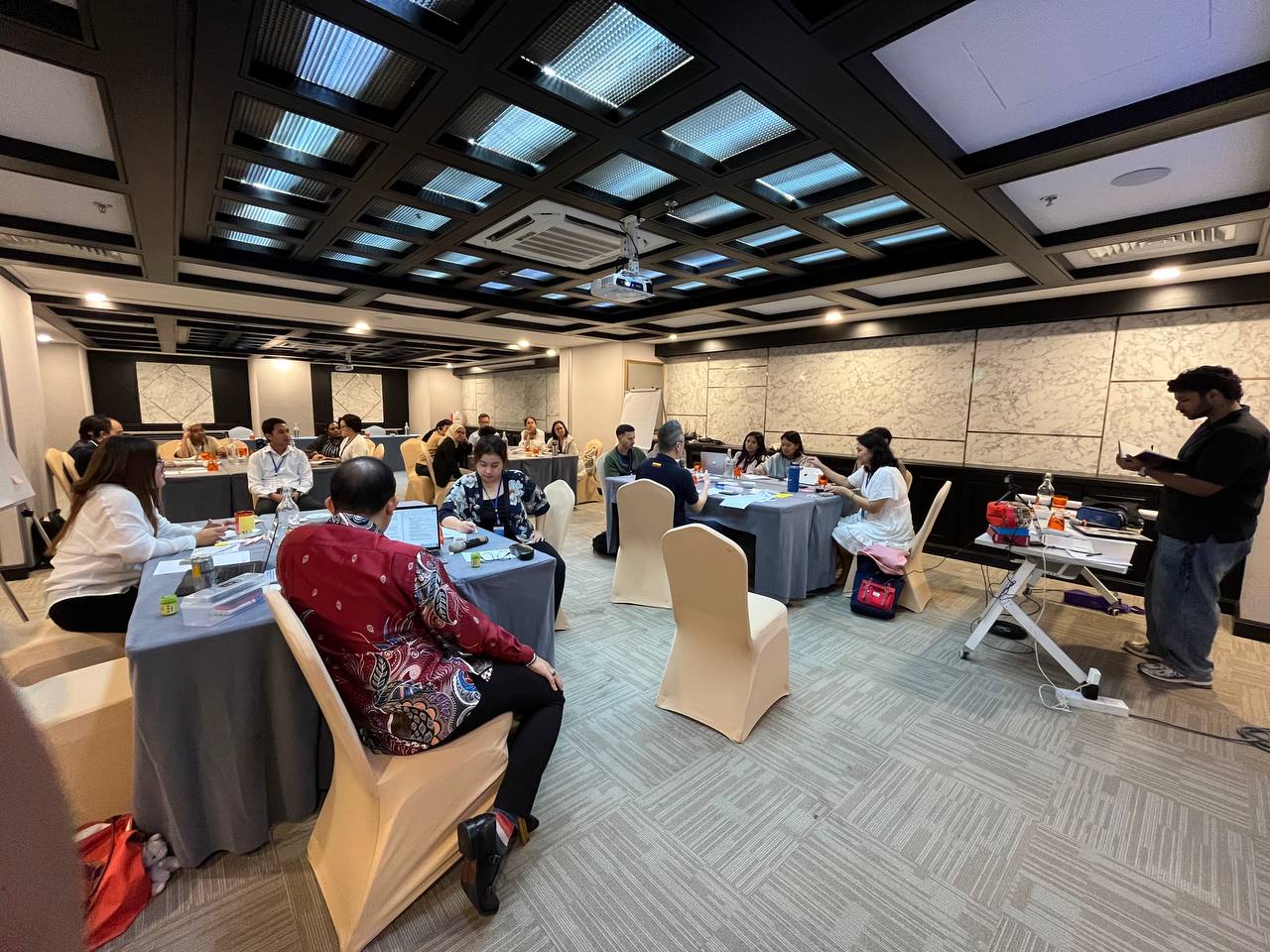
On 24–26 August 2025, the International Commission of Jurists (ICJ), together with the Centre for Independent Journalism, Malaysia (CIJ), and the Numun Fund, gathered human rights defenders and experts to discuss the need for Southeast Asian States to adopt and implement a human rights-based approach in efforts to tackle the growing spread of harmful content in digital spaces.
The workshop in Kuala Lumpur, Malaysia, focusing on leveraging ASEAN platforms, brought together 24 representatives from organizations across the ASEAN region, including Cambodia, Indonesia, Lao PDR, Malaysia, Myanmar, the Philippines, Thailand, and Viet Nam, all States that are members of the Association of Southeast Asian Nations (ASEAN).
Participants underlined that the surge in hate speech, disinformation, and other harmful online content had elicited responses from ASEAN States which often relied on heavy-handed and repressive measures. These include application of criminal laws that are vague and prone to abuse, restrictive content takedown and licensing regimes; and even State-sponsored disinformation campaigns.
Participants heard that ASEAN regional mechanisms currently lack robust mandates and coordination capable of effectively addressing disinformation, harmful content, and other digital challenges. Participants considered means of ensuring platform accountability, in the context of advertisement-driven business models of technology companies with ineffective content moderation practices. The online platforms typically employ algorithms that amplify sensationalist or extreme content, fueling the viral spread of disinformation and other human rights abuses.
Workshop participants worked to develop joint next steps and produced a set of recommendations for ASEAN Member States, technology companies, and ASEAN human rights bodies, particularly the ASEAN Intergovernmental Commission on Human Rights (AICHR). The recommendations included strengthening ASEAN human rights institutions and mechanisms in responding to and addressing human rights complaints submitted to them, enhancing their independence, and embedding human rights–centered advocacy into ASEAN work plans and instruments….
On 25 August, additional discussions were held with a representative from the Big Tech company Meta, focusing on the need to improve accountability and remedies through effective, accessible, and confidential grievance mechanisms. Participants also proposed multi-stakeholder co-regulation frameworks to ensure CSO participation through ongoing dialogue and collaboration on digital platform services, human oversight—not AI alone—in guiding content moderation standards, and the strengthening of independent third-party fact-checking across the region.
The series concluded with a panel discussion on 26 August 2025, co-hosted by the ICJ during the Digital Rights Asia-Pacific Assembly 2025. The panel, titled “The Role of ASEAN Human Rights Mechanisms in Institutionalizing Human Rights in the Digital Space: Towards Accountability and Collective Advocacy,” was also attended by AICHR representatives from Indonesia, Malaysia, and Thailand. It focused on how AICHR can better safeguard human rights online and identified concrete pathways for institutionalizing monitoring and accountability mechanisms related to human rights in the digital space.
Egyptian media reported on 22 September, 2025, that President Abdel Fattah al-Sisi had issued a presidential pardon for the imprisoned Egyptian-British activist Alaa Abdel Fattah. On 23 September the Guardian, HRW and others reported that the British-Egyptian human rights activist Alaa Abd el-Fattah has indeed been released from jail after serving six years for sharing a Facebook post.
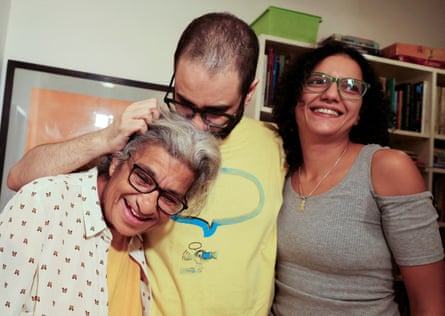
Early on Tuesday morning his campaign said in a statement that Abd el-Fattah was released from Wadi Natron prison and was now in his home in Cairo. “I can’t even describe what I feel,” his mother, Laila Soueif, said from her house in Giza as she stood next to her son surrounded by family and friends. “We’re happy, of course. But our greatest joy will come when there are no [political] prisoners in Egypt,” she added.
Alaa Abd el-Fattah stands next to his mother, Laila Soueif, and sister, Sanaa, at their home in Giza. Photograph: Mohamed Abd El Ghany/Reuters
Amnesty International’s Erika Guevara Rosas said the release was welcome but long overdue. “His pardon ends a grave injustice and is a testament to the tireless efforts of his family and lawyers, including his courageous mother Laila Soueif and activists all over the world who have been relentlessly demanding his release,” she said. The following quote can be attributed to Amr Magdi, senior Middle East and North Africa researcher at Human Rights Watch: “President Sisi’s pardon of the imprisoned Egyptian activist Alaa Abdel Fattah is long overdue good news. Though we celebrate his pardon.
The campaign for Abd el-Fattah’s release was led by his family, including his mother, who was admitted to hospital in London twice after going on hunger strikes trying to secure his release. The UK prime minister, Keir Starmer, is also known to have telephoned Sisi three times to lobby for Abd el-Fattah’s release. see: https://humanrightsdefenders.blog/2022/07/07/mona-seifs-letter-a-cry-for-help-for-alaa/





 Hans Thoolen on Human Rights Defenders and their awards
