Archive for the 'organisations' Category

Human rights defenders in Greece, my adopted country: not doing well

July 28, 2022
OHCHR | Ms Mary Lawlor

Special Rapporteur on the situation of human rights defenders, Mary Lawlor, conducted an official visit to Greece from 13 to 22 June 2022, to assess the government’s efforts towards creating an enabling environment for those seeking to protect and promote human rights.

Human rights defenders in Greece, particularly those working on migration, operate in an environment of pervasive fear and insecurity, concluded Mary Lawlor. “I am concerned about the increasing criminalization of humanitarian assistance in Greece. Solidarity should never be punished and compassion should never be put on trial,” she said while presenting her preliminary findings at the end of a 10-day mission in the country.

With Greece facing intense international criticism over unlawful pushbacks of migrants at its borders and wider human rights concerns related to migration and asylum, the Greek government has moved to silence groups and individuals documenting these abuses. While acknowledging Greece’s migration challenges and government efforts to address them, Lawlor criticized burdensome rules for the registration of nongovernmental organizations working on migration, introduced in 2019, calling them discriminatory and in violation of Greece’s international human rights obligations. See my earlier: https://humanrightsdefenders.blog/2021/11/17/greeces-mistaken-deterrence-migrants-and-aid-workers-facing-heavy-prison-sentences/

The UN expert noted that human rights defenders not only face criminal sanctions for their activities, but are operating in an increasingly hostile environment where the general public is influenced by negative rhetoric from high-ranking officials and their unfavorable portrayal in the media, which often conflates their activities with traffickers and criminal networks.

Greece fell 38 positions within a year in Reporters Without Borders’ 2022 report on the Press Freedom Index, with the organization marking it the lowest-ranked European Union country for press freedom. “Journalists who counter the government’s narrative on the management of migration flows are often under pressure and lack access to mainstream media outlets.… Journalists reporting on corruption are sometimes facing threats and even charges,” Lawlor said. She noted that journalists have very limited or no access to facilities where migrants, refugees, and asylum seekers are being held, further contributing to a general lack of transparency regarding the government’s policies in this area.

See also: https://humanrightsdefenders.blog/2022/02/18/greek-court-fails-human-rights-defenders-on-antisemitism/

Lawlor will present a detailed report with her findings at the March 2023 session of the UN Human Rights Council. The government should listen to what the UN expert has to say and champion human rights defenders. The European Commission, which noted in July last year the narrowing space in Greece for groups working with migrants and asylum seekers, should step up its engagement on the issue and press Greece to stop harassing civil society groups and activists.

https://www.ohchr.org/en/media-advisories/2022/06/un-human-rights-expert-visit-greece-assess-situation-human-rights

https://www.ohchr.org/en/press-releases/2022/06/greece-migration-policy-having-suffocating-effect-human-rights-defenders

https://www.amnesty.org/en/location/europe-and-central-asia/greece/report-greece/

see also later:

https://www.theguardian.com/world/2022/aug/31/greece-should-face-more-checks-over-asylum-seeker-treatment-eu-official

https://www.theguardian.com/world/2022/aug/31/i-was-close-to-death-syrian-man-tells-how-greek-officials-pushed-refugees-back-out-to-sea

And on 7 November : https://www.hrw.org/news/2022/11/07/greeces-surveillance-scandal-puts-rights-risk

and then: https://www.hrw.org/news/2023/03/16/un-expert-slams-greece-over-civil-society-curbs

Kavala ruling of European Court of Human Rights – infringement procedure against Turkey

July 27, 2022
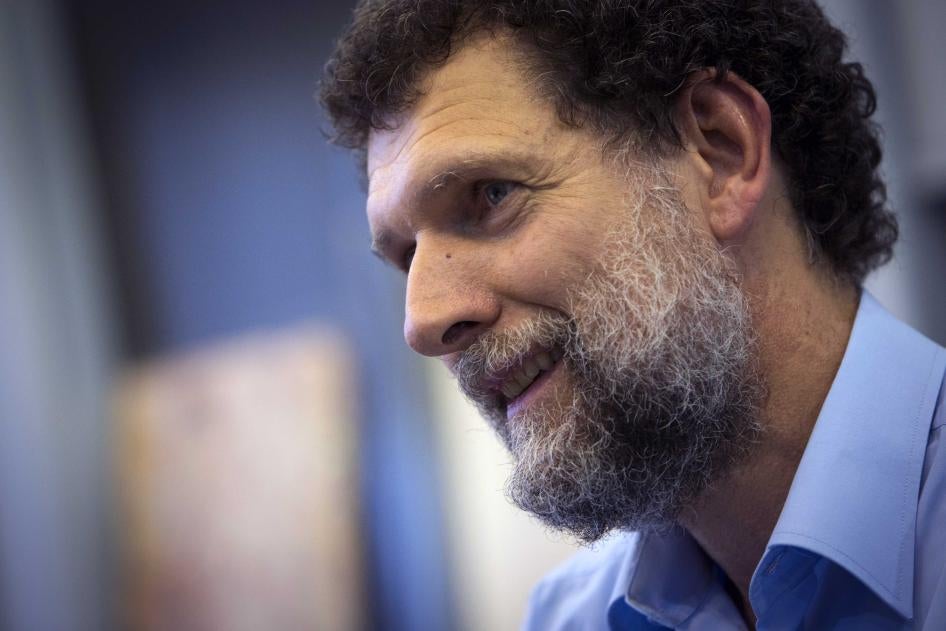
Osman Kavala © 2017 Private

Several sources (here HRW) reported on the European Court of Human Rights (ECtHR) handing down a landmark judgment (announced on July 11, 2022) against Turkey for its failure to carry out the court’s order to free the imprisoned human rights defender Osman Kavala. See: https://humanrightsdefenders.blog/2022/04/27/unexpected-in-its-harshness-kavala-gets-life-sentence-without-parole/

The court found in Kavala v. Türkiye, a case brought by the Council of Europe’s Committee of Ministers, that Turkey failed to fulfil its obligation under Article 46(1) of the European Convention on Human Rights to comply with its judgment issued on  December 10, 2019.  The judgment is an important step toward accountability for Turkey’s systemic disregard for the convention system and as recognition of the urgency of implementing the court’s order to release Kavala.

This is the only second time, after Mammadov v. Azerbaijan, that the ECtHR has ever conducted infringement proceedings and determined that a member state has not complied with a European Court judgment,” said Helen Duffy of the Turkey Litigation Support Project.

It is an acknowledgement of Turkey’s ever-deepening rule of law crisis, which has involved seriously undermining the Convention system and the escalating use of criminal law for political purposes.”

In its new judgment, the court held that “Türkiye has failed to fulfil its obligation under article 46§1 to abide by the Kavala v. Türkiye judgment of 10 December 2019.”

The European Court underlined that:

Its finding of a violation of Article 18 taken together with Article 5 in the Kavala judgment had vitiated any action resulting from the charges related to the Gezi Park events and the attempted coup. It is nonetheless clear that the domestic proceedings subsequent to the above judgment, which resulted first in an acquittal and then a conviction, have not made it possible to remedy the problems identified in the Kavala judgment (para. 172).

The Grand Chamber judgment addresses these practices of the Turkish authorities by stating that “the measures indicated by Türkiye do not permit it to conclude that the State Party acted in good faith,’ in a manner compatible with the ‘conclusions and spirit’ of the Kavala judgment, or in a way that would make practical and effective the protection of the Convention rights which the Court found to have been violated in that judgment” (para. 173).

Aisling Reidy, senior legal adviser at Human Rights Watch said: “As the European Court has now confirmed Turkey’s failure to execute the 2019 Kavala judgment, the Committee of Ministers needs urgently to take all feasible measures to ensure the judgement is respected and Kavala released“.

The Committee of Ministers is expected to resume its supervision process and take more robust steps to discharge its mandate of ensuring the necessary individual and general measures are taken by Turkey to implement the court’s ruling.

Now, it is up to the Committee of Ministers, which oversees the implementation of the ECtHR rulings, what measures to take against Turkey after the country failed to comply with the court’s ruling. This could lead to Turkey’s suspension from the Council of Europe. In anticipation, the Foreign Ministry of Turkey said they expected the Committee of Ministers “to act without bias and with common sense” in a statement.

However, see: https://stockholmcf.org/coe-fails-to-sanction-turkey-over-jailed-philanthropist-opts-for-dialogue-instead/

https://www.hrw.org/news/2022/07/12/landmark-judgment-against-turkey-ignoring-european-ruling

Genocide case against Rohingya population progresses

July 27, 2022

The International Court of Justice (ICJ) on 22 July, 2022, rejected Myanmar’s preliminary objections to the case brought by Gambia under the international Genocide Convention. The case concerns Myanmar’s alleged genocide against the ethnic Rohingya population in Rakhine State, with a focus on military operations launched in October 2016 and August 2017.

Gambia filed the case before the ICJ in November 2019 alleging that the Myanmar military committed the genocidal acts of “killing, causing serious bodily and mental harm, inflicting conditions that are calculated to bring about physical destruction, imposing measures to prevent births, and forcible transfers … intended to destroy the Rohingya group in whole or in part.”

The ICJ decision opens the door toward an overdue reckoning with the Myanmar military’s murderous campaign against the Rohingya population,” said Elaine Pearson, acting Asia director at Human Rights Watch. “By holding the military to account for its atrocities against the Rohingya, the World Court could provide the impetus for greater international action toward justice for all victims of the Myanmar security forces’ crimes.”

In February 2022, the ICJ heard Myanmar’s four objections challenging the court’s jurisdiction and Gambia’s legal standing to file the case, as well as Gambia’s response.

In response to Myanmar’s argument that Gambia has no standing to bring the case due to its lack of ties to Myanmar or the Rohingya, the court concluded, “All the States parties to the Genocide Convention thus have a common interest to ensure the prevention, suppression and punishment of genocide, by committing themselves to fulfilling the obligations contained in the Convention.”

By rejecting the preliminary objections, the ICJ is allowing the case to proceed on the merits to examine Gambia’s genocide allegations against Myanmar. Myanmar will now have to submit its response to Gambia’s main arguments filed in October 2020 detailing its case.

The ICJ case is not a criminal case against individual suspects, but a legal action brought by Gambia against Myanmar alleging that Myanmar bears responsibility for genocide as a state.

In December 2019, the court held hearings on Gambia’s request for provisional measures to protect the Rohingya remaining in Myanmar from genocide, which it unanimously adopted in January 2020. The provisional measures require Myanmar to prevent all genocidal acts against the Rohingya, to ensure that security forces do not commit acts of genocide, and to take steps to preserve evidence related to the case. The court also ordered Myanmar to report on its compliance with the provisional measures every six months.

Myanmar is legally bound to comply with the order. However, Human Rights Watch and other groups have continued to document grave abuses against the 600,000 Rohingya remaining in Myanmar, contravening the provisional measures.

The court’s decision on Myanmar’s preliminary objections should encourage the United Kingdom, Netherlands, Canada, and other concerned governments to support Gambia’s case through formal interventions to bolster the legal analysis on specific aspects of the Genocide Convention as it relates to the Rohingya, Human Rights Watch said.

Under article 41(2) of the ICJ Statute, the court’s order for provisional measures is automatically sent to the UN Security Council. As the fifth anniversary of the military’s atrocities against the Rohingya approaches, Security Council members should take steps to address the failure to secure justice and security for the Rohingya. Council members should work to adopt a resolution that gives the International Criminal Court (ICC) a mandate over the situation in Myanmar and severs the junta’s supply of arms and revenue, even if the resolution would be vetoed by Russia or China.

As the Myanmar armed forces continue to carry out atrocities against civilians and ethnic minorities, the ICJ remains one of the few available paths for holding the military to account. Ethnic groups and human rights defenders have aligned in Myanmar to push for the establishment of democratic rule, efforts that are amplified by the pursuit of justice at the ICJ.

“Concerned governments seeking to be leaders for accountability in Myanmar should formally intervene in the Genocide Convention case,” Pearson said. “The case provides an important opportunity to scrutinize the Myanmar military’s abusive policies and practices that have preserved its power over decades.”

https://www.hrw.org/news/2022/07/22/world-court-rejects-myanmar-objections-genocide-case

Al-Roken remains in UAE jail even after 1 his ten years have expired.

July 27, 2022

On 22 July 2022 Brian Dooley and Quinn Fulton wrote for Human Rights First a post: “Ten Years But Still Counting – UAE Fails To Release Jailed Activist Al-Roken

..Prominent Emirati human rights defender and lawyer Dr. Mohammed Al-Roken finished his ten-year sentence on July 17, but still hasn’t been released from jail. [see: https://www.trueheroesfilms.org/thedigest/laureates/7B69B1D9-E359-444A-B448-02E8B9C0750C]

Al-Roken practiced peaceful activism, looking for minimal reforms towards democracy and standing up for human rights. He and other peaceful activists, including Ahmed Mansoor and Nasser bin Ghaith, were given long sentences after unfair trials. [see also: https://www.trueheroesfilms.org/thedigest/laureates/074ACCD4-A327-4A21-B056-440C4C378A1A]

Human Rights First has covered their cases and others for many years, and urged a succession of U.S. administrations to use the influence they have accrued – not least through supplying the Emirates with billions of dollars of weapons – to push for the release of jailed human rights activists there.

The U.S. government knows exactly who Al-Roken is and what he stands for.  He has been featured in a succession of U.S. reports describing him as “a human rights activist” (2007), “a lawyer…reportedly held incommunicado and without charge for unknown reasons” (2012), and a “lawyer, academic and human rights defender” (2021).

In 2015, Human Rights First wrote about his wrongful imprisonment, and noted in a report that year on human rights in the Emirates that “Former heads of the Jurists Association are now political prisoners, including renowned constitutional scholar Dr. Mohammed Al-Roken. He is one of dozens serving long prison sentences after being convicted in mass trials.”

We have continued to raise cases through the media of human rights defenders wrongfully detained in the Emirates, and we successfully campaigned for the release of American citizens Mohammed and Kamal Al Darat when they were tortured and detained in the Emirates for over a year.

We are not alone in recognizing Al-Roken’s human rights work and wrongful imprisonment. Major international human rights organizations have campaigned for him for years, and in 2017 he was awarded the prestigious Ludovic-Trarieux International Human Rights Prize

When calling for Al-Roken’s release, the UN Special Rapporteur on Human Rights Defenders noted that he was jailed on charges of “plotting against the government,” and “subjected to intermittent periods in solitary confinement, allegedly without justification or explanation.” The UN Working Group on Arbitrary Detention said Al-Roken “is reportedly well known for defending victims of human rights violations in the United Arab Emirates,” and deemed his detention as arbitrary.

We know that getting people who have been wrongfully detained in the Emirates out of prison is difficult, but it sometimes can be done if there is substantial international public pressure – as with the Al Darats and the British academic Matthew Hedges.

That’s why it’s important that the Biden administration speaks out publicly about Al-Roken. Our years of advocacy experience tells us that behind-the-scenes diplomacy is unlikely to work..

https://www.humanrightsfirst.org/blog/ten-years-still-counting-uae-fails-release-jailed-activist-al-roken

Webinar to introduce ISHR’s #EndReprisals database

July 12, 2022

Join the International Service for Human Rights on 13 July 2022 for a webinar to introduce ISHR’s #EndReprisals database. In follow up to ISHR’s 2021 study on the impact of the UN Secretary-General’s reports on reprisals, the ISHR’s #EndReprisals Database compiles cases or situations of intimidation and reprisals documented by the United Nations Secretary-General since 2010. [ See: https://humanrightsdefenders.blog/2021/09/30/reprisals-on-the-agenda-of-the-un-and-the-new-ishr-campaign-to-endreprisals/]

Each year the Secretary-General prepares a report that documents acts of intimidation and reprisals aimed at creating fear or blocking access to the United Nations of people who defend human rights. With ISHR’s #EndReprisals Database, users can more easily navigate the information contained in those reports, and research, analyse, and take action on the cases or situations so that together we can #EndReprisals. The webinar will introduce users to the database and its functionalities.

Register now for Webinar on 13 July 2022 15:00-16.00 pm CEST

https://mailchi.mp/ishr/749qlxejj6-33545?e=d1945ebb90

Mona Seif’s letter: a cry for help for Alaa

July 7, 2022

On 7 July 2022, Egyptian Human Rights Defender Mona Seif [https://www.martinennalsaward.org/hrd/mona-seif/] wrote the following letter asking for your help:

Dear Friends, colleagues and human rights defenders 

As I write this, I am on day 25 of my hunger strike, and Alaa, my brother, is on day 96 of his.

Alaa is a British-Egyptian prisoner of conscience and pro-democracy activist imprisoned in Egypt for most of the past decade.I decided to go on this hunger strike right after I last saw my brother in prison, on June 12th. He has lost a lot of weight, there was a very frail air about him, his hands looked thin and so pale that I could see the blue veins, and he was livid with anger. He kept on telling me to get over the notion that he can be rescued, he will never make it out of prison. “Focus on making the political price of my death the highest possible”, he said. It was an incredibly intense visit. [see also: https://humanrightsdefenders.blog/2021/12/21/alaa-abdel-fattah-and-two-others-receive-heavy-prison-sentences-in-egypt/]

I stepped out of prison and decided I will join his hunger strike. I was frustrated with how all officials seemed to take his strike lightly. The Egyptian government was blatantly denying his hunger strike on national TV  and all official meetings, while making sure no one sees Alaa but his family, so they blocked his lawyer from visiting, the national council for human rights from seeing him, and they have been blocking his British consular visit for months. On the other hand the British officials while sharing their genuine concern with us as a family in meetings, in their public official communication seemed to tip toe around Alaa’s hunger strike and how critical his situation is. 

Things have changed over the course of the past weeks. 

On June 21st the British Foreign Secretary confirmed to parliament that she is “working very hard to secure his release.” On July 4th a letter written by MP David Lammy, my MP and shadow foreign minister to the foreign secretary Liz Truss stressing on the importance of her intervention for Alaa’s release and highlighting his hunger strike. Another letter signed by 35 MPs and Lords was sent to the Egyptian minister for foreign affairs, Sameh Shoukry, on the same day.

And finally Sameh Shoukry arrived in London this week and my brother’s case was brought up during the bilateral meetings he attended, we are still waiting for an update about these meetings and if any agreement has been reached between both governments with regards to Alaa.

Accordingly I have decided to put an end to my strike, mostly because I feel I am growing too weak and tired to carry out my most important role right now: advocating for my brother’s life and freedom. But Alaa, being a prisoner, has no way of voicing out his frustration and anger at the continued injustice he is trapped in, except through his body, and depriving himself of the comfort of food. So he continues with his hunger strike, and next Sunday will be his 100th day!

Things seem to be moving but it worries us that the pace is very slow given how critical and life-threatening Alaa’s situation is.

So I am writing asking for your help, and asking you to believe that no help is too little. Every small action at this point really helps in building more awareness, sympathy and pressure to help us save my brother and with him the possibility of any happy future for my family. I will share some suggestions but please feel free to reach out, or organize any kind of action you think might help.

– Write to the Egyptian ambassador in your respective countries, address the urgency of Alaa’s case and situation.

– Write to your parliament representatives asking them to write to their counterparts in the UK and Egypt discussing Alaa’s case. If they could also issue any solidarity public statements it’d help immensely. Only today the German MP Tobias B. Bacherle published this statement in solidarity

– With the coming UN Climate conference #COP27 taking place in Egypt this year, all participating governments can influence and help in improving the human rights situation in Egypt prior to their attendance. So accordingly you have a chance to write to your government’s representatives who might be taking part in it and urge them to raise Alaa’s case with their Egyptian counterparts, and stress on how devastating it’d be if they allowed a British/Egyptian activist to die in prison after years of unjust detention. – Statements of solidarity by Human Rights defenders and organizations, and any solidarity vigils are always welcome

Feel free to share this email with anyone you think could help. For more resources and info regarding Alaa : check https://freealaa.net/, and on twitter @FreedomForAlaa

I urge you to carry my brother’s case as yours and help me in every possible way. I am exhausted and scared we’d lose him, but I also think this is the first time in years his release seems like an actual possibility not just a dream.

Much love Mona Seif #FreeAlaa,

50th session Human Rights Council: issues directly affecting Human Rights Defenders

June 22, 2022

A bit belatedly this overview for the 50th session:

The 50th session of the UN Human Rights Council, from 13 June to 8 July 2022, will consider issues including sexual orientation and gender identity, violence and discrimination against women and girls, poverty, peaceful assembly and association, and freedom of expression, among others. It will also present an opportunity to address grave human rights situations including in Afghanistan, Belarus, China, Eritrea, Israel and OPT, Russia, Sudan, Syria and Venezuela, among many others. With “HRC50 | Key issues on agenda of June 2022 session” the ISHR provided again its indispensable guide. Here’s an overview of some of the key issues on the agenda that are the most relevant to HRDs [see also: https://humanrightsdefenders.blog/2022/02/21/guide-to-49th-session-of-human-rights-council-with-human-rights-defenders-focus/ and https://humanrightsdefenders.blog/2022/04/15/results-49th-session-human-rights-council-as-seen-by-ngos/

Thematic areas of interest

Here are some highlights of the session’s thematic discussions

Business and human rights

Despite their vital work to protect the environment and combat climate change, Indigenous peoples as well as land and environmental defenders continue to be attacked. New data shows an alarming pattern of violence and harassment as a precursor to lethal attacks against defenders. 

In 2020, Global Witness registered the killings of 137 land and environmental defenders in just five of the most dangerous countries for them: Colombia, Guatemala, Kenya, Mexico and the Philippines. However, a new dataset from the ALLIED Data Working Group, a coalition in which ISHR takes part, focused on these countries has for the first time documented what is often hidden – the non-lethal attacks, including threats, harassment, smear campaigns and stigmatisation that are a precursor to the shocking number of deaths we see each year.

The findings highlight the urgent need for States to monitor, collect data, report on the situation of these defenders, and address the root causes of attacks against them. ISHR urges all States to make a commitment to the systematic monitoring of attacks on indigenous, land and environmental defenders in their countries, and to take stronger action, together with civil society and relevant UN Special Procedures, to address the root causes of attacks in the debate with the Working Group due to take place on 21 June 2022. 

Reprisals

Reports of cases of intimidation and reprisal against those cooperating or seeking to cooperate with the UN not only continue, but grow. Intimidation and reprisals violate the rights of the individuals concerned, they constitute violations of international human rights law, and they undermine the UN human rights system.

The UN has taken action towards addressing this critical issue, including:

  • Requesting that the Secretary General prepare an annual report on cases and trends of reprisals;
  • Establishing a dedicated dialogue under item 5 to take place every September;
  • Affirmation by the Council of the particular responsibilities of its Members, President and Vice-Presidents to investigate and promote accountability for reprisals and intimidation; and
  • The appointment of the UN Assistant Secretary General on Human Rights as the Senior Official on addressing reprisals.

Despite this, ISHR remains deeply concerned about reprisals against civil society actors who try to engage with UN mechanisms, and consistent in its calls for all States and the Council to do more to address the situation.

During the 48th session, the Council adopted a resolution on reprisals. The text was adopted by consensus for the first time since 2009 and invites the UN Secretary General to submit his annual report on reprisals and intimidation to the UN General Assembly. Once again the resolution listed key trends, including that acts of intimidation and reprisals can signal patterns, increasing self-censorship, and the use of national security arguments and counter-terrorism strategies by States as justification for blocking access to the UN. The resolution also acknowledged the specific risks to individuals in vulnerable situations or belonging to marginalised groups, and called on the UN to implement gender-responsive policies to end reprisals. The Council called on States to combat impunity by conducting prompt, impartial and independent investigations and ensuring accountability for all acts of intimidation or reprisal, both online and offline, by condemning all such acts publicly, providing access to effective remedies for victims, and preventing any recurrence.

Item 5 of the Human Rights Council’s agenda provides a key opportunity for States to raise concerns about specific cases of reprisals, and for governments involved in existing cases to provide an update to the Council on any investigation or action taken toward accountability. The President should also update the Council on actions taken by the President and Bureau to follow up on cases and promote accountability under this item.

Due to the lack of a general debate under item 5 at HRC 50, ISHR encourages States to raise concerns about specific cases of reprisals during the interactive dialogues on the relevant countries on the agenda at this session or in the context of thematic interactive dialogues where relevant.

During the organisational meeting held on 30 May, the President of the Council stressed the importance of ensuring the safety of those participating in the Council’s work, and the obligation of States to prevent intimidation or reprisals.

In line with previous calls, ISHR expects the President of the Human Rights Council to publicly identify and denounce specific instances of reprisals by issuing formal statements, conducting press-briefings, corresponding directly with the State concerned, publicly releasing such correspondence with States involved, and insisting on undertakings from the State concerned to investigate, hold perpetrators accountable and report back to the Council on action taken.

Sexual orientation and gender identity

The mandate of the Independent Expert on violence and discrimination on the basis of sexual orientation and gender identity is up for renewal for the second time at this session. We will be following this closely and call on all States to support the mandate and contribute to the Council’s efforts to combat violence and discrimination on the basis of sexual orientation and gender identity.

Other thematic reports

At this 50th session, the Council will discuss a range of civil, political, economic, social and cultural rights through dedicated debates with the mandate holders and the High Commissioner, including interactive dialogues with:

  • The Special rapporteur on the rights to freedom of peaceful assembly and of association
  • The Independent Expert on protection against violence and discrimination based on sexual orientation and gender identity
  • The Special Rapporteur on the right of everyone to the enjoyment of the highest attainable standard of physical and mental health
  • The Special Rapporteur on the promotion and protection of the right to freedom of opinion and expression
  • The Special Rapporteur on the right to education
  • The Independent Expert on human rights and international solidarity
  • The Special Rapporteur on extrajudicial, summary of arbitrary executions
  • The Special Rapporteur on extreme poverty and human rights
  • The Special Rapporteur on promotion and protection of human rights in the context of climate change
  • The Working Group on the issue of human rights and transnational corporations and other business enterprises
  • The Special Rapporteur on contemporary forms of racism, racial discrimination, xenophobia and related intolerance
  • The High Commissioner on State responses to pandemics 

In addition, the Council will hold dedicated debates on the rights of specific groups including;

  • The Special Rapporteur on the rights of internally displaced persons
  • The Working Group on discrimination against women and girls
  • The Special Rapporteur on violence against women and girls, its causes and consequences
  • The Special Rapporteur on the human rights of migrants
  • The Special Rapporteur on trafficking in persons, especially women and children
  • The Special Rapporteur on the elimination of discrimination against persons affected by leprosy and their family members
  • The Special Rapporteur on independence of judges and lawyers

Country-specific developments

Afghanistan

Together with WHRDs from the country and civil society organisations from all regions, ISHR calls on States to lead and support an Urgent Debate at HRC50 on women’s rights in Afghanistan.

Since August 2021, when the Taliban took control of the country, there has been an enormous deterioration in the recognition and protection of the rights of women and girls in Afghanistan, including with respect to the rights to non-discrimination, education, work, public participation, health, and sexual and reproductive health. The Taliban has also imposed sweeping restrictions on the rights to freedom of expression, association, assembly and movement for women and girls. Afghanistan is now the only country in the world to expressly prohibit girls’ education.

The world’s worst women’s rights crisis demands a response and it would be unacceptable for the June session of the HRC, traditionally the session focused on gender-related issues, to pass without some meaningful action on the issue. I

The Council will hold an interactive dialogue with the High Commissioner on the update on Afghanistan on 15 June 2022. 

China 

The High Commissioner’s visit to China failed to adequately address widespread and systematic violations in the country, express solidarity with victims and defenders, or pave the way for meaningful monitoring of China’s human rights crisis across the Uyghur and Tibetan regions, Hong Kong and mainland China. The High Commissioner’s end of mission statement failed to address strong, specific concerns or make substantive, concrete recommendations to the governmen. The broad concerns issued in a light language do not match the scope and gravity of human rights violations across the country that have been thoroughly documented by UN experts and civil society and that could amount to crimes against humanity and genocide.

States should call on the High Commissioner to immediately publish her OHCHR report on the Uyghur region, with clear, compelling recommendations to the government, and present her findings in a briefing to the Human Rights Council. The High Commissioner should also ensure that the established annual meeting and working group for dialogue with the authorities are of public nature, include specific substantive recommendations to the government, and involve substantial consultation with a diverse set of independent civil society groups. China should also follow suit on promises for subsequent visits by the OHCHR by granting prompt unfettered access to Hong Kong and the Tibetan region. See also: https://humanrightsdefenders.blog/2022/06/09/disappointment-with-un-high-commissioners-visit-to-xinjiang-boils-over/

Burundi

The Commission of Inquiry on Burundi (CoI) concluded its work at the 48th HRC session in October 2021 while a new resolution establishing a mandate of UN Special Rapporteur on Burundi was adopted, resolution 48/16. The resolution tasks the mandate with monitoring the human rights situation in the country, making recommendations for its imp­ro­ve­ment, and re­por­ting to the Human Rights Council. During the 50th HRC session, the newly nominated Special Rapporteur on Burundi will present their first oral update on 29 June 2022.

Egypt

Notwithstanding the launch of a national human rights strategy, the fundamental purpose of which is to deflect international scrutiny rather than advance human rights, there has been no significant improvement in the human rights situation in Egypt since the joint statement delivered by States in March 2021 at HRC46. Emblematic recent examples include: Ayman Hadhoud’s death in the custody of Egyptian security forces following his enforced disappearance over two months ago and the execution of seven people in Egypt on 8 and 10 March 2022 following trials in which the defendants were forcibly disappeared, tortured, and denied their right to a lawyer.

In response to the Egyptian President’s announcement of “reactivating the work of the Presidential Pardon Committee” on 26 April 2022, Egyptian human rights organisations submitted a proposal for a fair and transparent process to release political prisoners in Egypt. Yet, recent harsh sentences in unfair trials against peaceful critics demonstrate further the lack of political will of the Egyptian authorities to address the crisis of arbitrary detention in Egypt. ISHR joined more than 100 NGOs from around the world in urging the HRC to create a monitoring and reporting mechanism on the ever-deteriorating human rights situation in Egypt. 

Israel and oPT

This session, the COI on the oPt and Israel established in 2021 will present its first report to the HRC. Civil society from around the world had welcomed the historic resolution establishing the standing Commission of Inquiry to address Israel’s latest and ongoing violations against the Palestinian people on both sides of the Green Line, while also addressing the root causes of Israel’s settler colonialism and apartheid. The interactive dialogue with the CoI comes in the context of mounting recognition of Israel’s establishment and maintenance of an apartheid regime by Israel over the Palestinian people as a whole. During HRC49, the SR on the oPT called on the international community to accept and adopt his findings as well as the “findings by Palestinian, Israeli and international human rights organisations that apartheid is being practised by Israel in the occupied Palestinian territory and beyond.” In its 2019 concluding observations, the Committee on the Elimination of Racial Discrimination found that Israel’s policies violated Article 3 of ICERD pertaining to segregation and apartheid on both sides of the Green Line. In 2022, the Human Rights Committee concluding observations on Israel emphasized the “pre-existing systematic and structural discrimination against non-Jews”.

While some States continue to seek to undermine the mandate of the CoI and effective accountability mechanisms to put an end to Israel’s apartheid regime, CSOs support the CoI’s methodological approach to fulfill its vital mandate. We call on States to engage with the substance of the mandate of the CoI during the interactive dialogue, express support for this important accountability mechanism and ensure it has sufficient resources to discharge its mandate.

Russia 

Together with a coalition of international and regional NGOs, as well as numerous Russian civil society organisations, ISHR urges the Council to establish an independent international monitoring and reporting mechanism on Russia. In the context of the systematic repression of civil society organisations, severe restrictions on press freedoms and independent media, severe restrictions and criminalisation of many forms of free expression, association, assembly and peaceful protest, and the propagation of huge volumes of misinformation, a Special Rapporteur is necessary to ensure that the international community receives vital information about the human rights situation on the ground. 

Sudan

The Council will hold a debate with the High Commissioner and Expert on Sudan on 15 June 2022.

The Sudanese Women Rights Action documented from March to April 2022 the violations against women protesters, including arrests, injuries, and sexual violence. Their report also highlighted the economic and humanitarian situation in conflict areas and in the country in general. The report shows that “the coup leaders are using increasing violence against women protesters, including arrests, fabricated charges, direct lethal violence in protests, and sexual violence. The civic space is shrinking across Sudan, where human rights groups and WHRDs are not able to work freely and safely. Surveillance on internet, communication, movement, and offices of many groups led them to work from underground. The economic conditions and the fragile political situation is increasing women insecurity, as the peace process failed to end violence conflict areas. Women in Sudan are living in constant fear of violence with growing threats of the collapse of the state.”

In light of this context, ISHR urges all States to support the adoption of a resolution that ensures continued attention to Sudan’s human rights situation through enhanced interactive dia­logues at the Council’s 52nd and 53rd regular sessions. While the Expert’s mandate is ongoing, a resolution is required for the Council to hold public de­bates and continue to formally discuss the situation. A resolution at the Council’s 50th session would ope­ra­tio­nalise resolution S-32/1, which in its operative paragraph 19 called upon “the High Commis­sioner and the designated Expert to monitor human rights violations and abu­ses and to continue to bring information thereon to the attention of the Human Rights Council, and to advise on the further steps that may be needed if the situation continues to deteriorate.”

Venezuela

On 29 June, the Council will hold an interactive dialogue with the High Commissioner on her report on the situation of human rights in Venezuela. The Council requested her to provide in this report a detailed assessment of the implementation of the recommendations made in her previous reports. Implementation of recommendations and improvements in the human rights situation on the ground remains a critical question as HRC mandates for OHCHR and the international investigative body for Venezuela expire in September. Venezuelan civil society groups continue to show evidence of a lack of any substantive human rights reform in the country, of a lack of meaningful cooperation by the State and – in fact – of regression in key areas such as judicial independence and civic space. ISHR urges States at the upcoming session to express support for the work of OHCHR in the country, and encourage the Office to speak clearly to realities on the ground. In addition, States should signal their support for the continuance of the work of the HRC’s fact-finding mission to the country through an extension of the Mission’s mandate at HRC51. 

The adoption of the report of the third cycle UPR on Venezuela will also take place on the 29 June or 1 July.  

Other country situations

The Council will hold an interactive dialogue on the High Commissioner’s annual report on 14 June 2022. The Council will hold debates on and is expected to consider resolutions addressing a range of country situations, in some instances involving the renewal of the relevant expert mandates. These include:

  • Interactive Dialogue with the Special Rapporteur on Eritrea
  • Interactive Dialogues with the High Commissioner and Special Rapporteur on Myanmar
  • Interactive Dialogue with the High Commissioner on Nicaragua
  • Interactive Dialogues with the High Commissioner on Ukraine
  • Interactive Dialogue with the Commission of Inquiry on Syria
  • Interactive Dialogue with the International commission of Human Rights Experts on Ethiopia 
  • Interactive Dialogue with the Special Rapporteur on Belarus
  • Interactive Dialogue with the Independent Fact-Finding Mission on Libya
  • Interactive Dialogue with the Independent Expert on Central African Republic 

Council programme, appointments and resolutions

The President of the Human Rights Council will propose candidates for the following mandates: 

  1. Special Rapporteur on freedom of religion or belief
  2. Special Rapporteur on the right to education
  3. Special Rapporteur on the situation of human rights in the Democratic People’s Republic of Korea
  4. Working Group on the issue of human rights and transnational corporations and other business enterprises, member from African States
  5. Expert Mechanism on the Right to Development, member from Latin American and Caribbean States
  6. Special Rapporteur on torture and other cruel, inhuman or degrading treatment or punishment
  7. Working Group on Enforced or Involuntary Disappearances, member from Eastern European States
  8. Working Group on the issue of human rights and transnational corporations and other business enterprises, member from Western European and other States

Resolutions to be presented to the Council’s 50th session

At the organizational meeting on 30 May the following resolutions were announced (States leading the resolution in brackets):

  1. Elimination of discrimination against women (Mexico), mandate renewal 
  2. Freedom of expression (Brazil, Canada, Fiji, Sweden, Namibia, Netherlands) 
  3. Elimination of female genital mutilation (Africa Group)
  4. Rights to freedom of peaceful assembly and of association (Czech Republic, Indonesia, Lithuania, Maldives, Mexico), mandate renewal 
  5. Human rights situation in Sudan (United Kingdom, Germany, Norway, United States)
  6. Human rights situation in Syria (Germany, France, Italy, Jordan, Kuwait, Netherlands, Qatar, Turkey, United States, United Kingdom)
  7. Mandate of the Independent Expert on protection against violence and discrimination based on sexual orientation and gender identity  (Argentina, Brazil, Chile, Colombia, Costa Rica, Mexico, Uruguay), mandate renewal 
  8. Casualty recording and the promotion and protection of human rights (Liechtenstein, Croatia, Costa Rica, Sierra Leone) 
  9. Human rights and climate change (Bangladesh, Philippines, Viet Nam)
  10. Access to medicines and vaccines in the context of the right of everyone to the enjoyment of the highest attainable standard of physical and mental health (Brazil, China, Egypt, India, Indonesia, Senegal, South Africa, Thailand)
  11. Enhancement of international cooperation in the field of human rights (NAM)
  12. Independence and impartiality of the judiciary, jurors and assessors, and the independence of lawyers (Hungary, Australia, Botswana, Maldives, Mexico, Thailand)
  13. Human rights and the regulation of civilian acquisition, possession and use of firearms (Ecuador, Peru)
  14. Human rights in Belarus, mandate renewal (European Union)
  15. Human rights in Eritrea, mandate renewal (European Union) 
  16. The promotion and protection of human rights in the context of peaceful protest (Switzerland, Costa Rica)
  17. Situation of human rights of Rohingya Muslims and other minorities in Myanmar (OIC) 
  18. Accelerating efforts to eliminate all forms of violence against women (Canada), mandate renewal 
  19. Mandate of the Special Rapporteur on the human rights of internally displaced persons (Austria, Honduras, Uganda), mandate renewal
  20. Human rights and international solidarity (Cuba)
  21. Social Forum (Cuba)

Read the calendar here

Adoption of Universal Periodic Review (UPR) reports

During this session, the Council will adopt the UPR working group reports on Myanmar, Togo, Syrian Arab Republic, Iceland, Venezuela, Zimbabwe, Lithuania, Uganda, Timor-Leste, Republic of Moldova, South Sudan, Haiti and Sudan.

Panel discussions

During each Council session, panel discussions are held to provide member States and NGOs with opportunities to hear from subject-matter experts and raise questions. Seven panel discussions are scheduled for this upcoming session:

  1. Panel discussion on the root causes of human rights violations and abuses against Rohingya Muslims and other minorities in Myanmar 
  2. Panel discussion on menstrual hygiene management, human rights and gender equality
  3. Panel discussion on good governance in the promotion and protection of human rights during and after the COVID-19 pandemic
  4. Annual full-day discussion on the human rights of women
  5. Panel discussion on the adverse impact of climate change on the full and effective enjoyment of human rights by people in vulnerable situations
  6. High-level panel discussion on countering the negative impact of disinformation on the enjoyment and realization of human rights
  7. Annual thematic panel discussion on technical cooperation and capacity-building

Stay up-to-date: Follow @ISHRglobal and #HRC50 on Twitter, and look out for its Human Rights Council Monitor. During the session, follow the live-updated programme of work on Sched. 

https://ishr.ch/latest-updates/hrc50-key-issues-on-agenda-of-june-2022-session/

Cambodia: Quash Convictions of ‘ADHOC 5’

June 22, 2022
201808asia_cambodia_adhoc
© 2018 ADHOC

The Cambodian authorities should quash the baseless criminal convictions of four members and one former member of the Cambodian Human Rights and Development Association (ADHOC), Human Rights Watch said on 22 June 2022. On June 21, 2022, four of the defendants, Yi Soksan, Lim Mony, Ny Sokha, and Ny Chakrya appealed a May 23 appeals court ruling upholding their convictions to the Cambodian Supreme Court.

From the very beginning, the Cambodian authorities have sought to unjustly punish the ADHOC 5 as a way to intimidate all civil society activists from criticizing Prime Minister Hun Sen’s government,” said Phil Robertson, deputy Asia director at Human Rights Watch. “Foreign governments, the United Nations country team, and international donor agencies should urge the authorities to drop these cases and end all repression of human rights defenders.” See also: https://humanrightsdefenders.blog/2017/03/11/even-landmark-un-decision-does-not-change-cambodias-treatment-of-human-rights-defenders/

In April 2016 the government’s Anti-Corruption Unit arrested ADHOC members Ny Sokha, Nay Vanda, Yi Soksan, and Lim Mony, along with the former ADHOC member Ny Chakrya, who was then deputy secretary-general of the National Election Committee, and accused them of making false statements regarding a criminal case against the then-opposition leader Kem Sokha.

The five activists spent 14 months in pretrial detention. During their criminal trial, the prosecution failed to present any of the witnesses mentioned in the case or provide any credible evidence to substantiate the charges.

On September 26, 2018, the Phnom Penh municipal court convicted Vanda, Sokha, Soksan, and Mony of “bribery of a witness” (article 548 of Cambodia’s criminal code) and Chakrya of being an accomplice (articles 28 and 548). All five received suspended five-year prison terms, minus 14 months of time served.

On October 24, 2018, the defendants appealed the guilty verdicts to the Court of Appeal. The prosecutor’s office also filed an appeal, seeking to have the defendants serve the remainder of their suspended sentence in prison. The Court of Appeal denied both appeals on May 23, 2022.

The ADHOC 5 case arose during a broader government crackdown on civil society and the political opposition, specifically on the Cambodia National Rescue Party (CNRP), which the government-dominated Supreme Court later dissolved in a politically motivated ruling.

The former CNRP leader, Kem Sokha, continues to face unsubstantiated, politically motivated treason charges brought in September 2017. While he is no longer detained, his trial only recommenced in January, after being suspended for two years ostensibly because of the Covid-19 pandemic and the government deemed his case to not be a “priority”. The allegations against Sokha are based on the government’s groundless claim that the CNRP fomented a “color revolution” to overthrow the government.

Human Rights Watch has documented the situations of more than 50 current political prisoners in Cambodia, including both those in pretrial detention and those serving prison sentences following politically motivated convictions. They include political opposition members, human rights defenders, land and environmental rights activists, and journalists.

“The Cambodian authorities should recognize that every day the ADHOC 5 case persists, the greater this travesty of justice inflicts harm to the government’s reputation,” Robertson said. “The only way for justice to be served is for the prosecutor to quash the convictions and provide the defendants with an appropriate remedy for the years of hardship the case caused them.”

see also: https://www.martinennalsaward.org/hrd/the-khmer-5/

https://www.hrw.org/news/2022/06/22/cambodia-quash-convictions-adhoc-5

https://thediplomat.com/2026/04/ten-years-after-the-adhoc-5-cambodias-human-rights-defenders-are-still-paying-the-price/

Today event by ISHR on Resisting police violence

June 22, 2022

Register here for this on-line event. When we think of police violence, the images that are conjured up are of Black men being targeted and tortured at the hands of law enforcement. 
Demanding justice and accountability for victims of systemic racism, Wednesday 22 June
16:00 – 18:00 CET

While these images are important, they tell only a part of the story. What are the harms that we are not seeing?  How are those harms felt more broadly by communities that are impacted directly and those who witness its affects as the humdrum of terror running automatically in the background? And, how are human rights defenders using the United Nations as a tool to expose these violations and seek justice for victims? 

This event, organised by the UN Anti-Racism Coalition, will address these questions and expand the definition of what it means to be directly impacted by police and State-sanctioned violence. The aim is to highlight and recognise the broader and deeper impacts of systemic racism. 


SPEAKERS: 

Ana Paula Oliveira, Bruna da Silva, Vanessa Francisco Sales, human rights defenders from Brazil 

María Mercedes Manjarrez, human rights defender from Colombia  

Esther Mamadou, human rights defender from Spain  

Ejim Dike, human rights defender from Nigeria  

Adrienne Hood, human rights defender from the United States 

MODERATOR: Iki Yos, Caribbean, afrodiasporic-transborder artist, performer, and anti-racist activist You are welcome to join this discussion, which will be held in English with simultaneous interpretation in Spanish, French and Portuguese. Click here to register to the event and here for more information. 

Download flyer in English,FrenchSpanish and Portuguese

Film “THE STORY WON’T DIE” about Syrian protest art

June 18, 2022

THE STORY WON’T DIE is an inspiring, timely look at a young generation of Syrian artists who use their work to protest and process what is currently the world’s largest and longest ongoing displacement of people since World War II. The film is produced by Sundance Award-winning producer Odessa Rae (Navalny). Rapper Abu Hajar, together with other celebrated creative personalities of the Syrian uprising, including post-rock musician Anas Maghrebi, members of the first all female Syrian rock band Bahila Hijazi and Lynn Mayya, breakdancer Bboy Shadow, choreographer Medhat Aldaabal, and visual artists Tammam Azzam, Omar Imam and Diala Brisly, use their art to rise in revolution and endure in exile in this new documentary reflecting on a battle for peace, justice, and freedom of expression. It is an uplifting and humanizing look at what it means to be a refugee in today’s world, and offers inspiring and hopeful vantages on a creative response to the chaos of war.

The Human Rights Foundation organised the New York Premiere of THE STORY WON’T DIE on Friday, June 17 at Cinema VillageThe screening was followed by a Q&A with award-winning filmmaker David Henry Gerson and the film’s co-producer Abdalaziz Alhamza.

https://mailchi.mp/hrf.org/you-are-invited-june-15th-screening-of-the-dissident-288999?e=f80cec329e