Archive for the 'organisations' Category

ICJ new President is human rights defender Carlos Ayala

December 11, 2024

On 28 November, 2024 the International Commission of Jurists announced Carlos Ayala as its new President

CarlosAyala_3
Ayala brings decades of experience defending the rule of law, advocating for constitutional justice, and championing the rights of marginalized groups

The International Commission of Jurists (ICJ) proudly welcomes Carlos Ayala as its new President, taking over from Robert Goldman after seven years in the role. A distinguished legal scholar and human rights advocate, Ayala brings decades of experience defending the rule of law, advocating for constitutional justice, and championing the rights of marginalized groups.

Ayala, born in Caracas in 1957, has dedicated his career to advancing human rights. From his early days as a law student at Universidad Católica Andrés Bello, Ayala developed a profound sense of defending rights and social justice, which he carried through his graduate legal studies at Georgetown University and later in his legal practice. He is tenured professor and chair of Constitutional Law and a member of the board of the Ibero-American Institute of Constitutional Law. His commitment has spanned defending indigenous land rights in Venezuela to addressing transitional justice issues across Latin America. Notably, Ayala was instrumental in the landmark decision against blanket amnesty laws for human rights violators in Peru, a victory that set critical international legal precedents.

He has been President of the Inter-American Commission on Human Rights, as well as Rapporteur on the Rights of Indigenous Peoples of the Americas, and President of the Andean Commission of Jurists, giving him a vision of the human rights landscape that takes in the whole hemisphere of Americas from Alaska to Tierra Del Fuego.

Ayala has worked extensively on issues relating to the independence of the judiciary and he became involved with the OHCHR in monitoring the appointment of judges of several high courts. He states that one of the cases that impacted him most has been that of Venezuelan Judge Maria Lourdes Afiuni, who was arrested and detained after making a ruling that implemented a decision of the UN Working Group on Arbitrary Detentions which was not in the political interest of the government. She was immediately arrested and her trial lasted 10 years, was a flawed process throughout and ended in a flawed decision to convict.

As President, Ayala envisions the ICJ working as a unified community with other partners and allies committed to reinforcing the rule of law and international justice. Under his guidance, he will support the ICJ to advance human rights standards globally, counter setbacks, and provide critical support to governments, civil society, and multilateral institutions.

“We are facing new threats to reverse the advancement of human rights that we have achieved in the past 70 years – we need to defend against unilateralism and authoritarianism. The ICJ has been actively contributing to stop any setback in international standards, and we will continue this essential work.”

https://www.icj.org/icj-welcomes-its-new-president-human-rights-advocate-carlos-ayala/
Special Rapporteur: harmful narratives restricting freedom of assembly

November 29, 2024

In her latest report to the UN General Assembly, the Special Rapporteur on the rights to freedom of peaceful assembly and of association , Gina Romero, underscored the effects of a growing negative rhetoric directed at civil society and activists.

The Special Rapporteur presented her report ‘Protecting the Rights to Freedom of Peaceful Assembly and of Association from Stigmatization’ in an interactive dialogue with States at the UN General Assembly’s Third Committee.

The report highlights the growing number of harmful narratives that stigmatise civil society groups and activists engaged in association and peaceful assemblies, labeling them as ‘enemies or threats to security and values.’

The Special Rapporteur highlighted an alarming trend of harmful narratives that undermine the legitimacy of peaceful activism and target human rights defenders and the public for exercising their rights to freedom of assembly and association. She discussed how activists and organisations face stigmatising labels and accusations for organising peaceful protests, forming associations, and bringing urgent issues to the attention of authorities and the international community. Her report listed specific narratives and language used in various countries to stigmatise the work of civil society organisations and activists.

Particularly vulnerable to these harmful attacks are advocates for ethnic and religious minorities, women, children, young activists, LGBTIQ+ people, environmental and Indigenous activists, and defenders of democracy, transparency, and fair elections, with trade unions and labor rights groups also being targeted frequently.

These narratives result in the restriction of human rights. While most States participating in the interactive dialogue welcomed the report, some rejected  the references to  their country in the report, including China, India, Iran, and Russia. Several States asked the Rapporteur about best practices and concrete examples to support and protect the right to peaceful assembly and association.

Gina Romero responded that States should avoid stigmatising protesters and civil society, facilitate peaceful assembly and association, and ensure any restrictions are evidence-based and meet the requirements of legality, necessity and proportionality. She also responded to criticism from China, India, Iran and Russia by emphasising the challenges faced when there are no responses from States to inquiries, denial of requests for country visits, or lack of clear information about state actions and called on states to engage more openly with her mandate. 

The Special Rapporteur also noted that harmful narratives from both State and non-State actors restrict access to freedoms of assembly and association, leading to rights violations and shrinking civic space. She called on States to detect, monitor, and counter such cases to ‘prevent undue legal restrictions and repression of these freedoms, which create a cycle of repression and stigmatization’ and implement legal and policy reforms.

https://ishr.ch/latest-updates/unga79-special-rapporteur-reports-alarming-rise-in-harmful-narratives-restricting-freedom-of-peaceful-assembly-and-association

ISHR’s training for human rights defenders 2025:

November 27, 2024

Are you a human rights defender keen to use the UN to push for change at home? If so, apply for the 2025 edition of ISHR’s flagship training, the Human Rights Defender Advocacy Programme (HRDAP)!

After a successful edition in 2024, [https://humanrightsdefenders.blog/2023/11/07/human-rights-defender-advocacy-programme-2024-applications-now-open/] ISHR launches the call for applications for the 2025 Human Rights Defender Advocacy Programme (HRDAP25), which will take place both remotely and in Geneva! Below are some important dates to consider before applying:

  • Mandatory distance learning course: 14 April – 8 June 2025 (part time)
  • In-person course in Geneva: 10- 20 June 2025 (full time) 
  • Deadline to apply: 10 January 2025, midnight CET (Geneva Time)
  • Programme description with all the information can be downloaded here.
  • Application form can be found here. 

Learn more about why you should apply for HRDAP by watching this video!

What is the Human Rights Defender Advocacy Programme 2025 (HRDAP25)?

The course equips human rights defenders with the knowledge and skills to integrate the UN human rights system into their existing work at the national level in a strategic manner and provides an opportunity for participants to prepare for and engage in advocacy activities at the UN with the aim to effect change back home.  

Online course topics – ISHR

Defenders will complete a 10-week hybrid learning programme, online and offline, which will include: 

  • Accessing the HRDAP Platform, where they can complete e-learning courses on each key UN human rights mechanism and on advocacy strategies, and access interactive learning materials and case studies on the ISHR Academy 
  • Taking part in live Q&A sessions with human rights experts 
  • Receiving a continuous personalised advocacy support and coaching in order to develop concrete advocacy objectives to make strategic use of the international human rights system taking into account the local context
  • Building networks around the world, and learning from peers from a range of regions working on a range of human rights issues 
  • Applying their knowledge to case-studies scenarios and enhancing their advocacy toolbox according to their specific needs (elevator pitch, SMART recommendations…)
  • Receiving support and advocacy accompaniment to conduct activities during the 59th and 60th Human Rights Council sessions and other relevant opportunities. 

Participants will have the unique opportunity to apply their knowledge and skills while being in Geneva as well as to meet and share with their peers and experts (UN staff, diplomats, supporting NGOs…). The blended format of the course allows defenders to continue their vital work on the ground, while diving into the inner workings of each key UN human rights mechanism and gaining first-hand experience from advocates and UN staff on how civil society can strategically engage in the international human rights space.  The methodology we use is interactive and learner-centred and encourage participation of everyone.

By participating in HRDAP, defenders:

  1. Gain knowledge and tools, which they can use to ensure their voice is central in international human rights decision-making 
  2. Explore and compare the benefits of engagement with the Human Rights Council, the Special Procedures, the OHCHR, the Universal Periodic Review and the Treaty Bodies, and examine how they can use them to bolster their work at the national level 
  3. Develop strategies and advocacy techniques to increase the potential of their national and regional advocacy work 

This programme is directed at experienced human rights defenders working in non-governmental organisations, with existing advocacy experience at the national level and some prior knowledge of the international human rights system. 

ISHR supports, and promotes solidarity with and between, defenders working in the following areas or contexts, which we recognise as intersectional and interdependent: 

  1. Equality, dignity and non-discrimination
  2. Environmental justice and sustainability 
  3. International accountability for the repression of human rights defenders 
  4. Transparency and rule of law 

The hybrid programme will bring together around 16 committed human rights defenders from different backgrounds, who work on a wide range of areas that are linked with our programmes to ensure a sustainable collaboration. This can include, but is not limited to, defenders working on the following thematics: women rights; Indigenous people’s rights; the human rights of LGBTIQ+ persons; anti-racism; reclaiming civil society space and increasing protection of human rights defenders.  

What do former HRDAPers say? 

16 human rights defenders from 15 countries took part in the last edition, HRDAP24. At the end of the training, 98% of the participants were either extremely satisfied or very satisfied with the programme and felt that they would be able to apply what they learnt to their own day-to-day work. Find out more about the outcomes of HRDAP24 here. 

More testimonials from HRDAP Alumni here.  

How to apply?

First, download and read carefully the HRDAP 2025 Programme Description to find out more about modalities, requirements and funding. If you meet the criteria, take some time to apply using this online form before midnight Geneva time on Friday 10 January 2025! 

As only a limited number of human rights defenders are able to participate in HRDAP each year, in addition to our range of guides and handbooks, ISHR has developed an e-learning space in English, French and Spanish to help human rights defenders strengthen their advocacy skills with the UN for greater impact on the ground: the ISHR Academy. The learning modules demystify the UN human rights system and build capacity to push for change. Discover new tools, insider tips, defender stories, and more! 

For more information, please contact us: training@ishr.ch

https://ishr.ch/latest-updates/hrdap-2025-apply-now-for-ishrs-hybrid-training-for-human-rights-defenders

Soltan Achilova again banned from traveling to receive her award

November 21, 2024

The undersigned human rights organisations, which together represent the Jury for the Martin Ennals Award for Human Rights Defenders, condemn the continued harassment against 2021 Martin Ennals Award Finalist and woman human rights defender from Turkmenistan, Soltan Achilova. This morning, Soltan Achilova and her daughter were once again prevented from travelling to Geneva. As in 2023, Soltan Achilova was set to be recognized for her valuable contributions to the documentation of human rights violations in Turkmenistan by the Martin Ennals Foundation.

Soltan Achilova is a woman human rights defender and journalist, who continues to work in Turkmenistan, one of the most repressive and isolated countries in the world, ranking 176th out of 180 countries in terms of press freedom and working conditions for journalists. She has been reporting about her country for over a decade. Her pictures of daily life are one of the few sources of documentation of human rights violations occurring in Turkmenistan. As a result of this work, she remains under constant surveillance by Turkmen authorities and has suffered numerous incidents of harassment, intimidation, and threats. Despite the challenges, Soltan Achilova persists in her human rights work, regularly sending information and pictures outside the country so that government authorities can be held accountable. [see: https://humanrightsdefenders.blog/tag/soltan-achilova/]

On the morning of 20 November 2024, Soltan Achilova and her daughter Maya Achilova were scheduled to travel from Ashgabat to Geneva, to participate in the Martin Ennals Award ceremony. At 6:30 a.m. local time, according to the information received by the Martin Ennals Foundation, a group of law enforcement officers pushed Soltan Achilova, her daughter and her daughter’s husband into an ambulance and brought them to the specialised hospital “Infectious Disease Control Centre” in the Choganly neighbourhood of Ashgabat, located near the Ashgabat International Airport. Maya Achilova reported to the Foundation that her husband, her mother and herself are being retained at the medical facility, guarded by the security forces, and that one of the security service agents is in possession of the keys to Soltan Achilova’s apartment. Thereby, Turkmen authorities have once again prevented Soltan Achilova from travelling to Geneva, Switzerland, where she would finally be recognized as a Finalist of the 2021 Martin Ennals Award for her documentation of land grabs and forced evictions of ordinary citizens in Ashgabat.

Turkmen authorities have prevented woman human rights defender Soltan Achilova from traveling freely outside of her country on several occasions; the latest occurring as recently as November 2023. In the early hours of 18 November 2023, Soltan Achilova and her daughter were stopped by Turkmen government officials from boarding their flight to Switzerland. A customs official took their passports, wet them with a damp rag and declared the passports to be ruined, preventing Soltan and Maya Achilova from boarding the plane. Despite receiving assurances at high-level from Turkmen authorities that Soltan Achilova would not be prevented from traveling once again, the authorities continue to harass the woman human rights defender with travel restrictions and arbitrary detention.

The human rights organisations that make up the Jury of the Martin Ennals Award, as well as the Martin Ennals Foundation, once again condemn Turkmen authorities for their continued harassment of woman human rights defender and photojournalist Soltan Achilova and her family members and call for their immediate release. The organisations jointly call upon the Turkmen authorities to provide all the necessary assistance to enable her travel outside of Turkmenistan. Finally, the organisations renew their calls for Turkmenistan to fully implement their human rights obligations, including, inter alia, allowing human rights defenders and journalists to conduct their work without fear of reprisals.

Following the writing of this statement, an article containing further details was published by the Chronicles of Turkmenistan, an online publication of the Turkmen Initiative for Human Rights, which, according to its author, has also been in contact with Soltan Achilova’s family.

Signatories:

Amnesty International

Human Rights Watch

World Organisation Against Torture (OMCT)

International Service for Human Rights (ISHR)

International Federation for Human Rights (FIDH)

HURIDOCS

Human Rights First

Front Line Defenders

Brot für die Welt

International Commission of Jurists

The Martin Ennals Foundation

https://www.frontlinedefenders.org/en/statement-report/turkmen-authorities-yet-again-prevent-woman-human-rights-defender-and-2021-martin

https://www.reuters.com/world/journalist-seized-turkmenistan-ahead-swiss-award-ceremony-say-rights-groups-2024-11-21/

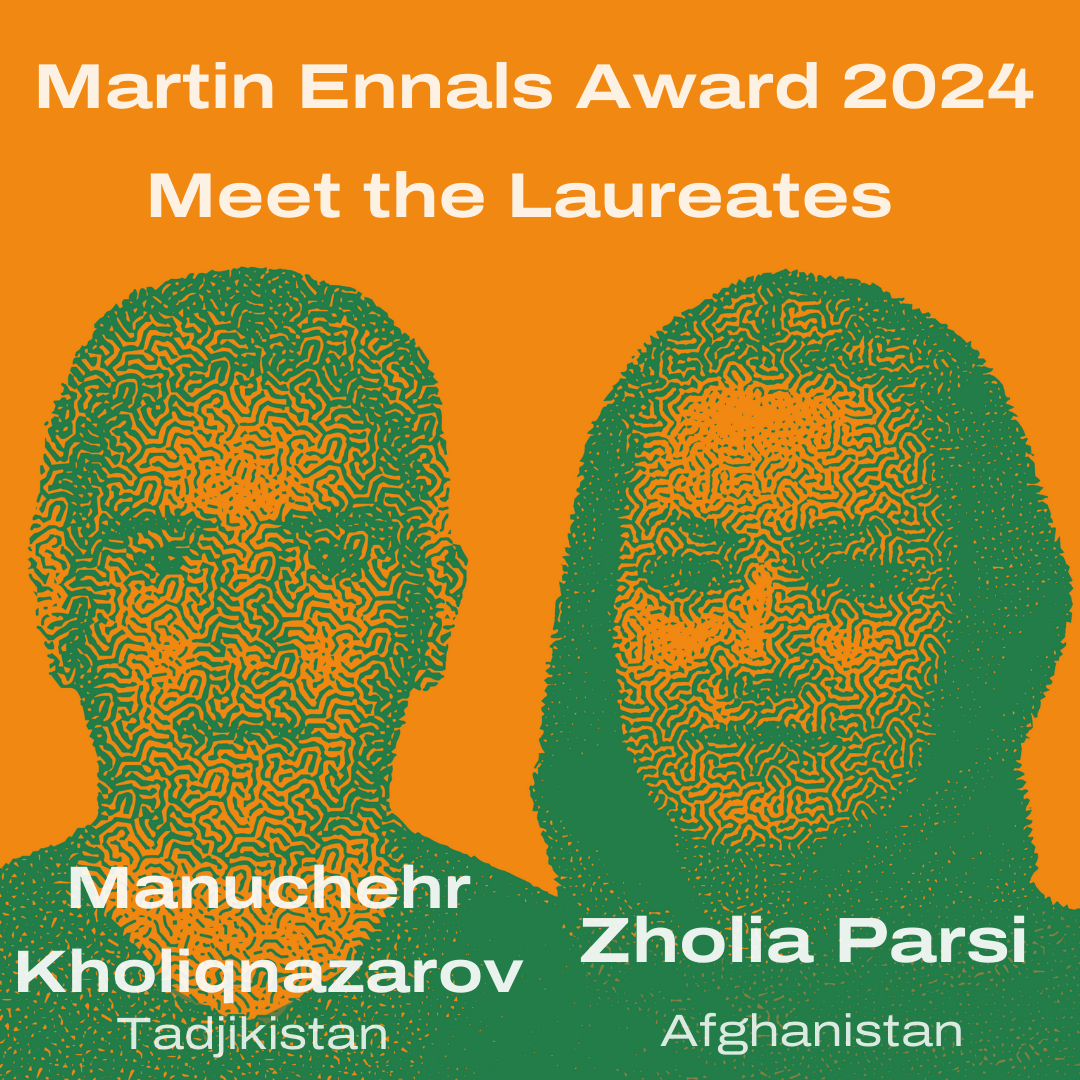
Breaking News: The Laureates of the 2024 Martin Ennals Award are….

November 21, 2024

Two outstanding human rights defenders who have made it their life mission to protect human rights in Afghanistan and in Tajikistan will receive the Martin Ennals Award 2024 on November 21th, 2024, in Geneva, Switzerland, on the occasion of the 30th anniversary of the Martin Ennals Award.

The Jury of ten of the world’s leading human rights NGOs – Amnesty International, Human Rights Watch, FIDH, HURIDOCS, Bread for the World, Human Rights First, World Organisation Against Torture, International Commission of Jurists (ICJ), International Service for Human Rights (ISHR), and Front Line Defenders – has selected, after much deliberation, the two human rights defenders whom it strongly believes deserve to be recognized and honored in 2024, on the 30th anniversary of the Martin Ennals Award. [see also: https://www.trueheroesfilms.org/thedigest/awards/043F9D13-640A-412C-90E8-99952CA56DCE]

The two 2024 Laureates, Zholia Parsi (Afghanistan) and Manuchehr Kholiqnazarov (Tadjikistan) have shown exceptional courage and determination to bring human rights at the forefront despite evolving in deeply repressive environments.

We are very proud to honor these two exceptional Laureates. They have paid too big a price for justice and equality to be respected in Afghanistan and Tajikistan and the international community must support their efforts instead of battling geostrategic interests in the region“.
– Hans Thoolen, Chair of the Martin Ennals Award Jury

The two Laureates 2024:

Zholia Parsi: is a teacher from Kabul, Afghanistan. Having lost her career and seeing her daughters deprived of their education with Taliban takeover in August 2021, she founded the Spontaneous Movement of Afghan Women (SMAW) to protest the return of policies and practices against women rights and fundamental freedoms. She displayed remarkable leadership and resilience in organizing numerous public protests despite the risks involved. The grassroots movement that is the SMAW quickly grew momentum in Kabul and other provinces, now counting 180 members and having mobilized communities to resist the Taliban’s policies and practices.
She was arrested in the street by armed Taliban in September 2023, and detained along with her son. She was released after three months of torture and ill-treatment under their custody, which further strengthened her resolve to resist Taliban oppression and repression.

Manuchehr Kholiqnazarov: is a Pamiri human rights lawyer from the Gorno-Badakhshan Autonomous Oblast (GBAO), Tajikistan. He is serving a 16 year-long prison sentence after what is widely considered an unfair trial in retaliation for his human rights work.
As Director of the Lawyers’ Association of Pamir (LAP), he led strategic advocacy efforts in the GBAO, a region marked by its ethnic minority and historical tensions with the central government, including by lobbying for the incorporation of international human rights standards into domestic law and practice, and by providing legal support to residents of the GBAO.
Through the human rights initiatives Commission 44 and Group 6, he played a key role in investigating the death of youth leader Gulbiddin Ziyobekov in November 2021, and the violent repression of subsequent mass protest in the regional capital Khorog. The investigation resulted in critical evidence of an unlawful killing, possibly an extrajudicial execution of the young man, and the unlawful use of force of security forces against protesters, resulting in two deaths, seventeen injured and hundreds detained.
He was arrested on 28 May 2022 together with two other members of Commission 44 amid a widespread crackdown on local informal leadership and residents of the GBAO.

The Martin Ennals Award (MEA): 30 years alongside human rights defenders

The Martin Ennals Award (MEA) was given for the first time in 1994 to recognize, promote and protect human rights defenders at risk or from under-reported contexts. Over the years, the MEA has offered defenders a platform to issues that are of global concern and the means to steer the movement for human rights and larger freedoms.
The MEA culminates every year in a public ceremony in Geneva, co-hosted with the City of Geneva (Ville de Genève). The 2024 MEA Ceremony will take place on November 21th, 2024 at the Salle communale de Plainpalais. The Ceremony, which is also livestreamed, draws many local and international human rights supporters to an inspiring event which celebrates the achievements and commitment of exceptional human rights defenders.
“Geneva has a long tradition of hosting international diplomacy and promoting human rights and fundamental freedoms. The City of Geneva is proud to co-host the Martin Ennals Award and shed light, on this 30th anniversary, on the impressive resilience of two human rights defenders and the hope they bring for peace and equality” concludes Alfonso Gomez, Administrative Counselor of the City of Geneva.

https://www.frontlinedefenders.org/en/statement-report/martin-ennals-award-2024-laureates-announced

https://ishr.ch/latest-updates/martin-ennals-award-to-reward-rights-activists-from-afghanistan-tajiskitan-on-its-30th-edition/

https://www.france24.com/en/live-news/20241119-afghan-woman-teacher-jailed-tajik-lawyer-share-top-rights-prize

https://asiaplustj.info/en/news/tajikistan/society/20241120/afghan-teacher-and-imprisoned-tajik-lawyer-declared-co-winners-of-prestigious-rights-award

https://www.intellinews.com/award-seen-as-nobel-prize-for-human-rights-won-by-kabul-women-s-rights-activist-and-jailed-tajik-lawyer-354320/

https://hawarnews.com/en/afghan-feminist-wins-martin-ennals-human-rights-award

https://asiaplustj.info/en/news/tajikistan/society/20241120/afghan-teacher-and-imprisoned-tajik-lawyer-declared-co-winners-of-prestigious-rights-award

https://www.ohchr.org/en/statements-and-speeches/2024/11/deputy-high-commissioner-human-rights-nada-al-nashif-delivers

WITNESS: A LIBRARY OF FREE RESOURCES FOR VIDEO ACTIVISTS, TRAINERS AND THEIR ALLIES

November 14, 2024

All Library resources are free to download, use and remix (learn more)

see also:https://www.youtube.com/humanrights

VIEW ALL FEATURED

https://library.witness.org/

UN General Assembly: UN expert urges recognition of vital work of defenders for 2030 Agenda

November 10, 2024

On 17 October 2024, the Special Rapporteur on the situation of human rights defenders, Mary Lawlor, presented her latest report in an interactive dialogue with United Nations member States during the 79th session of the United Nations General Assembly in the Third Committee.

In an interactive dialogue presenting her report to the Third Committee of the General Assembly, the Special Rapporteur on the situation of human rights defenders Mary Lawlor urged States to acknowledge the crucial role of human rights defenders in achieving seventeen Sustainable Development Goals (SDGs) and advancing 2030 Agenda. During the interactive dialogue, Mary Lawlor highlighted human rights defenders’ contributions to various SDGs, including zero hunger (Goal 2), good health and well-being (Goal 3), quality education (Goal 4), gender equality (Goal 5), clean water and sanitation (Goal 6) as well as affordable and clean energy (Goal 7). The report illustrates specific examples of human rights defenders’ work and contributions to each of seventeen Sustainable Development Goals.

During the dialogue, the Special Rapporteur noted that ninety percent of SDG targets are linked to human rights obligations. Given that only seventeen percent of the goals are on track, she emphasised the need for human rights defenders to be supported in their work in making the SDGs a reality. She noted that despite this crucial work of defenders in advancing the SDGs, they face severe barriers and threats including stigmatisation, criminalisation and other violations of fundamental rights.

In her concluding remarks, the Special Rapporteur emphasised that amidst global disagreements, the SDGs represent a rare consensus and urged States to support, partner with and respect HRDs working to support 2030 Agenda. Mary Lawlor in her recommendations, urged States to publicly acknowledge the essential role human rights defenders play in advancing the 2030 Agenda and called for legal frameworks that protect rather than restrict defenders and civil society in their legitimate work in achieving SDGs.

https://ishr.ch/latest-updates/unga79-un-expert-urges-recognition-of-the-vital-work-of-hrds-in-fulfilling-the-2030-agenda

See also SDG – Human Rights Data Explorer : https://sdgdata.humanrights.dk/en/node/252884

and

https://www.fidh.org/en/issues/business-human-rights-environment/human-rights-and-environmental-rights/cop-29-environmental-defenders-must-be-protected

Indigenous human rights defender Victoria Maladaeva from Russia

November 6, 2024

Indigenous communities must have better political representations to ensure our rights are protected both constitutionally and in practice,‘ says Victoria Maladaeva, and Indigenous peoples’ rights defender from Russia. Victoria was also a participant in ISHR’s Women Rights Advocacy Week this year. She spoke to ISHR about her work and goals.

Hello Victoria, thanks for accepting to tell us your story. Can you briefly introduce yourself and your work?

Sure! I’m a Buryat anti-war decolonial activist, co-founder of the Indigenous of Russia Foundation.

What inspired you to become involved in the defence of human rights?

Since the full-scale Russian invasion of Ukraine, Indigenous peoples, particularly Buryat, have been hit the hardest. I wanted to help my people, fight the Russian propaganda and raise awareness about systemic colonial oppression and discrimination faced by Indigenous people and ethnic minorities in the Russian Federation.

What would Russia and your community look like in the future if you achieved your goals, if the future you are fighting for became a reality?

The country needs a large-scale transformation— political, economic, and cultural. Indigenous communities must have better political representations to ensure our rights are protected both constitutionally and in practice. Genuine democratic reforms involve fundamental rights for self-determination and autonomy where Indigenous peoples gain control of their land and resources. Putin’s constitution’s amendments to national Republics must be reversed, our languages must be mandatory in all schools, universities, and institutions where Indigenous communities live. 

How do you think your work is helping make that future come true?

I’m advocating for the rights of Indigenous peoples with international stakeholders and institutions to raise awareness about issues faced by our communities and spreading awareness, producing documentaries, and mobilising diasporas. 

Have you been the target of threats or attempts at reprisals because of your work?

Unfortunately, yes. There have been threats because of my anti-war activism and for shedding light on the disproportionate mobilisation in the Republic of Buryatia. For some reason, my colleagues and I were denied participation in the UN Permanent Forum on Indigenous Issues. I would like to believe this was a mistake and that there was no influence from the Russian delegation at the UN.

Do you have a message for the UN and the international community?

Russia needs decolonisation and de-imperialisation. Without revising the past and acknowledging colonial wars (not only in Ukraine) and discrimination, there can be no bright future for Russia—free and democratic. The international and anti-imperialist community should acknowledge that the Russian government is not for any anti-colonial movement. Stand in solidarity with independent Indigenous activists!

https://ishr.ch/defender-stories/human-rights-defenders-story-victoria-maladaeva-from-russia

Hope and defiance abound as Dublin event hosts 100 human rights defenders

October 27, 2024

At a time of unprecedented backlash against them, dozens of the most at-risk human rights defenders (HRDs) from all regions of the world will come together with dignitaries and civil society leaders in Dublin for three days from 23-25 October at Front Line Defenders’ flagship event, the Dublin Platform. This is Front Line Defenders’ 12th Platform, bringing together around 100 HRDs from close to 100 different countries.

First held in 2002, previous Dublin Platforms have given HRDs from almost every country the opportunity to share strategies for advocacy and protection, build solidarity with colleagues around the world, and network with high-level decision makers.

Human rights defenders represent the best of the human spirit. They steadfastly champion the human rights of others, often at great personal risk, to push for fairer, more just societies,” said Alan Glasgow, Executive Director of Front Line Defenders.

“But the challenges they face are enormous. For their courageous work, human rights defenders are often targeted with the worst forms of violence, surveillance, criminalisation and other repression.

The dignitaries addressing this year’s Platform will include: Volker Türk, UN High Commissioner for Human Rights; Mary Lawlor, UN Special Rapporteur on the situation of human rights defenders; Michael O’Flaherty, Commissioner for Human Rights of the Council of Europe; and Seán Fleming, Minister of State in Ireland’s Department of Foreign Affairs. https://www.ohchr.org/en/statements-and-speeches/2024/10/human-rights-defenders-are-oxygen-human-rights-ecosystem

Among the HRDs attending the Dublin Platform are LGBTIQ+ rights defenders; Indigenous, land and environmental rights defenders; women human rights defenders; journalists facing threats and persecution; those fighting against corruption and corporate abuse, and those working on a range of other issues.

The HRDs taking part in the Platform face a wide range of risks, from digital surveillance and online harassment, to death threats and violent attacks, to criminalisation and vilification through smear campaigns. Some work in extremely challenging circumstances amid armed conflicts, crackdowns and other large-scale crises. Front Line Defenders documents the wide array of risks faced by HRDs in its Global Analysis, published annually.

The HRDs in attendance will also attend a special tribute at the HRD Memorial monument in Dublin’s Iveagh Gardens, to commemorate the hundreds of their colleagues around the world who are killed every year for their peaceful work. According to the HRD Memorial initiative – which Front Line Defenders coordinates – at least 300 HRDs across 28 countries were killed in 2023

https://www.frontlinedefenders.org/en/statement-report/hope-and-defiance-abound-dublin-event-hosts-around-100-human-rights-defenders

Venezuela’s opposition wins top EU human rights award

October 27, 2024
Opposition Leader Maria Corina Machado Speaks After Presidential Election
Democratic leader María Corina Machado and exiled presidential candidate Edmundo González won the top human rights award for representing all Venezuelans who are “fighting for the restoration of freedom and democracy.” | Marcelo Perez del Carpio/Getty Images

The European Parliament on Thursday 24 October 2024 awarded the Sakharov Prize to Venezuela’s opposition leaders. Democratic leader María Corina Machado and exiled presidential candidate Edmundo González won the top human rights award for representing all Venezuelans who are “fighting for the restoration of freedom and democracy.”

The Venezuelan opposition leaders were nominated by the center-right European People’s Party (EPP) and the hard-right European Conservatives and Reformists (ECR). The far-right Patriots group rallied behind them after their original candidate, tech billionaire Elon Musk, failed to make the shortlist for the prestigious prize.

After Venezuela’s elections in late July, in which incumbent socialist President Nicolás Maduro declared victory for another term, the European Union’s foreign service said it would not recognize the results because the government had failed to release supporting voting records from polling stations. 

The authoritarian Maduro’s disputed declaration of victory sparked massive opposition protests and a violent government crackdown that left more than two dozen people dead and nearly 200 injured.

Later, presidential candidate González — who fled to Madrid during the crackdown — was recognized by the European Parliament as the country’s legitimate leader.

For more on the Sakharov Prize for Freedom of Thought and its laureates see: https://trueheroesfilms.org/thedigest/awards/BDE3E41A-8706-42F1-A6C5-ECBBC4CDB449

Two other finalists made the shortlist. One was Gubad Ibadoghlu, a jailed Azerbaijani dissident and critic of the fossil fuel industry nominated by the Greens. The other finalist was a joint nomination of Israeli and Palestinian peace organizations Women Wage Peace and Women of the Sun. The groups, who announced a partnership in 2022, were nominated by the Socialists and the Renew group.

https://www.politico.eu/article/eu-human-rights-award-venezuela-opposition-maria-corina-machado-edmundo-gonzalez-nicolas-maduro/

https://www.europarl.europa.eu/news/en/press-room/20241017IPR24738/maria-corina-machado-and-edmundo-gonzalez-urrutia-awarded-2024-sakharov-prize

see: https://www.lapatilla.com/2024/10/26/at-least-900-people-arrested-after-venezuelas-post-election-protests-are-being-held-in-tocoron-prison/