According to Front Line Defenders a rather curious case seems to have been construed against a human rights defender in Mongolia. The trial of human rights defender Mr Beejin Khastamur will start on 8 July 2016 at the Songinokhairkhan District Court in Ulan Bator. He was arrested on 16 March 2016 and denied bail on 22 March. He was eventually released pending trial on 31 March. Beejin Khastamur is the founder of a non-governmental organisation Delhiin Mongol Nogoon Negdel (DMNN), which advocates for the protection of environment and the rights of the nomad people of Mongolia. The organisation has exposed many violations of Mongolia’s environmental laws by foreign and domestic mining companies, in which Mongolian politicians had a stake. It has also organised numerous workshops, public gatherings and demonstrations to educate the public on environmental issues. https://www.frontlinedefenders.org/en/profile/beejin-khastamur
According to the police Beejin Khastamur allegedly attacked the driver of another car using a knife. On 6 February 2016, Beejin Khastamur was indeed involved in a car accident, during which no one was killed or injured and the material damage caused was minimal. The human rights defender was driving in Ulan Bator when a Nissan car tried to pass him on the wrong side twice and eventually hit his vehicle. Its driver got out of the car and attacked Beejin Khastamur kicking him and hitting the human rights defender in his head. Subsequently, during the forensic examination it was revealed that Beejin Khastamur sustained bruises all over his body and had a brain concussion, while the second driver had only small scratches on one of his knees. When police arrived at the scene, they concluded that the accident had been the fault of the second driver and left. However, they subsequently returned and brought Beejin Khastamur to the police station for questioning. The actions of the police have given rise to the suspicion that the accident may have been used as a pretext to target Beejin Khastamur for his human rights work.
[On 21-23 December 2015, Beejin Khastamur organised a sit-down strike protesting the illegal permit given to a Canadian and Mongolian joint company enabling it to mine gold right on Onon River. Since then he has received multiple threats. On several occasions people came to his house, banging on his door at night, cutting his electricity, puncturing his car tires, threatening his wife and children. The human rights defender also received death threats on the phone.]
Sebnem Korur Fincanci, president of the Human Rights Foundation of Turkey, and Erol Onderoglu, Turkey’s representative to Reporters Without Borders, are to remain free pending trial on charges of “propaganda for terror organization PKK,” or the Kurdistan Workers’ Party, according to the state-run Anadolu Agency. The first hearing is scheduled for November 8. A different court is handling the case against writer and journalist Ahmet Nesin and there has been no decision yet on the possibility of his release pending trial, according to Anadolu.
The three had participated in a solidarity campaign taking turns as co-editors in support of Ozgur Gundem, a pro-Kurdish publication subject to multiple investigations and lawsuits.
A lawyer, Willie Kimani, his client, Josphat Mwenda and their taxi driver, Joseph Muiruri, were last seen returning from a traffic court hearing at Mavoko Law Courts on 23 June 2016. Many feared that they were abducted. Now, on 1 July 2016 their bodies have been found. Kimani was a lawyer with NGO International Justice Mission in Kenya. Kimani had been representing Mwenda in a case he had brought against the police after he was shot by them during a traffic stop.
“We are deeply saddened by reports of the murders of Kimani, his client, and his taxi driver, and offer our condolences to their families and colleagues who continue to incur great risk fighting for justice and accountability,” said Human Rights First’s President and CEO Elisa Massimino. “It’s vital for the future of Kenya that its human rights lawyers are able to operate without fear of violence, and that the killers be swiftly brought to justice.”
“Police should not hesitate to interrogate and arrest their own officers when there is cause,” said Namwaya of HRW. “This case stands as a clear threat to the legal profession and all those who push for police accountability in Kenya.” http://www.hrw.org/africa/kenya
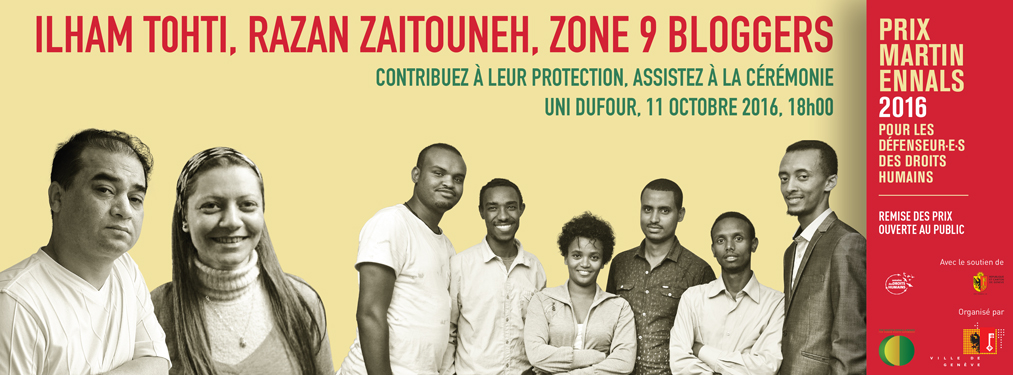
The 2016 Martin Ennals AwardCeremony, organized annually by the City of Geneva and the Martin Ennals Foundation, will this year take place on 11October, 6.00 pm, at Uni Dufour, Geneva, as thethe opening of the Human Rights Week hosted by the University of Geneva from October 11 to 14 and with the support of the Canton of Geneva.
The laureate will be selected from among three 2016 finalists:
Mr. Ilham Tohti (China) was sentenced to life imprisonment after working for two decades to foster dialogue and understanding between Uyghurs and Han Chinese.
Mrs. Razan Zaitouneh (Syria) was kidnapped after dedicating her life to defending political prisoners and documenting crimes against humanity in Syria.
Zone 9 Bloggers (Ethiopia) have been prosecuted for documenting human rights abuses in their country.
The finalists and laureate are selected by the Jury of the Martin Ennals Award, made up of ten of the world’s leading human rights organizations: Amnesty International, Human Rights Watch, Human Rights First, International Federation for Human Rights (FIDH), World Organisation Against Torture (OMCT), Frontline Defenders, the International Commission of Jurists, EWDE-Germany, the International Service for Human Rights, and HURIDOCS. The detailed programme of the ceremony will follow at the beginning of September.
Martin Ennals Award for Human Rights Defenders
For the conversation in the social media, use the hashtag: #Ennals2016.
The debate, moderated by Professor Andrew Clapham, featured Human Rights Defenders Taslima Nasrin and Aida Khemiri, as well as Stavros Lambrinidis, EU Special Representative for Human Rights.
“Too many people are dying for protecting human rights,” Mr Lambrinidis said, while promising that “the EU is committed to defending the defenders.”
“There is a price on my head,” revealed Taslima Nasrin, a Bangladeshi author and blogger who has been targeted by radical Muslim groups who have condemned her writing as blasphemous. “It’s been 22 years since I have been allowed to return to my country, not even in times of sickness and death of my closest family.”
Aida Khemiri, an LGBTI activist from Tunisia drew attention to the psychological challenge of having to lie to her friends and family for their protection. “As a Human Rights Defender, I have to live a double life. I cannot tell my family all I am doing, I have to protect them.”
Following the debate, participants and panelists marched past the UN Palais des Nations to express their support to Human Rights Defenders who were not able to walk freely. The event concluded at the Ariana Museum, with a spectacular show of the Violonissima Duo, performing from a hot air balloon. A playlist with photos from the event can be found through the link below.
Bahrain does everything it can to keep itself in the spotlight of human rights concern. A coalition of NGOs, as well as the UN and (reluctantly) the USA have recently come out with criticism over travel bans, reprisals, denationalization and other violations:
When the 32nd session of the United Nations Human Rights Council opened in Geneva on 13 June 2016, Nabeel Rajab, Bahrain’s best-known human rights defender, was arrested after dozens of police officers raided his home at around 5am and confiscated his electronic devices. The day before, Bahraini human rights defenders and victims of violations were prevented from flying to Geneva. On 16 June21 NGOs signed a statement of serious alarm by Bahrain’s restrictions civil society especially preventing them from engaging with the UN.
[Rajab, President of the Bahrain Center for Human Rights (BCHR – nominee of the MEA 2012), founding Director of the Gulf Centre for Human Rights (GCHR) and Deputy Secretary General of FIDH, was reportedly arrested under order from the Ministry of Interior’s Cybercrimes Unit. Bahraini officials had imposed a travel ban on Rajab a year ago, and since April 2015 have maintained charges against him for crimes related to freedom of expression online. Despite the submission of several appeals against the ban, authorities remained unresponsive. On 14 June 2016, Rajab was transferred to the public prosecution; and new charges were brought against him of allegedly ‘publishing and broadcasting false news that undermines the prestige of the state’. The public prosecution remanded him to seven days in detention pending investigation.]
In a new escalation of its crackdown against civil society, Bahraini authorities have now also banned other human rights defenders from leaving the country. The bans were imposed as the activists were attempting to travel to Geneva to participate in the Human Rights Council.
In light of this escalated attack on civil society in Bahrain, the 21 NGOs call for the immediate release of all human rights defenders in Bahrain, including Nabeel Rajab, and for the removal of the imposed travel bans which unfairly restrict activists’ freedom of movement. We also request that the President of the HRC, the UN High Commissioner for Human Rights, the Special Rapporteur on the Situation of Human Rights Defenders, the Special Rapporteur on Freedom of Opinion and Expression and the Special Rapporteur on the Rights to Freedom of Peaceful Assembly and Association call on the Bahraini authorities to immediately and unconditionally lift the travel ban imposed on Bahrain’s civil society activists and guarantee Bahraini human rights defenders are free from intimidation and restrictions on their work, including at the UN. We also call on the international community to hold the government of Bahrain to its commitments and obligations to foster a safe environment for the peaceful enjoyment of universal human rights. The government of Bahrain must immediately stop the ongoing reprisals against human rights defenders who are engaging with international mechanisms including the UN system. [21 signatories to be hound at the bottom of this post.]
On 21 June 2016, the Office of the UN High Commissioner for Human Rights stepped in with an expression of great concern over this intensification of a crackdown on free expression and association, and the right to a nationality: Read the rest of this entry »
An academic and two journalists who play a key role in Turkey’s human rights movement have been jailed pending investigation into spurious allegations of spreading terrorist propaganda. Human Rights Watch, Reporters without Boarder, Front Line, and the Observatory for the Protection of Human Rights Defenders (a joint program of FIDH and OMCT), among others, have raised serious concern and demanded their immediate release.
An Istanbul court on 20 June, 2016, accepted a prosecutor’s request for them to be placed in pretrial detention on suspicion of having committed terrorist offenses. They are Erol Önderoglu, who is the Turkey representative of Reporters Without Borders and a journalist with the independent news website Bianet; Professor Şebnem Korur Fincancı, an academic at Istanbul University’s forensic medicine department and head of the Human Rights Foundation of Turkey; and Ahmet Nesin, a writer and journalist.
“The decision to demand the detention of Önderoğlu, Fincancı, and Nesin is a shocking new indication that the Turkish authorities have no hesitation about targeting well-known rights defenders and journalists who have played a key role in documenting the sharp deterioration in human rights in the country,” said Hugh Williamson, HRW’s Europe and Central Asia Director. “
The three were among 44 journalists, writers, and activists who participated in a solidarity campaign for media freedom in which each of them acted as a symbolic co-editor-for-a-day at the pro-Kurdish daily Özgür Gündem in Istanbul. The government sees the newspaper as hostile to it and as a result has placed it under immense pressure.
“Jailing a world-renowned journalist and human rights defender such as Erol sends a very powerful signal of intimidation to the entire profession in Turkey. It’s a new, unbelievable low for press freedom in Turkey,”Johann Bihr, head of the Eastern Europe and Central Asia desk at RSF, told CPJ. At least 14 journalists were imprisoned in Turkey on December 1, 2015, when CPJ last conducted its annual census of journalists jailed around the world. [see also: https://thoolen.wordpress.com/2016/03/20/turkey-fair-trial-human-rights-lawyers-expression-l4l/]
While the NGO reactions are expected, more remarkable is the reaction from Russia which (in the good company of the USA, the UN and the EU) has condemned the crackdown on Turkey’s press freedom: Read the rest of this entry »
That reprisals also take place in a regional human rights context is made clear by a report on 21 June 2016 by the New-York based Human Rights Foundation (HRF). It condemns the arbitrary arrest of activists Oscar Luis Milian and Yoandrys Gutiérrez, members of the Cuba-based youth movementMesa de Diálogo de la Juventud Cubana. Both activists were detained for six hours last week at José Martí Airport in Havana when returning to the country after taking part in meetings with the Secretary General of the Organization of American States (OAS), Luis Almagro. The meetings — organized by the Latin American Youth Network for Democracy within the framework of the 46th General Assembly of the OAS in Santo Domingo — brought together human rights and democracy activists from all over the hemisphere.
“Bringing notepads and pens with slogans in favor of democracy and human rights into Cuba has always been considered a ‘subversive’ activity by Cuba’s 57-year-old dictatorship,” said Javier El-Hage, HRF’s chief legal officer. “Oscar and Yoandrys join an endless list of brave activists who are treated like criminals for daring to bring information from the outside world to ordinary citizens in Cuba. If Raúl Castro really wants to show tolerance and openness, he should begin by dismantling the regime’s repressive structure that prohibits people to think for themselves.”
Milian and Gutiérrez were released six hours after their arrival in the Cuban capital and were never informed of the reason for their arrest.
The Commission on the Status of Women (CSW) is the principal global intergovernmental body exclusively dedicated to the promotion of gender equality and women’s rights. Its 60th session this year focused on women’s empowerment and its link to sustainable development. Despite mounting evidence of targeted violence against women human rights defenders (WHRDs), particularly those working on development issues, the Commission on the Status of Women failed at ensuring their adequate protection says the International Service for Human Rights (ISHR) in a report of 12 May 2016.
‘The role and contribution of WHRDs around the world in human rights and development policies and programmes must be a guarantee by all States,’ said Ms Pooja Patel, programme manager at ISHR. ‘It is disappointing that the Agreed Conclusions did not go further to call for a safe and enabling environment explicitly for women defenders, and that the text was adopted without any acknowledgement of the particular risks faced by women human rights defenders’.
The UN General Assembly resolution 68/181, adopted in 2013, outlines a series of steps for States to better protect women defenders. This was echoed by CSW in 2014, however, negotiations in subsequent years have seen such references taken out.
Noelene Nabulivou, who spoke on a panel on the role of women human rights defenders held during CSW noted, ‘The 60th Commission on the Status of Women missed another opportunity to adequately support and defend women human rights defenders, despite increased public calls and momentum this year,’
She added that..’Women human rights defenders are targeted, imprisoned and killed for their work every day. Soft language and fence sitting do not help. Governments must publicly stand with those at the dangerous front-lines of gender equality, women’s human rights, and economic, ecological and social justice, and clearly reject those rolling back decades-long gains. Where there is violation of the human rights of WHRDs there must be clear political response – from south, north and all between.’