The UN Human Rights Council will hold its 38th regular session at Palais des Nations in Geneva from 18 June to 6 July 2018. The International Service for Human Rights (ISHR) has – as usual – published an excellent alert full of substantive issues (see link at the bottom of this post). Here I just highlight some of the session’s features that are of special interest to human rights defenders;
Sexual orientation and gender identity. The first interactive dialogue with the new Independent Expert on protection against violence and discrimination based on sexual orientation and gender identity will be held between 9:00 and 12:00 on Monday 18 June. The Council will consider the new report of the mandate holder as well as the report of the country visit to Argentina.
In a joint written submission to the Independent Expert submitted in the lead-up to the presentation of his report to the Council, a group of 12 NGOs detail State obligations that if implemented, would work towards ensuring that LGBTI defenders’ rights are protected (based in existing international human rights law and articulated in the Yogyakarta Principles (YP) and Yogyakarta Principles plus 10, (YP +10). ISHR and ILGA will organise a side-event that will build on this submission and discuss in more detail State obligations set out in the YP +10. The event will take place on 21 June 2018 from 15:00 to 16:30 in Room XXIII.
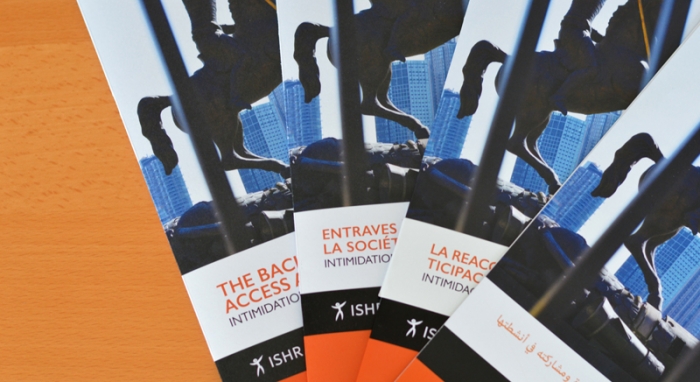
Reprisals. Reports of cases of intimidation and reprisal against those seeking to cooperate with the UN not only continue, but grow. Item 5 of the Human Rights Council’s agenda provides a key opportunity for States to raise concerns about reprisals, and for governments involved in existing cases to provide an update to the Council on any investigation or action taken toward accountability to be carried out. [see recent: https://humanrightsdefenders.blog/2018/06/08/ishr-new-report-on-reprisals-and-restrictions-against-ngo-participation-in-the-un/]
Women human rights defenders and women’s rights. The Annual Full Day Discussion on the human rights of women will take place on Thursday 21 June from 16:00 to 18:00. It will focus on the specific impact of online violence on the work of women human rights defenders. It is crucial that the Council’s discussions and resolutions recognise the critical role of women human rights defenders (WHRDs) and organisations led by women and girls as rights holders and agents of change. The Council will hold an interactive dialogue with the Special Rapporteur on violence against women, its causes and consequences on 20 June between 09:00 and 12:00 and will consider her report including the report of her visit to Australia. The Council will also hold an interactive dialogue with the Working Group on the issue of discrimination against women in law and in practice and will consider their reports including a report on the country visit to Samoa and Chad.
Business and human rights. The Council consider the report of the Working Group on the issue of human rights and business. It examines the duty of States to protect against human rights abuses by business enterprises to whom they provide support for trade and investment promotion. It will also consider the Working Group’s report on its mission to Canada, Peru, and on the sixth session of the Forum on Business and Human Rights. Both country reports contain specific sections analysing the situation of human rights defenders, with the report on Peru raising serious concerns about the high level of threats, attacks and violence against local leaders and human rights defenders. The interactive dialogue will be an opportunity for States to follow-up to recommendations made in the UPR in that regard. The core group on the resolution on business and human rights (Argentina, Norway, Ghana and Russia) have announced that they will present a resolution at this Council session to request the OHCHR to continue with the accountability and remedy report with a focus on non-State based remedy mechanisms. The first informal consultation on the draft resolution will be held on 18 June at 16:30 in Room XXIV.
Other thematic reports
The Council will also hold an interactive dialogue and consider the report of the new Special Rapporteur on the rights to freedom of peaceful assembly and of association. Switzerland with Costa Rica also announced that they will be running the resolution on the protection and promotion of human rights in the context of peaceful protests. The first informal consultations will be held on 19 June from 11:30 to 12:30 in Room V.
The Council will also hold an interactive dialogue and consider the report of the Special Rapporteur on the promotion and protection of the right to freedom of opinion and expression, which examines regulation of user-generated content online. The Council will consider the report of the High Commissioner on procedures and practices in respect of civil society engagement with international and regional organisations. The core group on the civil society space resolution (Chile, Ireland, Japan, Sierra Leone and Tunisia) announced that they will present a resolution this session.
The Council will also consider the reports of and hold interactive dialogues with the Special Rapporteur on the independence of judges and lawyers, including the report of his mission to Poland, and with the Special Rapporteur on extrajudicial, summary or arbitrary executions, including reports of her missions to Iraq and El Salvador.
Country specific developments
Burundi During its 36th session, the Council passed two resolutions on Burundi. One resolution was led by the European Union and extended the mandate of the Commission of Inquiry. The second resolution was led by the African Group and requested OHCHR to urgently dispatch a team of three experts to engage with the Burundian authorities and all other stakeholders to “collect and preserve information, to determine the facts and circumstances in accordance with international standards and to forward to the judicial authorities of Burundi such information”. The aim was to establish the truth and ensure that the perpetrators are held accountable. Read here ISHR’s analysis of the two resolutions. At the 38th session, the Council will hear the oral briefing by the High Commissioner on the mission of OHCHR on 4 July between 15:00 and 18:00. The Council will also hear an oral briefing by the Commission of Inquiry on 27 June between 09:00 and 12:00. For more information on the situation of human rights defenders in Burundi, check ISHR Briefing Paper for the UPR here. [see also: https://humanrightsdefenders.blog/2016/10/26/enough-is-enough-ngos-call-for-burundi-suspension-from-un-human-rights-council/]
China. By any measure, the Chinese government is not living up to the commitments to protect and promote human rights inherent in its Human Rights Council membership. Since the twelve-country joint statement on the human rights situation in China in March 2016, there has been no concerted effort to use the Council space creatively to call for accountability and transparency related to violations in China. This, despite the fact that in July 2017, Chinese security authorities presided over the death in custody of Liu Xiaobo, the first Nobel Peace Prize winner to die in detention since Carl von Ossietzky died in Nazi Germany in 1938… In this context NGOs , incl. the iSHR, continue to call for the release of individuals arbitrarily detained and/or held incommunicado, including Wang Quanzhang, Gui Minhai, Tashi Wangchuk, Lee Ming-che, and Yu Wensheng. [see also: https://humanrightsdefenders.blog/2018/03/07/china-and-the-un-human-rights-council-really-win-win/]
Eritrea. The Council will hold an interactive dialogue with and consider the report of the Special Rapporteur on the situation of human rights in Eritrea on 25 June. A cross-regional group of non-governmental organisations urged the Council to support and co-sponsor at the 38th session a streamlined resolution that accurately reflects the gravity of the situation on the ground, renews the mandate of the Special Rapporteur under the Council’s agenda item 4, and sets out a framework for needed reforms to improve the human rights situation in the country and advance accountability.
Other country situations include:
- An interactive dialogue on the oral update by the High Commissioner on the situation of human rights of the minority Rohingya Muslim population and other minorities in Rakhine State of Myanmar, and the oral report of the Special Rapporteur on the situation of human rights in Myanmar
- An enhanced interactive dialogue on the report of the High Commissioner on the findings of the team of international experts on the situation in the Kasai regions of the Democratic Republic of the Congo (DRC) and on the oral update by OHCHR on the situation of human rights in the DRC
- An oral update by the High Commissioner on the situation of human rights in Ukraine
- An oral update by the Independent Expert on the situation of human rights in the Central African Republic
- An interactive dialogue with the Commission of Inquiry on Syria (oral update) and consideration of the summary report of OHCHR on the high-level panel discussion on violations of the human rights of children in Syria
- An interactive dialogue with the Special Rapporteur on the situation of human rights in Belarus on his report
- During this session, the Council will adopt the UPR working group reports as part of the 29th session of the UPR. These reports list recommendations the following States under review are expected to implement: France, Tonga, Romania, Mali, Botswana, the Bahamas, Burundi, Luxembourg, Barbados, Montenegro, the United Arab Emirates, Israel, Liechtenstein, and Serbia.
This session of the Council will provide an opportunity for Burundi, Mali and the United Arab Emirates to to accept recommendations made in relation to human rights defenders, as proposed in ISHR’s briefing papers on those countries.
The Council appointed new Bureau members due to the departure of the Ambassadors of Chile and Germany. The members of the Bureau for 2018 now comprises of the following Ambassadors:
- Vojislav ŠUC (Slovenia), President of the Human Rights Council
- Evan P. GARCIA (Philippines), Vice President
- Cristobal Gonzalez-Aller Jurado (Spain), Vice President
- Juan Eduardo EGUIGUREN (Chile), Vice President and Rapporteur
- François Xavier NGARAMBÉ (Rwanda), Vice President
Panel discussions
During each Council session, panel discussions are held to provide member States and NGOs with opportunities to hear from subject-matter experts and raise questions. All panel discussions will be broadcast live and archived on http://webtv.un.org. Four panel discussions are scheduled for this upcoming session:
- The Annual Full Day Discussion on the human rights of women will be held in two sessions. First, on 21 June from 16:00 to 18:00, the panel will focus on the impact of violence against women human rights defenders and women’s organisations in digital spaces. The concept note of the panel is available here.
- The second panel will be held on 22 June from 10:00 to 12:00 and will focus on advancing women’s rights through access and participation in information and communication technologies (ICTs). The concept note of the panel is available here.
- A panel discussion will be held on 26 June from 16:00 to 18:00 on the human rights of internally displaced persons in commemoration of the twentieth anniversary of the Guiding Principles on Internal Displacement. The concept note of the panel is available here.
- The Annual Thematic Panel Discussion on technical cooperation in the promotion and protection of human rights will be held on 4 July from 10:00 to 12:00. The topic will be “Human rights and the Sustainable Development Goals: enhancing human rights technical cooperation and capacity-building to contribute to the effective and inclusive implementation of the 2030 Agenda for Sustainable Development”. The concept note of the panel is available here.
The ISHR and other NGOs will again organize quite a few side events on which I will report separately.
https://www.ishr.ch/news/hrc38-key-issues-agenda-june-2018-session