Archive for the 'organisations' Category

China, Russia and Pakistan in UN fail at attempt to muzzle human rights defenders (for now)

July 7, 2018

On 6 July 2018 Stephanie Nebehay reported for Reuters that China, Russia and Pakistan lost their bid on Friday to weaken a U.N. resolution upholding the crucial rule of human rights defenders. The United Nations Human Rights Council adopted a resolution calling on all states to protect civil society groups from threats and intimidation, and prosecute reprisals against them. Chile presented the resolution text on behalf of more than 50 countries on the final day of a three-week session. Amendments proposed by China, Pakistan and Russia – declaring that civil society groups must respect “the sovereignty and territorial integrity of states” and that their funding must be “legal and transparent” – were soundly defeated. So, in spite of increasing retaliation against human right defenders and pressure on civil society in many countries [see recently: https://humanrightsdefenders.blog/2018/06/08/ishr-new-report-on-reprisals-and-restrictions-against-ngo-participation-in-the-un/ ], the UN is still able to resist some of the more blatant attempt to silence critics.

“China and Russia are often the least tolerant of civil society at home. They are now seeking to introduce similar restrictions at the international level,” John Fisher of Human Rights Watch told Reuters. Their attempts to place national sovereignty above international human rights law “would turn guarantees of peaceful assembly and association on their heads”.

“These amendments were a swing and a miss for China and its allies on the Council,” Sarah Brooks of the International Service for Human Rights told Reuters, using an American baseball term. “Their efforts to limit civil society’s independence and shut down civil society voices were rebuffed by a strong message – from member states across the globe – about the importance of keeping defenders’ voices at the table”.

[At the current session, China tried unsuccessfully to block the accreditation of Uighur activist Dolkun Isa, U.N. sources said. China’s delegation publicly challenged activists speaking on behalf of Uighur and Tibetan ethnic minorities. Council president Vojislav Suc, Slovenia’s ambassador, said allegations of intimidation and reprisals had emerged during the session and urged “all necessary measures” to prevent such acts.]

https://www.reuters.com/article/us-un-rights/china-russia-fail-to-curb-activists-role-at-u-n-rights-forum-campaigners-idUSKBN1JW2EM

Inventivity of evil: how states restrict HRDs access to the UN in 10 case studies

June 27, 2018

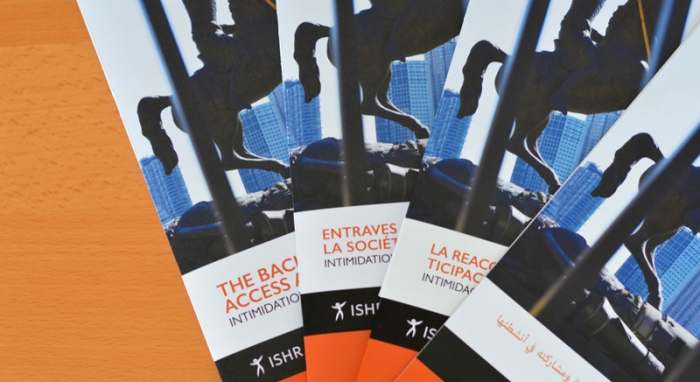
In a new report entitled “The Backlash Against Civil Society Access and Participation at the United Nations” the ISHR outlines the many different ways States employ to keep critical voices out of multilateral spaces. ISHR’s new report provides a road map for States and UN representatives to prevent and counter restrictions on civil society participation in UN processes.

Civil society has the right to ‘unhindered access to and communication with international bodies. However, that right is not being respected.  ISHR’s new report documents a broad range of obstacles faced by human rights defenders, from opaque bureaucracies and procedures to reprisals, physical threats and attacks. ‘States decide who gets through the door,’ said ISHR’s Eleanor Openshaw.  ‘States that fear calls for accountability and justice do what they can to prevent civil society access to and participation in UN spaces’.

Click on the video below to get an insight into the report:

Opaque practices and procedures provide covers for States seeking to block NGO entry.  An NGO seeking to participate in a UN high-level event can be a victim of the ‘no-objection’ procedure.  This is the means by which any State can veto their participation without being named or providing any justification. ‘The no-objection procedure is poorly defined, and provides no formal criteria for objections to NGO participation,’ said ISHR’s John Indergaard. ‘It’s carte blanche to exclude legitimate NGOs for illegitimate reasons.’

Even when civil society representatives make it into an actual UN building, they have been thrown out without explanation or asked to leave while events were ongoing. At some high-level events and committee meetings, NGO representatives have been barred from giving statements or bringing in documents related to their work. Physical attacks and intimidation against those seeking to cooperate with the UN are well documented.  ‘These restrictions and reprisals are all aimed at dissuading civil society participation,’ said Openshaw. ‘They need to be challenged in each and every case.’

For some of my earlier posts on reprisals: https://humanrightsdefenders.blog/tag/reprisals/

To say it again clearly: assaults on human rights defenders are incompatible with international human rights treaties

June 27, 2018
In a ground-breaking joint statement on 23 May 2018, the UN Special Rapporteur on human rights defenders and representatives from all of the UN human rights treaty bodies have affirmed that all forms of abuse or undue restrictions against human rights defenders constitute violations of States’ parties obligations towards the realisation of rights set out in the Treaties. The statement was adopted on the eve of the 30th annual meeting of Treaty Body chairs on the occasion of a consultation initiated by the UN Special Rapporteur on human rights defenders and ISHR in New York.

“This pronouncement constitutes a major step forward in the protection of human rights defenders and lays the ground for substantial enhancement of treaty body recommendations and jurisprudence in that area” says ISHR head of treaty body advocacy Vincent Ploton.

The statement reiterates the vital and central role played by human rights defenders to promote and support the application of the fundamental rights enshrined in the core international human rights treaties. It further contextualises the importance and relevance of the UN Declaration on human rights defenders which “reaffirms, is underpinned by, and elaborates binding human rights obligations, including rights set out in the Treaties, and is relevant to the interpretation and implementation of the Treaties”.

The Committee on economic, social and cultural rights (CESCR) was the first to adopt in 2016 a statement affirming that threats and violence against human rights defenders amount to violations of the Covenant. “We are delighted that fellow Treaty Bodies are now following suit with the adoption of this new joint statement”, says ISHR’s New York Director Madeleine Sinclair.

Marking the 20th anniversary of the UN Declaration on human rights defenders, the statement confirms that the core international human rights treaties and the Declaration prohibit discrimination against individuals and groups who champion such human rights norms and standards. It reaffirms that all individuals should be able to engage with treaty bodies free from all forms of interference, intimidation, abuse, threat, violence, reprisal, or undue restriction. It concludes with a series of practical measures that States ought to take to guarantee the protection of human rights defenders, including the adoption of specific legislation to protect and recognise defenders, and the revocation of legislation which restricts or hinders their work.

Read the full statement: http://www.ohchr.org/EN/NewsEvents/Pages/DisplayNews.aspx?NewsID=23154&LangID=E

[The statement was endorsed by the Committee on Enforced Disappearances, the Special Rapporteur on Human Rights Defenders, and the following Treaty Body members in their individual capacity: Virginia Brás-Gomes, CESCR Chair; Dalia Leinarte, CEDAW Chair; Noureddine Amir, CERD Chair; Ahmadou Tall, CMW Chair; Danlami Basharu, CRPD Vice-Chair; Felice Gaer, CAT Vice-Chair; Marcia Kran, HRCttee member; Olga Khazova, CRC Vice-Chair and Satyabhooshun Gut Domah, SPT member.]

https://www.ishr.ch/news/treaty-bodies-threats-and-assaults-human-rights-defenders-incompatible-core-international-human

New Global Center for Sport and Human Rights created to address abuses

June 27, 2018

Atlas of Torture: a new and timely project

June 25, 2018

A global cooperation platform has been launched to advance the fight against torture and ill-treatment worldwide: https://www.startnext.com/atlas-of-torture.
The Atlas of Torture – developed by Ludwig Boltzmann Institute of Human Rights in Austria together with HURIDOCS – aims at providing the largest database on torture and ill-treatment, a map of organisations and activities as well as a learning and exchange platform for states, researchers, human rights defenders and the general public. Thereby they want to raise awareness, improve the access to information, strengthen cooperation and empower people worldwide. The project has already been endorsed by many human rights experts (from the UN SPT, Council of Europe, NGOs, academics and medical professionals). You will be able to view their testimonials over the coming weeks on the project’s Facebook <https://www.facebook.com/Atlas-of-Torture-115526871812308/> and Twitter <https://twitter.com/AtlasofTorture> channels.

A concept note with more details is available from: contact@atlas-of-torture.org 

http://atlas-of-torture.org/

Guide to HRD issues at the 38th session of the UN Human Rights Council

June 15, 2018

The UN Human Rights Council will hold its 38th regular session at Palais des Nations in Geneva from 18 June to 6 July 2018. The International Service for Human Rights (ISHR) has – as usual – published an excellent alert full of substantive issues (see link at the bottom of this post). Here I just highlight some of the session’s features that are of special interest to human rights defenders;

Sexual orientation and gender identity. The first interactive dialogue with the new Independent Expert on protection against violence and discrimination based on sexual orientation and gender identity will be held between 9:00 and 12:00 on Monday 18 June. The Council will consider the new report of the mandate holder as well as the report of the country visit to Argentina.
In a joint written submission to the Independent Expert submitted in the lead-up to the presentation of his report to the Council, a group of 12 NGOs detail State obligations that if  implemented, would work towards ensuring that LGBTI defenders’ rights are protected (based in existing international human rights law and articulated in the Yogyakarta Principles (YP) and Yogyakarta Principles plus 10, (YP +10). ISHR and ILGA will organise a side-event that will build on this submission and discuss in more detail State obligations set out in the YP +10. The event will take place on 21 June 2018 from 15:00 to 16:30 in Room XXIII.

Reprisals. Reports of cases of intimidation and reprisal against those seeking to cooperate with the UN not only continue, but grow.  Item 5 of the Human Rights Council’s agenda provides a key opportunity for States to raise concerns about reprisals, and for governments involved in existing cases to provide an update to the Council on any investigation or action taken toward accountability to be carried out. [see recent: https://humanrightsdefenders.blog/2018/06/08/ishr-new-report-on-reprisals-and-restrictions-against-ngo-participation-in-the-un/]

Women human rights defenders and women’s rights. The Annual Full Day Discussion on the human rights of women will take place on Thursday 21 June from 16:00 to 18:00. It will focus on the specific impact of online violence on the work of women human rights defenders. It is crucial that the Council’s discussions and resolutions recognise the critical role of women human rights defenders (WHRDs) and organisations led by women and girls as rights holders and agents of change. The Council will hold an interactive dialogue with the Special Rapporteur on violence against women, its causes and consequences on 20 June between 09:00 and 12:00 and will consider her report including the report of her visit to Australia. The Council will also hold an interactive dialogue with the Working Group on the issue of discrimination against women in law and in practice and will consider their reports including a report on the country visit to Samoa and Chad.

Business and human rights. The Council consider the report of the Working Group on the issue of human rights and business. It examines the duty of States to protect against human rights abuses by business enterprises to whom they provide support for trade and investment promotion. It will also consider the Working Group’s report on its mission to Canada, Peru, and on the sixth session of the Forum on Business and Human Rights. Both country reports contain specific sections analysing the situation of human rights defenders, with the report on Peru raising serious concerns about the high level of threats, attacks and violence against local leaders and human rights defenders. The interactive dialogue will be an opportunity for States to follow-up to recommendations made in the UPR in that regard. The core group on the resolution on business and human rights (Argentina, Norway, Ghana and Russia) have announced that they will present a resolution at this Council session to request the OHCHR to continue with the accountability and remedy report with a focus on non-State based remedy mechanisms. The first informal consultation on the draft resolution will be held on 18 June at 16:30 in Room XXIV.

Other thematic reports

The Council will also hold an interactive dialogue and consider the report of the new Special Rapporteur on the rights to freedom of peaceful assembly and of association. Switzerland with Costa Rica also announced that they will be running the resolution on the protection and promotion of human rights in the context of peaceful protests. The first informal consultations will be held on 19 June from 11:30 to 12:30 in Room V.

The Council will also hold an interactive dialogue and consider the report of the Special Rapporteur on the promotion and protection of the right to freedom of opinion and expression, which examines regulation of user-generated content online. The Council will consider the report of the High Commissioner on procedures and practices in respect of civil society engagement with international and regional organisations. The core group on the civil society space resolution (Chile, Ireland, Japan, Sierra Leone and Tunisia) announced that they will present a resolution this session.

The Council will also consider the reports of and hold interactive dialogues with the Special Rapporteur on the independence of judges and lawyers, including the report of his mission to Poland, and with the Special Rapporteur on extrajudicial, summary or arbitrary executions, including reports of her missions to Iraq and El Salvador.

Country specific developments

Burundi During its 36th session, the Council passed two resolutions on Burundi. One resolution was led by the European Union and extended the mandate of the Commission of Inquiry. The second resolution was led by the African Group and requested OHCHR to urgently dispatch a team of three experts to engage with the Burundian authorities and all other stakeholders to “collect and preserve information, to determine the facts and circumstances in accordance with international standards and to forward to the judicial authorities of Burundi such information”. The aim was to establish the truth and ensure that the perpetrators are held accountable. Read here ISHR’s analysis of the two resolutions. At the 38th session, the Council will hear the oral briefing by the High Commissioner on the mission of OHCHR on 4 July between 15:00 and 18:00. The Council will also hear an oral briefing by the Commission of Inquiry on 27 June between 09:00 and 12:00. For more information on the situation of human rights defenders in Burundi, check ISHR Briefing Paper for the UPR here. [see also: https://humanrightsdefenders.blog/2016/10/26/enough-is-enough-ngos-call-for-burundi-suspension-from-un-human-rights-council/]

China. By any measure, the Chinese government is not living up to the commitments to protect and promote human rights inherent in its Human Rights Council membership. Since the twelve-country joint statement on the human rights situation in China in March 2016, there has been no concerted effort to use the Council space creatively to call for accountability and transparency related to violations in China. This, despite the fact that in July 2017, Chinese security authorities presided over the death in custody of Liu Xiaobo, the first Nobel Peace Prize winner to die in detention since Carl von Ossietzky died in Nazi Germany in 1938… In this context NGOs , incl. the iSHR, continue to call for the release of individuals arbitrarily detained and/or held incommunicado, including Wang Quanzhang, Gui Minhai, Tashi Wangchuk, Lee Ming-che, and Yu Wensheng. [see also: https://humanrightsdefenders.blog/2018/03/07/china-and-the-un-human-rights-council-really-win-win/]

Eritrea. The Council will hold an interactive dialogue with and consider the report of the Special Rapporteur on the situation of human rights in Eritrea on 25 June. A cross-re­gional group of non-governmental organisations urged the Council to support and co-sponsor at the 38th session a streamlined resolution that accurately reflects the gravity of the situation on the ground, renews the mandate of the Special Rapporteur under the Council’s agenda item 4, and sets out a framework for needed reforms to improve the human rights situation in the country and advance accountability.

Other country situations include: 

  • An interactive dialogue on the oral update by the High Commissioner on the situation of human rights of the minority Rohingya Muslim population and other minorities in Rakhine State of Myanmar, and the oral report of the Special Rapporteur on the situation of human rights in Myanmar
  • An enhanced interactive dialogue on the report of the High Commissioner on the findings of the team of international experts on the situation in the Kasai regions of the Democratic Republic of the Congo (DRC) and on the oral update by OHCHR on the situation of human rights in the DRC
  • An oral update by the High Commissioner on the situation of human rights in Ukraine
  • An oral update by the Independent Expert on the situation of human rights in the Central African Republic
  • An interactive dialogue with the Commission of Inquiry on Syria (oral update) and consideration of the summary report of OHCHR on the high-level panel discussion on violations of the human rights of children in Syria
  • An interactive dialogue with the Special Rapporteur on the situation of human rights in Belarus on his report
  • During this session, the Council will adopt the UPR working group reports as part of the 29th session of the UPR. These reports list recommendations the following States under review are expected to implement: France, Tonga, Romania, Mali, Botswana, the Bahamas, Burundi, Luxembourg, Barbados, Montenegro, the United Arab Emirates, Israel, Liechtenstein, and Serbia.

This session of the Council will provide an opportunity for Burundi, Mali and the United Arab Emirates to to accept recommendations made in relation to human rights defenders, as proposed in ISHR’s briefing papers on those countries.

The Council appointed new Bureau members due to the departure of the Ambassadors of Chile and Germany. The members of the Bureau for 2018 now comprises of the following Ambassadors:

  • Vojislav ŠUC (Slovenia), President of the Human Rights Council
  • Evan P. GARCIA (Philippines), Vice President
  • Cristobal Gonzalez-Aller Jurado (Spain), Vice President
  • Juan Eduardo EGUIGUREN (Chile), Vice President and Rapporteur
  • François Xavier NGARAMBÉ (Rwanda), Vice President

Panel discussions

During each Council session, panel discussions are held to provide member States and NGOs with opportunities to hear from subject-matter experts and raise questions. All panel discussions will be broadcast live and archived on http://webtv.un.org. Four panel discussions are scheduled for this upcoming session:

  • The Annual Full Day Discussion on the human rights of women will be held in two sessions. First, on 21 June from 16:00 to 18:00, the panel will focus on the impact of violence against women human rights defenders and women’s organisations in digital spaces. The concept note of the panel is available here.
  • The second panel will be held on 22 June from 10:00 to 12:00 and will focus on advancing women’s rights through access and participation in information and communication technologies (ICTs). The concept note of the panel is available here.
  • A panel discussion will be held on 26 June from 16:00 to 18:00 on the human rights of internally displaced persons in commemoration of the twentieth anniversary of the Guiding Principles on Internal Displacement. The concept note of the panel is available here.
  • The Annual Thematic Panel Discussion on technical cooperation in the promotion and protection of human rights will be held on 4 July from 10:00 to 12:00. The topic will be “Human rights and the Sustainable Development Goals: enhancing human rights technical cooperation and capacity-building to contribute to the effective and inclusive implementation of the 2030 Agenda for Sustainable Development”. The concept note of the panel is available here.

The ISHR and other NGOs will again organize quite a few side events on which I will report separately.

https://www.ishr.ch/news/hrc38-key-issues-agenda-june-2018-session
Seven more land rights defenders killed in Guatemala in a single month

June 13, 2018

The seven people killed in the last four weeks were all involved in defending their communities’ land, territory or the environment, and they were all members of the Campesino Development Committee (CODECA) or the Altiplano Campesino Committee (CCDA). The wave of attacks began on 9 May, when CODECA coordinator Luis Arturo Marroquín, 47, was shot dead by unidentified assailants in San Luis Jilotepeque. The next day, CCDA member José Can Xol, 37, was also shot to death by unidentified assailants in Choctún Basilá in the municipality of Cobán.

On 13 May, 31-year-old Mateo Chamám Paau, another CCDA member, was found dead in San Juan Tres Ríos, also part of Cobán. He had previously been threatened because of his activism. Then, on 30 May, two men attacked Ramón Choc Sacrab, an Indigenous Q’echí’ leader and regional CCDA leader in Ixloq San Pedrito, Cobán. He died two days later from the injuries sustained to his throat and face. On 4 June, the CODECA community leaders Florencio Pérez Nájera, 42, and Alejandro Hernández García, 40, were found dead in the southern Jutiapa region shortly after attending a community meeting. Their bodies bore machete wounds. Four days later, 68-year-old Francisco Munguia, another CODECA community leader, was also hacked to death by assailants with machetes in Guatemala’s Jalapa region.

To date, no one has been arrested or charged in connection with these killings, which have occurred within a context of extreme violence, including threats, attacks and smear campaigns to demonize human rights defenders. President Jimmy Morales has referred to CODECA using stigmatizing and defamatory language in recent weeks, thus contributing to the atmosphere of hostility and violence against its members. The Unit for the Protection of Human Rights Defenders in Guatemala (UDEFEGUA), a non-governmental organization, documented 493 attacks against human rights defenders in 2017, and there have already been 12 killings this year. Those working on rights related to land, territory and the environment are among the most commonly targeted.

The ray of hope I signaled recently [https://humanrightsdefenders.blog/2018/05/25/ray-of-hope-2-guatemala-and-impunity/], turned out be just a ray. On 16 January 2018 Cargill’s withdrawal sendt an important signal to the palm oil industry, and set an important precedent for environmental and social accountability. “However, it brings with it real concern for ongoing repression,”​ said Jeff Conant, Senior International Forests Program Director for Friends of the Earth. “Unfortunately, land defenders continue to be under threat, and companies that have profited from activities in the region have a responsibility to prevent these threats.”​

ISHR: new report on reprisals and restrictions against NGO participation in the UN

June 8, 2018

There are many different approaches States employ to keep critical voices out of multilateral spaces. ISHR’s new report of 30 May 2018 [The Backlash Against Civil Society Access and Participation at the United Nations] outlines what these are and provides a road map for States and UN representatives to prevent and counter reprisals and restrictions on civil society participation in UN processes.

Civil society has the right to ‘unhindered access to and communication with international bodies’. However, that right is not being respected.  ISHR’s new report, ‘The Backlash Against Civil Society Access and Participation at the United Nations‘ documents a broad range of obstacles faced by human rights defenders, from opaque bureaucracies and procedures to physical threats and attacks.

‘States decide who gets through the door,’ said ISHR’s Eleanor Openshaw.  ‘States that fear calls for accountability and justice do what they can to prevent civil society access to and participation in UN spaces’. Opaque practices and procedures provide covers for States seeking to block NGO entry.  An NGO seeking to participate in a UN high-level event can be a victim of the ‘no-objection’ procedure.  This is the means by which any State can veto their participation without being named or providing any justification. ‘The no-objection procedure is poorly defined, and provides no formal criteria for objections to NGO participation,’ said ISHR’s John Indergaard. ‘It’s carte blanche to exclude legitimate NGOs for illegitimate reasons.’

Even when civil society representatives make it into an actual UN building, they have been thrown out without explanation or asked to leave while events were ongoing. At some high-level events and committee meetings, NGO representatives have been barred from giving statements or bringing in documents related to their work. Physical attacks and intimidation against those seeking to coöperate with the UN are well documented.

‘These restrictions and reprisals are all aimed at dissuading civil society participation,’ said Openshaw. ‘They need to be challenged in each and every case.’

I have published many posts on the issue of reprisals [https://humanrightsdefenders.blog/tag/reprisals/] starting with https://humanrightsdefenders.blog/2014/03/13/zero-tolerance-for-states-that-take-reprisals-against-hrds-lets-up-the-ante/

Click on the video below to get an insight into the report:

Ahmed Mansoor: ten years jail for tweeting and a street named after you

June 7, 2018
Joe Odell's picture Joe Odell (press officer for the International Campaign for Freedom in the UAE) wrote on Wednesday 6 June 2018 a long piece in the Middle East Eye about the “UAE‘s shameful imprisonment of Ahmed Mansoor“. As the last dissident voice in the Emirates is silenced, it remains to be seen who is left to speak out about injustice in the UAE, he states rightly. As I have posted regularly on him (see e.g. https://humanrightsdefenders.blog/2018/04/13/update-on-mansoor-in-uae-after-one-year-detention-appears-in-court/), will only refer to a few highlights in Odell’s article:

“Last week Abu Dhabi’s Supreme Court sentenced the awarded-winning Emirati human rights activist Ahmed Mansoor to 10 years in prison after finding him guilty of using his social media account to “defame the nation” by spreading “rumours and lies about the UAE” and promoting “sectarian feelings and hatred” among its citizens. It is a ruthless ruling for one of the region’s most prominent rights campaigners, who in 2015 won the prestigious Martin Ennals Award for Human Rights Defenders after his tireless struggle for basic political and civil rights in the UAE.……

It was almost as if the UAE wanted to get this news out in a way that created as little fanfare as possible. Many hours were to pass before the UAE state-owned publication the National confirmed that this was indeed Ahmed Mansoor; international media promptly picked up the story within minutes – no doubt to the ire of the UAE government. Emirati authorities, however, are yet to give an official comment on the court decision. More pertinently, Mansoor’s exact whereabouts remains unknown, leaving the 48-year-old father of four at grave risk of torture and other forms of ill-treatment.

https://www.facebook.com/plugins/video.php?href=https%3A%2F%2Fwww.facebook.com%2FMiddleEastEye%2Fvideos%2F1707420759323305%2F&show_text=0&width=476

…..Perhaps, in his heart, Ahmed knew this day would come. But he always refused to place himself above the struggle, telling journalist Bill Law prior to his arrest: “The only way to counter repression is by revealing it. And, yes, there is always that possibility that I will go back to jail. But if activists do not talk, who will?”

This knock-on effect has already begun. In the UK, pressure is now mounting on Manchester mayor Andy Burnham to issue a statement on Ahmed’s case after a coalition of 34 NGOs, including Amnesty International and the European Centre for Democracy and Human Rights, demanded intervention. This is a sensitive and fought over issue in a city whose council have burgeoning commercial links with the UAE, and whose football club is owned outright by the Emirates’ deputy prime minister, Sheikh Mansoor bin Zayed al-Nahyan. [see below]

…….Meanwhile, in north London, Arsenal supporters are now questioning their club’s links with the UAE, which began with their move to the Emirates Stadium more than 10 years ago. In response to Ahmed’s sentence, leading Arsenal fan website the Daily Cannon published an editorial calling for a review of the club’s sponsorship deal with Emirates Airline. Perhaps for the first time the UAE’s soft-power project in the UK now lies on contested ground, not only from regional foes, but increasingly from ordinary people across Britain….[ see also my: https://humanrightsdefenders.blog/2015/09/15/fly-emirates-if-the-emirs-let-you/]

And indeed on Friday 3 June 2018, campaigners in Manchester, UK, held a “street renaming” ceremony for Ahmed Mansoor and to highlight the city’s close links with the UAE government. Activists raised a banner saying “Ahmed Mansoor Street” in Manchester, to pressure the city’s council to bring up the case of the blogger who was sentenced to a decade in jail by UAE authorities this week.

The protest took place on Thomas Street, in the city’s fashionable Northern Quarter district. Supporters of Mansoor in the UK have asked Manchester Mayor Andy Burnham to help secure the release of the free-speech activist. The campaigners believe one way that could help is for Burnham to name a street after the 2015 Martin Ennals Award for Human Rights Defenders laureate.

“As the first directly-elected Mayor of Greater Manchester you are in a unique position to show leadership on this issue,” a letter by Mansoor’s supporters to Burnham stated. “Your public support for a street named after Ahmed Mansoor – and calling for his immediate and unconditional release – would demonstrate your commitment to this heritage and these ideals.”

Manchester has deep ties with the Gulf state, including companies and investment groups tied to Abu Dhabi Crown Prince Mohammed bin Zayed al-Nahyan, the de-facto ruler of the UAE. The football club, Manchester City, is also owned by leading Emirati royal Sheikh Mansour bin Zayed al-Nahyan.

——-

The bravest World Cup team in Russia….

June 7, 2018
On 7 June 2018, one week before the opening of the FIFA World Cup in Russia, Amnesty International comes with a marvelous contribution: a team of 11 Russian human rights champions who routinely put their lives on the line to defend human rights in Russia. A new campaign, Team Brave, will profile a human rights defender from each of the 11 regions hosting World Cup matches to raise awareness of their important work, and you can send messages of solidarity to show these brave individuals that they are not alone.

“As World Cup excitement builds, we want to highlight the work of the inspiring men and women who risk their lives and freedom to fight for human rights in Russia. The lineup of Team Brave includes activists who have fought to end torture in police stations, protect the environment, defend LGBTI rights and sex workers’ rights, and support victims of domestic violence – they are the real champions in Russia,” said Inga Kelekhsaeva, Russia Campaigner at Amnesty International.

The lineup of Team Brave includes activists who have fought to end torture in police stations, protect the environment, defend LGBTI rights and sex workers’ rights, and support victims of domestic violence – they are the real champions in Russia:
  • Grozny: Oyub Titiev, the head of the NGO Memorial’s office in Chechnya imprisoned under bogus charges since January 2018
  • Sochi: Andrei Rudomakha, an environmental human rights defender who was brutally attacked in 2017
  • St Petersburg: Irina Maslova, who founded a movement to defend the rights of sex workers.
  • Volgograd: Igor Nagavkin, who worked on fighting torture and corruption in the Volgograd region until he was arbitrarily detained in October 2016.
  • Rostov-on-Don: Valentina Cherevatenko, a women’s rights activist
  • Kaliningrad: Igor Rudnikov, an independent journalist investigating cases of corruption until his arbitrary detention in 2017.
  • Samara: Oksana Berezovskaya, who runs an LGBTI rights organization
  • Nizhny Novgorod: Igor Kalyapin, who founded the Committee Against Torture
  • Kazan: Yulia Fayzrakhmanova, an environmental human rights defender
  • Yekaterinburg: Aleksei Sokolov, who fights torture and other abuses in the prison system
  • Saransk: Vasiliy Guslyannikov, the founder of the NGO Mordovian Republic Human Rights Centre

Many of these human rights defenders have faced harassment, intimidation, physical attacks, smear and in some cases have been arbitrarily detained simply for carrying out their vital work.

As part of the Team Brave campaign, Amnesty International is asking supporters to take action for three of the human rights defenders featured, who remain in prison to date or whose assailants remain at large.

Oyub Titiev has been detained for almost six months on fabricated charges because of his human rights work. Environmental human rights defender Andrei Rudomakha was brutally assaulted in 2017 by unknown assailants for documenting illegal construction work on the Black Sea coast, and his attackers still walk free. Igor Nagavkin has spent more than a year and a half in pre-trial detention on trumped-up charges for his work defending prisoners’ rights and combatting torture and corruption.

“The Russian authorities cannot continue to intimidate and harass every critic into silence. With the eyes of the world on Russia, they must decide what they want the legacy of this World Cup to be. There can be no winners in Russia until human rights defenders are recognized, protected and free to do their important work unobstructed and without fear of reprisals.”

[On 29 May, FIFA took the important step of launching a complaints mechanism for human rights defenders and media representatives to report rights violations and committed to supporting human rights defenders and freedom of the press in relation to FIFA’s activities. With the 2018 World Cup taking place amidst a crackdown on human rights by the Russian authorities, FIFA commitments and mechanisms will be put to the test. Amnesty International has urged the Football’s governing body to be ready to confront the Russian authorities and use all of its leverage to effectively protect human rights defenders and stop the 2018 World Cup providing the backdrop for a renewed wave of oppression.] See also: https://humanrightsdefenders.blog/2018/05/24/fifa-expresses-concern-about-chechen-human-rights-defender-but-to-whom/

https://www.amnesty.org/en/latest/news/2018/06/russia-the-bravest-world-cup-team-youve-never-heard-of/