Archive for the 'organisations' Category
April 10, 2018
The nomination form, and the full list of past awardees of the Baldwin Medal is available on the award webpage of Human Rights First. Deadline is 10 May 2018
Nominations can be made by an individual or an organization. Nominees will be judged based on the following criteria:
- The nominee’s work is unique or particularly distinctive;
- The nominee’s work has been effective in advancing human rights in a country other than the United States;
- The nominee faces risk or insecurity as a result of their work; and
- The nominee would benefit significantly from receiving the Baldwin Award, in the form of enhanced protection, or in any other way.
For further information about the award or the nomination process, please contact Zahava Moerdler at Moerdlerz@humanrightsfirst.org or (212)-845-5272.
https://www.humanrightsfirst.org/press-release/human-rights-first-calls-nominations-29th-annual-roger-n-baldwin-medal-liberty-award
Posted in awards, HRF, human rights, Human Rights Defenders | Leave a Comment »
Tags: awards, call for nominations, digest of human rights awards, human rights award, Human Rights First, Roger Baldwin Medal, USA
April 3, 2018
An Egyptian lawyer, Samir Sabry, has requested the Attorney General to bring human right defender Asmaa Mahfouz to court. The reason? Winning the Sakharov Prize in 2011! If Egypt Today had reported it a day earlier (on 1 April), I would have credited it as a good April 1st spoof, but unfortunately it is not. In his complaint, Sabry called for the Attorney General to transfer Mahfouz to a Criminal Court trial and ban her from travelling outside the country. He stated that the prize, worth €50,000 was given to her suddenly, and he did not know why. He asked whether it is funding, a reward, or for certain service, and what the reason is for this award. The complaint from Sabry also claimed that this is a Jewish award [SIC} and questions the award’s links to Zionism. According to Sabry, the answer is that Mahfouz received the prize money, and accepted the award, in return for betraying Egypt.
Asmaa Mahfouz was one of the founding members of the April 6 Youth Movement, which sparked nation-wide demonstrations in April 2008 and was indeed awarded the Sakharov prize in 2011 (sharing it with four other Arab figures).
The prize in question is the Sakharov Prize for Freedom of Thought [http://trueheroesfilms.org/thedigest/awards/sakharov-prize-for-freedom-of-thought], which is of course is not granted by Israeli but by the European Parliament!
However, the issue of foreign funding is a major one in the Egyptian context as demonstrated by the case of two Egyptian woman human rights defenders in the ‘NGO foreign-funding case” (as ISHR reminds us on 29 March 2018): harassed and targeted Egyptian woman defenders Azza Soliman and Mozn Hassan [https://humanrightsdefenders.blog/2017/02/02/right-livelihood-has-to-go-to-egypt-to-hand-mozn-hassan-her-2016-award/] face life imprisonment if their cases are brought to trial simply for conducting legitimate human rights work.
Read the rest of this entry »
Posted in CIHRS, human rights, Human Rights Defenders, ISHR | 2 Comments »
Tags: Asmaa Mahfouz, Azza Soliman, Cairo Institute for Human Rights Studies, digest of human rights awards, Egypt, foreign funding, human rights award, human rights awards, ISHR, Israel, Mozn Hassan, NGO foreign-funding case, Sakharov Prize for Freedom of Thought, Samir Sabry, travel ban, woman human rights defenders
April 1, 2018
The funding of the office of the high commissioner for human rights in Geneva has also been cut. The current high commissioner, Zeid Ra’ad Hussein, has announced that he will be stepping down this year and not seeking another term in the post, explaining to his staff that the lack of global support for protecting human rights made his job untenable. [https://humanrightsdefenders.blog/2017/12/22/bound-to-happen-but-still-high-commissioner-zeid-announces-he-will-not-seek-second-term/]
Last week, Zeid was due to address the UN security council on plight of civilians in Syria but before he began, Russia called a procedural vote to stop him speaking on the grounds that the council was not the proper forum for discussing human rights. “The fifth committee has become a battleground for human rights,” Louis Charbonneau, the UN director for Human Rights Watch, was quoted in the Guardian. “Russia and China and others have launched a war on things that have human rights in their name.”
“China has real political momentum at the UN now,” Richard Gowan, a UN expert at the European Council for Foreign Relations, said. “It is now the second biggest contributor the UN budget after the US, and is increasingly confident in its efforts to roll back UN human rights activities. It is also pushing its own agenda – with an emphasis on ‘harmony’ rather than individual rights in UN forums. And a lot of countries like what they hear.”
A western diplomat at the UN conceded that human rights were losing ground at the UN, in part because China had become a more assertive voice, prepared to lead lobbying campaigns, and because Beijing is increasingly leveraging its vast and growing investments in the developing world to win votes for its agenda at the UN.
https://www.theguardian.com/world/2018/mar/27/china-and-russia-accused-of-waging-war-on-human-rights-at-un
https://www.amnesty.org/en/latest/news/2018/03/a-new-low-for-the-un-security-council-as-russia-takes-syrian-human-rights-off-the-table/
Posted in Amnesty international, HRW, human rights, Human Rights Council, OHCHR, UN | Leave a Comment »
Tags: AI, ‘win-win’ resolution, budget, China, funding, HRW, international human rights mechanisms, Julian Borger, Russia, the Guardian, UN, UN High Commissioner for Human Rights Zeid, UN Human Rights Council
March 30, 2018
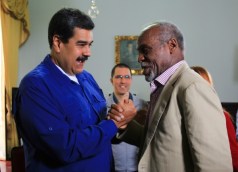
The way celebrities involve themselves in human rights (positively or negatively) has been a topic in this blog several times [see e.g. https://humanrightsdefenders.blog/2014/02/28/and-the-nominees-are-oscars-for-human-rights/ and recently https://humanrightsdefenders.blog/2017/11/10/helen-hunt-joins-list-of-celebrities-that-show-insensitivity-on-human-rights/]. Venezuela has played the game getting star power on its side, but the president of the New York based Human Rights Foundation, Thor Halvorssen, is quite right that when it concerns a UNICEF goodwill ambassador matters become more serious: “…the moment Danny Glover travels to Venezuela using the seal of the United Nations’ highest office that deals with children, then Glover’s statements deserve higher scrutiny,” Thus HRF’s demand that UNICEF should strip Danny Glover from its honorary Ambassadorship.
This Saturday in Caracas, Glover praised Maduro’s government for “advancing humanity through education, health, and other aspects that honor humankind.” Meanwhile, the dictatorship’s economic policies have brought over 30 million Venezuelans into the worst humanitarian crisis in the 200-year history of the country. In 2017, Venezuelans lost 24 pounds in average due to hunger and undernourishment and, according to NGO Caritas, 33% of Venezuela’s 10 million child population has stunted growth.
[HRF adds: “Danny Glover has behaved unspeakably in his support for the Venezuelan regime and his motivation is unbridled greed. Eleven years ago, Glover received close to 20 million dollars from the Venezuelan regime to produce a film that was never made, and the funds have yet to be returned to the Venezuelan people. The payment was a crude payoff, masked as a production budget, in order to ensure that Glover was a permanent public relations agent for the Venezuelan government. In doing so, Glover violated American laws regarding registration as a foreign agent. But most of all, he lost all credibility as a spokesperson for human rights,”]
(Early this year, the International Criminal Court in The Hague (ICC), Netherlands, opened an investigation against the Venezuelan regime for crimes against humanity, while the Organization of American States (OAS) has created a commission to investigate gross human rights violations committed by the regime and refer their results to the ICC.)
https://mailchi.mp/e97c4e3f959c/hrf-to-un-fire-danny-glover-from-unicef-ambassadorship?e=f80cec329e
Posted in films, Human Rights Foundation | Leave a Comment »
Tags: celebrities, Danny Glover, film star, goodwill ambassador, Human Rights Foundation, Maduro, star power, UNICEF, Venezuela
March 29, 2018
 The Frank Jennings Fellowship was set up to give an opportunity for dedicated and talented individuals to gain experience working for the protection of human rights defenders in an international NGO and at the Office of the UN High Commissioner for Human Rights. It is named after Front Line Defenders’ former Head of Research who died after a long illness in 2005. Frank made a huge contribution to the development of human rights activism in Ireland and candidates who have some experience of human rights work in Ireland will be given priority.
The Frank Jennings Fellow spends 3 months at Front Line Defenders where they will be trained in relation to Human Rights Defenders; the UN Declaration on Human Rights Defenders; the Mandate of the UN Special Rapporteur; the procedures and methodology of the mandate; the role of Front Line Defenders and other national and international organisations in the support and protection of Human Rights Defenders. The Fellow will then move to Geneva for a period 6 months before returning to Front Line Defenders for a further 3 months.
The Fellow will be able to draft well and have good analytical skills. They will have some knowledge of the UN system and international and human rights law. They must be able to work in both English and Spanish (required!). They will be able to work on own initiative and as a member of a team. They will have good oral and written communication skills and be computer literate. They will be flexible and co-operative. Previous work experience with organisations working in the field of Human Rights would be desirable.
Basic Terms of reference – Front Line Defenders Dublin
- Provide support to Front Line Defenders’ Protection Coordinators including dealing with routine queries and correspondence with human rights defenders;
- Cooperate closely with the Regional Fellows and Protection Coordinators in drafting urgent appeals on behalf of human rights defenders at risk around the world
- Input HRD-related information on the Front Line Defenders database;
- Undertake clerical tasks such as faxing, photocopying, word processing, sending press releases, data entry, collating, emailing
- Support follow-up on cases taken up by Front Line Defenders or other specific projects relating to Human Rights Defenders as requested;
- Draft as requested, minutes, briefings, reports, appeals;
Basic Terms of Reference – Geneva SR
- Gather information on the situation of human rights defenders around the world (with a particular focus on themes of concern identified by the SR);
- In coordination with other thematic mechanisms and with geographic desk officers, and under the supervision of the HRD assistant to the SR, draft urgent appeals and communications to Governments concerning human rights violations against human rights defenders;
- Support follow-up of cases;
- Analyse replies received from Governments and prepare summaries for inclusion in the annual Human Rights Council (HRC) report;
- Assist in the drafting of annual reports to the HRC and the General Assembly;
- Assist in the preparation of background materials for official missions by the Special Rapporteur;
- Assist in liasing with non-governmental organizations for the smooth implementation of the mandate, as needed.
Honorarium: €1200 per month Dublin and €1400 per month Geneva.
The next Frank Jennings Fellowship will start on 1 April 2018.
Applications comprising a cover letter and CV should be sent to Ed O’Donovan, Head of Protection, at recruit@frontlinedefenders.org by 30 November 2017.
Important: please indicate the FULL title of the position you are applying for in the subject heading of email: ‘Frank Jennings Internship’ or the application may be missed.
https://www.frontlinedefenders.org/en/frank-jennings-fellowship-dublin-and-geneva
Posted in Front Line, human rights, Human Rights Defenders | 1 Comment »
Tags: call for applications, Dublin, fellowship, Frank Jennings Fellowship, Front Line (NGO), Geneva, internship, job opportunity, vacancy, youth
March 22, 2018
There is no doubt that Europe is doing more than other regions to support individual human rights defenders and their organisations. The statement issued on 27 February 2018 to mark World NGO Day by EU High Representative Fedrica Mogherini says all the right things: “Civil society organisations are a voice for those who are too often not heard. They have the courage to stand up against injustices, even if sometimes with risks for themselves”. She noted that the EU’s annual support worth two billion Euros represents 73 percent of the world’s support to local civil society organisations. “The European Union will never leave human rights defenders and civil society organisations alone; it’s the most invaluable partnership we can rely on to protect rights and build opportunities.”
Moreover, there is growing disappointment over the region’s unwillingness to stand up for human rights in its foreign policy, especially from those who had hoped that Europe would be able step up when the USA is no longer leading. Two lengthy pieces attest to this:
The
first is by
Judy Dempsey on 21
March 2018 under the title “The European Union has decided that it’s time to cuddle up to dictators’ in the Washington Post

European Commission President Jean-Claude Juncker (in green tie) meets with other officials in Brussels on Wednesday. (Olivier Hoslet/EPA-EFE/Shutterstock)
Jean-Claude Juncker, the president of the European Commission, has just set a new low for Europe’s standing in the world. In the wake of Russia’s sham presidential election on Sunday, Juncker sent the victorious Vladimir Putin a message of unctuous praise. “Congratulations on your re-election,” Juncker tweeted. ……..Just like the United States’ President Trump, who was widely criticized this week for congratulating Putin on the Russian election’s outcome while failing to mention its flagrantly undemocratic character, Juncker had nothing to say about the brazen ballot stuffing, the intimidation of independent candidates, the unexplained deaths of activists, the role of state media, or a host of other irregularities leading up to the poll.
This latest failure of moral courage once again shows the growing indifference of European leaders and governments to the defense of human rights. At a time when the Trump administration seems uninterested in advancing the cause of democracy overseas and has just chosen Gina Haspel, who is closely linked with the George W. Bush administration’s policies on torture, to lead the Central Intelligence Agency, Europe should be at the forefront in taking a united stand against the flagrant abuse of human rights. But it isn’t. Dissidents and activists pushing for civil rights and democracy outside the E.U., and who once looked to Europe as a beacon for the values of freedom, can count on little support from Brussels these days. Authoritarian regimes have every cause to be overjoyed.
…When Iran’s foreign minister, Mohammad Javad Zarif, took the floor at last month’s annual Munich Security Conference, he was, once again, treated with kid gloves. Forget about the torture, the executions, the flogging, the deaths during detention.
…French President Emmanuel Macron and German Chancellor Angela Merkel have rolled out the red carpet for Egyptian president Abdel Fatah al-Sissi — despite a crackdown on opposition that in its harshness has left the Hosni Mubarak regime far behind. Disappearances, torture, police brutality, detentions without trial: None of this seems to bother the French or German leaders. “Disgraceful policies of indulgence” was the term human rights activists used in connection with Sissi’s visit to Paris in October.
On China, the E.U. has completely discredited itself in the eyes of reformers and those struggling for human rights. It has criticized neither the Communist Party’s state-of-the art mass surveillance of its citizens nor the constant harassment and imprisonment of dissidents. Indeed, in June the E.U. failed, for the first time ever, to make a statement about China’s crackdown on dissidents and activists at the United Nation’s Human Rights Council in Geneva. The 28 member states couldn’t agree. (Greece blocked the statement. ..Athens didn’t want to offend Beijing). Hungary, which has also benefited from Chinese investments, has repeatedly blocked E.U. statements criticizing China’s rights record under Communist President Xi Jinping, according to diplomats.
….But there can be no hiding the shameful reality. Europe has lost its moral compass. Its current enthusiasm for interests and “stability” will one day come back to haunt it.
The second piece is by FLORIAN IRMINGER on 22 March 2018 in Open Democracy under the title “Council of Europe: don’t compromise on human rights in Russia!”
After congratulating Vladimir Putin on re-election, the COE must hold Russia accountable and require the same respect for fundamental freedoms as it does from other countries. In the past year, Russia has seen numerous violations of freedom of assembly, as well as politically motivated criminal investigations dogged by poor evidence and procedure. While Vladimir Putin won the recent presidential election, he made his country fail a much more important test: the test of human rights, freedoms, and space for civil society and independent voices. So why has Thorbjørn Jagland and the Council of Europe welcomed him as a winner? …This came shortly after the OSCE election observation mission concluded that the presidential election took place in an “overly controlled legal and political environment marked by continued pressure on critical voices.”
…Instead of abiding by his mission to defend the Convention and therefore highlighting the shortcomings during election day and the generally repressive climate, the Secretary General “hoped” for active engagement with Russia. He spoke of “our common duty to work together in order to consolidate and strengthen our common European legal and human rights space.”
The Council of Europe must hold Russia accountable and require the same respect for fundamental freedoms as it does from other countries
Since Vladimir Putin’s re-accession to the presidency in 2012 – and the fully devoted Duma elected in 2011 – 50 laws have been adopted “designed to strangle opposition voices and raise the level of fear and self-control in the society,” as reported by the International Federation for Human Rights (FIDH). [see: https://humanrightsdefenders.blog/2018/03/18/fidh-collected-russias-50-anti-democracy-laws/]
In light of President Putin’s internal policies, we need a Council of Europe that stands firm on its values and upholds the human rights obligations enriched in the European Convention for Human Rights. What we see instead is a Secretary General “touring European capitals [since November 2017] warning of a serious risk that Moscow could withdraw… unless its demands are met.”
..Russia has now said it will stop contributing financially to the Council of Europe. At the Council of Europe, just like at the United Nations with President Trump’s administration, we see that governments are willing to defund the structures with which they disagree. In other words, they institute a relativism in such mechanisms and threaten their ability to continue working independently and serve the purpose they were set up for: holding governments accountable to their own commitments.
Yes, we must fight for the European Convention to apply to as many citizens as possible in Europe. However, we must not shy away from saying that the cost of withdrawing from the Council of Europe is high for the Russian state, for its credibility at home and abroad. The Council of Europe is worth something. If states can be members at no cost – not even the cost of showing respect and cooperation to the organisation – it will soon be worth nothing….
—–
https://www.kuna.net.kw/ArticleDetails.aspx?id=2697509&language=en
https://www.reuters.com/article/us-usa-immigration-un/u-n-rights-chief-attacks-eu-and-u-s-over-migrants-and-dreamers-idUSKCN1GJ1IZ
https://www.opendemocracy.net/od-russia/florian-irminger/do-not-compromise-on-russian-human-rights
Posted in EU, Human Rights Defenders | 1 Comment »
Tags: China, Council of Europe, Egypt, EU, Fedrica Mogherini, Florian Irminger, human rights policy, Iran, Jean-Claude Juncker, Judy Dempsey, Open Democracy, Russia, the Washington Post, USA
March 19, 2018
Posted in awards, films, OMCT | 2 Comments »
Tags: awards, Documentary film, Festival du Film et Forum International sur les Droits Humains, FIFDH, Geneva, human rights film festival, Libya, Libye - Anatomie d’un crime
(film), OMCT, Stranger in Paradise (film), The Cleaners (film)
March 18, 2018

Since re-election in 2012, the Russian president has overseen the creation of 50 laws designed to strangle opposition voices and raise the level of fear and self-censorship in society. FIDH with its Russian member organizations released a table of the latest 50 new anti-democracy laws since 2012. It explains the impact of each of them on the fundamental freedoms of Russian citizens, cutting down every day a little bit more the free exchanges with the outside world. It also provides some, far from exhaustive examples of the legal abuses it provokes in the every day life of citizens.
Not only the present but also the past gets filtered and controlled.
The laws and regulations range from increased surveillance and censorship powers, to laws banning “questioning the integrity of the Russian nation” – effectively banning criticism of Russia’s presence in Eastern Ukraine and the Crimea – broad laws on “extremism” that grant authorities powers to crack down on political and religious freedom, to imposing certain views on Russian history forbidding to think differently.
CHECK OUT THE TABLE OF LAWS
Posted in FIDH, Human Rights Defenders | 2 Comments »
Tags: censorship, Civil society, Democracy, documentation, elections, FIDH, Human Rights Defenders, International Federation for Human Rights, Putin, restrictive laws, Russia
March 17, 2018

 recently published its report on ‘Lessons Learnt: Human Rights Defenders Working in States in Transition.’ A State’s transition towards democracy will invariably present particular challenges for human rights and their defenders. But it will also present opportunities. ISHR seeks to ensure that defenders have the tools that will enable the development of national laws and mechanisms that are compatible with, and give effect to, international human rights obligations. ISHR hopes that this report will be used by defenders to reflect on the strategies, successes and shortcomings of other campaigns and programmes in order to appreciate the impact they’ve had in various African States.
https://mailchi.mp/ishr/ishr-african-commission-monitor-july-31701?e=d1945ebb90
Click to access final_sitroadmap_compressed.pdf
Posted in books, human rights, Human Rights Defenders, ISHR | Leave a Comment »
Tags: african region, enabling environment, Human Rights Defenders, report, transition
March 16, 2018
The 2018 United Nations Human Rights Prize(s) will be given out at the United Nations HQ in New York on Human Right Day, 10 December 2018. The Call for Nominations is now open. This year’s award will coincide with the celebration of the 70th anniversary of the Universal Declaration of Human Rights.
 The honorary prize is given out every five years, usually shared by 6 laureates. For more information see http://trueheroesfilms.org/thedigest/awards/united-nations-prizes-in-the-field-of-human-rights
An remarkable feature of this ‘inter-governmental’ award is that nominations can be received from: “member States, specialized agencies and non-governmental organizations in consultative status and from other appropriate sources.” Nominations may be made by submitting the online nomination form with basic identifying information about the nominee and the reasons for making the nomination.
Hard copies can, alternatively, be sent by post to: Human Rights Prize, OHCHR New York Office, Room S-1306, United Nations, New York, NY 10017. A printable form for submitting a nomination by post is available for download here.
The deadline for submission of nominations is 6 April 2018.
—-
See also: https://humanrightsdefenders.blog/2017/12/08/new-human-rights-award-music-to-our-ears/
Posted in awards, human rights, Human Rights Defenders, Observatory for the Protection of Human Rights Defenders, UN | Leave a Comment »
Tags: 70th anniversary UDHR, call for nominations, digest of human rights awards, human rights awards, UN, UN human rights prizes, United Nations