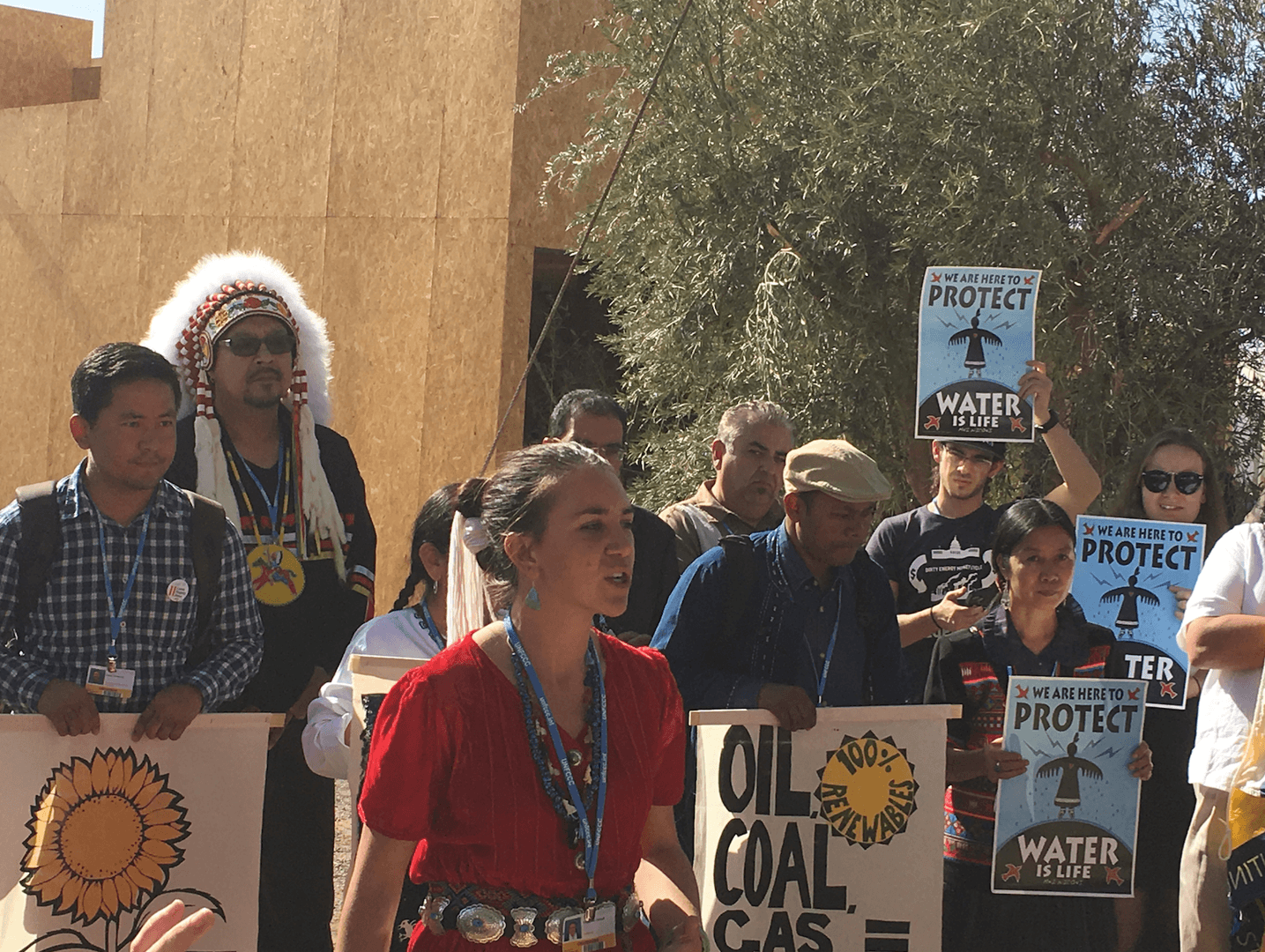
The talks wrapped up on Friday, and during the last two weeks, advocates for gender equality and indigenous peoples made their voices heard and won hard-fought battles to better respect their rights. Notably, governments agreed to create a platform to promote the participation of indigenous peoples in United Nations climate responses, and adopted a Gender Action Plan that aims to better integrate gender equality in climate change policies.
Just when the talks were nearing their end, human rights were pushed to the fore when Fijian prime minister and president of the climate talks, Frank Bainimarama, convened a high-level event about the importance of rights in climate negotiations. Why was this such a big deal? Because never before has any government presiding over the talks hosted an official event on human rights.
Bainimarama has also long been among those who have been silent on human rights issues. But on Thursday, he announced that integrating human rights in the implementation of the Paris Agreement was an important element of Fiji’s presidency, which will continue through the coming year. Costa Rica’s environment minister, Edgar Gutiérrez-Espelata, also proposed concrete ways to integrate rights into the current negotiations about the so-called Paris Rulebook. For example, governments could reference human rights obligations in climate change action plans and climate negotiators could agree to build capacity among states on promoting human rights in climate action.
The authors realize that of course, “such commitments are worth little unless governments are willing to turn rhetoric into reality. If they are serious about fighting climate change, governments should also do more to integrate the protection of human rights in climate policies, while defending the rights of people working to protect the environment.”
Similar ideas are to be found in the “Opening speech at seminar on human rights defenders” given the the Norwegian State Secretary Audun Halvorsen in Oslo, on 30 October for a seminar on “Environmental human rights defenders under threat from business operations“. The seminar was organised by Amnesty International Norway and Rainforest Foundation Norway.
he head of the World Health Organization, Tedros Adhanom Ghebreyesus, is rethinking his decision to name Zimbabwe’s president, Robert Mugabe, as a goodwill ambassador. The move provoked global outrage. WHO member states and activists alike noted that Zimbabwe’s health care system, like many of its public services, has collapsed under Mugabe’s regime. “I’m listening. I hear your concerns. Rethinking the approach in light of WHO values. I will issue a statement as soon as possible,” Tedros, a former Ethiopian health minister, tweeted on Saturday night.
Human Rights Watch (HRW) said it was an embarrassment to give the ambassador role to Mr Mugabe, because his “utter mismanagement of the economy has devastated health services”. The main opposition party in Zimbabwe, MDC, described the appointment as “laughable”…“Mugabe trashed our health delivery system. He and his family go outside of the country for treatment in Singapore after he allowed our public hospitals to collapse.”
The Human Rights Foundation (HRF) also condemned the decision by the World Health Organization (WHO): “The irony of the World Health Organization’s decision to praise Robert Mugabe is staggering. This a strongman infamous for seeking medical attention for himself abroad. His recent visits to Singapore for medical treatment have cost Zimbabwean taxpayers tens of millions of dollars. Mugabe can’t get adequate treatment in his own country because his kleptocratic regime has left Zimbabwe’s hospitals and health industry in a state of ruin,” said HRF president Thor Halvorssen. “Dr. Tedros should nullify Mugabe’s appointment immediately and also issue a strong public condemnation of his repressive rule”.
On 23 September 2017 quite a number of observers and some media responded to the ill-deserved claim by the Philippines Government that it has scored a “big victory” in the UN’s UPR (Universal Periodic Review). The problem remains that the UN itself does not have the outreach and ‘spinning’ capacity to counter the propaganda spread, especially at the national level in the Philippines.
Seat of the United Nations Human Rights Council in Geneva. UN Brief photo
In reality it was ignoring important issues raised and rejected key recommendations made by other States. The Philippine delegation on Friday at the session in Geneva accepted only 103 out of 257 recommendations made by member-states. On Saturday, the Department of Foreign Affairs claimed the country “scored a big victory in Geneva” when the UN body “overwhelmingly adopted Manila’s human rights report card.” (Foreign Affairs Secretary Alan Peter Cayetano claimed the “adoption” of Manila’s report means that the country “has nothing to hide with its human rights record.“) [see also: https://humanrightsdefenders.blog/2016/11/02/duterte-is-wrong-human-rights-defenders-are-beautiful/]
Adoption of the UPR outcome report, however, cover both the report by the Philippines’ and also the other states’ positions on its human rights record, which included calls to investigate killings (the final document “consists of the questions, comments and recommendations made by States to the country under review, as well as the responses by the reviewed State,” according to a UN human rights office’s brief on its website.)
While member-states welcomed the Philippines’ acceptance of some of the recommendations such as on poverty and education, many expressed concern over its decision not to take action on most of the points raised. Key recommendations merely “noted” by the Philippines—a move interpreted as a rejection by observers—include 44 related to extrajudicial killings in the Duterte government’s campaign against illegal drugs. The Philippines also snubbed recommendations relating to the protection of journalists and human rights defenders, as well as those urging it to lift conditions to allow access of the UN special rapporteur on extrajudicial killings.
“A farce”. This was how human-rights group Karapatan described the Philippine government’s supposed “victory”. Karapatan secretary general Tinay Palabay said on Saturday the Philippine government delegation to Geneva “conveniently glosses over” the fact that it did not accept a number recommendation that aimed to resolve pressing issues on human rights. The Philippine delegation, however, practically denied before the UN body the existence of extrajudicial killings in the drug war despite the increasing number of deaths of suspects without trial.
International watchdog Human Rights Watch also reminded the Philippines to cooperate as a member of the council in all of its mechanisms, such as in allowing the special rapporteur without conditions to look into cases in the Philippines.
With elections coming up in Germany this weekend it is interesting to alert you to three items that may have escaped attention:
(1) A report by Deutsche Welle states that Germany granted asylum to 196 Turkish diplomats:
In response to a parliamentary question by Left Party, Germany’s Interior Ministry said 196 Turkish nationals, who applied for asylum in Germany following a botched coup attempt in July, 2016, were recognized. According to the ministry statement, 80% of 249 Turkish applicants with diplomatic status and their families were given asylum. Members of Turkish Armed Forces (TSK) are also among those seeking asylum, said the ministry. The number of asylum applications from Turkey has been significantly increasing. There were 433 applications in June while this number rose to 620 in July and 962 in September.
(2) On 20 September Human Rights Watch made public its assessment of the ‘human rights’ content of the political platforms of the different parties. It concludes that the parties differ on human rights approach and in migration policy.
“The election platforms of the main German parties offer a clear roadmap for voters when it comes to making sure their elected representatives will protect human rights,” says Wenzel Michalski, Germany director at Human Right Watch. “Of course, what matters is the actual political work after the elections, which we will closely monitor.” Three parties, the SPD (Social Democratic Party of Germany), Bündnis90/Die Grünen (Alliance 90/The Greens) and FDP (Free Democratic Party) devote separate sections of their platforms to human rights in foreign policy.
Separately, a German newspaper publisher said it filed an appeal to Turkey’s highest court against the incarceration for the past five months of a German-Turkish reporter, the Associated Press has reported. Deniz Yücel, who works for the daily Die Welt, was arrested Feb. 14 in Istanbul. He was accused of disseminating terrorist propaganda and inciting hatred, as well as espionage and ties to the outlawed Kurdistan Workers’ Party (PKK) – allegations Yücel denies. He hasn’t been formally charged.
On 15 August 2017, Jatupat Boonpattararaksa received a two and a half years jail sentence after pleading guilty to violating the lèse majesté law. The human rights defender – also known as Pai Dao Din – has been detained since 3 December 2016 in connection with his sharing of a BBC article on the life of King Vajiralongkorn on social media. Pai Dao Din, is leader of a student activist group called Dao Din based in Khon Kaen University. (https://www.frontlinedefenders.org/en/profile/jatupat-boonpattararaksa). The group advocates for community rights, social justice and democracy. He is also a member of New Democracy Movement (NDM), which opposes the military dictatorship in Thailand, a regime in place since the coup d’etat in May 2014. In May 2017, Jatupat Boonpattararaksa was awarded the Gwangju Prize for Human Rights [https://humanrightsdefenders.blog/2017/05/10/gwangju-award-for-human-rights-defender-pai-dao-din-upsets-thai-government/]The defender was originally sentenced to five years in jail, however this sentence was reduced after he pleaded guilty to sharing material deemed insulting towards the country’s monarchy.
{While authorities did not file charges or even a complaint against the London-based BBC for publishing the article, only Jatupat was arrested. His bail requests were consistently rejected as authorities regarded lèse majesté as a serious charge possibly entailing severe punishment. Domestic and international campaigns over recent months have failed to free him on bail. Prior to the court judgment, Jatupat, who had maintained his innocence for months, agreed to plead guilty after consulting with his family and legal team to get a more lenient sentence.}
“It appears that Jatupat was singled out, from thousands of people who shared the BBC article, and prosecuted for his strong opposition to military rule rather than any harm incurred by the monarchy,” said Brad Adams, Asia Director at Human Rights Watch. “His guilty verdict and jail sentence show yet again how Thailand’s draconian ‘insulting the monarchy’ law has been misused to punish dissenters.”
No country for questions. (Vietnam News Agency via AP)
With a blue fish painted on her cheek, a smiling Nguyen Ngoc Nhu Quynh stares out from her Facebook page, where she writes in Vietnamese under the name Mẹ Nấm, or Mother [of] Mushroom. Nguyen, a single mom and tour guide, began blogging over a decade ago adopting her daughter’s nickname as part of her writing name; in recent years she’s sometimes added on “Bear,” a nickname for her younger child.
Last week, Vietnam convicted and sentenced her to prison for a decade on charges of “conducting propaganda against the state.” The main evidence against her? A body of writing, some 400 Facebook posts about fish deaths, China’s intervention in the South China Sea, and police brutality in Vietnam. Her Facebook posts were described by the police as “a pessimistic, one-sided view that caused public confusion and affected the people’s faith [in the State].”
Nguyen has described her writing differently, saying it was motivated by wanting to leave a better country for her children. She’s part of a wave of environmental activism that is growing in the one-party state where civil liberties and the press are severely restricted; in recent years Vietnam has seen public rallies over harm to marine life and to protect trees. Over years, from posting about parenting, she graduated to impassioned writing about the environment and human rights:
The 2016 fish die-off. Nguyen has often posted about the deaths of some 70 metric tons of fish in April 2016 that locals blamed on waste water from a new steel plant in the Ha Tinh province owned by Formosa Ha Tinh Steel, a subsidiary of Taiwan-based Formosa Plastics Group, a major investor in Vietnam. State-media first blamed the firm for the marine crisis, which hurt both fishing and tourism, but then back-tracked. The firm also initially said it was not to blame, sparking anger and protests. While heading to an environmental rally last May, Nguyen was assaulted in a hotel lobby, according to the Office of the United Nations High Commissioner for Human Rights (OHCHR). Later that month, Nguyen made it to another rally and managed to hold up a sign asking “Why did the fish die?” Vietnam eventually officially blamed Formosa, which has promised to pay $500 million for clean-up and compensation. Security authorities cited signs they found in Nguyen’s home, including one that says “Fish need water,” as part of their evidence against her, according to the OHCHR.
South China Sea In November 2015, Nguyen called on people to rally against the visit of Chinese president Xi Jinping, citing detentions of fishermen as well as China’s treatment of its ethnic minorities. Vietnam and China have ongoing territorial disputes in the South China Sea. In an earlier post she criticized Vietnam’s stance with China over the South China Sea.
Deaths in detention Nguyen and others compiled reports from state-owned media and put together a file called “Stop police killing civilians” about 31 people who died in police custody. The document was later criticized by the police: “[It] bears a hostile viewpoint against the people’s police force.” ….
Offline protests Apart from blogging, she also waged her battles in offline protests. She actively participated and advocated for activities to promote a freer political atmosphere and cleaner environment. …
..She was detained and allegedly assaulted by police several times before her current incarceration. One time she faced a $66 fine over her Facebook posts. When Civil Rights Defenders, a Swedish advocacy group, awarded her the title of Defender of 2015, she was not able to receive the prize in person as she was in detention. At the same time as she was becoming an increasingly active blogger, Nguyen continued to support her family, including her two children, 60-year-old mom and 90-year-old grandmother, by working as an independent tour guide.
Things came to a head last year. Nguyen was arrested in October 2016 after she accompanied the mom of an imprisoned online activist to help her see her son. Her daughter, now 11, saw her being hand-cuffed and taken away by numerous police officers. Nguyen’s son was just two at the time of her arrest. In March, the US awarded her its “Women of Courage” award. Numerous rights groups have called for her release, including Human Rights Watch, Civil Rights Defenders and Pen America.
“Her activism has been motivated in part by her strong views that her children should inherit a country where human rights, environmental protection, and rule of law are meaningful and part of everyday reality, and not just rhetoric spouted by the ruling Communist Party,” wrote Phil Robertson, of Human Rights Watch….
The European Union – when criticizing countries by name in the UN Human Rights Council – does so with unanimity. It was the first time that the European Union did not make a statement in the Human Rights Council regarding rights violations in specific countries, including China as it was blocked by one of its member countries: Greece! A spokesman for the Greek Foreign Ministry in Athens called it “unproductive criticism.” The NYT reports that a spokesman for the Greek Foreign Ministry (who requested anonymity) said in a telephone interview: “When the stability of a country is at stake, we need to be more constructive in the way we express our criticism” …“because if the country collapses, there will be no human rights to protect.” It was an odd explanation, commented the NYT, considering that China’s stability does not appear to be at risk. Unless the stability at stake was referring to Greece?!
In its struggle for economic recovery, Greece is indeed increasingly courting Chinese trade and investment. China’s largest shipping company, known as China COSCO Shipping, bought a majority stake last year in the Greek port of Piraeus. The Greek prime minister, Alexis Tsipras, has visited China twice in two years. And China will be the “country of honor” at Greece’s annual international business fair in September in the port of Thessaloniki.
In the previous Human Rights Council session in March, the European Union statement pointed to China’s detention of lawyers and human rights defenders [see e.g. https://humanrightsdefenders.blog/2016/01/19/letter-from-legal-experts-on-detained-lawyers-in-china/]. Human Rights Watch said it was “shameful that Greece sought to hold the E.U. hostage to prevent much-needed attention to China’s human rights crackdown.”
Human Rights Watch (HRW) on Thursday 8 June 2017 called on Turkish authorities to immediately release Taner Kılıç, chair of the board of Amnesty International’s Turkey section, who has been under detention since June 6. It is heartening to see the two biggest NGOs coming to each other’ rescue from time to time. In February this year AI Israel co-signed a statement deploring the decision not to allow Omar Shakir of Human Rights Watch to take on his post [“We stand in solidarity with him and our colleagues at HRW.” – see https://humanrightsdefenders.blog/2017/02/26/israel-denies-work-permit-to-human-rights-watch-and-continues-harassment-of-hrds/]
The anti-terror unit of the Izmir police on Tuesday detained lawyer and human rights defender Kılıç together with 22 other attorneys as part of a witch-hunt targeting people linked to the Gülen movement. “Turkey should release Taner Kılıç, who is a tireless defender of human rights, known for his support for Amnesty International over many years,” said Hugh Williamson, Europe and Central Asia director at Human Rights Watch. “Detaining Kılıç on suspicion of terrorist offenses looks like a tactic aimed at discrediting his legitimate human rights work.”
Kılıç is a founding member of AI Turkey and has been chairman of its board of directors since 2014. He has also played a strong role in advocating for refugee rights as a lawyer and with domestic nongovernmental groups and others working on these issues. The European Union on Thursday expressed concern about the recent detention of Taner Kılıç.
(According to a report by the state-run Anadolu news agency on May 28, 154,694 individuals have been detained and 50,136 have been jailed due to alleged Gülen links since the failed coup attempt.
Lotte Leicht ,director of Human Rights Watch’s Brussels office, wrote about “Five Names to Listen for at the EU-China Summit”. She writes that “under President Xi Jinping, whose senior officials arrive in Brussels this week for the European Union-China Summit, courageous human rights defenders, lawyers and academics in China have sustained an extraordinary body blow.”
The EU has pledged to “throw its full weight behind advocates of liberty, democracy and human rights” and to “raise human rights issues” including “at the highest level.” If that’s the case, the summit is an ideal opportunity for the EU’s highest officials to explicitly call for these people’s release. After all, the EU’s human rights pledges will only be meaningful if applied in real situations, with determination and conviction. The EU has acknowledged that human rights improvements in China are key to the future of their bilateral relationship, and calling for the freedom of those unjustly imprisoned is an obvious place to start. That the summit falls just ahead of the anniversary of the 1989 Tiananmen Massacre – an event that galvanized China’s contemporary human rights community – places a responsibility on EU leaders to call for accountability from Beijing.
From left to right: Ny Chakrya, Yi Soksan, Ny Sokha, Lim Mony and Nay Vanda. RFA
On 27 April 2017, the Phnom Penh Municipal Court extended the pre-trial detention of senior ADHOC staff and human rights defenders, Lim Mony, Ny Sokha, Nay Vanda, Yi Soksan and Ny Chakrya by an additional six months, purportedly to further investigate their case. The five human rights defenders have already spent a year in pre-trial detention! The Cambodian Human Rights and Development Association (ADHOC) [https://www.frontlinedefenders.org/en/profile/adhoc] is a human rights organisation founded in December 1991 by a group of former political prisoners aiming to address the absence of basic rights and freedoms in Cambodia. The organisation assists human rights victims and disseminates information on human rights, law and democracy to the Cambodian public.
Many NGOs and the UN (including an opinion by the UN Working Group on Arbitrary Detention last November) have called on he Cambodian government to immediately release five the human rights defenders and urge all to participate in the #FreeThe5KH campaign at https://freethe5kh.net/. “Cambodia’s donors should publicly call for the release and dropping of bogus charges against the ‘ADHOC Five,’ which were instigated by Prime Minister Hun Sen to intimidate and suppress human rights work,” said Brad Adams, Asia director of HRW. “These human rights defenders are in jail as part of a campaign to destroy the opposition and scare Cambodian human rights workers into silence.”
Radio Free Asia reported on 28 April that the children of two of the human rights defenders said that their families faced serious hardship during the year their parents have spent in prison and expressed hope they might be freed.