Archive for the 'Front Line' Category
February 10, 2016
On 21 January 2016 a group of United Nations Rapporteurs (Maina Kiai, Special Rapporteur on the rights to freedom of peaceful assembly and of association; David Kaye, Special Rapporteur on the promotion and protection of the right to freedom of opinion and expression; Michel Forst, Special Rapporteur on the situation of human rights defenders; Christof Heyns, Special Rapporteur on extrajudicial, summary or arbitrary executions; and the Working Group on Enforced or Involuntary Disappearances) called on the Ethiopian authorities to end the ongoing crackdown on peaceful protests by the country’s security forces, who have reportedly killed more than 140 demonstrators and arrested scores more in the past nine weeks. “The sheer number of people killed and arrested suggests that the Government of Ethiopia views the citizens as a hindrance, rather than a partner,” the independent experts said, while also expressing deep concern about allegations of enforced disappearances of several protesters.
The current wave of protests began in mid-November, in opposition to the Government’s ‘Addis Ababa Integrated Development Master Plan’ to expand the capital’s municipal boundary. The ‘Master Plan’ could reportedly lead to mass evictions and the seizure of agricultural land in the Oromia region, as well as extensive deforestation. The UN experts welcomed the Government’s announcement on 12 January 2016 suspending the implementation of the ‘Master Plan’, but were concerned about continuous reports of killings, mass arrests, excessive use of force and other abuses by security forces. “The Government’s decision is a positive development, but it cannot be seen as a sincere commitment until the security forces stop their crackdown on peaceful protests,” they said. “The role of security forces should be to protect demonstrators and to facilitate peaceful assemblies, not suppress them.”
“We call on the Government to immediately release protesters who seem to have been arrested for exercising their rights to freedom of peaceful assembly and expression, to reveal the whereabouts of those reportedly disappeared and to carry out an independent, transparent investigation into the security forces’ response to the protests,” the experts said. “Impunity, on the other hand, only perpetuates distrust, violence and more oppression.”
The UN independent experts also expressed grave concern over the Ethiopian Government’s application of the Anti-Terrorism Proclamation 652/2009 to arrest and prosecute protesters, labelling them as ‘terrorists’ without substantiated evidence. This law authorises the use of unrestrained force against suspects and pre-trial detention of up to four months. “Ethiopia’s use of terrorism laws to criminalize peaceful dissent is a disturbing trend, not limited to the current wave of protests,” they experts noted. “The wanton labelling of peaceful activists as terrorists is not only a violation of international human rights law, it also contributes to an erosion of confidence in Ethiopia’s ability to fight real terrorism. This ultimately makes our world a more dangerous place.”
How the law was used recently is clear from the case of the “Zone 9” bloggers. Fortunately, on 16 October 2015 Front Line was able to report that all “Zone 9” bloggers were cleared of terrorism charges by the Federal Court in Addis Ababa. All bloggers and journalists whose terrorism charges have been dropped are members of the “Zone 9” and prominent social media activists. With the exception of Soliana Shimelis, the other human rights defenders, namely Mss Mahlet Fantahun and Edom Kassaye and Messrs Natnael Feleke, Befekadu Hailu, Atnaf Birhane, Zelalem Kibret, Abel Wabela, Tesfalem Weldyes and Asmamaw Haile Giorgis, were arrested on 25 and 26 April 2014 and remained in detention for over a year before being freed. The human rights defenders’ lawyer stated that “all the evidence presented was very weak to prove they were planning any kind of terrorism”. However, charges of inciting violence remain pending against Befekadu Hailu, who might face a ten-year imprisonment sentence if convicted. See: https://www.frontlinedefenders.org/node/29137
On Ethiopia: https://thoolen.wordpress.com/2015/02/14/suffocating-dissent-in-ethiopia-counterpunch-tells-the-facts-and-names-the-names/
http://www.ohchr.org/en/NewsEvents/Pages/DisplayNews.aspx?NewsID=16977&LangID=E
Posted in Front Line, human rights, Human Rights Defenders, UN | 3 Comments »
Tags: "Zone 9” bloggers, Befekadu Hailu, bloggers, Christof Heinz, crackdown, David Kaye, disappearances, Ethiopia, freedom of assembly, Front Line (NGO), Human Rights Defenders, killings, Maina Kiai, Michel Forst, Oromia, UN Rapporteurs
February 9, 2016
Only a few days ago I referred to the widening impact of the ‘foreign agent’ law in Russia [https://thoolen.wordpress.com/2016/02/04/russian-foreign-agents-law-starts-to-affect-monitoring-in-detention-centers/]. Now it seems that even organizations that do NOT accept foreign funding, may actually fall under it.

reports that on 28 January 2016, the Orenburg regional department of the Ministry of Justice accused the Committee for Prevention of Torture (CPT) and its chairman Mr Igor Kalyapin of violating the ‘Foreign Agents’ law. Read the rest of this entry »
Posted in awards, Front Line, human rights, Human Rights Defenders, MEA | 2 Comments »
Tags: Committee for Prevention of Torture (CPT), foreign agent law, foreign agents, Front Line (NGO), Front Line Defenders Award for Human Rights Defenders at Risk, Igor Kalyapin, Inter-regional Committee against Torture, judicial harassment, MEA 2013, NGOs, Russia
February 4, 2016
reports that on 26 January 2016, the Russian Duma (lower chamber of Parliament) adopted at first reading amendments to the law regulating the work of Public Monitoring Commissions (PMCs). There is serious concern that if passed, the draft amendments will put an end to the independent and effective monitoring of places of detention by excluding the many human rights defenders labeled as foreign agents. Read the rest of this entry »
Posted in Front Line, HRW, human rights, Human Rights Defenders | 1 Comment »
Tags: ADC Memorial, detention center, foreign agent law, foreign agents, foreign funding, Front Line (NGO), HRW, human rights monitoring, legal restrictions, Magomed Mutsolgov, Memorial, Public Monitoring Commissions (PMCs), Russia, Tanya Lokshina
January 29, 2016
On 30 November I referred to the systematic killing of human rights defenders in 2015 [https://thoolen.wordpress.com/2015/11/30/closing-civil-society-space-a-euphemism-for-killing-human-rights-defenders/] and mentioned the annual report by Front Line for 2015 listing Latin America and the Philippines as the most dangerous places [https://thoolen.wordpress.com/2016/01/06/latin-america-philippines-most-dangerous-places-for-human-rights-defenders/]. If further illustration is needed, here some short summaries of cases of killing human rights defenders as reported by Front Line over the last few months:
Honduras: Killing of LGTBI rights defender Paola Barraza. On 24 January 2016, human rights defender Ms Paola Barraza was assassinated by unknown attackers in front of her house in the neighbourhood of Lempira, in Comayaguela. Paola Barraza, a trans woman, was a member of the board of directors of Asociación LGTB Arcoíris (LGTB Rainbow Association). The human rights defender was at home when unknown persons knocked at her door and called her outside. When Paola Barraza answered the door she was fired upon five times. She died at the scene as a result of her wounds. Paola Barraza was previously attacked in connection with her LGTBI rights work on 15 August 2015 [https://www.frontlinedefenders.org/node/29495] Between 23 June 2015 and 31 August 2015, three other LGTBI rights defenders working in country were killed https://www.frontlinedefenders.org/node/29495.
Read the rest of this entry »
Posted in Front Line, human rights, Human Rights Defenders | 1 Comment »
Tags: Angis Precioso, assassination, Cesar Estrada, Colombia, Daniel Abril, Emerito Samarca, environmental issues, Front Line (NGO), Genesis Ambason, Héctor Sánchez Losada, Hitler Ananias Gonzales Rojas, Honduras, Human Rights Defenders, indigenous groups, killings, LGTBI rights, Lito Abion, Paola Barraza, Peru, Philippines, Venezuela
January 28, 2016
Five years ago, human rights defender Ahmed Abdullah was among thousands of Egyptians who took to the streets for 18 days of mass protests in Cairo’s Tahrir Square, eventually forcing then-President Hosni Mubarak to step down and the security forces to retreat. Today, Ahmed is on the run. He dodged arrest by the thinnest of margins on January 9, after plainclothes police in Cairo raided his regular coffee shop. The NGO which he chairs, the Egyptian Commission for Rights and Freedoms, had recently exposed a surge in enforced disappearances, which has seen hundreds vanish at the hands of state security forces over the last year alone. He is not the only one whose activism has put him at risk. In recent weeks, security forces have been rounding up activists linked to protests and journalists critical of the government’s record. This how Amnesty International starts its assessment of the fifth anniversary and it concludes: “Five years since the uprising that ousted Mubarak, Egypt is once more a police state. The country’s ubiquitous state security body, the National Security Agency, is firmly in charge.”
The same sentiment is echoed in the long piece in the Huffington Post of 25 January 2016 by Karim Lahidji, President of FIDH and Bahey eldin Hassan, Director of Cairo Institute for Human Rights Studies.
Read the rest of this entry »
Posted in Amnesty international, CIHRS, FIDH, Front Line, HRF, human rights, Human Rights Defenders | 2 Comments »
Tags: Abdel Fattah el-Sisi, Ahmed Abdullah, Ahmed Malik, Amnesty International, Arab spring, Bahey eldin Hassan, condoms video, Egypt, FIDH, Foreign Policy of the USA, Front Line, Human Rights Defenders, Human Rights First, Karim Lahidji, Malek Adly, Sanaa Seif, Shady Hussein Abu Zaid, Tahrir Square
January 16, 2016
Calls of nomination for two major human rights awards are now open:
The Front Line Defenders Award for Human Rights Defenders at Risk was established in 2005. The Award seeks to focus international attention on the human rights defender’s work, thus contributing to the recipient’s personal security, and a cash prize of Euro 15,000 is awarded to the Award recipient and his/her organisation in an effort to support the continuation of this important work. If you would like to nominate a human rights defender for the Twelfth Annual Front Line Defenders Award for Human Rights Defenders at Risk (2016), please click on the following link to access a secure online nomination form: https://www.frontlinedefenders.org/secure/nomination.php (English). Age deadline is Friday 19 February 2016.
The Parliamentary Assembly of the Council of Europe (PACE), in partnership with the Vaclav Havel Library and the Charta 77 Foundation, has today issued a call for nominations for the 2016 Václav Havel Human Rights Prize, which will be awarded on 10 October in Strasbourg. The Prize aims to reward outstanding civil society action in defending human rights in Europe and beyond. Candidates should have made a real difference to the human rights situation of a given group, been instrumental in uncovering systemic violations on a large scale, or have successfully mobilised public opinion or the international community for a given cause. The Václav Havel Human Rights Prize consists of a sum of €60,000. The deadline is 30 April 2016. More details can be found at http://assembly.coe.int/nw/xml/News/News-View-EN.asp?newsid=5976&lang=2&cat=37.
—-
For more on these and other awards see True Heroes’ awards Digest:
http://www.brandsaviors.com/thedigest/award/front-line-defenders-award
http://www.brandsaviors.com/thedigest/award/václav-havel-prize-human-rights
Posted in awards, Front Line, Human Rights Defenders | Leave a Comment »
Tags: call for nominations, Council of Europe, digest of human rights awards, Front Line (NGO), Front Line Defenders Award for Human Rights Defenders at Risk, human rights awards, Parliamentary Assembly of the Council of Europe, THF, Vaclav Havel, Vaclav Havel Human Rights Prize
January 13, 2016
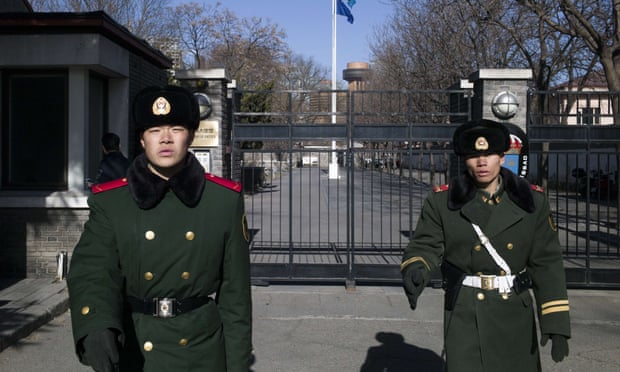
Perhaps one should be ‘grateful’ that China on 3 January 2016 decided to detain the Swedish human rights campaigner Peter Dahlin (first foreigner to be detained for ‘endangering state security’) as this helped international media the take note of the extraordinary crackdown by Chinese president Xi Jinping who is now widely considered to be China’s most authoritarian leader in decades. Here a short overview of the most notable cases in the first two weeks of 2016:
Paramilitary guards stand in front of the gates of Sweden’s embassy in Beijing on Wednesday. Photograph: Fred Dufour/AFP/Getty Images
Read the rest of this entry »
Posted in Front Line, human rights, Human Rights Defenders, OMCT | 2 Comments »
Tags: Cai Xin, China, crackdown, Deng Xiaoming, detention, Fengrui (law firm), Front Line (NGO), Gui Minhai, He Xiaobo, Human Rights Defenders, human rights lawyers, Meng Han, Peter Dahlin, Shu Xiangxin, Sweden, Wang Qiushi, Wang Yu, Zeng Feiyang, Zhou Shifeng, Zhu Xiaomei
January 11, 2016
reports that on 23 December 2015, the Supreme Court confirmed the 2012 sentencing of human rights defender Ms Chiranuch Premchaiporn to eight months’ imprisonment, suspended for one year, and a fine of 20,000 baht, for failing to delete allegedly offensive comments about the Thai monarchy, which had been posted on the now-defunct Prachatai web forum.
Chiranuch Premchaiporn [https://frontlinedefenders.org/ChiranuchPremchaiporn] is executive director of Prachatai, an independent news website that reports on human rights, social and political issues in Thailand and Southeast Asia. She was the webmaster of the now defunct Prachatai web board which was set up to promote the exchange of information and opinion on Thai political and social issues. Chiranuch Premchaiporn was the recipient of the International Women’s Media Foundation Courage in Journalism Award in May 2011 and the Human Rights Watch Hellman/Hammet Award in September 2011.
The Supreme Court ruling confirmed the verdicts of the Court of Appeals and the Court of First Instance, which were made against the human rights defender in November 2013 and May 2012 respectively. Chiranuch Premchaiporn was convicted under Article 15 of the 2007 Computer Crime Act (CCA) for allowing the alleged offensive comments to remain on the Prachatai web forum for 20 days. Article 15 of the CCA states that any service provider intentionally supporting or consenting to the importation of illegal computer content, as provided for in Article 14 of the CCA, shall be subjected to the same penalty as that imposed upon a person committing an offence under Article 14.
Front Line Defenders expresses concern at the decision of the Supreme Court to confirm the sentence against Chiranuch Premchaiporn, and thus to continue the use of the Computer Crime Act to silence and intimidate human rights defenders in Thailand. Front Line Defenders fears for the potential chilling effect of the decision on the exercise of freedom of expression in Thailand, and the restrictive effect of this on the work of human rights defenders.
Posted in awards, Front Line, Human Rights Defenders | Leave a Comment »
Tags: Chiranuch Premchaiporn, Computer Crime Act (Thailand), freedom of expression, Front Line (NGO), Hellman/Hammet Award, Human Rights Defenders, Journalist, lese majeste, Prachatai, woman human rights defender
January 7, 2016
On 6 and 7 January 2016, human rights lawyers Mr Sui Muqing and Mr Huang Liqun in China were released from police custody reports Front Line Defenders on 7 January. The two human rights defenders were detained on 10 July 2015 in the midst of a nationwide crackdown on human rights lawyers [https://thoolen.wordpress.com/2015/07/29/the-remarkable-crackdown-on-lawyers-in-china-in-july-2015/] and placed under ‘residential surveillance at a designated location‘. Article 73 of the Criminal Procedure Law allows for the detention of suspects in state security, terrorism and serious bribery cases for up to six months in undisclosed locations, under the guise of ‘residential surveillance’. The authorities are not obliged to specify the place of detention or notify the suspect’s relatives or legal representative of the reasons for the residential surveillance in cases relating to the three charges, if doing so may “interfere with the investigation”. Neither of the human rights defenders were permitted access to lawyers during their six months’ detention. https://frontlinedefenders.org/node/29112
(Sui Muqing is a Guangzhou-based human rights lawyer who has represented a number of other human rights defenders, including Guo Feixiong, and has suffered harassment, intimidation and travel bans as a result of his work. Huang Liqun is a human rights lawyer with Beijing Fengrui Law Firm, a firm specifically targeted by the authorities in Beijing. Six other lawyers with the firm remain in detention).
Up to 20 other human rights defenders in the July crackdown are still in detention.
Posted in Front Line, Human Rights Defenders | 1 Comment »
Tags: China, crackdown, Fengrui (law firm), Front Line Defenders, House arrest, Huang Liqun, Human Rights Defenders, human rights lawyers, illegal detention, Sui Muqing
January 6, 2016
The latest statistical report released by Front Line Defenders revealed the appalling reality that human rights defenders all over the world are at great risk to be victims of extreme forms of violence. And based on the organization’s annual report, 157 human rights activists were killed or died in detention in 25 countries in 2015. Latin America, Philippines are named as most dangerous places for Human Rights Defenders. Read the rest of this entry »
Posted in Front Line, human rights, Human Rights Defenders | 6 Comments »
Tags: annual report 2015, asian region, enabling environment, environmental issues, EU, Human Rights Defenders, Ireland, killings, Latin America, Latin Post, LGBTI, Mary Lawlor, Philippines, resource extraction, restrictions, statistics

 Hans Thoolen on Human Rights Defenders and their awards