Archive for the 'Amnesty international' Category

Annual Report Amnesty 2021 is out

March 29, 2022

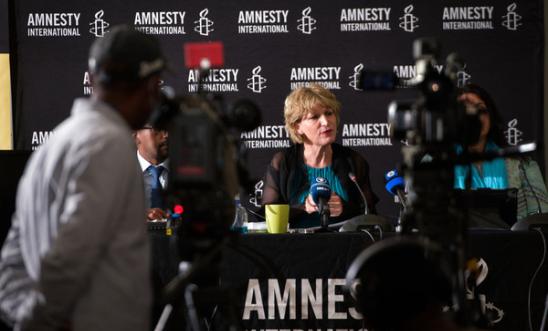
The human rights organisation looks back on 2021, “a year of dashed hopes“. According to Amnesty International, the digital sphere is increasingly becoming a space for activism — and repression.

Despite promises and pledges to the contrary, at almost every turn, leaders and corporations opted for a non-transformative path, choosing to entrench rather than overturn the systemic inequalities behind the pandemic. Yet, people the world over have made it abundantly clear that a more just world, grounded in human rights, is what they want

Agnès Callamard SG AI

Here is how Deutsche Welle summarized it:

Every year, Amnesty International looks at developments around the world and compiles an analysis of the most important global trends in human and civil rights. In its latest annual report, Amnesty Middle East and North Africa research and advocacy director Philip Luth says: “2021 was a year of really quite significant promises. … The reality was completely otherwise.”

There had been hope that the world might emerge from the pandemic equitably, Luther told DW, but richer countries in particular have prevented the widespread manufacture and distribution of vaccines. The annual report cites the facts: Fewer than 8% of the 1.2 billion people in Africa were fully vaccinated at the end of 2021 — the lowest rate in the world and far from the WHO’s 40% vaccination target…..The study also found that many governments have used the pandemic to suppress opposition and civil society. “It’s across regions and that’s one of the reasons we highlighted it in our global analysis,” Luther said. “Some governments very specifically used the smoke screen of the pandemic to restrict freedom of expression.” Examples of countries where protests have been broken up and human rights defenders are at risk include Cambodia, Russia, China and others.

According to Amnesty and other international organizations, the pandemic is also having an effect on civil society. “There are various strategies that are making it increasingly difficult for civil society to operate in different regions of the world,” Silke Pfeiffer, head of the department for human rights and peace at the Christian-affiliated aid organization Brot für die Welt (Bread for the World), told DW. “This is quite specifically directed at individual activists, who are discriminated against, threatened, persecuted and in some cases murdered.” In many countries, Pfeiffer said, governments cultivate a hostile environment. “It becomes increasingly difficult for civil society organizations to work,” she said. “That goes as far as the closure of NGOs; we see that again and again.” To cite just one example: In late March, Nicaraguan President Daniel Ortega had 25 nongovernmental organizations closed. One of them is the Nicaraguan partner organization to Brot für die Welt.

Governments and NGOs are increasingly doing their work online. Luther describes the development as a “double-edged sword.” Authorities clandestinely use technology in ways that have a negative impact on people’s human rights, he said: “Governments in many cases were also then trying to shut down and disrupt tools that enable civil society to better communicate with each other and spread information.”

Amnesty International’s annual report cites multiple examples of this: the internet shutdown from August 4, 2019, to February 5, 2021, in the India-controlled regions of Jammu and Kashmir; the use of facial recognition technology at protests in Moscow; and the use of Israel’s Pegasus spyware against journalists, opposition figures and human rights activists. Pfeiffer said the internet was an important way for civil society to organize and mobilize. But she added that, around the world, “governments and other actors have completely upgraded digitally and are now also taking very strong action against freedom on the internet — through censorship, by shutting down internet services, through mass surveillance.”

Across the world, Amnesty noted, people took to the streets to fight for their rights and the rights of others in 2021 — in Russia, India, Colombia, Sudan, Lebanon and at least 75 other countries. in the words of AI Secretary General: “The palpable and persistent resistance offered by people’s movements the world over is a beacon of hope. Uncowed and undaunted, theirs is a clarion call for a more equal world. If governments won’t build back better – if they seemingly are intent on building back broken – then we are left with little option. We must fight their every attempt to muzzle our voices and we must stand up to their every betrayal. It is why, in the coming weeks, we are launching a global campaign of solidarity with people’s movements, a campaign demanding respect for the right to protest. We must build and harness global solidarity, even if our leaders won’t.”

She also said:

Global trends to stifle independent and critical voices gathered steam in 2021 as governments deployed a widening gamut of tools and tactics. Human rights defenders, NGOs, media outlets and opposition leaders were the targets of unlawful detention, torture and enforced disappearance, many under the smokescreen of the pandemic.

At least 67 countries introduced new laws in 2021 to restrict freedom of expression, association or assembly. In the USA, at least 36 states introduced more than 80 pieces of draft legislation limiting freedom of assembly, whilst the UK government proposed the Police, Crime, Sentencing and Courts Bill, which would drastically curtail the right to freedom of peaceful assembly, including by expanding police powers.

Global trends to stifle independent and critical voices gathered steam in 2021 as governments deployed a widening gamut of tools and tactics. Human rights defenders, NGOs, media outlets and opposition leaders were the targets of unlawful detention, torture and enforced disappearance, many under the smokescreen of the pandemic.

At least 67 countries introduced new laws in 2021 to restrict freedom of expression, association or assembly. In the USA, at least 36 states introduced more than 80 pieces of draft legislation limiting freedom of assembly, whilst the UK government proposed the Police, Crime, Sentencing and Courts Bill, which would drastically curtail the right to freedom of peaceful assembly, including by expanding police powers.

https://www.dw.com/en/amnesty-international-2021-was-the-year-of-broken-promises/a-61285728

Premier League Football and human rights: continuing saga

March 25, 2022
Newcastle United players warm up before the Premier League match at the Amex Stadium, Brighton, United Kingdom on July 20, 2020.
Newcastle United players warm up before the Premier League match at the Amex Stadium, Brighton, United Kingdom on July 20, 2020. © 2020 AP Images

The English Premier League should immediately adopt and implement human rights policies that would prohibit governments implicated in grave human rights abuses from securing stakes in Premier League clubs to whitewash their reputations, Human Rights Watch said 0n 23 March 2022. The ban should be extended to state entities that they control, abusive state leaders, and individuals funding or otherwise assisting in serious abuses. See also: https://humanrightsdefenders.blog/2020/08/07/human-rights-compliance-test-for-football-clubs/

On March 14, 2022, media reported that a consortium led by a Saudi media group closely connected to the Saudi government had expressed interest in purchasing Chelsea Football Club. This reinforces the urgent need for the Premier League to adopt policies to protect clubs and their supporters, before any sale takes place, from being implicated in efforts to whitewash rights abuses. The Premier League’s approval of the sale of Newcastle United to a business consortium led by the Saudi Arabia’s Public Investment Fund (PIF), a government-controlled entity implicated in serious human rights abuses, was conducted in an opaque manner and without any human rights policy in place. The Premier League should reconsider the approval of the Newcastle United sale. [see also: https://humanrightsdefenders.blog/2020/01/30/newcastles-takeover-bid-from-saudi-arabia-welcomed-by-many-fans-but-it-remains-sportswashing/]

Allowing Newcastle United to be sold to a business consortium led by Saudi Arabia’s sovereign wealth fund, an institution chaired by a state leader linked to human rights abuses, has exposed the farcical inadequacies of the Premier League’s Owners and Directors Test,” said Yasmine Ahmed, UK advocacy director at Human Rights Watch. “As another consortium with Saudi government links eyes acquiring Chelsea, the Premier League should move fast to protect the league and its clubs from being a fast-track option for dictators and kleptocrats to whitewash their reputations.”

Human Rights Watch wrote to the Premier League CEO, Richard Masters, on March 15, to express concerns over the Newcastle United decision and to raise further concerns about the involvement of Saudi Arabia’s Public Investment Fund in facilitating human rights abuses.

The October 7, 2021 Premier League statement announcing the sale said that the league had “received legally binding assurances that the Kingdom of Saudi Arabia will not control Newcastle United Football Club.” The league did not disclose what these assurances were, nor explain how they would be legally binding. Instead, the Premier League appears to have acquiesced to the notion that the Public Investment Fund is separate from the Saudi state, even though its chairman is the de facto Saudi ruler, Crown Prince Mohammed bin Salman, its board members are nearly all currently serving ministers and other high-level officials, and it is a sovereign wealth fund that reports to the government’s Council of Economic and Development Affairs…

Human Rights Watch has significant concerns around the role of the investment fund itself in facilitating human rights abuses. Human Rights Watch wrote to the fund’s governor, Yasir al-Rumayyan, who, according to a LinkedIn page attributed to al-Rumayyan and various media reports, was managing director of the fund between 2015 and 2019, on December 21, 2021, and again on March 15 requesting his response to allegations of serious human rights violations associated with the fund. He has not responded. Al-Rumayyan is also Newcastle United’s new nonexecutive chairman.

Human Rights Watch has reviewed internal Saudi government documents submitted to a Canadian court as part of an ongoing legal claim filed by a group of Saudi companies against a former intelligence official. The documents showed that in 2017, one of Mohammed bin Salman’s advisers ordered al-Rumayyan, then the fund’s “supervisor,” to transfer 20 companies into the fund as part of an anti-corruption campaign. There is a risk that these companies were “transferred” from their owners without due process.

..

The Premier League has a responsibility to respect human rights throughout all its operations. The UN Guiding Principles on Business and Human Rights sets out these responsibilities, including the expectation that businesses will adopt specific policies and conduct due diligence to identify any risks of contributing to human rights harm. Such harm may include conferring reputational benefits that help cover up human rights abuses. The Premier League’s handbook does not include human rights under its “owners and directors test,” even though ownership of prominent football clubs by state entities or individuals close to state leaders is on the rise throughout Europe. This gap has allowed Saudi Arabia to employ its “sportswashing” strategy in the Premier League.

On March 3, the Premier League said it was considering adding a human rights component to its owners’ and directors’ test as it reviews its governance and regulations, and Masters told the Financial Times that this had come under “a lot of scrutiny” and league officials were looking to see if “we need to be more transparent and whether those decisions should be approved by an independent body.” The Premier League should also investigate the allegations of involvement of the fund’s and al-Rumayyan’s involvement in abuses, including Khashoggi’s murder, and publish its findings.
 
Potential purchase of Chelsea FC by Saudi-led consortium
The Saudi-led consortium that has reportedly made a £2.7bn bid to purchase Chelsea is being spearheaded by the Saudi Research and Media Group (SRMG), one of the largest publishing companies in Middle East, headed by a prominent Saudi media executive, Mohammed al Khereiji. The company owns more than 30 media outlets including Asharq Al-Awsat, Asharq News, and Arab News – media outlets with an apparently pro-Saudi government bias – and has its headquarters in Saudi Arabia where there are almost no independent media. Al- Khereiji is the only name mentioned in any reports regarding the Chelsea bid, and it is unclear who else is involved in the consortium.

While the media company has reportedly gone out of its way to deny any direct links to the Saudi government, it has repeatedly been reported that the group has longstanding close ties to former and current Saudi rulers. Between 2002 and 2015, three of King Salman’s sons chaired it. The position was then filled by Prince Badr bin Abdullah bin Mohammed bin Farhan, who is reported to have close ties to Crown Prince Mohammed bin Salman, until 2018, when he was appointed culture minister. Prince Badr is also chairman of the Misk Art Institute, a subsidiary of the crown prince’s non-profit Misk Foundation.

In 2020, Al-Khereiji who holds several high-level positions, was appointed board chairman of MBC Media Solutions, a commercial advertising and sales unit created in partnership between MBC Group, a media conglomerate owned by the Saudi government, and Engineer Holding Group (EGH), the media company’s parent company which al-Khereiji also heads.

Given how closely connected the media company is to Saudi state-controlled entities, how little independence the Saudi-based media outlets under its control have, and how much influence it wields – it claims it has a combined monthly reach of 165 million people – it contributes heavily to promoting the image of the Saudi government.  

The Saudi government has gone all-out in the past years to bury its human rights abuses under public spectacles and sporting events,” Ahmed said. “Until there is real accountability for these abuses by the Saudi leadership, those silently benefiting from the kingdom’s largess risk being an accomplice in whitewashing their crimes.

https://www.hrw.org/news/2022/03/23/english-premier-league-urgently-adopt-human-rights-policy

100 NGOs join Amnesty International’s call for Biden to pardon Steven Donziger

March 16, 2022
Amnesty International Logotype

For more than two years, human rights lawyer Steven Donziger – currently serving the remainder of a six month sentence on house arrest – has been arbitrarily detained in apparent retaliation for his work to hold Chevron accountable for its deliberate dumping of more than 16 billion gallons of toxic oil waste into the Amazon rainforest. Despite repeated calls from human rights advocates and governmental authorities for Donziger’s release, the Department of Justice has refused to respond or take any action to remedy this human rights violation. Today, over 100 human rights and environmental organizations from around the world joined Amnesty International, Greenpeace USA, Amazon Watch, Global Witness, Rainforest Action Network, HEDA Resource Center, ReCommon, and the Pachamama Alliance to call on President Biden to exercise his clemency powers to pardon Steven Donziger as a way to ensure his immediate release.

In a letter to President Biden, the organizations state: “More than four months since a discerning opinion by the UN Working Group on Arbitrary Detention that found Steven Donziger’s detention to be arbitrary, U.S. judicial authorities have thus far failed to take any action to remedy the situation and implement the Working Group’s call to ensure Mr. Donziger’s  immediate release.”  See also: https://humanrightsdefenders.blog/2020/08/17/steven-donziger-speaks-out-himself-about-being-targetted-by-chevron

In a statement in October 2021, President Biden promised the U.S. would “stand in solidarity with, and continue to work tirelessly in support of, the activists, human rights defenders, and peaceful protestors on the front lines of the struggle between freedom and tyranny.”All the while, the administration has failed to side with the brave human rights defenders within the United States and respond to the demand of the U.N. Working Group on Arbitrary Detention, Congress, and the international community to free Steven Donziger. 

Steven Donziger is a human rights defender that bravely stood up against one of the most powerful corporations in the world,” said Daniel Joloy of Amnesty International. “In response, he has endured years of harassment, intimidation, smear campaigns and more than two years in arbitrary detention. President Biden must now listen to the over 100 human rights and environmental organizations calling to pardon Steven Donziger and ensure he is released immediately and unconditionally. Allowing this ordeal to continue only sends a chilling message that corporations around the world can continue attacking human rights defenders without consequences.”

Paul Paz y Miño of Amazon Watch said “Instead of supporting the people of Ecuador who were poisoned by Chevron’s admitted deliberate dumping of billions of gallons of toxic waste, Biden has turned a blind eye to the persecution of a key lawyer who worked to win a historic judgment against Chevron. The U.S. government’s responsibility should be to make Chevron clean up its waste and support efforts to hold the fossil fuel company accountable, not allow the appointment of a private prosecutor with ties to the very same oil company to imprison human rights lawyer Steven Donziger. This travesty has gone on for over two years, and Biden has ignored members of the E.U. parliament, members of the House and Senate, and even the United Nations High Commissioner for Human Rights. Well over 100 organizations are now demanding action, and Biden’s lack of action continues to be a dark stain on his alleged claims to respect human rights. Oil companies do not prosecute and imprison people in the U.S. This must end now.”

Chevron’s legal attack on Donziger is not the first, nor will it be the last case of its kind. Right now, the right to dissent is being repressed by both our government and corporations

Annie Leonard, co-Executive Director Greenpeace USA

Simon Taylor, Co-Founder & Director, Global Witness said “I have spent much of the past 25 years seeking accountability of the fossil fuel industry for its gross human rights abuses and other crimes. Amongst the judicial authorities we have liaised with during this time, the Southern District of New York has stood as a beacon in this fight against criminality. Shockingly, just as Biden gears up this struggle, New York’s judicial authorities seem instead intent on destroying their reputation, thanks to their apparent complicity in the unprecedented corporate prosecution and judicial harassment of Steven Donziger. These acts, in my experience, are more what I would expect from one of the ‘Banana Republics’ we have investigated around the world. These are shameful acts. If Biden is serious about tackling the climate crisis, he cannot allow the fossil fuel industry to weaponise the US judicial system to go after its detractors – Biden must act now and release Steven Donziger.”

https://www.commondreams.org/news/2022/03/15/100-groups-urge-biden-pardon-human-rights-lawyer-steven-donziger

Saudi human rights defender Raif Badawi freed after 10 years!

March 12, 2022

On Friday 11 March 2022, AFP reported that Saudi blogger Raif Badawi has been released from prison in Saudi Arabia after serving a 10-year sentence for advocating an end to religious influence on public life.

Raif called me. He is free,” his wife, Ensaf Haidar, who lives in Canada with their three children and had been advocating for his release, told AFP. Badawi’s release was also confirmed by a Saudi security official who said on condition of anonymity that Badawi “was released today”. “I jumped when I found out. I couldn’t believe it. I can’t wait to see my dad, I’m so excited,” one of his daughters, Nawja Badawi, 18, told AFP. Badawi’s son Terad Raif Badawi tweeted: “After 10 years my father is free!

Badawi won 5 international awards according to THF’s digest: https://www.trueheroesfilms.org/thedigest/laureates/33454B83-61A6-180A-27D6-7FFDEC25D330

Raif Badawi, human rights defender in Saudi Arabia, has finally been released!” Amnesty International tweeted. “Thousands of you have mobilized alongside us in the defense of Raif Badawi for 10 years. A big thank you to all of you for your tireless support.

Every Friday for almost seven years, Haidar – who fled to Canada after Badawi’s arrest and has since become a Canadian citizen – had held a public vigil for him. Quebec has paved the way for Raif Badawi to come to the country if he chooses by placing him on a priority list of possible immigrants for humanitarian reasons.

No details of his release conditions were immediately available. But Amnesty noted that the Saudi blogger could still face a 10-year ban on all travel outside Saudi Arabia following his release.

Raif Badawi’s sister, Samar Badawi, as well as activist Nassima al-Sadah, released in 2021, remain stranded in the kingdom. See also: https://humanrightsdefenders.blog/2016/01/13/saudi-arabia-arrest-of-human-rights-defender-samar-badawi/

https://www.theguardian.com/world/2022/mar/11/raif-badawi-saudi-blogger-freed

https://mailchi.mp/hrf.org/hrf-welcomes-release-of-saudi-writer-and-activist-raif-badawi?e=f80cec329e

Amnesty Nairobi seeks urgently short-term consultant

March 10, 2022

The Nairobi Office of Amnesty International’s Regional Office for East and Southern Africa (ESARO) is seeking an enthusiastic, and strategic campaigner with substantial experience in developing and implementing campaigns for a short-term consultancy. Under the supervision of, the Deputy Regional Director – Campaigns, the consultant will provide support to ongoing campaigns in Tanzania and Uganda whose thematic focus include freedom of expression, association and assembly, gender justice, right to health, right to housing among others and will do this using an intersectional
approach.

This is a four-month contract (March to June 2022) and the consultant could be based in Nairobi or remotely in Tanzania or Uganda.
Consultant profile includes:
– Very good knowledge of the human rights and the political context in East Africa with specific knowledge of Tanzania and/or Uganda.
– Knowledge of and experience working with the UN mechanisms, African Union institutions, sub-regional and national authorities is also essential.
– Excellent oral and written communication skills and ability to understand and express ideas in English. Ability to communicate in Swahili is also desirable.

To apply for the role, please provide your CV (three pages maximum) and a cover letter outlining how your skills and profile are aligned to the role as described above. Please send applications to amnesty.earo@amnesty.org 2022.

The deadline has been extended to Thursday 17 March 2022.

International Women’s Day 2022

March 8, 2022

International Women’s Day is today 8 March and celebratory events are being held around the world. This year’s theme is #BreakTheBias, aimed at imagining “a world free of bias, stereotypes, and discrimination.” While this special day offers hope for gender equity, it is also a reminder of the omnipresent phenomenon of violence against women, which exists regardless of the day, and needs to be addressed in a fundamental way.

See also: https://www.humanrightscareers.com/issues/why-international-womens-day-is-important/

There is too much to choose from (as usual); for last year’s see: https://humanrightsdefenders.blog/2021/03/08/celebrating-international-womens-day-in-2021/]

Still, here some concrete samples:

Upasana Rana reports Global Voices of 7 March on Nepal [https://globalvoices.org/2022/03/07/this-international-womens-day-lets-come-together-against-violence/]

On the same site Njeri Wangari tells us about how Feminist music icons from around Africa to celebrate this International Women’s Day. See her Spotify playlist with hits from artists like Fatoumata Diawara, Cesária Évora, Shishani Vranckx, Thandiswa Mazwai, and more.

Amnesty International issued a statement “International Women’s Day: Dramatic deterioration in respect for women’s rights and gender equality must be decisively reversed

  • Alarming assaults on women’s rights around the world in 2021/22. 
  • Legal protections dismantled, and women human rights defenders now at unprecedented risk.
  • Protection and promotion of women’s and girls’ rights and support for women human rights defenders crucial, including for Covid-19 recovery. 
  • Governments must act decisively to reverse regressions and uphold human rights for women and girls. 

Catastrophic attacks on human rights and gender equality over the past twelve months have lowered protection for and upped threats against women and girls across the globe.  On International Women’s Day, the organization called for bold action to reverse erosions of human rights for women and girls.   

 “Events in 2021 and in the early months of 2022 have conspired to crush the rights and dignity of millions of women and girls.  The world’s crises do not impact equally, let alone fairly. The disproportionate impacts on women’s and girls’ rights are well-documented yet still neglected, when not ignored outright.  But the facts are clear. The Covid-19 pandemic, the overwhelming rollback on women’s rights in Afghanistan, the widespread sexual violence characterizing the conflict in Ethiopia, attacks on abortion access in the US and Turkey’s withdrawal from the landmark Istanbul Convention on Gender Based Violence: each is a grave erosion of rights in its own terms but taken together? We must stand up to and stare down this global assault on women’s and girls’ dignity,” said Amnesty’s Secretary General, Agnès Callamard. [see https://www.amnesty.org/en/latest/news/2022/03/international-womens-day-dramatic-deterioration-in-respect-for-womens-rights-and-gender-equality-must-be-decisively-reversed/]

Human Rights Watch focuses on Afghanistan: On International Women’s Day, we should remember Afghanistan, and consider what the state of women’s rights there means for the struggle for gender equality worldwide. The Taliban were notorious for violating women’s rights when they ruled Afghanistan from 1996 to 2001. So, when the Taliban took control of Afghanistan again on August 15 last year, Afghan women’s rights defenders were deeply skeptical that the new rulers would be any different from the Taliban that controlled the country before, despite their pledges to respect women’s rights. They were right.

In less than seven months since taking over, the Taliban have:

  • closed most girls’ secondary schools;
  • created barriers to women and girls pursuing higher education;
  • banned women from most paid employment;
  • abolished the Ministry of Women’s Affairs;
  • restricted women’s movement including blocking them from leaving the country alone;
  • dismantled Afghanistan’s system that provided protection from gender-based violence;
  • created barriers to women and girls accessing health care;
  • beaten and abducted women’s rights protesters;
  • silenced female journalists;
  • banned women’s sports; and
  • appointed a men-only administration.

Afghanistan is not the only country where women’s rights are under attack this International Women’s Day. But the speed and extent of the obliteration of women’s rights in Afghanistan is a warning to women around the world about the fragility of progress toward equality, how quickly it can vanish, and how few will defend it. We should all be in solidarity with Afghan women; their fight is a fight for women’s rights everywhere. [See: https://www.hrw.org/news/2022/03/08/standing-afghan-women-and-girls-international-womens-day]

Caitlin Fitzsimmons in the Sydney Morning Herald of 6 March argues that “International Women’s Day highlights climate justice as a feminist issue”. Women are on the front lines of the global climate crisis, making up 80 per cent of the 21.5 million people displaced every year by climate-related events. [See: https://www.smh.com.au/environment/climate-change/international-women-s-day-highlights-climate-justice-as-a-feminist-issue-20220303-p5a1ba.html]

On International Women’s Day, UN Human Rights stands with women and girls human rights defenders of all ages, backgrounds & identities leading our collective struggle to protect our climate and environment. See.g.:

Meet Brianna Frueran, a Pacific climate change activist fighting for her native Samoan islands’ survival.

Meet Mya Pol, a content creator from the United States who advocates for disability rights and educates people about environmentalism on her social media platform.

https://news.un.org/en/story/2022/03/1113872

NGOs express great worries about human rights situation in Russia at UN Human Rights Council

March 5, 2022

UN Human Rights Council should take urgent action to address the dire human rights situation in Russia say NGOs in a Joint Letter to the United Nations Human Rights Council. See also: https://humanrightsdefenders.blog/2022/02/27/anti-war-human-rights-defenders-in-russia/

To Permanent Representatives of Member and Observer States of the United Nations (UN) Human Rights Council:

Excellency,

As the 49th session of the UN Human Rights Council gets underway, and Russia continues its invasion of Ukraine, we, the undersigned civil society organisations, would like to draw your attention to the dire human rights situation within the Russian Federation, and urge all states to bring this neglected country situation onto the agenda of the Human Rights Council.

A year after last year’s joint statement on the situation in Russia, authorities there have further intensified the already unprecedented crackdown on human rights. A fully-fledged witch hunt against independent groups, human rights defenders, media outlets and journalists, and political opposition, is decimating civil society and forcing many into exile.

The gravity of this human rights crisis has been demonstrated in the last few days by the forcible dispersal of anti-war rallies and pickets across Russia with over 6,800 arrested (as of 2 March  2022), attempts to impose censorship on the reporting of the conflict in Ukraine and to silence those media and individuals who speak out against Russia’s invasion of Ukraine, including through blocking media websites, threats of criminal prosecution under “fake news” and “high treason” charges and other means.

In a shocking development, the authorities moved to shut down “Memorial,” one of the country’s most authoritative human rights organizations. At the end of December, courts ruled to “liquidate” the group’s key legal entities, International Memorial Society and Human Rights Center Memorial, over alleged persistent noncompliance with the repressive legislation on “foreign agents.” On 28 February, the Supreme Court upheld this decision, despite an article 39 ruling from the European Court of Human Rights ordering the Russian authorities to halt liquidation proceedings.

The December rulings came at the end of a particularly terrible year for human rights in the country, during which authorities threw top opposition figure Alexei Navalny in prison, banned three organizations affiliated with him as “extremist,” launched criminal proceedings against several of his close associates, doubled down on Internet censorship, and designated more than 100 journalists and activists as “media-foreign agents”.

Recent months also saw a dramatic escalation of repression in Chechnya, where Russian law and international human rights obligations have been emptied of meaning. With the Kremlin’s tolerance or acquiescence, the local governor, Ramzan Kadyrov has been eviscerating all forms of dissent in Chechnya, often using collective punishment. In December 2021, Kadyrov opened a brutal offensive against his critics in the Chechen diaspora, by having the police arbitrarily detain dozens of their Chechnya-based relatives. It continued in January with the abduction and arbitrary detention on fabricated charges of Zarema Musaeva, mother of human rights lawyer Abubakar Yangulbaev, and death threats issued against the Yangulbaev family and some prominent human rights defenders and journalists. 

This is a country situation urgently requiring the Council’s attention. We urge the Human Rights Council to adopt a resolution expressing serious concern about the human rights violations and abuses occurring in Russia, requesting the High Commissioner to monitor and report on the situation, and appointing a dedicated Special Rapporteur to address the human rights situation in Russia.

Yours sincerely,

Signed:

  1. Human Rights Watch
  2. Amnesty International
  3. Human Rights House Foundation
  4. International Federation for Human Rights
  5. International Service for Human Rights
  6. Human Rights Centre Memorial (Russia)
  7. Civic Assistance Committee (Russia)

There was also a statement was delivered by Yulian Kondur and the International Charitable Organization Roma Women Fund ‘Chiricli’ in the name of Minority Rights Group (MRG) and other organizations at the Human Rights Council’s Urgent Debate, held on Friday 4 March 2022, on the situation of human rights in Ukraine stemming from the Russian Aggression. They called on authorities and aid actors to ensure that Roma, minorities and marginalised peoples are granted equal access to protection and safety when seeking refuge, including those without identity documentation.

https://www.hrw.org/news/2022/03/04/joint-letter-united-nations-human-rights-council-human-rights-situation-russia

Prosecution of human rights defender Öztürk Türkdoğan in Turkey should be dropped

February 23, 2022

All charges against Öztürk Türkdoğan, the co-chair of Turkey’s most prominent human rights organisation and a respected lawyer, should be immediately dropped, Amnesty International said ahead of the start of his trial. Öztürk Türkdoğan, the co-chair of the Human Rights Association (IHD), faces baseless charges of “membership of a terrorist organization”, “insulting a public official” and “insulting the Turkish nation and the Turkish state” for public statements he made in relation to his association’s human rights work.
See also: https://humanrightsdefenders.blog/2021/03/22/turkey-arrests-and-backsliding-on-femicide/.


The prosecution of Öztürk Türkdoğan is an undisguised attack on this one human rights defender and also on all those who speak out for human rights in Turkey,” said Julia Hall, Amnesty International’s Deputy Director for Research for Europe. “With these spurious charges against the co-chair of Turkey’s longest-standing human rights organisation, the prosecuting authorities send a chilling message that increases the climate of intense fear among Turkey’s already beleaguered human rights community.

According to IHD’s records, over 200 separate criminal investigations and prosecutions of IHD members and elected representatives of the organization are ongoing across Turkey.

The criminalization of human rights defenders and of the Human Rights Association are the true insults here. The authorities’ unrelenting attack on Öztürk Türkdoğan and Turkey’s civil society movement has to end,” said Julia Hall. “Turkey must immediately drop all charges against Öztürk Türkdoğan and create an enabling, protective environment for civil society in line with its obligations under international human rights law.”

In December 2021, the Turkish authorities initiated three separate prosecutions against Öztürk Türkdoğan. He was tried under Article 125 of the Turkish Penal Code allegedly for “insulting” a public official in a statement published on the IHD website on 29 June 2018. The first hearing of this prosecution, in which the Minister of Interior is the alleged victim, was held on 18 February 2022. The next hearing will be held on 11 May.

He was also charged with “membership of a terrorist organization” under Article 314/2 of the penal code after the authorities detained him and searched his home on 19 March 2021. During the search, his phone and laptop were confiscated. The first hearing for this case will take place on 22 February 2022.

https://www.amnesty.org/en/latest/news/2022/02/turkey-baseless-prosecution-of-ozturk-turkdogan-an-attack-on-all-those-who-speak-out-for-human-rights/

https://www.arabnews.com/node/2029361/middle-east


Amnesty joins debate on Apartheid versus Palestinians but reactions debase struggle against real antisemitism

February 4, 2022

In Newsweek of 3 February 2022 Omar Baddar, Director of the Arab American Institute, published an opinion piece entitled “Amnesty Settles It: It’s Time for U.S. Accountability on Israel”.

Amnesty International, issued on 1 February 2022 an extensive report titled “Israel’s Apartheid against Palestinians: Cruel System of Domination and Crime against Humanity.” As the report documents, “Israel has imposed a system of oppression and domination over Palestinians wherever it exercises control over the enjoyment of their right.” The report further found that Israel’s policies are part of a “systematic as well as widespread attack directed against the Palestinian population, and that the inhuman or inhumane acts committed within the context of this attack have been committed with the intention to maintain this system and amount to the crime against humanity of apartheid.

In recent years, some leading Israeli human rights organizations have started using the word apartheid to describe their government’s systems of oppression. Last year, Human Rights Watch, one of the best-known American human rights organization, similarly accused Israel of apartheid. Amnesty International following suit this week has solidified the human rights community’s emerging consensus on Israeli apartheid. See: https://humanrightsdefenders.blog/2021/01/18/israel-and-apartheid-israeli-human-rights-group-stirs-debate/ and https://humanrightsdefenders.blog/2021/07/09/israel-and-the-international-crime-of-apartheid-a-response-by-human-rights-watch-worth-studying-in-full/

Omar Baddar, states: The most important consequence of this consensus is that it lays to rest the false but popular notion of an “Israeli-Palestinian conflict” between two equal sides. The new consensus instead frames the issue more accurately as a struggle between an oppressor and an oppressed people. In the same way that Apartheid in South Africa and Jim Crow segregation in the American South denied people the ability to live in freedom with their full rights simply because of who they are, Israel also denies freedom to Palestinians and many basic rights to Palestinians just because they are Palestinians.

Like the Human Rights Watch report before it, what’s remarkable about the new Amnesty report is how extensive and detailed it is. Amnesty did its due diligence and made sure that its central claims are backed by a mountain of evidence, meticulously documenting unlawful killings, forced displacement and systemic discrimination on a massive scale. Unsurprisingly, the devastating and irreproachable nature of this report triggered a meltdown among Israel’s apologists. See for this also: https://yubanet.com/world/human-rights-organizations-from-israel-condemn-vicious-attacks-on-amnesty-international/

Unable to argue with the substance of the Amnesty report, pro-Israel groups have resorted either to blindly asserting—as AIPAC did—that Amnesty was lying, or baselessly claiming—as the ADL did—that the report would spark antisemitic attacks. The latter is nothing short of a cynical weaponization of antisemitism—which, in fact, is a serious and rising scourge in America and across the world—unscrupulously exploited in order to silence criticism of Israeli government policy.

We cannot have the open debate we need in a free society if speaking honestly about Israeli policy results in smears of bigotry. By misusing the charge of antisemitism in this fashion, Israel’s apologists aren’t just harming the human rights defenders being smeared by it; they’re also harming the real effort to eliminate antisemitism—a goal that we all have a moral obligation to come together and accomplish.

What this Amnesty report should have done is serve as a wake-up call to an American political establishment that prioritizes pandering over sensible policy, and that has turned a blind eye to a grave injustice for far too long. After all, it is U.S. military funding, to the unrivaled tune of $3.8 billion per year, which enables the Israeli military to maintain its suffocating grip on the occupied Palestinian population, and it is U.S. diplomatic protection, through more than 40 vetoes at the UN Security Council and beyond, that shields Israel from accountability for its crimes.

And yet, despite repeatedly claiming to prioritize human rights in its foreign policy, the Biden administration’s reaction to this report was utterly disappointing. The administration rejected it out of hand.

The Amnesty report bemoans the fact that, “for over seven decades, the international community has stood by as Israel has been given free rein to dispossess, segregate, control, oppress and dominate Palestinians.” It criticizes countries like ours that have “actively supported Israel’s violations by supplying it with arms, equipment and other tools to perpetrate crimes under international law and by providing diplomatic cover, including at the UN Security Council, to shield it from accountability.” The report also reiterated its call for “states to immediately suspend the direct and indirect supply, sale or transfer of all weapons, munitions and other military and security equipment.”

https://www.newsweek.com/amnesty-settles-it-its-time-us-accountability-israel-opinion-1675876

https://www.juancole.com/2022/02/prolonged-occupation-palestinians.html

https://www.thecitizen.in/index.php/en/NewsDetail/index/6/21449/Why-Is-Israel-Fearful-of-Amnestys-Apartheid-Report

Rights Arcade – a game to help human rights education

January 24, 2022

This International Day of Education, Amnesty International has launched Rights Arcade, a free human rights game app which aims to educate the next generation of human rights defenders about rights such as freedom of expression and freedom of peaceful assembly.

Rights Arcade is designed to strengthen the human rights movement through action-oriented education. The games will boost players’ knowledge about human rights and encourage people to take action on human rights issues.  

One of Rights Arcade’s key features is a self-paced approach that allows players to learn, reflect and take action at their own pace while navigating through the game’s stories.

This game has been designed to empower and encourage people everywhere, but especially younger audiences, to learn about human rights in an engaging manner,” said Agnès Callamard, Amnesty International’s Secretary General.

Young people are pivotal in setting the human rights agenda, today and for the future. Reaching them in the spaces they inhabit, or with which they engage regularly, is key to enabling new generations of activists and empowering them to fight for, and protect, human rights – now and in the future.”

The players take a human rights journey through the experiences of three real-life people: Ahmed Kabir Kishor, a cartoonist unjustly charged under the Digital Security Act in Bangladesh [see: https://humanrightsdefenders.blog/2020/06/16/30-information-heroes-honored-by-reporters-without-borders/] Zhang Zhan, a citizen journalist sentenced to four years in prison for reporting about Covid-19 in China [see: https://humanrightsdefenders.blog/2021/11/06/chinese-journalist-zhang-zhan-at-imminent-risk-of-death/]; and Panusaya Sithijirawattanakul, a student activist facing more than 25 charges for protesting in Thailand [see: https://humanrightsdefenders.blog/2021/01/04/new-year-new-charges-against-thai-protesters-the-lese-majesty-law-in-thailand/].

The game’s stories, which are fictionalized experiences inspired by real world events, are driven by a player’s choices.

The player gets to play the role and navigate the experiences of the three central characters, making decisions based on their own understanding of human rights and unpacking how human rights concepts apply in daily life.

People around the world will be able to access a collection of three games currently available in four languages: English, Simplified Chinese, Thai and Korean.

Rights Arcade can be downloaded on iOS and Android devices, ensuring its accessibility in regions with poor internet connectivity.

Rights Arcade will be regularly updated to accommodate learning in more languages, and with new game offerings in the months and years to come.