Archive for the 'AI' Category

10 Organisations Demand The Dropping Of Charges Against Journalist Nguyen Lan Thang in Viet Nam

April 13, 2023

On 11 April 2023 10 NGOs demanded the dropping of charges against journalist Nguyen Lan Thang and a fair trial by admitting observation.

Dear President Võ Văn Thưởng,

We are writing to express our concern about the ongoing persecution of Mr Nguyen Lan Thang, a journalist, and we demand that he be released immediately, and all charges dropped against him. Mr Nguyen Lan Thang is a victim of persecution by the Vietnamese government and has been criminally charged due to his work as a journalist. Mr Nguyen Lan Thang is one of many journalists and activists throughout the country who is facing ongoing persecution for reporting of the government of Viet Nam in a critical manner.

On 5 July 2022, Mr. Thang was arrested for “making, storing, distributing, or disseminating information, documents, and items against the State” under article 117 of the 2015 Criminal Code. He has been held in incommunicado detention in Hanoi’s Detention Centre No. 1 for more than seven months, during which time he was prohibited from meeting with his family members and legal counsel. After being arrested in July 2022, he did not meet his lawyer for the first time until 16 February 2023.

According to his lawyers, Mr. Thang will be tried on 12 April 2023 at a closed hearing at Hanoi’s People’s Court. Failing the dropping of charges and release of Mr Nguyen Lan Thang before the trial commences, we demand that his right to a fair trial be upheld, at least in part, by ensuring that media and the public may observe it, as is the obligation of the state of Viet Nam under the International Covenant on Civil and Political Rights (ICCPR).

The right to a public trial is guaranteed under Article 14 of the ICCPR with few exceptions. We understand that Mr Nguyen Lan Thang has been denied this human right. According to Article 14 of the ICCPR:

“the press and the public may be excluded from all or part of a trial for reasons of morals, public order (order public) or national security in a democratic society, or when the interest of the private lives of the parties so requires, or to the extent strictly necessary in the opinion of the court in special circumstances where publicity would prejudice the interests of justice; but any judgment rendered in a criminal case or in a suit at law shall be made public except where the interest of juvenile persons otherwise requires or the proceedings concern matrimonial disputes or the guardianship of children.”

Paragraph 28 of General Comment No 32 of the Human Rights Committee clarifies that the importance of public hearings “ensures the transparency of proceedings and thus provides an important safeguard for the interest of the individual and of society at large”. The Committee has made clear in paragraph 29 that the special circumstances that allow exclusion of the press and public from a trial are “exceptional circumstances”, and otherwise a trial must be open to ensure transparency and assist in guaranteeing the human right to a fair trial.

Despite efforts to obtain further information on the charges and the rationale the court has adopted in excluding the press and public from the trial of Mr Nguyen Lan Thang, there is no information that we possess that indicates any exceptional circumstances exist that would allow the closed nature of this trial under international human rights law.

Accordingly, we demand that the right to fair trial is respected and that members of the public, the press, the United Nations, and the diplomatic community be allowed to monitor the proceedings. We call on the government of Viet Nam, including its courts, to uphold their international obligations and ensure the human rights of those within the justice system.

Yours sincerely,

  • Access Now
  • Amnesty International
  • ARTICLE 19
  • Asian Forum for Human Rights and Development (FORUM-ASIA)
    CIVICUS: World Alliance for Citizen Participation
  • Front Line Defenders
  • Human Rights Watch
    People In Need
  • The Project 88
  • Vietnamese Advocates for Change

See also: https://humanrightsdefenders.blog/2023/03/29/vietnam-should-drop-charges-against-human-rights-defender-truong-van-dung/

Human rights lawyer Thulani Maseko shot dead in eSwatini

January 23, 2023

On 22 January 2023 Freedom Under Law (FUL) said that the news that eSwatini human rights lawyer Thulani Maseko has been gunned down in cold blood comes as no surprise. The eSwatini government said Maseko was brutally shot and killed by unknown criminals at his home in Mbabane on Saturday night. See: https://www.trueheroesfilms.org/thedigest/laureates/03464020-c1e6-11ea-a3f7-933e766692a6

A ceaseless and fearless human rights lawyer, an outspoken critic of the regime in his beloved eSwatini, Thulani had all too long suffered at the hands of a heedless regime. But he lived by the motto: ‘My head is bloody, but unbowed … I am the master of my fate: I am the captain of my soul’.

“Sadly, and to the shame of those engaged in the administration of justice in his country, all too often he was a lone beacon of light,” FUL chair judge Johann Kriegler said. He said no-one could be misled by the cynical message of condolence put out on behalf of the eSwatini government.

His passing has not only left his family bereft of a loved one; his country has been left the poorer, its human rights conscience brutally stifled.

FUL said in paying tribute to Maseko that it respectfully suggested it would be fitting if the Law Society of eSwatini were to mark his passing by observing January 21 every year as a day of mourning his death and rededication to the rule of law. “To his widow and family we express our grateful condolences. They have paid a bitter price on behalf of all who try to serve the principles for which their dear one lived.

According to the eSwatini government, Maseko was shot by “unknown criminals”. “[His] demise is a loss to the nation, and his footprints as a human rights lawyer are there as proof of his contributions to the country. He will be surely missed,” it said in a statement.  Spokesperson Alpheous Nxumalo said the country’s security forces had assured the government that they were already at work looking for the killers and would not rest until they have been brought to book. “Government also wants to warn against speculations and insinuations, peddled particularly on social media platforms in instances like these. Again, government distinctively disassociates… and the country’s authorities from these heinous acts.”

Maseko chaired the Multi-Stakeholders Forum, a collaboration of political parties and civil society groups working to amplify calls for democratic reforms. 

In 2018, Maseko took Swaziland’s King Mswati III to court for changing the country’s name. He had argued that the resources to be channelled to the name change should rather go towards improving living standards of the poor, according to reports by City Press. In 2014, Maseko was sentenced to two years in prison, with the editor of news magazine The Nation, Bheki Makhubu, for contempt of court over articles critical of the government and judiciary. The Nation published articles co-authored by the two men which were critical of the chief justice and suggested that he may have abused his powers. See also: https://lawyersforlawyers.org/en/lawyers/thulani-maseko/

A very impressive group of NGOs and individuals co-signed a statement condemning his killing: https://www.fidh.org/en/issues/human-rights-defenders/eswatini-condemnation-of-assassination-of-renowed-hrd-thulani-maseko

https://www.businesslive.co.za/bd/national/2023-01-22-human-rights-lawyer-thulani-masekos-murder-is-no-surprise-says-freedom-under-law/

https://www.hrw.org/news/2023/01/25/eswatini-activist-rights-lawyer-brutally-killed

https://www.news24.com/news24/southafrica/news/human-rights-lawyer-thulani-maseko-shot-dead-outside-home-in-eswatini-20230122

https://www.frontlinedefenders.org/en/case/case-history-thulani-maseko

Amnesty International looking for Senior Regional Campaigner for Eastern Europe and Central Asia region

December 19, 2022

The urgent human rights issues in the Eastern Europe and Central Asia region are hugely varied and demand creative campaigns that are well-researched, well-planned and well-managed despite the time pressures that surround them.

JOB PURPOSE: To lead the identification, development, implementation and evaluation of Amnesty International’s campaigning and advocacy strategies on human rights violations in the Eastern Europe and Central Asia region, to deliver impact in relation to agreed priorities, utilizing political judgment and analytical, communication and representational skills.

ABOUT YOU

  • Lead the development and implementation of campaign strategies, ensuring campaigns result in measurable change.
  • Advise on, coordinate and review the contribution to relevant campaigns by regional colleagues and other programmes.
  • Coordinate action planning and ensure consistency with campaigning standards and optimal use of resources.
  • Assess opportunities for action, identifying creative and effective campaigning tactics.
  • Provide advice to sections and structures and external partners on the development and implementation of campaign strategies.
  • Responsible for ensuring there is effective communication between relevant IS teams, sections and structures and partners about projects.
  • Draft, review and advise on campaign materials for internal and external use, ensuring products are coherent within the campaign strategy.
  • Communicate AI’s concerns, positions and messages to external and internal audiences.
  • Contribute to planning, execution and evaluation stages of campaign projects; develop and share campaigning best practice.

SKILLS AND EXPERIENCE

  • The ability to adapt to fast-changing political situations in, and related to, Eastern Europe and Central Asia.
  • Experience of leading and implementing campaigns at the national & international level and the ability to lead innovation and creative approaches to campaigning.
  • Knowledge of working on, and in, the region and a specialist knowledge in relation to specific countries or other geographical areas in the region.
  • Digitally competent, with experience of digital campaigning and keeping up to date with digital trends and campaigning methodologies.
  • Experience of working with colleagues and partners based around the world.
  • Excellent communications skills in English and Russian in a fluent, clear and concise way. Knowledge of another regional language desirable
  • Experience of leading project teams and the ability to engage and inspire team members.
  • Experience of managing conflicting demands, meeting deadlines and adjusting priorities
  • Ability to undertake research to gather information relevant to the development of campaign strategies.
  • Ability to evaluate campaigns and projects and to report progress against stated objectives; experience of managing budgets and reporting against expenditure.

Amnesty International is committed to creating and sustaining a working environment in which everyone has an equal opportunity to fulfill their potential and we welcome applications from suitably qualified people from all sections of the community. For further information on our benefits, please visit https://www.amnesty.org/en/careers/benefits/

APPLY HERE

https://careers.amnesty.org/vacancy/senior-regional-campaigner-london-3481/3509/description/

Davos’ annual meeting starts on 22 May under human rights cloud

May 22, 2022
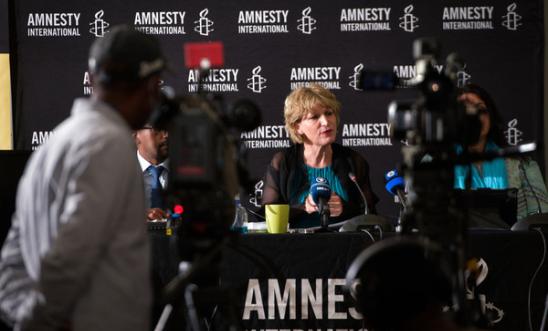
Agnès Callamard at a press conference

Agnès Callamard at a press conference © Amnesty International

Ahead of the World Economic Forum’s annual meeting in Davos that starts today, Sunday 22 May 2022, Agnès Callamard, Amnesty International’s Secretary General, said: 

This year’s Davos conference takes place amid a gathering storm of human rights crises. Russia’s mounting war crimes in Ukraine, the terrifying rollback on abortion rights in the US, the still-neglected climate emergency, the ongoing failure to secure universal vaccine access – these are just a few examples of what happens when human rights are sacrificed for power and profit.  

“Many of the political and business leaders attending Davos are directly responsible for these catastrophes, whether through their explicit pursuit of anti-human rights agendas or through their contemptible inaction and failure to implement solutions.  

“The Davos guestlist includes some of the richest and most powerful people in the world, and they have a moral obligation to put respect for human rights at the top of the agenda. They must use their vast wealth and influence to change the status quo and end the rampant inequality which has been the root cause of so much recent suffering.

The World Economic Forum’s annual meeting will take place in Davos, Switzerland, between 22 and 26 May.

https://www.amnesty.org.uk/press-releases/global-rich-and-powerful-meet-davos-amid-gathering-storm-human-rights-crises

Major NGO offices in Russia now closed

April 9, 2022

On 8 April 2022, the Russian government closed the offices of Amnesty International and Human Rights Watch and several other NGOs such as Carnegie Endowment for International Peace, Friedrich Naumann Foundation for Freedom, Friedrich Ebert Foundation. This decision has been taken “in connection with the discovered violations of the Russian legislation.

On 11 March, Russia’s media regulator had already blocked access to Amnesty International’s Russian-language website.

Human Rights Watch had maintained an office in Russia for 30 years. The action was announced just days after an appeals court upheld the liquidation of Russia’s human rights giant, Memorial. [see also: https://humanrightsdefenders.blog/2021/11/12/it-had-to-happen-russian-authorities-move-to-shut-down-memorial/]

Human Rights Watch has been working on and in Russia since the Soviet era, and we will continue to do so,” said Kenneth Roth, executive director of Human Rights Watch. “This new iron curtain will not stop our ongoing efforts to defend the rights of all Russians and to protect civilians in Ukraine.”

Reacting to the news, Agnès Callamard, Secretary General of Amnesty International, said: “Amnesty’s closing down in Russia is only the latest in a long list of organizations that have been punished for defending human rights and speaking the truth to the Russian authorities. In a country where scores of activists and dissidents have been imprisoned, killed or exiled, where independent media has been smeared, blocked or forced to self-censor, and where civil society organizations have been outlawed or liquidated, you must be doing something right if the Kremlin tries to shut you up.

https://www.hrw.org/news/2022/04/08/russia-government-shuts-down-human-rights-watch-office

https://www.themoscowtimes.com/2022/04/08/moscow-shutting-down-amnesty-human-rights-watch-in-russia-a77290

Shocking case of refoulement from Spain

March 31, 2022

On 30 March 2022, Statewatch along with 13 other human rights organisations condemned the deportation from Spain to Algeria of Mohamed Benhalima, a human rights activist who faces a serious risk of torture and other ill-treatment in the North African state.

The organisations strongly condemn the deportation by Spain of Algerian activist Mohamed Benhalima, in the evening of 24 March 2022, despite the risks of torture and serious human rights violations he faces in Algeria, and therefore in blatant violation of Spain’s international obligations on non-refoulement. The authorities had been made aware, through civil society and legal appeals, that Mr Benhalima faces a high risk of torture, arbitrary detention and unfair trial in Algeria, where such violations are increasingly common against prisoners of opinion and peaceful activists.

Mohamed Benhalima is an Algerian citizen and a former Army corporal turned whistleblower, who exposed corruption among Algeria’s high-ranking military officials in 2019. He left Algeria after receiving information that his name was on a list of wanted military officials at risk of detention by the Algerian army for their participation in the Hirak, a mass pro-democracy protest movement.

He sought asylum in Spain on 18 February 2020 and again on 18 March 2022; Spain refused him asylum both times. On 14 March 2022, authorities opened an administrative file of expulsion for infringement of Art. 54.1.a. of Immigration Law 4/2000, alleging that Mr. Benhalima took part in “activities contrary to public security or which may be harmful for Spanish relationships with foreign states”.

Spanish authorities justified the opening of an expulsion file based on Mr. Benhalima’s alleged association with political opposition group Rachad, which was listed as a terrorist group by Algeria on 6 February 2022. Spanish authorities claimed that Rachad’s objective was to infiltrate radical youth into Algerian society to protest against the Algerian government, and concluded that the activist was a member of a terrorist group.

Authorities did not provide any proof of violent action or speech or any other action taken by the activist that would fall under a definition of terrorism in accordance with the definition proposed by the UN Special Rapporteur on the protection of human rights while countering terrorism. Authorities also do not appear to have considered a context in which Algerian authorities have been increasingly levelling bogus terrorism and state security charges against peaceful activists, human rights defenders and journalists since April 2021. On 27 December 2021, UN Special Procedures warned that the definition of terrorism in the Algerian Penal Code was too imprecise and undermined fundamental rights. They stated that the procedure for registration on the national terrorist list did not comply with international human rights standards and expressed concern that it could give rise to abuse.

On 24 March around 7pm, Mr. Benhalima’s lawyers were notified of the resolution of expulsion and promptly filed a request for an interim suspensive measure at the National Court of Spain, which was rejected; however, it was revealed later that the activist was already on his way to Algeria at the time.

On 21 March 2022, the UN High Commissioner for Refugees (UNHCR) submitted a non-public report to the Spanish government stating that Mr. Benhalima’s asylum request should be studied thoroughly in a regular procedure and not rejected expediently, arguing that the fear of torture was credible and that Algeria’s criminalisation of peaceful opposition was internationally recognised.

On 27 March, Benhalima appeared in a video broadcasted on Ennahar TV, in which he “confesses” to the crimes of conspiracy against the state, and states that he was not treated badly in custody. However, the undersigned organisations call into question the reliability of such statements which might be the result of duress. In addition, Benhalima had himself released a video from the retention centre in Valencia, before his deportation to Algeria, in which he warns that such videos would not be genuine and would show that he “was subjected to severe torture at the hands of intelligence services.”

In January and March 2021, in Algeria, Mohamed Benhalima was sentenced in absentia to a total of 20 years in prison for charges including “participation in a terrorist group” (Article 87bis 3 of the Penal Code) and “publishing fake news undermining national unity” (Art.196 bis) among other charges. The overly broad formulation of both articles has been used by Algeria repeatedly to criminalise fundamental freedoms. In one of the verdicts, issued on 9 March 2021, the judge sentenced Benhalima to 10 years in prison for his online publications, including videos exposing corruption in the army, a form of peaceful expression, which is protected under the right to freedom of expression.

Spanish authorities additionally motivated the expulsion based on Mr. Benhalima’s close relationship with Mohamed Abdellah, another Algerian whistleblower and former member of the military, who also sought refuge in Spain in April 2019 and was forcibly returned on 21 August 2021 using Art. 54.1.a. of Law 4/2000, in similar circumstances and for the same motives.

Mohamed Abdellah, currently detained in the military prison of Blida, stated in court on 2 January 2022 that he had been subjected to various forms of torture and ill-treatment upon his return to Algeria, including prolonged solitary confinement in a cell with no light and physical abuse, according to a witness who attended the hearing. He was also deprived of access to a lawyer.

Despite the strong similarities between both cases providing a compelling precedent about the actual risk of torture and ill treatment of activists and whistleblowers, notably former members of the military, in Algeria, the Spanish government showed its determination to forcibly return someone where their physical and psychological integrity was not guaranteed. In doing so, Spain flouted critical international law obligations under which nobody should be returned to a country where they would be in danger of suffering torture or other cruel, inhuman or degrading treatment.

Signatures

  • MENA Rights Group
  • Justitia Center for legal protection of human rights in Algeria
  • World Organisation Against Torture
  • Red Jurídica
  • CIHRS
  • Amnesty International
  • Irídia, Center for Human Rights
  • Collectif des familles de disparus en Algérie
  • Al Karama
  • Statewatch
  • Spanish Commission for Refugees – CEAR
  • Euromed Rights
  • Alianza
  • ActionAid

https://www.statewatch.org/news/2022/march/spain-forsakes-international-obligations-in-appalling-refoulement-of-algerian-whistleblower/

https://www.aljazeera.com/features/2022/4/6/rights-defenders-slam-spains-deportation-of-algerian-dissident

Annual Report Amnesty 2021 is out

March 29, 2022

The human rights organisation looks back on 2021, “a year of dashed hopes“. According to Amnesty International, the digital sphere is increasingly becoming a space for activism — and repression.

Despite promises and pledges to the contrary, at almost every turn, leaders and corporations opted for a non-transformative path, choosing to entrench rather than overturn the systemic inequalities behind the pandemic. Yet, people the world over have made it abundantly clear that a more just world, grounded in human rights, is what they want

Agnès Callamard SG AI

Here is how Deutsche Welle summarized it:

Every year, Amnesty International looks at developments around the world and compiles an analysis of the most important global trends in human and civil rights. In its latest annual report, Amnesty Middle East and North Africa research and advocacy director Philip Luth says: “2021 was a year of really quite significant promises. … The reality was completely otherwise.”

There had been hope that the world might emerge from the pandemic equitably, Luther told DW, but richer countries in particular have prevented the widespread manufacture and distribution of vaccines. The annual report cites the facts: Fewer than 8% of the 1.2 billion people in Africa were fully vaccinated at the end of 2021 — the lowest rate in the world and far from the WHO’s 40% vaccination target…..The study also found that many governments have used the pandemic to suppress opposition and civil society. “It’s across regions and that’s one of the reasons we highlighted it in our global analysis,” Luther said. “Some governments very specifically used the smoke screen of the pandemic to restrict freedom of expression.” Examples of countries where protests have been broken up and human rights defenders are at risk include Cambodia, Russia, China and others.

According to Amnesty and other international organizations, the pandemic is also having an effect on civil society. “There are various strategies that are making it increasingly difficult for civil society to operate in different regions of the world,” Silke Pfeiffer, head of the department for human rights and peace at the Christian-affiliated aid organization Brot für die Welt (Bread for the World), told DW. “This is quite specifically directed at individual activists, who are discriminated against, threatened, persecuted and in some cases murdered.” In many countries, Pfeiffer said, governments cultivate a hostile environment. “It becomes increasingly difficult for civil society organizations to work,” she said. “That goes as far as the closure of NGOs; we see that again and again.” To cite just one example: In late March, Nicaraguan President Daniel Ortega had 25 nongovernmental organizations closed. One of them is the Nicaraguan partner organization to Brot für die Welt.

Governments and NGOs are increasingly doing their work online. Luther describes the development as a “double-edged sword.” Authorities clandestinely use technology in ways that have a negative impact on people’s human rights, he said: “Governments in many cases were also then trying to shut down and disrupt tools that enable civil society to better communicate with each other and spread information.”

Amnesty International’s annual report cites multiple examples of this: the internet shutdown from August 4, 2019, to February 5, 2021, in the India-controlled regions of Jammu and Kashmir; the use of facial recognition technology at protests in Moscow; and the use of Israel’s Pegasus spyware against journalists, opposition figures and human rights activists. Pfeiffer said the internet was an important way for civil society to organize and mobilize. But she added that, around the world, “governments and other actors have completely upgraded digitally and are now also taking very strong action against freedom on the internet — through censorship, by shutting down internet services, through mass surveillance.”

Across the world, Amnesty noted, people took to the streets to fight for their rights and the rights of others in 2021 — in Russia, India, Colombia, Sudan, Lebanon and at least 75 other countries. in the words of AI Secretary General: “The palpable and persistent resistance offered by people’s movements the world over is a beacon of hope. Uncowed and undaunted, theirs is a clarion call for a more equal world. If governments won’t build back better – if they seemingly are intent on building back broken – then we are left with little option. We must fight their every attempt to muzzle our voices and we must stand up to their every betrayal. It is why, in the coming weeks, we are launching a global campaign of solidarity with people’s movements, a campaign demanding respect for the right to protest. We must build and harness global solidarity, even if our leaders won’t.”

She also said:

Global trends to stifle independent and critical voices gathered steam in 2021 as governments deployed a widening gamut of tools and tactics. Human rights defenders, NGOs, media outlets and opposition leaders were the targets of unlawful detention, torture and enforced disappearance, many under the smokescreen of the pandemic.

At least 67 countries introduced new laws in 2021 to restrict freedom of expression, association or assembly. In the USA, at least 36 states introduced more than 80 pieces of draft legislation limiting freedom of assembly, whilst the UK government proposed the Police, Crime, Sentencing and Courts Bill, which would drastically curtail the right to freedom of peaceful assembly, including by expanding police powers.

Global trends to stifle independent and critical voices gathered steam in 2021 as governments deployed a widening gamut of tools and tactics. Human rights defenders, NGOs, media outlets and opposition leaders were the targets of unlawful detention, torture and enforced disappearance, many under the smokescreen of the pandemic.

At least 67 countries introduced new laws in 2021 to restrict freedom of expression, association or assembly. In the USA, at least 36 states introduced more than 80 pieces of draft legislation limiting freedom of assembly, whilst the UK government proposed the Police, Crime, Sentencing and Courts Bill, which would drastically curtail the right to freedom of peaceful assembly, including by expanding police powers.

https://www.dw.com/en/amnesty-international-2021-was-the-year-of-broken-promises/a-61285728

Human Rights Prize of AI Germany honours Ethiopian Human Rights Council EHRCO

March 14, 2022

The Ethiopian Human Rights Council (EHRCO) receives the Human Rights Award 2022 from the German section of Amnesty International. For more on this and similar awards, see: https://www.trueheroesfilms.org/thedigest/awards/1270FFCC-C0FA-4C95-822C-219533587262

For over 30 years, the independent Ethiopian Human Rights Council (EHRCO) has been the voice of human rights in Ethiopia. The employees investigate human rights violations, provide legal advice for those affected and are involved in human rights education. Their use is often associated with reprisals and personal dangers. The outbreak of the armed conflict in 2020 in the north of the country, especially in the Tigray region, makes EHRCO’s human rights work indispensable.

The EHRCO is the voice of the unheard in Ethiopia,” says Markus N. Beeko, Secretary General of Amnesty International in Germany. “For 30 years, EHRCO has been fighting for those affected by human rights violations: its supporters have been insulted, imprisoned, tortured and even killed for this. Nevertheless, EHRCO has never allowed itself to be intimidated. Amnesty International is honoring this courage and commitment with the eleventh Amnesty Human Rights Prize.

Receiving the award and working with international human rights organizations such as Amnesty International are of great importance to us. Human rights are universal and require cooperation and solidarity to improve human rights and democracy,” said Dan Yirga Haile, Executive Director of EHRCO.

We now know that if something happens to us, others will raise their voices and stand up for us in solidarity. In Ethiopia, the government and politicians suppress many popular voices in various ways. These voices do not receive the attention they deserve. The human rights award of Amnesty International is helping to make these voices heard by recognizing EHRCO’s tireless commitment to human rights over the past thirty years.”

Since the armed conflict in northern Ethiopia began in November 2020, Amnesty International has observed that all parties to the conflict are responsible for gross human rights violations, including extrajudicial executions and sexualised violence against women and girls. These constitute violations of international humanitarian law, war crimes and, in some cases, possible crimes against humanity, according to Amnesty International. Millions of people have been internally displaced and millions of people in Tigray and neighboring regions are being denied humanitarian assistance. Clashes between the armed groups claimed at least 1,500 lives, according to Amnesty. Police have been arbitrarily detaining people coming from Tigray or working on the conflict since early 2021.

You will find extensive press material here.

https://california18.com/germany-amnesty-human-rights-prize-2022-goes-to-ethiopian-human-rights-council-ehrco/3879812022/

https://allafrica.com/stories/202203150064.html

https://www.dw.com/en/ethiopia-human-rights-abuses-amid-tigray-conflict/a-61134938

Amnesty Nairobi seeks urgently short-term consultant

March 10, 2022

The Nairobi Office of Amnesty International’s Regional Office for East and Southern Africa (ESARO) is seeking an enthusiastic, and strategic campaigner with substantial experience in developing and implementing campaigns for a short-term consultancy. Under the supervision of, the Deputy Regional Director – Campaigns, the consultant will provide support to ongoing campaigns in Tanzania and Uganda whose thematic focus include freedom of expression, association and assembly, gender justice, right to health, right to housing among others and will do this using an intersectional
approach.

This is a four-month contract (March to June 2022) and the consultant could be based in Nairobi or remotely in Tanzania or Uganda.
Consultant profile includes:
– Very good knowledge of the human rights and the political context in East Africa with specific knowledge of Tanzania and/or Uganda.
– Knowledge of and experience working with the UN mechanisms, African Union institutions, sub-regional and national authorities is also essential.
– Excellent oral and written communication skills and ability to understand and express ideas in English. Ability to communicate in Swahili is also desirable.

To apply for the role, please provide your CV (three pages maximum) and a cover letter outlining how your skills and profile are aligned to the role as described above. Please send applications to amnesty.earo@amnesty.org 2022.

The deadline has been extended to Thursday 17 March 2022.

Human rights work seen as a market

February 27, 2022

For a rather unusual look at human rights as a “market”see the following:

On 25 February 2022 the annual “Human Rights Organizations Global Market Report 2022 report has been added to ResearchAndMarkets.com’s offering.

The global human rights organizations market is expected to grow from $16.60 billion in 2021 to $17.47 billion in 2022 at a compound annual growth rate (CAGR) of 5.3%. The growth is mainly due to the companies rearranging their operations and recovering from the COVID-19 impact, which had earlier led to restrictive containment measures involving social distancing, remote working, and the closure of commercial activities that resulted in operational challenges.

The market is expected to reach $20.53 billion in 2026 at a CAGR of 4.1%.

The human rights organizations market consists of revenue generated through human rights services by entities that are engaged in promoting causes associated with human rights either for a broad or a specific constituency.

Establishments in this industry address issues such as protecting and promoting broad constitutional rights and civil liberties of individuals and those suffering from neglect, abuse, or exploitation, promoting the interests of specific groups such as children, women, senior citizens, or persons with disabilities, improving relations between racial, ethnic, and cultural groups, and promoting voter education and registration.

The main types of human rights organizations are nongovernmental organizations, intergovernmental organizations, governmental organizations and international organizations. Governmental human rights organizations are run by government bodies and are involved in the protection of human rights and the reduction of human rights violations.

The different modes of donation include online, offline. The organization locations can be domestic, international and have various applications in areas such as all humans, children, women, disabled, LGBTQ, others.

Asia Pacific was the largest region in the human rights organizations market in 2021. North America was the second largest region in the human rights organizations market. The regions covered in this report are Asia-Pacific, Western Europe, Eastern Europe, North America, South America, Middle East and Africa.

The rise in hate crimes is expected to drive the human rights organizations market. Hate crime is a form of criminal violence upon a person or property, caused in whole or in part by an offender’s bias against a race, religion, disability, sexual orientation, ethnicity, gender, or gender identity.

As per the annual report of FBI published in 2019, physical attacks against individuals have risen, accounting for 61% of the 7,120 cases reported by law enforcement authorities nationally as hate crimes in the USA. Government and non-governmental organizations aim to curb the abuses that challenge people’s human rights, which further aids in the growth of the human rights organizations market. Increasing attacks against human rights defenders are anticipated to hinder the human rights organization market. Attacks against human rights organizations that strive to safeguard human rights are rising at an alarming rate.

For instance, in 2019, the Business and Human Rights Resource Center has tracked around 572 attack cases that were related to business-related activities. These attacks cause a sense of fear and timidness among individuals who work for human rights protection and challenges human rights protection activities, which thereby impedes the growth of the market. See alsO: https://humanrightsdefenders.blog/2022/02/18/business-network-on-civic-freedoms-and-human-rights-defenders-launches-new-website/

Organizations and human rights defenders are working towards protecting the digital human rights of individuals.

Companies” mentioned in the report inlcude:

  • Amnesty International
  • Human Rights Watch
  • Civil Rights Defenders
  • Human Rights Without Frontiers International
  • Physicians for Human Rights
  • Anti-Slavery International
  • Global Rights
  • UN Watch
  • European Centre for Minority Issues
  • International Federation for Human Rights

For more information about this report visit https://www.researchandmarkets.com/r/a3tco8