Responding to news that the Emirati authorities have begun a mass prosecution on trumped-up terrorism charges of more than 80 Emirati human rights activists – including renowned currently-jailed Emirati human rights activists who have already spent a decade behind bars – Aya Majzoub, Amnesty International’s Middle East and North Africa Deputy Director, said:
“To begin hearings in a new sham mass trial in the midst of what it billed as ‘the most inclusive COP ever’, is a jaw-dropping show of contempt for human rights by the Emirati authorities. The timing appears to be deliberately intended to send a clear message to the world that it will not tolerate the slightest peaceful dissent and that the authorities have no intention of reforming the country’s dire rights record. COP28 has already laid bare the barriers of fear and legalised repression that smother dissent in the UAE.
“The UAE must immediately release all arbitrarily-detained prisoners, drop charges against them and end their ruthless assault on human rights and freedoms.”
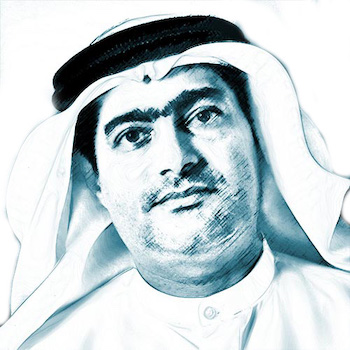
The new mass trial – first reported by the Emirates Detainees Advocacy Centre and confirmed to Amnesty by exiled Emirati activists – is a joint prosecution of more than 80 defendants, including victims of a past mass trial such as Mohamed al-Siddiq, father of the late exiled Emirati human rights defender Alaa al-Siddiq, prisoners of conscience such as Khalid al-Nuaimi, Hadef al-Owais, Nasser bin Ghaith and Sultan al-Qasimi, and longstanding human rights defenders such as Mohamed al-Roken and Ahmed Mansoor (see below).
Fresh charges against Ahmed Mansoor
Last month, Amnesty UK campaigners flew a protest plane over Manchester City FC’s Etihad Stadium carrying a large banner saying “UAE – Free Ahmed Mansoor”. Mansoor is a blogger, poet and leading Emirati human rights activist who has been in jail and kept in solitary confinement in the UAE since 2017 as a direct result of his campaigning activity. In 2017, Mansoor was convicted on charges which included “insulting the status and prestige of the UAE and its symbols”, “publishing false information to damage the UAE’s reputation abroad” and “portraying the UAE as a lawless land”. The following year, Mansoor was sentenced to ten years’ imprisonment, with the sentencing court also ordering that he be placed under surveillance for three years after release. His conviction and sentence were upheld by the country’s supreme court on 31 December 2018.
On 5 December 2023 Amnesty International launched its global website as an .onion site on the Tor network, giving users greater access to its work exposing and documenting human rights violations in areas where government censorship and digital surveillance are rife.
In recent years, a number of countries including Algeria, China, Iran, Russia and Viet Nam have blocked Amnesty International websites.
“By making Amnesty International’s website available as a secure .onion site on Tor, more people will be able to read our human rights research and engage with the vital work of speaking truth to power, and defending human rights.”Donncha Ó Cearbhaill, Head of Security Lab at Amnesty Tech.
However, audiences accessing the Amnesty.org website through Tor will be able to bypass attempts at censorship.
An .onion site is a website that is only accessible through Tor, a volunteer-run network of servers which encrypt and route internet traffic through multiple servers around the world, providing users with an added layer of privacy and anonymity.
“The onion site provides a means for individuals around the world to exercise their rights to privacy, freedom of expression, freedom of peaceful assembly, and freedom of association in a safe and secure online environment,” said Donncha Ó Cearbhaill, Head of Security Lab at Amnesty Tech.
The Tor Project has a version of the Tor Browser for many common platforms, including Windows, Mac, Linux, and Android. Onion sites can also be accessed on iPhone through the Onion Browser app. In countries where the Tor network is blocked, visitors will also need to configure Tor bridges which help bypass attempts to block connections to the network.
Amnesty International is also making language-specific content published in Chinese, Farsi and Russian available on the Amnesty International Tor onion website.
“We are thrilled that one of the most recognized human rights organizations has adopted an onion service to provide greater online protections for those seeking information, support and advocacy. Amnesty International’s choice to offer an onion version of their website underlines the critical role of this open-source privacy technology as an important tool in our shared work of advancing human rights,” said Isabela Fernandes, Executive Director, the Tor Project.
What are .onion sites?
Onion services never leave the Tor network. Their location and IP addresses are hidden, making it difficult to censor them or identify their operators. In addition, all traffic between users and onion services is end-to-end encrypted. As a result, users leave no metadata trail making it impossible for their identity or internet activity to be tracked.
Both Tor and virtual private networks (VPNs) can help internet users bypass website blocking and censorship.
Tor routes connection through a number of volunteer run and randomly assigned servers preventing anyone individual or organization from being able to track both the identity and internet activity of users while a VPN connects through a single privately owned server.
The Tor software was first released more than 20 years ago and is now developed and maintained by the Tor Project, a US-registered not-for-profit organization which is focused on advancing human rights and freedoms by creating and deploying free and open-source anonymity software and privacy technologies.
Responding to the indictment of two prominent human rights defenders, Fatia Maulidiyanti and Haris Azhar, Amnesty International Indonesia’s Executive Director Usman Hamid said on 13 November 2023:
“This disgraceful indictment will have a destructive effect on the work of human rights defenders in Indonesia. Instead of protecting the right to freedom of expression, the Indonesian authorities are obliterating civic space. These alarming indictments illustrate the increasing oppression faced by activists who express dissenting opinions. We urge the Indonesian authorities to immediately release Fatia Maulidiyanti and Haris Azhar. The right to freedom of expression must be respected and guaranteed.” See also: https://humanrightsdefenders.blog/2021/10/15/indonesia-human-rights-defenders-under-pressure/
The prosecutor demanded that Fatia should be imprisoned for three years and six months, and Haris for four years. They were deemed guilty after being sued by the Coordinating Minister for Maritime Affairs and Investment, Luhut Binsar Pandjaitan. The minister filed a defamation case against Fatia and Haris in September 2021. Both were charged by the police on 17 March 2022 with defamation under Article 27 section (3) of the Electronic Information and Transactions (EIT) Law. Amnesty International Indonesia has voiced concerns related to problematic provisions in Indonesian EIT Law, including this provision.
The police investigation relates to a YouTube video of a conversation between the two human rights defenders where they discussed the findings of a report on the alleged involvement of several military figures in the mining industry.
Amnesty International Indonesia has recorded that at least 1,021 human rights defenders were prosecuted, arrested, attacked and intimidated by various actors from January 2019 to December 2022. Meanwhile, there are at least 332 people that have been charged under the EIT Law, most of them accused of defamation, between January 2019 and May 2022.
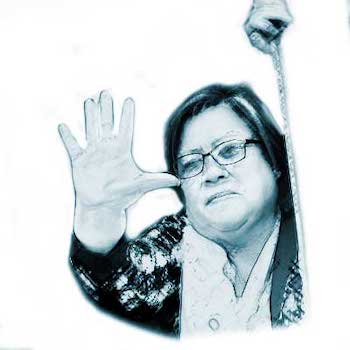
In response to the news that the court granted former Philippine Senator Leila de Lima bail for the third and last drug-related charge against her, Butch Olano, Amnesty International’s Philippines Director, said: “This is a welcome development and a step towards justice.
As a human rights activist and former Senator, she has been one of the staunchest critics of the human rights violations under the administration of former President Rodrigo Duterte. Since her arrest, Amnesty alongside many other organisations have repeatedly said that the charges against her were fabricated and that the testimonies by witnesses against her were manufactured. See: https://www.trueheroesfilms.org/thedigest/laureates/35cd51c0-93fb-11e8-b157-db4feecb7a6f
The authorities arrested de Lima after she sought to investigate violations committed in the context of the so-called “war on drugs” under the former Duterte administration, including the extrajudicial execution of thousands of people suspected of using or selling drugs, which Amnesty has said may amount to crimes against humanity. As in the case of de Lima, there has been almost no justice or accountability for the victims of these abuses and their families.
Court proceedings against de Lima in the last six years have been marked by undue delays, including the repeated failure of prosecution witnesses to appear in court and changes in judges handling the cases against her. In 2018, the UN Working Group on Arbitrary Detention concluded that the detention of de Lima was arbitrary because of the lack of legal basis and the non-observance of international norms relating to the right to a fair trial.
The arbitrary detention of de Lima reflects the broader context of increasing impunity for human rights violations in the Philippines. These violations include killings, threats and harassment of political activists, human rights defenders, members of the media and other targeted groups.
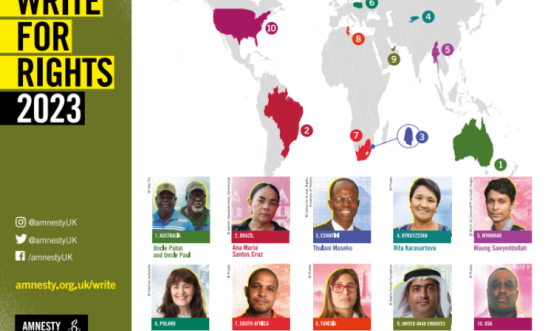
Amnesty International launched its flagship Write for Rights campaign to help people facing human rights abuses around the world. Millions of letters and emails will be sent to support these individuals and urge authorities to end injustices. ‘While sending a letter may seem like a small gesture for any single one of us, the collective action of many of us has the potential to transform lives’ said Sacha Deshmukh, Chief Executive of Amnesty International UK.
Taking place across November and December, Write for Rights will see people around the world send millions of cards, emails and social media posts of solidarity to individuals whose fundamental rights are being threatened or denied, while urging those in power to put a halt to the abuses.
This year, the global Write for Rights campaign will focus on 10 cases of individuals and communities from across the world who are facing human rights violations, including:
Rocky Myers, a Black man, has been on death row in Alabama, USA, since 1994. A nearly all-white jury convicted and sentenced him to life without the possibility of parole for the murder of his white neighbour. The trial judge overrode their decision and imposed a death sentence – a practice now outlawed in Alabama. No evidence linked Rocky to the murder, except for a VCR stolen from the victim, which he maintains he had found abandoned in the street. In 2018, Rocky and others on death row were given 30 days to choose if they wanted to die by nitrogen gas asphyxiation or by amended lethal injection protocols. Rocky chose the former, and his execution could be reset as soon as the new protocol for execution by nitrogen gas asphyxiation is finalised and ready to be implemented, which is expected by the end of this year.
Rita Karasartova, a Kyrgyzstan-based human rights defender who works for the Institute of Civic Analysis – a human rights organisation and think-tank. Rita was arrested in October 2022 for joining group of activists who objected to a border demarcation agreement with Uzbekistan. After the group called for a public assembly and formed a committee to oppose the agreement, Rita and others were charged with attempting to violently overthrow the government, which carries a maximum sentence of 15 years imprisonment. Rita is now under house arrest and a strict curfew.
Ahmed Mansoor is a human rights defender and previously won the prestigious Martin Ennals Award for Human Rights Defenders in 2015. Ahmed has documented human rights abuses in the UAE since 2006, until he was arrested in early 2011 and March 2017, he was given a 10-year prison sentence. He has been held in solitary confinement since the beginning of his detention, and continues to be denied a mattress, access to books, and to be permitted to go out in a yard. See: https://humanrightsdefenders.blog/tag/ahmed-mansoor/ and https://www.trueheroesfilms.org/thedigest/laureates/074ACCD4-A327-4A21-B056-440C4C378A1A]
Justyna Wydrzyńska is a reproductive rights defender in Poland and is one of the co-founders of the Abortion Dream Team, an activist collective campaigning against abortion stigma and offering advice on accessing safe abortion in Poland, where abortion laws are among the most restrictive in Europe. In March 2023 Justyna was convicted to 8 months’ community service for helping a pregnant woman to access abortion pills in Poland, setting a dangerous precedent in a country where abortion is almost completely banned.
Amnesty International’s Write for Rights campaign dates back to the origins of Amnesty International in 1961. In the organisation’s early days, Amnesty campaigners wrote letters of support to individuals facing human rights violations. Now, Write for Rights is Amnesty’s flagship campaign, running every year to raise awareness about individuals whose rights are being seriously threatened.
Last year’s Write for Rights saw:
Over 5.3 million actions worldwide – of which at least 234,801 letters and cards were solidarity actions.
Letters were sent from around the world, from Zimbabwe to Hong Kong.
Amnesty’s International Secretariat digitally collected almost double the number of digital actions from 2021.
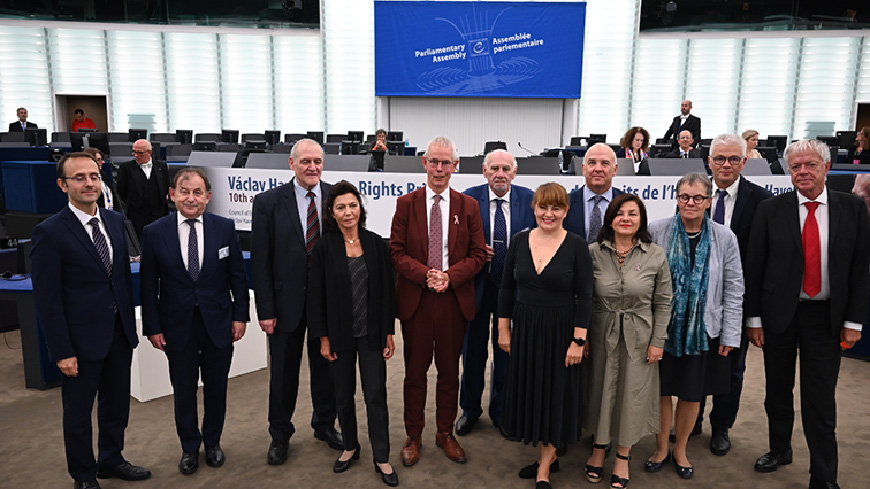
The eleventh Václav Havel Human Rights Prize has been awarded to imprisoned Turkish human rights defender, philanthropist and civil society activistOsman Kavala.
Mr Kavala, a supporter of numerous civil society organisations in Türkiye for many years, has been in prison continuously since 2017 following his arrest for his alleged links to the Gezi Park protests.
In a letter written from prison, read out by his wife Ayşe, Mr Kavala said he was honoured by the decision, and dedicated the Prize to his fellow citizens unlawfully kept in prison. He said the award reminded him of the words of Václav Havel, writing to his wife Olga from prison in 1980: “The most important thing of all is not to lose hope. This does not mean closing one’s eyes to the horrors of the world. In fact, only those who have not lost faith and hope can see the horrors of the world with genuine clarity.”
Responding to the awarding of the 2023 Václav Havel Prize to Turkish prisoner of conscience, Osman Kavala, by the Council of Europe’s Parliamentary Assembly, Amnesty International’s Deputy Regional Director for Europe, Dinushika Dissanayake, said:
“While we celebrate the fact that Osman Kavala has been recognised with this top human rights award, the fact that he cannot be in Strasbourg to collect it in person is heartbreaking. Instead, having already been in jail for almost six years, he is languishing behind bars in Türkiye on a politically-motivated life sentence without the possibility of parole.
Rather predictably: in a statement posted on X, formerly known as Twitter, Justice Minister Yılmaz Tunç said it was unacceptable for the CoE to award a “so-called” human rights prize to a convict, whose verdict of conviction was approved by one of Türkiye’s top courts.
A group of nine nongovernmental organizations including Human Rights Watch and Amnesty International said the prosecution of rights defender and businessman Osman Kavala and four codefendants in connection with mass protests a decade ago was unfair and essentially a political show trial from the beginning, calling for an urgent international response.
The international community must pursue pathways for justice at the international level to address systemic impunity for Iranian officials responsible for hundreds of unlawful killings of protesters and widespread torture, Amnesty International said on 13 September 2023, as Iran marks the one-year anniversary of the “Woman Life Freedom” uprising.
Over the past year, Iranian authorities have committed a litany of crimes under international law to eradicate any challenge to their iron grip on power. These include hundreds of unlawful killings; the arbitrary execution of seven protesters; tens of thousands of arbitrary arrests; widespread torture, including rape of detainees; widespread harassment of victims’ families who call for truth and justice; and reprisals against women and girls who defy discriminatory compulsory veiling laws.
“The anniversary of the ‘Woman Life Freedom’ protests offers a stark reminder for countries around the world of the need to initiate criminal investigations into the heinous crimes committed by the Iranian authorities under universal jurisdiction. Government statements calling on the Iranian authorities to halt the unlawful use of firearms against protesters, stop torturing detainees, and release all individuals detained for peacefully exercising their human rights remain as crucial as ever. These actions show victims they are not alone in their darkest hour.”
The anniversary of the ‘Woman Life Freedom’ protests offers a stark reminder for countries around the world of the need to initiate criminal investigations into the heinous crimes committed by the Iranian authorities under universal jurisdiction. Diana Eltahawy, Amnesty International’s Deputy Regional Director for the Middle East and North Africa
The Iranian authorities have waged an all-out assault on the human rights of women and girls over the past year. Despite months of protests against Iran’s compulsory veiling laws, triggered by the arbitrary arrest and death in custody of Mahsa/Zhina Amini, the authorities have reinstated “morality” policing and introduced a raft of other measures that deprive women and girls who defy compulsory veiling of their rights.
These include the confiscation of cars and denial of access to employment, education, healthcare, banking services and public transport. Simultaneously, they have prosecuted and sentenced women to imprisonment, fines and degrading punishments, such as washing corpses.
This assault on women’s rights is taking place amid a spate of hateful official statements referring to unveiling as a “virus”, “social illness” or “disorder” as well as equating the choice to appear without a headscarf to “sexual depravity.”
The authorities are also working on new legislation that will introduce even more severe penalties for defying compulsory veiling.
Mass arbitrary detentions and summons
During the uprising and in the months that followed, the authorities arbitrarily arrested tens of thousands of men, women and children, including protesters, human rights defenders and minority rights activists. Those arrested include at least 90 journalists and other media workers and 60 lawyers, including those representing families of individuals unlawfully killed. Scores of other lawyers were summoned for interrogations. [see e.g. https://humanrightsdefenders.blog/2023/05/11/now-it-is-the-turn-of-the-iranian-journalists-who-reported-on-mahsa-amini/]
Ahead of the anniversary, the authorities have intensified their campaign of arbitrary arrests targeting, among others, family members of those unlawfully killed, and forcing thousands of university students to sign undertakings not to participate in anniversary protests.
Execution of protesters
Over the past year, the authorities have increasingly used the death penalty as a tool of political repression to instil fear among the public, arbitrarily executing seven men in relation to the uprising following grossly unfair sham trials. Some were executed for alleged crimes such as damage to public property and others in relation to the deaths of security forces during the protests. All were executed after Iran’s Supreme Court rubber stamped their unjust convictions and sentences despite a lack of evidence and without carrying out investigations into their allegations of torture. Dozens remain at risk of execution or being sentenced to death in connection with the protests.
A crisis of impunity
The authorities have refused to conduct any thorough, independent and impartial investigations into the human rights violations committed during and in the aftermath of the “Woman Life Freedom” uprising and have failed to take any steps to hold those suspected of criminal responsibility to account.
Instead, authorities have applauded the security forces for suppressing the unrest and shielded officials from accountability, including two officials who admitted raping women protesters in Tehran. They have also dismissed complaints from victims and/or their families, threatening them with death or other harm if they pursued their complaints.
Amnesty International welcomed the establishment of a Fact-Finding Mission on Iran by the UN Human Rights Council in November 2022, yet much more is needed to combat the crisis of impunity for serious crimes in Iran – and to deter further cycles of bloodshed.
Amnesty International urges all states to consider exercising universal and other extraterritorial jurisdiction in relation to crimes under international law and other serious human rights violations committed by Iranian authorities, irrespective of the absence or presence of the accused in their territory. This includes initiating adequately resourced criminal investigations aimed at disclosing the truth about the crimes, identifying those suspected of responsibility, including commanders and other superiors and issuing, when there is sufficient admissible evidence, international arrest warrants. States should also contribute to achieving reparations for the victims.
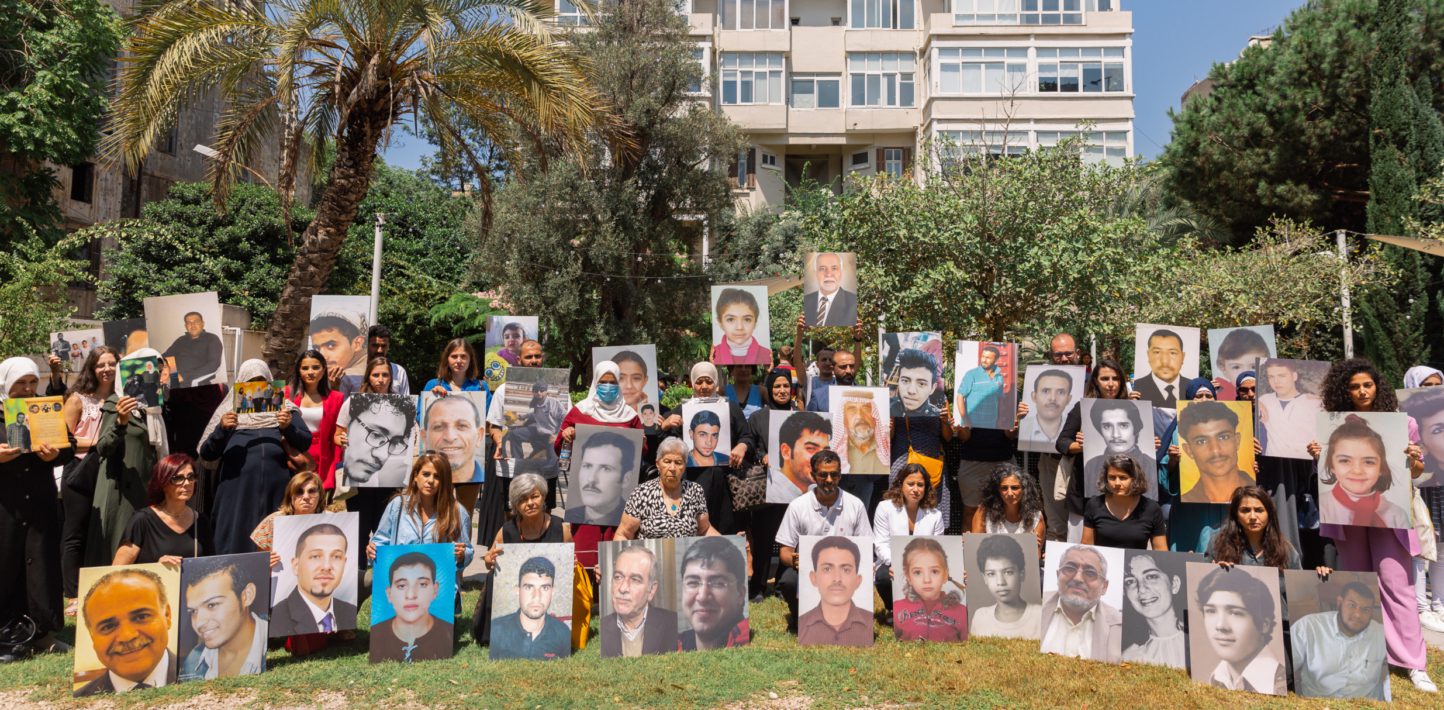
On 30 August 2023, Amnesty International reported on that Representatives of the families of people forcibly disappeared in Iraq, Lebanon, Syria and Yemen gathered in Beirut to demand that their governments uphold their rights to truth, justice and reparation, during an event organized by AI to mark the International Day of the Victims of Enforced Disappearances.
Across the Middle East, both state authorities and non-state actors, such as armed opposition groups, abduct and disappear people as a way to crush dissent, cement their power, and spread terror within societies, largely with impunity.
While most governments in the region have not yet investigated disappearances nor provided accurate numbers of those missing or disappeared, civil society organizations and UN bodies have published estimated numbers of people abducted and disappeared in each country. These numbers in Iraq, Lebanon, Syria and Yemen, when multiplied by a conservative estimate of the total years these individuals have been missing, suggest that families have spent more than a million years waiting for answers – an agonizing length of time.
“In the face of their governments’ apathy and complicity for the crime of enforced disappearances, the families of the disappeared across the Middle East have led the charge, year after year, in demanding their right to know what happened to their loved ones and to get justice and reparation – often at great personal risk,” said Aya Majzoub, Amnesty International’s Deputy Director for the Middle East and North Africa.
“Today we honour their perseverance and add our voice to theirs in calling for authorities to take real action to investigate these crimes, hold those suspected of criminal responsibility accountable and ensure these crimes are not committed again.”
Iraq
In Iraq, the UN estimates that between 250,000 to 1,000,000 individuals have been disappeared since 1968 – making it one of the countries with the highest number of disappearances in the world. Disappearances are still being carried out today at hands of militias affiliated with the government. Consecutive Iraqi governments have repeatedly failed to take meaningful steps to investigate disappearances or hold those suspected of criminal responsibility to account. Widad Shammari from Iraqi organization Al Haq Foundation for Human Rights, whose son has been missing since 2006, said: “I was a single protester until I met many others who shared my struggle, and we formed a strong coalition who fights for the truth for all the disappeared in the Arab region, not just Iraq.”
Lebanon
In Lebanon, the official estimate of those abducted or missing as a result of the 1975-1990 civil war is 17,415. Every year, on 13 April – the anniversary of the start of the Lebanese Civil War – the families of the missing and disappeared gather to mark the beginning of the conflict, repeating the mantra, “Let it be remembered, not repeated.”
The Lebanese authorities granted amnesty to the perpetrators of crimes that occurred during the civil war, but after years of campaigning, in 2018, the families of the disappeared successfully pressured the government to acknowledge the disappearances that took place. The government also passed a law that established the National Commission for the Missing and Forcibly Disappeared with a mandate to investigate individual cases, locate and exhume mass graves and enable a tracing process.
However, Wadad Halawani, whose husband was kidnapped in 1982 and who leads the Committee of the Kidnapped and Missing in Lebanon said: “Today, we raise our voice and shout out loud. The National Commission for the Missing and Forcibly Disappeared is 3 years old already. Only two years remain in its mandate. The Commission established a clear strategy for its work, but it cannot carry on without the needed financial and logistical support. The government must provide it with all the needed resources immediately.”
Syria
Since 2011, the Syrian authorities have forcibly disappeared tens of thousands of its actual or perceived opponents, including political activists, protestors, human rights defenders, journalists, lawyers, doctors, and humanitarian aid workers, as part of a widespread and systematic attack against the civilian population that amounts to crimes against humanity. Thousands have also gone missing after being detained by armed opposition groups and the so-called Islamic State. Given the Syrian government’s role in orchestrating the campaign of enforced disappearances, there has been total impunity for these crimes in Syria. The families have therefore resorted to international justice mechanisms.
In a momentous victory for the families, on 29 June 2023, the UN General Assembly voted to establish an international institution dedicated to shedding light on the fate and whereabouts of those missing and disappeared since the start of the armed conflict in Syria.
Fadwa Mahmoud from Families for Freedom, whose husband and son were disappeared in Syria in 2012 said: “We had big dreams in 2011. But we paid a very heavy price. My husband and son have been disappeared since September 2012… We faced our fears and raised our voice until it reached the United Nations …this [institution] is the product of our labour as the families of the detained…and this is its strength. We are demanding that we have an instrumental role in the institution.”
My husband and son have been disappeared since September 2012… We faced our fears and raised our voice until it reached the United Nations …this [institution] is the product of our labour as the families of the detained…and this is its strength.Fadwa Mahmoud from Families for Freedom, whose husband and son were disappeared in Syria in 2012
Yemen
In Yemen, human rights organizations have documented 1,547 cases of disappeared and missing people since 2015. All parties to the conflict, including the Huthi de facto authorities and the internationally recognized government forces, are still committing these crimes with impunity at a time when the world’s attention has turned away. Since the Human Rights Council voted in 2021 to end the mandate of the Group of Eminent Experts, following heavy lobbying from Saudi Arabia, efforts to hold all those suspected of criminal responsibility accountable in fair trials and realize victims’ rights to reparations have stalled.
The Abductees’ Mothers Association in Yemen said: “We were harassed and threatened and beaten-up during demonstrations, but we will not give up and we are determined at ensuring some progress every step of the way. We are not mothers of our own disappeared family members only; we consider ourselves mothers of every single disappeared person in the region and we will continue our fight for the truth for all of them.
On August 29, 2023, Amnesty International USA, Human Rights Watch, Project on Middle East Democracy (POMED) and 16 additional civil society organizations delivered an open letter urging U.S. Secretary of State Antony Blinken to encourage the United Arab Emirates (UAE) government to immediately and unconditionally release Emirati human rights defender Ahmed Mansoor ahead of the 28th Conference of Parties of the United Nations Framework Convention on Climate Change (COP28) that will take place from November 30 to December 12, 2023. [for more on UAE: see https://humanrightsdefenders.blog/tag/ahmed-mansoor/]
In the letter, the organizations urged Secretary Blinken to call on the UAE government to immediately and unconditionally release Ahmed Mansoor and other jailed human rights defenders and peaceful critics both privately and publicly at the highest levels. The organizations also called on the Secretary to signal deep concern about Mansoor’s well-being and request permission to visit him in prison as soon as possible.
“With the world’s attention on Dubai, the US government should deliver on this administration’s promise to center human rights in its foreign policy and press the Emirati authorities to finally release Ahmed Mansoor,” said Elizabeth Rghebi, Advocacy Director for the Middle East and North Africa, “As a participant in COP28, the US government can demand the UAE demonstrate through this high profile release its commitment to the human rights principles required for healthy civic space at this upcoming global gathering.”
Governments have an obligation to protect the civic space for protest, in particular guaranteeing the rights to freedom of peaceful assembly and freedom of expression. Subjecting human rights defenders and critics to unlawful use of force, arbitrary detention, unfair trials, and abusive detention conditions violate these and other rights. The US government should work to uphold its obligations both at home and when engaging diplomatic partners.
Mansoor was arrested by Emirati authorities in March 2017 for “spreading false news” to “harm the reputation of the state.” All the charges on which he was convicted were based solely on his human rights advocacy, including using email and WhatsApp to communicate with human rights organizations. Following more than a year in isolation in pre-trial detention and a grossly unfair trial, an Emirati state security court sentenced Mansoor to 10 years in prison. Mansoor is a laureate of the MEA [see: https://www.trueheroesfilms.org/thedigest/laureates/074ACCD4-A327-4A21-B056-440C4C378A1A]
Throughout his imprisonment, Mansoor has been subjected to treatment that violates the prohibition against torture and other cruel, inhuman, or degrading treatment, including being held in solitary confinement without access to reading materials, television, or radio. Since December 2017, he has been denied eyeglasses, most personal hygiene items and, at least until recently, a bed or mattress in his cell.
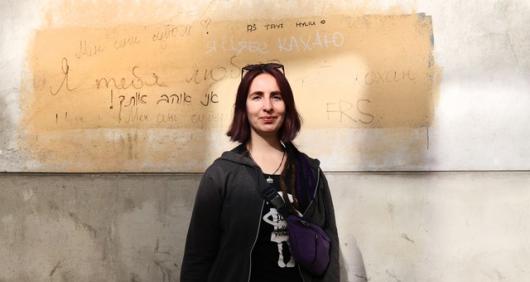
Nasta (Anastasia) Loika was sentenced to 7 years in a penal colony for “inciting racial, national, religious or other social enmity or discord” on 20 June 2023. She is a prisoner of conscience, targeted in retaliation for her human rights work.
Nasta (Anastasia) Loika is a prominent human rights defender and educator, focusing her work on human rights violations resulting from the use of the repressive “anti-extremist” legislation in Belarus, the protection of foreign nationals and stateless persons in Belarus, and on human rights education.
Nasta Loika was sentenced for “inciting racial, national, religious or other social enmity or discord” under Part 3 of Article 130 of the Belarusian Criminal Code on 20 June 2023. The Belarusian human rights defender and prisoner of conscience was arbitrarily detained on 28 October 2022, accused of “petty hooliganism”, a violation under Article 19.1 of the Code of Administrative Offences. As the Belarusian authorities repeatedly brought the allegations against her, she served a total of five consecutive 15-day terms in detention for the same purported offence. On 24 December 2022, she was arbitrarily charged under Articles 342.1 (“Organization and preparation of actions that grossly violate public order, or active participation in them”) and 130.3 (“inciting racial, national, religious or other social enmity or discord”) of the Belarusian Criminal Code.
Nasta Loika reported that she had been tortured by electric shock during questioning and that whilst in detention she was left out in the courtyard for eight hours without outerwear in cold weather. She has consistently not been provided with the medical care she requires, which in itself may amount to inhumane and degrading treatment.