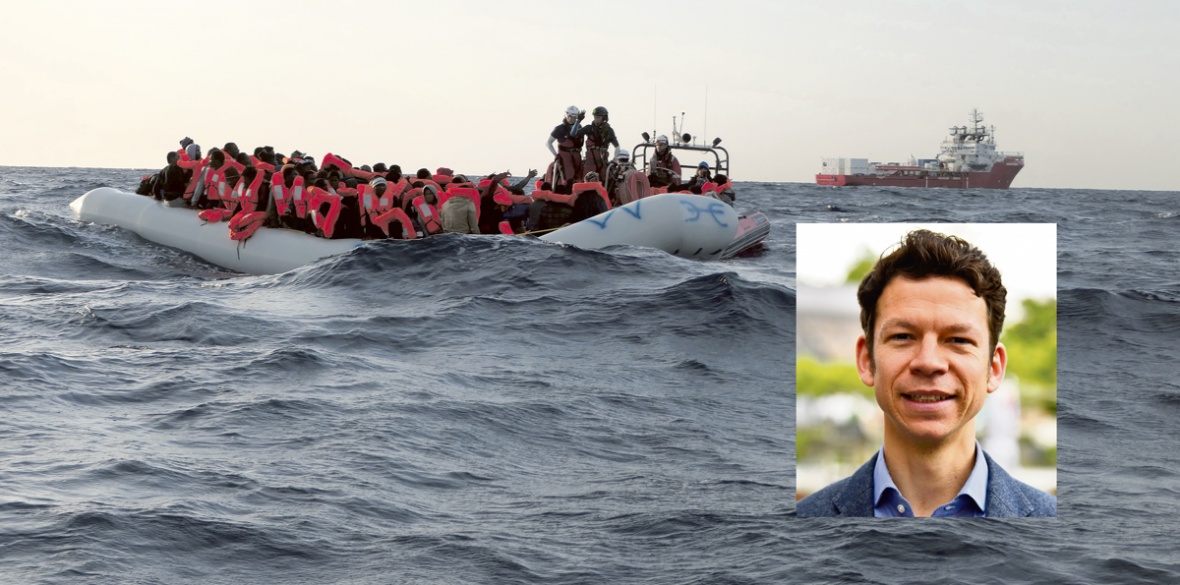
Ocean Viking completes another sea rescue and (insert) David Starke Photo: Avra Fialas/SOS Mediterranee
18 December was International Migrants Day and in honor of that a report from David Starke (general director of SOS Mediterranee Germany and Ben Cowlesthe Star’s web editor) in the Morning Star of 7 December 2019 arguing the case of rescuers as human rights defenders.
THE Ocean Viking, a refugee rescue ship operated jointly by SOS Mediterranee and Doctors Without Borders (MSF), saved the lives of 60 people from a watery grave in the Mediterranean last week. The European Union — having ignored the refugees’ initial distress calls as they attempted to escape war-torn Libya in an unseaworthy boat on the evening of November 28 — refused to provide the Ocean Viking with a port of safety. It wasn’t until Palermo mayor Leoluca Orlando called on Italian prime minister Giuseppe Conte to end the five-day standoff on Twitter that the ship was allowed to dock.,,,
SOS Mediterranee and MSF originally began operating refugee rescue missions in the central Mediterranean onboard the Aquarius. But after a series of legal threats from EU member states, the charities were forced to abandon it.
“In 2016-7 when we started operations, we were celebrated as heroes. The Aquarius rescued nearly 30,000 people,” Starke says. “But then in June 2018, the escalations started. We were the first ship to be refused access to harbours in Italy. We had to bring the rescued all the way from Italy to Valencia. That was the first really significant standoff, which by now has become the norm.”..
In November 2018, while the Aquarius was docked in Marseilles, the Panamanian government — under pressure from Italy — withdrew its flag from the ship. ….
“We tried Switzerland, Germany and France. These would have been robust flags — meaning that if there was political pressure then they would not give in so easily to the Italian government. But none of the governments granted them to us” and we had to give up.
—
“It’s maritime law to rescue people in distress at sea. All we do is follow existing laws. And according to those laws, a rescue is only completed once the rescued have reached land: once they’re put in a port of safety. “At the moment, it is European countries that have the nearest port of safety to our rescues and the only countries that can be considered safe. “The fact is our work is hampered by European governments.”
—
Despite abiding by refugee and maritime law, it is often the Ocean Viking’s crew (and the entire civil refugee rescue fleet in general) that are portrayed as the criminals or as human traffickers. “All we do is save people’s lives. We are human-rights defenders. However, if you talk to to some politicians, if you read some newspapers, if you read some of the nasty emails we receive, they say we smuggle people. They say we’re criminals.
—
Despite the EU’s willingness to allow refugees escaping Libya to die crossing the world’s deadliest border and the demonisation of those trying to prevent that, Starke says that he is optimistic. “I’m optimistic the situation will change, simply because it has to change.
Stock Daily Dish on 16 December 2019 reports that Melania Trump made a rare public appearance to present 13 women with the 2017 Secretary of State’s International Women of Courage Award. The prize honors those who fight for women’s empowerment, often at great personal risk. “Together, we must declare that the era of allowing the brutality against women and children is over while affirming that the time for empowering women around the world is now,” Mrs. Trump said. She called on leaders to “continue to work towards gender empowerment and respect for people from all backgrounds and ethnicities,” and on the international community to fight all forms of injustice. For more on this award – and 7 more that have ‘courage’ in the title – see: http://www.trueheroesfilms.org/thedigest/awards/international-women-of-courage-award.
Each US embassy can nominate one woman for the award. The 13 women honored this year are:
Malebogo Molefhe (Botswana), who used to play for the Botswana national basketball team, has served as an advocate for survivors of gender-based violence after she was attacked and shot eight times by her ex-boyfriend in 2009 and confined to a wheelchair,
Rebecca Kabugho (Democratic Republic of the Congo), has led peaceful anti-government protests calling for credible elections in the DRC, and spent six months in prison for her role as an activist
Major Aichatou Ousmane Issaka (Niger), currently the deputy director of social work at the Military Hospital of Niamey, was one of the first women to join the Nigerien army in 1996, and was one of the first to attend a military academy. She has served throughout Niger, including in the Diffa Region, a stronghold of the Boko Haram terrorist group.
Veronica Simogun (Papua New Guinea), the founder and director of the Family for Change Association, who works to help shelter and relocate women affected by violence,
Saadet Ozkan (Turkey) was a primary school teacher, who uncovered a “decades-long pattern of sexual abuse” and forced a criminal investigation of the principal; she still supports the victims and their case as a private consultant.
Jannat Al Ghezi (Iraq), helps Iraqi women escape violence, rape and domestic abuse, as well as Islamic State terrorism and occupation, and offers them shelter, training, protection and legal services through the Organization of Women‘s Freedom in Iraq
Sister Carolin Tahhan Fachakh (Syria), known as Sister Carol, runs a nursery school in war-torn Damascus for more than 200 Muslim and Christian children, as well as a tailoring workshop for internally displaced women.
Fadia Najib Thabet (Yemen) is a child protection officer who has dissuaded young boys from joining Al-Qaeda, exposed its Yemeni branch Ansar al-Sharia as a recruiter of child soldiers and reported on human rights violations for the UN Security Council.
Sharmin Akter (Bangladesh), a student who refused an arranged marriage at age 15, which resulted in the prosecution of her mother and her much-older prospective husband,
Sandya Eknelygoda (Sri Lanka), who fought for justice after the disappearance of her journalist husband in 2010 and who has served as a voice for the families of others who have disappeared during the country‘s civil war.
Natalia Ponce de Leon (Colombia), who has become a human rights activist for the victims of acid attacks after a stalker threw a liter of sulfuric acid on her in 2014,
Arlette Contreras Bautista (Peru), a domestic violence survivor and activist, who helped launch the Not One Woman Less movement, which aims to increase the social and political awareness of women‘s rights and gender-based violence in Peru.
The newspaper noticed that Mrs Trump did not mention her husband or his presidential administration during her 10-minute remarks.
In a statement to mark International Human Rights Day, the Zimbabwe Human Rights Commission (ZHRC) said young people have a significant role to play in the protection and promotion of human rights. The ZHRC said rights come with certain responsibilities and obligations and young people should exercise their rights responsibly. “For instance, young people must shun all forms of violence and refrain from being used to oppress other people, engaging in political violence and other acts inconsistent with human rights principles and values of respect for human dignity, honesty, justice, fairness and equality,” reads the ZHRC statement. The commission said it is advocating for youths across the political divide to push their parties towards embracing human rights. ZHRC said youths should positively change the national narrative towards enjoyment of rights.
The Bahamas Weekly used the occasion of International Human Rights Day to publish a statement by the OAS Secretary General: ..As Secretary General of the Organization of American States(OAS), I have dedicated myself above all else to promoting a strong vision: more rights for more people. ..This year I particularly want to express my concern about the violence suffered by people who defend human rights in the Americas. Unfortunately, all too often we are forced to remember what should be obvious: the human rights of social leaders are, as are the human rights of all citizens of the Hemisphere, inviolable. I want to recognize these leaders and defenders of human rights throughout the Hemisphere. For the OAS, it has been and remains imperative to accompany and support their efforts to promote, assert, respect and protect human rights. This work constitutes a central axis for social transformation and the consolidation of peace, democracy and the validity of human rights in the region. It is fair to make a special mention of all those women leaders defending human rights, for transforming their realities, for being peace-building agents, for opening spaces that historically have been denied them, making way for more women to exercise their rights every day with a powerful agenda of equality and peace.
The New Times of Rwanda focused on people with disabilities.
…..Despite political will and legal guarantees, persons with disabilities are generally denied many of their rights and dignity across the world. This is often due to discrimination and stigma in society. We see this discrimination and stigma in the way people relate to persons with disability and in the language that is used towards them, their parents and their siblings. We also see it in the names people give them, the way people look at them and the manner in which they are often dismissed, excluded and marginalized in schools and businesses etc.
This is why we must work hard on changing mindsets and improving awareness. We need the current and the next generation to realize that people with disabilities are still people, who think and dream and feel the same way we do. And they have abilities, as much as the rest of us, but they sometimes need some assistance to realize their full potential.
The Sustainable Development Goals (Agenda 2030) calls for the empowerment of persons with disabilities in all spheres of life. Disability is referenced in various parts of this Agenda and specifically in parts related to education, economic growth and employment, inequality, accessibility of human settlements, access to services, as well as data collection and monitoring. The 2030 Agenda encourages us to focus on providing fair and equitable opportunities to all, including persons with disabilities……How often do we stop to ask, “How accessible are our homes, schools, hospitals, public transport, churches, public offices, entertainment buildings to persons with disabilities?” Do we include sign language in meetings and television? Do we welcome persons with disabilities in our workshops and on our panels to discuss important topics pertinent to all? In our families, study and work environments, in our churches and communities, are we having conversations about the needs and rights and abilities of persons with disability?
Finally, empowerment is about equipping persons with disabilities with skills and facilities, including assistive devices, which allow them to actively and independently contribute to the development of themselves, their families, communities and countries. It is about not giving them a fish to survive on for a day but teaching them to fish to create a better future and, and also contribute to Rwanda’s development.
Yemen:
Over 17 NGOs wrote to the leaders of all warring parties in Yemen, Saudi Arabia and the UAE:
We write to you on Human Rights Day to call on you to take meaningful steps to end detentionrelated abuse in Yemen. Steps taken in recent weeks by both the Ansar Allah armed group (Houthis) and the Kingdom of Saudi Arabia to unilaterally release hundreds of detainees were positive. There remains an urgent need to address rampant, ongoing detention-related abuse that continues to affect tens of thousands of Yemenis across the country. The impact of detention-related abuse goes beyond the person detained – it impacts their family members, their loved ones and wider society. In addition to ending the suffering of victims and their families, ending and redressing detention-related abuses also would contribute towards reaching a just and sustainable resolution of the conflict in Yemen.
We specifically write to ask you to build on recent positive steps by using your authority and influence to help ensure the release of all those arbitrarily detained, an end to enforced disappearances, torture and other ill-treatment, the improvement of conditions of detention, including the facilitation of family visits, and full cooperation with efforts to ensure that individuals reasonably suspected of responsibility for war crimes and serious human rights violations, including torture and hostage-taking, are prosecuted in fair trials that preclude the death penalty.
……. While the recent unilateral release of prisoners – mostly fighters – by both the Houthis and KSA, may help build confidence between the parties, more extensive and comprehensive steps must be taken to address rampant detention-related rights abuse, regardless of the state of political talks. To that end, we call on you to use your influence and good offices to help bring about an end to ill-treatment, torture, arbitrary detention and forced disappearances by all parties to the conflict. We urge you to help secure the release of those arbitrarily detained, human rights defenders, journalists and peaceful activists; and that anyone deprived of their liberty is granted regular access to their families and lawyers; and that international monitors are allowed immediate access to all detention facilities, unofficial and official.
PNG/EU
The EU honored 5 civil society organizations which have over the years worked with the EU in advancing and defending Human Rights in communities across Papua New Guinea.
These five organizations are: Child Fund Papua New Guinea, World Vision Papua New Guinea, Transparency International Papua New Guinea, City Mission PNG Limited and PNG Tribal Foundation. The specific topics addressed by these civil society organizations include: providing safe refuge centers and accommodation for victims of intimate partner violence and abused children; training and capacity building of front line workers; advocacy and awareness raising; advocating for the recognition of the work of Human Rights defenders and fighting corruption in the country. They are just examples of many countless organizations and individuals who are at the forefront of promoting and defending human rights in Papua New Guinea. The European Union recognizes the importance of the work of such organizations in defending human rights, often in the face of adversity and personal cost. The European Union calls on all partners to allow such organizations and individuals to work in a safe and enabling environment, free from obstruction and insecurity.
Nigeria: Lawyers and activists have used this year’s International Human Rights Day to assess the human rights situation in Nigeria. Marking the event last week in Abuja, the activists were of the view that the human rights situation has dropped since the return of democracy in 1999. Speaking at the event organised by the Nigerian Bar Association (NBA), the International Federation of Women Lawyers (FIDA), and civil society groups, senior lawyers and rights defenders called on legal practitioners and citizens to defend liberty. In his remark, Jibrin Okutepa (SAN) said “until the legal profession begins to take objection to every violations of human rights, including self-violations, and begin to apply sanctions, the government will continue to violate human rights with such impunity and audacity of arrogance.” Speaking on the topic ‘The State of Human Rights in Nigeria’, a civil society activist, Ebun-Olu Adegboruwa (SAN), criticised the Social Media Regulation Bill and Hate Speech Bill before the National Assembly as a breach of the provisions of Section 39 of the 1999 Constitution which grants freedom of expression. “When you get to a situation in a country where the leader says people should not talk, then they are afraid of something. It is either we are getting set for a third term agenda or getting set for a full blown civilian dictatorship,” he said. Also commemorating the day, the Avocats Sans Francaise France (ASFF) otherwise known as Lawyers Without Borders, called on security agencies to adhere to the rule of law and due process in the discharge of their duties.
Heinrich Boell Foundation: used the occasion to publish a article by ISHR’s Salma El Hosseiny the 20th anniversary (in 2020) of the creation of the mandate of the UN Special Rapporteur on the situation of human rights defenders. For the full article follow the link below. “All UN agencies should treat the Declaration on human rights defenders as a ‘guiding star’ for their work. UN agencies working on promoting the implementation of the Sustainable Development Goals (SDGs) should integrate the protection of defenders as a vital component of contributing to implementation of the SDGs and the prevention of human rights violations. At a time where people across the globe are demanding more inclusive, sustainable and fairer societies, defenders are acting as leaders and agents of change to ensure that the world’s leaders have no choice but to listen.“
On 16 December 2019 Sean Ingle wrote in the Guardian “Craven Arsenal abandon Mesut Özil over his stance on China’s Uighur persecution“. He argued that the midfielder is in tune with human rights groups over the imprisonment of millions of Uighurs but the club chose to raise a white flag. The incident touches on more than the freedom of expression of an individual player. ‘Sports washing’ (see earlier posts: https://humanrightsdefenders.blog/tag/sports-washing/) is a widespread phenomenon to which Arsenal itself in no stranger. It plays in the Emirates Stadium and in Emirates T-shirts (in a 280 million $ deal) without ever mentioning Ahmed Mansoor the UAE’s most prominent political prisoner [see also: https://humanrightsdefenders.blog/2018/06/07/ahmed-mansoor-ten-years-jail-for-tweeting-and-a-street-named-after-you/]
A demonstrator in Istanbul holds up a picture of Arsenal’s Mesut Özil who expressed his horror at China’s treatment of the Uighurs. Photograph: Kemal Aslan/Reuters
On the Chinese social media site Weibo Arsenal quicly posted that Özil’s comments were merely his “personal opinion” and reminding that “Arsenal has always adhered to the principle of not involving itself in politics”. The article nicely quotes Simon Chadwick, a professor of sports enterprise at Salford University who specialises in China: “The world is in the midst of an ideological battle: western liberalism versus eastern authoritarianism. And sport is one of the front lines.”
Also saying it is just a personal opinion, seems a bit much: Özil was entirely in tune with a United Nations panel and multiple human rights groups who have spoken out about the imprisonment of millions of Uighur people in internment camps without trial for “re-education” in what has been described as the largest incarceration of one ethnic group since the Holocaust, with multiple accounts of torture, rape and abuse from eyewitnesses who have passed through.
Celebrities have been criticised for NOT speaking out when they insist on touring human rights violating regimes (e.g. only last week Anthony Joshua was widely criticised for not speaking out about human rights in Saudi Arabia and Mariah Carey in July this year [https://humanrightsdefenders.blog/2019/07/10/nicki-minaj-did-the-right-thing-and-cancelled-her-performance-in-saudi-arabia/]. Sean Ingle states” Yet can you blame sportspeople for staying quiet when they see Özil bravely raising his head above the parapet only to be shot down by his own club? As for Arsenal not involving themselves in politics, what did the club think they were doing when they agreed a £30m deal with the Rwandan government to promote tourism?
It would seem that what is ‘political’ is mostly determined by the sensitivity and power of the country being targeted. And in the case of China there is very little margin. Whether it is the according of awards to dissidents or accepting statements on Hong Kong by NBA officials [see more generally: https://humanrightsdefenders.blog/2012/12/06/china-and-its-amazing-sensitivity-on-human-rights-defenders/]. As Sean Ingle stated: The decision by CCTV not to show Arsenal’s match against Manchester City is another reminder that there is no middle ground here. No way to stick up for human rights and free speech without angering China. You are either for such values or against them.
In the Intercept of 12 December 2019, Natasha Lennard use the release of the new documentary film “The Animal People” – which is available on demand as of this week – to focus on the story of Harper and his co-defendants, all of whom were convicted under spurious charges of conspiracy to commit terrorism — though none of whom were found to have participated directly in any illegal acts. These were activists who attended raucous but legal protests, shared publicly available information about corporations on their website, and celebrated and supported militant actions taken in the name of the SHAC campaign. That is, they were convicted as terrorists for speech activity. It sounds eerily like the criminalisation fo human rights defenders today:
The convicted activists were members of Stop Huntingdon Animal Cruelty, known as SHAC, a decentralized animal rights movement that spread across the U.K. and U.S. from the late 1990s into the mid-2000s. The movement took aim at the notorious animal testing lab company Huntingdon Life Sciences, which did contract work for corporations. SHAC organized a potent direct-action campaign, which, at a number of points, threatened to shutter the huge testing corporation by driving investors to disaffiliate and divest. The tactics were diverse, from spreading information on animal cruelty, to holding demonstrations, to the occasional act of property damage. In response to SHAC activity, the FBI in 2005 deemed the animal liberation movement to be America’s No. 1 domestic terrorism threat. This, despite the fact that not a single human or animal was injured by SHAC activity in the country.
Each member of the so-called SHAC 7 — there were originally seven defendants before charges were dropped against one — has served their sentence and been out of prison for eight or more years. The broader militant campaign to close Huntingdon Life Science has long been inactive. Revisiting their case now, however, is a worthwhile exercise for understanding the extent to which the supposed rule of law can be bent in the interests of corporate power and its attendant servants in politics.
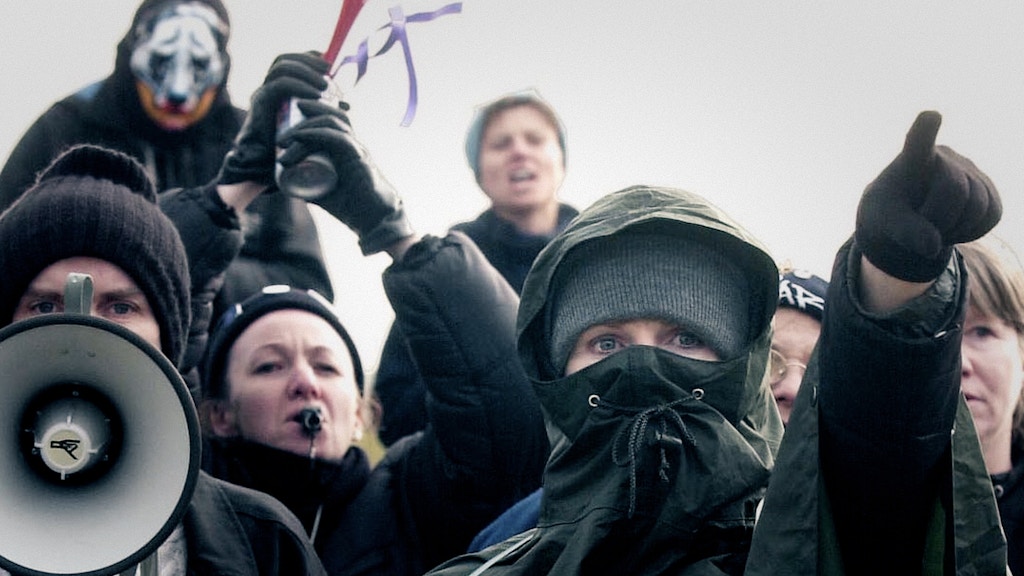
Stop Huntingdon Animal Cruelty protesters. Still: Courtesy of Virgil Films
The SHAC 7 case is a lesson in how legal instruments can be deployed to shut down dissent. At a time of renewed criminalization of protest activity nationwide, the so-called green scare stands as a worrying benchmark for the repression of political speech and the re-coding of protesters as criminals and terrorists. The capricious application of conspiracy charges — which we have seen recently deployed against protesters from Black Lives Matter advocates to Standing Rock water protectors — was mastered in the SHAC 7 prosecution. But “The Animal People” doesn’t only emphasize the excesses of the corporate-state power nexus; it recalls the passionate moral commitments of the SHAC members, and reminds us of a potent protest strategy and set of tactics, which I for one would happily see deployed again.
The first half of the film traces the rise of what seemed, at certain times, to be an “unstoppable” movement. What began as a series of protests in the U.K. soon spread to the U.S., as activists in cities across the country took it upon themselves to confront Huntingdon-affiliated companies and shareholders. Some of the most committed organizers spent hours on complicated research into Huntingdon’s financial infrastructure, following the money to find any and every chokepoint on which to put pressure: be it the major banks and insurance firms propping up the company, or even the janitorial services contracted by a given Huntingdon lab. The information about potential targets was then shared on the SHAC website for activists to use as they saw fit.
……
SHAC tactics were, as any radical political experiment necessarily is, imperfect. Under the campaign’s banner, some activists exposed the names of children of targeted executives — an outlier action, to be sure, but one that visibly still haunts a number of the SHAC defendants in the documentary. The prosecution also made much of the publication on the SHAC website of such information, even though the defendants had no direct involvement. (In the only incident of human harm associated with the movement to shut Huntingdon down, U.K. activists at one point assaulted CEO Brian Cass.)
Skepticism also hovers around the decision to focus wholly on closing Huntingdon, given the prevalence of abusive animal testing. The idea had only been to start with the company, which had already come under public scorn following the release undercover video footage of animal abuse in their labs (parts of which are replayed in “The Animal People”). The activists had planned to win against HLS and expand from there; the biochemical and pharmaceutical industry, with the weight of the federal government behind them, ensured otherwise. Huntingdon has since changed its name to the banal and faux-Latinate “Envigo.”
…..
“The Animal People,” along with most every decent retelling of the SHAC 7 case, makes clear that the six individuals indicted on terror charges were fall guys in the government’s scrambling attempt to put a stop to a movement, which was, against all odds, bringing major corporations to heel. “Corporations get to do what they want — that’s a rule in our society,” Lauren Gazzola, a former SHAC 7 defendant with a robust knowledge of constitutional law, tells the filmmakers. “We challenged the right of this corporation to exist.”
The story of who gets to be a labeled a “terrorist” in this country reflects the ideological underpinnings behind government policy and law. Under the Animal Enterprise Protection Act, expanded in 2006 into the Animal Enterprise Terrorism Act, a terrorist is someone who intentionally damages or causes the loss of property — including freeing animals — used by the animal enterprise, or conspires to do so. It is an obscene state sanctification of corporate private property over life.
…..
As I have written, the current pattern in law enforcement of labeling protests as “riots,” invoking slippery statutes of collective liability, and attempting to justify harsher crackdowns are all troubling for the same reason……
“The animal rights movement has really been the canary in the coal mine when it comes to modern government repression of activist campaigns,” the film’s co-director Denis Henry Hennelly told me by email. The sentiment was echoed by Potter, the journalist. “This is the new playbook for the criminalization of dissent,” he told me. “I’ve already seen it applied to other social movements, both here in the U.S. and internationally. In the years since the trial, though, it has only become more prescient.”
For viewers with little to no knowledge of this history of animal liberation struggle and its repression, “The Animal People” offers a compelling primer, organized through archival protest footage, old home videos of some of the SHAC 7 defendants, interviews with legal experts and investigative journalists, one smug businessman who was targeted by a SHAC campaign, and more recent interviews with the former defendants. As with any 90-minute film, the story the directors, Suchan and Hennelly, chose to tell is only one slice of an international and dispersed movement’s history. But for a documentary with some Hollywood backing — animal lover Joaquin Phoenix is an executive producer — “The Animal People” stands uncomplicatedly on the side of the SHAC defendants and doesn’t dampen their anti-capitalist message.
For Stepanian, this element of animal liberation and the necessary connection with anti-capitalist environmental activism can’t be forgotten. “In terms of the direct-action animal liberation movement today, it’s largely impotent compared to the time period of the SHAC campaign, because most messaging falls squarely in what is safe within the framework of capitalism: Much of the activity revolves around better consumer choices,” Stepanian told me. “I’d like to see another campaign with a lens critical of capitalism, which understands that it is this socioeconomic system which rewards the worst practices when it comes to the treatment of animals as resources, and rewards rapacious attitudes towards the environment.”
The film closes with a montage of uprisings, from students in Hong Kong, to the gilets jaunes in France, to Black Lives Matter activists in the U.S., and marchers for liberation in Palestine. It’s a minimal gesture toward intersectionality in a film that underplays the aspects of SHAC that were dedicated to shared struggle. “It’s not OK to be singular in your solidarity; justice and liberation for all life is paramount,” Stepanian told me, recalling how, prior to his indictment, he went on two organizing road trips with former Black Liberation Army member Ashanti Alston. “We are all intersectional activists,” he said of his former co-defendants.
Jake Conroy of the SHAC 7, who joined one of the road trips, comments near the film’s end: “It’s not just about earth liberation, it’s not just about human liberation, and it’s not just about animal liberation. It’s about collective liberation.”
Witness, the NGO that places importance on the use of video to highlight human rights issues, has been rebranded to “encourage collaboration and participation”. Witness was originally founded in 1992 by musician Peter Gabriel. Its central principal was to give cameras to human rights activists so that they could document their stories. The initiative was dubbed “little brother turning the cameras back on big brother”. In 2019 however, cameras in the hands of few have been replaced by smartphones in the hands of many. As a result, Witness’ mission has shifted somewhat, and now focuses on educating larger groups of human rights defenders in the safe, effective and ethical practice of video.
Pentagram partner Harry Pearce stresses in the new identity a focus on collaboration and participation from a “new generation of human rights defenders”.
Reportage shots and portrait photography play a key part in the new branding, emphasising a connection between different human rights battles around the world. Many of these images are closely-cropped shots of eyes, which are processed with a halftone dot technique. According to the team, this is done to achieve a “simple but effective device which holds the viewer’s gaze”. Throughout the branding, the organisation’s strapline “See it, Film it, Change it” can be found alongside the Witness logomark. Both have been set in Akzidenz Grotesk Medium, chosen for its “striking” and “dynamic” qualities. Alongside this, a “more optimistic” colour palette has also been developed, expanding on the organisation’s usual orange and black.
The winners of the 2019 Franco-German Human Rights and the Rule of Law Prize are fighting battles in key fields such as the fight against torture and inhuman or degrading treatment, against forced disappearances, against violence on women, against discrimination of LGBT people and the promotion of gender equality.
The prize winners include:
Ales BIALIATSKI (Belarus)
Li WENZU (China)
El Nadim Center (Egypt)
Mr Ameha Mekonnen Asfaw (Ethiopia)
Ms Robin Chaurasiya (India)
Nasrin SOTOUDEH (Iran)
Amina HANGA (Nigeria)
Ms Miluska Del Carmen Luzquinos Tafur (Peru)
Ms Mary Aileen Bacalso (Philippines)
Ms Irina Biryukova (Russia)
Ms Delphine Kemneloum Djiraibe (Chad)
Ms Asena Gunal (Turkey)
Luz Mely REYES (Venezuela)
Mr Vu Quoc Ngu (Vietnam)
—
RFA reported on 13 December that Wenzu Li received the Franco-German Prize for Human Rights and the Rule of Law from the French and German ambassadors to China on Wednesday at a joint ceremony in Beijing hosted by the embassies of both countries. Fellow activists were prevented from attending the ceremony by China’s state security police, and Li herself had been followed all the way to the embassy, only making it inside by losing her security detail. “The state security police found out about my award, and posted officers outside my door,” she said. “They followed me the whole time, until I was finally able to get into the embassy.”
Li Wenzu (center) receives the 2019 Franco-German Human Rights and Rule of Law Award, presented by the French and German ambassadors to China at the French embassy in Beijing, December 11, 2019.
In her acceptance speech, Li said the award was a boost not just to her personally, but to all the hundreds of lawyers, rights activists and their families caught up in a nationwide crackdown that began in July 2015.
——
(From left) Robin Chaurasia receiving the award from Sonia Barney and Juergen Morhard
Mumbai-based women’s rights activist Robin Chaurasiya has won the Franco-German Award for Human Rights. Ms. Chaurasiya, who co-founded the non-profit Kranti in 2010, has worked for the betterment of girls born in the red-light areas of the city. Consul General of the Federal Republic of Germany, Dr. Juergen Morhard, and the Consul General of France in Mumbai, Sonia Barbry, presented the award to Ms. Chaurasiya. “When I came to India from the U.S. to work with another NGO, I saw that many children were left on their own once they entered their teenage years. They would be locked in rooms for the slightest mischief,” she said. She believed these children had many talents but did not have the environment to flourish. “I recall they were only being taught how to make pickles and do basic work. I feel we need to get rid of these notions and let them pursue their passion, which could be the ambition to become a doctor or an engineer,” she said. Ms. Das said she met Ms. Chaurasiya at the NGO. “It motivated us to start this initiative. We nurture and help these women fulfil what they want for themselves, not the other way round. If someone wants to study something like music, we look for the best places where they can be enrolled. One of our members is now a music therapist.”
—-
Günal received the prize at a ceremony held at the Embassy of Germany in Ankara on 16 December. Receiving the prize, Asena Günal made a speech in brief:
“As someone working in the field of culture, it would not have occurred to me that I would receive a prize in the field of human rights. As the honorable Ambassador has said ‘cultural rights are more than just an ingredient to the international human rights framework. Participation in cultural life of the society on the one hand, freedom of expression on the other are indispensable rights of every human being’. However, for many years in Turkey, participation in cultural life and freedom of artistic expression remained as a side issue, because there were more pressing concerns such as torture, enforced disappearance and imprisonment. The struggle for human rights was the one carried out by those keeping watch day and night at the Human Rights Association in case someone appealed for help, lawyers who ran to police stations when people were detained, Saturday Mothers who gathered every week despite all obstacles.
“Today, the field of human rights in Turkey has expanded to include culture. There are two reasons for this: One of them is that people have become aware of the importance of considering access to artistic expression and culture and arts in the framework of human rights. The other reason is that state oppression on culture, arts and civil society has increased. Here, I would like to particularly underline the ongoing unjust detention of Osman Kavala that began two years ago and the following oppression and unfounded allegations that made him a target. “In trying times like these, such awards give the motivation to persevere, and make you feel that your efforts are worthwhile. I have never been alone in this process:
The Defenders’ Coalition and HRD Working Group in Kenya announced the winners of the Human Rights Defender of the Year 2019. The awards are a local initiative to honour, promote and protect the work of HRDs in the Kenya.
Wilfred Olal and the Social Justice Working Group are the winners of the Human Rights Defender of the Year 2019. Wilfred is the coordinator of the Dandora Community Justice Centre and Convener of the Social Justice Centres Working Group. He began his work in human rights in 2005 when he joined The Bunge la Mwananchi social movement. He started as a member then rose to the position of national coordinator. The movement is an advocacy for the expansion of civic space and a campaign on the right to protest against corruption and impunity. In 2014, Wilfred and other HRDs decided to set up social justice centres to advocate for social justice and human rights in informal settlements of Nairobi. He started the Social Justice Centres Working Group (SJCWG) in Mathare, then later Dandora. SJCWG advocates and fights for the promotion of human rights in all spheres through documentation, monitoring, reporting of cases of human rights violations and holding community dialogues within their areas of advocacy. Today, SJCWG is a consortium of 28 social justice centers mainly based in Nairobi, Kisumu and Mombasa’s informal settlements.
Benazir Mohammed and the Intersex Persons Society of Kenya won Upcoming Human Rights Defender of the Year while Denis Nzioka, Peninah Mwangi and the late Onyango Oloo won the Munir Mazrui Lifetime Achievement Award. The Human Rights Defenders Awards ceremony was hosted by the French Embassy in Nairobi, with the support from the Belgian, Dutch, German and Swedish Embassies and Haki Africa – a national human rights NGO based in Mombasa, Kenya.
International Human Rights Day, 10 December 2019, was celebrated or observed all around the world and there is no way to report on every event. Stil to add flavour here a selection of some 14 smaller and bigger events – for more details follow the links provided (and for last year’s anthology see references at the end):
There was of course the annual statement by UN High Commissioner for Human Rights Michelle BacheletRightly, these young people are pointing out that it is their future which is at stake, and the future of all those who have not yet even been born. It is they who will have to bear the full consequences of the actions, or lack of action, by the older generations who currently run governments and businesses, the decision-makers on whom the future of individual countries, regions and the planet as whole depends…We have a duty to ensure young people’s voices are heard. The Universal Declaration of Human Rights, adopted by the UN General Assembly on 10 December 1948, was a firm commitment by States to protect the rights of everyone – and that includes making it possible for future generations to uphold human dignity, equality and rights…..Climate harms will not be halted by national borders – and reactions based on hostile nationalism, or short-term financial considerations, will not only fail: they will tear our world apart. The struggles for climate justice and human rights are not a political quarrel. This is not about left or right: it is about rights – and wrongs… We need to mobilise across the world – peacefully and powerfully – to advance a world of rights, dignity and choice for everyone. The decision-makers understood that vision very clearly in 1948. Do they understand it now? I urge world leaders to show true leadership and long-term vision and set aside narrow national political interests for the sake of everyone, including themselves and all their descendants.
Pakistan: Human Rights Defenders asked the government to make serious efforts to provide fundamental rights. Human rights, labour rights and civil society activists called upon the government to make serious efforts for the provision of fundamental human rights and freedoms, especially the freedoms of association and expression, enshrined in the Constitution of Pakistan and the Universal Declaration of Human Rights. Addressing a joint press conference at the Karachi Press Club to mark International Human Rights Day, PILER joint director Zulfiqar Shah, human rights activists Naghma Shaikh and Saeed Baloch representing the Sindh Human Rights Defenders Network said the government should ensure the restoration of the freedom of expression and the freedom to association. They demanded that the government should bring in a law to protect the rights of human rights defenders as they stood up for the voiceless people…. They also demand fully restoring the freedom of expression, as it was a constitutional right of the people to express their thought. Access to the information right must be ensured, they said.
India: Activists say NHRC urgently needs to protect human rights defenders. The National Human Rights Commission should proactively protect the rights of ‘human rights defenders’, said activists at the national convention on rights of Dalit and Adivasi rights defenders in the capital on Tuesday. Human Rights Defenders appealed to the commission to proactively intervene in cases where the works of Dalit and Adivasi organisations were being obstructed. Activists said there were a growing attack on human rights defenders in India and said the need of the hour was collective action….On Human Rights Day, the convention highlighted the importance of the work of human rights defenders. Despite the country having national human rights institutions and over 160 state human rights institutions dealing with human rights, women, children, minorities, SCs, STs, right to information, persons with disabilities, and safai-karamcharis, these institutions have often failed to protect the human rights defenders, activists said. In addition to the usual challenges, women human rights defenders face gender-specific violations, such as rape and sexual violence which are used as tools for harassment, said activists. Caste discrimination has also presented a greater danger for women rights defenders belonging to the Dalit and Adivasi communities.
Cambodia: The Khmer Times reported that very differing opinions on the status of human rights in the Kingdom became apparent as various groups marked Human Rights Day at two venues in the capital. About 400 government officials and youth group members marked the day’s 71st anniversary at the Cambodia-Korea Cooperation Centre, while about 2,000 unionists and members of the public marked the day at Freedom Park.
Keo Remy, president of the Cambodian Human Rights Committee, at the CKCC said the government has always paid attention to the rights of citizens. “Our leaders prioritise peace and stability,” Mr Remy said. “Youths can make the country chaotic because of the words democracy and human rights. That is why we focus on youths and stability.” while..
Ath Thorn, president of the Coalition of Cambodian Apparel Workers’ Democratic Union, at Freedom Park said respecting the rights of workers has decreased over the years and it is a source of concern for many. “We see that respecting workers’ rights has decreased – investors do not pay attention to workers,” Mr Thorn said. “Investors need to consider the rights of workers.” He said garment factory workers are faced with decreasing salaries, overtime work, discrimination, short-term contracts, violence and imprisonment. The Cambodian Centre for Human Rights in a statement said the government has taken action to curb issues surrounding human rights, but it has not done enough. “We call on the government to encourage the celebration of Human Rights Day in Cambodia and acknowledge the benefit human rights have on society as a whole,” it said. “We implore the government to cease all arbitrary action and targetting of human rights defenders.” The CCHR also called for the charges against two former Radio Free Asia journalists and Kem Sokha to be dropped.
Palestine: the Addameer Prisoner Support and Human Rights Association reported that Palestinians marked International Human Rights Day following a year of nonstop violence and widespread human rights violations by Israeli Occupation Forces (IOF), against the Palestinian population used, as a form of collective punishment and a method to control Palestinian society. These consistent and systematic policies by the occupation include, extrajudicial executions and issuance of discriminatory legislations, mass arrests campaigns, torture, administrative detention, and medical negligence against Palestinian political prisoners…..In 2019, the (IOF) continued its crackdown and repression of human rights defenders. Currently, Addameer faces gag orders against around 40 of the cases they represent, who are in interrogation. The gag order prohibits us from releasing any information to the public regarding their detention status, or face grave consequences.
Philippines: Groups under the Ecumenical Voice for Human Rights and Peace in the Philippines (Ecuvoice) has submitted its first wave of reports on the human rights situation in the Philippines to United Nations Commissioner on Human Rights Michelle Bachelet on Monday, Dec. 9. This is in line with Resolution 41/2 which was adopted by the UN Human Rights Council (UNHRC) in July this year. “With the intensifying transgressions on the Filipinos people’s political rights and civil liberties, we are participating in this report-making process of the UN High Commissioner for Human Rights to pursue justice and accountability,” the convenor of Ecuvoice, Edita Burgos, said.
while
the international trade union movement was using international human rights day to call attention to the alarming attacks on human and labour rights defenders in the Philippines. The government’s targeting of trade unionists has been ramped up recently with fresh waves of arrests and violence. The international trade union movement is united in calling on the government to stop the attacks. The government is targeting labour activists through a practice known as red-tagging. By falsely identifying people who speak out against the government as associated to armed militia groups, the government purposely targets them with harassment and arrests and exposes them to violence and even murder….The International Labour Organization (ILO) has resolved to send a High-Level Tripartite Mission to the Philippines to investigate the human rights situation, but despite the urgency, the government has yet to receive the Mission. The international labour movement is undertaking solidarity events across the world to demand an end to the human rights abuses and the targeting of trade unionists. The ITUC has requested to meet with the representative of the Philippines to the EU on Human Rights Day and has outlined three key demands.
Turkey. Amnesty International Turkey and MetroPOLL Strategic and Social Research Center have jointly conducted a Survey on Perception of Human Rights. The results of the survey have shown that when they hear the expression of “human rights”, 65.2 percent of the participants think of “right to life” first. While “freedom of expression” comes to the minds of 33.5 percent, the right to a fair trial ranks third with 22.1 percent. According to the survey participated by 2,651 people from 28 cities and conducted in a face-to-face manner, 82.1 percent of the society think that fundamental rights and freedoms are violated in Turkey. Of these people, 58 percent say that fundamental rights are occasionally violated and 42 percent say that they are frequently violated. 62.6 percent of the participants are of the opinion that fundamental rights and freedoms are restricted in Turkey. While 72 percent of the young participants think that fundamental rights and freedoms are restricted, this rate falls as the age of the participant gets older. For more detials see the full report.
China:Samuel Wade posted an interesting piece in China Digital Times on how the Chinese government defends if record on human rights and how others see this. Here one excerpt out of manY:
On Tuesday, International Human Rights Day, spokesperson Hua Chunying mounted a familiar defense of China’s rights record at the Ministry of Foreign Affairs’ regular press conference …and went on to note that the MoFA and State Council Information Office would host the “2019 South-South Human Rights Forum” this week “with a view to adding new dimensions and injecting impetus into exchange and cooperation in the field of human rights.” ….. At Hong Kong Free Press, the Uyghur Human Rights Project’s Omer Kanat commented on the ‘South-South Human Rights Forum’ hailed by Hua Chunying,…… Among the enablers of Xi Jinping’s repression are states with disreputable recor[ds attracted to a possible exemption from universal standards that ‘human rights with Chinese characteristics’ affords. And again, if we could freely ask the populations who reside in these states how they feel about such a concept, there would be few advocates. Therefore, on Human Rights Day, we have a responsibility to defend those who defend universal values and be clear ‘never again’ has meaning. There is injustice everywhere and we must fight it. Uyghurs are among them, for example, the imprisoned Ilham Tohti, and in exile Rebiya Kadeer, Nury Turkel, Rushan Abbas, and Gulchehra Hoja, whose families have been detained and disappeared in East Turkestan because of their advocacy. The second ‘South-South Human Rights Forum’ is opening in Shanghai for this year’s Human Rights Day. The dangerous fiction of the ‘Beijing Declaration’ that there are exceptions to the universality of rights should be firmly resisted.
Afghanistan ‘Human Rights’ should be more focused during peace talks. MENAFN (Afghanistan Times) reported that UN Special Representative for Afghanistan and head of UNAMA, Tadamichi Yamamoto, in a gathering has expressed concerns regarding the human rights achievements, saying that these gains should be saved in the ongoing negotiation with the Taliban. He called on the National Security Council to consider perseverance of human and civil rights in talks with the Taliban, adding ‘Afghanistan Independent Human Rights Commission’s role is very important in the peace process, every voice that raise should be heard and rights of the victims should be observed.‘.. Moreover, head of AIHRC, Shaharzad Akbar has called on the Taliban to legislatively recognize the values of human rights. …There are massive concerns about the violation of achievements of human rights and freedom of speech in the peace negotiation with the Taliban militants. The Taliban has back in 1990 ruled Afghanistan with the sever restriction on girls and school students. The cultural Taboos and less freedom of women are one of the other key issues that have brought sever concerns from Afghan and foreign officials.
The NGO WITNESS used the occasion to publish its ANNUAL REPORT which looks at key successes from July 2018-June 2019 (fiscal year 2019). See the video clip:
Malaysia. “What happened to Harapan’s vow to improve human rights?” asks Jasmine Choin an open letter:…’When Pakatan Harapan won a dramatic victory in the GE14 elections, they vowed to steer the country forward with human rights as one of their top priorities. However, since their win, we have seen a heavy regression in the area. The kind of regression that has gotten us worried about our present and our future as a modern, fair, and humane nation. From the Suaram 2019 report, several areas of abuse were glaring. One was the treatment of prisoners. The government has yet to abolish the Security Offences (Special Measures) Act 2012, the Prevention of Crime Act 2015 and the Dangerous Drugs (Special Preventive Measures) Act 1985……….The list of human rights abuse is getting longer and the frustration we feel with our government is reaching boiling point. Malaysia is considered a modern and democratic country, so why are we so far behind when it comes to human rights? The government should stop pandering to the religious majority and stop focusing on external matters. The rights of the rakyat are being abused.
Netherlands/Sri Lanka. The Dutch Ambassador Gonggrijp spoke at an event for Human Rights Day 2019 organized by Equal Grounds Sri Lanka saying inter alia:
…Sri Lanka has recently known a long period of conflict, during which human rights were under pressure. The reconciliation process after the end of the war has been slow. And I hear people say: what is the point of looking back, let’s move forward. To my opinion it is about recognition and human dignity. To that respect we should also recognize the progress that has been made: the Office on Missing Persons has been mandated to restore the rights of every Sri Lankan of any background, language or religion, to know what happened to their loved ones. And the work of the Sri Lanka Human Rights Commission, as an independent entity, mirrors the country’s commitment to uphold human rights and civil freedoms. The Netherlands supports this and stands ready to help Sri Lankan institutions like these with capacity building and technical expertise…..
The policy of Netherlands is aimed at 1) abolishing the criminalization of homosexuality, 2) opposing discrimination on the basis of sexual orientation and gender identity and 3) achieving wider social acceptance of gay people. In the Netherlands we have taken the first step of decriminalization a long time ago, but we are also still working on stopping discrimination and promoting acceptance. As I hope Sri Lanka will also take this first step in the near future, I also recognize that this will not solve all issues the LGBTI community is facing. It is key to inform people about the rights they have, regardless of their sexual orientation. To empower them to take responsibility, stand up or seek justice. It is also key to educate and make people from outside the community aware of the harassment and discrimination that people from the LGBTI community face. In order to also empower them to show solidarity and to take action if necessary. Every form of emancipation has been and still is a struggle. It starts with a ‘fight for your rights’. This is why this initiative of Equal Ground is so important, because – and allow me to quote again:
Mongolia / EU: Montsame reported that on the occasion of International Human Rights Day the Delegation of the European Union to Mongolia together with the Embassies of France and Italy presented European Union Human Rights Defenders’ Award (a national award!) to nine people, who are making their efforts to human rights protection…..Unfortunately, we are still observing human rights violations in many countries, especially gender and racial discrimination and discrimination in sexual orientation. Therefore, the EU Delegation to Mongolia, the Embassies of France and Italy and the Embassies of other countries are showing respect to human rights activists in Mongolia. Protection of human rights is one of main principles of the European Union, which defines its internal, and foreign policies and it is belonged to everyone. We will ever protect and encourage the people who endeavor for human rights, “ Ambassador of the European Union to Mongolia Traian Laurentiu Hristea said at the opening of the award presenting ceremony. The Ambassador also highlighted that the event will be traditionally held in the future.
MEXICO An indigenous activist who documented and denounced abuse committed by the military in Guerrero is this year’s winner of the National Human Rights Prize. Obtilia Eugenio Manuel was awarded the prize at Tuesday’s presidential press conference by National Human Rights Commission (CNDH) president Rosario Piedra Ibarra. The human rights chief said that among the military abuses that have been documented by Eugenio are the forced sterilization, sexual assault and sexual torture of indigenous women. Piedra also said the activist has received numerous threats and noted that she was abducted for four days earlier this year. ..“We don’t want one more rapist in our way,” Eugenio said, making a reference to the Chilean feminist anthem that has been performed around the world in recent weeks. Also at Tuesday’s press conference, Piedra recognized the human rights work of Margarito Díaz González and presented an award to his widow, Modesta Chávez de la Rosa. A former member of the Wirikuta security council and an advocate for environmental and indigenous rights, Díaz was murdered in Nayarit last year. Piedra recalled that the activist opposed the construction of a dam and other projects in San Luis Potosí and the development of Canadian-owned mines on sacred sites of the Huichol people.
If you are interested to compare with last year, see:
Promoting human rights, tolerance and non-discrimination: role of education
Monday 16 December 2019, 18:30 – 20:00
Auditorium A2 | Maison de la paix, Geneva
Slurs and stereotypes are not only hurtful, but also symptomize ignorance and misunderstanding. Ideologies anchored in hate and prejudice threaten the realization of all peoples’ human rights and attack our common humanity. Technological changes are making it easier for extremists to disseminate their hate and discriminatory propaganda. This has a profound impact on society in a number of ways that are pertinent for education.
Panelists:
• Kate Gilmore, Deputy High Commissioner for the Office of the High Commissioner for Human Rights
• Ahmed Shaheed, United Nations Special Rapporteur on Freedom of Religion or Belief
• Herbert Winter, President of Swiss Federation of Jewish Communities and World Jewish Congress Vice PresidentModerator:
• Davide Rodogno, Professor of International History and Faculty Affiliate of the Albert Hirschman Centre on Democracy, Graduate Institute, Geneva




 Hans Thoolen on Human Rights Defenders and their awards