Archive for the 'human rights' Category
February 6, 2018
 Do you know any brave person or organisation who works in a visionary and exemplary manner to solve global problems? Take the chance to propose a candidate for the 2018 Right Livelihood Award, widely known as the “Alternative Nobel Prize” The Right Livelihood Award is not an award for the world’s political, scientific or economic élite, but an award for the people and their work and struggles for a better future. [http://trueheroesfilms.org/thedigest/awards/right-livelihood-award] Everyone is welcome to propose candidates for the Right Livelihood Award and four recipients are chosen each year by an international jury after extensive research work. The deadline is 1 March 2018.
See also: https://humanrightsdefenders.blog/2017/10/04/2017-right-livelihood-lau…
Read more about the nomination process here. If you want to propose a candidate (preferably in English), please follow these guidelines.
Posted in awards, human rights, Human Rights Defenders | Leave a Comment »
Tags: call for nominations, digest of human rights awards, human rights award, laureates, Right Livelihood Awards
February 3, 2018

HRF and Nelson Mandela Foundation Will Produce OFF in Johannesburg this March
On 26 March, 2018, the Human Rights Foundation (HRF) will bring the Oslo Freedom Forum experience and community together for the first-ever Oslo Freedom Forum in Johannesburg (OFFinJoburg). In 2017, HRF established a collaboration with the Nelson Mandela Foundation to bring the Oslo Freedom Forum to South Africa in 2018, the 100th anniversary of Mandela’s birth. OFFinJoburg will be held in Bryanston, Johannesburg, and live-streamed. You can register for the event here.
Speakers at OFFinJoburg will include Zimbabwean civil rights activist and #ThisFlag movement leader Evan Mawarire, former Maldivian president Mohamed Nasheed, Moroccan-born French free expression advocate and journalist Zineb El Rhazoui, Arab Spring writer and journalist Iyad el-Baghdadi, Chinese-Canadian actress and human rights activist Anastasia Lin, Angolan investigative journalist Rafael Marques de Morais, and Eritrean information activist and refugee rescuer Meron Estefanos, among others.
https://mailchi.mp/hrf/hrf-and-nelson-mandela-foundation-will-produce-off-in-johannesburg-this-march?e=f80cec329e
Posted in human rights, Human Rights Defenders, Human Rights Foundation | 2 Comments »
Tags: Anastasia Lin, announcement, Evan Mawarire, Human Rights Foundation, Iyad el-Baghdadi, Johannesburg, meeting, Meron Estefanos, Mohamed Nasheed, OFF, OFFinJoburg, Rafael Marques de Morais, South Africa, Zineb El Rhazoui
February 2, 2018
This weekend I would like to share some new research on issues of civic space and human rights defenders (HRDs). The Fund for Global Human Rights has collaborated with Conectas to produce Sur 26: Reclaiming Civic Space, the 26th edition of Sur – International Journal on Human Rights. This is a special edition of the journal, authored predominantly by activists for activists. It documents the resistance of human rights groups during a time of increasing repression and restrictions on civil society, and offers key insights on the strategies frontline activists are using to reclaim civic space.
As you know, research about the global crackdown on civil society often focuses on how the crisis has manifested and its impacts. Little has been documented about the ways national-level civil society groups are responding to closing civic space, or the effectiveness of these responses. Moreover, international actors conduct much of the current research, and when frontline activists do produce analysis, it is often to inform the work of larger groups or to feature as case studies. Sur 26: Reclaiming Civic Space helps change this. The research documents the learning of activists from 15 countries, how they have evolved their strategies to reclaim civic space, and the challenges they experienced along the way.
A letter to readers http://sur.conectas.org/en/sur-26-letter-to-the-readers/, authored by Juana Kweitel (Executive Director, Conectas Human Rights), Oliver Hudson (Editor, Sur Journal) and James Savage Program Officer of the Fund for Global Human Rights, provides insight into the special issue.
This collaboration with Conectas is a component of the Fund’s Enabling Environment for Human Rights Defenders Program <http://globalhumanrights.org/issues/activism-under-threat/> , a global initiative that supports human rights activists to resist the crackdown on civic space. A cornerstone of the program is to support documentation by and learning between activists.
Prior to the publication of Sur 26, with support from the Fund, Conectas brought together a dozen of the Sur 26 author-activists at a writers’ retreat in Sao Paulo. This opportunity helped the author-activists examine global and regional trends in closing space, discuss and share their strategies, review and provide feedback on each other’s texts, and reflect together on the importance of writing and documentation. The retreat enhanced and helped shape the final texts of Sur 26 while also providing a valuable space for frontline human rights defenders to collaborate on their work.
A video essay <https://youtu.be/fou-M3tb7WQ> , which was produced at the writers’ retreat, and offers a glimpse into the work explored throughout the 26th edition of Sur. Sur 26 is published in English, Spanish and Portuguese.
[see also: https://humanrightsdefenders.blog/2017/12/04/the-new-normal-rising-attacks-on-human-rights-defenders/]
http://sur.conectas.org/en/strategies-to-resist/
http://globalhumanrights.org/sur-international-journal-human-rights-issue-26/
Posted in books, human rights, Human Rights Defenders | Leave a Comment »
Tags: Brazil, civil society activists, Conectas, environmental activists, Fund for Global Human Rights, Human Rights Defenders, James Savage, Juana Kweitel, research, Sur – International Journal on Human Rights.
February 2, 2018
In a report released on Wednesday 31 January 2018 in London, Rodney Dixon QC and Lord Kenneth Donald John Macdonald said more than 60 individuals were detained in September last year, “many of whom are believed to be human rights defenders or political activists”.
“Our main recommendation is that steps should be taken by the General Assembly to suspend the government of Saudi Arabia from the [UN] Human Rights Council,” Dixon told Al Jazeera. It is “completely contradictory and ironic for a government with systemic patterns of abuse – as we have highlighted in the report – to be sitting on the council, and in fact previously to have chaired the council….That suspension will act as a major lever for the government to clean up their act and make a proper new start.”
The report, titled Shrouded in secrecy: the human rights situation in Saudi Arabia following arrests in September 2017, was commissioned by the relatives of detainees and will be forwarded to Saudi authorities. “Those detained have not been charged with any offence, and the information about the reasons for their arrests and circumstances of their imprisonment are very limited,” the report said. “There is cause for serious concern about the treatment of many of those detained, including Mr Salman Al-Awda who has recently been hospitalised and others who are, effectively, disappeared.” Awda is one of Saudi’s most popular Muslim leaders with almost 150 million followers on Twitter. He was recently hospitalised after five months of solitary confinement. It remains unclear why he was arrested..
Saudi Arabia’s membership in the United Nations Human Rights Council expires in 2019. “The suspension of membership rights is not simply a hypothetical possibility,” the report said.In February 2011, the council called for Libya to be suspended as the government of Muammar Gaddafi was being accused of human rights violations against civilians during the uprising. A month later, the General Assembly voted for the suspension of Libya’s membership – marking the first time it has used its power to revoke a country’s membership.
http://www.aljazeera.com/news/2018/01/uk-lawyers-remove-saudi-human-rights-council-180131114753148.html
Posted in books, human rights, Human Rights Council, Human Rights Defenders, UN | Leave a Comment »
Tags: Al-Jazeera, illegal detention, Kenneth Donald John Macdonald, lawyers, Rodney Dixon, Salman Al-Awda, saoudi arabia, Saudi Arabia, Shrouded in secrecy, suspension membership Council, UK, UN Human Rights Council
January 31, 2018
Following a decision by a court in Istanbul to conditionally release the Chair of Amnesty International Turkey, Taner Kılıç, after nearly eight months in detention, Gauri van Gulik, AI’s Europe Director said: “It is an enormous relief that Taner will soon be back with his wife and daughters, sleeping in his own bed for the first time in almost eight months. But we cannot forget that many other innocent people remain behind bars without a shred of evidence in Turkey.” “Today we take a brief moment to celebrate, but tomorrow we will continue our struggle to have all charges dropped against Taner, the Istanbul 10, and all other innocent victims wrongfully caught up in this vicious crackdown.”
NOTE: 1 February update in http://gkmen.com/2018/02/01/turkey-court-reverses-release-of-amnesty-head-taner-kilic/: “Andrew Gardner, a senior Amnesty researcher on Turkey, tweeted that Kılıç was transferred from prison custody to gendarmerie custody late Wednesday. While the Istanbul court rejected the appeal, it nonetheless sent the application to another court for a decision on Kilik’s detention. “This is devastating for Taner’s family and a disgrace to justice”, he added. The group said the next hearing in his trial has been set for June 21.
While Kılıç has now been released, the trial against him, director of Amnesty International Turkey İdil Eser, and the other nine human rights defenders on trumped-up terrorism related charges continues. [Kılıç was detained on June 6, 2017 and sent to jail three days later, where he has been ever since. Ten other activists “the Istanbul 10”, including Eser, were detained a month later. Eight of them were held for almost four months before being released on bail at their first hearing in October. The Istanbul 10 were accused of “membership of a terrorist organization,” a baseless allegation for which the prosecution has yet to provide any concrete evidence that would stand up to scrutiny. – https://humanrightsdefenders.blog/2017/11/22/celebrities-come-out-to-support-taner-kilic-amnesty-turkeys-chair-on-trial-today/ ]

Turkish police wrestle a lawyer to the ground outside of a courthouse in Turkey. (Photo: Social Media)
Ari Khalidi (Kurdistan24.net) reported on 30 January 2018 that an opposition lawmaker in Turkey revealed on Tuesday that authorities had arrested
572 lawyers during the one and a half year-long state of emergency in place since a failed military coup to topple the administration of President Recep Tayyip Erdogan. Republican People’s Party (CHP) lawmaker
Senal Sarihan told a press conference at the Turkish Parliament that of the lawyers arrested, 488 faced maltreatment in police custody, as 79 of them were given prison sentences.
..Last week, the International Bar Association’s Human Rights Institute (IBAHRI) urged the Turkish government to stop persecuting lawyers.
“This situation demonstrates a flagrant disregard for the rule of law and is a deliberate attack on human rights defenders and legal professionals. We call on the Turkish government to bring an end to this deplorable situation and to adhere to international instruments,” IBAHRI’s Co-Chair Hans Corell said. According to IBAHRI, 1,488 lawyers were prosecuted, and 34 bar associations were shut down in Turkey.
Human Rights Watch in its World Report stated that Turkey “increased restrictions on the media, political opposition, and human rights defenders during 2017, on the back of a very narrow referendum“. Turkey also introduced a presidential system with insufficient democratic checks and balances against the president’s abuse of power. “Everywhere you look, checks and balances that protect human rights and rule of law in Turkey are being eroded” said Hugh Williamson, Europe and Central Asia director at Human Rights Watch. “The move to a presidential system, the ongoing state of emergency, and charges against opposition lawmakers have all weakened parliament, the courts are under ever tighter government control, and the crackdown on media and civil society deepens.”..
—
http://www.kurdistan24.net/en/news/dc830090-68a9-4f8f-a766-d4725d5f9e6a
https://www.amnestyusa.org/press-releases/turkish-court-releases-amnesty-chair-after-nearly-8-months-in-jail/
https://www.hrw.org/news/2018/01/18/turkey-media-activists-political-opposition-targeted
https://www.ft.com/content/797ff3d2-f228-11e7-b220-857e26d1aca4
Posted in AI, HRW, human rights, Human Rights Defenders | 1 Comment »
Tags: AI, detention, HRW, Human Rights Defenders, human rights lawyers, Human Rights Watch, Idil Eser, International Bar Association’s Human Rights Institute, release, Senal Sarihan, state of emergency, Taner Kılıç, trumped up charges
January 29, 2018
On Wednesday, 24 January 2018 mwcnews reported on Israel‘s third Universal Periodic Review (UPR) session in Geneva. A large part of the session was devoted to the usual and heated tit-for-tat with UN member states criticizing Israel for failing to abide by human rights laws and UN resolutions (“
Israel is the only state in the world that can be called an apartheid state,” the South African delegate stated), while Aviva Raz Shechter, Israeli ambassador to the UN in Geneva, laid out bluntly how Israel was going to receive the recommendations of fellow members. “
The continuous discrimination against Israel in the HRC and the unparalleled number of one-sided biased and political resolutions adopted regularly by the automatic majority of its members testifies not only to the unfair treatment of Israel but also to the deficiencies of the council itself and its agenda,” she said.
Shechter listed what she claimed were some areas of improvement in human rights in Israel compared with the last review, which was in 2013. These, she said, included new initiatives and measures taken by Israel to uphold the rights of people with disabilities, minorities, the LGBT community and women. However, Shechter’s minimal references to the situation of Palestinians in the occupied territories left many delegates unimpressed. Emi Palmor, the director-general of the Israeli ministry of justice, stayed on the defensive before highlighting what she called the improvements in the judiciary, from the introduction of some prisoners’ rights and safeguards for juvenile detainees to taking over investigations of complaints against the Israel Security Agency, better known as Shin Bet. “A large part will not listen to what I am saying … this council has not acquired its reputation for equality or impartiality,” she said.
Palmor contended that Israel had made progress with regards to the detention of minors by establishing a dedicated juvenile court, improving its system by which families are notified, as well as authorising courts to appoint attorneys for the minors “if they wished so”. Still, delegates from Belgium, Bolivia, Canada, Madagascar and other UN member states called upon Israel to allow civil society and independent human rights organisations on its territory to work freely. Some called on Israel to allow human rights bodies to conduct fact-finding missions to investigate allegations of war crimes and crimes against humanity. They expressed concern over the perceived targeting of human-rights defenders and independent nongovernmental organisations in the context of Israel’s NGO Transparency Law and Anti-Boycott Law. The recommendations and concerns were rejected by Palmor, who claimed that Israel places no legal restrictions on human rights associations.
[https://humanrightsdefenders.blog/2017/02/26/israel-denies-work-permit-to-human-rights-watch-and-continues-harassment-of-hrds/ and https://humanrightsdefenders.blog/2017/04/27/human-rights-watch-granted-israeli-work-permit-in-the-end/ and https://humanrightsdefenders.blog/2016/01/05/michael-sfardjan-israels-human-rights-activists-arent-traitors/]
Some delegates called upon Israel to ratify the optional protocol to the Convention against Torture and to uphold the Geneva Convention relative to the Protection of Civilian Persons in Time of War, which prohibits individual or mass forcible transfers and deportations of protected persons from occupied territory. Germany was one of the countries with concerns in this regard.…..
Shechter, the Israeli ambassador, said it was deplorable that UN representatives would use the UPR session as what she called a platform to politicise the human rights discourse. “It is a cynical and hypocritical attitude meant to distort the reality,” she said, adding however that Israel would continue to cooperate with the HRC and take “seriously” the recommendations made at Tuesday’s session.
http://mwcnews.net/news/middle-east/70152-israel-gets-flak-over-human-rights-record.html
Posted in human rights, Human Rights Council, Human Rights Defenders | 2 Comments »
Tags: Human Rights Defenders, Israel, Israeli–Palestinian conflict, NGO Transparency Law and Anti-Boycott Law (Israel), UN, UPR
January 29, 2018
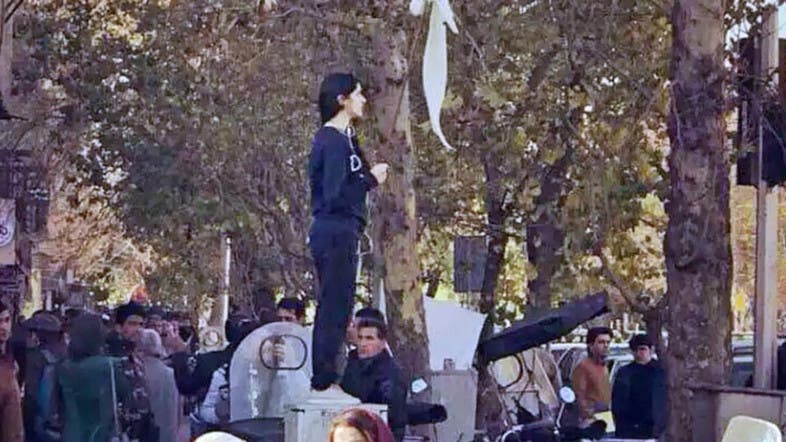
The woman, 31-year-old, Wida Mowahed stood in the middle of Tehran’s “Inqlab” (revolution) street raising her scarf on a stick and waving it like a flag. (Supplied)
Some good news to start the week: Al Arabiya reports that the Iranian authorities released on Sunday, 28 January 2018 the woman who was arrested in the center of Tehran after she took off her headscarf in protest of the law enforcing women to wear headscarves in Iran. Her lawyer Nisreen Stouda, of Iran’s Human Rights Defenders Center in Tehran, said in a statement that her release came after the government succumbed to calls by human rights and civil rights activists for her release. Stouda wrote on her Facebook page that when she checked with the prosecutor’s office to follow up on the woman’s case on Sunday, she was informed that the she had been released.
“I hope that she will not be harassed or abused by the judicial authorities because of a simple act that is considered her basic and natural right,” she said. The woman, 31-year-old, Wida Mowahed a mother of a 19 month old daughter, stood in the middle of Tehran’s “Inqlab” (revolution) street raising her scarf on a stick and waving it like a flag. A video of the protest was widely shared a three days before the outbreak of the popular protests in Tehran on December 27. After police arrested Mowahed activists initiated a hashtag through social media #Where_is_She.
http://english.alarabiya.net/en/News/middle-east/2018/01/28/Iran-releases-the-Inqlab-street-girl-after-popular-pressure.html
Posted in human rights | Leave a Comment »
Tags: #Where_is_She, Al Arabiya, headscarf, Inqlab street girl, Iran, Nisreen Stouda, peaceful protest, Wida Mowahed
January 27, 2018
In January 2018 the EU Fundamental Rights Agcncy (FRA) published a Report “Challenges facing civil society organisations working on human rights in the EU“. Its conclusion is that the situation is getting more difficult. Also, on 26 January 2018, the Thomson Reuters Foundation published an interview with Michel Forst, the U.N. Special Rapporteur on human rights defenders said that the EU are setting a bad example by allowing some of its members to stifle human rights groups, which is encouraging crackdowns elsewhere in the world.
In the interview done by Umberto Bacchi, Michel Forst said that the EU has historically done a good job supporting and protecting rights advocates worldwide but the bloc’s authority is now being undermined from within. Officials in Burundi, Democratic Republic of Congo, Israel and other countries pointed at recent laws in Hungary and Poland to justify their own regulations which may curb the independence of non-governmental organisations.
“There is a need for European countries to be more coherent … not to teach human rights outside of Europe and then not respecting human rights inside Europe,” said Forst, the U.N. Special Rapporteur on human rights defenders. Charities in dozens of countries, from Angola to India and Tajikistan have faced restrictions targeting their funding and operations over the past two years, according to an EU report. The trend is part of a global backlash on civil society that has seen rights activists in some parts of the world criminalised or branded as troublemakers, Forst stated.
Last year, Hungary introduced a measure requiring NGOs that get money from abroad to register with the state, a bill that NGOs say stigmatizes them and is intended to stifle independent voices. [see also: https://humanrightsdefenders.blog/2014/06/13/human-rights-defenders-in-hungary-not-yet-foreign-agents-but-getting-close/]. Poland instead introduced legislation to set up a centralised authority controlling charities’ funding. [see also: https://humanrightsdefenders.blog/2017/03/02/backsliding-on-civic-space-in-democracies-important-side-event-on-3-march-in-geneva/%5D. As countermeasure, the EU should boost direct funding of rights groups operating within its borders, Forst said. “What is absurd for me is that the EU is funding organisations in Latin America, in Africa – which is good – but there is no more funding for EU NGOs,” he said. Money should be allocated from a dedicated fund and not channelled through governments, he said.
Besides Europe, Forst also singled out Australia for its treatment of asylum seekers held in offshore camps, adding it was “not a safe place” for human rights defenders due to pressure from the government. A December report by Pro Bono Australia and the Human Rights Law Centre, two rights groups, found Australian NGOs were often pressured into “self-silencing” their advocacy work fearing funding cuts and political retribution.
“(Global civil society) space is shrinking because it is shrinking in Europe, because it is shrinking in the Americas, in Australia,” said Forst.
—-
The FRA’s report finds that civil society organisations in the European Union play a crucial role in promoting fundamental rights, but it has become harder for them to do so – due to both legal and practical restrictions. This report looks at the different types and patterns of challenges faced by civil society organisations working on human rights in the EU. While challenges exist in all EU Member States, their exact nature and extent vary. Data and research on this issue – including comparative research – are generally lacking. The report also highlights promising practices that can counteract these worrying patterns.

Posted in books, EU, human rights, Human Rights Defenders | 1 Comment »
Tags: civil society organisations, EU, Europe, Foreign agent, foreign funding, freedom of association, Fundamental Rights Agcncy (FRA), funding restrictions, Hungary, Michel Forst, NGOs, Poland, thomson reuters foundation, Umberto Bacchi, UN Rapporteur on Human Rights Defenders
January 26, 2018
On 24 January 2018 an important study was made public about the work of the UN Rapporteurs on Human Rights Defenders. It concerns the study “Chasing Shadows: A Quantitative Analysis of the Scope and Impact of UN Communications on Human Rights Defenders (2000–2016)” by Janika Spannagel and published by the Global Public Policy Institute. At the bottom of this post there is link to downloading the full report. [see also: https://humanrightsdefenders.blog/2017/12/11/good-introduction-to-the-anniversary-of-the-un-declaration-on-hrds-in-2018/].
Each year, the United Nations Special Rapporteur on human rights defenders receives a large number of submissions regarding individual cases of concern. Only a fraction of these cases are addressed by the rapporteur’s communications procedure. Unlike outgoing communications, incoming cases are not publicly reported or even systematically registered by the UN. Furthermore, the criteria for the selection of cases (beyond basic eligibility) remain largely undefined. The consequences of case selection, whether according to explicitly stated rules or implicitly applied criteria, are quite significant. Currently, only 550 individual cases can be addressed by the mandate each year. [there are tremendous constraints in terms of staff.] Given this reality, the case selection process defines which types of defenders under pressure receive the UN’s attention and legitimization – and which do not. Nobody can determine with certainty how many cases have fallen through the cracks over the 17 years the mandate has been in existence, or who tends to benefit from the UN’s attention and who is often overlooked.
Based on extensive empirical research, this policy paper provides the first systematic analysis of all communications sent out to date. It finds credible indications that outgoing communications have a positive impact, but also demonstrates that there is room for improvement. In particular, a more deliberate prioritization of cases is required to ensure that the mandate can serve its protective purpose more effectively under the constraints of very limited resources.
The policy paper advocates an approach that aims to maximize the potential impact on the individual defender while systematically striving for a balanced documentation of cases. It makes an evidence-based argument for a number of adjustments and offers actionable recommendations to the mandate as well as to the Office of the High Commissioner for Human Rights, to states, and to civil society actors regarding how to enhance the effectiveness of UN efforts to protect threatened human rights defenders around the world.
Among others, the paper recommends that the use of joint special procedures communications should be the exception rather than the rule, that states’ replies to cases should be systematically monitored and the respective data publicly released, and that more concerted international action should be taken with regards to ‘softer’ forms of repression.

 Download PDF (679.81 KB)
see also: https://humanrightsdefenders.blog/2017/06/08/news-from-the-hrc34-mandate-of-the-special-rapporteur-on-human-rights-defenders-extended/
http://www.gppi.net/publications/human-rights/article/chasing-shadows/
Posted in books, human rights, Human Rights Council, Human Rights Defenders, OHCHR | 1 Comment »
Tags: Chasing Shadows (Study), communications, Global Public Policy Institute, Human Rights Defenders, international human rights mechanisms, Janika Spannagel, research, study, UN Special Rapporteur on Human Rights Defenders
January 23, 2018
Africa on Line of 23 January 2018 report that human rights defenders NGOs have urged Liberian President Weah to prosecute war crimes.

The Center for Justice and Accountability describes the two phases of Liberia civil war, which caused the killings of an estimated 250,000 people and request that the atrocities are investigated and prosecuted. “A report by Liberia’s Truth and Reconciliation Commission (TRC) released in June 2009 found all sides responsible for serious violations of domestic and international law, including war crimes, crimes against humanity, widespread and systematic rape and sexual slavery, torture, use and recruitment of child soldiers, and mass executions of civilians,” the release said.
“Although the TRC recommended the establishment of an Extraordinary Criminal Tribunal in Liberia to investigate and prosecute perpetrators of serious violations of international criminal and humanitarian law, the only prosecutions to date have been outside of Liberia,” it added. Hassan Bility, Executive Director of Monrovia based Global Justice and Research Project and one of the authors of the open letter said: “Justice must be one of the cardinal points of the President’s new agenda. There must be justice for war crimes, otherwise there will be no lasting peace in Liberia.” Mr. Bility, a former journalist and torture survivor of the civil war, helped initiate the arrests of several Liberian perpetrators in Europe and the U.S. in partnership with the Swiss based NGO, Civitas Maxima.
President Weah, during his inaugural address, assured that his administration would protect human rights and justice for all Liberians: “Today, we Liberians have reached an important milestone in the never-ending journey for freedom, justice, and democracy; a search that has remained central to our history as a nation,” .
Reacting to the speech on Monday, Mr. Bility told FrontPageAfrica the President’s commitment to social justice and human rights would make some difference…“This is an opportunity for him to right many of the things that probably slipped through the safety net of the Ellen administration,” he added.
Recent cases such as the conviction of Jungle Jabbah in Philadelphia and the indictments of other alleged war criminals in Europe and the U.S. have shown that prosecuting war criminals will not reignite the civil war in Liberia, as has often been feared, added Nushin Sarkarati, Senior Staff Attorney at the Center for Justice and Accountability. “It is time to bring these examples of justice home, and make ending impunity in Liberia a priority.”
However, as the the Economist on 4 January 2018 says: Yet there are doubts about the kind of leader Mr Weah will be. Since his election as a senator in 2014, he has rarely attended parliament. Nor has he introduced or co-sponsored any legislation. Mr Weah’s relative lack of education, though, only seems to make him more popular. His supporters see the former slum-dweller as one of them—a champion from their streets. Much will depend on the ministers and advisers with whom he surrounds himself. Liberia needs better roads and schools, more jobs and electricity, and a thousand other things. Presidents, unlike footballers, must aim at multiple goals.
http://www.frontpageafricaonline.com/index.php/news/6709-human-rights-groups-urge-president-weah-to-prosecute-war-crimes
https://www.economist.com/news/middle-east-and-africa/21734008-far-beautiful-game-champion-footballer-george-weah-wins-liberias
Posted in human rights | 1 Comment »
Tags: Center for Justice and Accountability (CJA), Civitas Maxima, crimes against humanity, George Weah, Hassan Bility, ICC, impunity, Liberia, open letter, The Economist, universal jurisdiction
 Do you know any brave person or organisation who works in a visionary and exemplary manner to solve global problems? Take the chance to propose a candidate for the 2018 Right Livelihood Award, widely known as the “Alternative Nobel Prize” The Right Livelihood Award is not an award for the world’s political, scientific or economic élite, but an award for the people and their work and struggles for a better future. [http://trueheroesfilms.org/thedigest/awards/right-livelihood-award] Everyone is welcome to propose candidates for the Right Livelihood Award and four recipients are chosen each year by an international jury after extensive research work. The deadline is 1 March 2018.
 Hans Thoolen on Human Rights Defenders and their awards