Jalal Abukhater works as an advocacy manager for 7amleh, a digital rights and human rights organisation based in Palestine.
He spoke to ISHR about what drove him to take action for the digital rights of his fellow Palestinians and about the responsibility of big technology companies and online platforms in the suppression of Palestinian rights and voices.
‘There is a responsibility for big tech companies to uphold human rights to make sure that they are not complicit in the violation of human rights, especially in the context of genocide.’
One of Fasky’s photographs at sn exhibition showcasing his work during the Récréâtrales festival. In this photo, a young woman is weaving a traditional Burkinabe loincloth. Photo by Joel Hevi, used with permission.
Across Africa, art events serve as powerful platforms for activists seeking to raise awareness about social issues and human rights.
Zerbo Siaka, also known as Fasky, is a photographic artist from Burkina Faso operating at the intersection of artistic expression and activist movements. The artist is also the director of the association Photo’age. Through this association, he is dedicated to passing on his photographic expertise to the next generation. His exhibition at the 13th edition of the cultural festival ‘Les Récréâtrales’ — a pan-African space for writing, creation, research, and theatrical dissemination — exemplifies the positive impact art can have on society.
A long-time participant in this significant gathering, Fasky shared his perspectives with Global Voices during Les Récréâtrales, explaining how he uses his photography as a tool to foster resilience and encourage social engagement.
Fasky. Photo by Joel Hevi, used with permission.
Joel Hevi (JH): Could you tell us about what inspired your journey into photography and your role within the Photo’Age association?
Fasky (F): I am Zerbo Siaka, also known as Fasky, a photographer from Bobo-Dioulasso in Burkina Faso. My journey into photography happened by chance. Initially, I aspired to be a rapper, but my path changed when I discovered photography while accompanying some French friends who were part of an association in Burkina Faso. They gifted me a camera, and that’s when photography became my passion. Today, through Photo’Age, I share this art with the younger generation, including internally displaced children, helping them to express themselves and showcase their realities.
JH: You presented a series of portraits of women at Les Récréâtrales. What message are you hoping to share through these woman-centric pieces?
F: For four years now, I have taken part in Les Récréâtrales. During this time, I have been fortunate to build strong connections with the women I photograph, most of whom are internally displaced [due to the widespread violence caused by terrorist attacks]. The theme of my exhibition, ‘We Shall Overcome,’ reflects their resilience in the face of crisis. These are women who, despite everything, hold on to hope and fight for their dignity. Through their portraits, I invite visitors to witness their strength and vulnerability. My hope is that beyond their faces, one can see a moving and inspiring humanity.
JH: Do you hope to initiate a dialogue about gender equality? What potential impacts could arise beyond the aesthetic appeal of your work?
F: Definitely, photography is for me a political and social act. These portraits are a statement advocating for gender equality and a tribute to these strong women and their struggles. I hope to raise awareness, to showcase their strength, and to emphasize the urgency of achieving equality. If my photographs can spark a debate and motivate others to stand up for these women’s rights, they will have achieved their goal.
JH: Your photographic style conveys an intimate connection with your subjects. How do you manage to establish this trust, especially in often challenging situations?
F: Trust is at the heart of my work. The women I photograph know me; we have built relationships over time. The Terre Ceinte project allowed me to understand their lives and earn their trust. Before taking their pictures, I listen and respect their stories. This bond is reflected in their expressions in my photos — a sincerity that only patience and attentive listening can bring to life.
On International Human Rights Day, the Open Society Foundations reaffirmed their vision for a shared humanity where everyone can thrive, continuing the philanthropy’s role as the world’s largest private funder promoting rights, equity, and justice.
Under the leadership of Chair Alex Soros, the philanthropy is streamlining its programming to support new voices and approaches that align with today’s emerging forms of organizing and leadership. The Foundations will pursue targeted time-bound efforts, provide long-term institutional support, and retain the flexibility to respond to crises through rapid response funds.
Binaifer Nowrojee, president of the Open Society Foundations, said:
Across the world, we are seeing inspiring and powerful movements working to shape a future framed by human rights. Standing with them as allies, we will deepen, broaden, reimagine, and catalyze efforts to advance a new vision of human rights that is not bounded by historic double standards, exclusions, and inequities.
We are crafting and implementing thoughtful, future-focused strategies for change that will leverage gains made through key openings and convert them into wins. Our investments will aim to work with groups to build on and sustain these wins over time. We are committed to listening and to being informed by the needs of allies leading the fights for rights, equity, and justice.
The commitments include multiyear investments across a broad range of issues and geographies, including:
Rights protection: Supporting human rights advocacy as well as protection of rights defenders at risk, particularly environmental and women’s groups
Inclusion: Ensuring marginalized and vulnerable groups can fully exercise their rights without fear of violence or discrimination
Public safety: Promoting communities-centered approaches to tackling repressive or militarized responses to violence and public safety
Accountability: Supporting human rights–based litigation in national, regional, and international courts
Political participation: Supporting new champions and nonpartisan movements of inclusive and accountable democratic practice in specific countries and globally
Economic rights: Developing and promoting new state-led economic models for a green transformation to advance economic and social rights
In 2025, Open Society will be approving further programming to promote rights, equity, and justice.
Open Society has also approved funding across other areas, including ideas, impact investing, advocacy, and higher education.
On 28 November, 2024 the International Commission of Jurists announced Carlos Ayala as its new President
Ayala brings decades of experience defending the rule of law, advocating for constitutional justice, and championing the rights of marginalized groups
The International Commission of Jurists (ICJ) proudly welcomes Carlos Ayala as its new President, taking over from Robert Goldman after seven years in the role. A distinguished legal scholar and human rights advocate, Ayala brings decades of experience defending the rule of law, advocating for constitutional justice, and championing the rights of marginalized groups.
Ayala, born in Caracas in 1957, has dedicated his career to advancing human rights. From his early days as a law student at Universidad Católica Andrés Bello, Ayala developed a profound sense of defending rights and social justice, which he carried through his graduate legal studies at Georgetown University and later in his legal practice. He is tenured professor and chair of Constitutional Law and a member of the board of the Ibero-American Institute of Constitutional Law. His commitment has spanned defending indigenous land rights in Venezuela to addressing transitional justice issues across Latin America. Notably, Ayala was instrumental in the landmark decision against blanket amnesty laws for human rights violators in Peru, a victory that set critical international legal precedents.
He has been President of the Inter-American Commission on Human Rights, as well as Rapporteur on the Rights of Indigenous Peoples of the Americas, and President of the Andean Commission of Jurists, giving him a vision of the human rights landscape that takes in the whole hemisphere of Americas from Alaska to Tierra Del Fuego.
Ayala has worked extensively on issues relating to the independence of the judiciary and he became involved with the OHCHR in monitoring the appointment of judges of several high courts. He states that one of the cases that impacted him most has been that of Venezuelan Judge Maria Lourdes Afiuni, who was arrested and detained after making a ruling that implemented a decision of the UN Working Group on Arbitrary Detentions which was not in the political interest of the government. She was immediately arrested and her trial lasted 10 years, was a flawed process throughout and ended in a flawed decision to convict.
As President, Ayala envisions the ICJ working as a unified community with other partners and allies committed to reinforcing the rule of law and international justice. Under his guidance, he will support the ICJ to advance human rights standards globally, counter setbacks, and provide critical support to governments, civil society, and multilateral institutions.
“We are facing new threats to reverse the advancement of human rights that we have achieved in the past 70 years – we need to defend against unilateralism and authoritarianism. The ICJ has been actively contributing to stop any setback in international standards, and we will continue this essential work.”
The “Life is hanging on by a thread” campaign will shine a light on the countless stories of human rights defenders and environmentalists who risk their lives for their causes.
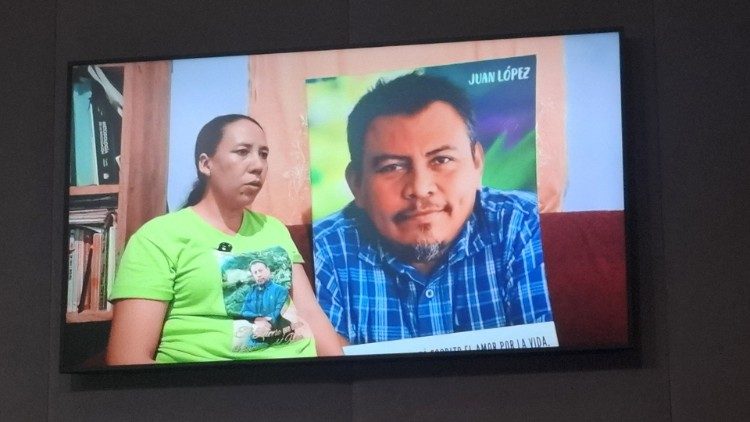
On September 14, Juan Antonio López, a city council member and environmental activist was murdered in Honduras. He was a member of the Mesoamerican Ecclesial Network and international organizations recognized his work. His assassination underscored the vulnerable situation of human rights defenders and leaders throughout Latin America.
In response, the Latin American Bishops’ Conference, together with the Platform for Peace, Democracy, and Human Rights and the Latin American Protection Community, is launching the campaign “Life is hanging on by a thread.”
The official launch of the campaign is scheduled for December 10, which will be held virtually to bring representatives from all over Latin America. It will coincide with events being held in Honduras to honour López.
The goal of the “Life is hanging on by a thread” campaign is to shine a light on symbolic cases of human rights and environmental defenders in Latin America and the Caribbean. Various testimonies of people defending human rights and indigenous peoples will come to light.
Promoters of the campaign stress its importance because “situations like the murder of Juan Antonio López are not isolated events, but part of a systematic pattern in Latin America, one of the deadliest regions for environmental and human rights defenders.” Global Witness, an international NGO, reports that 85% of environmental defenders who were killed in 2023 took place in Latin America. Specifically, in Honduras, 18 environmentalists were murdered last year. [see: https://humanrightsdefenders.blog/2024/09/18/global-witness-2023-2024-annual-report-violent-erasure-of-land-and-environmental-defenders/]
Juan Antonio López was an environmentalist killed on September 14, 2024
The campaign will end on December 10, 2025, coinciding with the Jubilee of Hope.
Here a few highlights for this year from UN and NGOs sources:
While commemorating the 76th anniversary of the Universal Declaration of Human Rights, the United Nations Secretary-General Antonio Guterres said that “human rights are under assault”. “Whether economic, social, civic, cultural or political, when one right is undermined, all rights are undermined,” Guterres said in a post on X. “Let’s protect, defend and uphold all human rights for all people,” he added. In a video message, The UN secretary-general said “we must stand up for all rights — always.”
..As we mark Human Rights Day 2024, we are reminded that human rights are not abstract ideals. They are vital tools for addressing these pressing challenges and advancing dignity and justice for all.
… the United Nations Development Programme (UNDP) works to support human rights solutions that strengthen accountability, protect communities and foster peace, recovery, and stability. This includes partnering with National Human Rights Institutions, which often represent the frontline defenders of human rights. … Local initiatives also remain key. That includes women in Somalia who are being supported to lead peace efforts including assisting those facing violence, discrimination, and injustice. “I have resolved numerous local disputes…I feel motivated when I see I have been able to change people’s lives positively,” says Fatuma who led a local Peace Working Group.
As the accelerating climate emergency threatens the ability of current and future generations to enjoy their right to a clean, healthy, and sustainable environment, UNDP is focusing on access to justice, working with the United Nations Environment Programme (UNEP) and OHCHR to help communities claim their rights. …The private sector also has a pivotal role to play. UNDP supports the implementation of the UN Guiding Principles on Business and Human Rights including to advance sustainable practices that protect the environment. Indeed, technology offers both risks and opportunities to advance human rights. The Global Digital Compact aims to create an inclusive, open, safe, and secure digital space that respects, protects and promotes human rights. Tech-enabled UNDP tools like iVerify and eMonitor+ deployed in over 25 countries to monitor and address false narratives and hate speech show the potential. It is now crucial to adopt a rights-based approach to technologies like A.I., addressing ethical challenges, protecting data, and tackling biases to mitigate risks today and unlock immense benefits for the generations to come. [https://humanrightsdefenders.blog/2024/09/27/united-nations-adopts-ground-breaking-pact-for-the-future-to-transform-global-governance/]
——
The NGO Index on Censorship spotlights four people standing up for human rights around the world:
Despite the declaration, all around the world human rights are being challenged, degraded and attacked. That is why this year, on Human Rights Day, we pay tribute to five human rights defenders who have worked tirelessly to defend people’s rights and have been persecuted as a result.
Jemimah Steinfeld, CEO at Index on Censorship said: “In this increasingly polarised and authoritarian world these people stand out as beacons of hope and light. It’s depressing to think that over 75 years since the Declaration, we still need a day like this but that should not detract from the bravery and fortitude of these people. May their example show us all how we can all better fight injustice.”
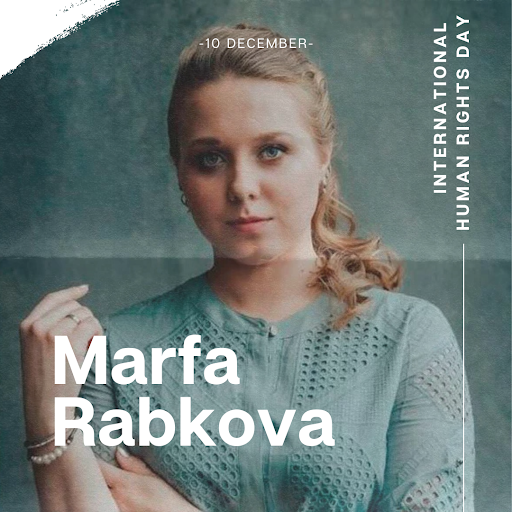
Marfa Rabkova (Belarus) Marfa Rabkova is a human rights defender who has been behind bars since 17 September 2020. She has long been targeted by the Belarusian authorities as a result of her civic activism. Marfa became head of the volunteer service at the Human Rights Centre Viasna in 2019. During the 2020 presidential election, she joined the “Human Rights Defenders for Free Elections” campaign, which registered over 1,500 election observers. When peaceful protests began to take place after the election, she helped document evidence of torture and violence against demonstrators. Marfa was indicted on a long list of charges, including inciting social hostility to the government and leading a criminal organisation. She was sentenced to 14 years and 9 months in prison in September 2022, after nearly two years of pre-trial detention. Index on Censorship calls for her immediate and unconditional release. See also: https://humanrightsdefenders.blog/2021/03/22/belarus-end-reprisals-against-human-rights-defenders/
The Turkish government has refused to respond to allegations of systematic repression against individuals allegedly affiliated with the Gülen movement made by United Nations special rapporteurs, according to official documents published on Friday by the Office of the United Nations High Commissioner for Human Rights.
In a joint letter dated October 7, 2024, seven UN special rapporteurs asked the Turkish government about alleged measures of “systematic repression against persons ostensibly affiliated with the Gülen Movement through the misuse of counter-terrorism legislation, and the concomitant impact on civil society, human rights defenders, political dissidents, and journalists.”
The allegations center on Turkey’s treatment of people allegedly associated with the faith-based Gülen movement, inspired by the late Muslim cleric Fethullah Gülen.
In its response via a diplomatic note dated October 30, the Turkish government refrained from answering the allegations brought up by the special rapporteurs and instead listed their accusations against the Gülen movement and requested the “Special Procedures of the Human Rights Council not to allow FETÖ and its members to abuse these mechanisms, and to dismiss their allegations.”
FETÖ is a derogatory acronym used to refer to the Gülen movement as a terrorist organization.
Turkish President Recep Tayyip Erdoğan has been pursuing followers of the Gülen movement since corruption investigations revealed in 2013 implicated then-Prime Minister Erdoğan and some members of his family and his inner circle.
Dismissing the investigations as a Gülenist coup and conspiracy against his government, Erdoğan designated the movement a terrorist organization and began to target its members. He intensified the crackdown on the movement following an abortive putsch in 2016 that he accused Gülen of masterminding. The movement has strongly denied involvement in the coup attempt or any terrorist activity.
The rapporteurs outlined practices they say violate international human rights laws, including arbitrary arrests, torture, transnational renditions and surveillance abuses.
The UN Rapporteurs said these individuals face intensified crackdowns involving mass detentions, forced disappearances and unjust prosecutions under vague anti-terrorism laws. Between June 2023 and June 2024, more than 8,800 people were detained and 1,500 were charged with terrorism offenses, they said.
Among the rapporteurs’ chief concerns was the treatment of children detained as part of these operations. In May 2024, 16 children were arrested in İstanbul and allegedly subjected to psychological pressure, physical torture and denial of legal counsel. The UN rapporteurs described these actions as clear violations of international protections for children under the Convention on the Rights of the Child.
The rapporteurs also criticized Turkey’s use of public “grey lists,” wanted lists where individuals — ranging from journalists to human rights defenders — are labeled as terrorists, often without evidence or due process. These lists, which include photos and personal details, are made public alongside monetary rewards for information leading to their capture. This practice, according to the rapporteurs, endangers lives, undermines freedoms and creates a “hitman economy.”
Another key concern involved transnational renditions. The rapporteurs alleged that Turkey has systematically abducted and forcibly returned suspected Gülen affiliates from other countries under vague bilateral security agreements. Victims were reportedly detained in secret, subjected to torture and coerced into confessions used in prosecutions.
The misuse of surveillance powers also drew heavy criticism. Turkey’s intelligence agency was accused of fabricating evidence from the ByLock messaging app to convict thousands of people on tenuous charges of affiliation with the Gülen movement. The UN noted that such actions lack due process and violate privacy rights under international law.
The rapporteurs called on Turkey to address these alleged violations, halt ongoing abuses and ensure compliance with international human rights standards. They expressed particular concern about the government’s expansive interpretation of anti-terrorism laws, which they argue target legitimate political activity, dissent and human rights advocacy.
The letter was authored by seven UN special rapporteurs and a UN expert, including Mary Lawlor, special rapporteur on the situation of human rights defenders; Alice Jill Edwards, special rapporteur on torture and other cruel, inhuman or degrading treatment or punishment; and Fionnuala Ní Aoláin, special rapporteur on the promotion and protection of human rights while countering terrorism. Other contributors included Gabriella Citroni, chair-rapporteur of the Working Group on Enforced or Involuntary Disappearances and Irene Khan, special rapporteur on freedom of opinion and expression.
On 4 December 2024, Aytan Farhadova in OC media reported that human rights defender Rufat Safarov was detained in Azerbaijan a week before he was set to be awarded the Human Rights Defender of the Year award by US State Secretary Antony Blinken. That day, Safarov’s lawyer, Elchin Sadigov, posted on Facebook that Safarov was accused of hooliganism and fraud resulting in major damage.
Sadigov later posted a message written by Safarov, in which he explained that he was planning to visit the US two days after receiving his visa in order to accept the Global Human Rights Defender Award from Blinken. [not totally clear which award is referred to – ed]
‘So I was awarded as a strong human rights defender of the year. Because the United States initially nominated me, I express my deep gratitude to [Mark] Libby, the US Ambassador in Azerbaijan, and Mr Blinken, US Secretary of State, who supported my candidacy.’
State Department’s Deputy Spokesperson, Vedant Patel, during a press briefing on Tuesday, said: We’re deeply concerned by reports that human rights defender Rufat Safarov has been detained in Azerbaijan’, Patel said, adding that they were ‘closely monitoring the case.’
Frank Schwabe, the head of the German delegation of the Parliamentary Assembly of the Council of Europe (PACE), criticised Safaravo’s arrest, saying that PACE will ‘respond to this in January’.
Safarov, a former prosecutor’s office official who spoke out against human rights abuses by the government, was sentenced to nine years in prison on charges of bribery, fraud, and human rights violations in 2016. He was released from prison alongside almost 400 others after Azerbaijani President Ilham Aliyev issued an amnesty to mark Novruz in 2019.
On 27 November, 2024 Amelia Shindelar (managing director of the Human Rights Initiative at the University of Minnesota) published in Open Global Rights an assessment of the situation of n HRDs in the USA: From grief to activism: The dangers confronting human rights defenders in the United States
Human rights defenders who have lost loved ones to law enforcement violence face additional traumas and risks. These activists need safety and support for their mental and physical well-being.
…HRDs are at high risk of adverse health and safety outcomes. They face significant mental health challenges, particularly when the defenders are from a marginalized community and work on issues related to their identities and their communities. Through a series of interviews with HRDs involved in the anti-law enforcement violence movement, my research team learned about the particular risks faced by HRDs in the United States who have lost a loved one to law enforcement violence.
The most recognised risk to HRDs is the threat to their physical safety. This danger can take various forms, including direct violence and assault, ranging from beatings to torture and abduction at the hands of both state and non-state actors. Tragically, hundreds of HRDs are killed each year. Front Line Defenders reported over 300 killings in 2023 alone, and this figure likely underestimates the true toll.
The unique struggles of defenders who have lost loved ones to law enforcement violence
In the United States, HRDs who have lost family members or loved ones to law enforcement violence face an exceptional set of traumatizing experiences that go beyond the already significant challenges associated with the loss of a loved one to violence. We identified four common risk factors that contribute to this:
1. Dehumanization and criminalization by the media
Traditional media often relies on official statements from law enforcement, which emphasize perceived threats and reinforce that the officer is justified in their use of force. Victims of law enforcement violence are regularly portrayed as criminals in an effort to justify their deaths and shift the focus elsewhere.
Shortly after the death of her son in 2022, Monique Johnson shared with us her experience of how the media portrayed the situation, saying, “They always put their own narrative out there so that people think that he’s the bad guy.” Monique’s experience mirrors that of all the other activists that we interviewed. This negative portrayal can have severe consequences, including exacerbating grief, traumatization, and a loss of social support, as community members withdraw their assistance based on these representations.
2. Recurring exposure to law enforcement violence
Each new incident of violence reopens the wounds. With over 1,000 people killed by law enforcement in the United States each year, the reminders are frequent and painful. Cindy Sundberg, whose son Tekle was killed in 2022, vividly described her experience: “Each event and each killing is like you just open up the wound, and they take a knife and stir it up. And you are just oozing pain.”
In the cases that receive substantial media attention, there’s an added layer of daily trauma. Courteney Ross, George Floyd’s fiance, described this experience: “It never stops. I know loss and grief don’t stop, but when you are faced with literally a symbol of your loved one’s murder every single day, it’s exhausting. It’s just—it’s fearful; it’s anxiety ridden.”
This recurring exposure leads to chronic stress, keeping defenders in a state of heightened alertness that can have severe physical and mental health consequences and affect their ability to process their grief and trauma.
3. Surveillance and harassment by law enforcement
Many HRDs report surveillance or harassment by law enforcement following the death of their loved ones, ranging from increased police presence in their neighborhoods to overt acts of intimidation. Such experiences contribute to a pervasive sense of fear and insecurity.
Matilda Smith shared her experience of constant fear after the officer who killed her son moved into her apartment building: “I was afraid for my life, and my daughter was, and my son as well.” This anxiety led her to move to a different part of town, but the feeling of being watched persisted. The psychological impact of surveillance can be severe, leading to a constant state of alertness and paranoid thoughts and behaviors.
4. Negative consequences of activism
All of the affected individuals with whom we spoke turned to activism to find purpose and healing after the death of their loved ones. As demonstrated by the examples above, among others, activists face multifaceted risks. “I’ve known people in this work that have died of a broken heart,” said Jeralynn Brown-Blueford, co-founder of the Alan Blueford Foundation. Other interviewees also described the emotional, physical, financial, and social toll of their work.
Activism can involve difficult physical labor; carrying protest materials for long distances, building temporary blockades, setting up and taking down sound systems and event spaces, and distributing supplies and resources are just a few examples. Marilyn Hill, whose son was killed in 1997 and has since been active in the anti-law enforcement violence movement, talked about the physical toll the work takes: “I had to load and unload and pick up heavy things…I ended up with a hole in my stomach, and it got bigger and bigger. I ended up having the most excruciating surgery that left me in a nursing home for a month after the surgery.”
The intense focus on activism can strain family relationships. According to Colette Flanagan, founder of Mothers Against Police Brutality, “People get confused; they don’t know what to do when you fight against the policeman. It has damaged our family. I basically lost my daughter. We’re estranged—we haven’t spoken in ten years.” Family estrangement can lead to a loss of crucial support systems, leaving defenders more vulnerable to burnout and emotional exhaustion.
Conclusion
Understanding the risks faced by HRDs in the United States is crucial not only for supporting individual defenders but also for ensuring the sustainability of human rights movements. As the rights community continues to grapple with issues of systemic injustice and human rights violations, we must recognize the human cost borne by those on the front lines of these battles and work towards creating safer, more supportive environments.
Her research focuses on the protection, security, and well-being of human rights defenders.
The top awards for the 2024 International Contest for Minority Artists were presented to five award winners — Bianca Broxton, Joel Pérez Hernández, Francis Estrada, Laowu Kuang and youth laureate Jayatu Chakma — during a special ceremony in Geneva, Switzerland.
UN Human Rights partnered with civil society organizations, Freemuse, Minority Rights Group International, the City of Geneva, the Centre des Arts of the International School of Geneva, and with the support of the Loterie Romande. The theme, Memory in the Present, celebrates the creativity and cultural expression of minority artists whose artwork explores themes relating to memory and memorialization around the globe.
“Naturally, such collective identities will largely be grounded in a collective memory of events, generating or perpetuating values or traditions that shape the way persons belonging to a minority feel bound together by common experiences,” said Nicolas Levrat, United Nations Special Rapporteur on Minority Issues. “Such memories often define how and why these past experiences shared by persons belonging to a given minority (or by previous generations) make them singular, different from other groups.”
The contest serves as a platform for minority artists human rights defenders who play a key role worldwide to build bridges of understanding, dialogue and empathy through creative and artistic means. It celebrates minority artists who have made significant contributions to raise awareness, inspire action, and foster deeper understanding of human rights across diverse communities.
Bianca Broxton is an American interdisciplinary artist who focuses on raising awareness of health inequalities among minority women in the United States. She frames historical narratives and memories around the marginalized voices using sculptures and collages to portray minorities with dignity and a focus on restorative justice.
“My experience as a Black woman drives me to tell the histories of those who have faced systemic oppression and to portray them positively. I refuse to have my subjects seen only as victims of systemic injustice,” she said.
Laowu Kuang is a visual artist belonging to the Tibetan minority in China. Through a vivid interplay of colors and textures displayed on large canvases, his artwork navigates themes of memory and memorialization in contemporary China, through traditional Tibetan symbols and motifs.
“In contrast to Western painting, with its excessive color scale, and Han Chinese painting, with its muted and elegant concept of applying colors, Tibetan painting has a strong and intense contrast of colors,” he said. “The stone carvings of Tibetan folk art are a perfect combination of religion and nature, which is a communication and dialogue between human beings and gods, between heaven and earth.”
Joel Pérez Hernández is a visual and plastic artist from the Maya Tseltal people, born in the Lacandón jungle of Chiapas, Mexico. Hernández has dedicated years to studying traditional techniques and motifs with elder artisans and creators of his community.
“Much knowledge is asleep in our mountains, voices are trapped in the rivers, colors sleep under the stones, and in our collective memory, as well,” he said. “My people nourish me and motivate me to awaken all that; that is what I include in my works. I find no need to sign my pieces, because my people, my family, my friends make up the essence of each one of them.”
Born in the Philippines, Francis Estrada is a visual artist and educator, currently residing in the United States. Estrada’s artwork focuses on culture, history, and perception, and questions the influence of historical photographs, mass media, political propaganda, and personal archives on social narratives and collective memory.
“My art is a tool through which I confront how our understandings of culture are mediated, and the methods through which history and memory are created and perpetuated,” he said. “I think of my work as partial narratives for the viewers to complete based on their own experiences and associations.”
Youth laureate Jayatu Chakma is an artist belonging to the Chakma Indigenous community of the Chittagong Hill Tracts region in Bangladesh. His artwork features ink, acrylic, watercolor, and natural elements like mud and colors from leaves, as a way to reflect on the life of his community in relation with forced displacement and the loss of their lands.
“Chittagong Hill Tracts is a part of Bangladesh which represents a culture of variation in terms of people and landscape,” he said. “But there are stories hidden behind the decorated valleys of Chittagong Hill Tracts: my artworks are influenced by the stories of being displaced, losing belongings and relatives. I want to create artworks that show a different side of Chittagong Hill Tracts, besides its natural beauty and cultural diversity that we see on TV.”




![Mga Nalimutan [The Forgotten], inspired by a photography taken by Joe Galvez New York City, United States, 2017.](https://www.ohchr.org/sites/default/files/styles/hero_5_image_desktop/public/2024-11/minority-artists-award-memory-in-present-2024-972x700.jpg?itok=oQgPdm-9)


