Author Archive

Uncalculated Risks: attacks on human rights defenders in name of development

July 30, 2019

The Campaign is made up of defenders and those who work with them on issues of development and human rights – community organizations, human rights and environmental groups, defender security organizations, transparency and accountability NGOs, and indigenous peoples and women’s networks. It is hosted by the Coalition for Human Rights in Development. You can find the Campaign Declaration and list of participant organizations here. In June, the Coalition for Human Rights in Development (CHRD) launched a landmark report with the Defenders in Development Campaign, exposing the risks of mega-infrastructure  and other ill-planned development projects on human rights defenders (HRDs). The report laid out 25 case studies demonstrating that HRDs are facing increasing threats and attacks in the context of their resistance to activities undertaken in the name of development, including harassment, physical violence, criminalisation, arbitrary detention and murder.

The Findings:

  • Threats and attacks against human rights defenders in the context of development activities are widespread.
  • Though they take many different forms, the threats and attacks often start with the labeling of communities, groups, and individuals as “anti-development.”
  • The imposition of development activities without the consent or meaningful consultation of local communities and marginalized groups is one of the key root causes of threats for defenders in development.
  • Development finance institutions have a duty to respect human rights and to ensure that their investments are not putting people at risk.
  • Yet too often, development interventions exacerbate risks for defenders due to lack of adequate attention to the rights and interests of local communities and marginalized populations, and to the contextual risks and power imbalances that may cause them to bear negative impacts or to be made vulnerable.
  • Early warning signs of potential threats to defenders are often missed or ignored.
  • DFIs have a wide range of resources and influence that can be utilized to change the risk equation for defenders under threat, but often fail to proactively develop this leverage or are reluctant to utilize the leverage they have.
  • DFIs often remain silent in the face of threats and attacks, or responses come too little, too late and defenders and communities are left without protection or remedy for harm.
  • Several DFIs are beginning to grapple with threats to defenders in development, but much more is needed.

Effectively addressing the shrinking space for participation in development processes and the growing threats to defenders will require not only a change in policy and practice, but a fundamental shift that places human rights and local communities at the center of how development is conceived and implemented.

Landmark report finds attacks on human rights defenders in name of ‘development’ on the rise

https://rightsindevelopment.org/uncalculatedrisks/

Call for Consultancy for Strategic Plan for AfricanDefenders

July 30, 2019

Call for Consultancy to develop a Strategic Plan for AfricanDefenders.

The scope is to develop Strategic Assessment report recommendations and a five years Strategic Framework for AfricanDefenders for the period of 2020 to 2025. The scope and focus of the assignment is to provide technical, strategic and facilitation support to enable the development of AfricanDefenders’ strategic plan. Develop an analysis framework and work plan to guide the assessment.

The Consultant will conduct a thorough but focused assessment of AfricanDefenders’s strengths and weaknesses, as well as external opportunities and threats, with a view to identifying appropriate strategic options for the 2020 to 2025 operational period. The assessment will include review of relevant documents, in particular the Kampala Plan of Action for Human Rights Defenders+10, the Paris Plan of Action, the Marrakesh Declaration on Human Rights Defenders and the Zanzibar 2019 Final Communique. In addition to existing project documents, strategic plans of key partner agencies, donor organizations, and related domestic and international reports.

The consultant will also develop the following:
1. Online/offline survey for AfricanDefenders members and stakeholders and beneficiaries;
2. Conduct individual interviews with key informants; and
3. Facilitate in-depth focus group/facilitated discussions using web-based technologies and/or teleconferencing.

The tasks under this assignment are to be undertaken in a maximum period of 30 working days. A draft as well as final strategy will be presented to the Steering Committee of the AfricanDefenders. The location of the assignment is flexible, but part of the work will be in Kampala, Uganda and most probably the validation in Banjul, The Gambia.

QUALIFICATIONS

The Consultant(s) is expected to:
• Have professional experience of work in the human rights sector in Africa.
• Be Fluent in spoken and written English and French.
• Knowledge in Arabic or Portuguese is a high added advantage.
• Be willing to travel to Kampala and other focal countries and be available to meet with partners.

The Consultant(s) are requested to submit a project proposal (outlining the tools, methods and sampling model to be used) and comprehensive indicative project budget as part of their motivation and application for consideration.

Submitting your application
Please send your application to jobs@defenddefenders.org with the subject line “AfricanDefenders Consultancy” by 30 August 2019. Your application should include your CV and past experience, budget, work-plan and 3 references for similar work undertaken. Do not send copies of certificates or degrees.

Call for Consultancy to develop a Strategic Plan for AfricanDefenders

China’s cyber-dissident Huang Qi get 12 years jail

July 30, 2019

Quite a few mainstream media have paid attention on 29 July 2019 to the sentening of human rights defender Huang Qi, often referred to as the country’s “first cyber-dissident”, to 12 years in jail. Huang Qi is the founder of 64 Tianwang, a news website blocked in mainland China that covers alleged human rights abuses and protests. See: https://humanrightsdefenders.blog/2018/11/06/14-major-ngos-call-for-immediate-release-of-chinese-human-rights-defender-huang-qi/

He had been found guilty of intentionally leaking state secrets to foreigners. The statement, from Mianyang Intermediate People’s Court, added Mr Huang would be deprived of his political rights for four years and had also been fined $2,900. Huang has kidney and heart disease and high blood pressure. And supporters have voiced concern about the consequences of the 56-year-old remaining imprisoned.

This decision is equivalent to a death sentence, considering Huang Qi’s health has already deteriorated from a decade spent in harsh confinement,” said Christophe Deloire, the secretary-general of Reporters Without Borders. The press-freedom campaign group has previously awarded Huang its Cyberfreedom Prize. It has now called on President Xi Jinping to “show mercy” and issue a pardon.

Amnesty International has called the sentence “harsh and unjust”. “The authorities are using his case to scare other human rights defenders who do similar work exposing abuses, especially those using online platforms,” said the group’s China researcher Patrick Poon.

And in December 2018, a group of the United Nations’ leading human rights experts also pressed for Huang to be set free and be paid compensation. According to Reporters Without Borders, China currently holds more than 114 journalists in prison.

https://www.jurist.org/news/2019/07/chinese-journalist-huang-qi-sentenced-to-12-years-for-allegedly-leaking-state-secrets/

https://www.bbc.com/news/technology-49150906

How Twitter moved from Arab spring to Arab control

July 29, 2019
Social media platforms were essential in the Arab Spring, but governments soon learned how to counter dissent online”, writes
Twitter played an essential role during the Egyptian Revolution and was used to get info to an international audience [File: Steve Crisp/Reuters]

In a series of articles, Al Jazeera examines how Twitter in the Middle East has changed since the Arab Spring. Government talking points are being magnified through thousands of accounts during politically fraught times and silencing people on Twitter is only part of a large-scale effort by governments to stop human rights activists and opponents of the state from being heard. In the next part of this series, Al Jazeera will look at how Twitter bots influenced online conversation during the GCC crisis on both sides of the issue.

https://www.aljazeera.com/news/2019/07/exists-demobilise-opposition-twitter-fails-arabs-190716080010123.html

NHRF seeks a ‘theory of change’ consultant

July 29, 2019

The Norwegian Human Rights Fund (NHRF) recently went through the process of an external evaluation (November 2018) with a focus on the current strategy and its implementation. The findings of the evaluation were positive and we’re currently working on integrating the recommendations into our future work. The NHRF is seeking a consultant who can advise and support us through, to a limited extent, the development of our theory of change. The NHRF will begin a collaborative and holistic process that will include NHRF personnel (NHRF Secretariat and local consultants) and stakeholders (e.g. grantees and board members) to build a conscious theory of change that reflects the work of the Secretariat as a support mechanism and the work of our grantees on the ground.

The primary objective of the overall project is to develop a theory of change for the NHRF with longevity and adaptability in mind. The NHRF has developed an expansive and in-depth M&E framework that was just recently updated. ….The theory of change should be developed with the idea that it will be the core that our M&E framework and all other organizational development can stem from. As stated above, the overall project will be led by the NHRF’s LME officer, but will be advised by the selected consultant.

The consultant will be asked to advise on the following activities:

  • Early stage guidance and preparation for a theory of change retreat with the NHRF Secretariat and engagement via questionnaire and other methods with other stakeholders and NHRF personnel for collecting input and feedback throughout the development process.
  • Co-lead the NHRF Secretariat retreat in Oslo, Norway
  • Advise on the early drafts of the theory of change once all input, data, and feedback has been collected, interpreted, and translated into a draft

The NHRF is primarily seeking to be advised throughout this process, therefore it is expected that the consultancy will be no more than 5 working days of 7.5-8 hours.

Submissions

  • Candidate’s CV
  • Budget with daily rates based on a 7.5-8-hour workday and estimated flight costs for travel to Oslo in November based on consultant’s location
  • Brief (max 500 words) proposal that includes a timeline of the distribution of the 3 working days that will not be used for the NHRF Secretariat theory of change retreat.
  • 1-2 references (name, email, phone)

Deadline: Thursday, 1 August 2019

Send to: sarah.mcmains@nhrf.no and cc: info@nhrf.no Subject line: “Application – NHRF Theory of Change consultancy”

https://nhrf.no/article/2019/consultant-advisor-on-theory-of-change-development

FOR SAMA also wins award at Durban International Film Festival 2019

July 25, 2019

On 25 July 2019 the Durban International Film Festival (DIFF) announced that the Amnesty International Durban Human Rights Award 2019 has gone to: For Sama directed by Edward Watts and Waad al-Kateab. The film earlier won Galway’s: https://humanrightsdefenders.blog/2019/07/16/31st-galway-film-festival-honors-for-sama-as-best-human-rights-film/

https://www.screenafrica.com/2019/07/25/film/business/40th-durban-international-film-festival-award-winners-2019/

Egypt: crackdown and new NGO law dont augur well

July 25, 2019
On 23 July 2019 FIDH, the World Organisation Against Torture (OMCT) and the Cairo Institute for Human Rights Studies (CIHRS) denounce the new crackdown and call on the Egyptian authorities to immediately end any act of harassment, including at the judicial level, against all peaceful activists, in particular political opponents and human rights defenders in Egypt, such as former member of Parliament and human rights lawyer Zyad al-Elaimy. At least 83 persons, including political opposition activists, journalists and human rights defenders, have been arrested in Egypt over terrorist charges since June 25 for their alleged implication in a plot against the State.Human Rights Watch published the next day an elaborate report on Egypt’s New NGO Law which renews draconian restrictions and imposes disproportionate fines and bans links with foreign groups. Here some key elements but the ful lreport should be read:

Four Honduran woman human rights defenders say why funders need to prioritize social movmements

July 25, 2019

This video is part of an editorial partnership with the Fund for Global Human Rights.

In this video, Miriam Miranda, executive director of OFRANEH – the Honduran Black Fraternal Organisation – talks about the importance of funding social movements, not just structured NGOs (which inherently seek to sustain themselves). She also discusses the need for more funders to support work happening at the community level. She shares her thoughts on how flexible funding allows activists to respond to the changing needs of their communities and the difficult context in which they work. She stresses the critical importance of donors trusting their partners on the ground and building trust-based relationships.

Denia Castillo, coordinator of Red De Abogadas Defensoras de Derechos Humanos (Network of Human Rights Defenders), shares why grassroots activism is often the most effective to way to spur on social change. This is because activists on the ground best understand their communities and the challenges they face, and they don’t have the costs of much larger organisations – allowing for resources to be distributed closer to the ground. She also talks about the need for international funders to provide flexible funding, which allows grassroots groups to adapt their plans and support their communities in the emergencies they often face on Honduras.

Indyra Mendoza, executive director of CATTRACHAS – a feminist lesbian network – provides insight into the importance of funding and working with non-registered entities. In countries where governments are cracking down on the work of activists and NGOs, restrictive legislation is making it harder to register as an NGO or operate freely as a registered NGO. For this reason, many activists and groups doing critical work for their communities choose not to register as NGOs, which creates difficulties for them in receiving foreign funding and support.

Bertita Caceres is the general secretary of COPINH – Civic Council of Popular and Indigenous Organisations of Honduras. She is also the daughter of COPINH’s founder Berta Caceras, who was murdered in 2016 because of her campaigning work to stop a hydro-electric dam from destroying indigenous lands and livelihoods. Bertita shares her thoughts on the importance of international allies helping build the capacity and strength of organisations like COPINH, specifically around security and protection. She also shares how important it is for groups like hers to have international partners and funders use their positions of power to speak out on behalf of grassroots groups and apply pressure internationally in a way that supports their strategies and advocacy on the ground.

https://www.opendemocracy.net/en/frontline-insights/we-need-relationships-based-on-trust-how-supporters-can-help-honduran-activists/

CONSULTANCY VACANCY – Final evaluation of the EU Human Rights Defenders mechanism

July 25, 2019


announced on 23 July 2019 that it is looking for a consultancy team to conduct an external evaluation at the end of the first phase of the Project. This evaluation should focus on documenting the impact that the EU Human Rights Defenders mechanism has had on the situation of human rights defenders during 37 months of implementation and whether the Consortium has delivered in accordance with the Project proposal and main objective of the Project. The evaluation should focus in particular on the direct support to human rights defenders under components and should compare this with other programmes and the broader EU support to HRDs. It should also provide recommendations to improve the relevance and effectiveness of the EU Human Rights Defenders mechanism in its follow-up phase of implementation. See also: https://humanrightsdefenders.blog/2019/05/28/the-eu-human-rights-defenders-mechanism-a-short-overview/

The evaluation should concentrate as far as possible on the EU Human Rights Defenders mechanism in its entirety. It is not the intention to evaluate the performance of the individual ProtectDefenders.eu Partners, although comparisons of practices can be used when relevant in order to draw lessons learned and contribute to improve overall performance.

The terms of reference of this assignment are available here.

Applicants are requested to send their submissions to recruit@protectdefenders.eu, with the subject “Evaluation consultantby 16 August 2019.

Report of the Nelson Mandela Human Rights Lecture 2019

July 24, 2019
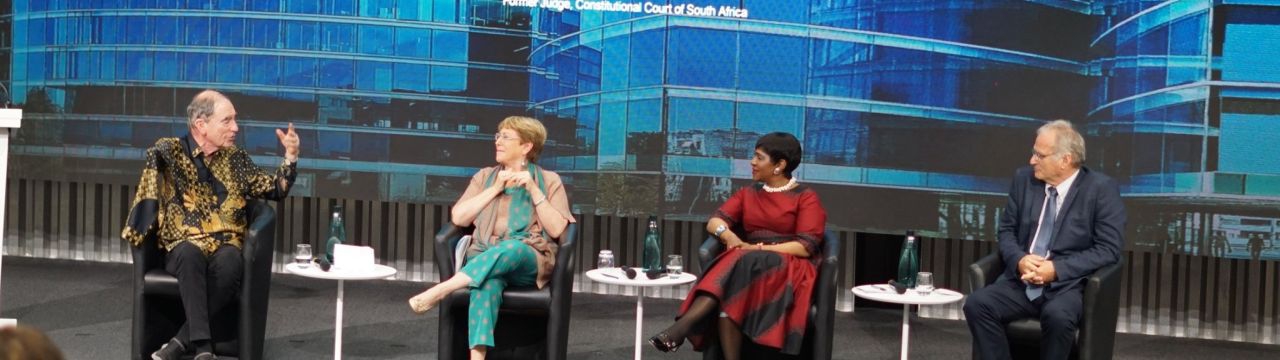
Panelists at the 2019 Nelson Mandela Human Rights Lecture

The Nelson Mandela Human Rights Lecture was held at the Graduate Institute 18 July 2019 [see: https://humanrightsdefenders.blog/2019/07/12/nelson-mandela-human-rights-lecture-in-geneva-on-18-july-2019/]. For the lecture, Michelle Bachelet, United Nations (UN) High Commissioner for Human Rights, and Albie Sachs, Former Judge of the South African Constitutional Court, were present to share their incredible personal experiences of fighting for human rights.

Establishing the Rule of Law in South Africa as a form of ‘Soft Vengeance’ against Apartheid

A piece of paper, a body, a voice and the dreams of millions of people, including our hope; for those of you in the audience, that’s my text for today’, began Mr Sachs, who had fought against apartheid since age 17, was appointed by Nelson Mandela to the Constitutional Court of South Africa in 1994 and played a critical role in the creation of the first draft of South Africa’s Bill of Rights, adopted in 1996 by the South African parliament as an integral part of the South African Constitution. Mr Sachs explained that his efforts to establish a rule of law in South Africa were a form of ‘soft vengeance’ against apartheid, exemplified through his own, personal tribulation. On 7 April 1988 in Mozambique, as a result of a car bomb, he lost his right arm. …Commenting on the trial of one of the accused car bombers, Mr Sachs said, ‘My vengeance will be if the person receives a fair trial, and if his guilt is not beyond doubt, will be acquitted, because this will prove that we will have established the rule of law’.

Standing Up and Acting for Change

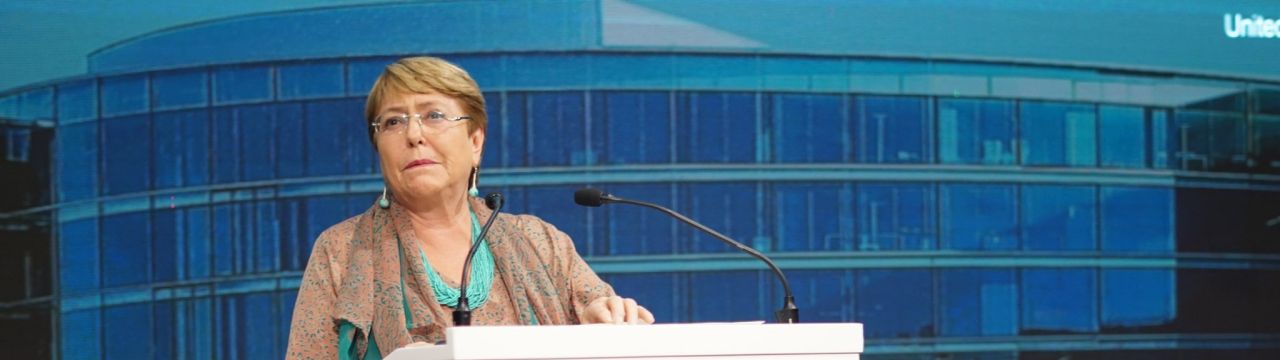
Michelle Bachelet recounted her own experience as a human rights defender. She told of dictatorship in Chile, the torture and killing of her father and her mother’s detention. In defiance of the anger she felt at her family’s situation, she found the perseverance to stand up and act for change, becoming the first woman President of Chile (dually elected), then Executive Director of UN Women, and eventually replacing Zeid Raad Al Hussein in 2018 as the UN High Commissioner for Human Rights.

‘[…] the world today faces complex challenges, challenges too big for one country, challenges that do not respect borders’, she said. ‘[…] And we see a pushback on human rights. And I say, let’s pushback the pushback’.

Nelson Mandela Human Rights Lecture Michelle Bachelet

Video of the Lecture. You can watch here the Nelson Mandela Human Rights Lecture in its entirety.

https://www.geneva-academy.ch/news/detail/247-human-rights-warriors-tell-their-stories-at-the-nelson-mandela-human-rights-lecture