ISHR interviewed Nfor Hanson Nchanji, award winning Human Rights Journalist from Cameroon. Published on 16 July 2019.
share information on human rights defenders, with special focus on human rights awards and laureates
ISHR interviewed Nfor Hanson Nchanji, award winning Human Rights Journalist from Cameroon. Published on 16 July 2019.
This short video dates back to 17 November 2015 but is now available as UN VIDEO. It is a short version of a full-length documentary film on Theo van Boven who was head of the UN Human Rights Division in the late seventies/early eighties when in Latin America hundreds of thousands were tortured, killed and disappeared. Theo was one of the few courageous UN leaders to speak out: “It is inexplicable and indefensible for the United Nations not to react urgently to situations of gross violations of human rights”.
https://humanrightsdefenders.blog/2015/12/16/theo-van-boven-reflects-on-70-years-united-nations/
https://videos.un.org/en/2015/11/17/the-van-boven-principles/
 File photos of senior advocates Anand Grover and Indira Jaising. | IANS
Citing three recent cases, the former civil service officers condemned what they said “appears an attempt to govern by fear and intimidation”. One of the cases the former bureaucrats commented on in their open letter was the Central Bureau of Investigation’s action against advocates Indira Jaising and Anand Grover. The searches at their homes and offices on July 11 were vindictive and the government had launched the “fresh attack” on the couple to silence them instead of following legal process, the signatories added. The group denounced “the abuse of authority in harassing human rights defenders”. The two advocates and their organisation Lawyers Collective have been “at the forefront in furthering women’s rights, gender equality, and environmental issues and have been committed to fighting over decades for the rule of law”, the open letter added. The writers pointed out that Jaising and Grover had been involved as lawyers in politically sensitive matters, especially a case in which Amit Shah, now the Union home minister, was an accused.
The former bureaucrats also referred to the labelling of social activists as “urban Naxals” by a wing of the Rashtriya Swayamsevak Sangh. The wing is “certifying some of India’s most credible leaders of social movements such as Aruna Roy, Nikhil Dey and Shankar Singh as ‘urban Naxals’,” they added. “These are respected persons who have given their life’s efforts in working for the common man.”
The letter also mentioned the case filed by the Assam Police against 10 people, most of them Bengali Muslim poets and activists who are often pejoratively referred to as Miya and whose body of work is known as Miya poetry. “In the tradition of protest Black, Dalit and Queer poetry, these poets have created a new genre of poetry which they call Miya poetry, in which they lament and protest about the suffering of their people as a result of the NRC process,” the former bureaucrats said. “They now are charged with inciting hatred under sections which could keep them in jail for many years of their lives.”
They condemned these attacks on human rights defenders, dissenters and poets. “Dissent and freedom of expression are the life-blood of any democracy,” they added. “We find it intensely worrying that there are crude and ham-handed attempts to intimidate such voices into silence, using the institutions of state authority.”
Despite President Rodrigo Duterte’s threat to sever diplomatic ties, Iceland expressed hope the Philippines will cooperate with the United Nations Human Rights Council’s investigation into the human rights situation in the country, including the drug war. “Icelandic authorities sincerely hope that the Philippine authorities will engage the UN on this and the resolution,” Icelandic Ministry for Foreign Affairs said in a press statement. The resolution was backed by 18 out of 47 member-countries. [https://humanrightsdefenders.blog/2019/07/11/un-council-agrees-action-on-philippines-in-spite-of-vehement-objection/]
When Iceland led the resolution at the UN Human Rights Council, it did so as a country that puts a high priority on human rights. As one of the most peaceful countries in the world, Iceland also leads by example when it comes to observing human rights. Iceland carried that responsibility when it became a member of the UN rights council last year, taking the place of the United States which left the rights body it called a “cesspool of political bias.” “For a small and peaceful country like Iceland, international law and the multilateral system is our sword, shield and shelter,” Iceland’s Ministry for Foreign Affairs said in statement to Rappler.
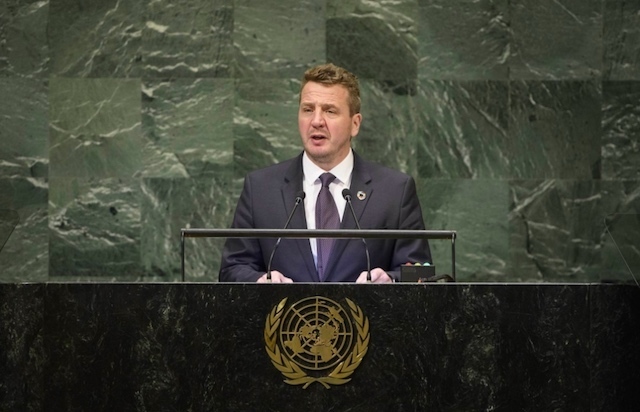
In an interview with the Iceland Monitor, Iceland Foreign Minister Gudlaugur Thór Thórdarson said, “We are fortunate enough to enjoy human rights in Iceland, which we take for granted….It is our duty to contribute to the fight for improving the state of human rights affairs in the world.”
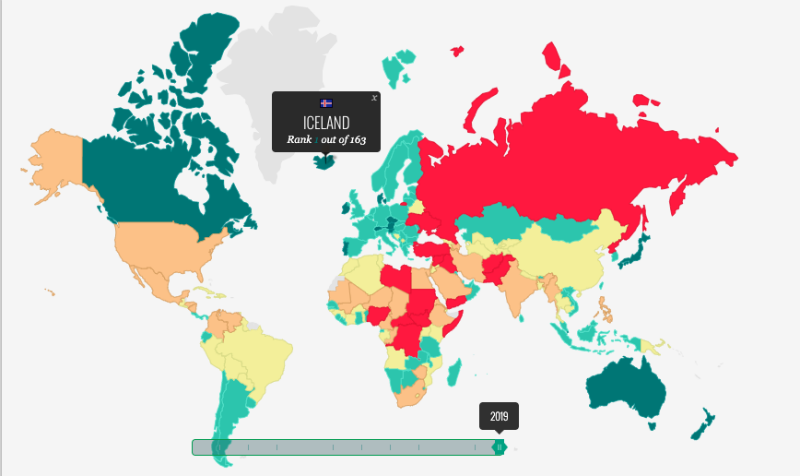
According to the Fund for Peace’s 2019 Fragile States Index, Iceland was considered among the most stable countries in the world, enjoying stable observance of human rights and the rule of law among other factors. The Philippines, meanwhile, was described as a state with “high warning” over eroding human rights and higher levels of crime and violence. Aside from this, the 2019 Global Peace Index ranked Iceland as the most peaceful country in the world, while the Philippines was 134th out of a total of 163 countries.
For Human Rights Watch deputy director of Geneva Laila Matar, Iceland’s actions as a new member of the powerful rights body live up to its reputation as a country that champions human rights. “Iceland is a country that takes the Human Rights Council seriously and that takes their membership in the Human Rights Council seriously. The Human Rights Council is meant to ensure that gross violations of human rights are addressed,” Matar said in an interview with Rappler.

The Committee to Protect Journalists on 16 July gave one of its International Press Freedom Awards 2019 to Neha Dixit, an Indian freelance reporter, who has covered politics, gender, and social justice in print, TV, and online media for more than a decade. [see: https://humanrightsdefenders.blog/2019/07/17/international-press-freedom-awards-2019/]
She began her career at Tehelka magazine and then joined the special investigation team at India Today. In 2019, Dixit spent months investigating and reporting stories that shed a light on important issues in the country, including extrajudicial killings by police. She also reported on the illegal detention of citizens under draconian laws that appeared to be motivated by political interests. In January 2019, the Office of the United Nations High Commissioner for Human Rights sent a notice to the Indian government to express its concern about the detentions. In 2018, Dixit reported on the damage to the health of poor Indians who were being used as guinea pigs by pharmaceutical companies in illegal drug trials.
In 2016, she wrote a story for Outlook magazine that accused members of a right-wing nationalist group of trafficking more than 31 girls in Assam state to other parts of India in order to inculcate them with a nationalist ideology. After the story was published, members of the ruling party filed a criminal defamation suit against Dixit and Outlook, accusing both of violating Indian law. CPJ condemned the case, which continues today, and provided Dixit with support for its legal fees. CPJ’s research has found that section 153A of India’s colonial-era penal code, under which the suit was filed, has been used to silence journalists, writers, and academics in India. Dixit was also charged with “inciting communal hatred through writing,” for which she could face a five-year prison term.
After Dixit’s exposé on extrajudicial killings by the police, she said high-ranking police officials threatened her family’s safety if she continued to report on the issue. She is frequently harassed online as a result of her reporting, especially from alleged right-wing extremists. She has been threatened with physical attacks, rape, and death, and her personal information has been exposed online. She told CPJ in May 2019 that she faces up to 300 abusive messages a day.
Dixit’s work has been published in international outlets including The New York Times, Al-Jazeera, Caravan, and The Wire. She has received numerous awards, including the European Commission’s Lorenzo Natali Media Prize in 2011, the Kurt Schork Award in International Journalism in 2014, and the 2016 Chameli Devi Jain Award for Outstanding Woman Journalist.

Melo said he hoped the award would turn the spotlight on the exceptional difficulties faced by journalists in Tanzania. “This prize lifts a corner of the veil on what is happening in our country,” said Melo, who is barred from leaving Tanzania’s financial capital and biggest city, Dar es Salaam. “Never before in our country has a government violated press freedom so much.”
“It is of course not good news that my country is making the headlines because of its laws and practices that violate freedoms of the press and expression,” Melo said. “With the announcement of this award, I think the international community will take a greater interest in what is happening in Tanzania, in the difficult environment in which the media and human rights defenders work in Tanzania.” Melo, a father of three, said he had received death threats. “It is obvious that I am afraid, afraid for my personal safety, but also for the safety of my family,” he said.
In 2015, the East African country was 75th in the world in RSF’s press freedom rankings. By 2019, it had slid to 118th.

On 17 July 2019 the Unrepresented Nations and Peoples Organization (UNPO) is launched a report, Compromised Space: Bullying and Blocking at the UN Human Rights Mechanisms, with its partners at the University of Oxford and Tibet Justice Centre which details how China, Russia, Iran and other repressive regimes are manipulating the United Nations Human Rights System to block and attack those seeking to hold them accountable for gross human rights violations perpetrated against minorities, indigenous communities and other unrepresented peoples…
The report is based on three years of study conducted by the UNPO and its partners at the University of Oxford and the Tibet Justice Center, supported by the UK’s Economic and Social Research Council. It is based largely on interviews and testimonies from 77 human rights defenders working on behalf of minorities, indigenous communities and other people living in nation states whose political systems do not create governance structures representative of all. It identifies a systemic attack on the United Nations human rights system by these governments, led largely by China, Russia and Iran, designed to shield them from accountability for human rights violations and crimes against humanity. This includes efforts to deny civil society groups participatory status at the UN (so called “ECOSOC status”), to bully and block them when they are able to access the UN, to crowd out the UN space with “GONGOs” – government-sponsored organisations posing as NGOs – and to harass, intimidate and take reprisals against activists and their families, whether at home or abroad.
Among the indicative findings of the report are the facts that:
China has regularly detained or imprisoned activists from its Southern Mongolian, Uyghur and Tibetan communities who have sought to travel to the UN, with such success that, for example, no Tibetan from Tibet who is acting independently of the Chinese government has ever managed to leave Chinese- occupied Tibet to testify at the UN in Geneva or New York, and then return safely;
Russia, in order to shield itself from accountability for its crimes in Russian-occupied Crimea, has asked for rules of participation in forums, such as the UN Minority Forum, to be changed to restrict NGO participation to groups acceptable to Russia, and its Crimea occupation authorities have attacked Crimean Tatar activists and destroyed or confiscated their passports in order to prevent their travel;
Iran regularly engages in practices designed to intimidate activists from their minority communities, even while they are operating within the United Nations buildings, and have taken out reprisals against the family members of these activists still living within the Islamic Republic of Iran.
The story of Dolkun Isa, President of the World Uyghur Congress and Vice President of the UNPO, is indicative of all of these actions. Mr. Isa and his organization have regularly been denied ECOSOC status at the United Nations, his access to the UN buildings and events have been restricted due to Chinese demands, he and his supporters have been followed and harassed in the UN building, his mother was held in China’s anti-Muslim concentration camps as a result of his work and for many years his ability to travel freely around the world was frustrated by Chinese efforts to involve European and other states in his persecution by falsely labelling him a “terrorist”.
Reacting to the launch of the report, UNPO’s General Secretary, Ralph Bunche, stated that “the report presents the disturbing finding that the United Nations Human Rights system, which is the only outlet for many peoples living under repressive regimes to seek accountability for crimes committed against them, is being systemically undermined by perpetrator regimes. Unfortunately, democratic states are not doing nearly enough to push back against this phenomenon and in some instances are even adopting the conduct that we see from the repressive states. The withdrawal of the USA from the UN’s Human Rights Council has certainly not helped matters, but other states are simply not doing enough to counter this problem and protect human rights defenders.”
The Committee to Protect Journalists’ (CPJ) 2019 Gwen Ifill Press Freedom Award recognizing extraordinary and sustained achievement in the cause of press freedom will be presented to Zaffar Abbas, editor of Pakistan’s daily newspaper Dawn. Abbas, who has decades of experience as a reporter in Pakistan, has led Dawn since 2010. Under his leadership, Dawn and its reporters frequently have come under government pressure. This is the second Ifill award which replaces the Burton Benjamin Memorial Award. For more on this and other awards for journalists: http://www.trueheroesfilms.org/thedigest/awards/gwen-ifill-press-freedom-award
“Zaffar Abbas is the embodiment of journalistic courage, which is why the board is so pleased to honor him with the Gwen Ifill Press Freedom Award,” said Kathleen Carroll, chair of the CPJ board. “Every day he fights to deliver facts to Dawn’s readers in the face of pressure, obstacles, and blockades from the institutions in Pakistan that would much prefer to go about their business without scrutiny from the press or the public.”
https://cpj.org/2019/07/cpj-announces-2019-international-press-freedom-awa.php
The United Kingdom has recently published guidelines for the protection and support of rights defenders around the world. It joins a small group of countries such as Norway, the Netherlands, Ireland, Switzerland, Austria and Canada (although they differ – see the websites of these countries). There are also some mulitlateral ones such as the EU Guidelines.[https://humanrightsdefenders.blog/2012/01/13/quick-reminder-of-the-eu-guidelines-on-human-rights-defenders/] and those of the OSCE.
See also: https://humanrightsdefenders.blog/2016/12/13/canada-joins-select-group-of-governments-with-guidelines-on-human-rights-defenders/ and https://humanrightsdefenders.blog/2014/11/02/swiss-guidelines-on-human-rights-defenders-analyzed-by-civil-society/.
In the foreword to the publication Lord (Tariq) Ahmad of Wimbledon, Minister for Human Rights, states: To demonstrate our commitment of continued support of human rights defenders globally, this document sets out why human rights defenders are important to us and acknowledges the risks they face in the pursuit of universal human rights. We hope it will give human rights defenders encouragement to know how we may be able to support them, including through our network of embassies and high commissions overseas. Whilst every situation may be different depending on local context, our values and commitments in providing support remain the same
Human Rights Watch was not impressed: While welcome, real support requires a willingness to speak out even when it carries political costs. The new guidelines praise the courageous work of human rights defenders in the face of risks including threats, intimidation, harassment, and detention. The guidelines rightly identify groups which are in greater danger, such as journalists, women, and LGBT activists, and express the UK’s commitment to support them “wherever they are in the world.” But when it comes to actually standing up for human rights defenders, the UK’s record is patchy. While it sometimes speaks out in private, it remains reluctant to do so publicly, even though doing so would raise the cost to states that seek to silence those who speak truth to power. The UK government has so far done very little about credible reports of the torture, sexual harassment, and assault of Saudi women activists currently on trial for defending human rights in their country. It has failed to hold Hungary to account for its efforts to clamp down on human rights groups and rule of law. And it has failed to criticize United Arab Emirates authorities for the unjust imprisonment of Emirati activist Ahmed Mansoor on his peaceful calls for reform. The UK hopes that by publishing these guidelines, defenders might be encouraged to understand that the British government might be able to support them. But if the UK is really serious about this, it should be willing to speak out publicly on their behalf when they are in trouble, including when their safety is at risk in countries that are UK allies. In short, the UK’s new Prime Minister should make it a priority to protect and support human rights defenders no matter where they are in the world.
https://www.hrw.org/news/2019/07/19/will-next-uk-government-stand-human-rights-defenders
 Hans Thoolen on Human Rights Defenders and their awards