Author Archive

Chinese sensitivity again on display re human rights awards

August 29, 2020
Kunal Gaurav in Republic World of 29 August 2020 illustrates again how extremely sensitive China remains with regard to human rights awards, unwittingly underlining the strong symbolic value they can have.

China

China has warned Norway against awarding Nobel Peace Prize to pro-democracy activists of Hong Kong, saying it doesn’t want to see the politicisation of the award. Chinese Foreign Minister Wang Yi was on a rare visit to Norway as the country prepares to take up the rotational seat of United Nations Security Council, of which China is a permanent member, for 2021-22.

“I would only say one thing: In the past, today, and in future, China will firmly reject any attempt by anyone to use the Nobel Peace Prize to interfere in China’s internal affairs,” Wang told reporters when asked about the possibility.

The decision to award the Nobel Peace Prize to Dalai Lama, head monk of Tibetan Buddhism, for his willingness to compromise and seek reconciliation despite brutal violations had irked China. Later, the Nobel Foundation awarded the prize to Lui Xiaobo for his long and non-violent struggle for fundamental human rights in China. The decision immediately froze diplomatic relations between Norway and China, which resumed in December 2016.

Hong Kong has been the epicentre of pro-democracy protests and China enforced a controversial security law which has allegedly undermined the autonomy of the region. Several countries have revoked the extradition treaty with the semi-autonomous region, calling the draconian law as a flagrant violation of Sino-British agreement after which the city returned to Chinese rule.

According to a Hong Kong daily, the foreign minister said that the Chinese government doesn’t want to see anyone politicise the Nobel Peace Prize. Calling on Norway to cherish the current relationship, Wang said that the bilateral relationship can continue to develop in a sustained and sound manner if both parties can “continue to respect each other and treat each other as equals.”

At a press briefing on August 28, Norwegian Foreign Minister Ine Eriksen Søreide said that the leaders had an extensive discussion ranging from COVID-19 response to international trade and the free-trade agreement. She said that they also had extensive discussions on human rights, an issue of international concern given China’s history and ongoing crackdown in Xinjiang.

https://www.republicworld.com/world-news/china/china-warns-norway-against-awarding-nobel-peace-prize-to-hong-kong-act.html

UNEP FI: Tool for associating UN and financial sector

August 29, 2020

The United Nations Environment Programme Finance Initiative (UNEP FI) was established in 1992 as a platform associating the United Nations and the financial sector globally. The need for this unique partnership arose from the growing recognition of the links between finance and environmental, social and governance (ESG) challenges, and the role financial institutions could play for a more sustainable world.

UNEP FI works closely with 230 members from the banking, investment and insurance sectors, who have signed the UNEP FI Statement of Commitment. The membership is made up of public and private financial institutions from around the world, and is balanced between developed and developing countries. They recognize sustainability as part of a collective responsibility and support approaches to anticipate and prevent potential negative impacts on the environment and society.

UNEP FI Social Issues

UNEP FI is committed to exploring the intricacies between social issues, human rights and financial sector practices. UNEP FI aims to de-mystify the language and jargon surrounding the social agenda, and clarify how social issues relate to the activities of finance institutions.

The main objectives of the work stream include:

  • To develop and maintain an understanding of human rights and social issues and how they apply to financial institutions worldwide, so that financial sector professionals are equipped to make responsible decisions.
  • To produce internationally applicable guidance for finance sector organizations on identifying and addressing social issues relevant to their businesses, highlighting relevant international laws, standards and initiatives, and examples of best practice.

The UNEP FI Human Rights Guidance Tool for the Financial Sector is designed as an online signposting tool providing information on human rights risks for financial institutions.

Included in the tool finance practitioners will find:

  • background information on human rights and how they relate to finance
  • relevant international laws, standards and initiatives
  • key questions to assist in assessing human rights risks and impacts
  • issues relating to different industry sectors
  • key human rights topics
  • links to other relevant resources

The tool focuses specifically on human rights issues relevant to the assessment of business relationships and transactions. Links are also provided within each of the sector briefings to the broader environmental and social risk guidance provided by UNEP FI. Together these form part of the growing array of tools and guidance available to financial institutions to enhance their understanding of human rights risks.

This tool provides a framework for finance sector professionals to:

  • identify potential human rights risk in lending operations
  • assess the materiality of the human right risk
  • identify possible risk mitigants.

Financial institutions will want to use the tool to assess the human rights issues in their own business and its supply chain. They will also find it useful in reviewing other aspects of financial services provision, in addition to lending policies and practices. Whilst the tool is mainly addressed to lending managers, human rights are important in relation to all financial sector activity, so others will also find much of interest and relevance in it.

The Human Rights Guidance Tool has been fully revised in 2014. The tool was originally launched in 2007 and updated in 2011.


Table of Contents

Introduction

Key Issues and Questions

Human Rights Issues by Sector

Human Rights Issues by Topic

Resources

About this tool


https://www.unepfi.org/humanrightstoolkit/credits.php

Shirin Ebadi biopic: Until We Are Free

August 27, 2020

Harris says, “It’s been an honor to work with many remarkable Nobel Peace Laureates, including the Dalai Lama, Archbishop Desmond Tutu and Shirin Ebadi, as part of the PeaceJam Nobel Legacy film series and to lend my voice to Shirin’s story of fighting for women and children to be treated with basic human dignities.”

https://www.benzinga.com/pressreleases/20/08/p17263858/award-winning-producer-and-voiceover-actor-laurel-harris-narrates-shirin-ebadi-until-we-are-free-w

Egypt: 15-year term for human rights defender Bahey El-Din Hassan

August 27, 2020

President of the Cairo Institute of Human Rights Studies, Bahey El-Din Hassan, 26 August 2020 [thenewkhalij/Twitter]

President of the Cairo Institute of Human Rights Studies, Bahey El-Din Hassan, 26 August 2020 [thenewkhalij/Twitter]

The charges levelled against Bahey Hassan, who has been described as the spiritual father of the human rights movement, are familiar. They have been issued, in one form or another, against Egypt’s 60,000 political prisoners, multiple times: spreading false news and insulting the judiciary. The Cairo Institute for Human Rights Studies condemns the 15-year sentencing of its director, prominent human rights defender Bahey eldin Hassan, and calls for an end to a state security campaign of intimidation and vengeance that has targeted Egyptian rights advocates.

Bahey Hassan left Egypt in 2014 after receiving death threats for his work. Two years later a travel ban was issued against him and his assets were frozen after he and his organisation were targeted by what Amnesty terms a “politically motivated investigation into the work of human rights organisations in case 173”, or the foreign funding case.[see https://humanrightsdefenders.blog/2016/09/18/egypt-court-freezes-assets-of-rights-defenders-and-ngos/]

In 2019 Hassan was sentenced to three years in prison, again in absentia, and fined 20,000 Egyptian pounds ($1,259) for allegedly insulting the judiciary.

Amr Magdi, Egypt’s researcher for Human Rights Watch, has drawn comparisons with Bahey Hassan’s treatment by the Sisi government to how his organisation was allowed to operate under ousted President Hosni Mubarak.

Understandbly there have been massive reactions on Twitter and other social media  against the 15-year sentence by Egypt ‘s ‘terror’ court.


Egypt: Human rights defender Bahey el-Din Hassan handed outrageous 15-year prison sentence

Twitter ignites as Egypt ‘terror’ court hands 15-year term to human rights defender 


Egypt: Human rights defender Bahey eldin Hassan sentenced over a tweet

European MPs want EU to become serious about linking Corona virus payments to human rights

August 27, 2020
Political leaders in the European Parliament will insist that the EU’s massive budget payouts be dependent on countries meeting human rights and media freedom standards, they said on Wednesday.26 August 2020.  Targeted, but not named, were Hungary and Poland, countries that receive massive subsidies from the EU budget, but flout calls by Brussels to meet commitments on fundamental freedoms.

The time has come to accelerate the fight against the erosion of democracy, the rule of law and fundamental rights in the very heart of the EU,” said the letter, signed by leaders from the centre-right, centre-left, centrist and green parties.

The letter was addressed to Chancellor Angela Merkel of Germany, which currently holds the EU’s rotating presidency, as well as Ursula von der Leyen, the head of the commission, the EU’s executive arm that hands out the cash. Unless there are changes, the European Parliament has already vowed to veto the multi-year, one-trillion-euro budget — along with a massive pandemic recovery fund — that was thrashed out between heads of government at a summit in July.

Parliament members are due to sit down with representatives from the member states on Thursday to seek a compromise, with MEPs insisting on stricter conditions around civil rights.  The summit deal in July was seen by some as not putting enough pressure on countries to respect core EU values, especially after Hungarian Prime Minister Viktor Orban hailed a “huge victory” against conditionality after the talks.

In their letter on Wednesday, the MEPs insisted that EU member states approve a parliament proposal from April 2019 which would firmly link EU spending to the rule of law, which they vetoed at the time. Without its formal approval, “it will be impossible for us to move forward” on the EU budget, the group leaders said.

The EU budget is deeply intertwined with the 750 billion euro post-virus recovery fund, that parliament does not have a say over.  But given the historic recession afflicting Europe, member states are under huge pressure to implement the plan and the budget as soon as possible, hopefully by the end of the year.

Recent events in Hungary and Poland suggest the countries have little intention of addressing EU concerns over attacks on media freedom, LGBTI rights and the independence of the courts. A day after the summit in July, the editor of Hungary’s top independent news site was fired, seen as another sign of the Orban government’s attacks on opposition media. In Poland, the UN’s AIDS programme this month voiced deep concern about the “intensifying persecution” of LGBTI people, as well as crackdowns on human rights defenders.

https://www.macaubusiness.com/top-euro-mps-to-merkel-no-eu-budget-without-rule-of-law/

16 NGOs call on UN to convene special session on crackdown in Belarus

August 27, 2020
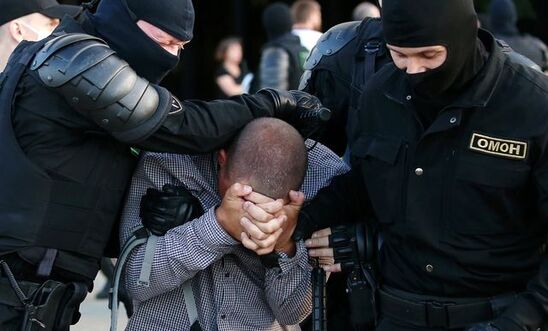
Police officers detaining a protester in Minsk on 10 August © Natalia Fedosenko/TASS

An open letter has been signed by: Article 19, Assembly of Pro-Democratic NGOs of Belarus, Barys Zvozskau Belarusian Human Rights House, Belarusian Association of Journalists, Belarusian Helsinki Committee, Civil Rights Defenders, Human Constanta, Human Rights House Foundation, Human Rights Watch, International Federation for Human Rights (FIDH), La Strada International, Legal Initiative, Legal Transformation center (Lawtrend), Viasna Human Rights Center and World Organisation Against Torture (OMCT).

The UN Human Rights Council must urgently convene a special session to address the human rights crisis in Belarus. The joint letter expresses the organisations’ “utmost concern” over “widespread violations of human rights, including arbitrary arrests, prosecutions under trumped-up charges, and torture and other ill-treatment”.

The letter calls on the council to adopt a resolution requesting the UN High Commissioner for Human Rights to monitor and report on human rights abuses in Belarus with “a view to ensuring full accountability”.

See also: https://humanrightsdefenders.blog/2020/08/13/what-can-we-do-about-the-result-of-the-belarussian-election-on-line-discussion-today-at-14h00/

[In the three days after the 9 August presidential election, the authorities in Belarus confirmed the arrest of at least 6,700 protesters. According to Viasna Human Rights Center, at least 450 of the detainees reported being tortured or otherwise ill-treated – including through severe beatings, being forced to perform humiliating acts, being threatened with rape and other forms of violence – while held in incommunicado detention for up to ten days.

Since 12 August, the authorities have taken steps to de-escalate the situation, refraining from mass arrests and releasing those detained. However, the threats against peaceful protesters recently made by President Alyaksandr Lukashenka and his subordinates together with the recent deployment of the armed forces in the country’s capital Minsk and elsewhere, signal a possible new spiral of violence and accompanying human rights violations.]

Here the Letter in full:

Click to access civil-society-organizations-call-on-the-united-nations-human-rights-council-to-convene-a-special-session-on-belarus.pdf

Witness’ animated film “We Have Rights” to be used when documenting ICE Arrests

August 27, 2020

It wil take only 3 minutes to watch this well-done animated film “We Have Rights When Documenting ICE Arrests” which Witness co-created for the We Have Rights Campaign.   


Iranian woman wins top award with religious freedom animation

August 26, 2020
An Iranian-born animator has won a top prize for her film about the importance of freedom of religion. Maral Karaee’s “District 18” tells the story of a little girl who lives in a world where people, animals of object of different colours – red, blue, green and yellow – are not allowed to mix. It won the Grand Prize in the Animation category in the Short Film Competition at the Empower Women Media and the Religious Freedom & Business Foundation. When the girl accidentally breaks the rules, she is fired from her job and made an outcast.

https://www.keepthefaith.co.uk/2020/08/25/iranian-christian-wins-top-award-for-religious-freedom-animation/

Pakistani Lawyer Mary Gill Wins Anna Lindh Prize 2020

August 26, 2020
Pakistani Lawyer Mary Gill Wins Anna Lindh Prize for her campaign '#SweepersAreSuperheroes'
Pakistan’s Human Rights activist and lawyer Mary Gill has been honored with this year’s Anna Lindh Prize.

Komal Fatima Web Editor of BolNews on 25th August, 2020 reports that Pakistani Lawyer Mary Gill has won the Anna Lindh Prize for her campaign ‘#SweepersAreSuperheroes’

Mary Gill is a former MPA and a member of Women in Law. Gill was nominated by WaterAid Sweden. Lena Hjelm-Wallen, the chairman of Anna Lindh’s Memorial Fund and former foreign minister in Sweden, stated: “As a lawyer and activist, Mary James Gill connects human rights, health, and working conditions not least thorough the Sweepers are Superheroes campaign. Mary’s insistent work for the most vulnerable groups, based on human rights is entirely in line with the values Anna Lindh stood for. Therefore, we are very proud to award Anna Lindh prize 2020 to Mary James Gill.

For more on this and similar awards see: http://www.trueheroesfilms.org/thedigest/awards/anna-lindh-memorial-fund-prize

Mary Hill has run a successful campaign. Her motive ‘Sweepers are Superheroes’ launched in 2017 has gained international recognition as well. Through this campaign, she became a voice of garbage collectors who work in vulnerable working conditions. She spoke for the rights and safety of sanitation workers.

https://www.bolnews.com/latest/2020/08/pakistani-lawyer-mary-gill-wins-anna-lindh-prize-for-her-campaign-sweepersaresuperheroes/

Sad story continues: Saba Sahar, Afghanistan’s First Female Film Director, shot

August 26, 2020
saba sahar
Saba Sahar facebook

Afghan actress Saba Sahar was reportedly shot in Kabul on Tuesday 25 August. Her husband Emal Zaki told the BBC that three gunmen opened fire on the car she was traveling in on her way to work just five minutes from their house, the outlet reported. Zaki said that Sahar was one of five people in the vehicle, including the driver, two bodyguards and a child, according to the BBC. It was not clear if the child was one of Sahar’s children. Both bodyguards reportedly also sustained injuries from the shooting, according to BBC. In addition to her work as an actress and director, Sahar is a trained police officer and women’s rights advocate.

Afghanistan: The rise in attacks and assassination attempts on human rights defenders, political activists, journalists and film actors is extremely worrying,” Amnesty International South Asia said in a tweet on Tuesday, responding to the news of the attack on Sahar.  See also: https://humanrightsdefenders.blog/2020/06/30/car-bomb-kills-two-human-rights-workers-in-afghanistan/

In an interview with The Guardian in 2012 she said:  “I want to show the conservatives who lock their daughters and wives at home that they should let them out to get an education, earn some money and help rebuild Afghanistan,” she said, adding that she has received death threats from anonymous phone callers. “They told me to say goodbye to my loved ones because I’d soon be dead.” After reporting the threats to authorities, Sahar said the calls only continued. “They called me again and asked why I’d gone to the authorities,” she said. “They said that even if the whole government is behind you, we will still kill you. We will murder you on the street, in public.” “Every morning when I leave the house, I know I might get killed, might never see my family again,” she told The Guardian at the time.