On 16 February 2015, the York Press carried a feature story by Stephen Lewis about 5 human rights defenders in the temporary shelter programmeat York University. The aim of the placements is to give those fighting for human rights around the world a breather, as well as the chance to forge contacts with other human rights workers and organisations around the world.
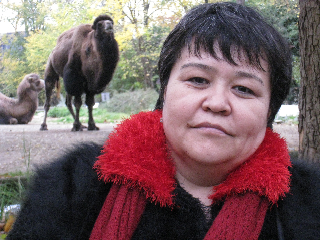
KatsiarynaBorsuk was born in a village not far from Chernobyl, Belarus, a year after the nuclear accident which made it infamous. The village was radioactively polluted. When she was four, her family were evacuated to the city of Gomel where, as a child, she was taunted for being ‘radioactive’ herself. Many people of her generation have chronic health problems, she says – her own brother has problems with his eyes and his throat.
Interested in environmental protection, she studied natural sciences at university in Gomel. She got caught up in student environmental protests, then became involved with the youth movement. When she graduated, she began working for a banned youth organisation – one that promoted democracy and civil rights. She was several times questioned by the KGB. “They pretended to not be KGB. But they took notes,” she says. “They mostly took you somewhere. Once, they came by car, and interviewed me in the car.”
Katsiaryna Borsuk
In 2012, although heterosexual herself, she became involved with Gay Belarus. Homophobia is widespread in Belarus, and there are very few people willing to stand up for LGBT people, she says. They are regularly subjected to homophobic attacks – attacks which are often filmed and posted on social media. Her organisation works with the victims of homophobia, trying to convince families to prosecute cases, talking to police and prosecutors’ offices, arranging free legal representation and even psychological support. But it is not easy. “The police are homophobic. They won’t protect you. Even if people are killed – there have been murders – the police don’t take the case.”
On 16 February 2015, the York Press carried a feature story by Stephen Lewis about 5 human rights defenders in the temporary shelter programmeat York University. The aim of the placements is to give those fighting for human rights around the world a breather, as well as the chance to forge contacts with other human rights workers and organisations around the world.
Valdênia grew up in the slums – or favelas – of Sao Paolo, Brazil’s biggest city. Home for her mother, father, three brothers, two sisters and herself was a small house with a tin roof. Her mother took in sewing. Her father worked in a factory until, in his mid-40s, he became ill. Because of poverty, many children end up on the streets, where they’re at risk of violence, abuse, disease and hunger. They have little chance of an education – and many girls end up in prostitution, Valdênia says.
When she was 14, Valdênia helped open a ‘safe’ house for young girls who worked as prostitutes. The police didn’t approve. “Who controls prostitution?” she says. “The policemen, and the men who have money.”
Valdênia Paulino Lanfranchi
She lived with the girls for ten years, then helped open two human rights centres to help families in the favelas. She went to university, and got degrees in education and law. Eventually, after suffering repeated attacks and threats, she and her husband Renato, also a human rights worker, moved to Paraiba, in north-eastern Brazil. There Valdênia, now 47, joined the Oscar Romero human rights centre, working to protect the rights of local ‘indigenous’ people.
She also, in 2011, became Police Ombudsman for Paraiba – the first woman to hold the post. It brought her into conflicts with ‘those in power’. “I was then a victim of everything from raids on the headquarters of our organisations to sexual violence and death threats.” Brazil is supposed to be one of the world’s emerging democracies. “But we have more than 100 human rights defenders threatened with death,” she says. “We have inequality, poverty, hunger. Why? What has happened?”
On 16 February 2015 the York Press carried a feature story by Stephen Lewis about 5 human rights defenders in the temporary shelter programmeat York University. The aim of the placements is to give those fighting for human rights around the world a breather, as well as the chance to forge contacts with other human rights workers and organisations around the world.As these are not the human rights defenders who figure highly in the news, I will in the coming days give you their stories. The first is Ruth Mumbi from Kenya:
Ruth Mumbi
LIFE is tough in Nairobi’s Mathare slums in Kenya and “a lot of young people opt for crime so that they can have something to put on the table,” says Ruth Mumbi, who grew up here. There are small seeds of hope, however: among them the Bunge la Wamama Mashinani. It means the ‘grassroots women’s parliament’, says Ruth, flashing a smile. She helped found it, and now acts as coördinator.
“We wanted to create a space for women to come together to discuss the challenges they are facing. Most women felt that we were not being fully heard.” The Bunge has few resources – not even a building. “We usually use small open spaces in the slums to hold our debates“.
The slum is riven by racial divides as well as crime – in 2006, fighting between rival Luo and Kikuyu groups saw at least ten people killed and hundreds of homes burned. But the young men who go out to rob, and rape, and kill, all have mothers or wives, Ruth says. “At the end of the day, they go back to their households, to their women. We should be talking with our kids to stop this.”
The Bunge also lobbies for better access to health care – and better access to justice for women who are raped or abused. The law can be an impossibly expensive business. “So we have been working with pro-bono lawyers and women’s rights organisations to provide free legal representation to women,” Ruth says.
As a human rights defender, she herself has faced harassment and intimidation. In 2011, she and a colleague were charged with incitement and remanded for two days in prison after leading a protest about the high death rates at a local maternity ward. [https://thoolen.wordpress.com/2013/10/15/kenya-rights-defenders-remain-under-attack/]. The harassment continues Ruth says: “Telling me to stop, sending threat messages, sending my mother messages telling her daughter to shut up or else.” And who is this shadowy ‘they’? “I believe they were the police.”
Last December, Brussels-based Protection International launched a new campaign, ‘The Women Who Defend Human Rights.’ In this series of monthly interviews, figure talks with Women Human Rights Defenders (WHRDs) about their work, challenges and every-day-life.
This month, the interview is with Rehana Hashmi from Pakistan. Rehana has been a defender of human rights since a young age. She is also the founder of two national networks that support women and helps them to take charge of their rights. Due to her work, she has received threats to the point that she has had to flee her native Pakistan. You can now read her full story on PI’s website: http://protectioninternational.org/2015/01/14/the-women-who-defend-human-rights-rehana-hashmi/
As a relative specialist on human rights awards [https://thoolen.wordpress.com/2013/11/27/my-post-number-1000-human-rights-awards-finally-made-accessible-for-and-by-true-heroes/], I would be amiss not to relate the following ‘problem’ with a human rights award in Zimbabwe. The local NGO ZimRights gave a number of human rights awards and ended up having to defend the People’s Choice Award, which had been attributed to a ZANU-PF MP Joseph Chinotimba. A number of human rights defenders activists protested as they said it as was wrong to honour a war veteran who is known to have led violent farm invasions which claimed lives and displaced thousands of people.
Buhera-South MP Joseph Chinotimba
ZimRights has responded by saying that the People’s Choice Award is not [really] a Human Rights Defender Award but is an award “linked to the raising of pertinent developmental issues in the nation using platforms that one has access to”. It also explained that the nominees were selected by the people in all ZimRights’ eleven provinces and when votes were tallied Hon Chinotimba emerged as the winner. ZimRights said they take this result as a challenge and lesson on future education and human rights voting. The 3rd Edition of the Community Human Rights Defenders Award was held in Bulawayo last week on Thursday and the controversy may have obscured that the Overall Human Rights Defender of the Year was awarded to Rebecca Chisamba, a television talk show host. The New Zimbabwe report on 21 December added that “It is not clear what has endeared Chinotimba to the people but a few months ago the comical legislator arrived in Victoria Falls where he bought 200 cases of beer for the revellers at a local beer garden. Chinos, as the Buhera South MP is affectionately known, also pledged to pay school fees for over 20 school children at Chinotimba School which he claims is named after his ancestor.”
Another paper, Newsday, on 22 December, reported that the MP in question, perhaps in response to the criticism, “stunned the more than 200 invited guests that included donor agencies, MPs, civil society leaders, community human rights defenders and commissioners of a variety commissions when he turned down the holiday offer and requested that the money be channelled towards improving infrastructure in his constituency” [The prize was a paid holiday at Victoria Falls with his wife.]
[Chinotimba came into the political limelight in 2000 when he together with the late war veterans’ leader Chenjerai Hunzvi led violent farm invasions and later stormed then High Court judge Justice James Devitte’s chambers in protest against his court rulings on land issues. Since his election into Parliament last year, Chinotimba has generated a lot of controversy through his fearless debates.]
Yesterday, 19 December 2014, the Istanbul High Criminal Court acquitted Ms. Pınar Selek,an academic known for her commitment towards the rights of the most vulnerable communities in Turkey. She was prosecuted for allegedly causing a bomb to explode in Istanbul’s Egyptian bazaar on July 9, 1998, and for membership in a terrorist organisation.
Previously, the Istanbul Special Heavy Penal Court No. 12 had acquitted her on three occasions: in 2006, 2008, and 2011. Notwithstanding, the Supreme Court quashed the first two acquittal decisions and requested the lower court to convict her. In, 2013, the Istanbul Special Heavy Criminal Court No. 12 deferred to the Supreme Court’s request and sentenced Ms. Pınar Selek to life imprisonment, while the case was still pending before the Supreme Court. On June 11, 2014, the Criminal Chamber No. 9 of the Supreme Court decided to overturn the conviction on procedural grounds. [https://thoolen.wordpress.com/2014/07/09/pinar-selek-case-in-turkey-the-supreme-court-overturns-life-sentence-against-pinar-selek/]
“Countless procedural irregularities have been observed during the trial. She should have never been prosecuted in the first place. This decision should now become final”, recalled Martin Pradel, Lawyer at the Paris Bar, who has been observing the legal process for the Observatory since 2011.
The Observatory (a coöperation between FIDH and OMCT) has been particularly mobilised on this case, through the publication of nine urgent alerts, six trial observations and demarches towards the Turkish authorities and the international community at the highest level. For more information see Observatory mission report published in April 2014, available in English on the following web links: http://www.omct.org/files/2014/04/22642/turkey_mission_report_pinar_selek_2014.pdf
Under the title “FAMED UGANDAN ACTIVIST URGES UK HOME OFFICE NOT TO DEPORT LESBIAN” Melanie Nathan reports in her post of 11 December 2014 on O-blog-dee-o-blog-da that Kasha Jacqueline Nabagesera, the MEA laureate of 2011 has intervened strongly with the UK not to force Judith Twikiriz back to Uganda. “The UK has been very supportive of the Uganda Gay rights movement and it will be an embarrassment that your office doesn’t live up to its expectations in protecting those that need the protection most from persecution” Kasha writes in her letter. She would be sent back to the country where she already experienced torture and where she now faces likely persecution. The letter contains detailed arguments against deportation.
COPY OF THE LETTER to be found in the original post:
On 9 December, on the eve of Human Rights Day, Zainab Al-Khawaja was sentenced to 4 years and 4 months in two separate court hearings in Bahrain. Front Line, Human Rights First and others have reported extensively on this courageous human rights defenders [see also: https://thoolen.wordpress.com/tag/zainab-al-khawaja/] .
She was sentenced to 16 months’ imprisonment for “sabotaging properties belonging to the Ministry of Interior” and “insulting a public official” to three months’ imprisonment and fined 3,000 Bahraini Dinar (approx. 6,400 Euro) for “tearing up a photograph of the King”.
also shockingly reports that on the same day as her sentencing, the European Union presented a human rights awardto Bahrain’s National Institution for Human Rights and the Ombudsman of the Ministry of the Interior! Although this concerns a relatively unknown regional award (the Chaillot Prize is presented annually by the Delegation of the European Union in Riyadhhttp://www.ambafrance-bh.org/Press-release-Delegation-of-the.) the state press has been making the best of it [http://www.gulf-daily-news.com/NewsDetails.aspx?storyid=391213] and it is hard to see this as in line with the EU policy on Human Rights Defenders.
In mere 17 seconds Khadija Ismayilova,Azerbaijan’s leading investigative journalist and ardent government critic, shows courage and optimism in spite of her arrest. On 5 December 2014 (a few days before Human Rights Day) the Sabail District Court of Baku sent Ismayilova to two-months of pretrial custody, pending investigation on charges of allegedly driving someone to attempt suicide.
(The four winners of this year’s Right Livelihood Award (from left): Asma Jahangir, Bill McKibben, Alan Rusbridger and Basil Fernando. US whistle-blower Edward Snowden (not pictured) also received an honorary award)
Qantara.de 2014 on 9 December 2014 published an interesting interview by Roma Rajpal Weiss with Asma Jahangir, a prominent human rights defenders, winner of the Right Livelihood Award of this year and Laureate of the MEA as far back as 1995. The title “Every restriction is justified in the name of religion” is taken from Asma’s statement that most restrictions on the human rights of women in Pakistan are justified by arguments (perhaps rather feelings) based on religious or tradition. Read the rest of this entry »