Martine Anstett (born on 15 March 1969) was a French human rights defender who worked for a variety of organizations. For NGOs such as APT and AI, for the UN and the French diplomatic service. Her last post was with the Organisation Internationale de la Francophonie. She died at a young age on 29 April, 2015
Friends of hers decided to create an association to remember Martine and honor her memory so that her outstanding commitment should not be lost. The main activity of the association is to award every year – on 29 April – a remarkable human rights defender who deserves to be noticed and supported with the Martine Anstett Prize. The award comes with a prize of a minimum 1,500 euros. The website http://www.prixmartineanstett.org/En-PrixModeEmploi.html gives ample instructions on how to apply and on the life and work of Martine Anstett.
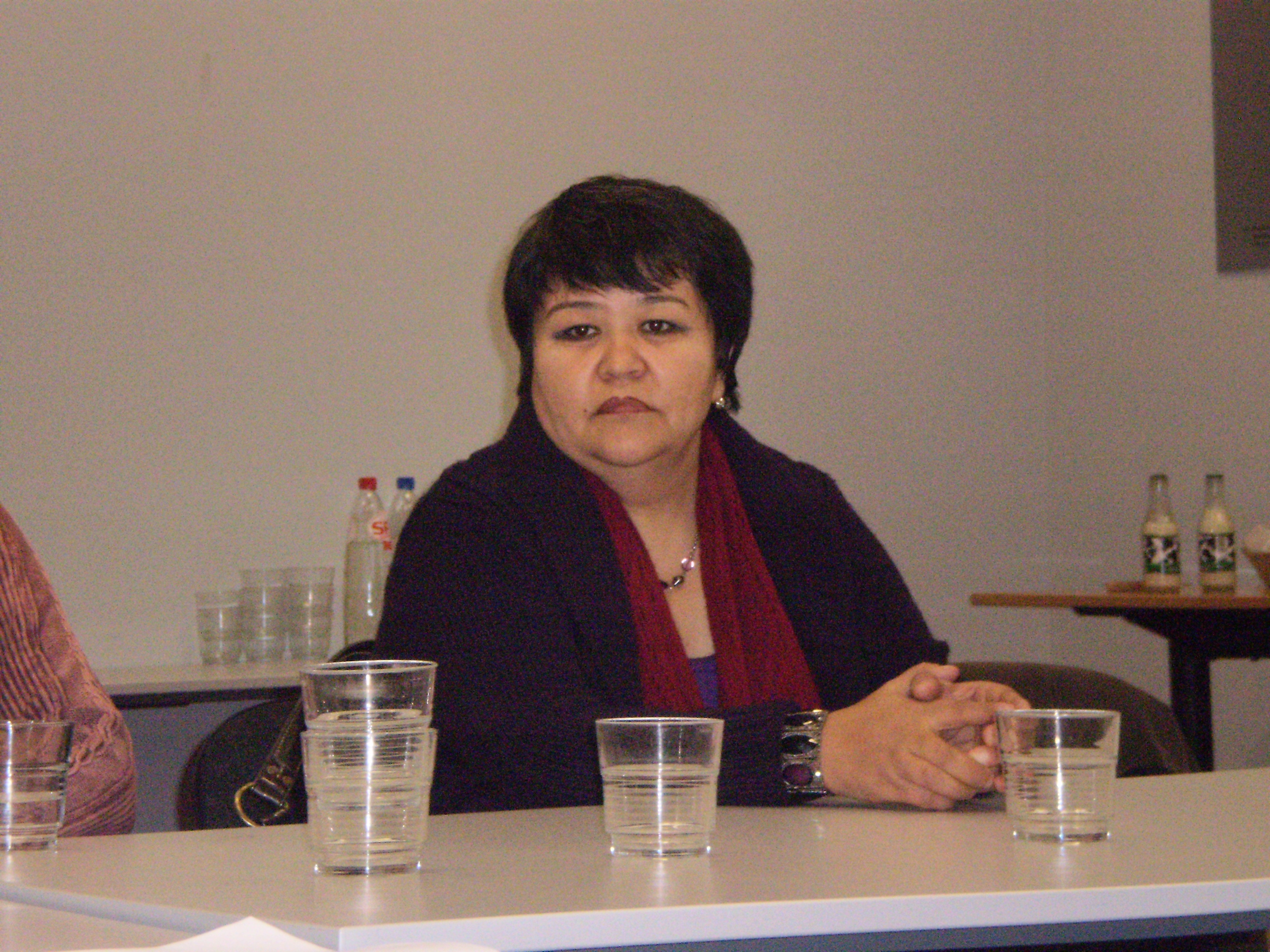
But she does not just live quietly in exile in Paris. She continues fight for her rights, lodged a complaint to the UN Human Rights Committee in 2012 and this body found on 6 October 2015 that there had been “multiple violations” of her rights, according to a press release issued by three human rights NGOs on 8 October (the Fiery Hearts Club, Redress and FIDH). Read the rest of this entry »
The Parliamentary Assembly of the Council of Europe has awarded its annual Vaclav Havel Human Rights Prize to veteran Russian activist Ludmilla Alexeeva, 88, at a special ceremony in Strasbourg on the opening day of its fall plenary session on 28 September 2015.
“Ludmilla Alexeeva has inspired many generations of activists in Russia, but also abroad, to commit themselves to the struggle for justice” – PACE President Anne Brasseur, chair of the selection panel, said presenting the award on 28 September. In her youth, Alexeeva gave up an academic career to join the Soviet dissident movement, going on to become a founding member of the Moscow Helsinki Group in 1976. A year later, she was forced to emigrate to the United States. Alexeeva returned to Russia in 1989 and became the International Helsinki Foundation president and later joined the Russian presidential human rights commission. At a demonstration in Moscow’s Triumfalnaya Square in 2010 against restrictions on the freedom of assembly, the by then 82-year-old head of the Moscow Helsinki group, received a severe blow to the head.
Alexeeva told the Assembly that for her receiving the prize was a “recognition of all Russian human rights defenders who work in very hard circumstances”. She also condemned the so-called foreign-agent law adopted in 2012, which she said aimed at “destroying” civil society groups. [Critics say the Russian government is using the foreign-agent law to hound non-governmental organizations that are critical of the Kremlin. As of June, there were 67 organizations deemed as such by Russia’s Ministry of Justice, including Transparency International and the Sakharov Center.]
on 21 September 2015 carries an interview with Lira Ismailova, a human rights defender from Kyrgyzstan.
She starts by crediting her mother, Tolekan Ismailova – a celebrated Kyrgyz human rights defender, with influencing her. Lira, previously a lawyer advocating for a wide range of human rights related issues, currently works at Bir Duino Kyrgyzstan – which focuses on defending freedom of association and protecting human rights defenders in Kyrgyzstan.
‘My first position in the field of human rights was with an NGO working for the protection of the rights of internal migrants. I then advocated for the repeal of the death penalty in Kyrgyzstan. I participated in a working group to prepare a draft law for reforming our criminal legislation, and on several reforms for the penitentiary system which included monitoring prisons in Kyrgyzstan.’ Lira’s work on the death penalty was ultimately successful in 2007 when President Bakiyev abolished the death penalty. However, this achievement did not herald a significant practical improvement in the human rights situation in Kyrgyzstan. Instead, since then, it is ‘much more difficult’ for human rights defenders on the ground.
Lira recalls numerous occasions when she and her family had to temporarily leave Kyrgyzstan for safety reasons. Lira highlighted the restrictions imposed on Bir Duino’s operations and recalled that its Kyrgyzstan office has been burgled twice in connection with attacks on ‘nationalists’. Bir Duino’s activities were also ‘supervised’ by authorities during the trial of well-known human rights defender Azimzhan Askarov in 2013 who is currently serving a life sentence in a Kyrgyz prison [https://thoolen.wordpress.com/2015/07/23/fury-about-us-award-for-askarov-in-kyrgyzstan-backlash-or-impact/].
‘We need help from international institutions to raise awareness of the Government’s attempts to implement these restrictive laws and help us to stop these laws from passing in Parliament’
…..According to Lira, it is critical that, among other international mechanisms, the UN Special Rapporteur on the situation of human rights defenders visit Kyrgyzstan. Some of the main aims of such visit would be to observe the effect of Russian-derived legislation on civil society space and support human rights defenders, such as Askarov a defender who needs urgent humanitarian aid.
Lira adamantly talks about what needs to be done in Kyrgyzstan – the Government needs to ensure the protection of human rights defenders in accordance with the UN Declaration on human rights defenders; ensure that national legislation complies with this Declaration, including by repealing legislative barriers to obtaining financial resources, independence, freedom of association, assembly and expression; and create a parliamentary committee on observance of the situation with the human rights defenders.
On 1 September 2015, the ISHR carried an interview with Soraya Aziz Souleymane, a business and human rights defender from the Democratic Republic of Congo (DRC).
Soraya holds the role of Deputy Field Office Director in charge of The Carter Center’s Mining Governance Program in the DRC, part of a new generation of young activists and NGO workers dedicated to seeing their country reach its potential.
Soraya started managing grants to affected communities at a large mining company’s foundation. She described her frustrations with the limitations of working within the foundation; she had discovered that many of the decisions about where and how to disburse the funds had already been made as part of the initial negotiations with affected communities. She soon decided to move into the corporate structure itself.
[When I joined the corporation,] it was an exceptional time, because the company was just beginning work in a new area and there was a need for many people… so much so that I was able to create a whole community relations department from the ground up.
Despite the positive experience of getting the first community relations department off the ground, Soraya said she still wasn’t satisfied. She described the realization of the limitations of working with projects, saying: My impact was limited just to this one small community. I couldn’t take those impacts and apply them to others. Also, all the policies had to be linked to production, to the generation of profit for stakeholders and investors. That’s how companies have always worked, and this was no different.
Feeling sidelined after production began at the mine, she joined The Carter Center’s office in 2014.
Soraya described her transition from private sector to civil society, highlighting both challenges and opportunities:
At the company, it was good – we had resources, support, the voice, we had almost immediate access to the ministries, no problem. A big challenge at The Carter Center is that we don’t have the same financial resources or the same level of influence. But other things are better, at least for me. My primary goal now at work is to change the situation of communities – all communities – not simply to increase production or placate one group.
Soraya also uses her new role to engage in direct advocacy with the DRC government. As she said, the chance to influence the policies of the state is ultimately a great opportunity. She also emphasized the value of gaining perspective through exposure to different sectors, and dismissed the idea that working for a company was ‘treason’. Instead, she noted that this kind of movement back and forth, especially within a sector, can lead to a lot of evolution and changing perspectives. It can also lead to more cooperation. We’ve seen many times when civil society and companies have joined forced against the government to say, “No, that will not fly.” It’s a strategic alliance.
…….
And despite the challenges, Soraya has a passion to do this work, and an optimism about civil society. I think my background, the fact that I am Congolese and that I have worked in the sector means I have real interest in and capacity to influence what my country becomes – my children will grow up here.
I am very optimistic because there are many young people who are innovators, who are open to new ideas, who are willing to sit down with a range of stakeholders. They are also willing to say to the international community, “No, we don’t need x, we need y.”
And as for the government, the emphasis is also on frank discussion, even when there is a disagreement. As Soraya says, We must work with them for change – and we must be clear that this is not the same as working for them, as accepting the problem.
On 26 June 2015 the ISHR (International service for Human Rights) featured a portrait of Elsa Saade, a woman human rights defender who works for the Gulf Centre for Human Rights (GCHR), an independent, non-profit and non-governmental organisation that works to provide support and protection to human rights defenders in the Gulf region by promoting freedom of expression, association and peaceful assembly.
Elsa, who has worked closely on the issue of women human rights defenders in the Gulf and neighboring countries, explained how women human rights defenders are at particular risk. E.g. she received a message from a women defender stating that she could no longer talk, that she was going underground. ‘They are threatening to kill me’, she said. ‘They will arrest me. I need to disappear.’ Elsa confirmed that she could not mention the defender’s name or where she is from as it would endanger her life, however highlighted how women not only face pressures from the government or non-state actors when she stands up for human rights, but even faces societal and cultural clashes which could be reflected inside her home.
Elsa explained how States in the Gulf region are mostly patriarchal. The simplest example of patriarchy is the fact that women in Saudi Arabia cannot drive. Two women defenders in Saudi Arabia, Maysaa Al Amoudy and Lujain Al-Hathlol, who were caught driving as a statement to allow women to drive, were arrested and tried in the Specialized Criminal Court in Riyadh, which deals with cases of terrorism and State security. They currently await sentencing.
Elsa referred to the situation in Iran, KSA, and Syria, which she considers is especially bad. ‘If we hadn’t publicised certain cases, some of our human rights defenders would already be dead. If no-one knew their names, the government wouldn’t consider them, as if they didn’t exist. Those who exercise their right to freedom of expression face death threats, flogging and indefinite prison sentences.’..‘Some defenders fall silent but others gain confidence when bad things happen – it confirms the need to struggle for their rights. Although the conditions are depressing, it is inspiring to see how tragedies motivate women to raise their voice. Out of their misery they create something beautiful.’
At this point, Elsa further referred to cases of women Syrian refugees in Lebanon and how important their role in the house, family and society was. On that account she mentioned several challenges that humanitarian people who help Syrian refugees face. Having worked in the field she highlights that they are often at risk.
‘As a result of my work I have personally experienced challenges. I was put in a situation were I could have been beaten several times, just because I was helping the Syrian refugees.’ As a woman, and especially after having widened the scope of interest in the region’s several HRD cases, Elsa has begun to feel increasingly vulnerable. ‘The greater the exposure, the greater the risk. In Lebanon the situation is not so bad for women. But on a recent trip to Egypt I felt incredibly paranoid. I was on the constant look out. That is why so many women defenders prefer to stay on the low.’
Elsa is adamant, however, on the necessity of continuing her work to support human rights defenders.
‘Without human rights defenders, the reality would remain hidden. There is a clash between three concepts: reality, delusion and myth. You have the myth, the image that the State wants to portray; the delusion, as people keep quiet to put bread on the table; and the reality on the ground. Human rights defenders, be they journalists, bloggers, lawyers, teachers or women defenders, portray this reality. They are the ones who ask for accountability, for independent judges, for basic human rights.’
[The Gulf Centre supports and protects human rights defenders in different ways to eventually create a community of strong and safe human rights defenders protected by international mechanisms. Firstly, it can mobilise a network of prominent human rights defenders to generate support amongst each other. Secondly, it runs UN advocacy projects and provides funding and technical assistance for HRDs to attend UN meetings. Thirdly, it allocates private funding for relocation, personal finance, appeals, and assisting with the provision of safe havens in case they are in danger. Fourthly, it runs training workshops on various issues HRDs are in need of and specifically on how to engage with UN mechanisms and protection mechanisms.]
Nasrin makes a brief appearance in Jafar Panahi’s recent film “Taxi, which was awarded the Golden Bear for best film at the Berlin international film festival 2015.
On 8 July FIDH published an update on the situation of Iranian human rights defender Nasrin Sotoudeh: “With A Defiant Smile – A Portrait of Nasrin Sotoudeh“. For more posts on her see: https://thoolen.wordpress.com/tag/nasrin-sotoudeh/
Nasrin Sotoudeh is among the most prominent human rights lawyers in Iran (recipient of the 2012 Sakharov Prize, which she shared with the Iranian filmmaker Jafar Panahi, and the PEN/Barbara Goldsmith Freedom to Write Award). Known for her work in defending women’s rights activists, minors on death row, journalists, Kurdish rights activists and other human rights lawyers, including the Nobel prize winner Shirin Ebadi, she is a national hero to many Iranians.
In January 2011, she was sentenced to 11 years in prison on charges of “propaganda against the system,” and “acting against national security“. Following persistent calls for her release from the UN, governments, and NGOs her sentence was reduced to six years, to be spent in the notorious Evin prison.
In 2013, after three years in prison, Sotoudeh was unexpectedly released, without explanation from the authorities. During her incarceration, she spent time in solitary confinement and went on several hunger strikes in protest of the inhumane prison conditions and the 2012 travel ban imposed on her husband and young daughter. One of the hunger strikes lasted 49 days and resulted in her losing 95 pounds. Upon her release, despite her weakened physical state, Sotoudeh got right back to work fighting for the respect for human rights in Iran.
Since then she has reactivated the Professional Women Lawyers Association and the Children’s Rights Committee, both of which she had helped found before her imprisonment. However, she has been spending much of her energy on a new campaign to abolish the death penalty in Iran, called Step by Step to Stop the Death Penalty (LEGAM). The initiative focuses on amending Iranian legislation to gradually reduce and eventually abolish the use of the death penalty.
Until recently, her ability to push for legislative reforms remained greatly limited due to the Iran Bar Association’s October 2014 decision (under pressure from the Judiciary) to suspend her license to practice law for a period of three years. In protest, Sotoudeh staged daily sit-ins in front of the Bar Association’s offices in Tehran. Her perseverance and that of her supporters finally paid off when, on 23 June 2015, Sotoudeh was informed that the Bar Association had revised the ban and reduced it to a period of nine months [Sotoudeh declared that she would be applying to renew her license].
When asked how she became a human rights defender, Sotoudeh says that as a lawyer, she was forced to make a choice: “When a lawyer witnesses unfair trials, when a lawyer witnesses the execution of minors, either they must turn their back or they must face up to the problem they are witnessing. I think I entered the field of human rights on the day I decided not to avoid such issues.”
Sotoudeh seeks to change Iran from the inside, by arguing cases and convincing others that protecting human rights is necessary. As she said recently regarding the conflict with the Iran Bar Association: “The channel for negotiations should never be closed. However, there are prerequisites for negotiations. If they are fulfilled, we should welcome such negotiations. If not, we should not insist only on negotiations. We should use civil action to persuade the other party to engage in negotiations.”
In the brief appearance in Jafar Panahi’s recent film “Taxi,” (see above) Sotoudeh explains the trials and tribulations human rights defenders face in Iran all the time with a smile on her face, but a defiant smile!
At the 2015 Oslo Freedom Forum, on 27 May 2015, Tunisian human rights defender Amira Yahyaoui talks about the global youth as an underrepresented force in many governments. She draws attention to the fact that while the world’s citizenry is increasingly young, the global leadership remains old. She criticizes the lack of representation of women and youth by reminding us that these so-called “minorities” are, in fact, majorities in the world population. If we don’t fix this problem, she argues, more and more young people will be driven to extremist groups like the Islamic State where they are given the opportunity to lead.
President of the Australian Human Rights Commission Professor Gillian Triggs:”Were I to receive warm and congratulatory words from the government on a constant basis I think that taxpayers would be justified in asking for my resignation because I wouldn’t be doing my job.”
In March of this year the Australian government attacked Professor Gillian Triggs, President of the Australian Human Rights Commission (AHRC), for having published a critical report on the presence and treatment of children in Australian immigration detention centres. Other differences followed. Gillian Triggs has refused to resign and vowed not to bow to personal “attacks” from senior ministers (Attorney-General George Brandis and Immigration Minister Peter Dutton), who have labelled her a partisan “disgrace” whose position has become untenable. Gillian Triggs said that resigning would be the reverse of what she should do.
Michael Forst, the UN special rapporteur on human rights defenders, wrote to the government calling on it to cease verbal attacks. [In a letter sent to Australia’s mission in Geneva in February 2015, he urged the government to “halt the alleged violations and prevent their recurrence“, saying the government’s response would form part of a report to the UN’s Human Rights Council. In its written response, dated April 24, the government insisted it had not “sought to remove any member of the commission” and “Though the government will not always agree with the Commission’s recommendations, it welcomes a vigorous and diverse human rights debate in Australia, and the Commission plays a constructive role in that debate.“]
This statement is in contrast to Mr Dutton’s continued attacks on Professor Triggs describing her conclusions as “a stitch up”, “lacking credibility”, “biased” and “hopelessly untenable”.. Professor Triggs delivered the keynote address at a human rights dinner in Melbourne only hours after his attack, warning that overreach by the Executive represented “a growing threat to democracy“. She was given a standing ovation by many in the room, with the president of the Court of Appeal of Victoria, Justice Chris Maxwell, declaring: “Tonight we have been privileged to have amongst us one of our foremost warriors. As we have been pleased to see, Gillian, you might be bloodied but you are certainly unbowed.”
The nation’s first federal human rights commissioner, Brian Burdekin, responded on ABC radio: “I’m not sure whether the Prime Minister is presiding over it or whether he’s orchestrating it but [it appears to be] a campaign to denigrate, debilitate and I think possibly destabilise or even destroy an independent commission“.
[Attorney-General George Brandis got a Canberra bureaucrat to offer her a nice job overseas if she decided to retire from AHRC. Labor and the Greens asked the Australian Federal Police to investigate whether this constituted bribery, but Professor Triggs refused to make a formal complaint.]
Canadian-born Libyan activist Alaa Murabit speaking at 2015 Oslo Freedom Forum (26 May) shows how ongoing conflict has affected daily life in Libya. She stresses the importance of acknowledging and integrating local communities in peaceful solutions, and focuses on the key role women in particular should play in peacebuilding. Murabit shares how her organization, the Voice of Libyan Women, organized the largest grassroots campaign in the country to address security issues, the cycle of violence, and the rights of women. She emphasizes that by creating cohesive and cooperative societies, rather than ones divided into factions, Libya can achieve peace and stability.