Posts Tagged ‘video’

Sudanese Human Rights Defenders risk their lives to document the war

March 13, 2024

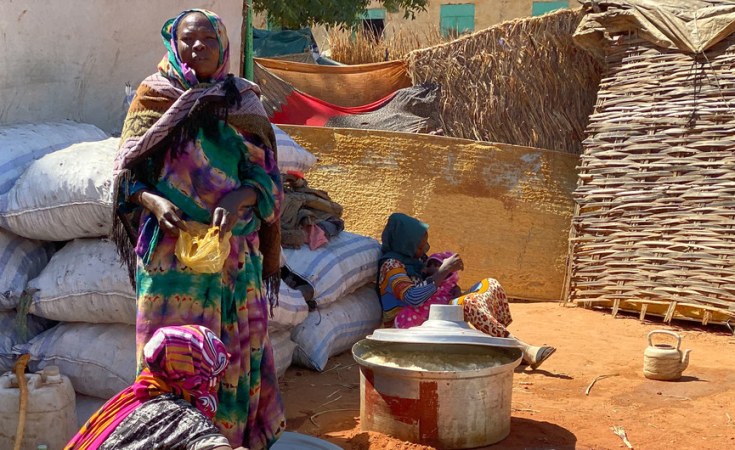
Internally displaced families gather at a temporary gathering point outside a school in El Geneina town following recent intercommunal conflict in West Darfur. Modesta Ndubi/UNHCR

Ela Yokes in The New Humanitarian (Geneva) of 11 March 2024 reports on the role of young people documenting the abuses in the war in the hope that it will contribute to justrice in the future.

Sudanese civil society groups are playing a pivotal role in documenting human rights abuses committed during 10 months of conflict, even as volunteers risk being arrested by the warring parties and are struggling with a month-long internet blackout. Youth groups, legal associations, and civilians acting in a personal capacity have all been involved in cataloguing the human rights impacts of the conflict that commenced in April 2023 and sets the army against the paramilitary Rapid Support Forces (RSF).

Documentation is a pathway to justice,” Noon Kashkoush of the Emergency Lawyers, a legal group monitoring abuses, told The New Humanitarian. She said she hopes the evidence her group has gathered will be used one day in the Sudanese justice system….

Access challenges for international aid agencies mean local mutual aid groups have shouldered the bulk of the relief effort in the most conflict-affected places. And likewise, civil society initiatives have carried the burden of human rights documentation. Despite the volatile security situation, local groups have led efforts to document sexual violence and killings, monitor ceasefire violations, track down missing persons, and report on the makeshift detention sites run by both the army and the RSF.

The findings of these civil society groups have fed into numerous human rights reports, including a detailed report last month by the UN, which charges both sides of the conflict of committing widespread abuses, some of which may amount to war crimes.

The report accuses RSF fighters of occupying residential buildings to shield themselves from army attacks, of massacring thousands of people in the Darfur region, and of committing extensive sexual abuse, including cases of rape and gang rape.

For its part, the army is accused of killing more than 100 civilians in airstrikes that were ostensibly targeting RSF positions but carried out in densely populated urban areas, or on public buildings including churches and hospitals.

The report also documents attacks on human rights defenders. It states that activists have been kidnapped and subjected to death threats and smear campaigns organised by army supporters, while several Darfuri rights monitors have been killed by the RSF.

Many groups documenting rights violations were active during the 2018-2019 Sudanese Revolution that toppled dictator Omar al-Bashir, and during the protests that followed the 2021 army-RSF coup that ended the post-Bashir democratic transition. Prior to the war, the Emergency Lawyers group was providing legal assistance to the families of pro-democracy protestors and activists who had been arbitrarily arrested, tortured, or killed by security forces.

Kashkoush said the group is now focused on war-related abuses, including the bombardment of civilian areas and the detention centres set up by the army and RSF in the capital, Khartoum, and the neighbouring cities of Omdurman and Bahri.

Kashkoush said the publication of the group’s reports and announcements have helped secure the release of hundreds of detainees – including some from the Emergency Lawyers network itself – though she described facing many difficulties.

“All of those documenting violations face the issue that movement on the ground is very challenging,” she said. “We depend a lot on open-source [information], such as video footage, and we work to verify it using witness statements.”

Another group involved in documenting abuses is the Youth Citizens Observers Network (YCON). It was established in late 2021 by volunteers wanting to shed light on violations committed against pro-democracy protesters and civil society activists. After the current conflict broke out, the network relaunched its platform under an anti-war stance, according to one of the group’s volunteers, who requested to remain anonymous to ensure their safety.

The volunteer said YCON has observers across Sudan and releases monthly reports on the impact of the war and the human rights situation. It also monitored several army-RSF truces that were violated last year. “In any given region, civilian monitors who are trained in documentation and verification methods are present on the ground and have a very wide network of connections,” said the volunteer. “Any event happening in a specific area, they would know about it.”

In cases where access to places affected by fighting has been too difficult for civil society groups, civilians already on the ground have taken it upon themselves to document what they are witnessing and publish evidence on social media.

When clashes between the RSF and the army first broke out in Khartoum, Hassan Abd al-Rauf, a local shop owner who ran a travel agency and a men’s clothing store, found himself caught in the epicentre.

Instead of escaping or complying with an RSF order that civilians should leave his neighbourhood, al-Rauf decided to stay, guard his properties, and offer assistance to others who were struggling to flee.

Walking through deserted streets, al-Rauf began recording live broadcasts on his Facebook page. His footage revealed the extent of the destruction and showed unarmed civilians who had been killed in the crossfire or targeted by snipers.

“When I started with the broadcasts, the aim was to connect people with what was happening on the ground and send photos [of the damage] back to the property owners in the area,” al-Rauf said in an interview after escaping Sudan for Qatar.

Two weeks after starting the broadcasts – which were getting hundreds of thousands of views – al-Rauf’s uploads suddenly stopped. He said he was captured by RSF fighters in the capital and held in a detention centre for 25 days.

“[The RSF] were certainly aware and it was the reason for my arrest,” al-Rauf said. “[One of my videos showed] a number of RSF vehicles after they had robbed the Bank of Khartoum and were hit by army aircraft.”

The volunteer at YCON said members of their group have faced harassment and the threat of detention from security forces as they attempt to move across different locations to document violations.

Similar threats were also described by Thouiba Hashim Galad, a member of the Missing Initiative, a local group with a platform that lets people post information about missing people. The group has a Facebook page with hundreds of thousands of followers.

“On a personal level, I receive private messages that include threats and very bad language,” Galad said. “Before the war, [the military authorities] were trying to hack our page many times,” she added.

On top of the security risks, volunteers told The New Humanitarian they are also struggling with a nationwide communication blackout that began in early February and has been blamed on the RSF.

Kashkoush of the Emergency Lawyers group said her organisation is unable to receive daily updates about human rights abuses, and instead gets a flurry of reports during the brief moments when they have an internet connection.

Kashkoush called for an international investigation into the blackout, which she described as a “constitutional violation” and a “deliberate attempt by one or both sides” to restrict access to information and thwart documentation efforts.

Documenting rights abuses has also had a psychological impact on volunteers, according to Galad of the Missing Initiative, which was founded in 2019 shortly after the RSF killed over 120 pro-democracy protesters at a Khartoum sit-in.

Galad, who currently volunteers for the initiative from outside Sudan, said the most difficult aspect of her work is delivering bad news to families when she learns that a missing person has been found dead.

During the first few weeks of the conflict, the Missing Initiative’s Facebook page was flooded with requests for information about people who had gone out to buy groceries or fuel and hadn’t returned.

Between April and August 2023, Galad said the group received over 600 reports of missing persons. She added that they stopped publishing statistics when they realised the actual number of cases was likely much greater than those reported to them.

Despite the challenges the group faces, Galad told The New Humanitarian she is determined to keep the initiative alive, especially as the conflict slips out of international focus.

“The main reason I am doing this is because I am a defender of human rights,” Galad said. “This is a continuation of the work we began after the [2019 Khartoum sit-in] massacre, on the basis that, in the future, both sides will be held accountable.”

The volunteer from YCON shared a similar view: “The fundamental motivation that allows us to continue monitoring the situation… is that this will provide accurate, recorded information for the institutions that will later work on [justice].”

Read this report on The New Humanitarian. The New Humanitarian puts quality, independent journalism at the service of the millions of people affected by humanitarian crises around the world.

Video of 2023 Right Livelihood Awards ceremony

January 20, 2024

For those who missed last this year’s #RightLivelihood Award Presentation on Wednesday 29 November 2023. It puts a spotlight on the importance of reconnecting to nature and our communities, calling for the systems that unite us to be built on trust and cooperation rather than suspicion and greed. For the winners, see: https://humanrightsdefenders.blog/2023/09/29/right-livelihood-awards-2023/

For more on this and similar awards: https://www.trueheroesfilms.org/thedigest/awards/97238E26-A05A-4A7C-8A98-0D267FDDAD59

Witness publishes video Guide for environmental defenders

April 26, 2023

WITNESS recognizes the great risks that environmental defenders take to stand up to power, and understand that the collection of visual evidence is only one strategy communities use to protect their environmental human rights. It wants to support this movement by sharing information and good practices to help community-based documenters collect visual documentation of environmental human rights crimes and violations so that it can be effectively used in advocacy and accountability processes. This Guide is primarily for community members who:

  • Live where industries that mine, extract oil and gas, build dams, cut timber, clear land for agri-business developments, grab land for high-end real-estate development, and do so in a way that violates the environmental human rights of communities
  • Want to—and can—safely document these violations with phones, cameras, and drones
  • Want to—and can—safely use the documentation to protect human rights
  • Would like to help train others to safely collect relevant and reliable visual documentation for human rights advocacy and accountability.

see also: https://humanrightsdefenders.blog/2022/03/02/human-rights-high-commissioner-bachelet-urges-support-for-environmental-defenders/

The 2022 “Human Rights Defenders Movement at a Crossroad” video report published

October 11, 2022

In September 2022, more than thirty human rights defenders from all over the world took the floor in a moment of a global backlash against the grass-roots movement for human rights and democracy. See: https://humanrightsdefenders.blog/2022/04/20/2021-protectdefenders-eu-annual-report/

The conference “The Human Rights Defenders’ Movement at a Crossroad“ featured the testimonies and experiences of a great diversity of grassroots activists coming from all backgrounds, including Yvette Mushigo (Synergie des Femmes pour la Paix et la Réconciliation des Peuples des Grands Lacs d’Afrique, DRC); Ukei Muratalieva (Nazik Kyz, Kyrgyzstan); Rocío Walkiria Santos Reyes (CEHPRODEC, Honduras); Yasmine Shurbaji (Families for Freedom, Syria); and Monika Maritjie Kailey (Komunitas Masyarakat Adat Marafenfen, Aru Islands, Indonesia).

With the participation of the United Nations Rapporteur on the situation of Human Rights Defenders, Mary Lawlor; the French Ambassador at Large for Human Rights, Delphine Borione; the Inter-American Commission on Human Rights Rapporteur on the Rights of Human Rights Defenders and Justice Operators, Commissioner Joel Hernández García; the Human Development, Migration, Governance, and Peace Unit Acting Director at the European Commission, Chiara Adamo.

“We call on the EU and the Member States to ensure the effective, timely, relevant and comprehensive implementation of the EU Guidelines on Human Rights Defenders”.

Read the keynote by Cristina Palabay (KARAPATAN Alliance, The Philippines)

Look around this room and you will see so many different nationalities full of patient, committed, resilient people working to defend human rights. That is hope” – UNSR on HRDs, Mary Lawlor.

You can see all the photos of the conference “The Human Rights Defenders Movement at a Crossroad” in the gallery here.

https://mailchi.mp/protectdefenders/bulletin-pdeu-conference-2022?e=ccacd47b1a

Video game launched to experience a refugee’s journey

July 14, 2022

Ruth Schöffl reported from Vienna, on 08 July 2022 how a Syrian refugee game developer, an Austrian company and UNHCR teamed up to create a video game that reveals the life-or-death decisions that refugees face.

Jack Gutmann was never one of those children whose parents badgered him to limit his screen time and go outside and play. On the contrary, they encouraged Jack and his four brothers to spend as much time as possible absorbed in computer games so they would stay indoors, safe from the conflict raging on the streets outside their home. 

I was scared, and I tried to escape reality,” says Jack, named Abdullah at birth and brought up in Hama, Syria’s fourth-largest city. “I didn’t want to see the war and I did not want to hear it.” When there was electricity, he played video games. When the electricity went out, he played on his laptop. When the laptop battery died, he designed on paper.  

He never dreamed that years later – safe in Austria – his passion for computer design would equip him to produce an award-winning video game. A teaching edition of Path Out was re-launched by UNHCR for World Refugee Day (20 June 2022) this year to help schoolchildren in Austria and elsewhere stand in the shoes of a refugee, making life-and-death decisions along a hazardous journey to safety. 

Jack, who took a new name when he forged a new life in Austria, began drawing and colouring digitally as a child and mastered the graphics programme Photoshop by the time he was fourteen.

Digital art and computer games were the window to the world for me, out of my room in Syria, away from the war into a diverse world with very different people,” he says, reflecting on the crisis that broke out in March 2011, the same month he turned 15.  

Since the start of the crisis in 2011, millions of Syrians have been forced to flee their homes. Today some 6.8 million Syrians have fled abroad as refugees, and almost as many – 6.9 million – are displaced within the country.  

At 18, facing the danger of being drafted into the army, Jack fled his homeland – a dangerous and circuitous journey to Turkey and then across a number of countries until he reached Austria in the heart of Europe. This was the first place he truly felt safe. 

“I didn’t plan to stay in Austria,” he freely admits. “But when I arrived here with my brother, we were really shocked because so many people helped us – positively shocked.” 

Shortly after arriving, Jack met Georg Hobmeier, head of Causa Creations, a Vienna-based game-design company that sees video games not only as entertainment but, in the words of its website, as “meaningful, enriching experiences that can connect us, challenge our perceptions, and give insights into the world around us.” They’ve worked on issues such as migration, climate change and nuclear energy. 

  • Game designer Jack Gutmann (left) sits alongside Georg Hobmeier, head of Causa Creations, at their offices in Vienna, Austria. Game designer Jack Gutmann (left) sits alongside Georg Hobmeier, head of Causa Creations, at their offices in Vienna, Austria. © UNHCR/Simon Casetti
Jack, eager to turn his passion into a profession, teamed up with Causa Creations on a joint project. The result was Path Out, in which the player replicates Jack’s surreptitious trek from Syria, sometimes in the hands of people smugglers. 

We decided that Jack himself would be the main character of the game,” says Georg, adding that it was particularly important to show that behind every refugee statistic there are complex stories and complex personalities.  

In the Japanese game style they chose, the cute characters contrast with the harsh reality of the journey. Jack – the designer and the character – are dressed throughout in the yellow shirt he actually wore on his odyssey, which now has sentimental value to him.  

From a box in the corner of the screen, real Jack comments on the players’ moves in Youtuber style, often with humour. “You just killed me, man,” he exclaims when the player makes the wrong move. “In reality I wasn’t as clumsy as you.” 

Originally released as a two-hour game in 2017, Path Out has won international and Austrian awards for “its effort to shed light on a serious issue.”

The new version Causa and UNHCR developed for schools takes no longer than one lesson and helps pupils who might never meet real refugees learn that Jack led a life much like theirs until his world was turned upside down and he had to leave everything behind. It was rolled out in German and English for World Refugee Day; other language versions are to follow. 

Jack the designer is still writing his own happy ending. He felt safe as soon as he reached Austria, but it took time for the country to become his true artistic and emotional home.  

It took five years until I felt my journey was over, until I really felt relieved,” he says. Now 26, he speaks nearly flawless German and English. He completed vocational training, worked for a few years in a game development company, and now is training further in 3D modelling and animation to become an even better game developer and designer.  

He met an Austrian woman who also plays video games – though not by profession – and they married last year. 

And he maintains his sense of humour, a trait he considers essential both in real life and in his game, Path Out. “The story of flight and war is bad enough; one needs humour to be able to cope with it,” he says.  Since the game reflects his reality, “it’s funny at the same time. After all, computer games are supposed to be fun.” 

https://www.unhcr.org/news/stories/2022/7/62c822f14/unhcr-video-game-lets-pupils-experience-refugees-perilous-journey.html

Profile of Barun Ghimire, human rights defender from Nepal

July 5, 2021

The rights of migrant workers is a global problem, and actors in different jurisdictions have to come together to make a difference in this particular area,” says Barun Ghimire, a human rights lawyer based in Kathmandu, Nepal. “And we need to create a collective narrative that is based on a rights-based approach of migrant workers”.

Barun Ghimire is a human rights lawyer and programme manager at the Law and Policy Forum for Social Justice. Barun works for the protection and defence of the rights of migrant workers in Kathmandu, Nepal. 

In this video, Barun explains his work in relation to the rights of migrants, as well as how Covid-19 has affected this group, which is facing even stronger vulnerability. He also calls the international community and other actors to come together and help improve the situation of migrants workers as well as their families.  To achieve this goal, it is necessary to create a new narrative and defend and promote the rights of migrant people in vulnerable situations, especially during and after Covid-19.

Barun was also a participant in ISHR’s Human Rights Defender Advocacy Programme (HRDAP) in 2020.

https://www.ishr.ch/news/human-rights-defenders-story-barun-ghimire-nepal

Bill Browder speaks about “his’ Global Magnitsky Act

August 29, 2020

The Human Rights Foundation published on 27 August this interview with Bill Browder in which international legal associate Michelle Gulino speaks with Browder about just how and why he’s become a thorn in Putin’s side, what makes the Kremlin such a threat to democracy and why Magnitsky legislation is so critical to address this threat, and finally, Sergei’s legacy and his message of resilience.On November 16, 2009, Sergei Magnitsky, the lawyer of global financier Bill Browder, was murdered for uncovering a $230 million corruption scheme by officials within Russia’s Interior Ministry. Bill became a thorn in Putin’s side after he began a campaign to seek justice for Sergei through the Global Magnitsky Act, which implements visa bans and asset freezes against serious human rights abusers and corrupt officials.

See also: https://humanrightsdefenders.blog/2019/08/29/european-court-rules-on-sergei-magnitskys-death/ and

https://humanrightsdefenders.blog/2015/05/08/the-case-for-smart-sanctions-against-individual-perpetrators/


Frontline’s Guide to Secure Group Chat and Conferencing Tools

July 21, 2020

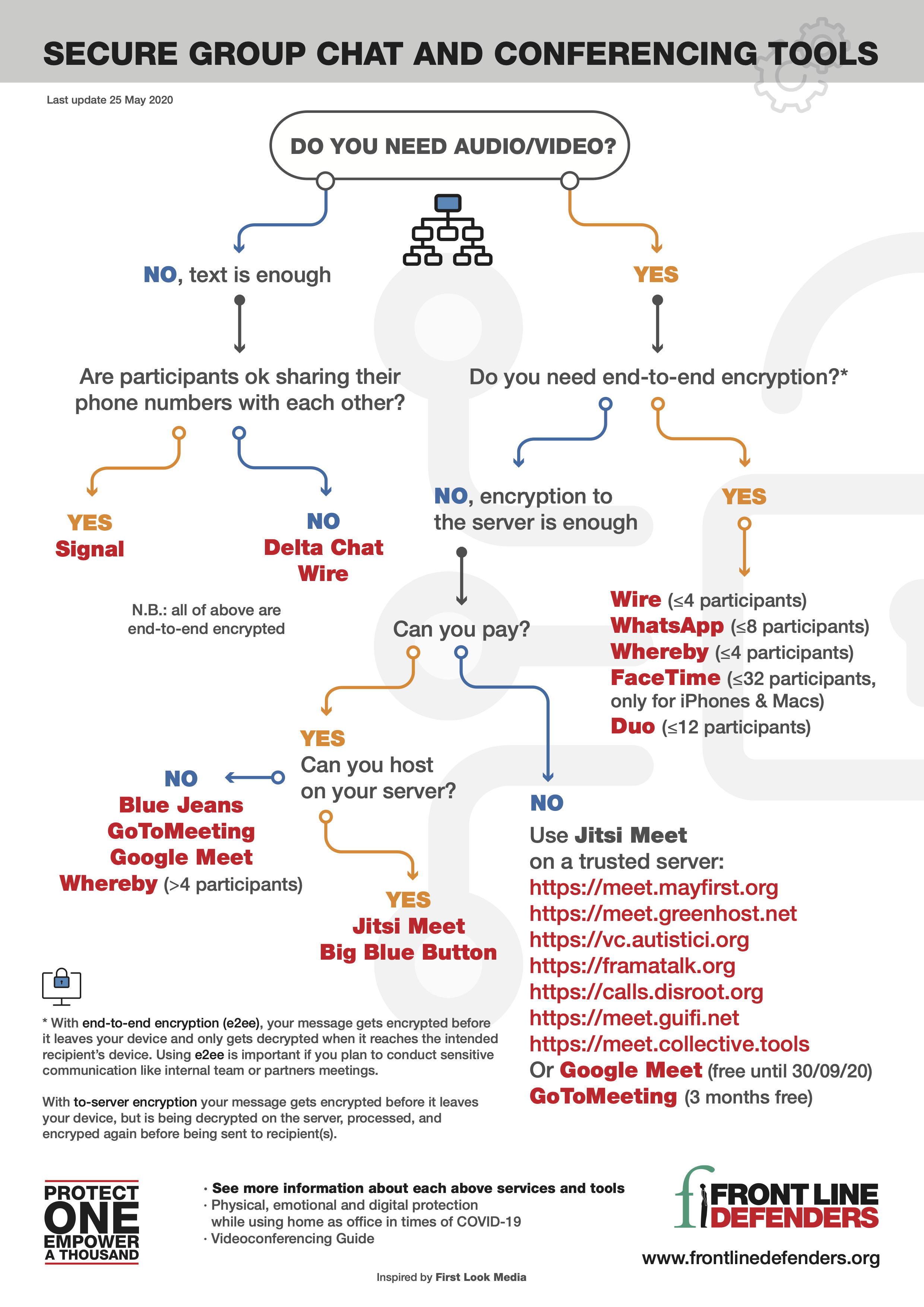
With teams increasingly working remotely during COVID-19, we are all facing questions regarding the security of our communication with one another: Which communication platform or tool is best to use? Which is the most secure for holding sensitive internal meetings? Which will have adequate features for online training sessions or remote courses without compromising the privacy and security of participants?

Front Line Defenders presents this simple overview which may help you choose the right tool for your specific needs.

FLD Secure Group Chat Flowchart

Download PDF of the flow chart

Note:

  • With end-to-end encryption (e2ee), your message gets encrypted before it leaves your device and only gets decrypted when it reaches the intended recipient’s device. Using e2ee is important if you plan to transmit sensitive communication, such as during internal team or partners meetings.
  • With encryption to-server, your message gets encrypted before it leaves your device, but is being decrypted on the server, processed, and encrypted again before being sent to recipient(s). Having encryption to-server is OK if you fully trust the server.

Why Zoom or other platforms/tools are not listed here: There are many platforms which can be used for group communication. In this guide we focused on those we think will deliver good user experiences and offer the best privacy and security features. Of course none of the platforms can offer 100% privacy or security as in all communications, there is a margin of risk. We have not included tools such as Zoom, Skype, Telegram etc. in this guide, as we believe that the margin of risk incurred whilst using them is too wide, and therefore Front Line Defenders does not feel comfortable recommending them.

Surveillance and behaviour: Some companies like Facebook, Google, Apple and others regularly collect, analyse and monetize information about users and their online activities. Most, if not all, of us are already profiled by these companies to some extent. If the communication is encrypted to-server owners of the platform may store this communication. Even with end-to-end encryption, communication practices such as location, time, whom you connect with, how often, etc. may still be stored. If you are uncomfortable with this data being collected, stored and shared, we recommended refraining from using services by those companies.

The level of protection of your call depends not only on which platform you choose, but also on the physical security of the space you and others on the call are in and the digital protection of the devices you and others use for the call.

See also:

Caution: Use of encryption is illegal in some countries. You should understand and consider the law in your country before deciding on using any of the tools mentioned in this guide.

Criteria for selecting the tools or platforms

Before selecting any communication platform, app or program it is always strongly recommended that you research it first. Below we list some important questions to consider:

  • Is the platform mature enough? How long has it been running for? Is it still being actively developed? Does it have a large community of active developers? How many active users does it have?
  • Does the platform provide encryption? Is it end-to-end encrypted or just to-server encrypted?
  • In which jurisdiction is the owner of the platform and where are servers located? Does this pose a potential challenge for your or your partners?
  • Does the platform allow for self-hosting?
  • Is the platform open source? Does it provide source code to anyone to inspect?
  • Was the platform independently audited? When was the last audit? What do experts say about the platform?
  • What is the history of the development and ownership of the platform? Have there been any security challenges? How have the owners and developers reacted to those challenges?
  • How do you connect with others? Do you need to provide phone number, email or nickname? Do you need to install a dedicated app/program? What will this app/program have access to on your device? Is it your address book, location, mic, camera, etc.?
  • What is stored on the server? What does the platform’s owner have access to?
  • Does the platform have features needed for the specific task/s you require?
  • Is the platform affordable? This needs to include potential subscription fees, learning and implementing, and possible IT support needed, hosting costs, etc.

The document then proceeds to give more detailed information related to each tool/service listed in this guide

Signal – https://signal.org/

Delta Chat – https://delta.chat/

Wire – https://wire.com/

Jitsi Meet – https://jitsi.org/jitsi-meet/

BigBlueButton – https://bigbluebutton.org/

Whereby – https://whereby.com

Blue Jeans – https://www.bluejeans.com/

GoToMeeting – https://www.gotomeeting.com/

Facetime / iMessage –https://www.apple.com/ios/facetime

Google Meet – https://meet.google.com/

Duo – https://duo.google.com/

WhatsApp – https://www.whatsapp.com/

Video calls, webinar or online training recommendations

Video calls recommendations: In the current situation you will undoubtedly find yourself organizing or participating in many more video calls than before. It may not be obvious to everyone how to do it securely and without exposing yourself and your data to too much risk:

  • Assume that when you connect to talk your camera and microphone may be turned on by default. Consider covering your camera with a sticker (making sure it doesn’t leave any sticky residue on the camera lens) and only remove it when you use the camera.
  • You may not want to give away too much information on your house, family pictures, notes on the walls or boards, etc. Be mindful of the background, who and what is also in the frame aside from yourself? Test before the call by, for example, opening meet.jit.si and click on GO button to get to a random empty room with your camera switched on to see what is in the picture. Consider clearing your background of clutter.
  • Also be mindful who can be heard in the background. Maybe close the door and windows, or alert those sharing your space about your meeting.
  • Video call services may collect information on your location and activity, consider using a VPN (see Physical, emotional and digital protection while using home as office in times of COVID-19 guide).
  • It is best to position your face so your eyes are more or less at the upper third of the picture without cutting off your head. Unless you do not want to reveal your face, do not sit with your back to a light or a window. Daylight or a lamp from the front is the best. Stay within the camera frame. You may want to look into the lens from time to time to make “eye contact” with others. If you are using your cellphone, rest it against a steady object (e.g. a pile of books) so that the video picture remains stable.
  • You may want to mute your microphone to prevent others hearing you typing notes or any background noise as it can be very distracting to others on the call.
  • If the internet connection is slow you may want to switch off your camera, pause other programs, mute the microphone and ask others to do same. You may also want to try sitting closer to the router, or connecting your computer directly to the router with an ethernet cable. If you share internet connection with others, you may ask them to reduce extensive use of internet for the duration of your call.
  • It it very tempting to multitask especially during group calls. But you may very soon realise that you are lost in the meeting and others may realize this.
  • If this is a new situation for you or you are using a new calling tool, you may want to give yourself a few extra minutes to learn and test it prior to the scheduled meeting to get familiar with options like turning on/off the camera and the microphone, etc.
  • If possible, prepare and test a backup communication plan in case you will have trouble connecting with others. For example, adding them to a Signal group so you can still text chat or troubleshoot problems on the call. Sometimes it helps to have an alternate browser installed on your computer or app on the phone to try connecting with those.

If you would like to organise a webinar or online training, you can use tools outlined above in the group communication. Some of best practices include:

  • Make sure that you know who is connected. If this is needed check the identities of all people participating by asking them to speak. Do not assume you know who is connected only by reading assigned names.
  • Agree on ground-rules, like keeping cameras on/off, keeping microphone on/off when one is not speaking, flagging when participants would like to speak, who will be chairing the meeting, who will take notes – where and how will those notes be written and then distributed, is it ok to take screenshots of a video call, is it ok to record the call, etc.
  • Agree on clear agendas and time schedules. If your webinar is longer than one hour, it is probably best to divide it into clear one-hour sessions separated by some time agreed with participants, so they have time to have a short break. Plan for the possibility that not all participants will return after a break. Have alternative methods to reach out to them to remind them to return, like Signal/Wire/DeltaChat contacts for them.
  • It is easiest to use a meeting service that participants connect to using a browser without a need to register or install a special program, one that also gives the webinar organiser the ability to mute microphones and close cameras of participants.
  • Prior to the call, check with all participants whether they have particular needs, such as if they are deaf or hard of hearing, if they are visually impaired or blind, or any other conditions which would affect their participation in the call. With this in mind, ensure that the selected platform will accommodate these needs and to be sure, test the platform beforehand. Simple measures can also improve inclusion and participation in your calls, such as turning on cameras when possible, as it can allow for lip-reading.
  • Encourage all participants to speak slowly and to avoid jargon where possible, as the working language of the call is most likely not everyone’s mother tongue language. Naturally, there will be moments of silences and pauses, embrace them. They can help to support understanding and can be helpful for participants who are hard of hearing, interpreters and will also aid assistive technology to pick up words correctly.

https://www.frontlinedefenders.org/en/resource-publication/guide-secure-group-chat-and-conferencing-tools

Human Rights Foundation starts interview series: “Dissidents and Dictators” with Srdja Popovic

June 23, 2020

Human Rights Foundation


The first episode features Serbian protest organizer and peaceful revolutionary Srdja Popovic.

In just a few years, Srdja transformed from a college student in a band to the leader of a national movement that ended the fearsome dictatorship of Slobodan Milošević with clever tactics and movement building, all without a single shot fired. After the tyrant’s fall, Srdja went on to serve in Serbia’s National Assembly and later launched an organization called CANVAS that teaches the art of protest to democracy activists around the world. He is the author of Blueprint for Revolution: How to Use Rice Pudding, Lego Men, and Other Nonviolent Techniques to Galvanize Communities, Overthrow Dictators, or Simply Change the World.

HRF chief strategy officer Alex Gladstein (@Gladstein) sat down with Srdja to discuss: How do you scale a movement of one up to millions of people? How do you overcome a regime that holds all the power and weapons? Why are peaceful revolutions much more successful than violent ones? Why are street movements like start-ups? Is it possible to sustain a movement during a global pandemic? How are protest movements around the world reacting to their new twin enemies, the coronavirus and the rise of authoritarianism?

[see also: https://humanrightsdefenders.blog/2019/05/22/human-rights-foundation-announces-its-first-10-freedom-fellows/]

You can listen on Apple Podcasts and Spotify, and you can watch the video versions on Youtube

Witness reminds us of the power of images through the Floyd Case

June 13, 2020

The video of the gruesome murder of George Floyd ignited protests around the world in solidarity against racism and white supremacy supported by the government and enforced by police. But we know for every video of police violence, there are many deaths that were not recorded that still deserve our attention and support.

Founded on the power of video to bring attention to the breach of human rights during the Rodney King arrest, beating, filming, and subsequent uprising 28 years ago, WITNESS continues to train and guide people to use their cell phone video camera to record incidents of human rights abuse, then share it with the media and justice system to prosecute wrongdoers. 

Today, the systems and patterns of police abuse are as rampant as ever. What has changed is our collective ability to document these moments. 

We help people document state violence, push for accountability, and implement structural change. In the past few weeks, we’ve seen a spike in demand for our guidance on how to shoot and share footage of police violence safely, ethically, and effectively. Our tips continue to inform ethical and strategic filming of police misconduct and protests.  Video is a tool to show violence. But more importantly, it’s a tool to show patterns. It forces the broader public to pay attention, and authority to change. We have seen commitments from local and state leaders and we encourage more people around the world to break down military and police power.  And to film it.  Ambika Samarthya-Howard Head of Communications WITNESS

https://mailchi.mp/witness.org/the-power-of-video-to-film-injustice?e=e2d40a1193

See also: https://humanrightsdefenders.blog/2020/04/05/policy-response-from-human-rights-ngos-to-covid-19-witness/