While not directly about Human Rights Defenders, this workshop organised by the Permanent Mission of Switzerland to the UN and others (see below) is of great importance to HRDs as they are the ones who provide most of the information to the Treaty Bodies, and are often the victims of the violations reported, including reprisals against them for having cooperated. Thus, this meeting on “The outcome of the treaty body strengthening process: Lessons learnt, implications and implementation” should be of interest to all. It takes place on 9 May 2014, 9.30am to 1pm in Room XXII, Palais des Nations, Geneva. Read the rest of this entry »
Posts Tagged ‘UN’
UN Committee on Enforced Disappearances weighs in on the issue of reprisals
April 25, 2014In the crucial battle for better protection of human rights defenders who give information to the UN, there is a small victory. The Committee on Enforced Disappearances has responded to the issue of intimidation and attacks against human rights defenders by creating a rapporteur on reprisals. This comes after other UN treaty bodies, including the Human Rights Committee, the Committee against Torture and the Sub-Committee on the Prevention of Torture also took some steps to better protect human rights defenders who contribute to their work.
In its message of 22 April 2014 the Geneva-based International Service for Human Rights refers to its submission – together with Child Rights Connect, the Center for Legal and Social Studies, FIACAT, the International Movement Against all forms of Discrimination and Racism and Al-Karama – identifying ways in which the Committee could better facilitate access and engagement by NGOs. ‘ISHR welcomes this development, which sends a clear signal that the Committee takes the danger of reprisals seriously and understands the need to address this threat,’ said ISHR’s Heather Collister, but she rightly points out that cases of reprisal will continue to occur as long as there is no means of holding States accountable for the safety of the defenders who engage with regional or international human rights systems. See my earlier post advocating stronger measures against States that take reprisals: https://thoolen.wordpress.com/2014/03/13/zero-tolerance-for-states-that-take-reprisals-against-hrds-lets-up-the-ante/
via UN Committee on Enforced Disappearances appoints focal point on reprisals | ISHR. or contact Heather Collister on: h.collister[at]ishr.ch
For all my earlier posts on reprisals see: https://thoolen.wordpress.com/tag/reprisals/
Ban Ki-Moon calls civil society “an indispensable part of the United Nations”
March 27, 2014“Civil society actors must be able to do their work freely, independently, safe from fear, retaliation or intimidation. This requires collective action to denounce reprisals and defend free voices and protect those targeted,” said the UN Secretary-General Ban Ki-Moon, referring to civil society as “an indispensable part of the United Nations”. “We must expand the space for civil society to meaningfully participate and contribute,” he added in a video statement screened at a discussion on the promotion and protection of civil society space, in the context of the Human Rights Council’s 25th session.
“Civil society actors around the world face risks ranging from threats and intimidation to horrible reprisals, even killings”, said UN Human Rights Deputy, Flavia Pansieri at a discussion on the promotion and protection of civil society space. “From the NGO who is prohibited from receiving funding to the whistle-blower who is imprisoned for revealing corruption… we must work to protect civil society from such practices,” she said.
Hina Jilani, Read the rest of this entry »
Louis Joinet (“Luis le Juste”) finally and rightly honored in France
March 26, 2014It is with great pleasure that I am able to announce that a great human rights defender from France, Louis Joinet, is honored with a colloque on the topic “Is sovereignty still the basis of international law?”. It coincides with the publication of his book: “Mes raisons d’Etat” [‘My reasons of state’ or better ‘How I saw the national interest].
Had he been fluent in English (he picked it up too late in life) he would have been probably one of the most famous human rights experts in the world. His nicknames range from “Louis le Juste” to “the Obstinate”. He played a major role within the French state apparatus as from the 1960s. One of the founders of the ‘Syndicat de la magistrature‘ in 1968 (sometimes called the ‘red judges’), he became the first director of the National Commission on Informatics and Freedoms [Commission nationale de l’informatique et des libertés]. He served five different Prime Ministers during the 1980s as advisor. It was during those days that I met him regularly to set up and run a number of Committees dealing with the military regimes in the Southern Cone of Latin America (e.g. SIJAU, SIJADEP). We travelled often to the region and on many occasions I saw returned refugees come up to Louis to embrace and thank him for the support he gave them in exile.
In the meantime during 33 years he was an expert in various UN bodies, travelling all over the world. Most pronounced was his leading role in the Sub-commission for Human Rights and the Protection of Minorities (now renamed and relegated to a research role for the new Council), where he spearheaded a great many and daring innovations, concerning many issue including disappearances, torture, international crimes and amnesty. His popularity with (certain) States suffered, but most NGOs considered him to be a hero.
Together with his late and much-beloved wife Germaine he had a less-known but rewarding social life that includes assisting young street criminals and a passion for circus and street theater. His musical talent is illustrated in the picture below from my private collection, where he is seen playing the accordion with Argentinian Leandro Despouy watching (August 1988).

The colloque in Louis honor is taking place on 27 Mars 2014, 18h30, at Université Panthéon-‐Assas, Centre Panthéon, Salle des Conseils, in the series of lectures under Professor Olivier de Frouville.
The book “Mes raisons d’Etat. Mémoires d’un épris de justice” is published by La Découverte: http://www.editionsladecouverte.fr/catalogue/index-Mes_raisons_d_etat-9782707178459.html
Ganji: Human rights in Iran improved, but still short of expectations
March 26, 2014
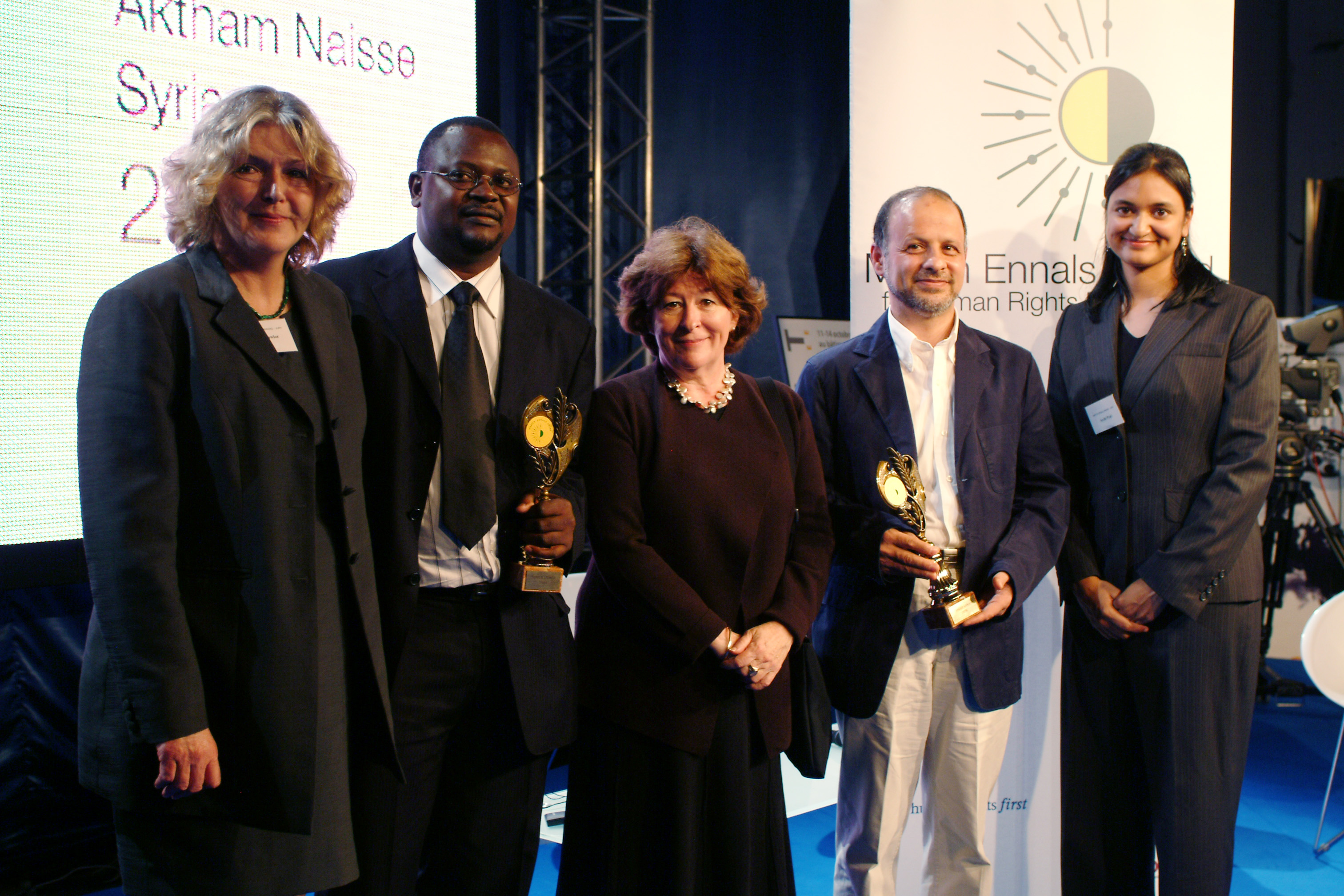
(Ganji – second from the right – at the MEA ceremony of 2006, where he received the award from UN High Commissioner Louise Arbour)
Al-Monitor of 25 March carries a lengthy interview with MEA Laureate Akbar Ganji in which Jahandad Memarian records many interesting insights, especially on the issue of sanctions and support to human rights defenders. The whole interview is certainly worth reading; here follow some long excerpts:
“It is not an exaggeration to say that Akbar Ganji is the most celebrated dissident within the ranks of Iranian journalists since the inception of the Islamic Republic of Iran in 1979. A former supporter of the revolution, Ganji became disenchanted and turned into one of its most vocal critics. He is best known for his work as a journalist covering the 1998 murders of Iranian dissidents in Reformist newspapers, a series which came to be known as “the chain murders” that implicated top governmental officials. For his work revealing the murders of dissidents and attending a conference in Berlin that was condemned by hard-liners who were reeling after a Reformist victory in parliament, Ganji was arrested and served time in Tehran’s Evin Prison from 2001 to 2006. During his final year in prison, he went on a hunger strike that doctors urged him to end for concerns he would suffer permanent brain damage.
Ganji has won several international awards, including the World Association of Newspapers’ Golden Pen of Freedom Award, the Canadian Journalists for Free Expression’s International Press Freedom Award, the Martin Ennals Award for Human Rights Defenders and the Cato Institute Milton Friedman Prize for Advancing Liberty. In an exclusive interview via email with Al-Monitor, Ganji, based in New York, shared his thoughts about human rights and democracy in the context of President Hassan Rouhani’s administration.
Al-Monitor: The UN secretary-general, Ban Ki-moon, has sharply criticized the Iranian president, Hassan Rouhani, saying, “He has not made any significant improvement” in ending human rights abuses since taking office. Nevertheless, Mahmoud Sadri — Iranian professor of sociology at the Federation of North Texas Area Universities — is optimistic about the new administration and has asked Iranian dissidents and intellectuals to take advantage of this historic opportunity. How do you evaluate the Rouhani administration?
Ganji: The situation has improved from various aspects compared with the [Mahmoud] Ahmadinejad administration. However, it falls short of the expectations of democracy advocates and human rights activists. The Rouhani administration truly seeks to improve the state of human rights, but it has faced obstacles in Iran’s power hierarchy, including organizations that [Supreme Leader] Ayatollah [Ali] Khamenei oversees, such as the judiciary, law enforcement, etc., in addition to the Majles [parliament] that is controlled by the conservatives and some radical reactionaries.
…….Since his administration came to power, Rouhani has spoken with the supreme leader about freeing the Green Movement’s leaders (former Prime Minister Mir-Hossein Mousavi and former Majles speaker Mehdi Karoubi) and political prisoners, guaranteeing that nothing would happen, if they were freed.
Al-Monitor: In January, you wrote a Huffington Post article titled “The Iran Nuclear Accord Is Good for Human Rights.” It seems to me whenever international pressure on the Iranian government increased, Iran improved its record. For example, Tehran released political prisoners ahead of Hassan Rouhani’s UN speech, including prominent human rights lawyer Nasrin Sotoudeh. Don’t you think such actions stem from international pressure? In the absence of this leverage — i.e., international pressure — Iran would continue human rights violations.
Ganji: With regard to “external pressure on an undemocratic regime and improvement of human rights or increased oppression,” there is no law/rule that would address the cause-reaction relationships. At most, one can speak of “correlation.”[…] we need to know the following:
First, economic sanctions represent the collective punishment of a country’s people and do not necessarily lead to dictatorships’ downfall.
Second, long-term sanctions destroy the internal infrastructure of societies. ..Consequently, trust that is the basis of social capital is destroyed. Because of the sanctions, the oppressive regime’s increasing level of oppression, the internal destruction of society, is not visible. It is only in the aftermath of the dictatorship’s downfall that we will witness the visible spread of a wave of hatred, revenge and violence.
Third, in a life and death situation, the state of human rights, democracy and freedom completely falls by the wayside.
Fourth, consider Iraq’s example again. Before, the invasion al-Qaeda forces did not exist in Iraq, but they were born and bred as a result of the US sanctions and the US attack on Iraq. This story has been repeated in Libya and Syria. …..Iranian, US and European officials have professed that economic sanctions against Iran have affected Iran’s economy negatively. Last year, the economic growth rate fell to -5.8%. The inflation rate rose to 40%. The corruption rate climbed, and other negative outcomes followed. We should ask ourselves, what is the impact of recession on ordinary people’s lives?
The middle class, as a vehicle of democracy, has been transformed to the impoverished class, and its democratic movement may lose its agents. Democracy is the product of the balance of power between the government and civil society.
The transformation of the nuclear agreement from temporary to permanent, improvement of Iran’s relationship with Western governments, rekindling of ties between Iran and the United States, lifting of all the economic sanctions and alleviation of foreign threats can help empower the people through their mobilization and expansion of civil society. In that sense, the regime’s focus and its supporters will not be on discovering conspiracies of foreign governments and military attacks to destroy the regime. Let’s not forget that democracy and human rights have a direct relationship with economic development.
Al-Monitor: You have opposed US aid to Iranian dissidents and human rights activists. What are your key criticisms against such aid? What actions should foreign countries.. take or avoid ?
Ganji: The opposition that I have spoken about consists of groups and people that advocate regime change in Iran, so they can come to power. It is not possible for the leaders of a country to be indebted to other foreign governments, including the United States, Israel, Saudi Arabia, Russia and China. In that case, they will become the greater powers’ pawns. Look at the groups that have received financial aid from foreign governments in the past 35 years. What have they done? Do their terrorist and espionage activities constitute human rights activism, or are such activities considered criminal in all countries, including the United States and Israel, and are they strongly punished?
However, I support educational financial aid, including student scholarships and research fellowships for scholars. Just think about what would have happened if the $1.5 trillion that was spent on the wars in Afghanistan and Iraq would have been used toward education and development of the Middle East, and how that would have changed the region. Why do Western governments, the United States included, not grant scholarships to tens of thousands of talented and smart Iranian youth as students in social sciences?
Western governments should protest all human rights violations; they should give ethical and spiritual support to pro-democracy and human rights activists; they should file complaints at the UN Human Rights Council and ease the process of bringing perpetrators to justice. Moreover, Western powers should stop selling weapons of torture and oppression to dictatorial regimes. Ultimately, they should allocate financial resources to form independent labor unions and improve the state of human rights.
Read more:
Who can speak for NGOs in the UN? A precedent set in 1982
March 21, 2014Yesterday, 20 March 2014, there was a fierce debate in the UN Council of Human Rights where the issue of the right of NGOs to speak came up, more precisely whether accredited NGOs had the right to let speakers mention other NGOs who do not have such accreditation. In this case it was China taking exemption to the FIDH letting its member NGOs (including a pro Tibetan group) take the floor in its name. For more context see my post of yesterday: https://thoolen.wordpress.com/2014/03/20/china-in-the-un-human-rights-council-manages-to-silence-cao-shunli-as-well-as-ngos/.
The Chair and Secretariat rightly spoke of a standing practice in this regards. One such precedent is 30 years old and probably lost to most observers, so I give here my own recollection of this story in the hope that someone with access to the UN files or a better memory can confirm or correct the details.
It is 1982 and the Working group on Disappearances (created in 1980 after a long struggle and with the active support from the then Director Theo van Boven)) is reporting to the Commission on Human Rights (the predecessor of the Council). The International Commission of Jurists (ICJ), of which I was the Executive Secretary at the time, has lined up to speak. Read the rest of this entry »
Sri Lanka: champion retaliator against human rights defenders
March 17, 2014Today, 17 March 2014, the Asian Human Rights Commission, comes out with a statement that makes Sri Lanka look like one the worst offenders when it comes to retaliation and reprisals against human rights defenders. My feelings about reprisals are well-known and were recently expressed in: https://thoolen.wordpress.com/2014/03/13/zero-tolerance-for-states-that-take-reprisals-against-hrds-lets-up-the-ante/
A draft resolution promoting reconciliation, accountability, and human rights in Sri Lanka is being discussed at the United Nations Human Rights Council. The proposed resolution calls for, among other things, the Office of the High Commissioner, “To lead a comprehensive investigation into alleged serious violations and abuses of human rights and related crimes by both parties in Sri Lanka and establish the facts and circumstances of such violations and of the crimes committed with the view to avoiding impunity and ensuring accountability with assistance from relevant experts”.
The statement of the AHRC reads: Read the rest of this entry »
What will Chinese authorities have to say about Cao Shunli’s death?
March 15, 2014
Today, 14 March, Amnesty International brought out a statement severely criticizing China‘s treatment of human rights defenders in need of medical care. Cao Shunli, 52, died from organ failure on Friday at a hospital in Beijing, after five months in detention. Repeated requests by Cao’s family for her to receive medical treatment for serious health problems were denied.[ https://thoolen.wordpress.com/2014/02/25/serious-concern-for-health-of-detained-human-rights-defender-cao-shunli/]
“Cao Shunli’s death exposes just how callous and calculating the Chinese authorities are prepared to be to silence critics. The authorities today have blood on their hands.” said Anu Kultalahti, China Researcher at Amnesty International. “Cao Shunli was a courageous woman who paid the ultimate price for the fight for human rights in China. She should have never been detained in the first place; but to then deny her the medical treatment she desperately needed is a most barbaric act.”
Cao had led attempts to allow activists to contribute to China’s national human rights report, ahead of a UPR review at the UN Human Rights Council in 2013 and was arrested in September as she attempted to travel to Geneva to attend a human rights training course. Her detention was seen by many as a reprisal for her wanting to contribute to a public discussion on violations in China – the charges against her concerned “picking quarrels and making trouble” . The full Council is expected to hear the result of the UPR session on Wednesday 19 March. It will be interesting to see how the States and in particular China is going to react to this tragic event.
Many other NGOs and media have come out with statements about the death of Cao Shunli including Front Line (“Chinese Government Responsible for the Death of Cao Shunli“) and the International Service for Human Rights (http://www.ishr.ch/news/un-human-rights-council-must-demand-accountability-death-cao-shunli).
Margaret Sekaggya succeeded as HRD Rapporteur by Michel Forst: Reassuring
March 13, 2014
In March, Margaret Sekaggya will finish her term as the UN Special Rapporteur on Human Rights Defenders. For more than five years the Ugandan Margaret Sekaggya has served the mandate with dedication and commitment, and has played an integral role in promoting the work of and furthering protection for human rights defenders around the world.
Also it has been announced that the new Special Rapporteur will be Michel Forst , from France.
 He is a lawyer by training and the Secretary General of the Commission Nationale Consultative des Droits de l’Homme de la Republique Française. From 2008 – 2013, he was the Independent Expert of the United Nations on the situation of human rights in Haiti. He was Director General of Amnesty International in France and worked in the human rights department of UNESCO. Mr. Forst is also a founding trustee of Front Line Defenders.
In short, Margaret Sekaggya did a great job – like her predecessor Hina Jilani – and the credentials of the new Rapporteur give all reason to hope that the level of knowledge and commitment will be maintained. Glad to report something good coming out of the Council!
Two more side events on Human Rights Defenders on 10 and 12 March
March 5, 2014In a post earlier in the day I mentioned that I would restrict myself to announcing Side Events to the UN Human Rights Council in Geneva that are specially focused on Human Rights Defenders, but that seems not be much of a restriction with two more interesting events scheduled for next week:
1. “Human Rights Defenders and the Shrinking Space for Civil Society” on Monday 10 March 2014 from 14 to 15h00 in Room XX Palais des Nations. Speakers:
- Navi Pillay UN High Commissioner for Human Rights
- Halah Eldoseri – Saudi Arabia [researcher on women’s health services; blogs (Saudi women’s rights) to educate women about the country’s international obligations towards women; writes and organises lectures and workshops in Saudi Arabia for activists and the public]
- Maksym Butkevych – Ukraine [radio and TV journalist working with “Hromadske Radio” (“Public Radio”) in Kiev; Co-Founder of “No Borders” project of the NGO “Social Action Centre”, which works on anti-discrimination issues; organised an independent radio station to directly cover the events in Ukraine; Co-Ordinator of the Independent Civic human rights violations Investigation Commission]
- Mary Lawlor Director of Front Line Defenders [Chair]


Co sponsors: Troicare, International Commission of Jurists, Permanent Mission of Ireland.
———————————————————
2. “Global Trends for Human Rights Defenders” on Wednesday 12 March from 09h30 -12h00 in the office of International Service for Human Rights (ISHR), Rue de Varembé 1. This Roundtable brings together human rights defenders, practitioners, academic scholars, intergovernmental officials, government representatives, and donors to discuss innovation and the way forward to improve understanding and protection of HRDs, specially to foster an enabling environments for human rights defenders. This discussion will draw upon:
- Recommendations made in the report of the UN Special Rapporteur on the Situation of Human Rights Defenders to the Human Rights Council on 10 March 2014,
- Ideas shared in the Side Eventof the Human Rights Council on ‘Creating a Safe and Enabling Environment for the Protection of Human Rights Defenders’ on 11 March 2014 (see my post:https://thoolen.wordpress.com/2014/02/14/important-human-rights-council-side-event-on-11-march-to-be-followed-on-internet/)
- Issues in the Special Issue on the Protection of Human Rights Defenders in the Journal of Human Rights Practice (https://thoolen.wordpress.com/2013/11/28/special-issue-on-human-rights-defenders-of-the-oup-journal-of-human-rights-practice/).
To attend this event, please register by Friday March 7 at 12:00 noon by completing this on-line form:
https://docs.google.com/forms/d/19rJ44GM_VQybtestvtH8gH26vn9B2TLCBQ0VVftpobs/viewform
 Hans Thoolen on Human Rights Defenders and their awards