Under the title “India dissociates itself from UN Human Rights Council resolution favouring pluralistic civil society“, Counterview of 30 September 2014, expresses its disappointment with the position taken by India (and other States such as South Africa) who one would normally expect to come out in support of a vibrant civil society, including specifically human rights defenders. They did not call for a vote – so the resolution passed – but expressed strong opposition. This is in line with earlier behaviour in the Council [see: https://thoolen.wordpress.com/2014/04/12/india-and-south-africa-forsaking-their-human-rights-credentials/]. Here some extracts: Read the rest of this entry »
Posts Tagged ‘UN’
India and South Africa in UN Human Rights Council remain reluctant towards civil society
October 1, 2014ISIL kills human rights defender Sameera Salih Ali Al-Nuaimy
September 26, 2014

The United Nations human rights High Commissioner for human rights today condemned the recent brutal, cold-blooded slaying by the Islamic State of Iraq and the Levant (ISIL) of Iraqi human rights defender Sameera Salih Ali Al-Nuaimy, as well as the continuing detention, sexual exploitation and sale of hundreds of women and girls in areas captured by the militant group. Read the rest of this entry »
UN special rapporteurs join calls on Azerbaijan
August 20, 2014Yesterday,19 August 2014, three United Nations human rights experts [The Special Rapporteur on the situation of human rights defenders, Michel Forst, the Special Rapporteur on the rights to freedom of peaceful assembly and of association, Maina Kiai, and the Special Rapporteur on the promotion and protection of the right to freedom or opinion and expression, David Kaye] alsoy condemned the growing tendency to prosecute prominent human rights defenders in Azerbaijan, and urged the Government “to show leadership and reverse the trend of repression, criminalization and prosecution of human rights work in the country.” Yesterday I referred to the UN expert group on business and human rights (currently in the country, see: https://thoolen.wordpress.com/2014/08/18/un-expert-group-on-business-and-human-rights-on-timely-visit-to-azerbaijan/) and reports of several major NGOs (see my post of yesterday: https://thoolen.wordpress.com/2014/08/18/azerbaijan-a-hot-summer-in-summary/)
The UN experts highlighted the specific cases of Leyla Yunus, director of the Azerbaijani Institute of Peace and Democracy; Arif Yunus, head of Conflict Studies in the Institute of Peace and Democracy; Rasul Jafarov, coordinator of Art of Democracy and head of Human Rights Club; and Intigam Aliyev, chair of Legal Education Society. “Azerbaijan’s recent membership of the UN Committee on Non-Governmental Organizations does not square well with the authorities’ actions directed at stifling freedoms on the ground,” the UN rights experts noted.
UN experts call on the Government of Azerbaijan | Scoop News.
New UN High Commissioner should be the “Human Rights Defender-in-Chief”
August 11, 2014(re-issued for technical reasons)
My reference last week to an interview with the new Special Rapporteur on Human Rights Defenders [https://thoolen.wordpress.com/2014/08/05/michel-forst-new-special-rapporteur-on-human-rights-defenders-gives-indication-of-his-priorities/] seemed well appreciated judging from the number of views. Therefore I now refer you to a piece by the Director of the ISHR, Phil Lynch, of 16 July, who addresses the incoming UN High Commissioner for Human Rights, Zeid Ra’ad Zeid al-Hussein as the “human rights defender-in-chief “, saying that he has a particular responsibility to protect human rights defenders, especially so when they face intimidation and reprisals for their efforts to seek accountability at the UN for human rights violations. Read the rest of this entry »
Navanethem Pillay finishes her term as UN High Commissioner for Human Rights: a great lady
July 9, 2014
In September 2014, Navanethem (Navi) Pillay will finish her term as the UN High Commissioner for Human Rights. Since her appointment in 2008, she has been a principled and dedicated advocate for universal human rights, the protection of human rights defenders, accountability for perpetrators of human rights violations, and access to justice for victims. She has encouraged her staff to speak out and has done so herself courageously. Unanimity about her performance should not be expected – for that the topics she had to deal with are too controversial – but the human rights world generally has seen her as a ‘champion’ and one of them.
To get some idea of the scope of her involvement in favour of human rights defenders, see some of my 20 previous posts: https://thoolen.wordpress.com/tag/navi-pillay/
Prince Zeid Raad Zeid al-Hussein of Jordan the new U.N. High Commissioner for Human Rights
June 7, 2014Yesterday, 6 June 2014, the UN and media reported that the U.N. Secretary-General Ban Ki-moon has proposed that Jordans U.N. ambassador, Prince Zeid Raad Zeid al-Hussein, as the new United Nations High Commissioner for Human Rights (to replace Navi Pillay who leaves in August after serving a second term). The General Assembly still has to approve, but usually no announcement is made unless there is already agreement.
Prince Zeid is generally well-liked as a diplomat and has established a solid reputation. He is a graduate of Johns Hopkins University and Cambridge University, has previously served as Jordans ambassador to the United States and Mexico. He was also a political affairs officer in UNPROFOR, the U.N. peacekeeping mission in the former Yugoslavia during the Balkan conflict.
Still, after a two women High Commissioners with broad experience in human rights and proven independence as judges before their appointments, it is fair to ask what human rights defenders can expect from this shift back towards a High Commissioner chosen for more diplomatic skills (as was the first one José Ayala-Lasso in 1994). Anyway, the only thing is to wait and see how he works out in practice. After all, another Prince, Sadruddin Aga Khan served as United Nations High Commissioner for Refugees from 1966 to 1978, and was excellent.
Reprisals: States must reduce unacceptable human cost of cooperating with UN
June 6, 2014The ISHR Monitor of June 2014 contains a good wrap-up of the situation regarding reprisals against Human Rights Defenders written by Eleanor Openshaw under the title: “Reprisals: States must reduce unacceptable human cost of cooperating with UN”.
‘Regrettably, reprisals against persons cooperating with the United Nations, its mechanisms and representatives in the field of human rights continue. ...’ said UN Secretary-General Ban Ki-moon in 2013. In response, the UN Human Rights Council adopted a landmark resolution in September 2013 calling on the Secretary-General to designate a UN-wide senior focal point to combat reprisals. Regrettably, Human Rights Council resolution 24/24 was blocked by the UN General Assembly in New York in December 2013, but NGOs are now calling again on States to revisit the issue as a matter of priority. “The disappearance, arbitrary detention, ill-treatment and death of human rights defender Cao Shunli in retaliation for her efforts to hold China to account for its human rights record at the UN is just one example among many of the unacceptable human cost of cooperating with the UN,’ said Ms Openshaw.
A number of positive recent developments (referred to in earlier blog posts [https://thoolen.wordpress.com/tag/reprisals/]) include a May 2014 decision by the African Commission on Human and Peoples’ Rights in Angola to appoint its own focal point, and a joint statement delivered by Botswana on behalf of 56 States in Geneva in March 2014 recognising that ‘the current response by the UN and the member States in addressing reprisals is inadequate’ and calling on them to ‘address cases of reprisals through a more effective and coordinated approach.‘
‘With the opportunity for the General Assembly to revisit the issue in September, NGOs are urging States to transfer the political will shown on this issue in Angola and Geneva to New York, and achieve an outcome that challenges impunity for the perpetrators of reprisals and increases protection for human rights defenders and others who engage with the UN human rights system,‘ Openshaw said (Program and Advocacy Manager, e.openshaw[at]ishr.ch).
The statement was signed by a coalition of 12 leading international and regional NGOs (of which 8 are members of the MEA Jury or Regional Panel):
- Amnesty International
- Association for the Prevention of Torture (APT)
- Asian Forum for Human Rights and Development (FORUM-ASIA)
- Cairo Institute for Human Rights Studies
- Commonwealth Human Rights Initiative
- Conectas Direitos Humanos
- Human Rights House Foundation
- Human Rights Watch
- International Commission of Jurists
- International Federation for Human Rights (FIDH)
- International Service for Human Rights
- World Organisation Against Torture (OMCT)
full article: Reprisals: States must reduce unacceptable human cost of cooperating with UN | ISHR.
Treaty Bodies add ammunition to struggle against reprisals
May 20, 2014Thanks to Theo van Boven, who alerted me, I am happy to report another small step in the war against reprisals. On 21 April 2014 the UN General Assembly adopted a resolution on the Strengthening on the Treaty Bodies in which operative paragraph 8 strongly condemns intimidation and reprisals against human rights defenders and others who coöperate with the treaty bodies. (A/RES/69/268). For text of resolution: http://www.un.org/en/ga/search/view_doc.asp?symbol=A/RES/68/268
for more posts on reprisals: https://thoolen.wordpress.com/tag/reprisals/
Health workers under attack: a major new report
May 18, 2014In a 28-page report, Under Attack: Violence against health workers, patients and facilities, Human Rights Watch and the Coalition “Safeguarding Health in Conflict” highlight recent attacks in countries around the world. Major examples include the targeted killing of more than 70 polio vaccination workers in Pakistan and Nigeria; the arrests of health workers for providing care to protesters in Bahrain and Turkey; the bombing of hospitals and deaths of hundreds of patients and health workers in Syria; and attacks targeting health workers in South Sudan and Afghanistan. The report is released in advance of a meeting from 19-24 May 2014, of health ministers from around the world.
ALERT: MEA Laureate 2007 Pierre Claver Mbonimpa arrested in Burundi
May 16, 2014
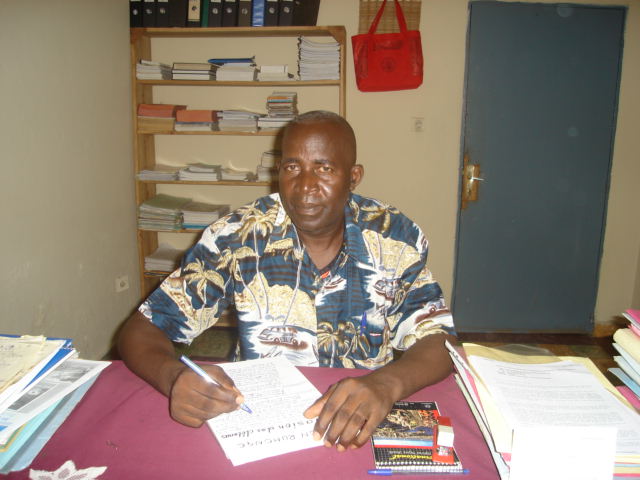
MEA Laureate 2007 Pierre-Claver Mbonimpa
MEA Laureate 2007, Pierre-Clavier Mbonimpa, was arrested this morning early. The latest information is that he is still detained at the Police-Judiciare. The background is rising tension in Burundi, where it is feared that President Pierre Nkurunziza is expected to campaign for a third term in office in 2015 despite a two-term constitutional limit. The Economist of 29 March 2014 already carried an article under the prescient title “Trouble Ahead” and on 17 April Paul Debbie, security chief at the UN office in Burundi, was ordered to leave the country in connection with a UN report disliked by the Government containing “allegations of weapons distribution to members of the youth league of the ruling party”. [http://www.aljazeera.com/news/africa/2014/04/burundi-expels-un-official-over-arms-report-2014417144546195161.html] It is feared that this youth wing, named the Imbonerakure, are being armed and trained in weapons use, raising fears of a return to civil war, even of genocide. No charges have been brought against Mbonimpa, but it is believed that the arrest is related to comments made on the radio regarding the above. Read the rest of this entry »

