Posts Tagged ‘Special Rapporteur on Human Rights Defenders’

Special Rapporteur for human rights defenders: open vacancy for impartial and competent candidates

July 29, 2025

In March 2026, the UN Human Rights Council (the Council) will appoint the next Special Rapporteur on the situation of Human Rights Defenders. The role of this Special Rapporteur is essential: they promote the work of those who defend human rights and they protect human rights defenders at risk. The Special Rapporteur serves in a voluntary capacity and is independent of the UN, States and non-governmental organisations. As other Special Rapporteurs, they are tasked by the UN to monitor and report on human rights situations around the world. They also provide advice and recommendations for the implementation of those rights.

The four rapporteurs until now have all been of exceptional calibre:

Mary Lawlor (Ireland)

2020-2026

She became a Board member of the Irish Section of Amnesty International in 1975, was elected Chair from 1983 -1987 and in 1988 became its Director. She founded Front Line Defenders in 2001 to focus specifically on the protection of human rights defenders at risk.

On 1 May 2020, she took up the mandate of the Special Rapporteur on the situation of human rights defenders, where she has adopted a people-centred approach to the mandate. Her mandate was renewed for another three-year term by the UN Human Rights Council in April 2023.

She is also currently an Adjunct Professor of Business and Human Rights in the Centre for Social Innovation (CSI), School of Business, Trinity College Dublin.

[see also: https://humanrightsdefenders.blog/tag/mary-lawlor/]

Mr. Michel Forst (France)

2014 – 2020

Mr. Michel Forst (France) was Special Rapporteur on the situation of human rights defenders from June 2014 until April 2020. From 2008 to 2013, Mr. Forst was the UN Independent Expert on the situation of human rights in Haiti, and between 2012 and 2013 he was the Chair of the Coordination Committee of the Special Procedures of the Human Rights Council.

[see also: https://humanrightsdefenders.blog/tag/michel-forst/]


Mrs. Margaret Sekaggya (Uganda)

2008 – 2014

Mrs. Margaret Sekaggya (Uganda) was the Special Rapporteur on the situation of human rights defenders from 2008 to 2014. Before her appointment as Special Rapporteur, Ms. Sekaggya was the Chairperson of the Uganda Human Rights Commission and a High Court Judge in the country.

see also: https://humanrightsdefenders.blog/tag/margaret-sekaggya/


Ms. Hina Jilani (Pakistan)

2000 – 2008

Ms. Hina Jilani (Pakistan) was Special Rapporteur on the situation of human rights defenders from 2000 – 2008. In 1980, she and her sister founded Pakistan’s first women-only legal practise. She became an Advocate of the Supreme Court shortly after her tenure as Special Rapporteur came to an end.

see also: https://humanrightsdefenders.blog/tag/hina-jilani/

We should be campaigning so the new person appointed is independent, impartial and competent and comes from a background that represents the diversity of our world. 

Are you a suitable candidate? Apply! (1) Complete the online survey (2) Submit the application form in Word format. The deadline for applications is 31 August 2025, noon Geneva time (CEST).

Apply now

Important Resolution on Human rights Defenders adopted by UN Human Rights Council

April 7, 2025

Led by Norway, the resolution crucially covers new grounds and further develops States’ obligations to protect human rights defenders in the digital age. It also considers the needs expressed by human rights defenders during the consultative process leading to its negotiation and approval. 

For the first time and in a major win for the human rights defenders movement, the resolution includes a reference to the Declaration +25 and is very much in line with its content. 

‘The Declaration +25 is a ground-breaking initiative,’ said Phil Lynch, Executive Director at ISHR. ‘Civil society organisations worldwide have united to produce this authoritative articulation of the international legal framework for the protection of human rights defenders. We are very pleased that the Human Rights Council recognised it,’ Lynch added.

For example, the resolution calls on States to forgo the use of biometric mass surveillance and to refrain from or cease the use or transfer of new and emerging technologies, including artificial intelligence applications and spyware to actors that are not liable to operating these in full compliance with international human rights law. 

Initially, the resolution included a reference to transnational repression but this was removed in the final version.  

‘While we welcome the reference to types of transnational repression referred to in the resolution, we stress that transnational repression is not only about actions taken by a State, but also its proxies, to deter, silence or punish people and groups who engage in dissent, critique or human rights advocacy from abroad, in relation to that State,’ said ISHR’s Lynch and civil society partners in their end of session statement. 

Indeed, transnational repression includes acts targeted directly against human rights defenders, journalists or activists, as well as acts targeting them indirectly by threatening their families, representatives or associates. Particularly vulnerable are nationals or former nationals, members of diaspora communities and those living in exile. ISHR will continue to push for States to publicly recognise and acknowledge this form of harassment. 

Another lost opportunity is the lack of explicit recognition of the positive role of child human rights defenders in promoting human rights and fostering change in societies, including their active role in the digital space. The resolution also doesn’t tackle the specific challenges and risks they face because of their age and their civic engagement, as highlighted by the Special Rapporteur on human rights defenders in her 2024 report.

The resolution fell short of reaffirming States commitments from UNGA A/RES/78/216, to enhance protection measures for child defenders and to provide a safe, enabling and empowering environment for children and young people online and offline. 

The negotiation of the resolution was a hard and long process: 12 informal sessions were needed to agree on a text. In a regrettable move, some States presented amendments to the tabled text trying to undermine and weaken it. The text was finally adopted without a vote.

OHCHR is now mandated to convene three regional workshops and a report to assess risks created by digital technologies to human rights defenders and best practices to respond to these concerns.

https://ishr.ch/latest-updates/hrc58-states-adopt-substantive-resolution-on-human-rights-defenders-emerging-technologies

https://mailchi.mp/ishr/ishr-hrc58-april-8900949?e=d1945ebb90

https://www.apc.org/en/news/digital-milestone-new-resolution-human-rights-defenders-and-new-technologies-adopted-un-human

Human rights defenders globally need increased political and financial support

March 11, 2025

During the 58th regular session of the Human Rights Council, ISHR delivered a statement during the Interactive Dialogue with the Special Rapporteur on Human Rights Defenders affirming that human rights, peace and security are deeply interconnected, and the importance of the international system to human rights defenders.

The international system – to which many human rights defenders turn for justice, solidarity and accountability – is under attack. 

Already weakened by double standards by States from all regions, human rights and the rule of law are being destroyed by a cabal of authoritarian leaders and unaccountable corporations. We thank the Special Rapporteur and other experts for their 27 February statement on this issue.  

It was gratifying to see the rapid solidarity of many States with Ukraine following Friday’s White House confrontation with one such authoritarian. It is disheartening that the shortsighted response of many of those same States to the existential human rights funding crisis is to increase security spending by reducing development assistance. Human rights, peace and security are deeply interconnected. 

Of course, no single State can fill the US gap or counter its influence, but a diverse group of States with a shared interest in universal rights and the rule of law must do so. Human rights defenders globally need your increased political and financial support, now. Our common interests are not served by lawlessness and raw power. 

Madame Rapporteur, thank you for endorsing the Declaration on Human Rights Defenders +25. Read with the 1998 Declaration, it elaborates authoritative standards on the rights of defenders, and State and non-State actors’ obligations to respect and protect them.  

Finally, alongside 196 organisations, ISHR calls on States to support a strong Norway-led resolution on human rights defenders and technology at this session. 

https://ishr.ch/latest-updates/hrc58-human-rights-defenders-globally-need-increased-political-and-financial-support

Call for Input: Special Rapporteur’s Human Rights Council report on human rights defenders in remote and rural areas

September 26, 2024

The Special Rapporteur on the situation of human rights defenders is seeking input for her upcoming report to the Human Rights Council, which will focus on human rights defenders working in remote and rural areas. The report, to be presented in March 2025, will explore the unique challenges faced by these human rights defenders, such as geographic isolation, limited access to resources, and lack of meaningful consultation. Despite these challenges, human rights defenders in these regions play a critical role in defending human rights, maintaining public institutions, and ensuring the rule of law.

This call for input invites contributions from a range of stakeholders, including States, businesses, civil society organizations, and human rights defenders themselves. The aim is to assess the nature of threats, obstacles, and opportunities for human rights defenders in these remote regions. Submissions should focus on topics like gender-specific challenges, protection strategies, successes achieved, and examples of good practices. These inputs will help shape practical recommendations on improving safety, access to resources, and support for defenders in rural areas.

The collected inputs will inform the report and be published on the OHCHR website to foster dialogue and improve protection measures for human rights defenders in these challenging environments.

Report of the Special Rapporteur on the situation of human rights defenders and development

August 19, 2024

The General Assembly received the report of the Special Rapporteur on the situation of human rights defenders, Mary Lawlor.

In the report, the Special Rapporteur on the situation of human rights defenders, Mary Lawlor, highlights the contributions made by human rights defenders to achieving the Sustainable Development Goals. In the report, she demonstrates that, across every one of the 17 Goals, human rights defenders are placing human rights at the core of sustainable development and, in doing so, are assisting States in their responsibility to leave no one behind. The Special Rapporteur highlights that this work is being made more difficult by increasing restrictions on the right to defend rights.

Download Report (PDF | 431.83 KB | English version)

https://reliefweb.int/report/world/report-special-rapporteur-situation-human-rights-defenders-a79123-enarruzh

Lawlor: more than 400 human rights defenders, journalists in DRC targeted within a year

June 22, 2024

On 19 June 2024, Mary Lawlor, Special Rapporteur on the situation of human rights defenders expressed alarm at increasing targeting of human rights defenders in the Democratic Republic of Congo (DRC), particularly in villages and provinces in the east of the country, as the armed conflict intensifies.

Attacks, intimidation and killings of human rights defenders continue on a daily basis in the Democratic Republic of Congo, despite repeated calls for authorities to step up efforts to investigate human rights violations in the country and arrest and bring perpetrators to justice,” she said

From June 2023 to April 2024, the United Nations Joint Human Rights Office in the DRC documented incidents of intimidation, threats of physical violence, attacks and acts of reprisals targeting 387 human rights defenders and 67 journalists, perpetrated by both State agents and armed groups.

Lawlor noted that two women human rights defenders, members of the Youth Movement for Change (LUCHA), had been facing violence and death threats from Twigwaneho armed group since November 2023.

“When LUCHA organised public protests against recent attacks on their village in the South Kivu province, the rebel group sent armed forces to arrest them, forcing them to flee and go into hiding. To this day, they continue to receive death threats and live in hiding,” the expert said. One of the women’s mothers was abducted by the same rebel group in February 2024 and reportedly executed for not revealing her daughter’s whereabouts.

Obedi Karafuru, a human rights defender and head of the workers’ committee, was shot dead by unidentified men in his home village in rebel-held Rutshuru territory in North Kivu province. The Special Rapporteur noted that he had been working to secure fair compensation for former workers on a logging project and had been complaining to authorities for the past four years about death threats against him and his colleagues. “No investigation has been opened into the murder,” Lawlor said.

A human rights defender received death threats in February 2022 when he questioned the effectiveness of the Government’s state of emergency in North Kivu, stating that authorities had failed to guarantee the safety of the population. “The death threats forced him into hiding, as State authorities never responded to his call for protection,” the expert said. Four women human rights defenders from the women-led organisation Tous pour la Paix et la Cohésion Sociale, have been victims of kidnapping and violence following activities they organised around women’s rights.

The expert noted that the DRC adopted a law on the protection of human rights defenders in 2023, which meets the minimum international standards, and ensures special protection for women human rights defenders as well as physical protection of human rights defenders and their families.

“Many executions of human rights defenders are preceded by death threats,” Lawlor said, referring to the report she presented to the Human Rights Council in 2021. “Unless the physical integrity of human rights defenders is guaranteed, they will not be able to fully contribute to the construction of a just society that respects human rights,” she said.

“I call on authorities in the DRC to take all necessary measures to ensure a safe working space and protection for human rights defenders, as well as to guarantee the exercise of their rights to freedom of peaceful assembly and association and to effectively and reliably investigate all cases of executions in accordance with international standards, including the Minnesota Protocol, and bring those responsible to justice,” Lawlor said.

This statement is endorsed by Gina Romero, Special Rapporteur on the rights to freedom of peaceful assembly and of association; Morris Tidball-Binz, Special Rapporteur on extrajudicial, summary or arbitrary executions.

Distributed by APO Group on behalf of Office of the UN High Commissioner for Human Rights (OHCHR).

see also: https://humanrightsdefenders.blog/2022/05/13/floribert-chebeya-dr-congo-policeman-sentenced-to-death-for-murder/

https://www.news24.com/news24/africa/news/war-on-activists-more-than-400-human-rights-defenders-journalists-in-drc-targeted-within-a-year-20240620

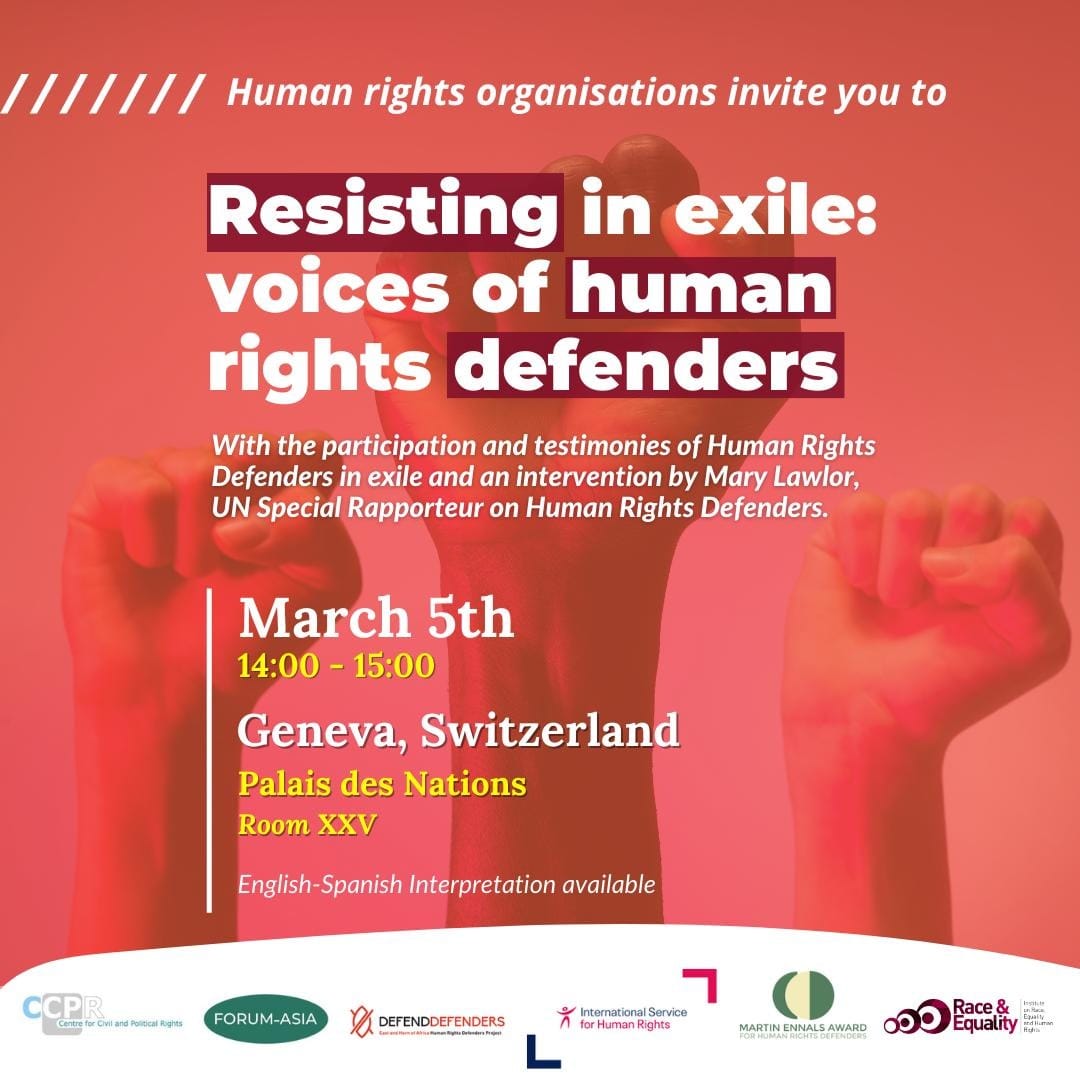
Resisting in Exile: Voice of Human Rights Defenders – side event tomorrow, 5 March 2024

March 4, 2024

On Tuesday, 5th March, 2pm – at the Palais des Nations, Room XXV- will take place the side event Resisting in Exile: Voice of Human Rights Defenders

“I do not like the idea of being a refugee. I do not want to leave the country because I wanted to make it better.”  Human rights defender quoted by the Special Rapporteur on Human Rights Defenders in A/HRC/37/51.

In ‘People Power Under Attack’ (2022), CIVICUS reports that the number of countries where civic freedoms are being curtailed and civil society is under severe attack is increasing… In such contexts and under such pressure, defenders can see leaving the country as their only option. These defenders, along with defenders expelled by their home governments, face the huge challenges of short or protracted exile, including economic insecurity and ongoing threats. Defenders in exile question if and how they can continue human rights work from abroad and how those who remain deal with a fractured human rights community.

In this event the four organisers [Centre for Civil and Political Rights (CCPR-Centre), International Institute on Race, Equality and Human Rights, (Race and Equality), International Service for Human Rights (ISHR), and DefendDefenders] will bring the voices of human rights defenders from around the world to the Council so that States, UN experts and officials and civil society colleagues can hear their voices. What is the experience of being in exile like? What is the impact on individual work and that of the community of defenders? What demands do exile defenders make to the Council?

This event aims to raise greater awareness about the phenomenon of defenders in exile and encourage discussion and action on how to support these defenders. It is also aimed at looking at what is needed to prevent exile becoming some defenders’ only feasible option.

During this event, defenders in exile from will speak of the impact of their experience of exile on their own lives, those of their families, and their communities. They will highlight the specific needs defenders in exile have in terms of legal guarantees, and political and financial support and of their ongoing work to defend rights from exile.

Defenders in exile will also send in testimonies, to be shown in video form or read out by fellow defenders. We aim to fill the room with the voices of those in exile who cannot be in Geneva to participate directly.

Recall the recommendations made by the previous Special Rapporteur on Human Rights Defenders, Michel Forst, in his 2018 report to the Council (A/HRC/37/51), including in regard to the prohibition of non-refoulement to persecution, relocation schemes, and access to protection measures for defenders in exile.

The conversation will take place during the Council session when the Special Rapporteur on Human Rights Defenders will be presenting her report to the Council. We hope that the Special Rapporteur will be available to, highlight the need for greater attention to, and investment in the prevention of, the closure of civic space so as to forestall the need for defenders to leave the country.

See also: https://humanrightsdefenders.blog/2022/03/04/warning-human-rights-defenders-in-ukraine-and-in-exile-will-be-danger/

See also: https://bnnbreaking.com/breaking-news/human/us-drl-launches-program-to-bolster-exiled-human-rights-defenders

Mary Lawlor returns from Algeria visit

December 7, 2023

On 5 December 2023, Mary Lawlor, the UN Special Rapporteur on the situation of human rights defenders concluded her visit to Algeria with the observation: “While I welcome the evident reforms which have taken place over the past four years and the new emphasis on public consultation, I regret that some human rights defenders who work on sensitive issues face continued restrictions”.

The UN expert observed four main patterns of violations used to suppress human rights defenders: ongoing judicial harassment, dissolution of key human rights organisations, limitations on freedom of movement and intimidation and surveillance leading to severely negative impacts on their mental health and that of their families.

I was saddened that a handful of human rights defenders who attempted to travel to Tizi Ouzou, where I was holding meetings, were prevented from doing so and detained for 10 hours,” Lawlor said.

“Given Algeria’s recent history, robust laws relating to terrorism are clearly necessary,” the expert said. “However, it is disappointing that laws designed to prevent terrorism are instilling terror in human rights defenders through overly broad and vague definitions of what constitutes terrorism in the Penal Code.”

The Special Rapporteur noted that Article 87 bis of the Penal Code was one of the most frequently cited laws used to prosecute human rights defenders.

Despite this, the expert said there were many people working to protect and promote human rights with the full support of the government and the newly created consultative bodies in areas including women’s rights, children’s rights, healthcare, poverty relief and political participation. Based on this collaboration and experience, the Special Rapporteur believes the government is now better equipped to reach out to human rights defenders working on sensitive issues.

Lawlor welcomed the acquittal of three human rights defenders, Jamila Loukil, Kaddour Chouicha and Said Boudour, of terrorism charges in Dar El Baida court on Sunday. 

“I hope this acquittal will kickstart a review process of Article 87 bis, and I stand ready to assist the Algerian government in any way I can in this regard,” she said.

11 human rights NGOs had publicly expressed their wish that this visit be an opportunity to free imprisoned activists and for reforms to see the light of day.

On 6 December, following the public report of this visit, NGOs support the main measures recommended by the Special Rapporteur, namely that:
• The Algerian government must view Human Rights Defenders as allies and opportunities within society, not as threats. The signatories call for the repeal of all repressive laws and legislative provisions relating to the rights to freedom of association and peaceful assembly, and the adoption, on the basis of broad consultation with Algerian society, a regulatory framework complies with international standards notably respect for human rights in Algeria.
• Many civil society organizations are in danger of disappearing. This is already the case of the Algerian League for the Defense of Human Rights (LADDH) and the Rassemblement Actions Jeunesse (RAJ). Civil society organizations must have the freedom to adequately play their role.
• Several articles of law must also be reformed in accordance with international standards. This is the case of articles 79 and 87 bis of the Penal Code, relating to the attack on the integrity of the national territory and the fight against terrorism which are abusively used to imprison activists. The same goes for the Ban on Exiting the National Territory (ISTN) which is today used in a punitive manner to restrict the movement of human rights defenders in Algeria.

The signatories finally call on the Algerian government to release all prisoners of conscience and human rights defenders currently in prison

https://www.ohchr.org/en/press-releases/2023/12/algeria-continued-restrictions-human-rights-defenders-undermine-social

https://www.fidh.org/en/region/north-africa-middle-east/algeria/algeria-reactions-following-the-visit-of-the-special-rapporteur-on

HRW submission to Special Rapporteur focuses on child and youth human rights defenders

November 13, 2023

Human Rights Watch’ submission discusses the risks climate activists have faced in Australia, India, and Uganda. It focuses on examples of activists under age 32, as requested by the UN Special Rapporteur on Human Rights Defenders.

Australia

Following increased climate protest activity in New South Wales (NSW), the government in March 2022 established a new police unit known as the Strike Force Guard. The unit is designed to “prevent, investigate and disrupt unauthorized protests across the state.” On April 1, the state parliament introduced new laws and penalties specifically targeting protests that blocked roads and ports. Protesters can now be fined up to AU$22,000 (US$15,250) and be jailed for up to two years for protesting without permission on public roads, rail lines, tunnels, bridges, and industrial estates.

In 2022, Human Rights Watch interviewed three climate protesters who had been arrested and charged under the new laws. These cases indicate that climate protesters are being targeted for disproportionate punishment.

Violet (Deanna) Coco, a 31-year-old activist, took part in a climate protest on April 13, 2022, that stopped traffic in one lane on the Sydney Harbor Bridge. Coco climbed on the roof of a parked truck and stood holding a lit emergency flare. After approximately 25 minutes, NSW police forcibly removed her and the other protesters from the road. Coco was charged with disrupting vehicles, interfering with the safe operation of a bridge, possessing a bright light distress signal in a public place, failing to comply with police direction, and resisting or hindering a police officer. She was also charged under explosives regulations for holding the emergency flare; with an incitement offense for “encouraging the commission of a crime” by livestreaming the protest on Facebook; and for uploading a video of a climate protest she took the previous week, and with disrupting traffic during three previous protests.

Coco pleaded guilty to two charges – blocking traffic and failing to comply with police direction – and not guilty to the other charges. She was released on AU$10,000 (US$6,940) bail, but the magistrate ordered her not to leave her apartment for any purpose except for emergency medical assistance or to attend court. She was also ordered not to associate with any other Fireproof Australia member. Coco spent 21 days under what amounted to house arrest. On May 5, 2022, a magistrate amended her bail and, while she was allowed to leave her property, the authorities imposed a curfew banning her from leaving her address before 10 a.m. and after 3 p.m.

In March 2023, Coco was issued with a 12-month conditional release order after a district court judge heard she had been initially imprisoned on false information provided by the New South Wales police.

In August 2022, the state of Victoria followed New South Wales with harsh new measures targeting environmental protesters at logging sites with up to 12 months in jail or $21,000 in fines. In Tasmania, environmental activists now face fines of $13,000 or two years in prison, while nongovernmental organizations that have been found to “support members of the community to protest” face fines of over $45,000.

On May 18, 2023, the South Australia government introduced harsh new anti-protest measures in the South Australian lower house in the morning and then rushed them through after lunch with bipartisan support after just 20 minutes of debate and no public consultation. The bill would increase the punishment for “public obstruction” 60-fold, from $750 to $50,000 or three months in jail, with activists also potentially facing orders to pay for police and other emergency services responding to a protest or action. On May 30, the laws were passed after a 14-hour debate in the South Australian upper house.

India

In February 2021, Indian authorities arrested Ravi who was sent to police custody for five days. Indian authorities also issued arrest warrants against Nikita Jacob, a lawyer, and Shantanu Muluk, an activist, who were granted pre-arrest bail. The authorities alleged Ravi was the “key conspirator” in editing and sharing an online toolkit shared by the Swedish Fridays for Future founder Greta Thunberg on social media, including Twitter, aimed at providing information to those seeking to peacefully support ongoing farmers protests. In granting bail to Ravi, the Delhi court said the evidence on record was “scanty and sketchy,” and that citizens cannot be jailed simply because they disagreed with government policies. It added: “The offense of sedition cannot be invoked to minister to the wounded vanity of governments.”

The Indian government has enforced Information Technology Rules that allow for greater governmental control over online content, threaten to weaken encryption, and seriously undermine media freedoms, rights to privacy, and freedom of expression online. These rules put youth and other human rights defenders and journalists at further risk of being targeted by the authorities for their online content.

Uganda

Young people from across Uganda have faced reprisals for fighting for climate justice. On September 25, 2020, Ugandan police arrested and detained for eight hours eight youth climate activists while participating in the global climate strike in Kampala. The police told them election campaigns were not allowed, although the activists repeatedly explained that they were an environmental—not a political—movement. The activists, only two of whom were above the age of 18, were detained in a room for eight hours, questioned, and then allowed to leave.

Human Rights Watch published a report that documented a range of restrictions on freedom of expression, association, and assembly related to oil development, including the planned East African Crude Oil Pipeline (EACOP) by the government. Civil society organizations and environmental defenders regularly report being harassed and intimidated, unlawfully detained, or arbitrarily arrested. Human Rights Watch interviewed 31 people in Uganda between March and October 2023, including 21 environmental defenders, and several of whom were under 32 years old.

Many student climate activists protesting EACOP have been arrested and charged with various offences in Kampala since 2021. These protests have been largely peaceful and usually small in scale. Since 2021, there have been at least 22 arrests, largely of students, at anti-EACOP protests in Kampala. Nine students were arrested in October 2022 after demonstrating support for the European Parliament resolution on EACOP and charged with “common nuisance.” Their case was finally dismissed on November 6, 2023, after more than 15 court appearances. Another four protesters were arrested on December 9, 2022, as they marched to the National Environmental Management Authority (NEMA) to demand a re-evaluation of the environmental damage caused by EACOP. One of the detainees was kept at an unknown location until the morning of December 12 when all four were released.

Another protesting student was arrested in Kampala on June 27, 2023, after trying to deliver a petition to the Speaker of the House of Uganda’s parliament. He told Human Rights Watch he was taken to an unlawful place of detention known as a “safe house” with his hands tied behind his back, questioned by plain-clothed security officials about who was providing the funding for the protests, before he was knocked to the floor. He said he awoke two days later in the hospital with serious injuries. On July 11, 2023, five individuals were arrested after protesting EACOP in downtown Kampala.

On September 15, 2023, four student protesters were arrested after a “Fridays for Future” and “StopEACOP” joint protest at the Ugandan parliament as part of the “Global Fight to End Fossil Fuels,” a global mobilization and day of action. They were released on bond five days later and have been charged with “common nuisance.” Their next hearing is scheduled for November 27, 2023. One of the students described to Human Rights Watch being held in a room inside parliament and beaten by uniformed parliamentary security officials and others in civilian clothes with “batons, gun butts, and using their boots to step on our heads” before being taken to Kampala’s Central Police Station (CPS). At the CPS he described plainclothes intelligence officers asking: “Who are your leaders? Among us, who is your leader? How many are you? Who are your leaders in different universities? Who is managing your social media accounts?” They then described being beaten further in CPS cells by other prisoners, one of whom said, “We have order from above to discipline you. You need to stop working on EACOP.”

See also: https://globalpressjournal.com/africa/uganda/ugandan-pipeline-project-begins-landowners-navigate-crooked-road-compensation/

Human Rights Watch encourages the Special Rapporteur to call on governments to:

  • Promote and protect universally recognized human rights and fundamental freedoms, respect, and protect the work of climate activists, in line with their human rights obligations.
  • Publicly condemn assault, threats, harassment, intimidation, and arbitrary arrests of activists, and direct security and other government officials to stop arresting, harassing, or threatening activists for protesting or on false accusations.
  • End arbitrary arrests and prosecutions of human rights defenders, anti-EACOP activists, and peaceful protesters.
  • Respect and protect the rights of all human rights defenders and civil society organizations to exercise freedoms of association, assembly, and expression, in accordance with international human rights norms.
  • Where applicable, ratify and implement regional human rights agreements to ensure public participation in environmental decision-making and to protect environmental defenders.

Submission to the Special Rapporteur on the situation of human rights defenders

Mary Lawlor urges India to release HRD Saibaba

August 29, 2023
Mary Lawlor, UN Special Rapporteur on the situation of human rights defenders.

Mary Lawlor, UN Special Rapporteur on the situation of human rights defenders.

An independent UN human rights expert has called for India to release an activist imprisoned since 2017, expressing concern over his persistent detention and deteriorating health. GN Saibaba, a former English professor at Delhi University, was arrested in 2014 and accused of links to banned Maoist groups, according to media reports. See: https://humanrightsdefenders.blog/2023/07/07/g-n-saibaba-in-india-continues-from-his-cell/

He was sentenced to life imprisonment three years later for multiple offences under the country’s Unlawful Activities Prevention Act.

GN Saibaba is a long-standing defender of the rights of minorities in India, including the Dalit and Adivasi people,said Mary Lawlor, UN Special Rapporteur on the situation of human rights defenders on 21 August “His continued detention is shameful. It bears all the hallmarks of a State seeking to silence a critical voice,” she added.
UN human rights experts have repeatedly raised grave concerns about the prosecution of Mr. Saibaba, who has suffered from a spinal disorder and polio since childhood and uses a wheelchair. 

His detention was declared arbitrary by the UN Working Group on Arbitrary Detention in an opinion issued in 2021.

In March 2024 came the good news: The Nagpur bench of Bombay High Court set aside the conviction, Read more at:
http://timesofindia.indiatimes.com/articleshow/108246679.cms?utm_source=contentofinterest&utm_medium=text&utm_campaign=cppst

https://news.un.org/en/story/2023/08/1139932

https://english.mathrubhumi.com/news/world/un-expert-pitches-for-ex-delhi-university-professor-g-n-saibaba-s-release-1.8840381