Nathalia Bonilla is an environmental human rights defender from Ecuador who works in the protection of the rights of Nature. She told ISHR about her country’s sharp policy turn in favour of extractive activities and spoke about the ‘utopia’ she and her peers would like to see in its place. ‘A revolution where you can’t dance is not my revolution,’ Nathalia said, in arguing for an ‘environmentalism for the people’.
On 15 January 2026 – the third anniversary of the enforced disappearance of Ricardo Lagunes and Antonio Díaz – UN experts demanded immediate answers about the fate and whereabouts of the two Mexican human rights defenders. “Mexican authorities must comply with the State’s international obligations, including by investigating the enforced disappearance, proactively searching for them, determining their fate and whereabouts, and holding perpetrators criminally responsible,” the experts said.
On 15 January 2023, Ricardo Lagunes, a human rights lawyer, and Antonio Díaz, an Indigenous leader, were forcibly disappeared in the state of Colima, Mexico. Their enforced disappearance occurred amid an ongoing dispute over natural resources between the Indigenous community of San Miguel de Aquila, Michoacán, and the Luxembourg-based mining company Ternium (part of the Argentine-Italian Techint Group). They were last seen after attending a community meeting to discuss collective action in response to the human rights impacts of the mining company’s operations.
“Refusing to succumb to despair after their enforced disappearance, the families of Mr Lagunes and Mr Díaz have undertaken a tireless quest for truth and justice over the past three years,” the experts said, noting that the authorities have so far not provided an effective response and that the company concerned has reportedly failed to fully cooperate with ongoing investigations and search activities.
The cases have been registered under the Committee on Enforced Disappearances’ Urgent Actions procedure and benefit from precautionary measures granted by the Inter-American Commission on Human Rights, acknowledging the serious, urgent and irreparable risk faced by the two human rights defenders.
“Enforced disappearances have a chilling effect on human rights defenders, including those advocating for land, natural resources and environment issues, as well as Indigenous leaders, and serve to silence critical voices,” the experts said, urging the Government to ensure that human rights defenders can carry out their work in a safe environment, including by strengthening the protection mechanism for human rights defenders.
In the context of resource-extraction projects, business enterprises have often reportedly sown and exacerbated community divisions, inciting violence among locals with opposing views on the projects and the use of land and natural resources. “The Government must ensure that businesses respect human rights across all their activities pursuant to the UN Guiding Principles on Business and Human Rights, including when engaging with human rights defenders and affected communities,” they said.
The experts are in touch with the Government of Mexico and the business concerned in this regard.
On 8 September 2025, a report “Defending forests shouldn’t cost lives: Forest 500 assesses corporate zero tolerance policies,” links world’s top banks to social & environmental harms from mining
… Global Canopy’s annual Forest 500 assessment looks at six human rights criteria closely associated with preventing deforestation. Three indicators are interconnected with deforestation as violations of these rights frequently happen around the point of forest loss. They are: Free, Prior and Informed Consent (FPIC); zero tolerance for threats and violence against forest, land and human rights defenders; and customary rights to land, resources and territory.
Among them, zero tolerance is least likely to be addressed by companies: only 9% of the 500 companies assessed have a public commitment in place for at least one forest risk commodity. By comparison, 37% of companies have committed to FPIC, and 24% have commitments to respect the customary rights of IPLCs to land, resources and territory.
… Only 47 Forest 500 companies have commitments for zero tolerance. Companies in the palm oil (18%) and cocoa (14%) supply chains are more likely to have commitments. Commitments are scarce in the beef (10%), soy (11%) and timber (6%) sectors, although these industries are linked to abuses in Latin America. According to BHRRC, 40% of attacks against human rights defenders over the last decade took place in Latin America, with Brazil recording the highest number of killings worldwide.
… Only six of the Forest 500 companies publish evidence of due diligence and progress reporting on eradicating violence and threats f
The report focuses on financing for companies mining critical minerals used in the global energy transition, including lithium, nickel, graphite and cobalt. Nearly 70% of these transition mineral mines overlap with Indigenous lands and roughly an equal amount is in regions of high biodiversity.
“Our findings shed light on the central role that financial institutions play in enabling this new wave of destruction as companies rush to expand mining operations as rapidly as possible,” Steph Dowlen, forests and finance campaigner for the Rainforest Action Network, told Mongabay by email. “While this extraction for raw minerals falls under a ‘green’, ‘clean’ or ‘renewable’ banner, it’s still extraction and the mining sector remains high-risk, dominated by companies with egregious track records on rights, the environment and corporate accountability.”
The report assessed environmental, social and governance policy scores of 30 major financial institutions and found an average score of only 22%. Vanguard and CITIC scored the lowest, each with just 3%. The assessment found that many financial institutions lacked policies to prevent financing issues, including pollution, Indigenous rights abuses or deforestation.
Of all institutions assessed, 80% lacked policies on human rights defenders and none had safeguards for Indigenous peoples living in voluntary isolation. Many institutions (60%) lacked grievance mechanisms, which allow communities that have been negatively impacted by mining activities to seek justice. Also, 60% of institutions had no policies on tax transparency, which is key to preventing companies from shifting profits abroad and ensuring that mining revenues remain in the resource-rich countries.
“Due to the significant overlap with transition minerals and Indigenous Territories, and high-biodiversity areas, there is an immediate need for governments, financial institutions and mining companies to stop and listen,” Dowlen said. “Indigenous Peoples and local communities have been raising the alarm for a long time but continue to face disproportionate harm as well as violence and intimidation for defending their rights and their lands.”
BlackRock and JPMorgan Chase declined to comment on the report. None of the other institutions mentioned in this piece responded to Mongabay’s emails.
Environmental activist Hipólito Quispe Huamán was shot and killed Saturday night in the Madre de Dios region of southeastern Peru, in what authorities suspect was a targeted attack linked to his work defending the Amazon rainforest, AFP reported on 29 July 2025.
Quispe Huamán was driving along the Interoceanic Highway when he was gunned down, according to local prosecutors. Karen Torres, a regional prosecutor, told reporters that investigators are considering his environmental advocacy as the likely motive.
“This is a murder with a firearm of yet another defender of the Madre de Dios region,” she was quoted as saying by AFP.
Quispe Huamán had served as an active member of the Tambopata National Reserve Management Committee and was a vocal opponent of deforestation and illegal land use in the Peruvian Amazon. His killing has sparked outrage from human rights and environmental organizations, which say the attack reflects a growing pattern of violence against Indigenous leaders and environmental defenders in the region.
“We condemn the murder of environmental defender Hipólito Quispe Huamán in Madre de Dios, another victim of the growing violence against those who protect our territories and ecosystems,” said the National Coordinator for Human Rights (CNDDHH) in a statement posted on social media. “Not one more death!”
Hipólito Quispe Huamán. Photo courtesy of CNDDHH (on X).
Quispe Huamán’s brother, Ángel, called for accountability. “I demand justice for my brother’s death. This kind of thing cannot happen,” he told local media.
The Ministry of Justice has pledged to support the legal defense of Quispe Huamán’s family and ensure the perpetrators are brought to justice. However, critics say the government’s response mechanisms remain under-resourced. The Intersectoral Mechanism for the Protection of Human Rights Defenders, led by the Ministry of Justice, has faced ongoing criticism for lacking the budget and personnel needed to respond effectively to threats.
Attacks against environmental defenders have increased across Peru’s Amazonian regions, where extractive industries, drug trafficking, and illegal land grabs often operate with impunity. In July 2024, the Interethnic Association for the Development of the Peruvian Rainforest (AIDESEP) declared a state of emergency after an Indigenous leader was tortured and killed in central Peru, citing escalating threats from coca growers and criminal networks.
According to Global Witness, at least 54 land and environmental defenders have been murdered in Peru since 2012—more than half of them Indigenous. Many of these killings remain unsolved.
Quispe Huamán’s death has reignited calls for stronger protections for those who safeguard the rainforest and Indigenous territories. As investigations continue, activists and family members are demanding not only justice—but a systemic response to end the violence.
The second week of witness testimonies continued with the court hearings with Egbert Wesselink and Petter Bolme, two individuals considered central to the broader context of the trial. .. Wesselink provided background on the report’s origins and its significance in bringing the case to light. He also discussed his extensive knowledge of Sudan at the time and his contact with the pre-trial investigation and Lundin oil over the years.
Hearing with Egbert Wesselink
This is a very long report but as the devil in the details……
The second week of witness hearings began with the testimony of individuals who had worked and lobbied for these allegations to be investigated. Egbert Wesselink is a historian working for PAX, the largest peace organization in the Netherlands and the lead author of the report “Unpaid Debt” and involved in the production of the report “Depopulating Sudan’s Oil Regions.”
The prosecution’s questioning focused on Egbert Wesselink’s knowledge of southern Sudan and Block 5A during 1997–2003, his contacts with the Lundin companies during that period, the preparation of the report Depopulating Sudan’s Oil Regions, and his role within PAX and ECOS. He was also questioned about investigation trips to Block 5A and his communication with individuals connected to the pre-trial investigation. During the hearing, Wesselink described the situation in Block 5A during 1997–2003 as highly violent, with conflict over oil-rich areas and systematic or indiscriminate attacks on civilians by the Sudanese military and allied militias. He stated that representatives of the Lundin companies were made aware of these conditions by him from 2000 onward and clarified that PAX and ECOS did not exert undue influence over any interviewees involved in their investigations. Wesselink’s testimony provided crucial context about the violent circumstances in Block 5A and the awareness of these conditions among various actors at the time. It also offered valuable insight into the efforts to document and report the actions of oil companies to the rest of the world, while also highlighting the ongoing pursuit of justice and reparations for the plaintiffs.
The hearing began with Egbert Wesselink talking about his academic background in history and education, early work in politics as an assistant to a member of the Dutch parliament and teaching geography and French, and then his transition into human rights, first as a volunteer, then as a UN officer in Cambodia in 1993. He later worked as researcher and expert for the UN Office for Migration/UNHCR before joining PAX in 1998, where he focused on corporate responsibility and human rights dialogue with various companies. Wesselink recounted his early corporate engagement with the first oil company he worked with, Shell, where alongside Amnesty International he was involved in a dialogue with the company concerning the company’s human rights policies and actions.
PAX and ECOS
In the early 2000s, PAX began working in Sudan, responding to reports of harm caused by the oil industry. After discovering Shell’s ties to Sudan, PAX intervened and discussed the company’s human rights policies and actions, leading to Shell’s withdrawal from the country and its cessation of fuel supplies to the Sudanese air force. Around the same time, Dutch NGOs recognized the need for European-level measures and formed the European Coalition on Oil in Sudan (ECOS) to address what they saw as the oil industry’s role in fueling conflict and displacement. PAX played a central role in forming and coordinating ECOS, which launched officially in Brussels in 2001. The coalition aimed to stop harmful oil activities and to create a more substantial and effective dialogue between the EU and Sudan. ECOS brought together over 50 European NGOs and produced major advocacy and research efforts. When asked about its contact with Sudanese churches and their influence, Wesselink responded by saying that while not directed by churches, ECOS regularly consulted Sudanese civil society and church groups through forums, but he emphasized that the ECOS acted based on requests from affected communities and their interests and rights, not on top-down instructions.
When asked about how PAX and ECOS formed their understanding of the oil operations and their harmful effects, Wesselink explained how they found important observations by John Harker, who in 1991 conducted a mission for the Canadian government. The conclusions they presented aligned with what PAX and ECOS had heard from local residents, churches, and organizations working in the area. This information was further confirmed by reports from the UN Special Rapporteur on Human Rights in Sudan and the findings matched entirely with their prior understanding of how the Sudanese government approached the oil issue. Wesselink also described how he met families from areas north of Lundin’s block, who had been forced to flee to Utrecht. Their testimonies were clear, they had been driven from their homes in one of the country’s central oil regions.
Wesselink described how after the initially unsuccessful “Peace First” campaign, ECOS shifted focus in 2002 to promoting responsible oil business standards. By 2003, it no longer called for companies to leave Sudan but instead advocated for reform within the industry. This aligned with the 2003 peace agreement and Sudan’s transitional constitution, which introduced the possibility of compensation to affected communities and international standards for oil operations. But there was also concern from the church and civil society in Sudan that the government would not be strong enough to push for this against an industry that was uninterested and fear that the government lacked the capacity or will to enforce these standards. To address this, PAX organized a major conference in Juba in late 2006, aiming to create space for dialogue on these governance issues.
When asked about ECOS now, Wesselink explained that ECOS no longer exists, following the separation of Sudan and South Sudan, as focus and momentum declined, and according to Wesselink ECOS “died a slow death.” However, PAX continues working toward justice and compensation for communities affected by oil exploitation.
Wesselink’s engagement and contact with oil companies
Egbert Wesselink described how his understanding of the situation in southern Sudan, particularly Block 5A between 1997 and 2003, developed gradually. He became actively involved around 2000, reading extensively, and his first visit to Sudan was in 2004 for a peace conference in Upper Nile, where he gathered firsthand accounts of problems near major oil fields.
Wesselink explained that contact with oil companies varied. He had early and regular engagement with Shell, including participating in a 2000 conference in Munich, where he also met Lundin and Petronas representatives. He had several conversations with Christine Batruch, the head of Lundin’s corporate social responsibility work, which he described as unproductive, noting her denial of human rights concerns and reliance on Sudanese government narratives. He described how he was used to having discussions with oil companies that were upfront about the facts and willing to discuss dilemmas, as morality is rarely black and white—there were many gray areas in these discussions. However, he said that with Batruch it was impossible to have that kind of conversation as she denied well-established facts and showed very little knowledge about human rights and the responsibilities of companies like Lundin in this regard. He described her as appearing to have a combination of real ignorance and purposeful lack of knowledge. Wesselink explained that it was clear that her knowledge was biased and mainly influenced by northern perspectives, as it was evident that the company was following the Sudanese government’s war propaganda that all conflict stemmed from tribal conflicts. He described it like hearing an echo of what the Sudanese government expressed. While Batruch expressed some openness to hearing from southern Sudanese leaders, Lundin ignored Pax’s invitation to have a dialogue regarding ethical guidelines and the oil industry’s impact on the local population. He also stated that he received no response when he asked Batruch about Lundin’s stance on provisions in the peace agreement, which stated that those affected by oil extraction in southern Sudan had the right to compensation and redress and that those affected by the peace agreement were to be compensated.After that, Wesselink had no further direct contact with Lundin, though he was informed that the Church of Sweden had reached out.
Regarding further contact with Lundin Oil, Wesselink described how in late 2001 he raised concerns about former Swedish prime minister Carl Bildt joining Lundin’s board of directors while also being involved with Amnesty Sweden, calling it a conflict of interest. He viewed this dual role as a serious risk to Amnesty’s credibility and structure. Concerned, he wrote to Amnesty International, questioning their cooperation with Lundin. Wesselink explained that he saw it as a great risk for Amnesty to be linked through Bildt with companies accused of serious crimes and that Amnesty should not cooperate with Lundin. However, when he pointed this out, he received a long reply from Carl Bildt defending his involvement, although Wesselink found the arguments factually incorrect. Bildt claimed that Lundin’s presence contributed positively to human rights and peace in the region, which Wesselink strongly refuted, noting that this contradicted all available evidence at the time. He said, “I found these arguments insincere and baseless; they contradicted everything we knew.”
In terms of contact with other companies, Wesselink also engaged with OMV, which was part of the same oil consortium as Lundin. ECOS contacted OMV in 2001, encouraging them to align with international standards. Upon learning more about the situation, OMV’s leadership grew uneasy, especially after commissioning a risk report from the security firm Control Risk Group whose findings raised internal concerns, although they were not a human rights organization. OMV considered halting road construction to Leer due to violence but ultimately yielded to pressure from the Sudanese government. Wesselink noted that OMV often echoed Lundin’s messaging, suggesting coordinated responses.
Preparation of the report “Depopulating Sudan’s Oil Regions”
Regarding the report Depopulating Sudan’s Oil Regions, Wesselink explained that it was based on a 2002 field mission near Block 5A, organized by ECOS and led by Diane de Guzman, with support from journalist Julie Flint. The team flew into the area from Kenya and documented extensive violence and interviewed traumatized civilians. Julie Flint had a camera with her, and they made a short ten-minute film that can still be seen on YouTube, and which they also distributed via the ECOS network. The trip, financed by ECOS, targeted areas near Block 5A and Nhialdiu, where alarming reports of renewed violence were surfacing. The goal was to document these events, recognizing that without credible information, international concern would be lacking. The field data, interviews, and visual evidence were then compiled into a comprehensive report. De Guzman drafted the original document, which included interviews, high-level analysis, and contextual information, but the report itself was then written by Wesselink. The report included interviews, analysis, background on the conflict, and references to arms use and oil revenue.
Unpaid Debt
After 2004, Wesselink and ECOS continued working to ensure oil companies took responsibility for the harm caused during Sudan’s oil conflict. Wesselink believed that Lundin had no real interest in implementing the 2003 peace agreement’s compensation clauses, while his and the Sudanese church’s goal was to make the agreement a success by pushing for reparations. Wesselink recalls that the Sudanese Minister of Justice at the time said, “If there are affected people, they can take their cases to court,” and that became the starting point for assessing the financial damages incurred over the years, followed by lobbying the oil companies to pay these costs. It also became the start for Unpaid Debt as the objective was not only focused on good business practices, but also on ensuring the “debt” was paid.
The prosecution moved on to inquire about the Unpaid Debt report and the individuals involved in its creation. Wesselink explained that he was the main author of the report but had assistance from numerous assistants and received advice and input from others. They also hired a British defamation lawyer to review the report because when the report was finalized in 2008 and sent to Lundin for comments, Lundin’s response, which came via their lawyers, was to claim that the report contained false information that was damaging to the company. They alleged the intent was to harm the company and reserved the right to claim damages. According to Wesselink, such responses are standard tactics companies use when they are unwilling to resolve issues and prefer confrontation instead. This legal threat caused panic among members of ECOS, with the majority of the core group reluctant to risk being taken to court. A smaller faction of members remained undeterred and wanted to move forward with the publication under the condition that the report would be reviewed by a British lawyer due to the UK’s strict defamation laws. This ensured the report’s legal soundness but also resulted in more legally influenced language, which Wesselink speculated might have contributed to the current situation.
The prosecutor then moved on and asked about the recent claims that the photographs in the report were mislabeled regarding the location of where they were taken — Riel in Thar Jath versus Riel in Mankien. Wesselink acknowledged he wasn’t involved in taking the photos and relied on photographers from DanChurch Aid and others. While he could not verify their accuracy, he expressed trust in their work and admitted to being slightly surprised by any alleged mistakes and stated he would be embarrassed if the defense’s claims were proven correct. Despite this, Wesselink maintained that such potential errors would not diminish the report’s overall reliability.
The organization of investigation trips to and near Block 5A
Wesselink was also asked by the prosecution about the organization of investigation trips to Block 5A. These missions were conducted in cooperation with the Sudan Council of Churches and aimed to assess damage and pressure companies for accountability. If companies didn’t respond, findings were intended for the Evaluation and Assessment Committee, which included representatives from the U.S., U.K., and Norway. As a last resort, civil lawsuits were considered. The trips required extensive preparation due to the political sensitivity surrounding oil-related matters. Wesselink mentioned the need to seek support and endorsements for the research from state authorities, the UN, and local chiefs to facilitate the investigation. He also explained how one couldn’t simply go somewhere and “start asking questions about oil” because it was politically sensitive. His role was therefore to travel down to seek support for this work from the local chiefs.
Contacts with the pre-trial investigation
The prosecutor turned its focus to Wesselink’s personal connections to individuals linked to the pre-trial investigation. Wesselink explained that he had limited direct involvement with the pre-trial investigation, having been interviewed twice by Swedish police and attending two meetings with prosecutors. Most contact was minimal, with only some email correspondence. His own involvement with the trial began after civil war broke out in Juba in 2013, where it became nearly impossible for the Swedish authorities to access witnesses. Wesselink and his colleagues suspected the authorities needed help to find witnesses and offered assistance, but the response from the police was vague and Wesselink described them as “mussels” who did not say anything. Wesselink said that they received similar responses from the prosecutors, stating that he and his colleagues had the right to share information that may be helpful to the investigation with the Prosecutor’s Office. However, they did not receive instructions, although the previous prosecutor Magnus Elving did provide general advice stating that witnesses should only be interviewed by the police and should not be guided or influenced in any way.
Believing that firsthand testimony would be crucial to the case, Wesselink and Petter Bolme hired journalist Moses Urhailot in early 2015 to identify witnesses and possible perpetrators in refugee camps across Kenya, Uganda, Ethiopia, and Khartoum. Moses had also contacted people who testified in the earlier Talisman case, as some were willing to engage. Moses was instructed to collect only basic contact info and ensure that witnesses were not influenced. Despite identifying 54 potential witnesses, Wesselink believed that only one was eventually used by prosecutors. According to Wesselink, this stark result underscored the failure of their objective to identify individuals willing to testify.
ECOS’s work in South Sudan and Leech Victim Voices
The final part of the prosecution’s questioning addressed the relationship ECOS had with various groups in South Sudan, focusing on interactions following the publication of the Unpaid Debt report. After the report was published, ECOS began receiving more interest from groups in South Sudan. One such group, Leech Victim Voices, was formed by victims seeking justice after being ignored by both Lundin and the South Sudanese government. Wesselink attended their founding meeting in Juba in 2016. Their demands were later published on PAX’s website, and in 2017, Wesselink presented their claims at Lundin’s shareholders’ meeting. He noted Lundin had already been aware of these claims, having warned him in 2013 against making public accusations.
Wesselink stressed that the claims made by the victims were not driven by a desire for monetary compensation but by the pursuit of justice and truth. He emphasized that remedy and reparation as legal concepts must begin with uncovering the truth. This sentiment was echoed in the efforts of Leech Victim Voices, whose primary goal was to ensure that their experiences and demands were heard. He shared the story of Andrew Jagei Hon Diet, a plaintiff who fled Juba after threats and the murder of his neighbor, believing it was meant as a message for him. PAX helped him escape with Petter Bolme’s assistance. Similar threats were reported by others, including former Lundin employees, who claimed they were pressured to testify in the company’s favor. Wesselink and his team took these reports seriously and, with help from regional human rights organizations, relocated witnesses to safety. The details of these incidents were communicated to Swedish authorities and later shared with the plaintiffs’ counsels.
The plaintiffs’ counsel
After the prosecution’s interrogation, Percy Bratt, one of the plaintiffs’ counsels, had a few questions for Egbert Wesselink. The first topic concerned Wesselink’s efforts to warn plaintiffs to be cautious about discussing potential compensation. Wesselink confirmed that he had done so, elaborating on the cultural distinctions within Nuer legal practices. He explained that while similar to Western legal systems in principle, Nuer culture focuses on reconciliation rather than revenge. For the Nuer, an admission of guilt must be accompanied by a gesture of compensation and amends to the injured party. As a result, it is difficult for someone from the Nuer culture to comprehend a criminal case that excludes reparation or compensation. However, Wesselink emphasized that this cultural expectation does not imply material motivation on the part of the victims, whose ultimate pursuit is justice.
When asked about the driving force behind the victims’ participation, Wesselink clarified that their primary focus is truth and recognition, which are essential prerequisites for reconciliation. This universal principle of law in the Nuer belief system is that those who cause harm must take steps to reconcile it. Wesselink noted that for the Nuer, reconciliation holds more significance than punitive measures, and their efforts to share their experiences often come at great personal expense.
Bratt shifted to the topic of the Unpaid Debt report and inquired whether Wesselink and his team perceived threats of a lawsuit by Lundin Oil. Wesselink affirmed this, talking about the likelihood of a defamation lawsuit arising from the report, which the company argued had caused damage to its reputation. As mentioned in the prosecution’s questioning, PAX hired a British lawyer as the UK defamation law, which places the burden of proof on the defendant to demonstrate that their statements were not defamatory, was the strictest. The lawyer reviewed the report to ensure the accuracy of its claims and their alignment with legal standards.
Wesselink also addressed the defense’s claim that the plaintiffs’ statements amounted to SPLA propaganda. He refuted this notion and cautioned against overestimating the political cohesion of SPLA or SPLM, describing SPLA as a predominantly military operation with no unified political line. He highlighted the absence of a coherent political framework within SPLA or SPLM capable of orchestrating such false testimony.
Andreas Sjögren, the other plaintiffs’ counsel present during this hearing, asked a series of questions about Wesselink’s meeting with Christine Batruch at the Milhauim Conference in late December 2000. Wesselink recalled informing Batruch about the disturbing news of human rights violations linked to oil operations, which was a provocative issue tied to the conference’s theme of Corporate Social Responsibility. While Batruch acknowledged the correlation between oil work and abuses like forced displacement, Wesselink found her understanding of human rights lacking. He explained that Batruch emphasized international law and corporate responsibilities without grasping the fundamental processes that define rights. The conversation was described as awkward, with Wesselink pointing out what he believed should be common knowledge for corporate representatives. He again criticized Batruch for combining ignorance with a willful lack of awareness, further noting that her sources were limited and biased.
Lastly, Sjögren asked whether Lundin had the opportunity to respond to the Unpaid Debt report. Wesselink explained that the report was not intended as a lobbying tool against specific companies but noted that Lundin’s response contained falsehoods and lacked counterarguments. Lundin claimed to have refuted accusations made in the Scorched Earth report by Christian Aid through its own report produced in 2001. However, Wesselink questioned the validity of this defense, as Lundin’s report only covered a brief timeframe and failed to address accusations that spanned years.
Cross-Examination by the defense
The defense started their cross examination by asking Wesselink who actually was behind the police report filed regarding suspected violations of international law linked to Lundin Oil’s operations in Sudan. They asked about the police report dated 17 May 2010. This report, submitted by the plaintiffs’ counsels, Percy Bratt’s law firm, requested an investigation into suspected war crimes. Among the attachments to this report was Wesselink’s Unpaid Debt report, which had been submitted on behalf of ECOS and himself to the International Prosecutor’s Office. Samuelsson pointed out a contradiction in Wesselink’s statement, as Wesselink had previously claimed that Sten De Geer was responsible for submitting the report. Sten De Geer is the person who filed one of the police reports regarding Lundin’s activities in Sudan, based upon the book “Affärer i blod och olja” by Kerstin Lundell. Acknowledging the discrepancy, Wesselink clarified that while others may have been involved in the process, he was ultimately the one who submitted it. Wesselink explained that submitting the report was initially intended as a way to inform prosecutors, not to file a formal police report, as ECOS’s original aim was to achieve justice for victims through political, rather than legal, processes. The publication of the Unpaid Debt report was intended to prompt South Sudanese victims to file criminal complaints independently.
Samuelsson then raised concerns about Percy Bratt’s dual roles, suggesting that Bratt’s prior representation of ECOS and current role as plaintiffs’ counsel might pose ethical issues. Wesselink dismissed these concerns, explaining that Bratt stopped representing ECOS well before taking up the plaintiffs’ case and that there was no conflict of interest.
Shareholder status in Lundin Energy
Turning to Wesselink’s shareholder status in Orrön Energy, Samuelsson highlighted what he perceived as a contradiction between Wesselink’s critique of Lundin and his ownership of shares in the company. Wesselink explained that he purchased five shares in Lundin Energy in 2010 in order to be able to engage directly with the company’s management and shareholders. His objective was to use his status as a shareholder to urge the company to respect international law and ethical business guidelines. He defended this approach as a legitimate and widely practiced method for advocacy, particularly in the United States, Canada, and Europe. At these meetings, Wesselink explained his proposals and urged Lundin to assess the human rights impact of their operations and to take responsibility, including paying reparations if harms were found. While he couldn’t recall exact figures, he confirmed that he proposed allocating funds to demonstrate goodwill toward those affected. He also advocated for the resignation of the company’s management, asserting that it was not in Lundin’s best interest to be led by individuals suspected of war crimes.
Samuelsson questioned whether Wesselink had demanded five million dollars in damages at a shareholder meeting. Wesselink clarified that he had proposed that a sum of money be allocated specifically for compensating those affected. He argued that the company’s approach failed to consider the broader consequences of their legal strategy and urged them to correct their practices to better align with international principles and standards. Wesselink maintained that his actions, whether as a shareholder or through his involvement in advocacy, were aimed at achieving justice and accountability for victims, while upholding ethical guidelines for corporate behavior. He said that had the company’s leadership adopted his proposals, the outcome could have been better both for the company and for those harmed. He also pointed out that Lundin Energy no longer exists, suggesting a different approach might have changed that trajectory. Wesselink also criticized Lundin’s defense lawyers for adopting an overly aggressive legal strategy, arguing that it delayed justice for victims and contradicted the principles of human rights the company had publicly endorsed.
When asked about PAX and their neutrality, Wesselink firmly denied that PAX sided with any party in Sudan’s civil war, calling it a “strange question to ask a peace organization” and explained that supporting peace in a conflict does not entail choosing sides. He acknowledged that neutrality in conflict zones can be difficult, as any action taken by a peace organization may be interpreted as supporting or opposing one side but said that PAX maintained professional impartiality.
The 2019 Svenska Dagbladet article and SPLA Update
Samulsson continued by asking Wesselink about Jan Gruiters, who Wesselink described as the former general director of PAX and a good friend of his. Samuelsson referenced a 2019 opinion piece in the newspaper Svenska Dagbladet calling for reparations from Lundin, which Jan Gruiters co-signed. The defense asked whether Wesselink was familiar with SPLA Update, to which Wesselink answered that he did not read this kind of information from the SPLA. Samuelsson then mentioned that Jan Gruiters wrote articles for SPLA Update and questioned whether PAX and had links to SPLA Update. Wesselink denied any connection and instead discussed how even neutral reporting can be exploited by conflicting parties. Wesselink reiterated that he could not explain why the article appeared in SPLA Update but emphasized that neutrality does not prevent information from being used for one party’s benefit, and that this should not deter individuals from speaking the truth.
Carl Bildt’s email
The defense then presented an email from former Swedish prime minister Carl Bildt, in which he criticized Wesselink for forwarding allegations of systematic human rights violations by Lundin to Amnesty International. Wesselink expressed surprise that Bildt had responded at all and stated that Amnesty shared his position regarding Sudan, making Bildt’s involvement in the organization ironic and noteworthy. He viewed Bildt’s response as an effort to deflect substantive discussions by portraying the conflict as tribal disputes. Samuelsson then asked how Wesselink could dismiss the accounts of Lundin staff who were on-site. Wesselink rebutted this, stating the area was experiencing violent clashes at the time Bildt described it as “calm.” He pointed to Nuer defections that intensified conflict and claimed the region was a “bloodbath.” He also noted that Lundin ceased operations shortly after Bildt’s letter, contradicting Bildt’s portrayal of peace. Wesselink described how the violence at the time was widely anticipated and criticized Bildt for failing to acknowledge the reality of the conflict. Wesselink described Carl Bildt’s interpretation as a reversal of reality, attributing it to state propaganda efforts to justify atrocities.
Criticism of Christine Batruch
The defense then addressed Wesselink’s characterization of Christine Batruch, Lundin’s representative, as a “propagandist” for the Sudanese regime. Samuelsson challenged this label, noting Wesselink had never been in Sudan during the relevant period, to which Wesselink replied, “Do you have to have been to a place to be convinced? I’ve never been to Ukraine, but I know there’s a terrible war happening.” He criticized Batruch for dismissing credible reports and for not answering questions about local conditions. Wesselink explained that he relied on the accounts of knowledgeable individuals and experts, whose information he deemed credible, and had suggested to Batruch that Lundin should collaborate with groups outside the Sudanese government to gain a broader understanding of the situation.
Samuelsson pressed Wesselink on whether his information could be considered objective, given that he had not personally witnessed these events. Wesselink responded again that he relied on a wide range of expert reports, field studies, and testimony from displaced people. He acknowledged the importance of source criticism and said he had engaged critically with the materials he reviewed yet found no reason to doubt the integrity of the core information he used.
Discrepancies between photos in Unpaid Debt Report
Samuelsson then focused on errors in photo captions in the Unpaid Debt report. Wesselink admitted to possible confusion over locations with the same name, specifically “Rier” but emphasized that any mistakes were unintentional. Samuelsson pressed further, noting that the report gave the impression that burned huts photographed in the village of Rier were in areas where Lundin operated. Wesselink acknowledged the misleading impression but reiterated that Lundin did not operate directly in that village. He admitted potential errors and commended the defense for spotting them, saying corrections should be made if verified. When Samuelsson questioned whether Wesselink had known about discrepancies in photograph captions dating back to an email from 2018, Wesselink admitted he had asked the photographer for the locations but did not connect the two photographs to their respective names at the time. Though embarrassed by the issue, he stressed that it did not undermine the overall integrity of the report and firmly stated there was no intent to mislead and apologized if the captions were incorrect.
When shown the version of the report which was sent as a copy in the police report discussed earlier, the photo had another caption, which the defense then questioned, stating that Wesselink must have realized that the caption was wrong and altered it. However, Wesselink denied making any deliberate changes. He explained that the confusion might stem from the commonality of village names and the challenges of recalling specific details from among hundreds of locations.
Identifying witnesses and contact with the investigation
The defense moved on, asking questions about Wesselink’s interactions with Swedish prosecutors and police, including emails referring to their collaboration as a “complete failure.” Samuelsson read aloud emails exchanged between police, prosecutors, and Wesselink, asking whether he had received a formal written request for information. Wesselink could not recall receiving such a request but remembered that police and prosecutors had indicated they welcomed any information that could strengthen their suspicions. He clarified that they worked under general guidance to avoid jeopardizing the investigation. Their role was always to support—not lead—the prosecution.
Samuelsson questioned whether Wesselink considered himself suitable to lead the witness identification process. Wesselink replied that the prosecutor was free to use or reject his findings. Asked about Moses, Wesselink explained he was a journalist known for navigating the sensitive political landscape in South Sudan and was considered neutral. Wesselink believed this neutrality made Moses well-suited for the assignment. When asked about Moses’s attitude toward the Sudanese and Khartoum regimes, Wesselink replied that they had never discussed it.
Regarding whether Moses had used a questionnaire form when approaching potential witnesses, Wesselink replied that they didn’t believe so, describing the process as more of a general approach to providing information. He explained that Moses had been tasked with identifying prospective witnesses, as well visiting various areas to gather support from villages, asking them to sign forms as a show of support, and compiling names. He admitted he had no oversight over Moses’s forms and was not familiar with the specifics of how Moses gathered testimonies. The defense then asked questions regarding the list that Moses’s work resulted in. Wesselink explained that they sent the list of names to the prosecutors but did not know much more about what it resulted in. He explained how their work continued with gathering and recording an incident list of threats and violence reported by some of the witnesses and plaintiffs, which they sent to the authorities. Wesselink clarified that they had been contacted by former Lundin employees who reported being threatened by a former security manager for Lundin. Some of these individuals reached out to Wesselink for guidance, which resulted in a report on the threats and violence, which was subsequently forwarded to authorities. Many of these individuals eventually became plaintiffs. Wesselink stressed that it wasn’t PAX and ECOS who sought them out, but rather Lundin, whose actions led them to approach PAX and ECOS.
Failure of peace campaign and EU ambassadors’ visit to Sudan
Schneiter’s defense team finished their questioning and Ian Lundin’s defense team took over. Their part of the hearing opened with a question about why the 2003 campaign driven by ECOS and Pax to align oil with peace had failed. Wesselink explained that the ECOS strategy included suspending oil operations and advocating for human rights benchmarks in the EU–Sudan dialogue. However, according to Wesselink, the EU–Sudan dialogue was ineffective, often serving as diplomatic cover for improving relations with Sudan while avoiding real human rights scrutiny. When the discussion turned to a visit by EU ambassadors to Sudan in 2001, including Block 5A, and why it didn’t alter the EU’s stance, Wesselink described the mission as superficial, recalling conversations with a Dutch colleague who believed it was designed to avoid meaningful follow-up. Wesselink noted that there was a strong political desire within the EU to continue and strengthen constructive engagement with Sudan, driven by economic opportunities for European countries, particularly in light of the US sanctions on Sudan. Regarding the report generated after the mission, Wesselink explained that it resulted in mixed results and expressed surprise that the report had been used as evidence to suggest everything was fine in the region. While it concluded that the visit did not provide evidence of displacement, the report later acknowledged that there was evidence suggesting the Sudanese government had armed militias and used its own forces to protect the oil fields. Wesselink highlighted that the ambassadors had been given a guided tour by Talisman, during which they were shown only favorable conditions. When asked whether the report accurately reflected the region’s situation, Wesselink said it offered a balanced summary, but the timing of the visit in May 2001 was misleading as it occurred during a brief lull in violence, when the government had temporarily secured control and civilians could move around. Thus, displacement wasn’t visible.
Wesselink acknowledged that some of the report’s findings about militias were accurate but emphasized that the that the report was excessive in its defense of oil activities and failed to connect them directly to human rights abuses, either through oversight or by design. When questioned about whether the EU delegation had done a proper job, Wesselink clarified that the diplomats had framed their actions in a diplomatic manner and were doing their job as they believed was right and emphasized that it was true that the delegation had not seen any evidence of displacement at the time because of the timing. The defense had no further questions, and the cross-examination concluded.
Next week In our next report, we will cover the testimony of Petter Bolme.
Catholic aid agency CAFOD has called for justice, after the murder of a prominent environmentalist that CAFOD supported.
Following the news of the murder of Juan Lopez – anti-mining, environmentalist, community leader and Municipal Councillor of Tocoa, northern Honduras – who was shot dead by several men as he headed home in his car from church, Paz Redondo, CAFOD’s Country Representative for Central America said: “The assassination of Juan Lopez clearly shows once again the complicity between the authorities, international companies, and organised crime in Tocoa, and the inability of the government to protect environmental and human rights defenders in the emblematic case of the Guapinol river – despite the fact that precautionary measures had been ordered by the Interamerican Court of Human Rights – IACHR.“
Juan Lopez denounced the corruption within local and central governments in Honduras during a public press conference just before he was killed.
Paz Redondo continues: “Justice needs to be more than words for the state of Honduras, a state that shows once again its fragility and inability to combat corruption within its ranks, as it continues to serve the interests of extractives and organised crime. Juan publicly denounced this corruption within local and central governments and was killed days after his and his fellow activists’ latest public press conference.”
For over a decade, the communities of Guapinol, San Pedro and other areas in the vicinity of Tocoa have been denouncing the illegal granting of mining concessions in the “Carlos Escaleras National Park” in Honduras. Their advocacy efforts were fruitful in February, when the Honduran government approved Decree 18-2024 to protect the core zone of the national park, a key achievement to safeguard the environment against mining and energy projects in the area.
The murder of Juan Lopez is not the first killing in the Guapinol case. Over 160 community members in Tocoa have been killed protecting their land and natural resources since 2010 (Amnesty, 2024). In 2023, three community leaders were killed in what the community saw as retaliation, following the release of defenders who had been criminalised. Later in the year, in October 2023, 30 members of the Municipal Committee for the Defense of Common and Public Goods of Tocoa and of the Bufete Justicia para los Pueblos, were granted precautionary measures by the Human Rights Interamerican Court (IACHR).
Juan Lopez was killed despite precautionary measures which were ordered by the IACHR last October. The community of Tocoa believes his death could have been prevented if the Honduran authorities had implemented the precautionary measures granted to Juan Lopez. CAFOD, alongside ERIC has accompanied the Guapinol community in their fight to protect the land and natural resources essential for their survival, and we will continue supporting them as they defend their environmental rights.
According to a new report by Global Witness released on 10 September, more than 2,100 land and environmental defenders were killed globally between 2012 and 2023.
An estimated 196 land and environmental defenders were killed in 2023 around the world, according to a new Global Witness report published today
The new figures take the total number of defenders killed between 2012 to 2023 to 2,106
For the second year running, Colombia had the highest number of killings worldwide – with a record 79 defenders killed last year, followed by Brazil (25), Mexico (18) and Honduras (18)
Once again, Latin America had the highest number of recorded killings worldwide, with 166 killings overall – 54 killings across Mexico and Central America and 112 in South America
Environmental defenders are also being increasingly subject to range of tactics for silencing those who speak out for the planet across Asia, the UK, EU and US
The new figures bring the total number of defender killings to 2,106 between 2012 and 2023.
Overall, Colombia was found to be the deadliest country in the world, with 79 deaths in total last year – compared to 60 in 2022, and 33 in 2021. This is the most defenders killed in one country in a single year Global Witness has ever recorded. With 461 killings from 2012 to 2023, Colombia has the highest number of reported environmental defender killings globally on record.
Other deadly countries in Latin America include Brazil, with 25 killings last year, and Mexico and Honduras, which both had 18 killings.
Central America has emerged as one of the most dangerous places in the world for defenders. With 18 defenders killed in Honduras, the country had the highest number of killings per capita in 2023. A total of 10 defenders were also killed in Nicaragua last year, while four were killed in Guatemala, and four in Panama.
Worldwide, Indigenous Peoples and Afrodescendents continue to be disproportionately targeted, accounting for 49% of total murders.
Laura Furones, Lead Author and Senior Advisor to the Land and Environmental Defenders Campaign at Global Witness, said:
“As the climate crisis accelerates, those who use their voice to courageously defend our planet are met with violence, intimidation, and murder. Our data shows that the number of killings remains alarmingly high, a situation that is simply unacceptable.
While establishing a direct relationship between the murder of a defender and specific corporate interests remains difficult, Global Witness identified mining as the biggest industry driverby far, with 25 defenders killed after opposing mining operations in 2023. Other industries include fishing (5), logging (5), agribusiness (4), roads and infrastructure (4) and hydropower (2).
In total, 23 of the 25 mining-related killings globally last year happened in Latin America. But more than 40% of all mining-related killings between 2012 and 2023 occurred in Asia – home to significant natural reserves of key critical minerals vital for clean energy technologies.
As well as highlighting the number of killings worldwide, the report unearths wider trends in non-lethal attacks and their harmful impacts on communities globally. It highlights cases of enforced disappearances and abductions, pointed tactics used in both the Philippines and Mexico in particular, as well as the wider use of criminalisation as a tactic to silence activists across the world.
The report also explores the crackdown on environmental activists across the UK, Europe and the US, where laws are increasingly being weaponised against defenders, and harsh sentences are more frequently imposed on those who have played a role in climate protests. The findings form part of a concerning trend of criminalisation cases emerging worldwide.
Despite the escalating climate crisis – and governments pledging to achieve the Paris Agreement target of 1.5C – land and environmental defenders are being increasingly subject to a wide range of attacks to stop their efforts to protect the planet. At least 1,500 defenders have been killed since the adoption of the Paris Agreement on 12 December 2015.
Nonhle Mbuthuma, author of the report’s foreword and Goldman Environmental Prize Winner 2024, said:
“Across every corner of the globe, those who dare to expose the devastating impact of extractive industries — deforestation, pollution, and land grabbing — are met with violence and intimidation. This is especially true for Indigenous Peoples, who are essential in the fight against climate change, yet are disproportionately targeted year after year.
Haroon Siddique in the Guardian of 15 February 2024 relates the story of lawyer Adil Meléndez Márquez who received a call from his bodyguards 20 minutes after receiving the Sir Henry Brooke award from the Alliance for Lawyers at Risk. Meléndez is no stranger to death threats, but things have just got a lot scarier. With bitter irony, 20 minutes after receiving the Sir Henry Brooke award from the Alliance for Lawyers at Risk, his bodyguards called him to say that they had been stood down from, leaving him without protection.
In an interview with the Guardian in London, Meléndez said he is a human rights lawyer who hails from among those he represents. He is Afro Colombian and works predominately on cases for Afro Colombians and Indigenous communities, often in areas under the control of paramilitaries rather than the government. He was kidnapped when he was 12 so has first-hand experience of the violence which blights the country and has received threats since becoming involved with Movice (movement of victims of state crimes) in 2006. See also: https://humanrightsdefenders.blog/2014/02/12/death-threats-in-colombia-on-the-rise-again/
After receiving threats Meléndez took a case to the Inter-American Commission on Human Rights – an organ of the Organization of American States – which, in 2009, ordered Colombia to provide him with protection. For the first eight years this amounted to three personal bodyguards and a bulletproof car, then the bulletproof car was removed and later one of the bodyguards, leaving him with two until last week, he says.
Meléndez describes his work as taking on “politicians, business interests, cattle ranchers, the armed forces and paramilitary groups”.
He expands: “Rampant corruption and violence is taken advantage of by [foreign] companies. They operate in such a way that it denies the rights of communities because all they’re interested in is the exploitation of natural resources. It means that they don’t have to provide compensation or justice for the communities because the rule of law, the writ of law doesn’t apply.”
One of the projects Meléndez has been helping to resist is the upgrading of the 115km Canal del Dique in Colombia’s Caribbean region, which he helped to get temporarily suspended. He believes that proper consultation was not carried out prior to the project, as is required by law and it involves “the privatisation of rivers which are the source of life of the Afro-descendent communities”. He said that as a result of the suspension he was called an “enemy of development” by a Colombian minister, words he claims were echoed by the the paramilitary group and notorious drug cartel, Autodefensas Gaitanistas de Colombia (AGC), also known as the Gulf Clan.
While he counts Colombia’s president, Gustavo Petro, the country’s first leftist head of state, as a friend and acknowledges his lack of control over swathes of the country, at the same time he says disapprovingly: “President Petro speaks in international fora about the protection of the environment but in his own country his government is awarding contracts to a project that is damaging to the environment.”
Meléndez does not blame Petro for the removal of his bodyguards, believing it was the work of someone lower down the food chain, but he believes it is for the president to ensure they are reinstated. Not doing so would put the government in breach of the Inter-American Commission on Human Rights, he says. “I have had to stop all my activities at the moment and it’s possible even that I will have to make the decision not to return to Colombia,” says Meléndez.
However, he hopes that the prize he was presented with in London, which he calls a reward for “the rebellious and those in resistance”, might offer a degree of protection. “This prize raises my profile,” he said. “It provides evidence that I’ve got support from the international community. The organised criminal actors or others who are against me, they calculate the consequences of their actions and so the calculation now includes a much higher level of risk for them if they make a decision to act against me.”
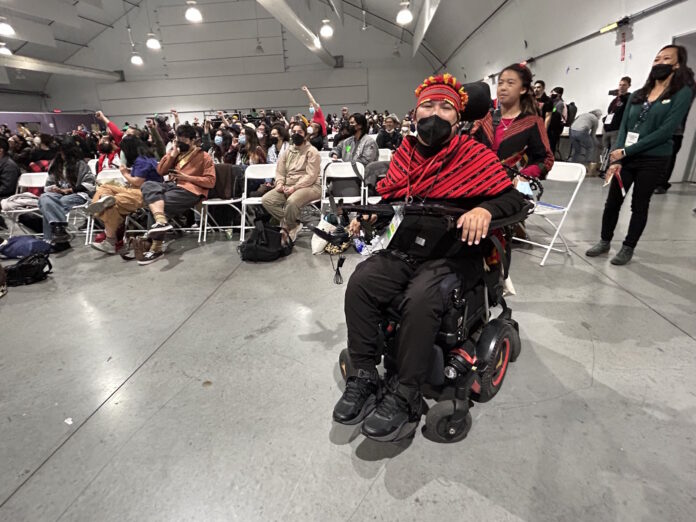
Brandon Lee and his daughter Jesse Jane at the People’s Counter Summit of the No To APEC Coalition, Nov. 11, 2023. Photo by Jia H. Jung
Jia Jung wrote on 20 November, 2023 about Chinese American Bay Area native Brandon Lee who gave the keynote speech at the No to APEC People’s Counter Summit, “People Over Profit and Plunder,” at San Francisco State University on Saturday, Nov. 11, 2023.
Lee was living with his wife and daughter in the Philippines and working as a human rights advocate, land defender, and journalist for the Northern Dispatch when he was shot by Philippine armed forces on Aug. 6, 2019. He survived – as a quadriplegic who remains steadfast in his international activism. Lee said, inter alia:
In high school, I was voted most shyest. I always preferred to work behind the scenes behind the camera, never in front. I was working security during rallies or painting posters the day before.
…In 2003, I transferred to this campus and joined the League of Filipino students at San Francisco State University. That’s where I learned that our country, the United States, continues to dominate and stagnate the Philippine economy, politics, and culture.
Around this time, I also started volunteering for the Chinese Progressive Association. That’s where I learned about the conditions and struggles of immigrant Chinese workers, and tenants. It was at that time I met Pam Tau Lee, the founder of the Chinese Progressive Association.
She was one of my mentors. And that’s where I learned that in the late nineties, San Francisco had 20,000 garment workers. But in less than 10 years, many of the immigrant monolinguistic women workers lost their jobs, with 88% of the workers being offshored to countries with weaker labor protection. It was during these years that I learned how interconnected our struggles are, and I became an internationalist and an anti-imperialist.
In 2007, I went on a life changing exposure trip to the Philippines. I met Youth and Students who are now movement leaders. I joined with workers boycotting Nestlé on their picket line. Ka Fort [Diasdado Fortuna], the chair of their union, was killed in cold blood by state agents. Ka Fort was dearly, dearly loved by the Nestlé workers for his leadership in building the union and his ultimate sacrifice.
So workers also launched a public campaign – “there’s blood in your coffee” – to draw international attention against Nestlé. Nestlé believes that water is a corporate right and not a human right. In this same trip, we visited many sectors, including the most oppressed majority and largest class – the peasants – as well as the Igorot Indigenous people in the northern part of the Philippines.
The Igorots, who live on resource-rich lands, are considered squatters on their own land because the Philippine government considers any land with a slope of 18 degrees Philippine land. The Igorots have been fighting against foreign occupation and colonization for hundreds of years.
And until now, they have continued their fight against government neglect and development aggression, militarization, and for the recognition for the right to ancestral land and self-determination.
On that exposure trip, our group also attended the one-year death anniversary of Alyce Claver, the wife of Chandu [Constancio]Claver, who was the provincial chair of the progressive party, Bayan Muna, and the president of the Red Cross. Chandu and Alyce were driving their kids to school when a motorcycle pulled up and shot at their car. Alyce shielded her husband and was riddled with two dozen bullets. Chandu made it out alive and is now in Canada with his kids after filing for political asylum, but the family today continues to be traumatized.
During this trip, we joined a medical and fact-finding mission to a remotevillage, and thankfully, the military had pulled out. The Indigenous peasants taught us about how the soldiers had blindfoldedthem and pointed a gun to their nape. The soldiers accused the farmers of supporting the land defenders and the resistance fighters known as the New People’s Army. The Philippine militarypretended to have a fake medical mission, giving out expired medicine to the local Indigenous people.
This trip, 16 years ago, changed the direction of my life.
I believe that we are shaped by our experiences, and this exposure program gave me new direction. It fortified my commitment to serving the fight for the Philippine liberation from U.S. imperialism. And to this day, the stories and sacrifices of Alyce Claver, Ka Fort, and so many others continue to fuel my commitment.
Two years later in 2009, I decided to deepen my commitment and decided to do a three-month integration in a remote area deep in the mountains. When I returned, I learned about Melissa Roxas, who was also from the U.S. and was abducted by the Armed Forces of the Philippines. She was conducting a medical mission. After a week, her captors released her as long as she promised to shut up.
She didn’t, though – she didn’t shut up. As she was she was released, she told the world what happened. As a health worker, Melissa diagnosed the Philippines’ societal problems and saw the illness of neoliberal policies from living among the poor. Melissa was brave. Her journey back from the trauma perpetuated by the Philippine military would soon follow for me.
The year following, 2010, I went all in and decided to live and serve the Igorot Indigenous people. I married my girlfriend, who is an Indigenous Ifugao, and we had a daughter, Jesse Jane, who is here with us today. I lived nine years with Indigenous people in the northern part of the Philippines, and I learned how they defended their land rights and lives in the resource-rich area known as the Cordillera region.
I saw firsthand how neoliberal policies promoted by APEC, such as the Philippine Mining Act of 1995, liberalize the mining industry, allowing foreign mining companies to reap 100% profit from the plundering of Indigenous people’s lands, unbridled large-scale destructive mining, dams, energy and other foreign projects, masquerading as development projects, and destroy the environment and forcibly displace Indigenous people who have been living there for generations.
Now, 13 years later, I’m speaking in front of you, a survivor of state violence and war that is spread by APEC and neoliberalism. They say APEC will promote sustainability. The Indigenous community say no. They are robbed of their life, land, culture, and worse, their future. Despite decades of people’s resistance, the plunder the natural resources, of indigenous – of ancestral – domains, continues. The region is blanketed with 176 large-scale mining and more than 100 energy projects, such as hydropower and geothermal projects awarded to private corporations.
One such energy project is the Chevron geothermal power project, which covers a large area in Kalinga. If left unchallenged and unopposed, all these could mean the ethnocide of the Igorots and the massive destruction of the ecosystem in the Cordillera region…
Indigenous communities were militarized, bombed, and strafed with artillery shelling, but they did not cower and they did not back down. They remained steadfast. They took care of each other. And they continued to hold the line.
They say APEC is innovative and will solve our problems. Hell, no.
Because I protested alongside the Indigenous communities, and, as a journalist, wrote about the daily attacks they face, I was also threatened and harassed. I was placed under surveillance. Tailed. Followed. They watched our office. They took pictures of us at our office and homes, as well as the tricycle, jeep, and bus terminal. I was red-tagged and politically vilified as a terrorist. I experienced death threats in the form of the burial blanket for the dead. I was detained and had my bag illegally searched at a military checkpoint the week before members of the 54th Infantry Battalion of the Philippine Army shot me in front of my daughter in front of my home on August 6th, 2018.
They had visited me at my house and office looking for me. They said they wanted to partner with my organization, the Ifugao Peasant Movement, but we refused. I told them two names – William Bugatti and Ricardo Mayumi – on why we do not want to partner with them.
While their assassination attempt against me was unsuccessful, I am permanently scarred and paralyzed. I am now quadriplegic, unable to use my hands and legs. I am considered one of the lucky ones. But I live with trauma every day. [see also: SF human rights activist fights for his life after being shot in the Philippines]
I know firsthand that the backdoor trade deals handled by APEC will not benefit the people; they only benefit the corporations and imperialist countries like the United States. That is why the United States sends its military around the world, finance schools, support fascist governments – to open up industries.
In fact, I have no doubt that the bullets lodged in my body today are paid by our taxpayer dollars.
Although I am paralyzed physically, they have failed to shut me up.
Today, I am proud to be standing with you, metaphorically speaking, in fighting back against APEC. Against state and political repression. Against corporate greed and power. Against the wealthy elite. Against the plunder of our planet. Against foreign domination of our peoples.
The Indigenous communities are resilient also. Like millions of people in the Global South, they are fighting back. They continue to protest despite being attacked. They have successfully barricaded several mines, rejecting countless mining and dam projects.
They have been on the frontlines of fighting the WTO [World Trade Organization], dismantling the Chico Dam equipment during the late dictator Marcos, which launched a coordinated people’s response that brought the Indigenous people to the national liberation struggle.
They are also on the frontlines of fighting APEC; a fight has led thousands to take up armed struggle as an appropriate response to defending their land, which is their life.
One of their martyr freedom fighter, Arnold “Ka Mando” Jaramillo, favorite expression ispayt latta! It means fight to the end, or continue to fight, and it’s today emulated by the Cordillera mass movement. Payt latta.
I will continue to fight as long as I breathe. Take a look around – my story is just one of many. There are a thousand people here today, diverse and multigenerational, coming from across the world, each with their own journey, own experiences, and reason for being here. But what unites us all is our opposition to APEC and neoliberal policies. We have so much in common – so much we can unite and rage against. A common enemy – APEC – and the neoliberal policies that prioritize profit and plunder over people and planet.
We will not go gently into that night. Rage. Rage! We will fight!
We will fight for a better future for all. Let us continue to talk, to build and work together, now and after APEC. For now, are you ready? Are you ready to shut down APEC?
Responding to the indictment of two prominent human rights defenders, Fatia Maulidiyanti and Haris Azhar, Amnesty International Indonesia’s Executive Director Usman Hamid said on 13 November 2023:
“This disgraceful indictment will have a destructive effect on the work of human rights defenders in Indonesia. Instead of protecting the right to freedom of expression, the Indonesian authorities are obliterating civic space. These alarming indictments illustrate the increasing oppression faced by activists who express dissenting opinions. We urge the Indonesian authorities to immediately release Fatia Maulidiyanti and Haris Azhar. The right to freedom of expression must be respected and guaranteed.” See also: https://humanrightsdefenders.blog/2021/10/15/indonesia-human-rights-defenders-under-pressure/
The prosecutor demanded that Fatia should be imprisoned for three years and six months, and Haris for four years. They were deemed guilty after being sued by the Coordinating Minister for Maritime Affairs and Investment, Luhut Binsar Pandjaitan. The minister filed a defamation case against Fatia and Haris in September 2021. Both were charged by the police on 17 March 2022 with defamation under Article 27 section (3) of the Electronic Information and Transactions (EIT) Law. Amnesty International Indonesia has voiced concerns related to problematic provisions in Indonesian EIT Law, including this provision.
The police investigation relates to a YouTube video of a conversation between the two human rights defenders where they discussed the findings of a report on the alleged involvement of several military figures in the mining industry.
Amnesty International Indonesia has recorded that at least 1,021 human rights defenders were prosecuted, arrested, attacked and intimidated by various actors from January 2019 to December 2022. Meanwhile, there are at least 332 people that have been charged under the EIT Law, most of them accused of defamation, between January 2019 and May 2022.



 Hans Thoolen on Human Rights Defenders and their awards