The Index ranks 180 countries and regions according to the level of freedom available to journalists. It is a snapshot of the media freedom situation based on an evaluation of pluralism, independence of the media, quality of legislative framework and safety of journalists in each country and region. (It does not rank public policies even if governments obviously have a major impact on their country’s ranking. Nor is it an indicator of the quality of journalism in each country or region.)
Along with the Index, RSF calculates a global indicator and regional indicators that evaluate the overall performance of countries and regions (in the world and in each region) as regards media freedom. It is an absolute measure that complements the Index’s comparative rankings. The global indicator is the average of the regional indicators, each of which is obtained by averaging the scores of all the countries in the region, weighted according to their population as given by the World Bank.
The degree of freedom available to journalists in 180 countries and regions is determined by pooling the responses of experts to a questionnaire devised by RSF. This qualitative analysis is combined with quantitative data on abuses and acts of violence against journalists during the period evaluated. The criteria used in the questionnaire are pluralism, media independence, media environment and self-censorship, legislative framework, transparency, and the quality of the infrastructure that supports the production of news and information. Click here for more information
The press freedom map, which is distributed in print and digital versions, offers a visual overview of the situation in each country and region in the Index. The colour categories are assigned as follows: good (white), fairly good (yellow), problematic (orange), bad (red) and very bad (black).
On Wednesday 24 January 2018, Dunja Mijatovic (Bosnia and Herzegovina) was today elected as the Council of Europe Commissioner for Human Rights by the Parliamentary Assembly (PACE) in Strasbourg. Ms Mijatovic was elected for a non-renewable term of six years starting on 1 April 2018.
She obtained 107 of the votes cast in the second round, a relative majority. Pierre-Yves Le Borgn’ (France) obtained 103 votes and Goran Klemencic (Slovenia) obtained 19 votes. Mijatovic will replace Nils Muiznieks, who has held the post since 2012.
From 2010 to 2017, Dunja Mijatovic was the OSCE Representative on Freedom of the Media. Previously, she served as Director of Broadcasting at the Communications Regulatory Agency of Bosnia and Herzegovina (CRA). She was also the Chairperson of the European Platform of Media Regulatory Authorities (EPRA) and she chaired the Council of Europe’s Group of Specialists on freedom of expression and information in times of crisis.
Mijatović was awarded the Médaille Charlemagne in 2015. Since 2000 the Médaille Charlemagne is awarded to a European personality who has made an outstanding contribution to the process of European integration and the development of a European identity. She is also the recipient of the City of Geneva PEC AWARD 2015 for her work on the issue of the safety of journalists and media freedom in Ukraine during the crisis and her “exceptional personal commitment for the promotion of freedom of information in the whole region.”
The International Peace Center in Sarajevo awarded her the “FREEDOM” prize in 2010 for her work and activities on the struggle for freedom, peace and development in Bosnia and Herzegovina, Europe and the world.
The Hong Kong Free Press (HKFP) of 12 November 2016 carried a fascinating report on the work of the Chinese “64 Tianwang citizen news site” which has continued to operate despite the continued arrest and detention of its reporters. Reporters Without Borders (RSF) awarded ’64 Tianwang’ its Press Freedom Prize 2016. The piece by Catherine Lai is richly illustrated by pictures. Tianwang founder Huang Qi throughout the interview remains remarkably optimistic about freedom of expression in China in the long-term.
An academic and two journalists who play a key role in Turkey’s human rights movement have been jailed pending investigation into spurious allegations of spreading terrorist propaganda. Human Rights Watch, Reporters without Boarder, Front Line, and the Observatory for the Protection of Human Rights Defenders (a joint program of FIDH and OMCT), among others, have raised serious concern and demanded their immediate release.
An Istanbul court on 20 June, 2016, accepted a prosecutor’s request for them to be placed in pretrial detention on suspicion of having committed terrorist offenses. They are Erol Önderoglu, who is the Turkey representative of Reporters Without Borders and a journalist with the independent news website Bianet; Professor Şebnem Korur Fincancı, an academic at Istanbul University’s forensic medicine department and head of the Human Rights Foundation of Turkey; and Ahmet Nesin, a writer and journalist.
“The decision to demand the detention of Önderoğlu, Fincancı, and Nesin is a shocking new indication that the Turkish authorities have no hesitation about targeting well-known rights defenders and journalists who have played a key role in documenting the sharp deterioration in human rights in the country,” said Hugh Williamson, HRW’s Europe and Central Asia Director. “
The three were among 44 journalists, writers, and activists who participated in a solidarity campaign for media freedom in which each of them acted as a symbolic co-editor-for-a-day at the pro-Kurdish daily Özgür Gündem in Istanbul. The government sees the newspaper as hostile to it and as a result has placed it under immense pressure.
“Jailing a world-renowned journalist and human rights defender such as Erol sends a very powerful signal of intimidation to the entire profession in Turkey. It’s a new, unbelievable low for press freedom in Turkey,”Johann Bihr, head of the Eastern Europe and Central Asia desk at RSF, told CPJ. At least 14 journalists were imprisoned in Turkey on December 1, 2015, when CPJ last conducted its annual census of journalists jailed around the world. [see also: https://thoolen.wordpress.com/2016/03/20/turkey-fair-trial-human-rights-lawyers-expression-l4l/]
While the NGO reactions are expected, more remarkable is the reaction from Russia which (in the good company of the USA, the UN and the EU) has condemned the crackdown on Turkey’s press freedom: Read the rest of this entry »
The winner of the 2015 UNESCO/Guillermo Cano World Press Freedom Prize is the Syrian journalist and human rights defender, Mazen Darwish, currently imprisoned. The Prize will be awarded during the celebration of World Press Freedom Day, 3 May, which will this year be hosted by Latvia (National Library, Riga, 6 p.m.).
An independent International Jury of media professionals recommended Mazen Darwish in recognition of the work that he has carried out in Syria for more than ten years at great personal sacrifice, enduring a travel ban, harassment, as well as repeated detention and torture. Darwish, a lawyer and press freedom advocate, is the president of the Syrian Centre for Media and Freedom of Expression (CMFE), founded in 2004, and one of the founders of the Voice newspaper and syriaview.net, an independent news site, which has been banned by the Syrian authorities. In 2011, Darwish established Media Club, the first Syrian magazine about media affairs.
He has been detained since February 2012, when he was arrested with colleagues Hani Al-Zitani and Hussein Ghareer. Mazen won earlier awards from Roland Berger (2011), Reporters without Borders (2012) and Bruno Kreisky (2013).
The $25,000 Prize is named in honour of Guillermo Cano Isaza, a Colombian journalist who was assassinated in front of the offices of his newspaper, El Espectador, in Bogotá, on 17 December 1986. It is funded by the Cano Foundation (Colombia) and the Helsingin Sanomat Foundation (Finland).
Simon Delaney, a media lawyer and advisor to the Decriminalisation of Expression Campaign, in The Guardian of 4 February reports on an important judgement by the African Court on Human and Peoples’ Rights on press freedom by ruling that criminal defamation laws cannot include custodial sentences or sanctions that are disproportionate, such as excessive fines.
[In 2012, Lohé Issa Konaté, the editor of a weekly newspaper in Burkina Faso, was found guilty of criminal defamation and sentenced to 12 months in prison after he published two articles accusing a public prosecutor of abusing his power. Konaté‘s paper was shut down for six months and he was ordered to pay an exorbitant fine, plus compensation and costs. Konaté argued that he was wrongfully punished for legitimate investigative journalism and his rights to freedom of expression were violated. A coalition of 18 media and human rights organisations added that criminal defamation laws undermine the democratic rights of the media and citizens to hold their governments to account. The court found that, although the Burkinabé law served the legitimate objective to protect the honour and reputation of public officials, the penalty of imprisonment was a disproportionate interference in the exercise of freedom of expression by Konaté and journalists in general. The court ordered Burkina Faso to change its criminal defamation laws and pay compensation to Konaté.]
The judgment is significant not so much because of the content of the decision (which is in line with international standards] but because it is homegrown ‘African’ decision.
The judgment, which is binding on African Union member states, gives impetus to the continent-wide campaign to decriminalise defamation. It also paves the way for the decriminalisation of ubiquitous laws prohibiting “the publication of matter with intent to bring the president into hatred, ridicule or contempt” and “the publication of false news with intent to cause fear and alarm to the public”.
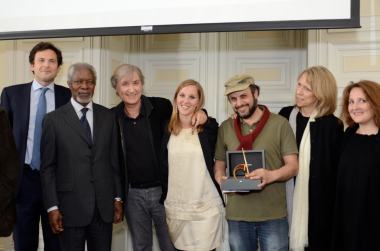
3 May 2014 Cartooning for Peace award, Geneva (c) THF
In case you noticed, my post of yesterday about the Cartooning for Peace Award came a day late; sorry. The award ceremony took place on Saturday 3 May, International Day for Press Freedom. To make up for the error here are the winners (Palestinian-Syrian Hani Abbasi, and Egyptian Doaa Eladl), in company of inter alia Kofi Annan and municipal councillor Guillaume Barazzone. The exhibit remains to be visited along the Quai Wilson in Geneva until 3 July 2014. Also present were the well-known cartoonists Chappatte, Plantu et Liza Donnelly. More information and links in my post of yesterday:
The Committee to Protect Journalists [CPJ] has published its Risk List, indicating where press freedom is in decline. In determining the list, CPJ staff examined six press freedom indicators: fatalities, imprisonments, restrictive legislation, state censorship, impunity in anti-press attacks, and journalists driven into exile. Countries named to the Risk List are not necessarily the world’s worst places for journalists; such a list would include nations like North Korea and Eritrea, where free expression has long been suffocated. Instead, the Risk List identifies the 10 places where CPJ documented the most significant downward trends during 2012. Those trends included:
High murder rates and entrenched impunity in Pakistan, Somalia, and Brazil.
The use of restrictive laws to silence dissent in Ecuador, Turkey, and Russia.
The imprisonment of large numbers of journalists, typically on anti-state charges, to thwart critical reporting in Ethiopia, Turkey, Vietnam, Iran, and Syria.
An exceedingly high fatality rate in Syria, where journalists faced multiple risks from all sides in the conflict.
CPJ, which is publishing its Risk List for the first time, identified Syria and Somalia, which are racked by conflict, along with Iran, Vietnam, and Ethiopia, nations that are ruled with an authoritarian grip. But half of the nations on the Risk List– Brazil, Turkey, Pakistan, and Russia, along with Ecuador–practice some form of democracy and exert significant influence on a regional or international stage.
Threats to press freedom were not confined within the borders of these nations. Four Risk List countries sought to undermine international or regional press freedom initiatives during the year. Russia pushed for centralized control of the Internet ahead of the World Conference on International Telecommunications. Ecuador led an effort, supported by Brazil, to weaken the ability of the Inter-American Commission on Human Rights to intervene in cases of systemic or grave press freedom abuses. Brazil and Pakistan were among a handful of countries that tried to derail a U.N. plan to improve journalist security and combat impunity worldwide.
Setbacks in Brazil are particularly alarming given its status as a regional leader and home to a diverse array of news media. But a spike in journalist murders, a failure to address impunity, and a pattern of judicial censorship have put Brazil’s press freedom at risk, CPJ found. Turkey, too, has projected an image as a regional model for freedom and democracy. But while Prime Minister Recep Tayyip Erdoğan has expressed a commitment to press freedom, his administration has wielded an anti-terror law as a club to jail and intimidate journalists.
Less surprising, but no less worrisome are setbacks in Vietnam, Ethiopia, and Iran. Though Ethiopia and Vietnam have been applauded for economic strides, both countries have lagged in terms of openness and freedom of the press. Conditions worsened in 2012, as Ethiopian and Vietnamese authorities ramped up efforts to stifle dissent by imprisoning journalists on anti-state charges. Iran, ignoring international criticism of its press record, has intensified an assault on critical voices that began after the disputed 2009 presidential election.
In Syria and Somalia, where journalists faced risks from multiple sides, the death tolls have mounted. Crossfire was the leading cause of death for journalists in Syria, although at least three journalists were assassinated, CPJ research shows. Both rebels and forces loyal to President Bashar al-Assad have been implicated in acts of violence against the press. All 12 journalists killed in Somalia in 2012, the country’s bloodiest year for the press, were targeted in direct reprisal for their reporting. Both insurgents and government officials were suspected of involvement. In both countries, the ranks of young journalists, many with little training and experience, have been particularly hard hit.
In the full report below you can find capsule reports on the 10 nations named to the CPJ Risk List:
The misuse of of human rights awards is also noteworthy as seen in the post by Miriam Berger of Buzzfeed who reports on 26 November that Azerbaijan’s authoritarian president has been awarded a “Friend of Journalists” prize by local media. President Ilham Aliyev received the award — his second — in an elaborate ceremony on November 24. The survey was conducted by the Azerbaijani [!] Committee for Protection of Journalists, as well as other media representatives. He won 89% of the votes. At the acceptance ceremony, Aliyev spoke of his democratic reforms in the country. “Azerbaijan has a free media,” he said. …That few inside Azerbaijan objected may be linked to the fact that many journalists and human rights defenders are in detention or harassed into silence. Read the rest of this entry »


 Hans Thoolen on Human Rights Defenders and their awards