Posts Tagged ‘Nigeria’
July 7, 2016
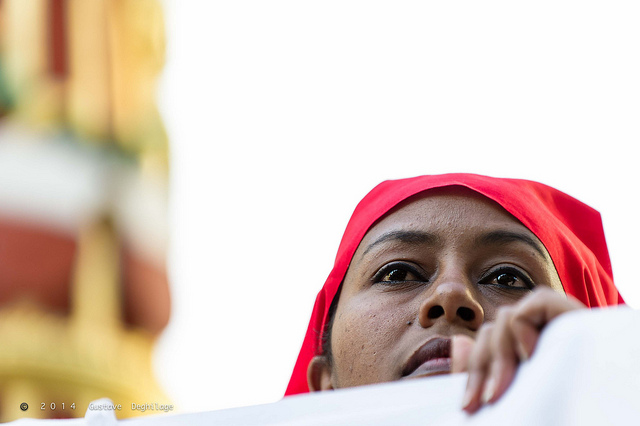
On 20 June 2016 the ISHR Monitor contained the following portrait of Ms Bose Agbonmerele Iro-Nsi, the founder and team leader of the Women’s Rights and Health Project (WRAHP) in Nigeria. WRAHP is an NGO that works to promote community and women’s rights, reproductive health and children’s development.

Ms Bose Agbonmerele of the Women’s Rights and Health Project (WRAHP) in Nigeria.
As an advocate, Bose focuses on access to justice for women suffering domestic violence, child abuse, and cultural practises that are detrimental to health and contravene fundamental rights of both women and children – an example includes female genital mutilation. Bose seeks to create awareness of existing laws that address domestic violence, and educates vulnerable communities on their rights contained in those laws.
‘WRAHP previously received between 2 and 4 cases of women who had suffered domestic violence each month. Since engaging with the media and speaking publically on the common violation of women and children’s rights, WRAHP now receives about 5 cases and large numbers of calls every day from women in distress.’
Challenges and risks
Cultural norms and practise endorse a system of patriarchy in Nigeria. This means that raising children in an environment rife with domestic violence perpetuates a vicious cycle. Bose highlights the importance of focusing on building awareness within the family, as well within religious institutions and churches – which can then create further awareness about Gender based violence.
‘Gender based violence constitutes a further challenge. Domestic violence is often viewed as a personal domestic dispute, which results in law enforcement agencies turning a blind eye. This further drives a system of impunity among the community. Moreover, the stigma associated with calling the police on your own family member and the lack of independence of women puts them at risk of destitution.’
Bose also identified gaps and loopholes in Nigerian laws and policies that need strengthening. She identified 2 major limitations in the Violence Against Persons Prohibition Act, which addresses, among other violations, female genital mutilation and acid attacks. This law is restricted to the capital of Nigeria and often imposes fines for offences that should result in more significant penalties.
Some community elders have claimed that WRAHP’s work is intrusive to their culture and traditions. As a result Bose has suffered intimidation. However, she has maintained a holistic approach to raising awareness, including amongst men who might oppose her views.
Engagement with the international community
Bose explained that her experience in Geneva at ISHR Human Rights Defender Advocacy Programme (HRDAP) has broadened her knowledge of UN mechanisms and her perspective about civil society engagement. Going forward Bose intends to incorporate the international networks she has made in Geneva into her existing regional networks. She also intends to engage with Special Procedures mandate holders to increase awareness about the human rights situation in Nigeria.
‘One of the positive aspects of my experience at HRDAP was the opportunity to share experiences with other participants. I learnt about the diverse issues which other human rights advocates face. The organisation of the programme and activities have been great.’
The change Bose would like to see
Through her brief experience at the UN, Bose has noticed the use of the phrase “intimate partner violence”. She believes the use of this phrase in addressing domestic violence overlooks other serious aspects of domestic violence. This term focuses only on partners, disregarding child abuse, parental abuse of children, and violence at the hands of extended family. Bose would like to see a more robust policy addressing all aspects of domestic violence.
Goals and objectives
Bose believes that it is crucial to understand successful strategies used by defenders working on other issues and defenders in different regions. Bose is grateful to have had the opportunity to interact with defenders working on different thematic groups, including LGBTI and business Human Rights issues. She believes that all activists share the same common goal and working together and learning from each other will help to improve advocacy success rates. Bose would like to continue engaging foreign missions to bolster her national advocacy.
In the long run, Bose would like to see herself as a regional and international advocate sharing her experiences on an international platform. She was impressed with the participation of young people in HRDAP and says she would like to encourage other young people to participate in advocacy training sessions in Nigeria.
‘I just can’t recommend HRDAP enough to other people.’
Source: Defender profile: Bose Agbonmerele Iro-Nsi, woman human rights defender from Nigeria | ISHR
Posted in Al-Hassani, human rights, Human Rights Defenders, ISHR | Leave a Comment »
Tags: Bose Agbonmerele Iro-Nsi, FGM, Gender Based Violence, Geneva, Human Rights Defender Advocacy Programme (HRDAP), human rights of women, ISHR, Nigeria, profiles, woman human rights defender, Women’s Rights and Health Project (WRAHP)
May 27, 2016
Attacks on higher education threaten the safety and well-being of scholars, administrators, staff and students; undermine academic work and instruction; and deny everyone the benefits of expert knowledge and scientific and creative progress. Too often such attacks go unreported. Scholars at Risk (SAR) publishes an Academic Freedom Monitor which tracks key attacks with the aims of protecting vulnerable individuals, promoting accountability and preventing future violations. In the period February – April 2016 SAR reports 20 incidents:
Read the rest of this entry »
Posted in Human Rights Defenders | Leave a Comment »
Tags: Academic freedom, anniversary, Bangladesh, Canada, Human Rights Defenders, human rights monitoring, India, Kuwait, Malaysia, meeting, Montreal, Nigeria, repression, Scholars at Risk, Sudan, Swaziland, Turkey, Venezuela
December 13, 2015
International human rights day is an occasion for a multitude of local activities, some denouncing violations others quietly remembering, some (trying to) march in the streets, others issuing statements. This anthology of 10 such events is far from complete but gives an idea of the variety, from human rights defenders speaking out to governmental institutions ‘celebrating’ …. Read the rest of this entry »
Posted in awards, human rights, Human Rights Defenders | Leave a Comment »
Tags: 10 December, Al Wefaq National Islamic Society, Bahrain, Cambodia, China, Cuba, Gani Fawehinmi, Georgia, Hada, India, international human rights day, Myanmar, national award, National Human Rights Commission, Nigeria, North Korea, Radio Free Asia, Rehana Sultana, Sierra Leone, Sri Lanka, University of Texas, USA, Zimbabwe
July 2, 2015
Catherine Russell, the U.S. Ambassador-at-Large for Global Women’s Issues, wrote in the Huffington Post of 1 July 2015 a piece which highlights 8 stories about women taken from the
State Department’s annual human rights reports, that she says would not reach the evening news but are a must. Here is her selection:

In Nepal, a mother may be denied the ability to confer her Nepali citizenship to her children if the father’s identity is unknown or he is not Nepali. This is not uncommon: 27 countries discriminate against women in their ability to pass citizenship on to their children. Too often this results in a child who is stateless, meaning he or she may not be able to access basic services like health care and education.
In Afghanistan, a survey found that 39 percent of Afghan women between the ages of 20 and 24 were married before the age of 18 — making them part of a global trend where one in three girls in the developing world is married as a child — and Afghan women who marry later in life often don’t have a choice in their marriage. These stories and statistics exist despite laws against early and forced marriage.
A story in the Nigerian report highlights the case of a college student who reported that a soldier lured her to a police station and raped her repeatedly. The soldier was reportedly “disciplined” for leaving his post, but as of December nothing else had happened.
In Burma, there is an effort underway to enact legislation that would mandate that women can’t have children more than once every three years. There are obvious questions as to how such a law would be enforced. Many are concerned that it would only be enforced in areas where many members of minority groups live.
Fortunately, the news is not all bad.
In Afghanistan, the national electoral commission’s gender unit focused on women’s political participation in the 2014 election, and increased the number of women who helped determine their country’s future.
In Brazil, the federal government operates a toll-free nationwide hotline for women to report intimate partner violence, while in India, a partnership between state government and civil society led to the launch of a crisis center for survivors of rape, dowry harassment, and domestic violence.
Another partnership — between government and civil society in Guinea — is helping to educate Guinean health workers on the dangers of female genital mutilation. The report says that more than 60 health facilities have integrated FGM/C prevention into their services thanks to this effort.
You can follow Catherine Russell on Twitter: www.twitter.com/AmbCathyRussell
8 Must-Read Stories From the Human Rights Reports | Catherine Russell.
Posted in human rights, Human Rights Defenders | Leave a Comment »
Tags: Afghanistan, Brazil, Burma, Catherine Russell, Civil society, Guinea, Huffington Post, human rights of women, India, Nepal, Nigeria, U.S. Ambassador-at-Large for Global Women’s Issues
December 19, 2014
On 19 December 2014, Naomi Sharang wrote a long piece in the Nigerian Observer (News agency of Nigeria – NAN). After a short general introduction, the author zooms in on the Nigerian situation and the role of human rights defenders, interviewing a NGO representative as well as someone from the Nigerian Human Rights Commission (NHRC). Here follow the main excerpts: Read the rest of this entry »
Posted in human rights, Human Rights Defenders | Leave a Comment »
Tags: access to justice, Advocacy, Aver Gavar, compensation, Emmanuel Onwubiko, Human Rights Defenders, Human Rights Writers Association of Nigeria (HURIWA), internally displaced, Naomi Sharang, National Human Rights Commission, News agency of Nigeria, Nigeria, rape, rights of women, terrorism
June 11, 2014
Defenders of the environment often face terrible consequences for their actions, suffering rights violations and violence, according to a new report by Friends of the Earth International to be released on June 26, during the 26th Session of the U.N. Human Rights Council . “A new case of violence against environmental rights defenders and violations of their rights is reported to us on average once a week, and this is just the tip of the iceberg,” said Lucia Ortiz, of Friends of the Earth International. “Environmental defenders who uphold the right of communities to determine their own development path in opposition to corporate-driven mega projects are subject to many types of human rights abuses, often committed by corporations or on their behalf”.
Friends of the Earth International recorded more than 100 incidents of violence against environmental rights defenders and violations of their rights in 27 countries around the world in the period November 2011 – October 2013. More than half of the killings recorded were targeted assassinations of peasant leaders and deaths of peasants during violent confrontations regarding land disputes, often involving the protection of peasant territories from polluting development projects such as hydroelectric dams, monoculture plantations or the extraction of oil, gas and minerals.
The new report calls on the UN Human Rights Council to create an international treaty to address corporate human rights violations. [On may 7, 2014, a global alliance of civil society organizations known as the Treaty Alliance representing more than 500 groups called on UN Human Rights Council members to support an initiative in June that would begin a process towards creating an international legally binding treaty to address corporate human rights violations. For more information read: www.foei.org/news/groups-call-for-un-treaty-to-tackle-corporate-human-rights-violations/ – A regulatory and enforcement framework that is legally binding for corporations has been proposed at the Council by a group of 84 nations since September 2013]
The following environmental defenders will be in Geneva on June 23-27:
1) Micaela Antonio Gonzalez from Guatemala and Victor Barro from Friends of the Earth Spain will expose the human rights violations by the Spanish company Hidralia in Guatemala.
2) Abeer Al Butmah from Friends of the Earth Palestine will expose the human rights violations by Israeli water company Mekorot in Palestine.
3) Godwin Ojo from Friends of the Earth Nigeria and Paul de Clerck from Friends of the Earth Europe will expose the human rights violations by Royal Dutch Shell in the Niger Delta.
4) Alberto Villarreal will expose the violations of the human right to health posed by the Philip Morris International challenge to the tobacco control legislation in Uruguay.
Friends of the Earth International is critical of ‘voluntary mechanisms’ such as the Global Compact and Ruggie’s UN Guiding Principles on Business and Human Rights and believes they have not reduced attacks on human rights defenders and are thus insufficient to protect human rights.
The report ‘We defend the environment, we defend human rights‘ is available at www.foei.org/resources/publications/publications-by-subject/human-rights-defenders-publications/we-defend-the-environment-we-defend-human-rights/
For some of my earlier posts on environmental issues and human rights defenders see: https://thoolen.wordpress.com/tag/environmental-issues/
Posted in human rights, Human Rights Council, Human Rights Defenders | 1 Comment »
Tags: binding international law, campesinos, corporate accountability, Environmental issue, Friends of the Earth, Guatemala, Human Rights Defenders, human rights violations, indigenous groups, legal protection, Nigeria, Palestine, resource extraction, treaty, UN Human Rights Council, Uruguay
May 18, 2014
In a 28-page report, Under Attack: Violence against health workers, patients and facilities, Human Rights Watch and the Coalition “Safeguarding Health in Conflict” highlight recent attacks in countries around the world. Major examples include the targeted killing of more than 70 polio vaccination workers in Pakistan and Nigeria; the arrests of health workers for providing care to protesters in Bahrain and Turkey; the bombing of hospitals and deaths of hundreds of patients and health workers in Syria; and attacks targeting health workers in South Sudan and Afghanistan. The report is released in advance of a meeting from 19-24 May 2014, of health ministers from around the world.
Posted in books, HRW, Human Rights Defenders | Leave a Comment »
Tags: Afghanistan, Bahrain, conflict, HRW, Human Rights Defenders, humanitarian workers, Nigeria, Pakistan, patients and facilities, polio vaccination, right to health, Safeguarding Health in Conflict Coalition, South Sudan, Syria, Turkey, UN, Under Attack: Violence against health workers, war
March 15, 2014
“Voices of LGBTI Human Rights Defenders” on 19 March, from 10h00 – 12h00 in Room XXIV of the Palais des Nations in Geneva. Human Rights Defenders from Nigeria and Malaysia will be among those presenting.
Contact: adam.hennings[at]graduateinstitute.ch
Posted in human rights, Human Rights Defenders | Leave a Comment »
Tags: Geneva, Human Rights Defenders, ILGA, LGBT rights, LGBTI, LGBTI Human Rights Defenders, Malaysia, Nigeria, side event, UN Human Rights Council
January 19, 2014
The most recent report by the UN Rapporteur on Human Rights Defenders, Margaret Sekaggya, has been made public and will be officially presented to the Human Rights Council in March 2014. It is the last report by this Rapporteur whose mandate will terminate. The report finds that human rights defenders – especially journalists, lawyers, trade unionists and those who work to promote women’s rights and the rights of gay, lesbian, bisexual and transgender persons – face ‘extraordinary risks’. It highlights cases of defamation, attacks, detention, torture and even killings. The report also documents an increased incidence of violations against people and communities opposed to mining, construction and development projects, with protesters attacked both by State and private security forces. ‘Human rights defenders play a crucial role in exposing and seeking accountability for violations by both governments and corporations. Their work is crucial to transparency, good governance and justice for victims,’ commented Phil Lynch of the International Service for Human Rights in Geneva.
The report also documents the worsening ‘use of legislation in a number of countries to refrain the activities of human rights defenders and to criminalise them’, with cited examples including laws to ‘curb the promotion of homosexuality’ and to restrict NGO access to foreign funds. ‘In the last four weeks alone, Nigeria, Russia, Uganda, Malaysia and the Ukraine have enacted or applied laws to criminalise human rights defenders and to silence their critical voice,’ Mr Lynch added.
In addition to documenting violations, the report makes a wide range of recommendations to ensure that human rights defenders are protected and can operate in a ‘safe and enabling environment’.
For those too busy to read the whole new UN report [PDF] here are the
V. Conclusions and recommendations: Read the rest of this entry »
Posted in books, human rights, Human Rights Defenders, ISHR, UN | Leave a Comment »
Tags: Civil society, corporate accountability, criminalization, development projects, enabling environment, environmental issues, foreign funding, freedom of association, freedom of expression, funding restrictions, Human Rights Council, Human Rights Defenders, International Service for Human Rights, ISHR, journalists, land rights, lawyers, LGBTI, local communities, Malaysia, Margaret Sekaggya, Nigeria, Phil Lynch, Russia, Special Rapporteur on the situation of human rights defenders, trade unionists, Uganda, Ukraine, UN Special Rapporteur, women human rights defenders
December 2, 2013

“Write for Rights” is one of Amnesty International’s major global campaigns. AI is capable of getting its own outreach and does not need my blog but I want to refer to it anyway as it is such a quintessential human rights action model. Read the rest of this entry »
Posted in AI, Amnesty international, human rights, Human Rights Defenders | 1 Comment »
Tags: 10 December, Advocacy Organizations, AI, Amnesty, Amnesty International, Bahrain, Belarus, Burma, Cambodia, Eskinder Nega, Ethiopia, Honduras, human rights, Human Rights and Liberties, Human Rights Defenders, international human rights day, Mexico, Myanmar, Nabi Saleh village, Nigeria, Palestine, Poland, Qatar, Russia, Tunisia, Turkey, urgent action, Yorm Bopha