Posts Tagged ‘minorities’

Young Syrian human rights defenders working for truth and justice express cautious hope

May 26, 2025

“Removing a dictator is not enough; real change requires a shift in governance, security, justice.”

Syrians gather in celebration days after the fall of Bashar Assad’s government at Umayyad Square in Damascus on Dec. 12, 2024. | Leo Correa/AP

On 19 May 2025 Bassam Alahmad, Noah Abbas, and Simav Hasan wrote in Global Citizen an interesting piece on how Syrian human rights defenders feel about the changes in their country:

In a previously published Global Citizen In My Own Words article, human rights defender Bassam Alahmad detailed his experiences of being a stateless citizen residing in Syria who stands for justice. In this article, following the fall of Al-Assad, Bassam Alahmad is joined by colleagues from Syrians For Truth and Justice, Simav Hasan, and Noah Abbas, as they share their reflections on what the regime change in the country means for them personally and for their hopes for a democratic Syria.

How would you describe your relationship with Syria and how has the decades-long conflict impacted you?

Bassam Alahmad: I think ‘complicated’ or ‘complex’ is the best way to describe my relationship with Syria. Being born stateless means having no rights, but we love our country because we were born there. We know the people and communities and we belong to the land but I didn’t feel as though I belonged politically. I didn’t feel as though I had full citizenship in the country. I like my country but unfortunately, the way in which the Kurdish people were treated for decades made it so we didn’t feel like we were equal parts of this country.  

Noah Abbas: As a Kurdish Syrian national, the long-standing conflict in Syria has profoundly influenced both my personal and professional life. It has not only shaped my views on war and peace, but has also deepened my understanding of resilience and the value of community. Witnessing the enduring struggles of friends, family, and the broader Syrian community has motivated me to advocate for humanitarian causes and pursue solutions that aim to bring lasting peace to the region. The impact of this conflict extends into my academic pursuits as well; I am currently engaged in postgraduate studies in military intelligence and security.

This academic path was chosen with a clear purpose: to shift the perspective on the role of intelligence in Syria. Under Al-Assad’s governance, intelligence agencies were often viewed as instruments of fear, particularly against opponents of the regime. As a human rights activist, I believe it is our duty to transform this perception and demonstrate how intelligence can serve as a cornerstone for justice and societal safety. Joining the efforts of Syrians for Truth and Justice has been crucial in my journey.

Simav Hasan: I am a Kurd from Qamishli, and so my existence here has always been shaped by layers of oppression, resistance, and hope. The decades-long conflict has left scars on my community and on me personally. I’ve witnessed forced displacement, the suffering of victims, and the destruction of lives and history. But more than that, I’ve felt the weight of injustice firsthand — whether through the fight for accountability, the struggle for basic rights, or the ongoing humanitarian crises. Despite everything, I refuse to detach myself from this reality. My work as a journalist and human rights activist is my way of pushing back against the violence, ensuring that the voices of the victims are heard, and trying to carve out a future where justice isn’t just a distant dream. The war has taken much, but it has also strengthened my resolve. Even in the darkest moments, I believe in the power of truth, memory, and resistance.

………

In 2024 the Al-Assad government fell, how did this make you feel? 

Alahmad: To be honest, while part of me is very happy that there is no longer the Assad regime, part of me also thinks that there is a big obstacle in the road to democracy, open civic society, and citizenship. As people working in human rights we must not be naive because we know the history and we know that there are human rights violations committed. The main issue is there is a huge gap betweenwhat they say to the west — to the EU, to the US, to the UN — and what they ultimately decide. For example, the national dialogue was kind of a missed opportunity, where instead of having a good version of national dialogue in Damascus and to be more inclusive, they excluded a huge part of Syria, including Kurds and other minorities.

It was a missed opportunity. The same is true with the constitutional declaration adopted in March 2025. They didn’t recognize the Kurdish people or the Kurdish language. They did not recognize diversity. Most of the authority was in the hands of the president. Our main problem is that Syria without the Assad regime is good, but there is no guarantee that we are going towards democracy. The recent Human Rights Watch report on the constitutional declaration clearly states that this constitutional declaration is not a road to a democratic country. This should be very clear for our partners in the US, the EU, and the international community. The most serious thing that happened in the coastal area in Latakia and Tartus is that hundreds of Alawite people were killed based on their identity, because they are from this minority group. A lot of violations happened by the groups linked to the government. 

Abbas: The fall of the Al-Assad government, as welcomed by human rights organizations, provoked a complex mix of emotions within me. On one hand, I felt a profound sense of relief and happiness that the brutal regime, known for its relentless human rights violations and oppressive rule, had come to an end. The release of prisoners of conscience and the acknowledgment of the sacrifices made by countless human rights defenders brought a wave of hope for a future where justice and accountability could finally be addressed. However, as a Kurdish-Syrian national, this transition also brought with it significant fears and concerns. The potential for ethnic conflicts or even ethnic cleansing within the new power structures (such as the factions that committed violations in Efrin city, my home town, and other Kurdish cities across the country) was alarming, especially given the historical challenges faced by Kurdish communities in asserting their rights and safety within Syria.

Despite these fears, the fall of the regime marked a critical moment for Syria — an opportunity to rebuild and redefine the nation on the principles of freedom, justice, and human dignity. It was a moment to champion the efforts of Syrians for Truth and Justice and engage more actively in the civil society space dedicated to transitional justice and documenting human rights violations. 

Hasan: With the fall of the Assad government, I felt a sense of cautious optimism. It marked the end of a regime responsible for decades of repression, war crimes, and mass atrocities — a moment many victims and survivors had long awaited. There was hope that this could be the beginning of rebuilding Syria on principles of justice, accountability, and human rights. However, I remained wary. The fall of a regime does not automatically guarantee freedom or stability. Power vacuums in Syria have often led to new forms of repression and external interference. Many armed actors still operate with impunity, and the path to true justice remains uncertain. While this moment was significant, real change depended on what came next. Would justice be pursued? Would the voices of victims and marginalized communities — especially Kurds and other oppressed groups — be heard? The fall of Assad was a turning point, but Syria’s future was still being written.

https://www.globalcitizen.org/en/content/syria-justice-human-rights-after-al-assad/

International Art Contest celebrates minority human rights defenders

December 1, 2024

27 November 2024, from UN Human Rights:

Mga Nalimutan [The Forgotten], inspired by a photography taken by Joe Galvez New York City, United States, 2017.

© Francis Estrada

The top awards for the 2024 International Contest for Minority Artists were presented to five award winners — Bianca Broxton, Joel Pérez Hernández, Francis Estrada, Laowu Kuang and youth laureate Jayatu Chakma — during a special ceremony in Geneva, Switzerland.

UN Human Rights partnered with civil society organizations, Freemuse, Minority Rights Group International, the City of Geneva, the Centre des Arts of the International School of Geneva, and with the support of the Loterie Romande. The theme, Memory in the Present, celebrates the creativity and cultural expression of minority artists whose artwork explores themes relating to memory and memorialization around the globe.

“Naturally, such collective identities will largely be grounded in a collective memory of events, generating or perpetuating values or traditions that shape the way persons belonging to a minority feel bound together by common experiences,” said Nicolas Levrat, United Nations Special Rapporteur on Minority Issues. “Such memories often define how and why these past experiences shared by persons belonging to a given minority (or by previous generations) make them singular, different from other groups.”

The winners and honourable mentions at the awards ceremony in Geneva, Switzerland (shown from left to right) — Francis Estrada, Maganda Shakul, Jayatu Chakma, André Fernandes, Bianca Broxton, Joel Pérez Hernández, Chuu Wai, Laowu Kuang. © OHCHR/Irina Popa

The contest serves as a platform for minority artists human rights defenders who play a key role worldwide to build bridges of understanding, dialogue and empathy through creative and artistic means. It celebrates minority artists who have made significant contributions to raise awareness, inspire action, and foster deeper understanding of human rights across diverse communities.

The Winners

Bianca Broxton in one of her performance pieces, A Conversation, in Boston, Massachusetts, USA. She invited audience members to engage in a dialogue about their personal relationships with hair, racism, and beauty, while she crocheted dreadlocks to add to the piece. © Bianca Broxton

Bianca Broxton is an American interdisciplinary artist who focuses on raising awareness of health inequalities among minority women in the United States. She frames historical narratives and memories around the marginalized voices using sculptures and collages to portray minorities with dignity and a focus on restorative justice.

“My experience as a Black woman drives me to tell the histories of those who have faced systemic oppression and to portray them positively. I refuse to have my subjects seen only as victims of systemic injustice,” she said.

Visual artist Laowu Kuang accepting his award at the ceremony in Geneva, Switzerland. © OHCHR/Irina Popa  

Laowu Kuang is a visual artist belonging to the Tibetan minority in China. Through a vivid interplay of colors and textures displayed on large canvases, his artwork navigates themes of memory and memorialization in contemporary China, through traditional Tibetan symbols and motifs.

“In contrast to Western painting, with its excessive color scale, and Han Chinese painting, with its muted and elegant concept of applying colors, Tibetan painting has a strong and intense contrast of colors,” he said. “The stone carvings of Tibetan folk art are a perfect combination of religion and nature, which is a communication and dialogue between human beings and gods, between heaven and earth.”

Joel Pérez Hernández is a visual and plastic artist from the Maya Tseltal people, born in the Lacandón jungle of Chiapas, Mexico. Hernández has dedicated years to studying traditional techniques and motifs with elder artisans and creators of his community.

“Much knowledge is asleep in our mountains, voices are trapped in the rivers, colors sleep under the stones, and in our collective memory, as well,” he said. “My people nourish me and motivate me to awaken all that; that is what I include in my works. I find no need to sign my pieces, because my people, my family, my friends make up the essence of each one of them.”

Born in the Philippines, Francis Estrada is a visual artist and educator, currently residing in the United States. Estrada’s artwork focuses on culture, history, and perception, and questions the influence of historical photographs, mass media, political propaganda, and personal archives on social narratives and collective memory.

“My art is a tool through which I confront how our understandings of culture are mediated, and the methods through which history and memory are created and perpetuated,” he said. “I think of my work as partial narratives for the viewers to complete based on their own experiences and associations.”

Youth laureate Jayatu Chakma is an artist belonging to the Chakma Indigenous community of the Chittagong Hill Tracts region in Bangladesh. His artwork features ink, acrylic, watercolor, and natural elements like mud and colors from leaves, as a way to reflect on the life of his community in relation with forced displacement and the loss of their lands.

“Chittagong Hill Tracts is a part of Bangladesh which represents a culture of variation in terms of people and landscape,” he said. “But there are stories hidden behind the decorated valleys of Chittagong Hill Tracts: my artworks are influenced by the stories of being displaced, losing belongings and relatives. I want to create artworks that show a different side of Chittagong Hill Tracts, besides its natural beauty and cultural diversity that we see on TV.”

https://www.ohchr.org/en/stories/2024/11/international-art-contest-celebrates-minority-human-rights-defenders

Colombian human rights lawyer Meléndez loses security after winning prize

February 23, 2024

Haroon Siddique in the Guardian of 15 February 2024 relates the story of lawyer Adil Meléndez Márquez who received a call from his bodyguards 20 minutes after receiving the Sir Henry Brooke award from the Alliance for Lawyers at Risk. Meléndez is no stranger to death threats, but things have just got a lot scarier. With bitter irony, 20 minutes after receiving the Sir Henry Brooke award from the Alliance for Lawyers at Risk, his bodyguards called him to say that they had been stood down from, leaving him without protection.

In an interview with the Guardian in London, Meléndez said he is a human rights lawyer who hails from among those he represents. He is Afro Colombian and works predominately on cases for Afro Colombians and Indigenous communities, often in areas under the control of paramilitaries rather than the government. He was kidnapped when he was 12 so has first-hand experience of the violence which blights the country and has received threats since becoming involved with Movice (movement of victims of state crimes) in 2006. See also: https://humanrightsdefenders.blog/2014/02/12/death-threats-in-colombia-on-the-rise-again/

After receiving threats Meléndez took a case to the Inter-American Commission on Human Rights – an organ of the Organization of American States – which, in 2009, ordered Colombia to provide him with protection. For the first eight years this amounted to three personal bodyguards and a bulletproof car, then the bulletproof car was removed and later one of the bodyguards, leaving him with two until last week, he says.

Meléndez describes his work as taking on “politicians, business interests, cattle ranchers, the armed forces and paramilitary groups”.

He expands: “Rampant corruption and violence is taken advantage of by [foreign] companies. They operate in such a way that it denies the rights of communities because all they’re interested in is the exploitation of natural resources. It means that they don’t have to provide compensation or justice for the communities because the rule of law, the writ of law doesn’t apply.”

One of the projects Meléndez has been helping to resist is the upgrading of the 115km Canal del Dique in Colombia’s Caribbean region, which he helped to get temporarily suspended. He believes that proper consultation was not carried out prior to the project, as is required by law and it involves “the privatisation of rivers which are the source of life of the Afro-descendent communities”. He said that as a result of the suspension he was called an “enemy of development” by a Colombian minister, words he claims were echoed by the the paramilitary group and notorious drug cartel, Autodefensas Gaitanistas de Colombia (AGC), also known as the Gulf Clan.

While he counts Colombia’s president, Gustavo Petro, the country’s first leftist head of state, as a friend and acknowledges his lack of control over swathes of the country, at the same time he says disapprovingly: “President Petro speaks in international fora about the protection of the environment but in his own country his government is awarding contracts to a project that is damaging to the environment.”

Meléndez does not blame Petro for the removal of his bodyguards, believing it was the work of someone lower down the food chain, but he believes it is for the president to ensure they are reinstated. Not doing so would put the government in breach of the Inter-American Commission on Human Rights, he says. “I have had to stop all my activities at the moment and it’s possible even that I will have to make the decision not to return to Colombia,” says Meléndez.

However, he hopes that the prize he was presented with in London, which he calls a reward for “the rebellious and those in resistance”, might offer a degree of protection. “This prize raises my profile,” he said. “It provides evidence that I’ve got support from the international community. The organised criminal actors or others who are against me, they calculate the consequences of their actions and so the calculation now includes a much higher level of risk for them if they make a decision to act against me.”

https://www.theguardian.com/world/2024/feb/15/adil-melendez-marquez-colombia-interview

Meet Cyrine Hammemi, a human rights defender from Tunisia

December 7, 2023

Cyrine Hammemi is a human rights defender and a project manager at the Association for the Promotion of the Right to Difference (ADD) in Tunisia. Her work focuses on the human rights of persons belonging to minority groups, through alerts on discriminatory situations and the violence they suffered.

Speaking to ISHR, Cyrine discussed her journey into activism and her vision for an inclusive future. She shared the personal triggers that led her to become an activist and emphasised her hopes for a world where every individual can fully enjoy their rights without discrimination based on identity, gender, religion, or sexual orientation.

https://ishr.ch/defender-stories/human-rights-defenders-story-cyrine-hammemi-from-tunisia/

UNPO: reprisals on the rise

April 22, 2021

On 20 April 2021, the Unrepresented Nations and Peoples Organization (UNPO) has told the United Nations that “threats to participation at and cooperation with the United Nations which minority and indigenous communities are presently facing, represent not only matters of individual concern, but also raise concern about whether the United Nations itself will be able to achieve its responsibilities under Article 1 of the UN Charter to ‘respect for the principle of equal rights and self-determination of peoples, and to take other appropriate measures to strengthen universal peace.’”

In a submission to the United Nations Reprisals Office, the unit within the UN’s human rights infrastructure that deals with instances where UN Member States have targeted or threatened human rights defenders for their work with the United Nations, the UNPO provided information to inform an upcoming UN Secretary General report on reprisals. Sewe also my ‘old’ post: https://humanrightsdefenders.blog/2014/03/13/zero-tolerance-for-states-that-take-reprisals-against-hrds-lets-up-the-ante/

The UNPO submission highlighted how cooperation with the United Nations is becoming increasingly difficult for minority and indigenous rights defenders given the extent of reprisals that such activists face from authoritarian states and the general closing off of space at the United Nations for these activists, compounded by the COVID-19 pandemic. 

The submission included a selection of individuals cases of threats and reprisals that have occurred in the year between April 2020 and April 2021 as a result of UN-related work of people associated with members of the UNPO, noting however that there are many more such cases that the UNPO was asked not to disclose. The cases included:

  • Family members of disappeared Hmong children in Laos who have been threatened by local authorities because of a case at the UN trying to push the government to find the children;
  • A Khmer Krom activist whose efforts to seek review of his unlawful detention in Vietnam were stymied by the strong possibility that the government would increase the severity of charges against him related to his unlawful arrest;
  • A Iranian Baluch refugee in Turkey, whose family members are repeatedly interrogated and coerced by the security forces in Iran whenever he engages with the United Nations; and
  • A Khmer Krom activist who was recently arrested for doing little more than distribute the UN Declaration on the Rights of Indigenous Peoples in Vietnam, a country that refuses to recognize the existence of indigenous popualtions.

The submission further highlighted that these individual cases were indicative of a broader and growing trend for UN Member States to target those who seek to engage with the UN system; a trend which is exacerbated by the failure of states in UN cost countries to adequately protect diaspora communities and other human rights defenders.

India, Pakistan, Sri Lanka are all in the same rickety boat when it comes to human rights

December 17, 2020

TRT World published a summary of a report by the South Asia Collective “India and Pakistan no different on how they treat minorities”. Please note that Turkish Radio and Television Corporation is the national public broadcaster of Turkey. One looks there in vain for information on human rights violations in Turkey itself. Still the report referred to (produced with the financial support of the European Union and the Norwegian Agency for Development Cooperation) is of interest:

The past ten years have been abysmal for minorities and civil rights activists in South Asian countries including India, Pakistan and Sri Lanka, according to the South Asia State of Minorities Report 2020. 

Governments have introduced repressive laws that curb freedom of expression, persecute journalists and bar people from organising peaceful demonstrations, says the report published by the South Asia Collective, an international group of activists and NGOs. Some laws disproportionately target minorities such as Muslims in India and Sri Lanka, and Christians in Pakistan.  One policy that transcends almost all the regional governments is their attempt to restrict the role of NGOs – especially if they receive funding  from abroad. 

India, where minorities have faced state-sanctioned violence since the Hindu nationalist Bharatiya Janata Party (BJP) was re-elected last year, has handicapped foreign NGOs by setting limits on how they can spend money received from international donors.  Most of the affected NGOs are the ones that work in areas which highlight abuse of power, government indifference towards the plight of minorities, and the brutality of security forces. [see also: https://humanrightsdefenders.blog/2020/07/06/istanbul-court-jails-four-human-rights-defenders-on-terror-charges-seven-acquitted/]

“BJP rule has been characterised by the open targeting of several high-profile NGOs, with foreign funding freezes being the weapon of choice,” the report said. [see: https://humanrightsdefenders.blog/2020/09/29/amnesty-feels-forced-to-shut-sown-its-india-office-amidst-govenment-pressure/]

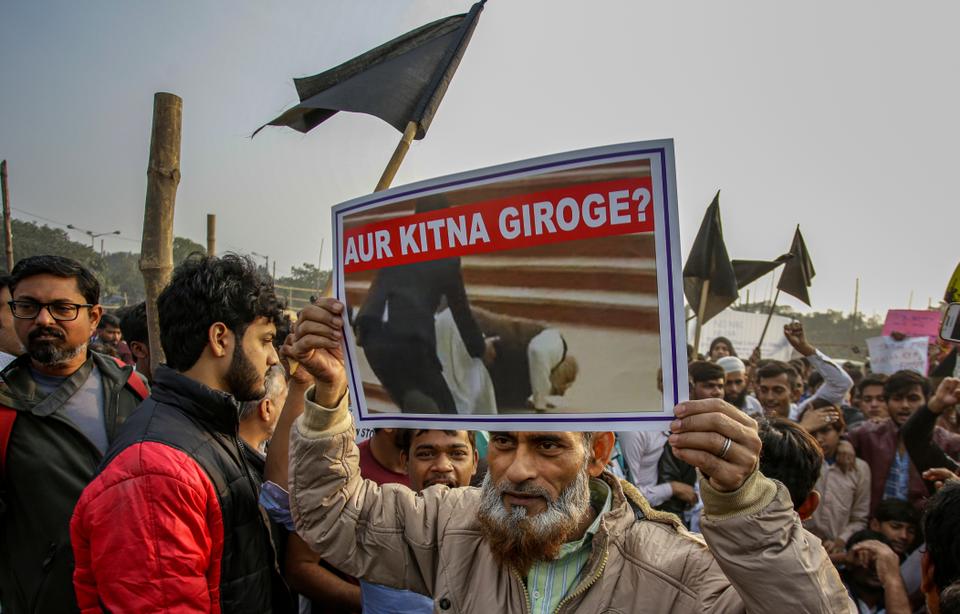
New Delhi's discriminatory amendment to citizenship law has further alienated India's Muslims.
New Delhi’s discriminatory amendment to citizenship law has further alienated India’s Muslims. (AP Archive)

Other policy changes such as requiring NGOs to register with income tax authorities every five years are a similar tool of “administrative harassment”. ..

The intimidation is not limited to NGOs as journalists reporting on creeping BJP authoritarianism often feel the wrath of the state.   “…between 25 March and 31 May 2020, at least 55 Indian journalists faced arrest, physical assaults, destruction of property, threats or registration of FIRs (police reports),” the report said. 

New Delhi increasingly relies on internet controls to curb dissent. Internet shutdowns jumped to 106 in 2019 from only six in 2014 as authorities used different laws to control the flow of information.  Kashmir faced a complete internet blackout for months after the Muslim-majority region’s nominal autonomy was withdrawn last year…

India is also using the draconian Unlawful Activities Prevention Act to target Dalits, a caste of Hindus who face widespread discrimination under the country’s hierarchical caste system… Changes in the Citizenship Act that target Muslim migrants and the brutal police reponse to subsequent protests — in which 22 people were shot dead in Utter Pradesh state in a single day — further illustrate the worsening status of minorities in India. 

In neighbouring Pakistan, India’s archrival, minorities and those activists trying to help them, fare no better. 

“NGOs and INGOs (international NGOs) are subject to extensive regulation involving multiple, lengthy procedures of registration, security clearance, and approvals for funding,” the report said.

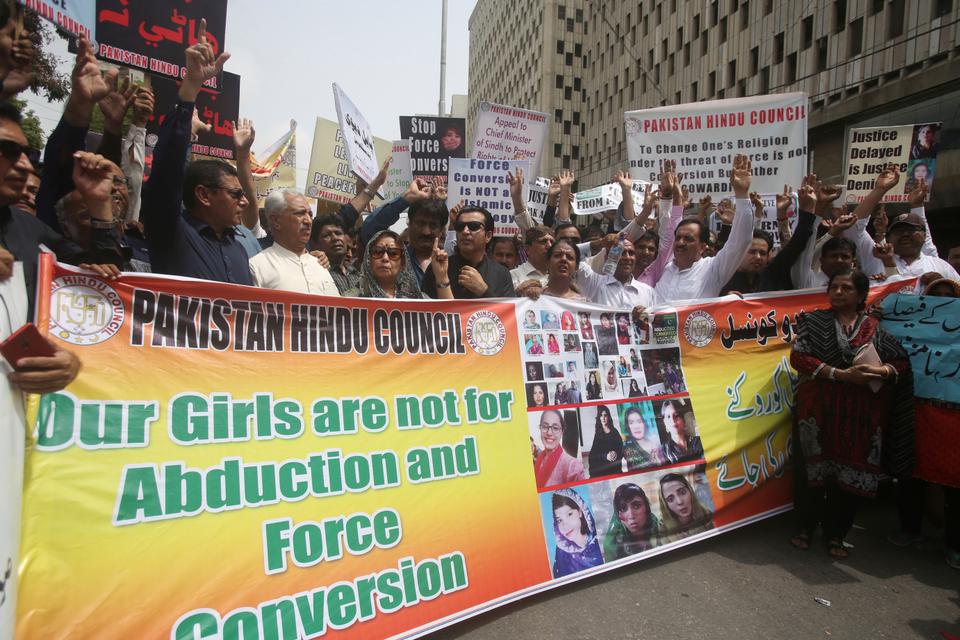
The Christians and Hindus in Pakistan regularly complain that young girls are forced to convert to Islam.
The Christians and Hindus in Pakistan regularly complain that young girls are forced to convert to Islam. (AP Archive)

In recent years, Islamabad has increased vigilance on NGOs which it fears might be working on a foreign agenda to promote dissent.  What will particularly bother Pakistan’s policymakers is the report’s focus on how the country’s Blasphemy Law, meant to protect religious sentiments, continues to be misused against minorities. 

In reality, the law explicitly discriminates against Ahmadiyas since parts of it criminalise public expression of Ahmadiya beliefs and prohibit Ahmadiyas from calling themselves Muslims, praying in Muslim sites of worship and propagating their faith.”  Just this week, a report by the United States Commission on International Rights Freedom pointed out that Pakistan accounts for nearly half of the incidents of mob violence against alleged blasphemers.  

At times, people accused of blasphemy are killed in court in front of police and lawyers.   Christians, another minority, are frequently targeted while authorities do little to protect them.  For instance, a church constructed in the Toba Tek Singh district of Punjab province had to be sealed in 2016 after local Muslims agitated against it.  This alienation doesn’t stop at the places of worship – young Chrsitan students are continuously harassed by their peers to convert to Islam, the report said. 

Similarly, Sri Lanka witnessed rising levels of intolerance towards minorities in recent years, especially as successive governments tried to pacify extremist Buddhists to garner their votes.  Muslims in Sri Lanka have felt a wave of discrimination and official apathy after the suicide attacks that killed more than 200 people last year.  “After the Easter attacks, Muslims, particularly a large number of Muslim men, were arrested seemingly without reasonable cause.” Jingoistic government-aligned media has helped paint Muslims as the villain in Sri Lanka. 

The incitement of hatred and vitriol by media outlets continues unabated. For example, Muslim Covid-19 patients were identified by their faith, unlike other patients, and blamed by the media for spreading coronavirus.” 

https://www.trtworld.com/magazine/india-and-pakistan-no-different-on-how-they-treat-minorities-42419

Asfreeas Jafri wrote interesting opinion on “Majoritarianism”

July 24, 2020

Asfreeas Jafri in Politics, of 14th July, 2020 wrote a fascinating opinion piece which I think deserves more attention. It is mostly about India but has wider implications: for ease of reference here the full text:

One complaint I often get from friends is that I say very “offensive” things online. My Facebook, Twitter, and Instagram, they accuse, are filled with the same sad and angry words against Islamophobia. Although despite my repetitive rants, they continue to ignore the agony of these words.

On July 10, 2020, the Turkish president announced that Hagia Sophia would be a mosque again.

Amongst other things, I am accused of being biased. Also, I am accused to be writing for a vested agenda. Usually, my Hindu friends make these allegations since I write a lot about the persecution of Indian Muslims. However, recently I noticed Muslim friends on social media making the same kind of accusations against those who expressed displeasure at the conversion of Hagia Sofia into a mosque.[ see also: https://humanrightsdefenders.blog/2020/07/06/the-unholy-wisdom-of-invoking-sovereignty/]

A few days back, some of them were irked after being questioned for running a homophobic WhySoProud trend on Twitter. This time the allegation against those Muslims who opposed this conversion is that they are doing this to please “Hindu liberals”.

Those who make these charges are undermining our agency and reason. It is insulting for me to think that what I and several other Muslims write, is not out of our individual agency and free will. When someone as outspoken as Umar Khalid is accused of doing that by several Muslims, I feel that we need to introspect.

The attackers are overlooking Umar’s incisive critique of Islamophobia in the Indian left. Muslims who are opposed to this are being called apologetic. I never pledged allegiance to the new sultan of Turkey. Not calling out Erdogan’s vile actions or political gimmicks does not fill any Muslims with a sense of vicarious guilt, at least in front of people we are allegedly supposed to be pleasing. But to say that those who dislike Erdogan are apologetic is quite irresponsible.

I will any day stand with someone like Umar Khalid who has been a constant ally in the fight against Islamophobia, rather than choosing a faraway ‘Sultan’ who is hardly bothered about the existence of Indian Muslims. It is people like Umar whose strong and sharp words have made young Muslims more unapologetic and bothered about their rights than their predecessors.

The other charge was against those liberals who wanted schools and hospitals on that disputed land, some congress leaders and “practising Hindu atheist” liberals like Dhruv Rathee who had strongly supported the Ayodhya verdict but are now opposed to Erdogan’s move. To many people’s shock, they had claimed that the Ayodhya verdict was respectable to all sides and that it will put a halt to the hate against Muslims. It did not halt. It actually increased.

I agree that this hypocrisy should be called out but when you also support either of the two majoritarian displays of power, are you not a hypocrite too? Also, what about those who have been vehemently opposed to the demolition and protested the SC verdict on Ayodhya? Do they have the right to comment on this?

Some found the comparison of Hagia Sofia with Babri Masjid as problematic. They said that it is not as bad in Turkey as it is in India. Umar rightly asks, ‘are we waiting for it to be that bad?’ Babri was illegally demolished and mobs killed hundreds. The history of these two events is different but what makes the comparison fair is how the Indian and Turkish governments and judiciary ignored the sentiment of the Muslim and Christian minorities. That the majoritarian will become the conscience of the state is starkly similar in both these cases.

As per media reports, Christians were blamed for spreading Coronavirus in Turkey. Consequently, some churches were attacked. The Christian community has faced mysterious disappearances and deaths, attacks and propaganda in recent years.

Turkey’s President Recep Tayyip Erdogan

Recently, a group of Erdogan backed lawyers published an article to “redo” what happened in Armenia. As somebody who often hears Hindutva extremists warning to repeat 2002, which they eventually did in North East Delhi earlier this year, I understand the consequences of these hateful words. The increasing murderous hate attacks on Kurds in Erdogan’s Turkey are known to everybody except those who deny the Armenian genocide.

Erdogan supporters see him as the emperor of the neo-Ottoman empire. The majority rallies behind his brand of Islamic nationalism. Through a constitutional referendum, he has vested immense new authority in himself. Institutions look timid. Rogue opposition is either tamed or jailed. Rivals have been pushed into a tunnel of silence.

The pandemic was used to target the feeble opposition while political prisoners languishing in jails were given no relief. Amnesty International observed that rivals have been targeted using anti-terror laws during the pandemic.

Apart from the political opposition, universities, intellectuals, writers and journalists have invited the severe wrath of the Sultan. Many “Anti-national” academics have lost their jobs in recent years. Many renowned Human rights defenders and lawyers are behind bars.

Ever since the failed coup, suspicion and divisions amongst the Turks has reached new heights. The recent losses in elections, a growing economic crisis and waning popularity of the ruling party are being seen as the reasons behind these desperate populist decisions.

Many wrote that the mosque was “bought” by the Ottomans centuries ago. I did not want to argue about that since copies of the receipt in modern digital font and scanned PDFs of the transaction are easily available on WhatsApp! Several individuals shared stories of Israel, Greece and Spain converting mosques into other structures. This was followed by “where were you then” and whataboutery. Ironically, if you are opposed to what the aforesaid nations did, then you should be opposed to what Turkey did as well.

At the same, I also acknowledge that the western media and academia in the post-cold war world villainised Islam and Muslims. The “Muslim victim” did not fit into the “war on terror” narrative pushed by the west.

The attack on Islam and Muslims did not receive the same kind of recognition or outrage, and was side-lined. Writers like Chomsky and Edward Said have noted the West’s white-washing of its crimes in that part of the world and its malicious contempt for Islam. This has increased anti-West hostility in that region.

A few months ago, I read a blog post while casually scrolling on social media. A young Erdogan critic made a very significant point which I think should be thought about more in the above-mentioned context. He said that as long as the western standards of Human rights will be limited to the people living on the American soil, as long as the west hates on ordinary refugees and working-class innocent Muslims, as long as the occupation and Persecution of Palestine are seen as Israel’s sovereign right, as long as people deny what the US did to ordinary Iraqis, people in the Middle East will continue to invest in defenders who eventually oppress.

In December, while protesting the CAA at Jantar Mantar, I spoke to the Wire and NDTV. That video went viral on social media. It was shared by hundreds of Muslims in Pakistan including actress Mehwish Hayat.

On that thread, many Pakistanis had expressed solidarity with Indian Muslims. I replied to one of the comments, “The best Pakistani Muslims can do in the interest of Indian Muslims is to set a good example for India’s Hindus by treating their minorities well.”

It angered a lot of people. They replied with “Thank you Jinnah” taunts. Many users made the same comments on Indian Muslim handles after the Delhi violence.

What were they actually mocking? They were mocking the fact that Indian Muslims refused to go to Pakistan to be a majority and instead chose to live as a minority in India. This also suggests that they believe minority persecution is natural and that Indian Muslims missed an opportunity to be a persecuting majority. The recent demolition of a Hindu religious structure in Islamabad or the post-Babri demolitions and attack on Hindu religious sites in Pakistan and Bangladesh describe majoritarian solidarity aptly.

On the recent Krishna temple debate, I saw an interesting thread on Twitter where a Pakistani Muslim was explaining it to a Pakistani Hindu that Temples are not essential to the faith20 of Hinduism while mosques are essential to the faith of Islam.

Babri Masjid
People demolishing the Babri Masjid.

In India, the judiciary applied the same principle to say that mosques are not necessary for prayers. This opens a door to another important debate: Are laws merely a manifestation of the majoritarian interpretation of morality and righteousness?

Even in the West, the so-called cradle of secularism, minorities face rampant discrimination and attacks. The recent murder of George Floyd in broad daylight attests to that. The need of the hour is strong debate around majoritarianism. It must gain global momentum.

As long as we are afraid of losing friends and being unpopular, such a debate is not possible. Right now, our only “agenda” is to rattle our people’s numbed conscience. We need to be courageous to be truthful. Sometimes, we have to offend those who like us when we offend others.

When violence becomes an everyday character of society, when irrationality overpowers reasons, when cruelty is seen defence, when injustice flows in a people’s vein, when malice rules their heads, oppression pleases their hearts and vulgarity embeds itself in their “proud” nation’s soul, writers are bound to protest, annoy, and be repetitive in what they write.

https://www.youthkiawaaz.com/2020/07/we-need-a-global-debate-on-majoritarianism/

OHCHR’s Minorities Fellowship Programme: Applications invited

February 12, 2020
OHCHR’s Minorities Fellowship Programme: Applications invited

On 10 February 2020 the Office of the United Nations High Commissioner for Human Rights (OHCHR) invited applications for its Minorities Fellowship Programme, a training programme for human rights and minority rights defenders belonging to national or ethnic, religious and linguistic minorities. During the Programme, human rights defenders will get an opportunity to establish contacts with other activists from different parts of the world.

Applicants of the fellowship must belong to a national, ethnic, linguistic or religious minority group. Selected persons will get a ticket from the country of residence to Geneva and stipend.

The application form for the fellowship can be download from the website of OHCHR (click here). Applications form along with the relevant documents can be sent to email id minorityfellowships@ohchr.org or by post to “Mr. Morse Caoagas Flores Coordinator, Indigenous & Minorities Fellowship Programmes Indigenous Peoples and Minorities Section Office of the High Commissioner for Human Rights 48, Avenue Giuseppe-Motta, Office 2-05 CH-1211 Geneva 10, Switzerland”. The deadline is 28 February 2020.

https://www.siasat.com/ohchrs-minorities-fellowship-programme-applications-invited-1821299/

Dunja Mijatović calls on Bulgaria to counter hate speech and domestic violence

December 3, 2019

A Roma family who fled the village of Voyvodinovo, Bulgaria, during the anti-Roma protest in January 2019. ©Angelina Genova

A Roma family who fled the village of Voyvodinovo, Bulgaria, during the anti-Roma protest in January 2019. ©Angelina Genova

“The government should step up its efforts to fight the hate speech prevailing today in Bulgaria in particular against Roma, LGBTI people and other minority groups” said the Council of Europe Commissioner for Human Rights, Dunja Mijatović, on 2 December 2019 after a 5-day visit to the country.

Hate speech and hostility against Roma persist, with little if any response from the authorities to counter this long-standing phenomenon. “The lack of reaction to some very serious instances of hate speech by some high-level politicians, which systematically go unsanctioned, is worrying.” The Commissioner deplored the situation of Roma who had to leave their homes earlier this year following anti-Roma rallies in several villages, including in Voyvodinovo where around 200 individuals left in fear. “Such disastrous events illustrate the highly detrimental impact that hate speech can have on the lives of people and communities. I call on the authorities to urgently address the situation of the persons affected,” she added.

“There is a need for a political and cultural shift as regards the treatment and image of minority groups in Bulgaria. Recognising racist motivation as an aggravating circumstance for all offences and implementing the judgments of the European Court of Human Rights, including those on forced evictions and the registration of associations of persons identifying as a minority are among the immediate steps which the government should take.” In addition, the Commissioner is concerned about the demonstrations organised by extremist groups and calls on the authorities to strongly and publicly condemn such manifestations.

…….The Commissioner visited the only crisis shelter for women victims of domestic violence currently operating in Sofia. “As a matter of urgency, the authorities should increase the number of shelters and other social services available to victims of domestic violence.” The Commissioner is also concerned by the climate of increased hostility against human rights defenders, in particular women’s and LGBTI rights activists.

Moreover, Commissioner Mijatović is alarmed by the continuous deterioration of media freedom in Bulgaria. Non-transparent media ownership, threats and harassment of journalists, and the use of defamation suits are chronic problems. In addition, political influence over media outlets severely undermines the credibility of the press. “This must stop. Citizens need a free, investigative and independent press in order to be able to participate more actively in the democratic fabric of society. Journalists should be free to play their crucial role without interference.”

https://www.coe.int/en/web/commissioner/-/bulgaria-should-counter-harmful-narratives-endangering-human-rights-and-step-up-efforts-to-fight-hate-speech-and-domestic-violence

Three award-winning Colombian human rights defenders on a European tour to raise awareness

May 29, 2019

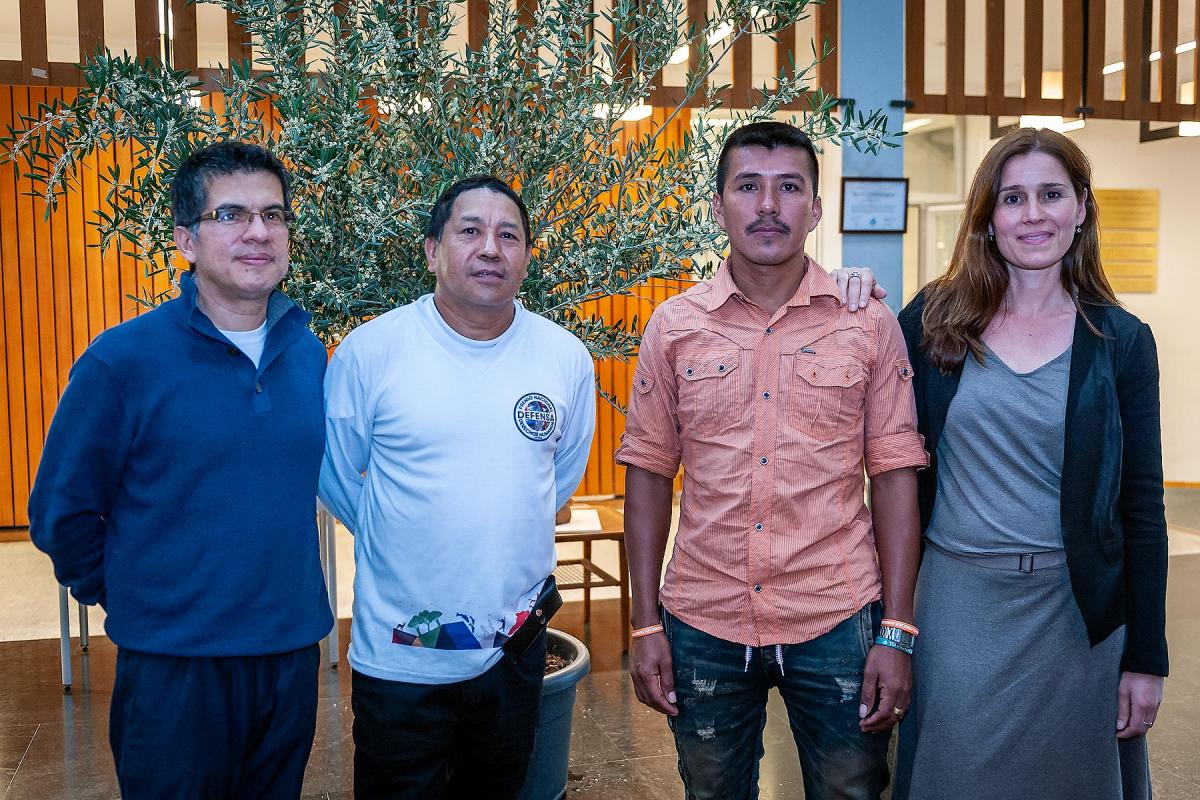
Three award-winning Colombian human rights defenders visited the Lutheran World Federation on 27-28 May as part of a European tour to raise awareness of the dangers and difficulties faced by so many people working for justice and peace in the country today. According to the Somos Defensores network which monitors attacks against human rights defenders, 2018 was one of the worst years ever for these activists and social leaders in Colombia, with over 800 attacks and 155 murders reported. [https://humanrightsdefenders.blog/2019/04/26/somos-defensores-in-colombia-publishes-annual-report-2018-worst-ever/]

The three are recipients of the 2018 National Human Rights Defenders award, presented by the Church of Sweden and the Swedish faith-based organization Diakonia, with the support of the Swedish government. Its goal is to draw international attention to struggles of those working for human rights, especially those located in isolated, grassroots communities/

Germán Graciano Posso, legal representative of the San José de Apartadó Peace Community in the northwest of Colombia, shared stories of over 300 members and supporters of his community who have been murdered in the past two decades. The small farming community of some 600 people was founded in 1997 at the height of the conflict between the government and members of the two main guerrilla groups, the Revolutionary Armed Forces of Colombia (FARC) and the National Liberation Army (ELN)… Germán said he and the community “had high hopes with the country’s peace process that everything would change for the better” but that has not happened. The paramilitary presence has been growing in the past months, he said, and young people continue to be recruited into their ranks, an issue that has been acknowledged by the Ombudsman office.

Dolis Estela Valencia is a leading member of the Black and Afro-Descendant Community Council of Alto Mira y Fronteras in Tumaco, on the Pacific coast close to the border with Ecuador. The Council represents 42 local communities, working to support the Afro-Colombian people whose collective land rights were recognized by the government in 1993. Despite that legal recognition, Dolis shared her experience of death threats, forced displacements and assassinations of those struggling to defend their land and livelihoods Farmers in this community are trying to grow cocoa beans, bananas and other traditional crops instead of the coca leaves that drive Colombia’s lucrative drug trafficking industry. Her community is included in the government program for the substitution of illegal crops as part of the peace accords.

Genaro de Jesús Graciano is legal representative of a socio-environmental organization, Movimiento Ríos Vivos in Antioquia which includes 15 grassroots communities affected by the giant Ituango hydroelectric dam project. Plans for the 220-meter high dam across the Cauca river were completed a decade ago and construction began in 2011, but Genaro said the project –one of the largest of its kind in Latin America – has been flawed from the start…Genaro and his organization have filed official complaints and requests for compensation from the construction company and shareholders, the Empresas Públicas de Medellin and the regional Government of Antioquia. Besides, the national environment authority (ANLA) has issued official warnings about the dangers of this project which have been disregarded. In the meantime, 5 environmental leaders have been killed, while many others have been the targets of death threats, discrimination and exclusion from public debates about the future of the dam.

As well as sharing stories during an encounter at LWF headquarters and meeting UN special rapporteurs in Geneva, Germán, Dolis and Genaro were also visiting Berlin, Stockholm and Uppsala as part of the 16 to 29 May European tour. A fourth prize winner, 78-year-old community leader Maria Ligia Chaverra, was unable to take part in the tour because of health reasons. All of them underline the importance of the Human Rights Defenders prize in shining a much-needed spotlight on their stories and bringing international attention to the plight of their communities.

https://www.lutheranworld.org/news/dangerous-task-defending-human-rights-colombia