Posts Tagged ‘Mexico’
February 27, 2016
The criminalization of human rights defenders in the context of the extraction of natural resources and megaprojects is becoming a very worrisome phenomenon in Latin America, denounces the Observatory in a report published today in Mexico. Entitled “The criminalization of human rights defenders in the context of industrial projects: a regional phenomenon in Latin America”, this document points to the role of businesses, civil servants, public prosecutors, judges, and the State. The report issued by OMCT and FIDH (in the context of their Observatory for Human Rights Defenders) on 25 February 2016 describes the specific cases of human rights defenders criminalized in eight Latin American countries (Brazil, Colombia, Ecuador, Guatemala, Honduras, Mexico, Nicaragua and Peru).
The report especially stresses two core issues common to all the countries studied: Read the rest of this entry »
Posted in books, FIDH, human rights, Human Rights Defenders, Observatory for the Protection of Human Rights Defenders, OMCT | 4 Comments »
Tags: Brazil, Colombia, criminalisation, criminalization, Ecuador, environmental issues, FIDH, Honduras, Human Rights Defenders, independence of the judiciary, Latin America, Mexico, Nicaragua, Observatory for the Protection of Human Rights Defenders, OMCT, Peru, regional NGOs, resource extraction
November 24, 2015
On 2 November the ISHR carries an interview with Alberto Solis Castro, a human rights defender concerned with the indigenous communities in Mexico.
Read the rest of this entry »
Posted in human rights, Human Rights Defenders, ISHR | Leave a Comment »
Tags: Alberto Solis Castro, attacks, Business and human rights, environmental issues, Human Rights Defenders, Indigenous rights, international cooperation, ISHR, Mexico, profiles, resource extraction
September 25, 2015

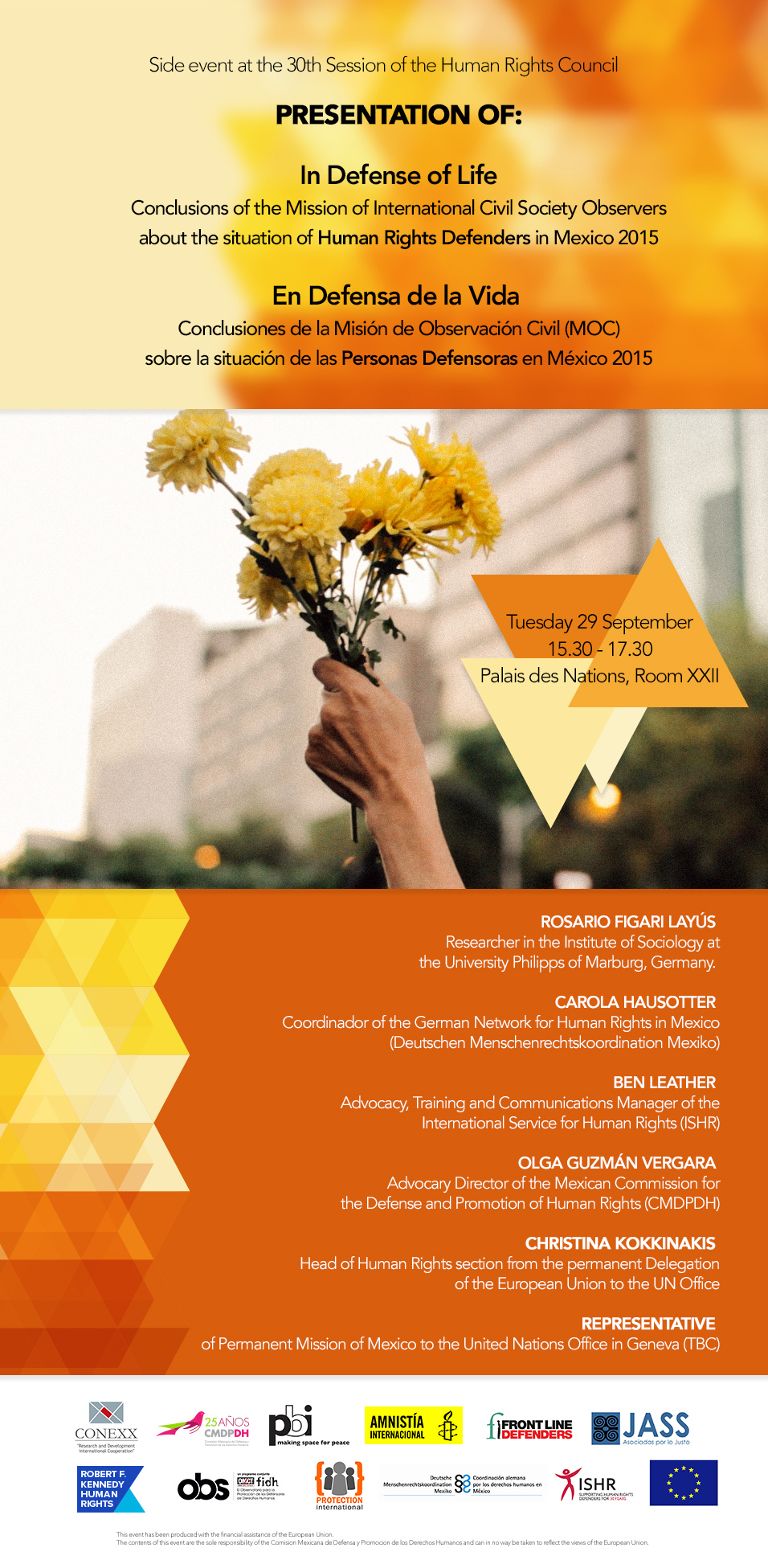
On Tuesday 29 September (15h30 – 17h30, Palais des Nations, Room XXII, Geneva), the CMDPDH, Asociación Civil and ISHR organise a side event about the situation for human rights defenders in Mexico. [A Mission of International Observers visited Mexico in November 2015 and will present its conclusions – under the title “In Defense of Life” – to the Mexican Government within the framework of the 30th session of the Human Rights Council.]
Panelists in the event are::
- Rosario Figari Layús – Researcher in the Institute for Interdisciplinary Research on Conflict and Violence (IKG) at the University of Bielefeld, Germany.
- Carola Hausotter – Coordinador of the German Network for Human Rights in Mexico (Deutschen Menschenrechtskoordination Mexiko)
- Ben Leather – Advocacy, Training and Communications Manager of the International Service for Human Rights (ISHR)
- Olga Guzmán Vergara – Advocary Director of the Mexican Commission for the Defense and Promotion of Human Rights (CMDPDH)
- Ambassador Jorge Lomónaco Tonda – Permanent Representative of Mexico to the UN in Geneva (TBC)
- Christina Kokkinakis – Head of Human Rights section from the Permanent Delegation of the European Union to the UN in Geneva
Download the flyer: HUMAN RIGHTS IN MEXICO
see previous posts: https://thoolen.wordpress.com/tag/mexico/
Posted in books, Human Rights Council, Human Rights Defenders, ISHR | Leave a Comment »
Tags: Ben Leather, Carola Hausotter, Christina Kokkinakis, Geneva, Human Rights Defenders, killings, Mexico, Observer, Olga Guzmán Vergara, Rosario Figari Layús, side event, UN Human Rights Council
September 21, 2015
A bit belatedly, I refer to the interview (19 June 2015) with Alejandro González in the Newsletter of the ISHR. Alejandro is a human rights specialist who works for PODER, an award winning and multi-faceted civil society organisation based in Mexico that helps build the capacities of communities, workers, NGOs, and other civil society groups affected by corporate malfeasance and accompanies their accountability campaigns.
‘We help communities participate in the consultative process. In the end, it is about what communities want. We are not in favour or against the project. We make sure communities know their rights and are aware of the potential positive and negative impacts of the project.’ Free, prior and informed consent of the local communities is needed to pass development projects in indigenous regions of Mexico. Recent reforms, however, have opened the energy sector to both national and international investment. Mexico is currently in a maelstrom of speculation. ‘This is a dangerous situation. Many powerful companies in Mexico have a poor track record in human rights and we are concerned that local communities will lose their power to defend their land rights. Communities affected by gas speculation can either be obliged to sell their land or be forcibly dispossessed. It is vital that we observe, facilitate and publicise these negotiations.’
PODER, together with rural communities, is currently conducting an ex ante human rights impact assessment on extractive projects in Puebla, Mexico. In other states, such as Hidalgo, Oaxaca, and Sonora, PODER conducts participatory research with communities and accompanies their advocacy efforts. In Oaxaca it is part of an international mission to monitor the Free, Prior and Informed Consent process regarding the construction of wind farms by Australian, Dutch, Japanese and Mexican corporations.
‘The government wants to use this case as a model – to set a precedent for all future negotiations. If it goes poorly, the consequences could be devastating … We have met frequently with the Dutch, European Union and other embassies to amplify the voices of local people. We have also conducted extensive research into the companies and provided this information to the community, to help them make informed decisions.’
Standing up to powerful economic actors is dangerous work. In 2013, Héctor Regalado Jiménez, member of the Popular Assembly of the Juchiteco People, was shot and killed after opposing the wind farms. ‘Another activist we were working with died in a suspicious car accident. We still don’t know what happened, but this is a common modus operandi in Mexico. The killers make it look like an accident. Community leaders are frequently subject to death threats and assaults.‘
Since PODER does not directly advocate on land rights issues, Alejandro is not in as much risk as the human rights defenders it supports, though he and his colleagues face increasing surveillance. He believes that a powerful political and corporate élite pose a major challenge to the work of business and human rights defenders across Mexico. ‘There is a small group of families who control most of the market. It is a secretive group who meet with the president and cabinet members behind closed doors. Together they decide the laws and regulations. That’s how they pushed through the reforms that opened up the energy sector.’
To address this lack of transparency in the government and private sector, PODER is involved in online platform such as “Who’s Who Wiki” (rindeucentas.org) and ‘MéxicoLeaks’ – a whistleblowing tool that allows people to send information of public interest through secure technologies that protect the identity of the source. The information received through MéxicoLeaks is then verified, analyzed and published by the partners of the alliance, made up of civil organizations and media outlets. “The investigations that follow allegations communicated via ‘MéxicoLeaks’ are dangerous. In a two-year period, 10 journalists were murdered and 326 attacked. We have seen an increasing use of cyber attacks – as hackers force outlets offline or bombard them with viruses. Any journalist who exposes government corruption can expect to lose his job.”
Despite these adverse conditions, Alejandro is positive that good business practice is in the best interests of businesses. ‘We make corporations aware that human rights violations are a material risk. For example, if a company pollutes a river, there will be mobilisation and litigation against the company as well as a huge attack on their reputation – all of which costs money. Making corporations aware of the cost of violating human rights puts pressure on them to improve their due diligence.‘
‘In Mexico we would like to see a civil society powerful enough to be on equal footing with both the authorities and the private sector. For this you need information, complete transparency in everything the government does and strong accountability mechanisms. The private sector must prioritise human rights with due diligence, and not merely refrain from doing harm, but actively to do good.’
Alejandro González: Mexican corporate accountability human rights defender | ISHR.
see also: https://thoolen.wordpress.com/tag/mexico/
Posted in human rights, Human Rights Defenders, ISHR | Leave a Comment »
Tags: Alejandro González, Business and human rights, corporate accountability, environmental issues, harassment, Héctor Regalado Jiménez, Human Rights Defenders, indigenous groups, interview, ISHR, Mexico, PODER (NGO), resource extraction
April 4, 2015
Henry Chamberlain in his blog
Comicsgrinder of 3 April reviews positively a new human rights book:
‘La Lucha: The Story of Lucha Castro and Human Rights in Mexico’

The border state of Chihuahua and its city of Juarez is like a war zone thanks to the inextricable link between drug cartels and official corruption. But thanks to human rights defenders, like Chihuahua lawyer and organizer Lucha Castro, fight back.

Edited by Adam Shapiro, head of campaigns at the human rights organization Front Line Defenders, and drawn by Jon Sack are a series of profiles and reportage that have the urgency of dispatches from the scene. Luca Castro wrote the preface.
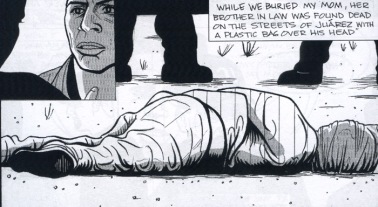
“There are all compelling stories to be found here. One example is the story of Marisela Escobedo Ortiz and her daughter, Rubi Marisol. Rubi was murdered by her boyfriend, Sergio Barraza. It was a clear-cut case. However, Sergio Barraza would never be found guilty simply for the fact that he was a member of the Zetas drug ring and that made him instantly untouchable. Rubi’s mother, Marisela Escobedo Ortiz, led a fight to bring Sergio Barraza to justice. She was able to repeatedly track him down when authorities were not. Sergio Barraza was eventually slain in a shoot-out in 2012 with the Mexican Army. But during Marisela’s struggle for justice, the Mexican authorities, from the local level to the federal level, would not get involved. In the end, Marisela was killed for her efforts. This is quite an involved story ”
“La Lucha” is an exemplary example of the comics medium. A book like this one proves how complex issues can be presented in a clear and concise manner that can benefit people in a myriad of ways. It can jump start conversations that require a number of facts that are not always easy to follow. It can make a difference. It can even save lives.
“La Lucha: The Story of Lucha Castro and Human Rights in Mexico” is published by Verso Books and is available as of March 31, 2015. You can find it here, here, here, and here.
Review: ‘La Lucha: The Story of Lucha Castro and Human Rights in Mexico’ |.
Posted in Front Line, human rights, Human Rights Defenders | 1 Comment »
Tags: Adam Shapiro, book, cartoon, comics, Comics Grinder, Education, Frontline Defenders, Henry Chamberlain, Human Rights Defenders, impunity, Jon Sack, La Lucha, Lucha Castro, Marisela Escobedo Ortiz, Mexico, visualisation
March 7, 2015

Jury announces the Finalists for the 2015 Front Line Defenders Award
On Wednesday 4 March the Jury for the 2015 Front Line Defenders Award for Human Rights Defenders at Risk announced the 5 finalists for this year, all of whom are either in jail, in hiding or face the threat of jail because of their peaceful work defending the rights of others:
Juan Carlos Flores Solís Mexico, an environmental rights campaigner, was recently released from prison, but has a charge pending, because he led the opposition of local peasant and indigenous communities to the construction of a gas pipeline on their land near an active volcano.
Diane Marie Rodríguez Zambrano Ecuador, LGBTI rights activist and the first trans woman to stand for public office in Ecuador is currently living in a safe house following death threats because of her work promoting the rights of the transgender community.
Guo Feixiong a Chinese legal activist, also known has Yang Maodong, has been repeatedly jailed and brutally tortured for challenging corruption, defending the rights of human rights defenders, minority groups and small farmers whose land had been confiscated. He is currently in prison awaiting sentencing.
Rasul Jafarov one of the most prominent HRDs in Azerbaijan, was arrested on bogus charges of “ illegal enterprise, tax evasion, and abuse of official power. A lawyer by profession, Rasul Jafarov is Head of the Human Rights Club and Coordinator of the Art for Democracy campaign, which has launched several campaigns against politically-motivated imprisonment, including the Sing for Democracy campaign which took place in the run-up to the Eurovision Song Contest in May 2012. His is still in detention and his trial is ongoing.
Yara Sallam – Egypt is a human rights lawyer with the Egyptian Initiative for Personal Rights (EIPR). On 21 June 2014, she was arrested with other protesters during a peaceful demonstration against the controversial “Protest Law”. On 29 October 2014, Yara, and a number of other activists, were convicted on these charges, despite the absence of credible evidence and clear inconsistencies in police reports of the event. She was sentenced to three years’ imprisonment,three years’ police monitoring and a fine of 10,000 Egyptian Pounds (approx. €1,098). This sentence was later reduced on appeal to two years’ imprisonment, two years’ monitoring and no fine.
The winner will be announced at an event in Dublin’s City Hall on 1 May.
via Finalists for the 2015 Front Line Defenders Award for Human Rights Defenders at Risk | Front Line.
Posted in awards, Front Line, human rights, Human Rights Defenders | 1 Comment »
Tags: Azerbaijan, China, Diane Marie Rodríguez Zambrano, Ecuador, Egypt, Front Line (NGO), Guo Feixiong, human rights awards, Human Rights Defenders, Juan Carlos Flores Solís, Mexico, nominees, Rasul Jafarov, Yang Maodong, Yara Sallam
February 11, 2015

Catholic priest, human rights defender and key organizer, Raul Vera, addressing the assembly. | Photo: Victor Figueroa / teleSUR
Marking the anniversary of the signing of Mexico’s 1917 constitution, activists, intellectuals and citizens participated in the first national ‘Citizen’s and Popular Constituent Assembly’ to propose a ‘bottom-up’ revision of Mexico’s Magna Carta. So reports teleSur on 5 February. The assembly, held in Mexico City and attended by nearly 1000 people, proposes to develop a new constitution that prioritizes social, political and economic rights.
One of the assembly’s key organizers, catholic bishop and social activist, Raul Vera, said that the current state and crisis of violence as well as political and economic corruption in Mexico is a primary driving force behind the initiative.“Justice and rights have disappeared for the mass majority of the Mexican multitude of poor and the small number of middle class that remains…thus, the idea of forming a new constitution in Mexico comes from the idea, finality, objective that we Mexican citizens can be become subjects of the country’s historical construction,”said the human rights defender in his address to the crowd.
Participating in the assembly were families of the disappeared 43 Ayotzinapa students, their fellow classmates, as well as human rights defenders, writers, artists, priests, students and labor leaders.
The Catholic priest and respected migrant rights defender, Alejandro Solalinde, exclaimed that the assembly and its objectives rule out the participation of political parties in the process, declaring that legislators “do not represent anybody.” Solalinde went on to send a message to Mexico’s president, Enrique Pena Nieto, that the work of the assembly will move forward to push for peaceful systemic political and social change. “It depends on you [Pena Nieto] that the changes will be pacific, we are going to carry them out no matter what, but if you repress or use force and violence, you will be the only one responsible … you will be guilty,” Solalinde stated.
Although it remains unclear as to how the assembly’s findings and declarations will be implemented legally, organizers say that the grassroots work and proposals of viable alternatives will carry on beyond 2017, marking 100 years of the original constitutional assembly of the Mexican Revolution.
Mexico Activists Convene First People’s Constitutional Assembly | News | teleSUR.
Posted in human rights, Human Rights Defenders | 1 Comment »
Tags: Alejandro Solalinde, Ayotzinapa, civil society activists, Constituent Assembly, Constitution, disappearances, Human Rights Defenders, human rights violations, Mexico, mobilisation, Raul Vera, Telesur
December 12, 2014
 To shine a light on the courageous work of women human rights defenders (WHRDs) worldwide, the NGO Protection International announces the launch of a series of interviews with women who defend human rights across the globe, from December and continuing in 2015, each month will see a new portrait of a WHRD.

This month’s conversation is with Alejandra Ancheita, a leading human rights defender from Mexico and winner of the 2014 Martin Ennals Award for Human Rights Defenders. Alejandra is the founder and executive director of The Project of Economic, Cultural, and Social Rights. To read the interview and watch the (Vimeo) video that goes with it go to Protection International’s website (see link below).
Other outstanding women lined up in the months to come include Rehana Hashmi (Pakistan), Eva Bande (Indonesia), María Martín (Spain), Porntip Honchai (Thailand).
Rehana Hashimi

Eva Bande
María Martín
Porntip Honchai

The Women Who Defend Human Rights – Alejandra AncheitaProtection International.
Posted in films, human rights, Human Rights Defenders, Protection International | 1 Comment »
Tags: Alejandra Ancheita, Eva Bande, films, Human Rights Defenders, Indonesia, interview, María Martín, MEA laureate 2014, Mexico, Pakistan, PI, Porntip Honchai, Protection International, Rehana Hashmi, Spain, Thailand, video, Vimeo, women human rights defenders
December 9, 2014
To mark Human Rights Day tomorrow, Wednesday 10 December, the Guardian organises a live chat with three women human rights defenders who will answer your questions on their campaigning work and the challenges they face in uncovering abuses. The panel looks most promising:
Read the rest of this entry »
Posted in human rights, Human Rights Defenders | Leave a Comment »
Tags: Alejandra Ancheita, Arif Yunus, Azerbaijan, Cristina Palabay, Dinara Yunus, Human Rights Day, Human Rights Defenders, international human rights day, Karapatan, Leyla Yunus, MEA laureate 2014, Mexico, Philippines, the Guardian, women human rights defenders
December 9, 2014
(Vidulfo Rosales (Center) | Photo: Clayton Conn/ teleSUR)
A lengthy report entitled: “
Ficha Cisen a abogado de normalistas” written in the electronic investigative journal,
Reporte Indigo, shows that
Mexico’s Intelligence Agency (CISEN) has opened dossiers on human rights defenders from the Human Rights Center of the Mountain “
Tlachinollan” calling them “dangerous to governance.” The report details that
Vidulfo Rosales, lawyer and representative of the 43 families of the Ayotzinapa students as well as Tlachinollan’s director,
Abel Barrera are “elements” that pose a “threat” to the government and that the two participate in “subversive” activities. Telesur of 8 December refers to a public letter signed by over a dozen reputable human rights organizations:
“It is outrageous that public resources are used to weaken the human rights movement instead of using intelligence capabilities to combat infiltration and corruption by narco-governments and guarantee that serious human rights violations do not go unpunished”.
Mexico Intelligence Agency Investigates Rights Defenders | News | teleSUR.
Posted in human rights, Human Rights Defenders | Leave a Comment »
Tags: Abel Barrera, Ayotzinapa, CISEN, disappearances, harassment, Human Rights Defenders, human rights organizations, intimidation, Mexico, Reporte Indigo, state security agency, students, Surveillance, Telesur, Tlachinollan, Vidulfo Rosales





 Hans Thoolen on Human Rights Defenders and their awards