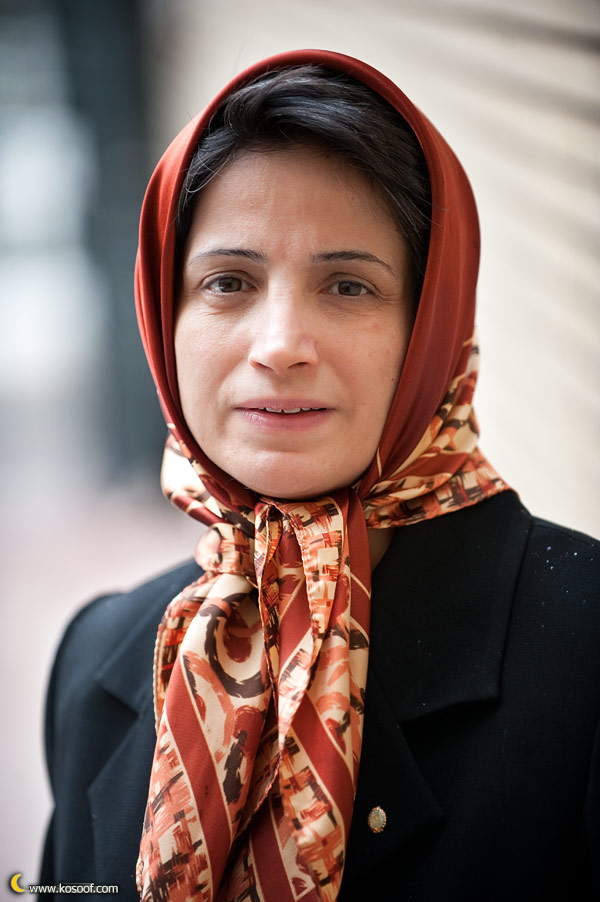
Today, 18 September 2013, the BBC and other news media brought the good news that Iran lawyer Nasrin Sotoudeh is among the freed political prisoners which Iran is reported to have freed (at least eight). Nasrin Sotoudeh was arrested in 2010 and jailed for six years on charges of acting against national security. She was one of the three Final Nominees of the MEA in 2012 and winner of the European Parliament’s Sakharov award.
The release of the political prisoners comes just days before Iran’s new President Hassan Rouhani visits New York for the UN General Assembly. In his election campaign, he promised to free political prisoners.
On 23 August 2013, the Observatory for the Protection of Human Rights Defenders, a joint programme of FIDH and OMCT, expresses its deep concern about the Iranian blogger and human rights activist Hossein Ronaghi-Maleki, whose health status has been deteriorating. On August 9, 2013, Mr. Hossein Ronaghi-Maleki started a hunger strike to protest the authorities’ ongoing refusal to allow him to continue his medical treatment out of Evin prison in Tehran. His mother, Ms. Zolaykha Mousavi, also started a hunger strike on August 20, 2013 to draw attention to his plight. Ronaghi-Maleki has been suffering from kidney and heart problems and bladder inflammation. Since the beginning of his hunger strike, he has suffered kidney bleeding, blood pressure oscillations and arrhythmic heart beats. He has already undergone several operations on his kidneys that were damaged after being repeatedly tortured during his detention, including 13 months in solitary confinement. He has been serving a 15-year prison sentence after being arrested on December 13, 2009 and convicted on charges of “membership of Iran-Proxy Internet Group”, “spreading propaganda against the system”, “insulting the Iranian Supreme Leader and the President”.
Since 13 July 2013, five ethnic Azerbaijani human rights defenders detained in Tabriz prison have taken part in an ongoing hunger strike in protest at their conviction following an unfair trial. Mahmud Fezli, Latif Haseni, Ayat Mehrali Baglou, Behboud Gholizadeh and Shahram Radmehr are members of the organisation Yeni Gamoh, Read the rest of this entry »
(Karim Lahidji, President of the International Federation of Human Rights(c) FRANCE 24)
Today Karim Lahidji was elected as new President of FIDH. He succeeds to Souhayr Belhassen who headed the Federation for six years. The vote was held during the 38th FIDH Congress in Istanbul where the FIDH member organisations were meeting to elect the new International Board and define the main FIDH orientations for the next three years. “It is an immense honour Read the rest of this entry »
When North Korea, Iran and Kazakhstan start praising your human rights records, it may be time to change tactics. Turkmenistan came under fire at a recent session of the United Nations Human Rights Council where it was questioned by its peers for its torture programs, systematic suppression of free speech and persecution of human rights defenders. Read the rest of this entry »
Sometimes my eyes fall on more esoteric contributions to the protection of human rights defenders. Let me share with you Mark Laham’s blog post for the Huffington Times of the 1st of May 2013 which calls for a “borderless” one-hour live online yoga class in honour of Nasrin Sotoudeh, the Iranian lawyer in jail, recipient of the Sakharov Award and Nominee of the MEA 2012. Mark got inspired – through AI – by what he read about Nasrin’s struggle and other brave human rights defenders around the world. “How does Nasrin’s story make you feel?” he asks, ” Me, I…I feel the need to do something that will create positive change for this woman and countless others like her.Read the rest of this entry »
Human rights group Reporters Without Borders has named and shamed five companies it claims allowed their products to be used by countries with bad human rights records and the NGO also named five countries as “enemies of the internet“. It said that five private sector companies; Gamma, Trovicor, Hacking Team, Amesys and Blue Coat are “digital era mercenaries”. The overall list of companies it believed were involved in selling products to authoritarian regimes was “not exhaustive” and will be expanded in the coming months. “They all sell products that are liable to be used by governments to violate human rights and freedom of information,” the group said.”Their products have been or are being used to commit violations of human rights and freedom of information. If these companies decided to sell to authoritarian regimes, they must have known that their products could be used to spy on journalists, dissidents and netizens.” It added that if surveillance products were sold to an authoritarian regime by an intermediary without their knowledge, “their failure to keep track of the exports of their own software means they did not care if their technology was misused and did not care about the vulnerability of those who defend human rights.” Research by Bloomberg, the Wall Street Journal and the University of Toronto’s Citizen Lab has established that surveillance technology used against dissidents and human rights defenders in such countries as Egypt, Bahrain and Libya came from western companies, it claimed.
The Paris-based group labelled Syria, China, Iran, Bahrain and Vietnam as“enemies of the internet” Read the rest of this entry »
(Special Rapporteur on the Situation of Human Rights in Iran Ahmed Shaheed. UN Photo/Jean-Marc Ferré)
On 11 March 2013 the Special Rapporteur on the situation of human rights in Iran, Ahmed Shaheed, voiced serious concern about the general situation of human rights in Iran, pointing to “widespread and systemic” torture, as well as the harassment, arrest and attacks against human rights defenders, lawyers and journalists. “The prevailing situation of human rights in Iran continues to warrant serious concern, and will require a wide range of solutions that are both respectful of cultural perspectives and mindful of the universality of fundamental human rights promulgated by the treaties to which Iran is a party,”.
Presenting his report to the Geneva-based Human Rights Council, Mr. Shaheed said that Iran has made some “noteworthy advances” in the area of women’s rights, including advancements in health, literacy and in enrolment rates on both the primary and secondary levels. Read the rest of this entry »
Human rights defenders from Iran, Cambodia, Kenya, Uzbekistan, Colombia and Mauritania are finalists for the 2013 Front Line Award for Human Rights Defenders at Risk. The jury is made up of members of the Irish and the European Parliament as well as Front Line Defenders board member Noeline Blackwell.
The winner of the 2013 Front Line Award for Human Rights Defenders will be announced at a ceremony in Dublin later in the year.
Finalists for Front Line Award for Human Rights Defenders at Risk 2013 are:
Mam Sonando – Cambodia – has devoted his life to helping the poor and disenfranchised of Cambodia, fighting for their rights while also following the non-violent precepts of his Buddhist faith. He is a journalist and the Director of one of only three independent radio stations in Cambodia where the state has almost complete monopoly over the media, and crackdowns on free speech have led to widespread self-censorship. He is also founder and president of a national organisation called the Association of Democrats, which actively promotes democracy and human rights. He was arrested In early July 2012 and despite there being absolutely no evidence to link him with the so-called secessionist movement, he was found guilty on 1 October 2012 of instigating insurrection and incitement to take up arms against the state and sentenced to 20 years imprisonment.
Mansoureh Behkish – Iran – is a women’s rights activist and co-founder of Mothers of Khavaran and Mothers of Laleh Park. As a supporter of non-violent resistance and a HRD she has spent the past three decades empowering survivors and victims of human rights abuses. In particular she seeks to help the mothers, sisters and wives of the thousands imprisoned or executed by the Islamic Republic authorities, to seek justice through legal and humanitarian channels.As a result of her work as a HRD, she herself has faced continuous harassment, confiscation of her passport and violation of her right to travel and three terms of imprisonment.
David Rabelo Crespo – Colombia – has worked for 35 years in the defence of human rights. In the early years, he worked mainly in defence of social, economic and cultural rights, and later worked for worker’s rights, promoting social and union mobilisation. In more recent years, he has worked to defend the lives of others although in doing so he has put his own life at risk. Between 1998 and 2004 he was director of the Municipal Peace Council, a body devised to protect the lives of the local people who, with the arrival of the paramilitaries were at risk from the upsurge in assassinations of social and community leaders, and a series of massacres carried out with impunity. David Rabelo Crespo has devoted his life to promoting respect for human rights and international humanitarian standards in the Magdalena Medio region of Colombia, and even though he is now imprisoned he continues to work to protect the rights of political prisoners in Colombian prisons.
Bahtiyor Hamraev – Uzbekistan – has been a dedicated campaigner for human rights in Uzbekistan for the last 15 years. He has been head of the Djizak regional branch of the Human Rights Society of Uzbekistan (HRSU) and has documented human rights violations in this region. In recent years he has become the main contact with families of imprisoned human rights defenders, helping to spread the information about their conditions in detention, the torture and ill-treatment and helping to provide the families with legal aid and financial assistance. The price he has had to pay has sometimes been far too high, but despite all of these difficulties, he has continued to work, refused to leave the country and tried to make a difference in one of the worst human rights situations in the region. Sadly, Hamraev is suffering from terminal cancer, yet he continues to send information about human rights violations and to assist families of imprisoned human rights defenders.
Biram Dah Ould Abeid – Mauritania – has been threatened, defamed and harassed because of his work for human rights and against slavery in Mauritania. He has been arrested and ill-treated on several occasions and in April 2012 he was “disappeared” for several weeks into a secret, high-security government facility, without being able to contact to his family and without any legal assistance. It is believed he would have been killed but for the international outcry. He was released in September 2012 but has chosen to continue his work inside Mauritania.
Ruth Mumbi – Kenya – is a passionate community mobiliser, and is the founder and current National Coordinator of Bunge la Wamama, a women’s chapter of Bunge la Mwananchi a movement that conducts strong advocacy and campaigning on issues of social justice and accountability in different parts of Kenya. She was born and still lives in Kiamaiko, a Nairobi slum and she began her involvement in community mobilisation initiatives in the late 1990s, when she was barely 16 years of age.
For further information please contact Jim Loughran, Head of Communications, Front Line Defenders
Tel +353 (0)1 212 37 50
Mobile +353 (0)87 9377586
Email: jimloughran@frontlinedefenders.org


 Mam Sonando – Cambodia – has devoted his life to helping the poor and disenfranchised of Cambodia, fighting for their rights while also following the non-violent precepts of his Buddhist faith. He is a journalist and the Director of one of only three independent radio stations in Cambodia where the state has almost complete monopoly over the media, and crackdowns on free speech have led to widespread self-censorship. He is also founder and president of a national organisation called the Association of Democrats, which actively promotes democracy and human rights. He was arrested In early July 2012 and despite there being absolutely no evidence to link him with the so-called secessionist movement, he was found guilty on 1 October 2012 of instigating insurrection and incitement to take up arms against the state and sentenced to 20 years imprisonment.
 Mansoureh Behkish – Iran – is a women’s rights activist and co-founder of Mothers of Khavaran and Mothers of Laleh Park. As a supporter of non-violent resistance and a HRD she has spent the past three decades empowering survivors and victims of human rights abuses. In particular she seeks to help the mothers, sisters and wives of the thousands imprisoned or executed by the Islamic Republic authorities, to seek justice through legal and humanitarian channels.As a result of her work as a HRD, she herself has faced continuous harassment, confiscation of her passport and violation of her right to travel and three terms of imprisonment.
 David Rabelo Crespo – Colombia – has worked for 35 years in the defence of human rights. In the early years, he worked mainly in defence of social, economic and cultural rights, and later worked for worker’s rights, promoting social and union mobilisation. In more recent years, he has worked to defend the lives of others although in doing so he has put his own life at risk. Between 1998 and 2004 he was director of the Municipal Peace Council, a body devised to protect the lives of the local people who, with the arrival of the paramilitaries were at risk from the upsurge in assassinations of social and community leaders, and a series of massacres carried out with impunity. David Rabelo Crespo has devoted his life to promoting respect for human rights and international humanitarian standards in the Magdalena Medio region of Colombia, and even though he is now imprisoned he continues to work to protect the rights of political prisoners in Colombian prisons.
 Bahtiyor Hamraev – Uzbekistan – has been a dedicated campaigner for human rights in Uzbekistan for the last 15 years. He has been head of the Djizak regional branch of the Human Rights Society of Uzbekistan (HRSU) and has documented human rights violations in this region. In recent years he has become the main contact with families of imprisoned human rights defenders, helping to spread the information about their conditions in detention, the torture and ill-treatment and helping to provide the families with legal aid and financial assistance. The price he has had to pay has sometimes been far too high, but despite all of these difficulties, he has continued to work, refused to leave the country and tried to make a difference in one of the worst human rights situations in the region. Sadly, Hamraev is suffering from terminal cancer, yet he continues to send information about human rights violations and to assist families of imprisoned human rights defenders.
 Biram Dah Ould Abeid – Mauritania – has been threatened, defamed and harassed because of his work for human rights and against slavery in Mauritania. He has been arrested and ill-treated on several occasions and in April 2012 he was “disappeared” for several weeks into a secret, high-security government facility, without being able to contact to his family and without any legal assistance. It is believed he would have been killed but for the international outcry. He was released in September 2012 but has chosen to continue his work inside Mauritania.
 Ruth Mumbi – Kenya – is a passionate community mobiliser, and is the founder and current National Coordinator of Bunge la Wamama, a women’s chapter of Bunge la Mwananchi a movement that conducts strong advocacy and campaigning on issues of social justice and accountability in different parts of Kenya. She was born and still lives in Kiamaiko, a Nairobi slum and she began her involvement in community mobilisation initiatives in the late 1990s, when she was barely 16 years of age.
 Hans Thoolen on Human Rights Defenders and their awards