Posts Tagged ‘Iran’

International Service for Human Rights rings alarm bell over composition of UN Committee on Civil society

May 1, 2014

Civil society loses as repressive States win election to regulate NGO access to UN” is the headline of a rightly alarming report on 23 April 2014 by the New York desk of the International Service for Human Rights [ISHR]. It calls on States that value and respect a vibrant civil society should do more to support non-governmental organisations to have their voices heard at the United Nations. The call comes after very few such States stood for election to an important UN committee that regulates civil society access to the UN, leaving the field to repressive States whose intolerance for civil society at home looks set to further restrict NGO access to the UN.ISHR-logo-colour-high Read the rest of this entry »

Ganji: Human rights in Iran improved, but still short of expectations

March 26, 2014


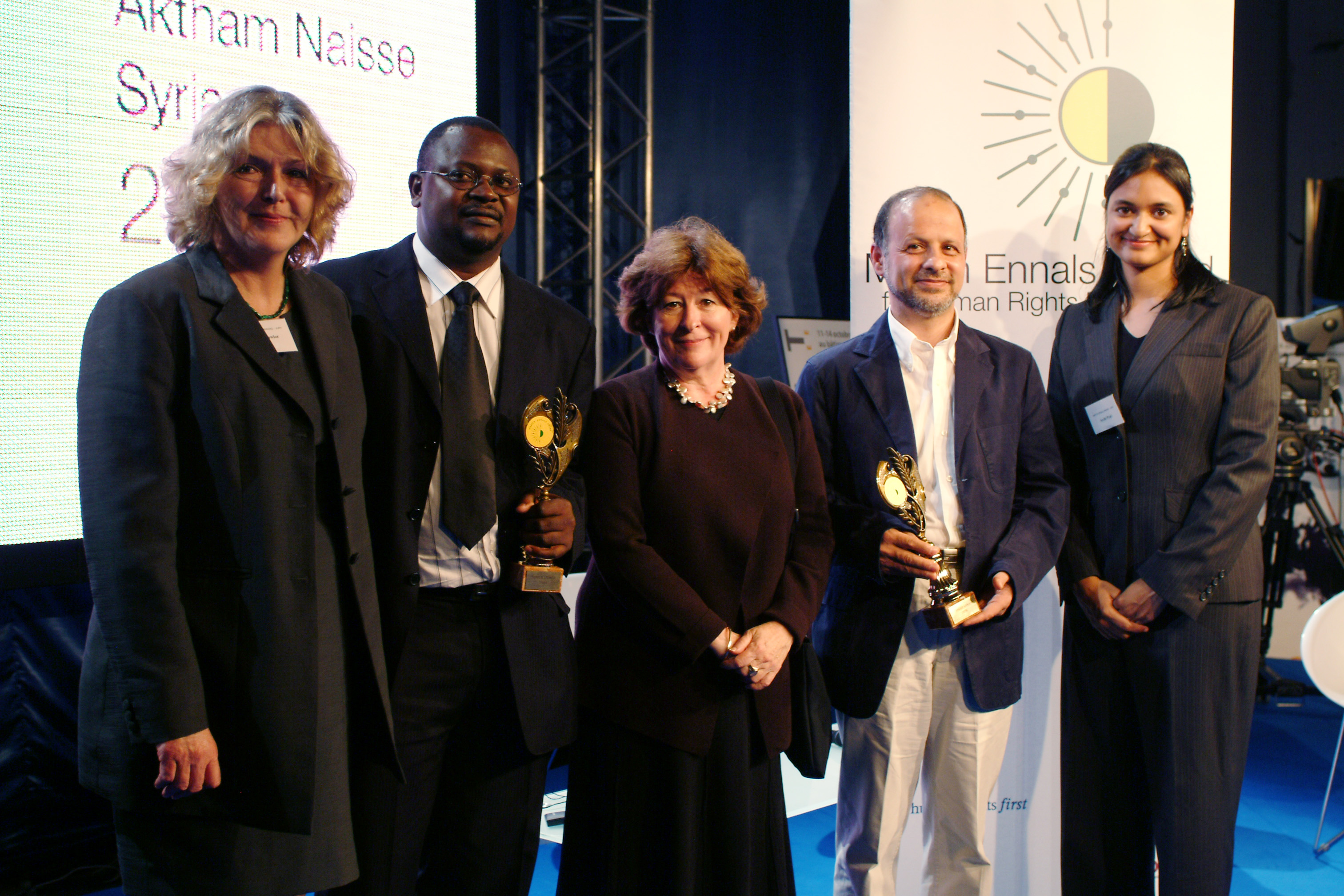
Remise du Prix Martin Ennals 2006

(Ganji – second from the right – at the MEA ceremony of 2006, where he received the award from UN High Commissioner Louise Arbour)

Al-Monitor of 25 March carries a lengthy interview with MEA Laureate Akbar Ganji in which Jahandad Memarian records many interesting insights, especially on the issue of sanctions and support to human rights defenders. The whole interview is certainly worth reading; here follow some long excerpts:

It is not an exaggeration to say that Akbar Ganji is the most celebrated dissident within the ranks of Iranian journalists since the inception of the Islamic Republic of Iran in 1979. A former supporter of the revolution, Ganji became disenchanted and turned into one of its most vocal critics. He is best known for his work as a journalist covering the 1998 murders of Iranian dissidents in Reformist newspapers, a series which came to be known as “the chain murders” that implicated top governmental officials. For his work revealing the murders of dissidents and attending a conference in Berlin that was condemned by hard-liners who were reeling after a Reformist victory in parliament, Ganji was arrested and served time in Tehran’s Evin Prison from 2001 to 2006. During his final year in prison, he went on a hunger strike that doctors urged him to end for concerns he would suffer permanent brain damage.

Ganji has won several international awards, including the World Association of Newspapers’ Golden Pen of Freedom Award, the Canadian Journalists for Free Expression’s International Press Freedom Award, the Martin Ennals Award for Human Rights Defenders and the Cato Institute Milton Friedman Prize for Advancing Liberty. In an exclusive interview via email with Al-Monitor, Ganji, based in New York, shared his thoughts about human rights and democracy in the context of President Hassan Rouhani’s administration.

Al-Monitor:  The UN secretary-general, Ban Ki-moon, has sharply criticized the Iranian president, Hassan Rouhani, saying, “He has not made any significant improvement” in ending human rights abuses since taking office. Nevertheless, Mahmoud Sadri — Iranian professor of sociology at the Federation of North Texas Area Universities — is optimistic about the new administration and has asked Iranian dissidents and intellectuals to take advantage of this historic opportunity. How do you evaluate the Rouhani administration?

Ganji:  The situation has improved from various aspects compared with the [Mahmoud] Ahmadinejad administration. However, it falls short of the expectations of democracy advocates and human rights activists. The Rouhani administration truly seeks to improve the state of human rights, but it has faced obstacles in Iran’s power hierarchy, including organizations that [Supreme Leader] Ayatollah [Ali] Khamenei oversees, such as the judiciary, law enforcement, etc., in addition to the Majles [parliament] that is controlled by the conservatives and some radical reactionaries.

…….Since his administration came to power, Rouhani has spoken with the supreme leader about freeing the Green Movement’s leaders (former Prime Minister Mir-Hossein Mousavi and former Majles speaker Mehdi Karoubi) and political prisoners, guaranteeing that nothing would happen, if they were freed.

Al-Monitor:  In January, you wrote a Huffington Post article titled “The Iran Nuclear Accord Is Good for Human Rights.” It seems to me whenever international pressure on the Iranian government increased, Iran improved its record. For example, Tehran released political prisoners ahead of Hassan Rouhani’s UN speech, including prominent human rights lawyer Nasrin Sotoudeh. Don’t you think such actions stem from international pressure? In the absence of this leverage — i.e., international pressure — Iran would continue human rights violations.

Ganji:  With regard to “external pressure on an undemocratic regime and improvement of human rights or increased oppression,” there is no law/rule that would address the cause-reaction relationships. At most, one can speak of “correlation.”[…] we need to know the following:

First, economic sanctions represent the collective punishment of a country’s people and do not necessarily lead to dictatorships’ downfall.

Second, long-term sanctions destroy the internal infrastructure of societies. ..Consequently, trust that is the basis of social capital is destroyed. Because of the sanctions, the oppressive regime’s increasing level of oppression, the internal destruction of society, is not visible. It is only in the aftermath of the dictatorship’s downfall that we will witness the visible spread of a wave of hatred, revenge and violence.

Third, in a life and death situation, the state of human rights, democracy and freedom completely falls by the wayside.

Fourth, consider Iraq’s example again. Before, the invasion al-Qaeda forces did not exist in Iraq, but they were born and bred as a result of the US sanctions and the US attack on Iraq. This story has been repeated in Libya and Syria. …..Iranian, US and European officials have professed that economic sanctions against Iran have affected Iran’s economy negatively. Last year, the economic growth rate fell to -5.8%. The inflation rate rose to 40%. The corruption rate climbed, and other negative outcomes followed. We should ask ourselves, what is the impact of recession on ordinary people’s lives?

The middle class, as a vehicle of democracy, has been transformed to the impoverished class, and its democratic movement may lose its agents. Democracy is the product of the balance of power between the government and civil society.

The transformation of the nuclear agreement from temporary to permanent, improvement of Iran’s relationship with Western governments, rekindling of ties between Iran and the United States, lifting of all the economic sanctions and alleviation of foreign threats can help empower the people through their mobilization and expansion of civil society. In that sense, the regime’s focus and its supporters will not be on discovering conspiracies of foreign governments and military attacks to destroy the regime. Let’s not forget that democracy and human rights have a direct relationship with economic development.

Al-Monitor:  You have opposed US aid to Iranian dissidents and human rights activists. What are your key criticisms against such aid? What actions should foreign countries.. take or avoid ?

Ganji:  The opposition that I have spoken about consists of groups and people that advocate regime change in Iran, so they can come to power. It is not possible for the leaders of a country to be indebted to other foreign governments, including the United States, Israel, Saudi Arabia, Russia and China. In that case, they will become the greater powers’ pawns. Look at the groups that have received financial aid from foreign governments in the past 35 years. What have they done? Do their terrorist and espionage activities constitute human rights activism, or are such activities considered criminal in all countries, including the United States and Israel, and are they strongly punished?

However, I support educational financial aid, including student scholarships and research fellowships for scholars. Just think about what would have happened if the $1.5 trillion that was spent on the wars in Afghanistan and Iraq would have been used toward education and development of the Middle East, and how that would have changed the region. Why do Western governments, the United States included, not grant scholarships to tens of thousands of talented and smart Iranian youth as students in social sciences?

Western governments should protest all human rights violations; they should give ethical and spiritual support to pro-democracy and human rights activists; they should file complaints at the UN Human Rights Council and ease the process of bringing perpetrators to justice. Moreover, Western powers should stop selling weapons of torture and oppression to dictatorial regimes. Ultimately, they should allocate financial resources to form independent labor unions and improve the state of human rights.

Ganji: Human rights improved, still short of expectations in Iran – Al-Monitor: the Pulse of the Middle East.

Read more:
https://thoolen.wordpress.com/tag/iran/

http://www.al-monitor.com/pulse/originals/2014/03/rouhani-reform-nuclear-iran-politics-student-human-rights.html#ixzz2x3K4G8RK

Iran’s Larijani attacks human rights report by UN and Sotoudeh expresses faith in the future

March 20, 2014

When it comes to the human rights situation in Iran one could refer to numerous recent reports that lament the continued repression and ill-treatment of human rights defenders in spite of the change of President at the top (as I did e.g. in: https://thoolen.wordpress.com/2014/03/10/iran-human-rights-defenders-arbitrarily-detained-are-made-to-suffer-again-through-lack-of-medical-care/), but perhaps another way to demonstrate the enormous gap between the fanatics in power and those who struggle for a better Iran is two contrasting quotes:

The first comes from the Head of Iran’s Human Rights Council, Mohammad Javad Larijani, who in a 2-hour press conference rejected again any criticism and attacked the UN Rapporteur on Iran, Ahmed Shaheed, saying that his report was biased and filled with inaccurate reports and double standards.Larijani said that “he was turned into a media actor for propaganda against the Islamic Republic of Iran”. [from Iran rejects latest human rights report by the UN | Iran Pulse: Must-Reads from Iran Today.]

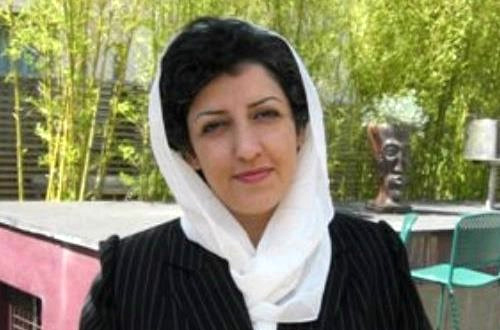
The other comes from http://www.arsehsevom.net/2014/03/nasrin-sotoudeh-equality-will-prevail/, quoting human rights lawyer Nasrin Sotoudeh, one of the Final Nominees of the MEA in 2012 and recently released:

nasrin-sotoudeh

Not much more to say!

Iran: Human Rights Defenders, arbitrarily detained, are made to suffer again through lack of medical care

March 10, 2014

The FIDH, on 6 March 2014, issued a statement on the lack of access to medical care for human rights defenders in Iran, resulting in further deterioration of their health FIDH fears this may amount to a systematic practice aiming at further intimidating civil society voices critical of the regime.logo FIDH_seul

On March 2, 2014, several prisoners of conscience detained in Evin prison, Tehran, wrote their second Read the rest of this entry »

“Human rights lectures are little more than a joke” but so is this article in the Herald Sun

February 27, 2014
People hold candles at Light the Dark - a vigil in response to tragic turn of events on M

(People hold candles at Light the Dark – a vigil in response to tragic turn of events on Manus Island that left one person dead and 77 injured. Source: News Corp Australia)

On 26 February the Australian Herald Sun contained an article by Rita Panahi under the provocative title: “Human rights lectures are little more than a joke. In it she hits hard at some countries that criticize Australia’s interception and detention policy of refugees. “Being lectured to by China and Iran about human rights abuses is a bit like taking advice on etiquette from Miley Cyrus. It’s not just the pot calling the sparkly stainless steel kettle black, but then accusing it of racial profiling.” Quite rightly she points to the irony that Iran feels “emboldened to attack, despite the fact the young man killed was supposedly fleeing that country.”[The riots in Manus Island detention centre escalated into a riot on Monday and 23-year-old Iranian Reza Berati was killed’]

Even China, with its record of silencing dissidents, felt entitled to question Australia’s record. China’s Foreign Affairs Vice-Minister, Li Baodong, criticised our asylum policy and expressed concern for “the protection of refugees and asylum seekers and the right of the children of refugees”. He said: “We have also asked about whether these refugees will be illegally repatriated to other countries.”

In looking at the China’s own human rights record the author then states: “Of course, China’s human rights abuses are not restricted to terrorising pregnant women. According to Amnesty International, “harassment, surveillance, house arrest and imprisonment of human rights defenders are on the rise and censorship of the internet and other media has grown. Repression of minority groups, including Tibetans, Uighurs and Mongolians, and of Falun Gong practitioners and Christians who practise their religion outside state-sanctioned churches, continues”. China and Iran indeed also execute more people than any other country.

However, to conclude now that these nations have “no right to question any country, let alone one with values of freedom and fairness, such as Australia” is a bit much. If only ‘sparkly’ clean countries are allowed to address human rights issues, it is going to be extremely silent. Would it not be preferable to have a substantive discussion of human rights issues? One that would include – in the case of Rita Pahani – at least a mention of the statement by Amnesty International – so eagerly quoted on above on China – on Australia’s refugee policy. It should not have escaped the author as the Amnesty statement came just two days before her own writing.

To help in her research: On Monday 24 February, Amnesty International in a report took a swipe at Australia for the way the country has responded to the global refugee crisis. Amnesty said Canberra should have accepted more refugees fleeing the bloody crisis in Syria.  The group said the country had the capability to take in seven thousand five hundred Syrian refugees. The rights group also called on Canberra not to send and detain vulnerable refugees on Islands in Papua New Guinea and the Republic of Nauru.” http://www.presstv.ir/detail/2014/02/24/352094/aussies-under-fire-over-refugee-stance/

Human rights lectures are little more than a joke | Herald Sun.

Committee to Protect Journalists publishes New Risk List: Where Press Freedom is going down

February 8, 2014

The Committee to Protect Journalists [CPJ] has published its Risk List, indicating where press freedom is in decline. In determining the list, CPJ staff examined six press freedom indicators: fatalities, imprisonments, restrictive legislation, state censorship, impunity in anti-press attacks, and journalists driven into exile. Countries named to the Risk List are not necessarily the world’s worst places for journalists; such a list would include nations like North Korea and Eritrea, where free expression has long been suffocated. Instead, the Risk List identifies the 10 places where CPJ documented the most significant downward trends during 2012. Those trends included:

  • High murder rates and entrenched impunity in Pakistan, Somalia, and Brazil.
  • The use of restrictive laws to silence dissent in Ecuador, Turkey, and Russia.
  • The imprisonment of large numbers of journalists, typically on anti-state charges, to thwart critical reporting in Ethiopia, Turkey, Vietnam, Iran, and Syria.
  • An exceedingly high fatality rate in Syria, where journalists faced multiple risks from all sides in the conflict.

CPJ, which is publishing its Risk List for the first time, identified Syria and Somalia, which are racked by conflict, along with Iran, Vietnam, and Ethiopia, nations that are ruled with an authoritarian grip. But half of the nations on the Risk List– Brazil, Turkey, Pakistan, and Russia, along with Ecuador–practice some form of democracy and exert significant influence on a regional or international stage.

Threats to press freedom were not confined within the borders of these nations. Four Risk List countries sought to undermine international or regional press freedom initiatives during the year. Russia pushed for centralized control of the Internet ahead of the World Conference on International Telecommunications. Ecuador led an effort, supported by Brazil, to weaken the ability of the Inter-American Commission on Human Rights to intervene in cases of systemic or grave press freedom abuses. Brazil and Pakistan were among a handful of countries that tried to derail a U.N. plan to improve journalist security and combat impunity worldwide.

Setbacks in Brazil are particularly alarming given its status as a regional leader and home to a diverse array of news media. But a spike in journalist murders, a failure to address impunity, and a pattern of judicial censorship have put Brazil’s press freedom at risk, CPJ found. Turkey, too, has projected an image as a regional model for freedom and democracy. But while Prime Minister Recep Tayyip Erdoğan has expressed a commitment to press freedom, his administration has wielded an anti-terror law as a club to jail and intimidate journalists.

Less surprising, but no less worrisome are setbacks in Vietnam, Ethiopia, and Iran. Though Ethiopia and Vietnam have been applauded for economic strides, both countries have lagged in terms of openness and freedom of the press. Conditions worsened in 2012, as Ethiopian and Vietnamese authorities ramped up efforts to stifle dissent by imprisoning journalists on anti-state charges. Iran, ignoring international criticism of its press record, has intensified an assault on critical voices that began after the disputed 2009 presidential election.

In Syria and Somalia, where journalists faced risks from multiple sides, the death tolls have mounted. Crossfire was the leading cause of death for journalists in Syria, although at least three journalists were assassinated, CPJ research shows. Both rebels and forces loyal to President Bashar al-Assad have been implicated in acts of violence against the press. All 12 journalists killed in Somalia in 2012, the country’s bloodiest year for the press, were targeted in direct reprisal for their reporting. Both insurgents and government officials were suspected of involvement. In both countries, the ranks of young journalists, many with little training and experience, have been particularly hard hit.

In the full report below you can find capsule reports on the 10 nations named to the CPJ Risk List:

 http://www.cpj.org/2013/02/attacks-on-the-press-cpj-risk-list.php

UN Working Group concludes that detention of human rights defenders in Iran is arbitrary

February 6, 2014

In an opinion adopted on 20 November 2013, the United Nations UN Working Group on Arbitrary Detention [WGAD] requested the release of Iranian human rights defenders Khosro Kordpour and Massoud Kordpour from arbitrary detention. The WGAD carried out its investigation pursuant to an appeal by the Observatory for the Protection of Human Rights Defenders and informed the Observatory (an FIDH-OMCT joint program me) of its decision on 4 February, 2014.logo FIDH_seulOMCT-LOGO Read the rest of this entry »

Larijani brothers, Iran, attack UN Rapporteur and human rights defenders

February 2, 2014

Just weeks before the United Nations Special Rapporteur for Human Rights in Iran is scheduled to present his latest report at the UN, the Head of the Iranian Judiciary, Sadegh Larijani, and his brother, Mohammad Javad Larijani, who heads the human rights council of that same Judiciary body, renew their verbal attacks on the Rapporteur. Read the rest of this entry »

Mary Lawlor: Making attacks on human rights defenders a “red line”

December 1, 2013

(Nasrin Sotoudeh was recently released from prison in Iran – EPA)

On 1 December Mary Lawlor, Executive Director of Ireland-based Front Line Defenders, published an opinion piece in Al-Jazeera on the place of human rights defenders in the recent developments concerning Iran and Syria. In order not to lose the coherence of the argument I give it here in full: Read the rest of this entry »

The release of human rights defenders written up in a Lifestyle Magazine

November 29, 2013

Just as an example of how human rights defenders and the work to support them can appear in a Lifestyle Magazine:

Across Canada human rights supporters have recently been celebrating the releases of a number of prisoners of conscience—people jailed solely for the peaceful expression of their beliefs.

In China, poet and journalist Shi Tao was released after more than eight years in prison. Supporters of the human rights organization Amnesty International (amnesty.ca) had long campaigned for his freedom by writing letters to the Chinese authorities and signing petitions calling for his release. Shi Tao was imprisoned in 2004 for sending an email using his Yahoo account. His email summarized a communiqué from the Chinese Central Propaganda Department telling journalists how they should handle the 15th anniversary of the crackdown on the 1989 pro-democracy movement. The Chinese authorities accused him of “illegally providing state secrets to foreign entities”. Shi Tao expressed his thanks to supporters: “The support and encouragement of friends from around the world have helped my mother and me through the difficult and lonely times.” Other prisoners of conscience recently released in China this year included human rights defender Ni Yulan, and Falun Gong practitioners Wang Xiuqing and her daughter Qin Hailong, released after 18 months in a “re-education through labour” camp.


In Iran, the sudden release of prisoner of conscience Nasrin Sotoudeh in September further showed how the passion and persistence of individual people around the world taking action by putting pen to paper can help human rights. Sotoudeh is widely respected for her work as a lawyer. She has represented children facing the death penalty, prisoners of conscience and human rights defenders, and has worked closely with Iranian Nobel Peace Prize laureate Shirin Ebadi. But in August 2010 Sotoudeh was locked up in Tehran’s notorious Evin prison though she had committed no crime. During her imprisonment, Nasrin was stopped from having regular visits with her husband, Reza Khandan, and two young children. Amnesty International declared her a prisoner of conscience and quickly launched a global appeal demanding her release. Supporters tirelessly wrote letters to the Iranian authorities requesting them to free the human rights lawyer. Their efforts helped win a great victory. Sotoudeh sent a thank you for the support she had received from people around the world. “I have been aware of all your efforts on my behalf and I want to thank you!

Human rights supporters celebrate recent prisoner releases : The Canadian Lifestyle Magazine.