On 22 May 2024 Front Line Defenders launched its Global Analysis 2023/24 on the situation of human rights defenders (HRDs) at risk around the world, an in-depth annual publication detailing the variety of risks, threats and attacks faced by HRDs around the world.
The report also reveals statistics gathered and verified by the HRD Memorial initiative – which Front Line Defenders coordinates – documenting the killings of at least 300 HRDs in 28 countries in 2023. Almost a third of those killed (31%) were Indigenous people’s rights defenders. This brings the total documented killings of HRDs in the last decade to nearly 3,000.
“This appalling wave of attacks on human rights defenders is a direct result of an international human rights framework left in tatters and governments’ double standards when it comes to respecting human rights,” said Alan Glasgow, Executive Director of Front Line Defenders. “A quarter decade after the UN adopted a Declaration on human rights defenders, not enough progress has been made to ensure defenders are valued and protected. In this time, thousands of defenders have paid with their lives and many more face ongoing attacks and intimidation for their peaceful work. Urgent action is needed to change this.”
Wide-ranging risks to HRDs
Globally, the violation most commonly cited by HRDs was arbitrary arrest/detention (15%), followed by legal action (13%), continuing an ongoing trend of criminalisation as the most-reported risk. This was followed by death threats (10.2%), surveillance (9.8%) and physical attacks (8.5%). Trans and non gender-conforming HRDs reported slightly higher rates of physical attacks, and a much greater risk of smear campaigns. Globally, the five most targeted areas of human rights defence were: LGBTIQ+ rights (10.2%); Women’s rights (9.7%); Human rights movements (8.5%); Indigenous peoples’ rights (7.1%); and Human rights documentation (5.2%).
The statistics in the Global Analysis are derived from Front Line Defenders’ casework and approved grant applications between 1 January and 31 December 2023. The statistics are based on 1,538 reported violations in 105 countries. Front Line Defenders documents multiple violations per case or grant, as this is the reality of the situation for human rights defenders. For more details on how these and the HRD Memorial data are gathered, please refer to the Methodology section at the end of the report.
Here Haris Azhar shares how and why he believes the law can be used as a powerful tool to deal with repression of democratic voices and their rights. Read more from our In My Own Words series here.
My name is Haris Azhar. I would say I’ve been working, in general terms, on human rights issues for the last 25 years. I work across the country in Indonesia on some human rights, issues or situations, and in some conflict areas such as in Papua.
I have been working for and dealing with some vulnerable groups such as labour groups, as well as the indigenous people and victims from the violence as well. These days I practise as a lawyer, I do pro bono and also professional for-profit work where I use the profits work to subsidise the pro bono and public interest legal work. I have also joined some organisations, and I was director for two human rights organisations. So that’s why I’ve been very human rights focused.
In early 2024 me and my friend Fatia were brought to court. We won, and we got a good decision from the court. But this is not the final one, because the attorney general has appealed to the Supreme Court. I think this whole process was meant to serve as an example.
The whole process, especially last year, was intended to be intimidation. The litigation or the pre-trial process was intended to intimidate me [and] not to not say more about the practice of business oligarchs in this country. But myself, lawyers, and groups here said, we would not say sorry. We would not stop speaking, and that those in power could continue their judicial harassment of us and that we would fight them.
And during the fight, a lot of things happened [such as] intimidations, negative accusations and campaigns. They accused us of hoax stories, but actually they did the hoax stories. They took over and intercepted my mobile phone as well. These are the lengths and practices of intimidation in place.
However, the process of the court for people like us, we pretty much don’t really care about the final decisions. We can see the shadow of the prisons, because what the government thinks is important for them is for us to not have democratic voices. There aremany cases by politicians and by business groups that aim to criminalise decent voices, and it has become a [common] practice. There are even consultants that can help you if you would like to know how to criminalise decent/democratic voices.
It’s become an industry against freedom of expression, to show that, “This is what happens if you are against us.” They wanted to show they could bring me to court so the warning was that anyone who becomes the client of Haris should be aware. It was symbolic, and that’s what I mean it is a message to intimidate and to intimidate vulnerable groups especially.
Widespread engagement on human rights, working through organisations, has developed not only my knowledge, my skill, but also my networks. This has also developed my interest in what some of the ways we (as a nation) would like to put on the table with regards to issues of human rights.
As a practising lawyer, we have always believed here that we can use the law [to achieve justice]. However the movement here is not like in South Africa, as an example, where at one point in South Africa there was no real equality. There was no legal institution that could be used to secure fairness. We don’t have that kind of situation here [in Indonesia], but we are still looking for the formalisation of equality and fairness.
We like to use the legal debate, space, and discourse as a way to combat evil, because the law provides the kind of tools or ammunition to attack evil. Those in power hide behind the law and therefore here in Indonesia, most of the battle and discourse always has an element of legality.
I believe that the law is one of the crucial things that need to be handled, in addition to other advocacy issues. Because we know that the law or legal mechanisms are [also] being used by the bad guys, by the oligarchs to justify and legalise their plans and to do their own business. Those in power always say that they have complied with the law, that they uphold the rule of law, but actually we know that the law they comply with is their own creation. It is their own definition. That’s why we [as legal practitioners] need to step in, even though it’s not the popular action to do so.
If those in, and adjacent to, power cannot be left to create what is good and not good within the framework of law. We need to bring in the voices from the ground. We need to bring the voices from the indigenous people. We need to bring the voices from the labour groups, from the students, from the women’s groups, and many other vulnerable groups who are connected to the issues.
This is instead of the politicians and the business groups alone making their own arguments and developing their own definitions. We cannot let them be, and let them take over in that kind of way. Rule of law and legislation, has to be accompanied and coloured by the vulnerable voices and interests. This is why we insist that a part of the campaign, part of the research, is that we take the legal action as well.
The gap between the haves and the political groups on the ground is huge. This has been happening year on year, and it is getting worse every year. The new regulations and legislations that we have here, which very much comply with the interests of the business groups which belong to some politicians, create more loose protection of rights of workers and women. For the youth and the students, they are getting fewer protections for their education and freedom.
There’s no freedom on campus for students anymore, [because of] intervention from the government and the police on campuses. It’s getting obvious these days. So I think we need at least two things. First, figuring out how to protect vulnerable groups, because why they were attacked or would be attacked is because they found irregularities, and problematic issues behind the policies of the government, or the law.
These issues have led to economic issues, social issues, business issues and so the vulnerable groups make a choice where they complain or protest, but they get attacked by police, government and intelligence. That is why we need more collaborations with vulnerable groups.
We also need more friends — lawyers, international advocates, researchers — coming down into the rural areas, and into the urban areas to capture what is happening and make a noise, to campaign. That’s why we need to have the first group that I mentioned before. We need not to deal with the substance of the problem, but with the second layer of the problem, [which is] the attacks of the participation, the effects to the participation. For this we need to have a lot of groups [working on] how to deal with this kind of shrinking space.
We just had the 2024 elections where we campaigned around the threat to our freedoms of speech and expression. Some of the candidates responded very well, but the one that was supported by the current regime didn’t have a strong resonance with what we are saying. In addition to the campaign, along with my criminalisation, myself, some friends and organisations submitted a complaint to the Constitutional Court.
Our complaint was regarding some legal articles which were being used against me and against some journalists. We won the case in the Constitutional Court earlier this year, and an article which had been used to criminalise a lot of people has now been dropped. But this win is very short [lived] because we have some articles within certain laws which allow the police to criminalise speech.
When I said we won, that’s regarding just one article in our criminal code. But in the next year and a half we will have a new criminal code implemented and new articles to criminalise speeches. We will need to challenge those articles in the next two years. It’s like Tom and Jerry, where we play hide and seek. It seems politicians and business need a shield to protect themselves from the public, hence these situations but we keep fighting them using the same law.
Legal institutions are not our institutions yet. They are still their institutions [meaning the powerful]. However to a certain degree, the legal space is an open stage for you to perform, to have a say. I think if we don’t fill the space, it will be filled by those who are not supportive of freedom of speech or freedom of expression.
These are the reasons why I think we have to join legal action. So as to not give space for evil to come in and occupy. Also, legal action is not the only type of work needed. It has to be one among others. For instance there is advocacy work too. But law cannot be neglected and that’s why this current situation (and the coming situations), require more than just focusing on the legal system. It has to be about a collaborative methodology and approach.
Human rights defenders and civil society are the voices of our communities. These voices must be at the heart of decision and policy making at all levels. Yet, some States and non-states actors feel those voices are too loud. Cao Shunli, Chinese human rights defender, victim of reprisals who died in detention 10 years ago. Around the world, inspiring voices echo Cao’s ambition, on different issues and in different contexts, but with the same aspiration: promoting and protecting human rights. In so doing, many have engaged with the United Nations to share evidence of abuses with experts and States. Regrettably, some are facing the same form of reprisals as Cao, and are now arbitrarily detained.
These include Trang in Viet Nam, Irfan and Khurram in India and Abdulhadi in Bahrain.
It’s time to take a stand. Join us in our campaign to #EndReprisals and call for the release of Trang, Abdulhadi, Khurram and Irfan. Let’s ensure that no one else faces Cao’s fate. Their voices deserve to be heard, and their freedom and lives must be protected.
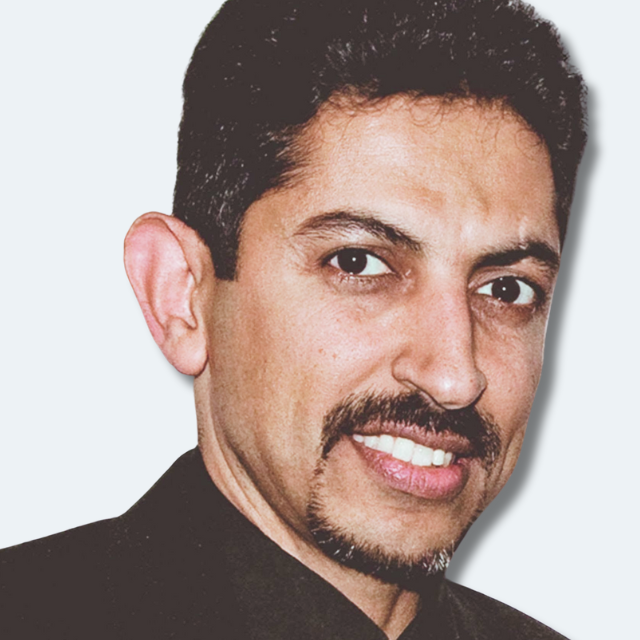
Abdulhadi Al-Khawaja
Abdulhadi Al-Khawaja is a Bahraini-Danish advocate known for his unwavering commitment to freedom and democracy. An outspoken human rights defender he serves as a source of inspiration for activists in Bahrain and globally. Abdulhadi has protested Bahrain’s unlawful detention and torture of several civilians since he was a student. He received political asylum in Denmark with his family where he continued his advocacy work, documenting human rights violations in Bahrain.
Abdulhadi Al-Khawaja was included for five times in the Secretary-General report on reprisals, noting “allegations of arbitrary arrest, torture and lengthy sentence following his engagement with United Nations human rights mechanisms.” In 2012, the Working Group on Arbitrary Detention found the detention of Abdulhadi arbitrary.
Pham Doan Trang is an author, blogger, journalist and pro-democracy activist from Viet Nam. She is a well-known advocate for human rights and has written on a wide range of human rights topics, including LGBTQI+ rights, women’s rights, environmental issues and on the suppression of activists.
She is considered among the most influential and respected human rights defenders in Viet Nam today. She has always been a major source of inspiration and mentorship for Vietnamese civil society and the next generation of human rights defenders.
Trang was prosecuted for her articles and reports on the human rights situation in Viet Nam, including an analysis of a 2016 report on the Formosa Ha Tinh Steel Plant environmental disaster that was shared with the United Nations. See also: https://humanrightsdefenders.blog/tag/pham-doan-trang/
Trang was the subject of several communications by special procedures mandate holders and an Opinion by the Working Group on Arbitrary Detention in 2021, which found her deprivation of liberty arbitrary. On 2 November 2022, experts addressed Trang’s detention, including restriction of her right to family visits and her deteriorating health status.
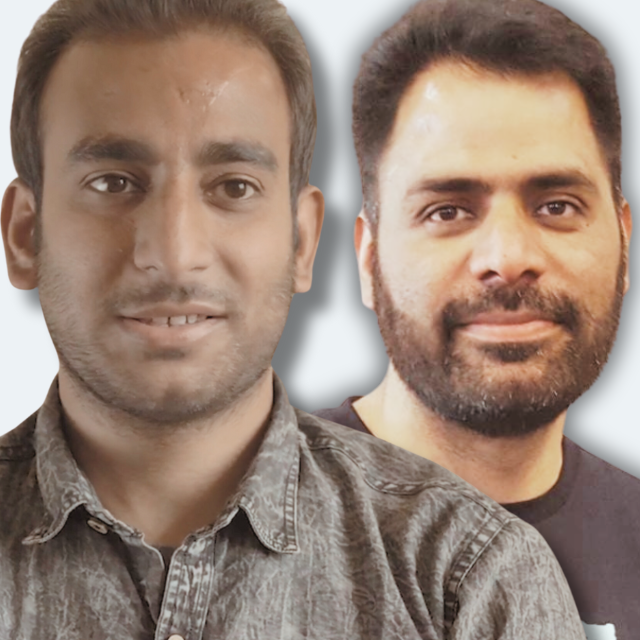
Irfan Mehraj and Khurram Parvez
Khurram Parvez and Irfan Mehraj are two Kashmiri human rights defenders. They have conducted ground-breaking and extensive human rights documentation in the Indian-administered Jammu and Kashmir, including through their work within the Jammu Kashmir Coalition of Civil Society (JKCCS) – Khurram as founder and programme coordinator, and Irfan as a researcher.
On 22 November 2021, Khurram was arrested again by the Indian Government, this time by India’s National Investigation Agency (NIA) under the Unlawful Activities (Prevention) Act (UAPA) and other laws, reportedly on allegations of “terrorism funding, being a member of a terrorist organisation, criminal conspiracy, and waging war against the state.” He remains in arbitrary detention to this day.
Meanwhile, on 20 March 2023, Irfan was summoned for questioning and arbitrarily detained by the NIA in Srinagar also under provisions of the UAPA and other laws. The NIA targeted Irfan for being ‘a close associate of Khurram Parvez.’ Both Khurram and Irfan are presently in pre-trial detention in the maximum-security Rohini prison in New Delhi, India. If convicted, Khurram and Irfan could face life imprisonment or even the death penalty.
Khurram’s situation has been included in the Secretary-General’s report on reprisals since 2017 and Irfan’s case was included in the 2023 report.
In June 2023, United Nations experts expressed serious concerns regarding the charges against and arrest of Irfan and Khurram, stating that their continued detention is ‘designed to delegitimise their human rights work and obstruct monitoring of the human rights situation in Indian-administered Jammu and Kashmir.’ The United Nation Working Group on Arbitrary Detention (WGAD) published an opinion in the same year, finding Khurram’s detention arbitrary.
What do we want? It’s simple. We want Irfan, Khurram, Trang and Abduhadi to be freed so they can continue their work without fear of further reprisals, and we want accountability for Cao.
How do we achieve this?
We mobilise diplomatic missions, encouraging them to speak out and raise individual cases of reprisals against defenders at the UN and in other spaces and hold their peers to account. We convince the UN Secretary General and his team to acknowledge and document ALL cases of reprisal and intimidation by including them in his annual report on reprisals and intimidation against defenders engaging or seeking to engage with the UN and its human rights mechanisms. We push the UN system to establish clearer protocols on how to consistently and effectively prevent, respond and follow up on cases of reprisals. We encourage governments, activists, and concerned individuals to stand in solidarity with human rights defenders and organisations who are subjected to reprisals and intimidations.
What can you do?
To achieve our goals, we are drawing attention to some of the most emblematic cases of reprisals that illustrate how human rights defenders are prevented from or punished for engaging with the UN. Here are impactful actions you can take:
In order to assist stakeholders with research, analysis and action on cases of reprisals and intimidation, ISHR launched an online database compiling cases or situations of intimidation and reprisals documented by the United Nations (UN) Secretary-General between 2010 and 2020.
878 Cases of intimidation and reprisals against human rights defenders engaging with the UN reported by the UN Secretary General between 2010 and 2020.
81 Countries were cases of reprisals were documented by the UN Secretary-General between 2010 and 2020.
13 Reports published by the UN Secretary General on intimidation and reprisals.
On 08 May 2024 the OHCHR published the address by Volker Türk, UN High Commissioner for Human Rights, to the 2024 Global Alliance of National Human Rights Institutions Annual Conference:
…The role that National Human Rights Institutions (NHRIs) can play in this era of global crises is more crucial than ever. An era of deepening divisions between our human family, where inequalities are widening, where poverty is at levels not witnessed in a generation.
…It implies that everyone can – and must – be a partner in the human rights movement. Including the private sector. This conference will address some of the big questions on the impacts – both negative and positive – that business can have on human rights.
On climate change, how can business avoid and avert harm, and instead innovate and adapt to be part of the solution?
On civic space, particularly in the online world, how can business live up to their responsibilities to enable and nourish freedom of expression and at the same time protect the human rights defenders bravely demanding change? More broadly, how can regulatory and policy measures on human rights work best for business, and how can we guarantee the necessary protection and support for affected individuals and communities?
And of course, ultimately, how can NHRIs leverage their unique mandate to guide and support businesses in addressing these issues?
The private sector is a key piece of the architecture needed to rebuild trust, and to restore faith in the unifying power of human rights. The landmark Edinburgh Declaration provides a robust framework to help NHRIs in these efforts.
And NHRIs are also playing a crucial role in ensuring governments live up to their responsibilities to implement effective remedies for the individuals and communities harmed by business-related activities.
As you well know, the United Nations Guiding Principles on Business and Human Rights were developed to protect against human rights abuse by business activity. The gold standard to ensure that business is held accountable. That business keeps on enhancing and adapting their practices to put human rights front and centre. And that victims of abuse have access to remedy.
Over the past thirty years, my Office has worked closely with Member States and their NHRIs to better promote and protect all human rights at the national level. A growing interest from countries in not only establishing NHRIs, but ensuring that they are independent, and that they are effective…
To date, 120 NHRIs have been accredited by the Global Alliance in an internationally legitimate process serviced by my Office. Eighty-eight of those have received ‘A’ status for their full compliance with the Paris Principles, the standards which all NHRIs must meet.
At the international level, too, my Office has supported NHRIs and their regional and global networks to engage with the UN human rights mechanisms, including the treaty bodies and the Human Rights Council, its Universal Periodic Review and the Special Procedures…
In the three decades since I became a lawyer, human rights – once understood as an uncomplicated good, a tool for securing dignity for the vulnerable against abuses by the powerful – have increasingly come under assault. Perhaps never more so than in the current moment: we are constantly talking about human rights, but often in a highly sceptical way. When Liz Truss loudly proclaims “We’ve got to leave the ECHR, abolish the supreme court and abolish the Human Rights Act,” she’s not the fringe voice she might have been in the 1990s. She represents a dangerous current of opinion, as prevalent on parts of the radical left as on the populist right of politics. It seems to be gaining momentum.
As an idealistic youngster, I would have been shocked to know that in 2024 it would be necessary to return to the back-to-basics case, to justify the need for fundamental rights and freedoms. But in a world where facts are made fluid, what were once thought of as core values have become hard to distil and defend. In an atmosphere of intense polarisation, human rights are trashed along all parts of the political spectrum – either as a framework to protect markets, or as a form of undercover socialism. What stands out for me is that the most trenchant critics share a profound nationalism. Nationalists believe that universal human rights – the clue’s in the name – undermine the ability of states to agitate for their narrower interests.
Given that so many of our problems can only be tackled with an international approach, a robust rights framework is more important than ever
It’s no coincidence that the governments keenest on turning inwards – Viktor Orbán’s in Hungary, that of former president Bolsonaro in Brazil – have been least keen on common standards that protect minorities in their own territories and hold them to high standards in the international arena. At a time of insecurity, these leaders leverage fear to maximise their appeal. The prospect of a second Trump administration in the US demonstrates that this trend shows no sign of abating. In that context, it’s vital to make the case for human rights anew.
It boils down to this: given that so many of our problems – in an age of climate change, global disorder and artificial intelligence – can only be tackled with an international approach, a robust rights framework is more important than ever. There are parallels with the postwar period in which human rights were most fully articulated, a time when it was obvious to everybody that cooperation and global standards were the best way to shore up our common humanity after a period of catastrophic conflict and genocide.
Of course everyone believes in some rights – normally their own and those of friends, family and people they identify with. It is “other people’s” freedoms that are more problematic. The greater the divisions between us, the greater this controversy. And yet, it is precisely these extreme disparities in health, wealth, power and opinion that make rights, rather than temporary privileges given and taken away by governments, so essential. They provide a framework for negotiating disputes and providing redress for abuses without recourse to violence.
New technologies, and AI in particular, require more not less international regulation. As people spend more time online, they become vulnerable to degrading treatment, unfairness and discrimination, breaches of privacy, censorship and other threats. The so-called “black boxes” behind the technology we use make ever more crucial decisions about our daily lives, from banking to education, employment, policing and border control. Anyone who flirts with the notion of computer infallibility should never forget the postmasters and other such abuses, perpetrated and then concealed.
Our shrinking, burning planet is the ultimate reason why nationalism does not work in the interests of humankind
Perhaps most important of all is the growing contribution of human rights litigation to the struggle against climate catastrophe. A whole generation of lawyers and environmentalists is taking notes from earlier struggles, just as suffragists once learned from slavery abolitionists. This is despite the machinations of fossil fuel corporations versed in a thousand lobbying, jurisdictional and other delaying tactics.
Our shrinking, burning planet is the ultimate reason why nationalism does not work in the interests of humankind. Today’s global empires, sailing under logos rather than flags, need to be more directly accountable under human rights treaties. Our existing mechanisms, whether local and national governments, domestic and international courts, or some of the more notoriously tortuous UN institutions, may be imperfect and in need of reform. Yet, like all structures of civilisation, they are easier to casually denigrate than to invest in and adapt to be more effective.
While I have been writing this, I have been voting in the House of Lords on amendments to the so-called safety of Rwanda bill. It is the most regressive anti-human rights measure of recent times, and intended to be that way. It will not stop the boats of desperate people fleeing persecution, but is designed to stop the courts. British judges will be prevented from ensuring refugees’ fair treatment before they are rendered human freight and transported to a place about whose “safety” our supreme court was not satisfied. Rishi Sunak will be able to use this situation as excuse for an election pledge to repudiate the European convention on human rights.
If he gets his way, rights will be removed not just from those arriving by boat, but from every man, woman and child in the UK. By contrast, the golden thread of human rights is equal treatment: protecting others as we would wish to be protected ourselves, if that unhappy day ever came. It’s a thread we must never let go of.
Right Livelihood Laureates illuminated the struggles and triumphs facing youth activists in a panel discussion organised by its Geneva office in March 2024. With speakers including Laureates from Belarus, Cambodia, and Egypt, as well as the UN Special Rapporteur on human rights defenders, the event painted a vivid picture of the evolving landscape of youth activism.
Natallia Satsunkevich, representing Belarusian Laureate organisation Human Rights Center “Viasna”, shared her journey, beginning as a civil rights summer school attendee to becoming an activist with Viasna to shed light on the abuses of Belarus’s repressive regime.
“I realised that I have this power to monitor and control the government,” she said. “This is obviously the aim of civil society in each country.”
She has faced backlash for her work: her apartment was searched and her mother was questioned by authorities. Eventually, Satsunkevich had to flee Belarus to avoid criminal prosecution. Five of her Viasna colleagues, including founder and Right Livelihood Laureate Ales Bialiatski, are imprisoned for their work.
“Nevertheless, I think the decision to become a human right activist and joining Viasna was one the best decisions of my life,” she said, pointing to the close friendships and working relationships she has developed. “The most important point is that I feel like I am doing the right thing, I know that I am making this world better.”
She called on young people around the world to “check your rights”: keep an eye on leaders and make sure that all human rights are respected.
Ratha Sun, from the Laureate organisation Mother Nature Cambodia, highlighted the innovative approaches of young activists. Despite facing legal challenges and imprisonment, the group’s viral campaigns and grassroots mobilisation have sparked significant environmental advocacy.
“For all our videos and campaigns, we … think about creativity and technical ideas to get more involvement from young people,” Sun said. “We also work closely with the local community that is being affected by the project [we’re fighting].”
The group’s activism has stopped damaging construction and extraction projects such as a hydropower dam and sand mining.
Their successes have resulted in more attention from the Cambodian public and, at the same time, also drew the ire of the government.
“Between 2015 and now, 11 members of Mother Nature Cambodia have been in jail, and now, six of us still have charges against us from the court,” Sun said, noting that the charges include insulting the king and plotting against the government. Sometimes, they are also accused of being members of the CIA.
“Even though we are facing 10 years in prison, our activists, who are young, are still standing to fight the government,” Sun said.
2016 Laureate Mozn Hassan, the founder of Nazra for Feminist Studies and the Doria Feminist Fund, talked about the double bind of being a young female activist in the Global South. Battling stereotypes and systemic challenges, Hassan emphasised the importance of expressing feminism and fighting gender-based discrimination creatively.
“Being a woman in these contexts is so problematic and has all these barriers from the private and the public – and all of them are affecting us,” Hassan said. “Especially if they are young: … it is also about resources, accessibility and acceptance.”
She noted that in the Middle East and North Africa region, the stigma for young feminist activists working on gender issues has been increasing, and they are targeted more often.
“For example, in Iraq, it’s not allowed to name any of the activity as something relating to gender,” she said, noting that this was especially the case for young activists expressing their femininity or sexuality in non-traditional ways.
When it comes to the tools young activists are using, in many countries, such as Egypt, they are being targeted and imprisoned for social media posts.
Having just finished a report on youth and child human rights defenders, Mary Lawlor, UN Special Rapporteur on human rights defenders, provided a global perspective. She highlighted the unique contributions of youth and child activists, drawing attention to their innovative use of social media, decentralisation, and creativity in campaigning.
“Young people face the same challenges as all other human rights defenders, and they often use the same approaches as other human rights defenders,” Lawlor said. “But where they differ is that they are very creative, and they have novel tools and methods.”
She noted their “extremely clever use of social media” that can garner attention.
However, she also pointed out the challenges they face, including exclusion from formal decision-making.
“Ageism is a frequent barrier to young and child activism: Young defenders feel they are not being heard, not being taken seriously, and their views are not being taken into account,” Lawlor said. “Even when their participation in public and political decision-making has been increased, it’s usually a tokenistic box-ticking exercise.”
ILGA World (https://ilga.org/) published a comprehensive index of deadlines facilitating engagement with UN human rights mechanisms. This invaluable resource is crafted to serve as a guiding beacon for human rights defenders (HRDs) dedicated to advancing the rights of individuals within the realms of sexual orientation, gender identity, gender expression, and sex characteristics (SOGIESC). The active involvement of HRDs in UN mechanisms is paramount, acting as a catalyst for transformative global change. The Guide is equally useful for non-SOGIESC submissions.
For those aspiring to witness targeted recommendations on SOGIESC issues directed at their respective countries, active participation in the Universal Periodic Review (UPR) holds utmost importance.
Similarly, collaboration with the Treaty Bodies provides a unique platform wherein a panel of experts rigorously evaluates a nation’s adherence to international human rights treaties, illuminating crucial intersections with the challenges faced by the LGBTI community.
This index serves as a vital compass, delineating pivotal deadlines and milestones, empowering HRDs to navigate the intricate UN mechanisms strategically, thus making substantial contributions to promoting and protecting human rights on a global scale.
On 25 April 2024, ProtectDefenders.eu, the European Union (EU) Human Rights Defenders Mechanism, presented its comprehensive annual report entitled “REACHING FURTHER,” covering the period November 2022 – October 2023. This report illustrates the support provided and efforts made by ProtectDefenders.eu to support human rights defenders (HRDs) around the world, and especially to reach those who are the most at risk.
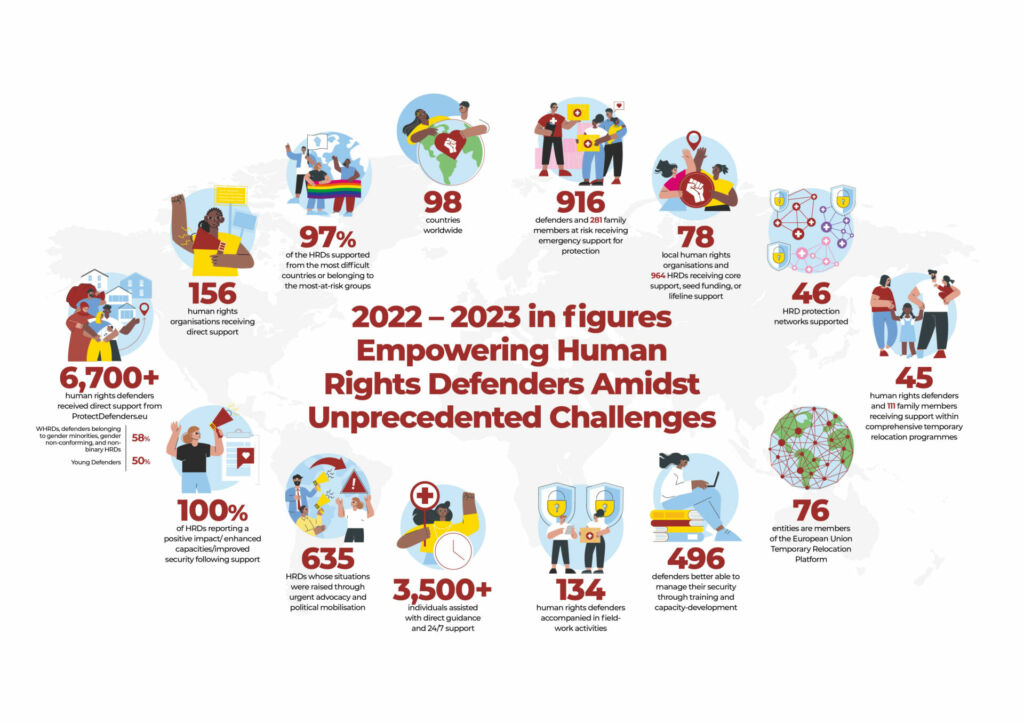
In November 2022, ProtectDefenders.eu entered the third phase of its implementation, marking a milestone in its commitment to safeguarding human rights defenders worldwide. Throughout the first year of this new phase, the renewed and consolidated EU HRD Mechanism has provided direct protection, support, and empowerment to over 6,700 at-risk HRDs, with a particular focus on those facing the highest risks. Notably, 50% of beneficiaries were young defenders, and 58% identified as women human rights defenders (WHRDs), trans-male, trans-female, genderqueer, or gender non-conforming individuals.
Despite facing extraordinary challenges amidst protracted crises globally, ProtectDefenders.eu has demonstrated remarkable effectiveness, efficiency, and adaptability in addressing the pressing needs of HRDs. The mechanism has extended support not only to individual defenders but also to their families, communities, and organizations. This comprehensive support, including financial aid, technical assistance, and guidance, has been delivered through collaboration among consortium partners, showcasing flexibility, creativity, and responsiveness in the face of evolving challenges.
ProtectDefenders.eu has actively responded to increased requests for protection support amid protracted crises in various regions, including Belarus, Myanmar, Afghanistan, Nicaragua, Sudan, Tanzania, and beyond. Emergency protection measures have been consistently provided, alongside investments in the capacity and resilience of human rights organisations and communities. The international temporary relocation system supported by ProtectDefenders.eu, including through the Shelter Initiatives program, further exemplifies the mechanism’s commitment to HRD safety.
Through reactive and preventative advocacy efforts, ProtectDefenders.eu has achieved multiple successes globally, pioneering a collective advocacy approach on shared concerns such as international funding for HRDs and EU visas. The enhanced coordination among consortium partners has facilitated continuous improvements and innovation, addressing challenges faced by HRDs and organizations at risk more effectively.
Moreover, significant progress has been made in enhancing outreach efforts to new groups, including young defenders and those with disabilities. Increased collaboration with local actors, context-specific support, and prioritized coordination have extended the impact of ProtectDefenders.eu widely, with 93% of supported organizations not affiliated with consortium partners.
Looking ahead, ProtectDefenders.eu will remain particularly committed to fulfilling its protection mandate by addressing comprehensively the unique vulnerabilities and barriers faced by HRDs with disabilities. The EU HRD mechanism will actively engage in finding innovative solutions to ensure their protection, inclusion, and access to resources.
Powerful governments cast humanity into an era devoid of effective international rule of law, with civilians in conflicts paying the highest price
Rapidly changing artificial intelligence is left to create fertile ground for racism, discrimination and division in landmark year for public elections
Standing against these abuses, people the world over mobilized in unprecedented numbers, demanding human rights protection and respect for our common humanity
The world is reaping a harvest of terrifying consequences from escalating conflict and the near breakdown of international law, said Amnesty International as it launched its annual The State of the World’s Human Rights report, delivering an assessment of human rights in 155 countries.
Amnesty International also warned that the breakdown of the rule of law is likely to accelerate with rapid advancement in artificial intelligence (AI) which, coupled with the dominance of Big Tech, risks a “supercharging” of human rights violations if regulation continues to lag behind advances.
“Amnesty International’s report paints a dismal picture of alarming human rights repression and prolific international rule-breaking, all in the midst of deepening global inequality, superpowers vying for supremacy and an escalating climate crisis,” said Amnesty International’s Secretary General, Agnès Callamard.
“Israel’s flagrant disregard for international law is compounded by the failures of its allies to stop the indescribable civilian bloodshed meted out in Gaza. Many of those allies were the very architects of that post-World War Two system of law. Alongside Russia’s ongoing aggression against Ukraine, the growing number of armed conflicts, and massive human rights violations witnessed, for example, in Sudan, Ethiopia and Myanmar – the global rule-based order is at risk of decimation.”
Lawlessness, discrimination and impunity in conflicts and elsewhere have been enabled by unchecked use of new and familiar technologies which are now routinely weaponized by military, political and corporate actors. Big Tech’s platforms have stoked conflict. Spyware and mass surveillance tools are used to encroach on fundamental rights and freedoms, while governments are deploying automated tools targeting the most marginalized groups in society.
“In an increasingly precarious world, unregulated proliferation and deployment of technologies such as generative AI, facial recognition and spyware are poised to be a pernicious foe – scaling up and supercharging violations of international law and human rights to exceptional levels,” said Agnès Callamard.
“During a landmark year of elections and in the face of the increasingly powerful anti-regulation lobby driven and financed by Big Tech actors, these rogue and unregulated technological advances pose an enormous threat to us all. They can be weaponized to discriminate, disinform and divide.”
Amnesty International’s report paints a dismal picture of alarming human rights repression and prolific international rule-breaking, all in the midst of deepening global inequality, superpowers vying for supremacy and an escalating climate crisis. Amnesty International’s Secretary General, Agnès Callamard
On 19 April 2024 – Indigenous Peoples Day in Brazil – tribal leaders and activists used the occasion to criticize government of Brazilian President Luiz Inácio Lula da Silva for falling short on promises to safeguard native land rights.
This is revolting for us Indigenous peoples to have had so much faith in the government’s commitments to our rights and the demarcation of our territories,” Alessandra Korap Munduruku, a member of the Munduruku people and a 2023 winner of the prestigious Goldman Environmental Prize, told Amazon Watch in a statement published Friday.
“We hear all of these discussions about environmental and climate protection, but without support for Indigenous peoples on the front lines, suffering serious attacks and threats. Lula cannot speak about fighting climate change without fulfilling his duty to demarcate our lands,” she added.
On the same day United Nations Special Rapporteur on the situation of human rights defenders, Mary Lawlor said that Brazil needs to prioritise the demarcation and titling of land – the root cause of most attacks against human rights defenders in the country.
“Human rights defenders are under extreme threat in Brazil. The Federal Government knows this but has so far failed to put the structures in place to provide them with better protection and tackle the root causes of the risks they face,” said Mary Lawlor, in a statement following an official visit to the country.
Brazil’s Federal Government recognises human rights defenders and their work, and understands the risks they face, the expert noted. However, when human rights defenders challenge structures of power that impose and reinforce injustice, they are violently attacked and face an extremely high level of risks, she said. “Again and again during my visit I heard from defenders who had survived assassination attempts, who had been shot at, had their houses surrounded, had death threats delivered to their door. I heard from defenders whose work had been criminalised,” Lawlor said.
“The defenders most at risk in Brazil are indigenous and quilombola people and members of other traditional communities. In many cases, perpetrators of the attacks are known. Yet, there is rampant impunity for these crimes,” the expert said.
The UN expert said business and markets play a key role as drivers of conflicts, putting human rights defenders at risk. “The demarcation and titling of indigenous, quilombola and other traditional peoples’ land, as well as the revision of the legality of all existing concessions given to companies must be prioritised,” she said.
Lawlor said that in urban areas, human rights defenders were also being attacked, defamed and heavily criminalised, specifically black women human rights defenders, journalists, popular communicators and lawyers, and social and cultural workers.
“The conflation of human rights defenders with criminals by local authorities – in particular defenders who are part of social movements and supporting the most vulnerable in society – is a clear problem and must end,” the expert said.
A protection programme to address situations of risk for human rights defenders has been in place in Brazil for some time. However, Lawlor said it was currently unfit for purpose and needs radical reform and expansion. Lawlor applauded the Federal Government for re-opening the door to human rights defenders and civil society in the design of policy that affects them and encouraged authorities to not abandon these efforts.
“The Federal Government needs to match the courage of human rights defenders in the country – and it must do so now,” Lawlor said.
On 22 April 2024 Maria Laura Canineu HRW’s Deputy Director, Environment and Human Rights, said she wanted to use this quilombolaas an opportunity to celebrate the work of the courageous people who put themselves at risk fighting for a world in which people and the planet can thrive. “I personally would like to honor Osvalinda Marcelino Alves Pereira. Sadly, she passed away from a long-standing illness just over a week ago.”






 Hans Thoolen on Human Rights Defenders and their awards