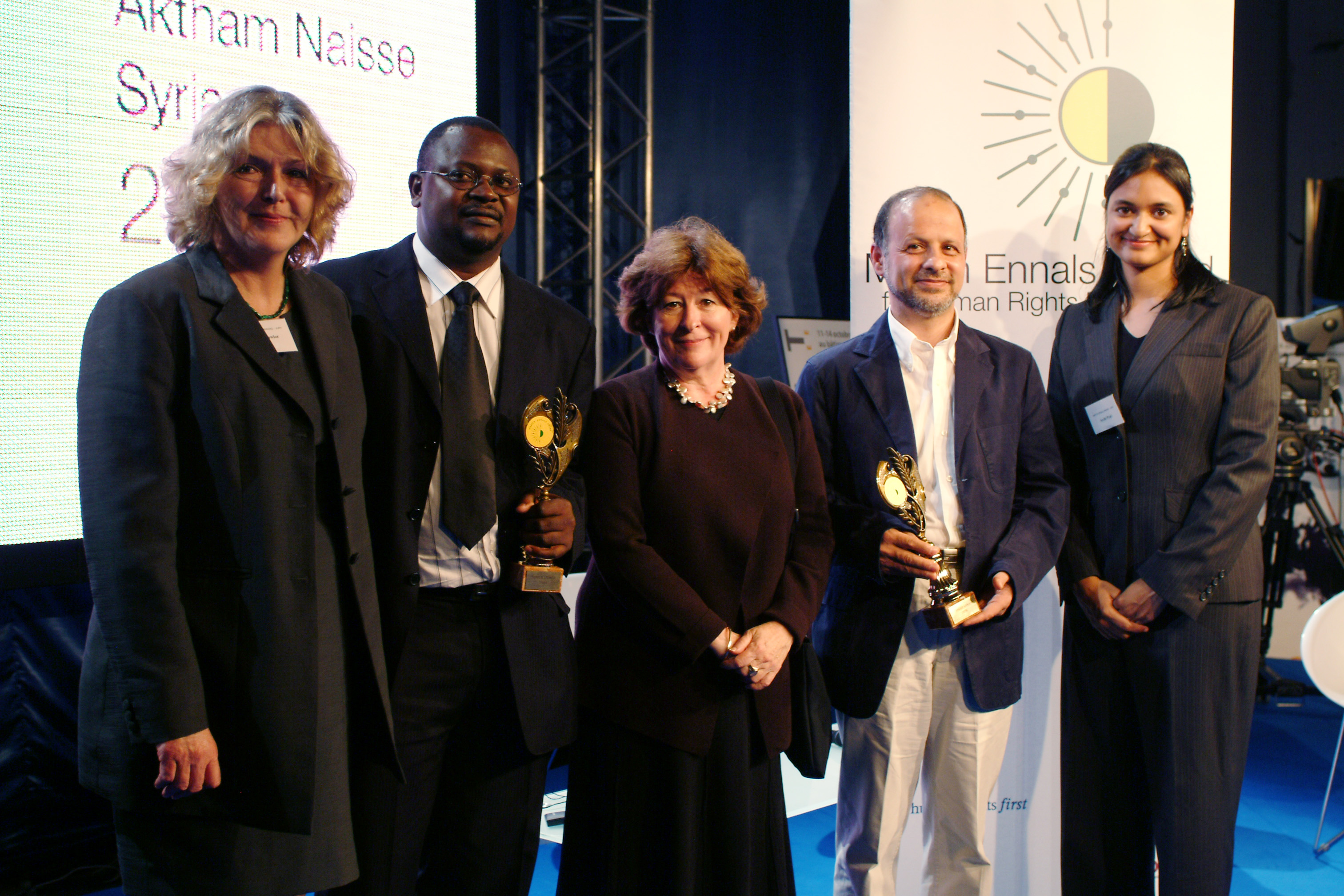
(Ganji – second from the right – at the MEA ceremony of 2006, where he received the award from UN High Commissioner Louise Arbour)
Al-Monitor of 25 March carries a lengthy interview with MEA Laureate Akbar Ganji in which Jahandad Memarian records many interesting insights, especially on the issue of sanctions and support to human rights defenders. The whole interview is certainly worth reading; here follow some long excerpts:
“It is not an exaggeration to say that Akbar Ganji is the most celebrated dissident within the ranks of Iranian journalists since the inception of the Islamic Republic of Iran in 1979. A former supporter of the revolution, Ganji became disenchanted and turned into one of its most vocal critics. He is best known for his work as a journalist covering the 1998 murders of Iranian dissidents in Reformist newspapers, a series which came to be known as “the chain murders” that implicated top governmental officials. For his work revealing the murders of dissidents and attending a conference in Berlin that was condemned by hard-liners who were reeling after a Reformist victory in parliament, Ganji was arrested and served time in Tehran’s Evin Prison from 2001 to 2006. During his final year in prison, he went on a hunger strike that doctors urged him to end for concerns he would suffer permanent brain damage.
Ganji has won several international awards, including the World Association of Newspapers’ Golden Pen of Freedom Award, the Canadian Journalists for Free Expression’s International Press Freedom Award, the Martin Ennals Award for Human Rights Defenders and the Cato Institute Milton Friedman Prize for Advancing Liberty. In an exclusive interview via email with Al-Monitor, Ganji, based in New York, shared his thoughts about human rights and democracy in the context of President Hassan Rouhani’s administration.
Al-Monitor: The UN secretary-general, Ban Ki-moon, has sharply criticized the Iranian president, Hassan Rouhani, saying, “He has not made any significant improvement” in ending human rights abuses since taking office. Nevertheless, Mahmoud Sadri — Iranian professor of sociology at the Federation of North Texas Area Universities — is optimistic about the new administration and has asked Iranian dissidents and intellectuals to take advantage of this historic opportunity. How do you evaluate the Rouhani administration?
Ganji: The situation has improved from various aspects compared with the [Mahmoud] Ahmadinejad administration. However, it falls short of the expectations of democracy advocates and human rights activists. The Rouhani administration truly seeks to improve the state of human rights, but it has faced obstacles in Iran’s power hierarchy, including organizations that [Supreme Leader] Ayatollah [Ali] Khamenei oversees, such as the judiciary, law enforcement, etc., in addition to the Majles [parliament] that is controlled by the conservatives and some radical reactionaries.
…….Since his administration came to power, Rouhani has spoken with the supreme leader about freeing the Green Movement’s leaders (former Prime Minister Mir-Hossein Mousavi and former Majles speaker Mehdi Karoubi) and political prisoners, guaranteeing that nothing would happen, if they were freed.
Al-Monitor: In January, you wrote a Huffington Post article titled “The Iran Nuclear Accord Is Good for Human Rights.” It seems to me whenever international pressure on the Iranian government increased, Iran improved its record. For example, Tehran released political prisoners ahead of Hassan Rouhani’s UN speech, including prominent human rights lawyer Nasrin Sotoudeh. Don’t you think such actions stem from international pressure? In the absence of this leverage — i.e., international pressure — Iran would continue human rights violations.
Ganji: With regard to “external pressure on an undemocratic regime and improvement of human rights or increased oppression,” there is no law/rule that would address the cause-reaction relationships. At most, one can speak of “correlation.”[…] we need to know the following:
First, economic sanctions represent the collective punishment of a country’s people and do not necessarily lead to dictatorships’ downfall.
Second, long-term sanctions destroy the internal infrastructure of societies. ..Consequently, trust that is the basis of social capital is destroyed. Because of the sanctions, the oppressive regime’s increasing level of oppression, the internal destruction of society, is not visible. It is only in the aftermath of the dictatorship’s downfall that we will witness the visible spread of a wave of hatred, revenge and violence.
Third, in a life and death situation, the state of human rights, democracy and freedom completely falls by the wayside.
Fourth, consider Iraq’s example again. Before, the invasion al-Qaeda forces did not exist in Iraq, but they were born and bred as a result of the US sanctions and the US attack on Iraq. This story has been repeated in Libya and Syria. …..Iranian, US and European officials have professed that economic sanctions against Iran have affected Iran’s economy negatively. Last year, the economic growth rate fell to -5.8%. The inflation rate rose to 40%. The corruption rate climbed, and other negative outcomes followed. We should ask ourselves, what is the impact of recession on ordinary people’s lives?
The middle class, as a vehicle of democracy, has been transformed to the impoverished class, and its democratic movement may lose its agents. Democracy is the product of the balance of power between the government and civil society.
The transformation of the nuclear agreement from temporary to permanent, improvement of Iran’s relationship with Western governments, rekindling of ties between Iran and the United States, lifting of all the economic sanctions and alleviation of foreign threats can help empower the people through their mobilization and expansion of civil society. In that sense, the regime’s focus and its supporters will not be on discovering conspiracies of foreign governments and military attacks to destroy the regime. Let’s not forget that democracy and human rights have a direct relationship with economic development.
Al-Monitor: You have opposed US aid to Iranian dissidents and human rights activists. What are your key criticisms against such aid? What actions should foreign countries.. take or avoid ?
Ganji: The opposition that I have spoken about consists of groups and people that advocate regime change in Iran, so they can come to power. It is not possible for the leaders of a country to be indebted to other foreign governments, including the United States, Israel, Saudi Arabia, Russia and China. In that case, they will become the greater powers’ pawns. Look at the groups that have received financial aid from foreign governments in the past 35 years. What have they done? Do their terrorist and espionage activities constitute human rights activism, or are such activities considered criminal in all countries, including the United States and Israel, and are they strongly punished?
However, I support educational financial aid, including student scholarships and research fellowships for scholars. Just think about what would have happened if the $1.5 trillion that was spent on the wars in Afghanistan and Iraq would have been used toward education and development of the Middle East, and how that would have changed the region. Why do Western governments, the United States included, not grant scholarships to tens of thousands of talented and smart Iranian youth as students in social sciences?
Western governments should protest all human rights violations; they should give ethical and spiritual support to pro-democracy and human rights activists; they should file complaints at the UN Human Rights Council and ease the process of bringing perpetrators to justice. Moreover, Western powers should stop selling weapons of torture and oppression to dictatorial regimes. Ultimately, they should allocate financial resources to form independent labor unions and improve the state of human rights.
Read more:


 Hans Thoolen on Human Rights Defenders and their awards