On 23 April, 2025 OMCT made public this interview with Armel Niyongere, exiled Burundian lawyer and Secretary General of SOS-Torture Burundi, a member of the World Organization Against Torture (OMCT) SOS-Torture network. He continues to denounce human rights violations in his home country. Despite 10 years of threats and intimidation from the authorities, Mr. Niyongere continues his fight to promote and protect human rights. In this interview he talks about the difficulties of exile, the challenges facing those who defend human rights, and the role of the international community.
On 4 April, 2025 the Miami Herald reported that Haiti-based human rights lawyer Mario Josep died in a car accident.
In a country where justice is often elusive, Mario Joseph was a fearless crusader who didn’t care whether his opponent was the Haitian government or the international community as he defended political prisoners and poor victims of human rights abuses in his Caribbean homeland. Joseph died Monday night from injuries sustained in a car accident last week as he pulled into his house. His death was confirmed by his longtime friend Brian Concannon and the Boston-based nonprofit Institute for Justice & Democracy in Haiti. He was 62. Concannon said in a statement. “The global human rights movement has lost an inspirational leader when the notion of human rights itself is under broad attack.”
Since 1996 Joseph had served as the attorney for the Bureau des Avocats Internationaux, or Bureau of International Lawyers, in Port-au-Prince. The organization represented victims of human rights violations, trained Haitian law students and worked with U.S. law schools clinics, while also closely collaborating with the Institute for Justice & Democracy in Haiti. His high-profile cases included championing the rights of 5,000 victims of waterborne-cholera who blamed the United Nations for its introduction into Haiti after the 2010 earthquake.
Among Jospeh’s many accolades over the years was the Judith Lee Stronach Human Rights Award from the Center for Justice & Accountability in San Francisco, the Alexander Human Rights Award from Santa Clara University, and honorary doctorates from the University of San Francisco and Indiana University School of Law. He was also a finalist for the 2013 Martin Ennals Human Rights Defenders Award.
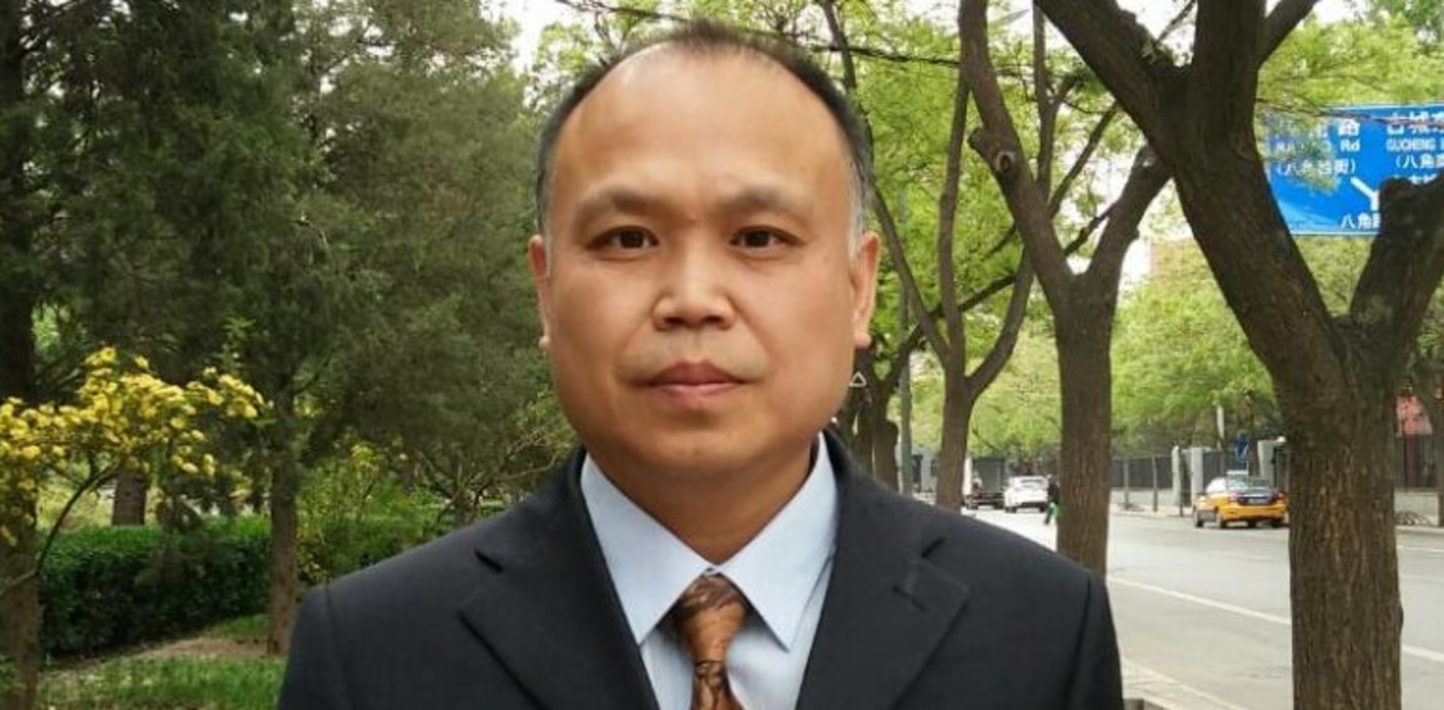
Responding to the rejection of Chinese human rights lawyer see also:s appeal against his three-year prison sentence for “inciting subversion of state power”, Amnesty International’s Interim Regional Deputy Director for Research Kate Schuetze said on 6 January, 2025: “The charges against Yu Wensheng and his wife, activist Xu Yan – who was convicted of the same offence – are entirely baseless. They reveal the authorities’ inability to provide any legitimate justification for their imprisonment.
“The Chinese government has used Yu’s online comments and his numerous international human rights awards as an excuse to label him a threat to national security. But all this really demonstrates is Beijing’s deep fear of human rights defenders who dare to dissent.
“Yu Wensheng and Xu Yan have been imprisoned solely for exercising their right to freedom of expression and they must be released immediately and unconditionally.”
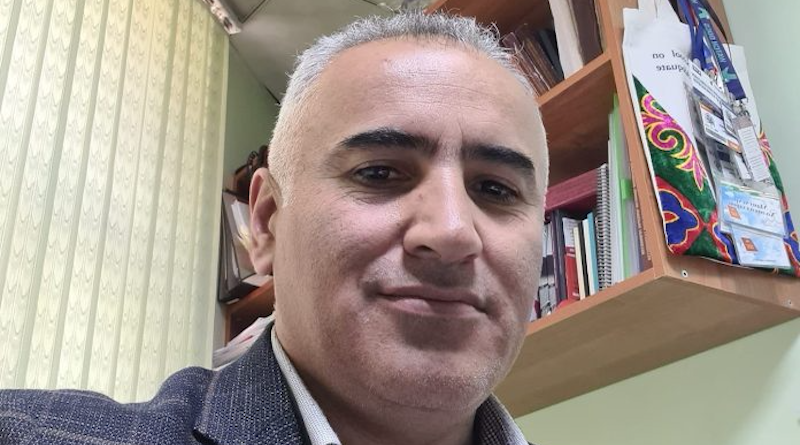
Manuchehr Kholiqnazarov. Photo from personal Facebook page
On 29 May 2024, IPHR (International Partnership for Human Rights – an independent, non-governmental organization founded in 2008 in Brussels) published an Op-ed about Human Rights Defender Manuchehr Kholiqnazarov.
Tuesday marked the sad anniversary of the arrest of lawyer and human rights defender Manuchehr Kholiqnazarov in Tajikistan. First arrested on 28 May 2022, he has now spent two years behind bars, serving a 16-year-long prison sentence in retaliation for his human rights work.
The organisations issuing this statement – International Partnership for Human Rights (IPHR), the Tajikistan Civil Society Coalition against Torture and Impunity, Helsinki Foundation for Human Rights (HFHR, Poland), Norwegian Helsinki Committee (NHC), as well as International Federation for Human Rights (FIDH) and World Organisation against Torture (OMCT) within the framework of the Observatory for the Protection of Human Rights Defenders – are increasingly worried about Manuchehr’s state of health and call again on the Tajikistani authorities to immediately and unconditionally release him.
“Manuchehr was arrested and imprisoned for no other reason than his tireless work to help the most vulnerable victims of human rights violations. We will not give up fighting against his unjust sentence until he is released and allowed to return home to his family,” said Brigitte Dufour, Director of IPHR.
On 9 December 2022 Tajikistan’s Supreme Court found Manuchehr guilty under articles 187, part 2 (participation in a criminal organisation) and 307 (3), part 2 (participating in the activities of a banned organisation due to its extremist activities) of the Criminal Code, sentencing him to 16 years’ imprisonment in a strict regime penal colony.
Manuchehr is the Director of the Lawyers Association of Pamir (LAP), one of the few civil society organisations in Tajikistan’s Gorno Badakhshan Autonomous Region (GBAO) that works to promote and protect human rights.
On 25-28 November 2021, mass protests erupted in Khorog, GBAO, over the extrajudicial killing of a young man, Gulbiddin Ziyobekov. After the protests settled, Manuchehr joined the “Commission 44”, consisting of representatives of local civil society and law enforcement agencies, to investigate the events. Given his professional experience, Manuchehr was included in the Joint Investigation Team headed by the Prosecutor General’s Office and helped secure lawyers for victims of indiscriminate violence during the November 2021 protests.
However, May 2022 saw a renewed crackdown on protests in Khorog and Rushan District of GBAO. On 28 May 2022, Manuchehr was arrested along with a dozen members of Commission 44 for alleged “participation in a criminal association” and “publicly calling for violent change of the constitutional order”. Their trial began on 20 September 2022, and was held behind closed doors at a detention facility of the State Committee for National Security (SCNS) in Dushanbe. Following his conviction, Manuchehr was transferred to a prison facility in the capital.
Manuchehr’s health has deteriorated significantly in detention. In particular, he suffers from back problems. The authorities should ensure that he has access to adequate medical assistance for these health problems and that his treatment complies fully with international standards as long as he remains behind bars.
In addition to human rights NGOs, the United Nations Special Rapporteur on Human Rights Defenders and other international human rights experts have repeatedly raised concerns about Manuchehr’s imprisonment and called for his release. The Tajikistani authorities should heed to these calls, promptly release him and allow him to reunite with his family.
Here Haris Azhar shares how and why he believes the law can be used as a powerful tool to deal with repression of democratic voices and their rights. Read more from our In My Own Words series here.
My name is Haris Azhar. I would say I’ve been working, in general terms, on human rights issues for the last 25 years. I work across the country in Indonesia on some human rights, issues or situations, and in some conflict areas such as in Papua.
I have been working for and dealing with some vulnerable groups such as labour groups, as well as the indigenous people and victims from the violence as well. These days I practise as a lawyer, I do pro bono and also professional for-profit work where I use the profits work to subsidise the pro bono and public interest legal work. I have also joined some organisations, and I was director for two human rights organisations. So that’s why I’ve been very human rights focused.
In early 2024 me and my friend Fatia were brought to court. We won, and we got a good decision from the court. But this is not the final one, because the attorney general has appealed to the Supreme Court. I think this whole process was meant to serve as an example.
The whole process, especially last year, was intended to be intimidation. The litigation or the pre-trial process was intended to intimidate me [and] not to not say more about the practice of business oligarchs in this country. But myself, lawyers, and groups here said, we would not say sorry. We would not stop speaking, and that those in power could continue their judicial harassment of us and that we would fight them.
And during the fight, a lot of things happened [such as] intimidations, negative accusations and campaigns. They accused us of hoax stories, but actually they did the hoax stories. They took over and intercepted my mobile phone as well. These are the lengths and practices of intimidation in place.
However, the process of the court for people like us, we pretty much don’t really care about the final decisions. We can see the shadow of the prisons, because what the government thinks is important for them is for us to not have democratic voices. There aremany cases by politicians and by business groups that aim to criminalise decent voices, and it has become a [common] practice. There are even consultants that can help you if you would like to know how to criminalise decent/democratic voices.
It’s become an industry against freedom of expression, to show that, “This is what happens if you are against us.” They wanted to show they could bring me to court so the warning was that anyone who becomes the client of Haris should be aware. It was symbolic, and that’s what I mean it is a message to intimidate and to intimidate vulnerable groups especially.
Widespread engagement on human rights, working through organisations, has developed not only my knowledge, my skill, but also my networks. This has also developed my interest in what some of the ways we (as a nation) would like to put on the table with regards to issues of human rights.
As a practising lawyer, we have always believed here that we can use the law [to achieve justice]. However the movement here is not like in South Africa, as an example, where at one point in South Africa there was no real equality. There was no legal institution that could be used to secure fairness. We don’t have that kind of situation here [in Indonesia], but we are still looking for the formalisation of equality and fairness.
We like to use the legal debate, space, and discourse as a way to combat evil, because the law provides the kind of tools or ammunition to attack evil. Those in power hide behind the law and therefore here in Indonesia, most of the battle and discourse always has an element of legality.
I believe that the law is one of the crucial things that need to be handled, in addition to other advocacy issues. Because we know that the law or legal mechanisms are [also] being used by the bad guys, by the oligarchs to justify and legalise their plans and to do their own business. Those in power always say that they have complied with the law, that they uphold the rule of law, but actually we know that the law they comply with is their own creation. It is their own definition. That’s why we [as legal practitioners] need to step in, even though it’s not the popular action to do so.
If those in, and adjacent to, power cannot be left to create what is good and not good within the framework of law. We need to bring in the voices from the ground. We need to bring the voices from the indigenous people. We need to bring the voices from the labour groups, from the students, from the women’s groups, and many other vulnerable groups who are connected to the issues.
This is instead of the politicians and the business groups alone making their own arguments and developing their own definitions. We cannot let them be, and let them take over in that kind of way. Rule of law and legislation, has to be accompanied and coloured by the vulnerable voices and interests. This is why we insist that a part of the campaign, part of the research, is that we take the legal action as well.
The gap between the haves and the political groups on the ground is huge. This has been happening year on year, and it is getting worse every year. The new regulations and legislations that we have here, which very much comply with the interests of the business groups which belong to some politicians, create more loose protection of rights of workers and women. For the youth and the students, they are getting fewer protections for their education and freedom.
There’s no freedom on campus for students anymore, [because of] intervention from the government and the police on campuses. It’s getting obvious these days. So I think we need at least two things. First, figuring out how to protect vulnerable groups, because why they were attacked or would be attacked is because they found irregularities, and problematic issues behind the policies of the government, or the law.
These issues have led to economic issues, social issues, business issues and so the vulnerable groups make a choice where they complain or protest, but they get attacked by police, government and intelligence. That is why we need more collaborations with vulnerable groups.
We also need more friends — lawyers, international advocates, researchers — coming down into the rural areas, and into the urban areas to capture what is happening and make a noise, to campaign. That’s why we need to have the first group that I mentioned before. We need not to deal with the substance of the problem, but with the second layer of the problem, [which is] the attacks of the participation, the effects to the participation. For this we need to have a lot of groups [working on] how to deal with this kind of shrinking space.
We just had the 2024 elections where we campaigned around the threat to our freedoms of speech and expression. Some of the candidates responded very well, but the one that was supported by the current regime didn’t have a strong resonance with what we are saying. In addition to the campaign, along with my criminalisation, myself, some friends and organisations submitted a complaint to the Constitutional Court.
Our complaint was regarding some legal articles which were being used against me and against some journalists. We won the case in the Constitutional Court earlier this year, and an article which had been used to criminalise a lot of people has now been dropped. But this win is very short [lived] because we have some articles within certain laws which allow the police to criminalise speech.
When I said we won, that’s regarding just one article in our criminal code. But in the next year and a half we will have a new criminal code implemented and new articles to criminalise speeches. We will need to challenge those articles in the next two years. It’s like Tom and Jerry, where we play hide and seek. It seems politicians and business need a shield to protect themselves from the public, hence these situations but we keep fighting them using the same law.
Legal institutions are not our institutions yet. They are still their institutions [meaning the powerful]. However to a certain degree, the legal space is an open stage for you to perform, to have a say. I think if we don’t fill the space, it will be filled by those who are not supportive of freedom of speech or freedom of expression.
These are the reasons why I think we have to join legal action. So as to not give space for evil to come in and occupy. Also, legal action is not the only type of work needed. It has to be one among others. For instance there is advocacy work too. But law cannot be neglected and that’s why this current situation (and the coming situations), require more than just focusing on the legal system. It has to be about a collaborative methodology and approach.
In the three decades since I became a lawyer, human rights – once understood as an uncomplicated good, a tool for securing dignity for the vulnerable against abuses by the powerful – have increasingly come under assault. Perhaps never more so than in the current moment: we are constantly talking about human rights, but often in a highly sceptical way. When Liz Truss loudly proclaims “We’ve got to leave the ECHR, abolish the supreme court and abolish the Human Rights Act,” she’s not the fringe voice she might have been in the 1990s. She represents a dangerous current of opinion, as prevalent on parts of the radical left as on the populist right of politics. It seems to be gaining momentum.
As an idealistic youngster, I would have been shocked to know that in 2024 it would be necessary to return to the back-to-basics case, to justify the need for fundamental rights and freedoms. But in a world where facts are made fluid, what were once thought of as core values have become hard to distil and defend. In an atmosphere of intense polarisation, human rights are trashed along all parts of the political spectrum – either as a framework to protect markets, or as a form of undercover socialism. What stands out for me is that the most trenchant critics share a profound nationalism. Nationalists believe that universal human rights – the clue’s in the name – undermine the ability of states to agitate for their narrower interests.
Given that so many of our problems can only be tackled with an international approach, a robust rights framework is more important than ever
It’s no coincidence that the governments keenest on turning inwards – Viktor Orbán’s in Hungary, that of former president Bolsonaro in Brazil – have been least keen on common standards that protect minorities in their own territories and hold them to high standards in the international arena. At a time of insecurity, these leaders leverage fear to maximise their appeal. The prospect of a second Trump administration in the US demonstrates that this trend shows no sign of abating. In that context, it’s vital to make the case for human rights anew.
It boils down to this: given that so many of our problems – in an age of climate change, global disorder and artificial intelligence – can only be tackled with an international approach, a robust rights framework is more important than ever. There are parallels with the postwar period in which human rights were most fully articulated, a time when it was obvious to everybody that cooperation and global standards were the best way to shore up our common humanity after a period of catastrophic conflict and genocide.
Of course everyone believes in some rights – normally their own and those of friends, family and people they identify with. It is “other people’s” freedoms that are more problematic. The greater the divisions between us, the greater this controversy. And yet, it is precisely these extreme disparities in health, wealth, power and opinion that make rights, rather than temporary privileges given and taken away by governments, so essential. They provide a framework for negotiating disputes and providing redress for abuses without recourse to violence.
New technologies, and AI in particular, require more not less international regulation. As people spend more time online, they become vulnerable to degrading treatment, unfairness and discrimination, breaches of privacy, censorship and other threats. The so-called “black boxes” behind the technology we use make ever more crucial decisions about our daily lives, from banking to education, employment, policing and border control. Anyone who flirts with the notion of computer infallibility should never forget the postmasters and other such abuses, perpetrated and then concealed.
Our shrinking, burning planet is the ultimate reason why nationalism does not work in the interests of humankind
Perhaps most important of all is the growing contribution of human rights litigation to the struggle against climate catastrophe. A whole generation of lawyers and environmentalists is taking notes from earlier struggles, just as suffragists once learned from slavery abolitionists. This is despite the machinations of fossil fuel corporations versed in a thousand lobbying, jurisdictional and other delaying tactics.
Our shrinking, burning planet is the ultimate reason why nationalism does not work in the interests of humankind. Today’s global empires, sailing under logos rather than flags, need to be more directly accountable under human rights treaties. Our existing mechanisms, whether local and national governments, domestic and international courts, or some of the more notoriously tortuous UN institutions, may be imperfect and in need of reform. Yet, like all structures of civilisation, they are easier to casually denigrate than to invest in and adapt to be more effective.
While I have been writing this, I have been voting in the House of Lords on amendments to the so-called safety of Rwanda bill. It is the most regressive anti-human rights measure of recent times, and intended to be that way. It will not stop the boats of desperate people fleeing persecution, but is designed to stop the courts. British judges will be prevented from ensuring refugees’ fair treatment before they are rendered human freight and transported to a place about whose “safety” our supreme court was not satisfied. Rishi Sunak will be able to use this situation as excuse for an election pledge to repudiate the European convention on human rights.
If he gets his way, rights will be removed not just from those arriving by boat, but from every man, woman and child in the UK. By contrast, the golden thread of human rights is equal treatment: protecting others as we would wish to be protected ourselves, if that unhappy day ever came. It’s a thread we must never let go of.
Haroon Siddique in the Guardian of 15 February 2024 relates the story of lawyer Adil Meléndez Márquez who received a call from his bodyguards 20 minutes after receiving the Sir Henry Brooke award from the Alliance for Lawyers at Risk. Meléndez is no stranger to death threats, but things have just got a lot scarier. With bitter irony, 20 minutes after receiving the Sir Henry Brooke award from the Alliance for Lawyers at Risk, his bodyguards called him to say that they had been stood down from, leaving him without protection.
In an interview with the Guardian in London, Meléndez said he is a human rights lawyer who hails from among those he represents. He is Afro Colombian and works predominately on cases for Afro Colombians and Indigenous communities, often in areas under the control of paramilitaries rather than the government. He was kidnapped when he was 12 so has first-hand experience of the violence which blights the country and has received threats since becoming involved with Movice (movement of victims of state crimes) in 2006. See also: https://humanrightsdefenders.blog/2014/02/12/death-threats-in-colombia-on-the-rise-again/
After receiving threats Meléndez took a case to the Inter-American Commission on Human Rights – an organ of the Organization of American States – which, in 2009, ordered Colombia to provide him with protection. For the first eight years this amounted to three personal bodyguards and a bulletproof car, then the bulletproof car was removed and later one of the bodyguards, leaving him with two until last week, he says.
Meléndez describes his work as taking on “politicians, business interests, cattle ranchers, the armed forces and paramilitary groups”.
He expands: “Rampant corruption and violence is taken advantage of by [foreign] companies. They operate in such a way that it denies the rights of communities because all they’re interested in is the exploitation of natural resources. It means that they don’t have to provide compensation or justice for the communities because the rule of law, the writ of law doesn’t apply.”
One of the projects Meléndez has been helping to resist is the upgrading of the 115km Canal del Dique in Colombia’s Caribbean region, which he helped to get temporarily suspended. He believes that proper consultation was not carried out prior to the project, as is required by law and it involves “the privatisation of rivers which are the source of life of the Afro-descendent communities”. He said that as a result of the suspension he was called an “enemy of development” by a Colombian minister, words he claims were echoed by the the paramilitary group and notorious drug cartel, Autodefensas Gaitanistas de Colombia (AGC), also known as the Gulf Clan.
While he counts Colombia’s president, Gustavo Petro, the country’s first leftist head of state, as a friend and acknowledges his lack of control over swathes of the country, at the same time he says disapprovingly: “President Petro speaks in international fora about the protection of the environment but in his own country his government is awarding contracts to a project that is damaging to the environment.”
Meléndez does not blame Petro for the removal of his bodyguards, believing it was the work of someone lower down the food chain, but he believes it is for the president to ensure they are reinstated. Not doing so would put the government in breach of the Inter-American Commission on Human Rights, he says. “I have had to stop all my activities at the moment and it’s possible even that I will have to make the decision not to return to Colombia,” says Meléndez.
However, he hopes that the prize he was presented with in London, which he calls a reward for “the rebellious and those in resistance”, might offer a degree of protection. “This prize raises my profile,” he said. “It provides evidence that I’ve got support from the international community. The organised criminal actors or others who are against me, they calculate the consequences of their actions and so the calculation now includes a much higher level of risk for them if they make a decision to act against me.”
On 14 December 2023, the Netherlands Ministry of Foreign Affairs announced that the 2023 Human Rights Tulip has been awarded to Hülya Gülbahar, a feminist attorney from Türkiye and founder of the Equality Watch Women’s Group (EŞİTİZ) and the Women’s Platform for Equality Türkiye (EŞİK). Minister of Foreign Affairs Hanke Bruins Slot presented the prize on 14 December at a ceremony in the Peace Palace.
In her speech, Ms Bruins Slot said: ‘Human rights are among the most important resources we have at our disposal to tackle the major problems of our time, such as war, poverty and climate change. ..The nominees for the Human Rights Tulip understand this at a profound level. Through their tireless efforts, these human rights defenders make a real difference for people and society.’
EŞİTİZ and EŞİK publish legal analyses of legislative bills and amendments on feminist and LGBTIQ+ issues, conduct awareness-raising campaigns (for example on the Istanbul Convention on preventing and combating violence against women and domestic violence) and promote social mobilisation by the Turkish feminist movement.
‘For more than 40 years,’ Ms Bruins Slot said, ‘Hülya Gülbahar has been defending women’s rights and fighting injustice in Türkiye. She does so using her extensive legal expertise and through her influential network, comprised primarily of women, which is too extensive to ignore. And she has been very successful at it.
Other finalists
The two other finalists for the 2023 Human Rights Tulip were:
Julienne Baseke is a journalist and human rights defender who fights for women’s rights in the Democratic Republic of the Congo (DRC). As a journalist, Ms Baseke founded the South Kivu Women’s Media Association (AFEM), which aims to enhance women’s visibility and participation in the DRC media.
Claudelice dos Santos is a human rights and environmental activist in the Amazon region. She is the founder of the Zé Claudio e Maria Institute, whose shelter and protection house provides a safe haven for indigenous land, environmental and human rights defenders.
The Christian Science Monitor of 30 October 2023, tells the story of attorney Dennis Muñoz who seeks to uphold human rights in El Salvador, despite increasingly difficult and dangerous odds.
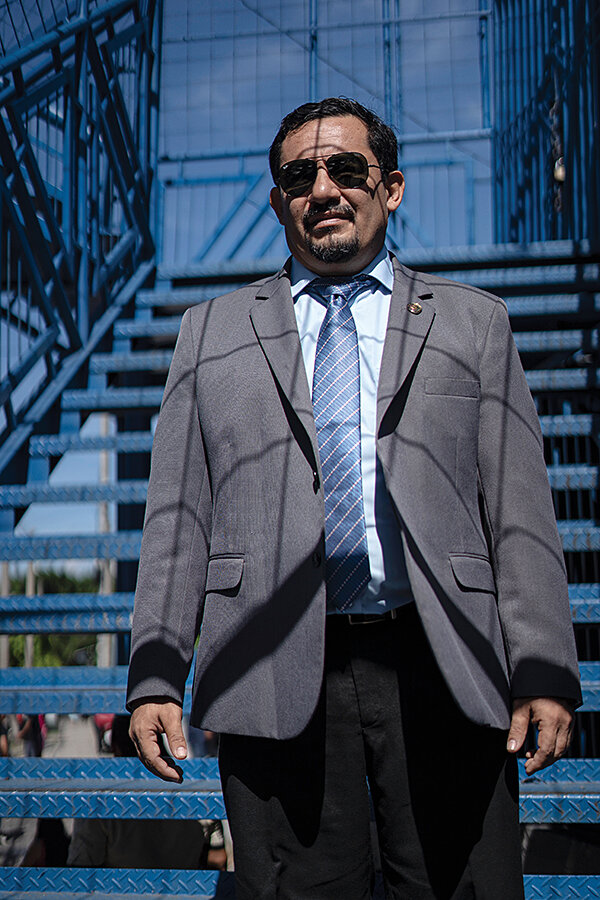
Víctor Peña/Special to The Christian Science Monitor
Mr. Muñoz found a way to channel his deep-seated desire for justice by becoming a lawyer in 2005. But he doesn’t work with just anyone – he goes for the tough cases of human rights abuses. He has defended multiple women who suffered miscarriages but were accused of murder in a nation where abortion is banned without exception. He has fought arbitrary arrests of environmentalists, activists, and average citizens. He could be called a defender of lost causes.
There’s no shortage of demand for Mr. Muñoz’s work in El Salvador, which has the highest incarceration rate in the world. And these days the risks of his work are almost as high as the demand for it.
In March 2022, a monthlong “state of exception” was enacted in response to extreme gang violence. The order suspended basic constitutional rights for those arrested under it. Securing a court warrant before searching private communications was no longer required, for example, and arrestees were barred from their right to a defense attorney and their right to see a judge within 72 hours.
But what started as an emergency measure has become ordinary practice. The state of exception has been extended every month for more than a year and a half now, with no end in sight. Violence has declined dramatically, but critics say the order’s extreme powers are seeping far beyond the gang-related arrests they were meant to address. Even those detained outside of the state-of- exception category are having their rights suspended.
That’s the group Mr. Muñoz focuses on. While he has taken a few state-of-exception cases, he primarily works on human rights violations, with the added burden now of his clients getting caught in the emergency order’s crosshairs. Despite death threats and intimidation, he’s not slowing down. Instead, fellow lawyers doing similarly risky work ask him to be on call if – or, perhaps more likely, when – they themselves are arrested.
… Despite quashing constitutional rights, the move has been overwhelmingly popular for providing a long-elusive sense of calm.
“A tired society, fed up with a lack of answers to the chronic problem of violence, is willing to accept short-term answers,” says Verónica Reyna, director of human rights for the Passionist Social Service, a nongovernmental organization focused on local violence prevention and support of human rights.
Gustavo Villatoro, minister of justice and public security, acknowledges that the state of exception is affecting more than gang members. Over 7,000 innocent people have been arrested, Mr. Villatoro said in August, noting that some degree of error is inevitable. But the consequences of those errors can be grave. Even if a case has nothing to do with gang activity, lawyers can be blocked from visiting their clients in detention, and court hearings can be suspended. Over 71,000 Salvadorans have been arrested under state-of-exception rules. With 6 million people in El Salvador, close to 2% of the adult population is currently behind bars. And many of them, even those not under the emergency order, lack access to a lawyer and may be tried en masse.
Margaret Satterthwaite, the United Nations special rapporteur on the independence of judges and lawyers, tweeted in May that in El Salvador, “public defenders reportedly have 3-4 minutes to present the cases of 400 to 500 detainees.” She warned that “fair trial rights must not be trampled in the name of public safety.”
In the last week of July, Salvadoran lawmakers eliminated a previous two-year limit on pretrial detentions and passed reforms to allow mass trials that could bring together 1,000 individuals in a single appearance before a judge.
“Maybe they won’t let us be lawyers anymore,” says Mr. Muñoz, “at least not private attorneys with independent criteria.”
“The reforms have disrupted the whole system and have turned innocence into an exception,” says Ursula Indacochea, program director at the Due Process of Law Foundation, based in Washington. “Presumption of innocence is disappearing because the roles have shifted. The state no longer has to prove I’m guilty, but now I’m guilty and have to prove I’m innocent,” Ms. Indacochea said in a Sept. 7 radio interview in El Salvador.
Of the 35,000 authorized lawyers registered in El Salvador, Mr. Muñoz stands out for almost exclusively taking cases of human rights violations.
“Things aren’t easy right now,” he says, describing the justice system as “made to convict.” The government is “criminalizing the job of lawyers,” he adds.
Yet Mr. Muñoz looked anything but cautious at a press conference in early July, where he was the only person wearing a suit at the San Salvador offices of the Christian Committee for Displaced People in El Salvador, a wartime human rights organization. He headed to the podium in the ample room, sparsely decorated with pictures of St. Óscar Romero, the archbishop of San Salvador murdered by right-wing death squads in 1980.
Mr. Muñoz discussed openly a forbidden topic. Five environmentalists were arrested in January over the alleged 1989 murder of a Salvadoran woman during the war. The case was under a court-issued gag order.
“It’s very serious that environmentalists are being unjustly accused, bending [what are considered] the rules of due process anywhere in the world,” Mr. Muñoz said, staring into the cameras.
His clients in this case are former guerrilla members, and two of the accused are part of the Association of Economic and Social Development Santa Marta, known as ADES. One of the country’s oldest environmental organizations, ADES was key in achieving the total ban on mining here in 2017. In a country where almost the entirety of war crimes remain unresolved and defendants in active cases are rarely imprisoned, the arrest of these men was an outlier, apparently due to their vocal criticism of the government. The U.N. called for the activists’ immediate release.
“Dare I say there are crimes being committed against these environmentalists,” Mr. Muñoz said before the media. “It’s nefarious that things like this happen in a country that calls itself democratic but really has a criminal injustice system in place.”
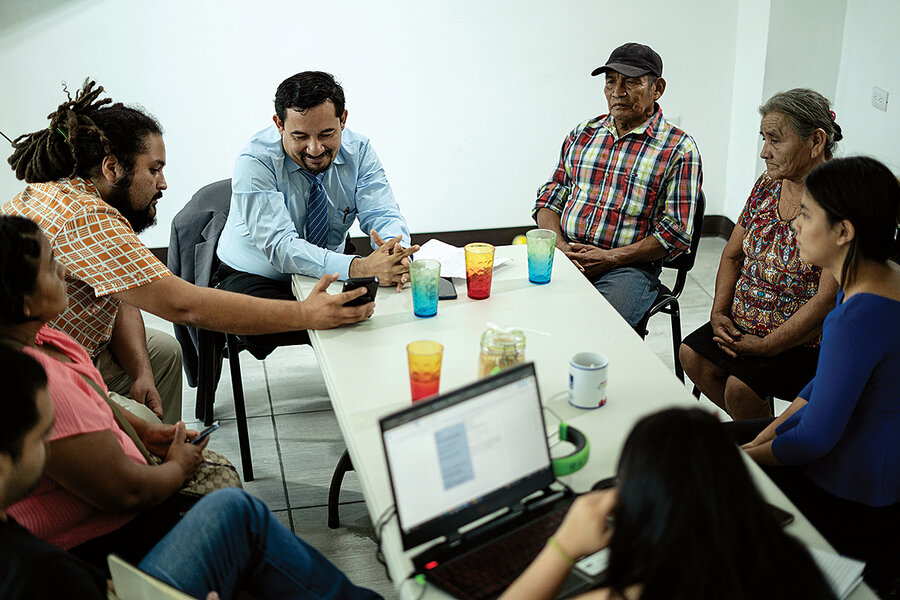
Víctor Peña/Special to The Christian Science Monitor
By late August, Mr. Muñoz had successfully convinced a judge to grant an order for his clients’ release. “It’s a crumb of justice, but we shouldn’t celebrate until there’s a dismissal of proceedings,” he said at a later press conference.
It’s hard to reconcile this image of seeming fearlessness with Mr. Muñoz’s request when the Monitor approached him for an interview: Could the piece leave out his last name? The question reflects a sense of fear that has built up over many years of doing this work.
Mr. Muñoz downplays receiving death threats, normalizing the culture of violence he’s lived under for most of his professional life. “They say they wish that I was extorted or killed because of the people I’ve defended,” he says about the social media threats. He thinks he’s been able to stay off the political radar by censoring his opinions. “I issue legal and technical opinions,” he explains. “Other colleagues have entered the political arena and expose themselves more to attacks.”
On 10 August 2023 Matthew Ogune of the Nigerian Guardian reported that Nigerian lawyer and human rights activist, Oluwafunke Adeoye, has emerged as one of the winners of the 2023 Waislitz Global Citizen Awards, with a prize money of $75,000. Adeoye is the founder of Hope Behind Bars Africa.
Adeoye was officially announced as a winner in the 2023 edition by the global body. The honour makes her the first individual working in the Criminal Justice sector to win this global award.
The Waislitz Global Citizen Awards are annual cash prizes totaling $250,000 that recognize the excellence of individuals in their work to end extreme poverty. The grand prize is $100,000 with two additional prizes at $75,000 each, for a total of three prizes. The awards are presented by the Waislitz Foundation and Global Citizen, and supported by the US and Australian based cellular medicines company, Mesoblast Ltd. and Unico Capital Holdings.
“Ending extreme poverty is not a choice, it’s an obligation. My hope is that it will inspire many thousands of people around the world to do what they can to improve the living standards of those in dire need,” Chairman and Founder of the Melbourne-based Waislitz Foundation, Alex Waislitz.
The Waislitz foundation exists to create a positive social impact locally and globally through innovative projects that empower individuals to meet their full potential and make a measurable difference to the world.
According to the global body, the Nigerian born lawyer has over the years helped in providing free legal services and direct support to indigent incarcerated people, while promoting criminal justice reform through research, advocacy and technology.
Reacting to the award in a statement on Wednesday in Abuja, Adeoye said she was inspired to begin the initiative in 2018, after some personal encounters with the justice system, including one where her father was arrested and detained for a crime he did not commit several years ago.
The organisation closes the justice gap by providing free legal services and direct support to low-income incarcerated individuals while promoting criminal justice reforms through research, evidence-based advocacy, and technology. Over 7,000 incarcerated individuals have benefitted from their interventions.
With the award, Adeoye plans to fully launch Justicepadi, a tech platform that will revolutionise legal aid in West Africa and also expand her work for climate justice.
“It is crucial for people to understand that behind the labels of ‘convicts’ or ‘prisoners’, there are human beings with stories, hopes, and dreams. By offering legal aid, we strive to ensure that every person, regardless of their circumstances, has access to fair representation and a chance to rebuild their lives,” Adeoye said.
The other winners of the award are: Peter Njeri and Esther Kimani, both Kenya citizens. They were named 2023 Waislitz Global Citizen Award winner and the Waislitz Global Citizen Disruptor Award winner respectively.