On Thursday 3 October the Robert F. Kennedy Center for Justice and Human Rights [RFK Center] launched its third annual “Speak Truth to Power Student Video Contest“. This year, the contest is for the first time open to student filmmakers from all of the USA in partnership with the American Federation of Teachers, the New York State United Teachers and the Tribeca Film Institute. The video competition, originally launched in New York State in 2011, invites students to create a 3-6 minute video examining a human rights issue or violation and profiling the defenders who are fighting to restore justice.
Last year’s prize went to students of the Young Women’s Leadership School of Brooklyn, who made a film about the work of sexual slavery and trafficking activist Juliana Dogbadzi of Ghana.
The World association for the School as an Instrument of Peace & the International Training Centre for Human Rights and Peace Teaching organise on 25 SEPTEMBER, from 10.00 – 12.00 in ROOM XXIV – PALAIS DES NATIONS, Geneva a side event:
“Making Human Rights a Reality : Challenges for Human Rights Education“.
Speakers include: Ms Rebiya Kadeer, President of the World Uyghur Congress [who is the laureate of the HRW “Human Rights Defenders Award” in 2000 as well as the Norwegian Rafto Award in 2004. Former member of the Political Consultative Congress of China (1992 -1997). Mr. Emmanuel Decaux, Professor, University of Paris II, Member of the UN Committee on Forced Disappearances Ms. Amina Lemrini,President of the High Council for Audiovisual Communication, Morocco
Ms. Nadira Eshmatova, Youth Human Rights Group, Kyrgyzstan
Ms. Géraldine Puig, Education program on citizenship and human rights, Ministry of public education, Republic and Canton of Geneva.
Moderator : Ms. Stefanie Rinaldi, University of Teacher Education, Lucerne
if you are interested contact: Cifedhop cifedhopATmail-box.ch.
Kerry Kennedy writes in an opinion in the WashingtonPost of 12 August about how her organisation was called by the superintendent of Bucyrus City Schools to address the issue of bullying in the school. The Speak Truth To Power [STTP], human rights education curriculum offered by the Robert F. Kennedy Center is taught in schools around the world — from Phnom Penh, Cambodia, to Pisa, Italy, from Stockholm to Chicago. Read the rest of this entry »
You can join the International Service for Human Rights (ISHR) and the New Tactics online community for an online conversation on Engaging the United Nations Human Rights Council fromFebruary 11 to 15 2013.
When utilized strategically, the HRC can be a powerful force for change. There are several different ways that human rights organizations can engage the HRC, including: providing reports for the Universal Periodic Review, sending complaints to the Special Procedures, and raising situations of human rights violations in the plenary sessions of the HRC. The key is to know when to use which approach, and how to maximize your efforts.
This online conversation will be an opportunity to exchange experiences, lessons-learned and ideas among practitioners who have successfully engaged the HRC. The HRC starts its main session on February 25.
For help on how to participate in this conversation, please check out these online instructions.
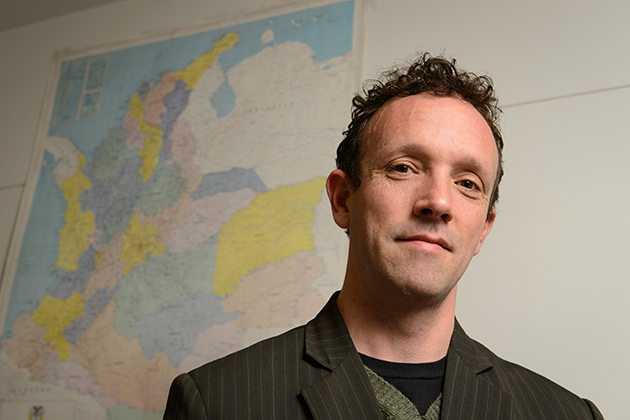
When writing about individual Human Rights Defenders the tendency is to give attention to those in the front line who are in immediate trouble. This time I want to refer to a HRD teaching at the University of Connecticut based on a blog post by Kenneth Best of 30 January 2013. It concerns Luis van Isschot, an assistant professor of history, who specializes in the study of human rights in Latin America ( photo by Peter Morenus/UConn Photo).
Conversation around the dinner table in the van Isschot home in Montreal was a bit different than in most Canadian homes. Growing up with a Spanish, Peruvian, and Dutch family heritage, Luis van Isschot listened to discussions about Latin American history and politics led by his father, a physician who treated families in a clinic based in Montreal’s Latino community…….
…His path to a doctoral degree developed from his volunteer work in Guatemala and later in Colombia, where he served as a human rights observer. It was during his time in Colombia that a friend who was a university professor and a historian told him that one of the most important books of Colombian history was written by a professor from his hometown of Montreal, Catherine Le Grand at McGill University, and that he should look her up. He did, and it led to his enrollment in the doctoral program. “She made it seem that you could be a wonderful teacher, a cutting-edge scholar, and have a balanced life of engagement in your community, and that the Ph.D. was a way of doing that,” van Isschot says. “The university is central to the community, not apart from it. That makes sense to me.”
He later became involved with MEA Laureate 2001 Peace Brigades International, a nonpartisan organization that sends international volunteers to areas of conflict to provide protective accompaniment to human rights defenders threatened by political violence in 11 nations, including in Asia, Africa, and Latin America. In addition to serving as a human rights observer in Colombia, he also traveled to the Great Lakes Region of Africa, doing research in the Democratic Republic of Congo, Rwanda, and Burundi.
“It was a really important experience for me to go somewhere where the language of human rights and social justice and the understanding of history really enriched my own understanding of what I was working on in Latin America,” he says. His experience in Colombia led him to focus his doctoral studies on human rights activities in that nation’s oil capital, Barrancabermeja, where he lived for a year. The city was the center of a major urban war between Colombian paramilitary groups and leftist guerillas. Between 1998 and 2002, in a city of 300,000 there were about 2,000 violent murders. “It was a devastating period. The relationships I made with Colombian human rights activists, teachers, and scholars convinced me that I needed to find some place to explore the issues,” he says.
His book, The Social Origins of Human Rights: Protesting Political Violence in Columbia’s Oil Capital, 1919-2010, is near completion, and scheduled to be published in early 2014. His new research project is titled “When the Courts Make History: the Impact of the Inter American Court of Human Rights in Latin America’s Conflict Zones,” and examines the historical changes set in motion by the pursuit of justice across borders.
Several Pakistani newspapers reported on Monday 3 December that “Prime Minister Raja Pervaiz Ashraf accepted in principle a proposal made by the Ministry of Human Rights to appoint Human Rights Defenders in the ministry”.
It all came from a presentation made by the Ministry of Human Rights. There were several welcome announcements (such as including human rights as a subject in educational institutions and plans to effectively implement its international obligations) but the idea to appoint Human Rights Defenders in the Ministry (as civil servants one has to assume) is baffling. It would completely do away with the idea that HRDs ought to be independent and capable of monitoring authorities. If accepted under this title it would surely confuse the current understanding of what are HRDs. The Minister for Human Rights would soon be called Human Rights Defender in Chief.
The Pakistani newspaper Dawn adds: “The basic idea to have human rights defenders in the country was to help those poor victims who could not afford to plead their cases in courts or seek other remedial measures against oppressors. “The number of human rights defenders and their service structure will be worked out by the ministry in collaboration with other ministries,” the official said. However, critics of the government say as elections were just a few months away, new positions are being created to accommodate pro-PPP voters.”
Let’s hope that the Ministry will revert to the more neutral and clarifying title of ‘human rights officers”.
A small Berlin based NGO has brought out a 8 mn video that is very basic but also very clear. I think it could be especially useful for educators in at the secondary school level or as introduction for a basic class in human rights. The first part (focusing on history and civil and political rights) exists in several languages. I am interested to see what they come up with when dealing with social and economic rights and collective rights.
On 8 October a forum of human rights defenders was launched in Baku. The forum was organized by the Legal Education Society, the Azerbaijan Human Rights House and the South Caucasus Network of Human Rights Defenders. The two-day forum is financed by the European Commission.
Current state of human rights in Azerbaijan, protection of human rights in the regions, pressures on rights defenders, public campaigns to protect rights defenders’ rights, the political prisoner issue and reporting on human rights issues were included in the agenda of the first day.
Human Rights House project coordinator Catherine Spasova and representatives of the Norwegian embassy informed the participants about international experience in the field of human rights.
The second day of the forum discussed youth and women’s movements, and their role in the protection of human rights.


 Hans Thoolen on Human Rights Defenders and their awards