Posts Tagged ‘Human Rights Defenders’

Imprisoned Human Rights Defender Narges Mohammadi awarded APS’ Sakharov Prize 2018

October 28, 2017

Only yesterday I referred to the fact that there are 3 international awards with Sakharov in the name [https://humanrightsdefenders.blog/2017/10/27/european-parliaments-sakharov-prize-awarded-to-venezuela-opposition/], and now I see that on 27 October 2017 the American Physical Society (APS) has awarded Iranian human rights defender Narges Mohammadi its Sakharov Prize 2018. For more on the award see: http://trueheroesfilms.org/thedigest/awards/andrei-sakharov-prize-aps. Praising Mohammadi, APS has averred that she was awarded the prize “for her leadership in campaigning for peace, justice, and the abolition of the death penalty and for her unwavering efforts to promote the human rights and freedoms of the Iranian people, despite persecution that has forced her to suspend her scientific pursuits and endure lengthy incarceration.” [see also: https://humanrightsdefenders.blog/tag/narges-mohammadi/

An Indian researcher, Ravi Kuchimanchi has also been awarded the prize “for his continued research in physics while simultaneously advocating for global policies that reflect science; for leading sustainable development, human rights, and social justice efforts; and for creating a vibrant international volunteer movement that learns from, works with, and empowers communities in India.”

In 2011 Mohammadi won the 2011 Per Anger Prize for defending human rights in Iran. In September 2016, the Tehran Appeals Court upheld a 16-year prison sentence for “membership in the [now banned] Defenders of Human Rights Center,” “assembly and collusion against national security,” and one year for “propaganda against the state.”

Prominent human rights organizations have repeatedly called for Mohammadi’s immediate release.

Source: Imprisoned Human Rights Defender Awarded Sakharov Prize

Advice from one defender to another: what to do when your office is raided

October 25, 2017
 The Directorate of Criminal Investigations (CID) in Uganda has written to the Non-Government Organisation Bureau (established under the NGO Act of 2016 to register, regulate, and oversee all NGO operations in the country) about the three civil society organisations it is investigating. The CID is investigating ActionAid Uganda, the Uhuru Institute for Social Development and Great Lakes Institute of Strategic Studies (GLISS) for allegedly funding opposition projects that the government believe are intended to cause unrest in the country. Investigators have demanded from Non-Government Organisation Bureau work plans and budgets of the three organisations. The spokesman of CID, Mr Vicent Ssekate, said the detectives want to understand whether the three organisations are following the law. “After the search of the offices of these organisations, our investigators found evidence that we suspect doesn’t tally with their mandate they stipulated while registering with the NGO Bureau. The purpose of our letter to the bureau is to obtain officially what they committed themselves to do in Uganda,” Mr Ssekate said yesterday.

Two weeks ago, detectives raided ActionAid Uganda and GLISS on the same allegations. The offices of the two CSOs were searched and financial documents and mobile phones of the workers seized by detectives. Another CSO, Solidarity Uganda in Lira District, was raided and its workers arrested on September 21. All affected organisations deny allegations that they are funding projects to destabilise the country. Since the raids, police have not got back to the NGO managers on the offences they committed. The affected NGOs are still open, but their operations have been constrained since their financial departments were disrupted by the detectives.

Since then Arthur Larok, the country director of ActionAid Uganda, shared his view: Our offices were raided in Uganda. Here’s what to do if yours are, too. This may be useful advice for other NGOs in other countries:

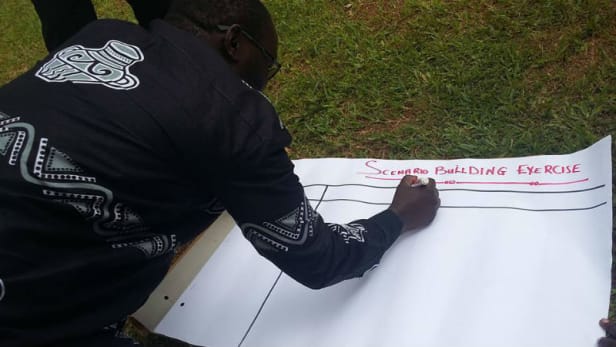
ActionAid Uganda leads a scenario building exercise. Photo by: ActionAid Uganda

The office raid appears to be part of a wider crackdown on legitimate protests against the plan to remove the presidential age limit from the Ugandan Constitution, thus allowing the current president to remain in power indefinitely.

We think these attacks have ulterior motives.

1. To delegitimize civil society. Police raids on our offices immediately present us as subversive elements. This could affect our public image, and that of civil society in general. It could also scare away our funding partners and threaten the stability of our work.

2. To compromise our systems and information. These attacks disrupt our work, and potentially sow seeds for future surveillance by targeting our communications systems and infrastructure.

3. To disrupt and derail us from our mission. Part of our mission as civil society is to help articulate public positions. We are opposed to regressive constitutional amendments. We will invest in organizing citizens to resist attempts to remove the age-limit, even though we know this puts us in direct conflict with the ruling party.

4. To threaten and demoralize civil society. In the hopes of driving us into self-censorship, weakening our resolve, and preventing us from tackling injustice.

5. To provide a justification for further action. Such as halting activities of civil society under the pretext that investigations are still ongoing. We have already seen this happening in the case of ActionAid, where two field activities have been halted by the police.

What can we learn from these attacks and what should civil society do to defend ourselves in ongoing efforts to protect civic space? How can we ensure that we are not derailed in our mission to tackle injustice and poverty?

Here are some tips if your office is at risk of being raided.

1. Always keep your house in order. You must update and back up all institutional information and documentation. During the impromptu siege, the police demanded documents without delay. If we had failed to do so, it may have caused unnecessary suspicion.

2. Staff and board members must understand all processes in the organization. If interrogated, we do not want colleagues to inadvertently arouse suspicion by saying inconsistent things about how we organize ourselves and what our business processes are.

3. Rapid legal response is necessary. As civic and political space continues to shrink in Uganda and globally, we must strengthen our legal response capabilities. The presence of competent lawyers is extremely important.

4. A positive relationship with the media is essential. The media were very helpful in reporting the siege — and established relations meant they did so in a manner that was both supportive and objective. Social media platforms were of increased importance during this crisis, and future investment here is key.

5. Being relevant to civil society and wider citizens’ struggles. The immense show of solidarity from other civil society organizations, politicians, and the public at our time of need demonstrated our value and relevance to civil society. The more outward looking an NGO, the more likely it is to receive much-needed solidarity from others. We were able to call upon our supporters both in Uganda and across the world to amplify our voice and provide solidarity.

6. Beware of potential informers. Finally, we have learned that the forces that seek to undermine our work are in our midst. It is therefore important to better understand our internal environment and partners with whom we work. We must remain vigilant and transparent and have the confidence to defend what we stand for.

The threat to civil society is far-reaching. We must learn from these attacks and work together to protect and defend the legitimacy and effectiveness of the work that we do.

196935scr
Arthur Larok is the current country director of ActionAid Uganda. He has previously worked with the Uganda National NGO Forum, the Forum for Education NGOs in Uganda and World Learning for International Development. He is the current chairperson of the Uganda National NGO Forum, the largest NGO platform in Uganda.

Sources:

Opinion: Our offices were raided in Uganda. Here’s what to do if yours are, too. | Devex

http://allafrica.com/stories/201710090056.html

Faith Leaders as Human Rights Defenders

October 25, 2017

This week (23 – 27 October 2017) there is an on-line Dialogue by New Tactics Supporting Faith Leaders and Faith-Based Organizations as Human Rights Defenders” with as goal: Mobilizing Allies and Modeling Systems and Structures.

The background to this interesting topic is the converging and diverging principles of secular human rights goals and religious values. On the one hand, there are historical and contemporary instances in which oppressors have used religious doctrines to endorse discrimination and violence against marginalized groups. Around the world, people continue to suffer daily from these acts of hate. Yet, many faith leaders from a range of religions denounce religiously motivated violence and actively work to combat human right abuses around the world. Some of history’s most impactful activists—El Salvador’s Oscar Romero, India’s Mahatma Gandhi, Iran’s Shirin Ebadi, the United States’ Martin Luther King drew upon their personal faith to promote civil rights and peace.
Today, many faith leaders and faith-based organizations have become leaders in human rights activism and humanitarianism, both locally and internationally. In Northern Uganda, the Acholi Religious Leaders Peace Initiative has united faith leaders to advocate for peace and strengthen the peacebuilding process in the wake of the region’s devastating civil war. Rabbis for Human Rights supports human rights in Israel and the Occupied Territories by performing acts of solidarity with Palestinians suffering from the Occupation, organizing interfaith dialogues, and educating their fellow community members on the interconnectedness of Judaism and human rights. Musawah is global human rights movement working to advance women’s rights in Muslim contexts, using Islamic teachings and universal human rights doctrinal frameworks to guarantee equality in the lived realities of men and women. Each of these organizations has incorporated their faith into action-based human rights movements that demonstrate their accountability in practicing what they preach: dignity, justice, and fairness for all humanity.
Faith leaders and organizations can contribute to strengthening human rights around the globe by countering voices of oppressors, mediating conflicts to end or avoid violence, denouncing discrimination, organizing humanitarian assistance, and so much more. Just as faith communities may thrive in environments where each member’s dignity and rights are recognized, the international human rights movement may learn from engaging communities with deeply rooted ethical and spiritual foundations. In March of 2017, the UN Office of the High Commissioner of Human Rights launched “Faith for Rights,” an initiative to strengthen the interconnectedness of the world’s religions and human rights. In the subsequent Beirut Declaration, participating faith-based and civil society actors recognized their mutual commitment to “upholding the dignity and the equal worth of all human beings.” Across the world, faith leaders and faith-based organizations can be valuable allies in achieving universal human rights for all.
In this conversation, New Tactics seeks to discuss the role of faith in promoting human rights across the globe and strategies for strengthening partnerships between secular and religious human rights defenders.  The Conversation Leaders are:
habdille's picture
Marie Juul Petersen's picture

Source: Supporting Faith Leaders and Faith-Based Organizations as Human Rights Defenders | New Tactics in Human Rights

Repressive governments and Ophelia compete to prevent HRDs to travel to Dublin

October 18, 2017

Andrew Anderson, the executive director of Front Line Defenders, published a piece at the beginning of the Dublin Platform for Human Rights hosted by Front Line Defenders in Ireland

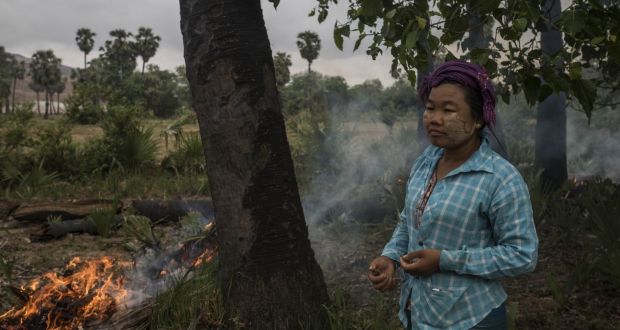
Thwe Thwe Win working on her land near the copper mine in Myanmar. 25 May 2016. Photo: Lauren DeCicca / Front Line Defenders

Thwe Thwe Win working on her land near the copper mine in Myanmar. 25 May 2016. Photo: Lauren DeCicca / Front Line Defenders
Thwe Thwe Win is one of the 117 at-risk activists invited to the 2017 Dublin Platform for Human Rights Defenders who actually made it to the bi-anual gathering of global activists. ….

Like thousands of people trying to get into Ireland on Monday, dozens of our international guests had flights canceled or postponed. Another 11, however, were prevented from attending long before Ophelia hit, banned from leaving home by their governments…..It is an opportunity for defenders typically preoccupied with defending their communities – and surviving the threats that ensure – to spend 72 hours not being physically surveilled by a totalitarian state, threatened at work by an extremist group, or receiving menacing phone calls demanding their stop their activism. It is an opportunity to relax, something activists tend to forget to do. It is also a chance for defenders to learn from their peers around the world. Feminists from Nigeria strategise with Colombians about how to peacefully defend indigenous land from paramilitaries. Emirati human rights defenders chat to Moroccans about the high-tech spying software both their governments recently purchased. Bahrainis lament with Bangladeshis the unrelenting influence of Saudi Arabia in each oppressive state’s policies. Rights activists from most of the former Soviet block tend to tease the Russian about their own governments’ adopting a “copy and paste” approach to many of Russia’s anti-NGO laws.

This year there will be a noticeable gap in our Dublin Castle crowd. Last week, we learned that our Kuwaiti invitee was threatened by state officials not to travel. The Bahraini invited is currently in detention; last time she was there, they sexually assaulted her. The second young Bahraini woman we invited in her place – who boldly took to Twitter to speak out for the former – now has a travel ban. The Saudi activist learned he was on an intelligence surveillance list last week; he rang our Blackrock office to say he was too scared to leave home. The Gulf has been a blackhole of restrictions of freedom of movement for human rights defenders for some time now, but unfortunately that’s not the end of it. Our Syrian colleague has had his passport confiscated by state security in Turkey, and a Ukrainian lawyer has yet to be granted permission to travel.

An activist in Cameroon was arrested for his peaceful activism a few weeks ago – he won’t be joining us this week; he’s in prison. A Cuban human rights defender planned to leave home in Guantanamo City extra early, knowing he’d be stopped at the town’s many American-run military checkpoints – security in Guantanamo is tight. Ultimately, he was never granted the “exit permit” required to leave Cuba. In Colombia, David Rabelo Crespo was recently released from prison after 7 years for a crime he did not commit, but has still been forbidden from travel to Dublin.

Governments world-over know that it is not laws, conventions, or UN resolutions that bring human rights reform to a country – it’s people. They know that activists are only as powerful as their communities, both local and international, and are working harder than ever to ensure that networks of solidarity cannot flourish.

Radical social change – the kind that undermines dictatorships, dismembers racist populist tides, secures indigenous peoples’ rights to their land – has always been born out of collective struggle. It is clear that in preventing our human rights defender colleagues from Bahrain, Kuwait, Colombia, Saudi Arabia, Cameroon, Syria, and Bolivia from traveling, the respective authorities are not only vindictive, they are terrified of activists. Authoritarians think that if they lock human rights defenders away – behind bars or travel bans or physical attacks – that we will stop listening, that we will forget them. Authoritarians are wrong……….When governments work hard to silence activists, we must work harder to hear them.” [see alsohttps://humanrightsdefenders.blog/2015/11/30/closing-civil-society-space-a-euphemism-for-killing-human-rights-defenders/#more-7208]

Andrew Gilmour, UN Assistant Secretary-General for Human Rights,made statement on 17 October 2017 which is worth reading in its totality but I copy here only the part on reprisals:

At times – as some of you have experienced or witnessed – engagement with the UN on human rights can lead to reprisals and intimidation. This has been a long-standing concern to the Organization, and we are distressed at the increasing number of such acts. These range from travel bans, threats and harassment, smear campaigns, surveillance, restrictive legislation, physical attacks, arbitrary arrest and detention, torture and ill-treatment, including sexual violence, denial of access to medical attention, and even killings. Intimidation of human rights defenders is happening all the time. The purpose is to penalize individuals who have already spoken out, thereby also sending a signal to many others from speaking out in future.

Recognising the gravity of this issue, last October the Secretary-General announced that he had asked me to lead efforts to strengthen UN-wide action for prevention of, protection against, investigation into and accountability for reprisals. Many Governments are very supportive, and have offered resources for this endeavor. Our host country Ireland is very strong in this regard. We are trying to get as much information about what is going on, and for this we need your input, and will circulate our email address to help us get it.… I recount a few lines of what I said in my speech to the Human Rights Council three weeks ago as I presented the Secretary-General’s report on reprisals:

We believe the significance of this report goes far beyond the individual cases contained in it. I think we should see these individuals as the canary in the coal mine, bravely singing until they are silenced by this toxic backlash against people, rights and dignity – as a dark warning to us all. (…)

It is frankly nothing short of abhorrent that, year after year, we are compelled to present cases to you, the UN membership, of intimidation and reprisals carried out against people whose crime – in the eyes of their respective Governments – was to cooperate with the UN institutions and mechanisms whose mandate of course derives from you, the UN membership. (…)

I salute the extraordinary courage that it sometimes takes for the victims and their families to come forward and share their stories with us, and also the dedication of the civil society organizations who act on behalf of those affected.

[see also: https://humanrightsdefenders.blog/2017/06/21/assistant-secretary-general-for-human-rights-andrew-gilmour-speaks-very-freely-at-the-united-nations-association-of-the-usa/]
Sources:

Its people and not laws that bring human rights reform to a country

http://www.ohchr.org/SP/NewsEvents/Pages/DisplayNews.aspx?NewsID=22251&LangID=E

Protection International releases its 2017 FOCUS REPORT on human rights defenders: global trends

October 16, 2017

On 10 October 2017 Protection International (PI) presented the 2017 edition of its Focus Report, monitoring worldwide developments in the field of national protection mechanisms and public policies for the protection of human rights defenders (HRDs). Since the publication of its handbook Protection of human rights defenders: Best practices and lessons learnt (in 2011), the public debate regarding national public policies for HRD protection has evolved: initially only a handful of Latin American governments were addressing systematic attacks against HRDs through national protection mechanisms, and civil society organisations approached the issue with a lot of mistrust and scepticism. In recent years, it has become mainstream with the adoption of national laws and the emergence of draft bills in several countries of Latin America and Africa, while permeating the discussions on HRD protection in countries of Europe, Central and South-East Asia.

Many developments in this field of the HRD protection ecosystem also occurred since the publication of the last edition the Focus Report in 2014. [https://humanrightsdefenders.blog/2014/12/03/protection-international-focuses-on-national-protection-mechanisms/] This heightened interest nonetheless, the implementation gap remains a big issue and trust is far from assured, especially among groups of HRDs taking the brunt of state repression and violence and those HRDs in remote areas where the presence of state authorities is weak or contested by non-state actors. Research shows that political will and backing is key to overcome these problems.

With the 20th anniversary of the UN Declaration on HRDs fast approaching, Protection International believes it is now high time to shift the focus of the debate away from adopting laws to protect human rights defenders at risk towards a more comprehensive approach, which addresses the structural violence and repression against them.

Source: New release: 2017 FOCUS REPORT | Public policies for the protection of Human rights defenders: global trends and implementation challenges – Protection InternationalProtection International

Urgent: Martin Ennals Award 2017 – live streaming of ceremony on 10 October

October 9, 2017

The 2017 ceremony of the Martin Ennals Award for Human Rights Defenders will take place on 10 October in Geneva at 18h15 CET. For the many people who cannot attend in person, there is the possibility of following the event on screen via: https://www.facebook.com/villegeneve.ch/

The ceremony is in English and French and features 3 short documentaries on the finalists as well as the announcement of the Laureate 2017 which the Jury of the MEA decided on this morning.

For more info see: https://humanrightsdefenders.blog/2017/06/28/save-the-date-10-october-2017-ceremony-martin-ennals-award-for-human-rights-defenders-in-geneva/

Geneva: the right place for the world’s human rights award

October 5, 2017

Global Geneva published today, 4 October 2017, an article by me called “[Geneva] The right place for the world’s human rights award“. Rather than summarizing it, here is the full article. There are lots of other interesting pieces in the issue, see: http://www.global-geneva.com.

——————

The 2017 Martin Ennals Award for Human Rights Defenders will be announced on Tuesday, 10 October, 2017 at the University of Geneva (UniDufour) in Geneva, Switzerland. For further information, go to MEA: This article also appears in the Oct-Nov 2017 edition of Global Geneva magazine.

WITHOUT INDIVIDUAL HUMAN RIGHTS DEFENDERS (HRDs), the Universal Declaration of Human Rights and other human rights law risk being a dead letter. Almost all human rights organisations have a mandate to come to the succour of threatened colleagues via urgent appeals and other campaigns. Some 150 now run an award and the number keeps growing – half were created since the beginning of the 21st century.

Curiously, however, the best known of these awards, the Nobel Peace Prize, is given out annually in Oslo and not in Geneva, the international hub for human rights. Alfred Nobel died on 10 December. Decades later, the United Nations declared 10 December as International Human Rights Day and designated 21 September as the International Day of Peace. The strange result is that the Nobel Peace Prize – intended for contributions to ‘peace’, not necessarily ‘human rights’ – is awarded every year in Oslo on 10 December, which is ‘Nobel Day’ in Sweden and Norway, and International Human Rights Day for the rest of the world.

In 1992, I became involved in the creation of the Martin Ennals Award for Human Rights Defenders (MEA). Originally, this was meant to keep alive the memory of the first Secretary General of Amnesty International and a key figure behind the creation of the modern human rights movement. In recognition of his work, 10 global human rights organisations, (Human Rights Watch, Amnesty International, World Organization Against Torture (OMCT), Front Line Defenders, Evangelisches Werk für Diakonie und Entwicklung, HURIDOCS, Human Rights First, the International Commission of Jurists, the International Service for Human Rights, and the International Federation for Human Rights (FIDH), all agreed to form the Jury. Later, a panel of regional NGOs joined the common effort.

The small volunteer secretariat operated out of Geneva, but many of the first award ceremonies were held abroad in places where the laureates are active. In 2001, it was decided to make Geneva the permanent location for the annual ceremony. By 2008, the lakeside city started offering serious support by making the award part of its “International Geneva” plan, an effort to galvanize the private and public sectors, including the rest of Switzerland, with regard to the region’s crucial importance as a hub for critical global issues. Since then, cooperation has grown into an admirable win-win partnership with the award run on a fully independent basis, while Geneva provides the infrastructure for the ceremony.

This suits all parties. The actual decisions are made by an autonomous jury of experts enabling the city to avoid having to deal with controversial aspects.

Mohamed Zaree of the Cairo Institute of Human Rights Studies (CIHRS) is one of the three finalists, and is subject to a travel ban to Geneva where he is supposed to attend the 10 October 2017 Martin Ennals Award Ceremony. Despite requests directly to Egyptian President Al-Sisi, the ban – at this time of writing – has yet to be lifted.

Presenting the awards: a matter of protection – and courage

The wisdom of this separation was reiterated in 2016 when the MEA went to an imprisoned scholar belonging to the Uyghur minority. China reacted furiously, but its target ended up being the UN High Commissioner for Human Rights, who courageously persisted in presenting the award at the ceremony as his predecessors have done over the years.

How effective are human rights awards? To answer this, one needs to know in which way they are intended to help human rights defenders. In the first place, all awards seek to offer recognition and encouragement at the psychological level. This goal should not be trivialized as activists often have to work in difficult environments. Furthermore, they may prove unpopular even within their own social circles.

Secondly, many awards come with some financial support. Even relatively small amounts go far in cash-strapped organizations, many based in developing countries.

Finally, the most important but also elusive goal is protection. The latter is not really possible without a fair degree of publicity. An example: On 13 May 2008, Mutabar Tajibaeva, a detained human rights activist in Uzbekistan, was announced as that year’s MEA Laureate. A few weeks later, on 2 June, she was released from prison on medical grounds, and a few months later, was allowed to travel abroad. She came to Geneva to receive the MEA in person, declaring publicly that the award saved her life. However, one cannot state categorically that her release was a direct result of the award; many other actors contributed to the pressure that resulted in her release from prison.

Karla Avelar 2017 FINALIST – EL SALVADOR: Karla Avelar has dedicated her life to defending, nationally and internationally, the Human Rights of LGBTI persons, HIV affected persons, migrants, persons deprived of liberty in situations of vulnerability as well as victims of discrimination due to their sexual orientation or gender identity.

For human rights abusers: embarrassment fueled by global press coverage 

That such impact cannot be taken for granted is shown by the case of Ahmed Mansoor from the United Arab Emirates, the 2015 Laureate. The government did not lift his travel ban and he had to address the audience via a video link.

His case received further global coverage in August 2016. Flaws in Apple’s iOS operating system were discovered by Mansoor who alerted security researchers to unsolicited text messages he had received. Apple has since released a software update that addresses the problem. Then, on 20 March, 2017, around midnight, Ahmed Mansoor was arrested at his home in a raid by a large team of the Emirates’ security forces.

His importance as a human rights defender was demonstrated by the international response to this sudden arrest. In addition to many newspapers and social media, the UN Special Procedures and the EU Parliament quickly called for his release. But today, six months later, he continues to linger in jail.

FreeThe5KH 2017 FINALIST = CAMBODIA: Mr Ny Sokha, Mr Yi Soksan, Mr Nay Vanda, Ms Lim Mony and Mr Ny Chakrya, the “Khmer 5” are Cambodian human rights defenders who face judicial harassment and had spent 427 days in pre-trial detention, as a result of their legitimate human rights work.

Some believe that human rights awards can endanger the lives of laureates. Clearly, this is a danger, but the best judge of the balance between increased risk and greater protection remains the human rights defender in question. And generally, they seem to regard public exposure foremost as a form of protection, reflecting the increased importance of the media even in tense situations. The biggest problem with seeking increased protection through publicity is perhaps that the media are not automatically interested in all human rights awards.

That the media are increasingly referring to the MEA as the “Nobel prize for human rights” is perhaps the best sign that after almost 25 years, the award has found its status and place in Geneva. With the delivery of the 2017 prize on 10 October in Geneva, it will again be in the hope to go ‘from the front line to the front page’.

Hans Thoolen is a Dutch national who has worked for various NGOs and inter-governmental organizations, including 12 years in Geneva. He is now retired but not tired. Read his blog: https://humanrightsdefenders.blog/

Source: The right place for the world’s human rights award | Global Geneva

2017 Right Livelihood Laureates announcement in video

October 4, 2017

The 2017 Right Livelihood Laureates (Robert Bilott from the USA (Honorary Award), Colin Gonsalves from India, Khadija Ismayilova from Azerbaijan, and Yetnebersh Nigussie from Ethiopia) are announced in a short video clip. For more information about the Laureates, please visit www.rightlivelihoodaward.org. For more info on this and other awards:  www.trueheroesfilms.org/thedigest .
see also: https://humanrightsdefenders.blog/2017/09/30/4-activists-receive-the-′alternative-nobel-prize′-2017/

Defend the Defenders newsletter about African developments

October 2, 2017

One of my sources is the Defend the Defenders network run by the East & Horn of Africa Human Rights Defenders Project. I will continue to follow it for you, but those with special interest in Africa should subscribe themselves:  https://app.getresponse.com/site2/publicsignup?u=Bl16k&webforms_id=1980102. Below the latest newsletter as an example: Read the rest of this entry »

Honduras, already the deadliest country in the world for environmental defenders, to get deadlier

October 2, 2017
 
Demonstrators protest in the wake of the 2009 coup in Honduras that ousted President Manuel Zelaya. Source: Creative Commons / Flickr–PBS NewsHour 

The article describes how activists in Honduras could soon face up to 20 years in prison for simply marching in the streets after Congress passed an article of the new Criminal Code last week that opposition lawmakers claim criminalizes social protest as a form of “terrorism.”…..Human rights defenders have raised alarm over the proposed reform, arguing that the sweeping definition of “terrorism” in the bill leaves activists and social leaders vulnerable to harsh criminalization and violence at the hands of military and police forces. As the piece is long and copyrighted, here just the link.

Earlier posts on Honduras, which is one of the most dangerous in the world for human rights defenders, include: https://humanrightsdefenders.blog/2016/03/07/exceptional-response-from-ngo-world-on-killing-of-berta-caceres/ .

Source: Honduras, the Deadliest Country in the World for Environmental Defenders, Is About to Get Deadlier – Upside Down World