Posts Tagged ‘Human Rights Defenders’

UK issues call for applications for funding human rights defenders work

May 14, 2019

On 13 May 2019 the UK Mission to the United Nations in New York issued a call for Programme Fund bids for the fiscal year 2019-2020.

placeholder

The UK Mission to the United Nations in New York is running an open call for project bids for funding under the Foreign and Commonwealth Office’s International Programme in support of the UK Government’s objectives at the UN in New York on Freedom of Religion or Belief and Human Rights Defenders. Funding will be available for ODA-eligible projects running between 1 April 2019 and 31 March 2020. Bids will be accepted from civil society, including NGOs and think tanks, as well as international organisations, including UN offices, agencies, funds and programmes. As a first step, interested parties must submit a written expression of interest to uk@un.intby Tuesday 21 May.

For more information on the programme, guidance for bidding, and additional deadlines, see the Programme Fund form below.

UN WEB TV: panel on human rights defenders and business

May 14, 2019
Panel on Safeguarding human rights defenders – Forum on Business and Human Rights 2018

On 27 November 2018 there was panel on “Safeguarding human rights defenders: new efforts and tackling growing threats” during the  Forum on Business and Human Rights. It is a bit old hat, but I wanted to show it as a good example of what is nowadays to be found on the internet as ‘on demand video’.

Brief description of the session :
The need for enhancing protection of human rights defenders who speak up against business-related human rights impacts is a standing item on the Forum’s agenda. This session led by the UN Working Group in collaboration with NGOs consists of two parts:
1. The first part of the session will be dedicated to showcasing new efforts to strengthen corporate respect and support for human rights defenders. Presentations will be brief, but meant to highlight encouraging initiatives and action.
2. The second part of the session will focus on the growing trend of criminalization and legal harassment of defenders who speak up against business-related impacts and identify concrete action to be taken by governments, business and others to address it. The panel aims to identify what “human rights due diligence” is needed and what are some of the practical considerations for preventing that companies become involved in criminalization and legal harassment of defenders who engage in legitimate efforts to address potential and actual adverse impacts. This will include identifying steps to be taken by:
•home States
•host States
•companies that cause negative impacts and who are the main targets of criticism
•companies that have business relationships to those causing the abuse (typically transnational corporations and their responsibility to address impacts in their supply chain)
•investors
•companies that invest in contexts where criminalization of human rights defenders is a salient issue

Moderator/ Introductory Remark…
•Michael Ineichen, Programme Director, International services for Human Rights
•Anita Ramasastry, Member, UN Working Group on Business and Human Rights

Speakers
•Brittany Benowitz, Chief Counsel, ABA Center for Human Rights
•Vaewrin Buangern, Community member from Lampang Province, Northern Thailand, Community member from Lampang Province, Northern Thailand
•Bennett Freeman, author of “Shared Space Under Pressure: Business Support for Civic Freedoms and Human Rights Defenders”, author of “Shared Space Under Pressure: Business Support for Civic Freedoms and Human Rights Defenders”
•Andreas Graf, Human Rights Manager, Sustainability & Diversity Department, FIFA
•Johanna Molina Miranda, Researcher on Human Rights and Business, CREER Lawyer, Specialist in International Law of Human Rights and International Humanitarian Law with studies in Politics and International Security and currently studying for a Masters in Public International Law.
•Mohammad Nayyeri, Legal Advisor and Program Manager, Justice for Iran
•Ana Sandoval, Peaceful Resistance “La Puya”, Guatemala, Peaceful Resistance “La Puya”, Guatemala
•Clément Nyaletsossi Voule, UN Special Rapporteur on Rights to Freedom of Peaceful Assembly and of Association

(Forum on Business and Human Rights)

ISHR on Reprisals: UN and States must do more to address reprisals

May 13, 2019

On 6 May 2019 the International Service for Human Rights (ISHR) submitted two reports to the UN Secretary General on the topic of reprisals against human rights defenders. The conclusion is that many defenders still face unacceptable risks and are unable to cooperate safely with the UN and regional human rights bodies and mechanisms. The reports were prepared in response to the call made by the United Nations High Commissioner for Human Rights inviting representatives of civil society to provide information on preventing and addressing acts of intimidation and reprisals related to cooperation with the United Nations. This blog has devoted many posts to this nefarious issue, see e.g.: https://humanrightsdefenders.blog/tag/reprisals/

Read the rest of this entry »

New contact group among intergovernmental organisations to support human rights defenders in Europe

May 12, 2019

On 10 May 2019 the Fundamental Rights Agency (FRA) reported that from 7 to 8 May, representatives from intergovernmental organisations and EU institutions responsible for cooperation with civil society and for supporting human rights defenders in Europe and Central Asia met in Warsaw at the invitation of the FRA and the OSCE Office of Democratic Institutions and Human Rights (ODIHR). Others represented at the meeting were the Council of Europe, European Commission, European External Action Service, European Asylum Support Office (EASO), OSCE Chairmanship in Office, OSCE Representative for Freedom of the Media, the OHCHR Geneva and Brussels office, UNDP, UN Women, and the World Bank.

The press release did not elaborate what was discussed or achieved but only that “It served to establish ongoing, practical information exchanges to facilitate further cooperation between these organisations in supporting human rights defenders.”

The need for more action in support of HRDs in Europe has been often referred to in this blog. See also: https://humanrightsdefenders.blog/2018/01/27/human-rights-ngos-in-europe-no-longer-the-standard-to-follow/

https://fra.europa.eu/en/news/2019/new-contact-group-support-human-rights-defenders-europe-among-intergovernmental

Special Rapporteur Forst launches campaign: “TOGETHER WE DEFEND HUMAN RIGHTS”

May 8, 2019

“We all can be human rights defenders, as long as we peacefully stand up for other people or speak out against injustice or discrimination” says Michael Forst – the UN Special Rapporteur on human rights defenders – in launching his new campaign #TogetherWeDefend. The campaign promotes human rights defenders worldwide by fully recognising the good they do. 

Follow the link https://togetherwedefend.org  to find out more, subscribe and join the campaign.

For some of my earlier posts on Forst see: https://humanrightsdefenders.blog/tag/michel-forst/

Ethiopia: a progress report by DefendDefenders made public on 7 May

May 7, 2019

In a new report launched 7 May 2019, Turning the Page: Rebuilding Civil Society in Ethiopia, the regional NGO DefendDefenders examines the challenges faced by Ethiopian human rights defenders amid the ongoing reform process and makes concrete recommendations for rebuilding a robust and inclusive civil society ahead of elections planned for 2020. Despite some positive developments, serious gaps remain, the report concludes and rights-based organisations in the country currently lack the capacity to keep pace with these developments. This report outlines several avenues donors and international organisations can use to help effectively rebuild civil society in Ethiopia, such as capacity-building activities, and areas of focus like psychosocial support.

I believe that the role of HRDs and civil society is prescient in ensuring that ideals of democracy and open civic space are not only achieved in Ethiopia, but offer a roadmap to other African countries,” says Hassan Shire, Executive Director of DefendDefenders. “This report should not only highlight the many achievements of Ethiopia in the last year, but also acknowledge the uneasy road ahead and make concrete recommendations to mitigate potentially negative outcomes.

After a 13-year crackdown on civil society (hundreds of killings and the arrest, arbitrary detention, and torture of thousands of peaceful protesters), amid internal pressure, Dr. Abiy Ahmed was appointed as the new Prime Minister In April 2018 and began a series of reforms aimed at opening political and civic space in the country. This has been accomplished by releasing thousands of political prisoners and granting them amnesty, and accepting previously banned groups back into the Ethiopian political mainstream, in addition to the appointment of prominent women to positions of power within the government. [see also: https://humanrightsdefenders.blog/2019/02/12/human-rights-defender-yared-hailemariam-back-in-his-homeland-ethiopia-after-13-years/]

However, concerns remain over the top-down nature of the reforms, as well as gaps in the economic, security, health, and legal sectors. This report also contains a detailed analysis of the new Civil Society Organisations Proclamation, with commentary on the provisions that mark an improvement, as well as remaining concerns.

Questions over how to achieve accountability for past and ongoing human rights violations remain, with concerns regarding civil society’s lack of capacity to effectively support such endeavors, as well as the state’s ability to constructively handle this process.

While the majority of the country’s media remains state-owned, small publications and online outlets have flourished since the reform process began. The ongoing liberalisation of the media sector raises concerns over the rise of online hate speech spurred by ethnic nationalism.

Women HRDs remain at risk in the country, with rigid social norms often preventing their active participation in public life or human rights organisations. Women also often lack access to justice, especially in cases of female genital mutilation and sexual and gender-based violence, as well as access to positions of power in the government.

Lesbian, gay, bisexual, transgender, and other sexual minority (LGBT+) HRDs remain a critically unaddressed group within Ethiopia’s burgeoning human rights movement, partially rooted in the country’s religious and conservative value systems, in addition to lack of prior experience and sensitisation. Mainstreaming LGBT+ organisations into the wider rebuilding of Ethiopian civil society will be paramount to addressing these gaps.

Forthcoming elections scheduled for May 2020 offer a critical test for the country with questions over what role civil society will be ready to play ahead of, and during, a free and fair poll, and whether there is sufficient capacity to conduct effective democratic sensitisation campaigns and monitor polls.

A properly functioning national coalition of HRDs is paramount to effectively rebuild civil society, however, issues remain with regard to the inclusion of previously marginalised groups. If these efforts are successful, Addis Ababa also bears the potential to become an important Ubuntu Hub City for HRDs from across Africa, with welcoming policies regarding migration, refugee rights, and institutional support from international organisations and diplomatic missions. For more information, please contact communications@defenddefenders.org.

https://www.defenddefenders.org/publication/turning-the-page-rebuilding-civil-society-in-ethiopia/

International Civil Society Week: 3 human rights defenders engaging business

May 4, 2019

Sutharee Wannasiri (Thailand)

Sutharee Wannasiri

Sutharee has been supporting the 14 Myanmar workers that have denounced labour rights abuses at the Thammakaset Farm in Thailand. She has actively engaged in public advocacy to demand business accountability on labour rights abuses, and an end to the judicial harassment workers are facing in retaliation for reporting these. To date, Thammakaset Farm has filed more than 13 criminal and civil complaints against the workers and the local CSO staff from Migrant Worker Rights Network and the journalists supporting them, including her – many of them are ongoing. The majority of the cases have been dropped by the courts.

Sutharee said:

“It is also the responsibility of international brands that buy from Thailand to make sure the companies they are sourcing from are not engaged in judicial harassment that creates a chilling effect on whistleblowers and other defenders. They should establish mechanisms that allow workers and defenders to communicate with the brands directly and ensure that they are protected from any retaliation from suppliers during the investigation. The results should be made public and bring accountability for the abuses.”


Amanda Segnini (Brazil)

Amanda Segnini

The organization engajamundo focuses on youth empowerment in Brazil, with a particular focus on climate change. Its main goal is to make young people ware of their power to transform their communities. The organization is concerned about how civic freedoms will be negatively affected under the new government of President Jair Bolsonaro. Engajamundo is open to dialogue and ongoing engagement with companies if there is an alignment in values. Amanda believes that companies and civil society could engage more with one another if they find a shared purpose.

Amanda said:

It might be right for companies to say something in support of activists that are under attack – but only if they have been working with the community long-term and have an ongoing relationship with them: for example, if they work with local producers and source responsibly from them. If such a community is under attack, a brand should say or do something in their support. But if they only say something without having that relationship, it’s like they are just ‘riding on the wave’, taking advantage of the buzz. Companies also should not censor civil society they engage with. For example, once we were invited to take part in a corporate event, but they tried to censor what we wanted to say. We decided not to participate in the end.”


Sasa Uzelac (from Serbia)

Sasa Uzelac

Sasa is the Solidarity Center‘s Regional Coordinator for South East Europe. Solidarity Center was established by AFL-CIO, and is the biggest international organization supporting trade unions and associations working to protect labour rights in South East Europe. He says trade unions and workers’ associations are increasingly under attack from governments, companies, and far-right political organizations and movements. Sasa says the tide of far-right populism is creating additional problems for organizations and people advocating for labour rights. Workers’ rights are being endangered on a daily basis by “ruthless” employers and “mindless” government officials. Freedom of association, decent working conditions, and human rights in the field of work are at risk due to governments’ failure to sanction unlawful activities by employers.

Sasa said:

“The best thing brands can do is to introduce union practices from their country of origin, rather than exploiting the weaknesses of the local system and local practices in their operations. But sadly they are not doing that to a high enough standard in this region. When big international companies enter the market, they should also make sure that the health and safety standards are brought to the levels of their countries of origin.”

https://www.business-humanrights.org/en/human-rights-defenders-discuss-engaging-with-business-at-international-civil-society-week-in-serbia

Michel Forst addressed the International Civil Society Week 2019

May 3, 2019
For the International Civil Society Week (ICSW), held  in Belgrade from 8-12 April 2019,  (Special Rapporteur on human rights defenders) contributed through IPS the
following piece: “Human Rights Defenders Need to be Defended as Much as they Defend our Rights”:

They are ordinary people – mothers, fathers, sisters, sons, daughters, brothers, friends. But for me they are extraordinary people – the ones who have the courage to stand up for everyone else’s rights. They are the human rights defenders. Last year, according to reliable sources, 321 of them were killed, in 27 countries. Their murders were directly caused by the work they do to ensure the rest of us enjoy the rights we claim as purely because we are human. Countless others were tortured, raped and threatened, also for the work they do protecting their, and others’ human rights.

In fact, 2018 was deadliest year for human rights defenders since the UN began monitoring the challenges they face through the establishment of a mandate for a Special Rapporteur on the situation of human rights defenders. It shouldn’t be like this.

Last year we marked 70 years since the Universal Declaration of Human Rights and 20 since the UN Declaration on Human Rights Defenders. The latter Declaration provides for the practical support and protection of human rights defenders as they go about their work. It is addressed not just to states and to human rights defenders, but to everyone. It tells us that we all have a role to fulfil as human rights defenders and emphasises that there is a global human rights movement that involves us all. This is a task we are not performing well.

Human rights should not need defenders, and human rights defenders should not need protection from the might of oppressive governments, corrupt multinationals and crooked legal systems. But this is an imperfect, human world.

Since 2000, when we UN Special Rapporteurs on the situation of human rights defenders began our monitoring work, much progress has been made. There has been extensive discussion on how these courageous people should be protected, and there is a Protection Mechanism for Human Rights Defenders and Journalists in a limited number of countries. Sadly, it is often not properly implemented, or funded. It is impossible to canvass each defender’s particular treatment or mistreatment by the authorities they face, or even that of communities of defenders. There are, however, trends.

  • On 23 October last year, Julián Carrillo, an indigenous rights defender from Mexico’s state of Chihuahua told a friend by phone that he believed he was being watched and that he was going into hiding. On the evening of 25 October, his body was found. He had been shot several times.
  • On 22 August last year, Annaliza Dinopol Gallardo, a Filipina land rights defender known to her community as “Ate Liza”, was shot dead outside Sultan Kudarat State University in Tacurong City. She had four children.

Mr Carillo’s murder is indicative of the largest trend. More than two-thirds – a full 77% – of the total number of defenders killed were defending land, environmental or indigenous peoples’ rights, often in the context of extractive industries and state-aligned mega-projects.

Ms Gallardo’s murder represents another trend – the number of attacks on women and girls who are defenders is increasing. In the recent report that I have presented to the UN Human Rights Council I have highlighted that, in addition to the threats experienced by their male colleagues, women human rights defenders face gendered and sexualised attacks from both state and non-state actors, as well as from within their own human rights movements.

This includes smear campaigns questioning their commitment to their families; sexual assault and rape; militarised violence; and the harassment and targeting of their children.

Changing all this is our task for the future. Protection Mechanisms for Human Rights Defenders and Journalists need to be properly implemented and funded, at national level.

We need to empower defenders and increase the abilities of those who are responsible for their protection to keep them safe. We also need to improve the accountability mechanisms these officials operate under.

To properly defend the defenders, we also need to recognise their diversity, and that each one of them faces challenges particular to their individual circumstances. There is no one-size-fits-all answer to ensuring each defender is able to do their work unfettered.

We need to acknowledge that defenders, just like all of us, live in this modern, interconnected world.

Protecting them means covering all aspects of their safety: physical, psychological and digital. It means doing so with flexibility. It also means that our protection needs to extend to their families, and the groups and organisations they belong to. We need to speak to them about what they need to feel safe.

In recent years the world has taken a worrying turn away from respect for human rights. Increasingly, groups are becoming inward-looking, and nations nationalistic. We need human rights defenders now more than ever. They also need us.

See also: https://humanrightsdefenders.blog/tag/2019-international-civil-society-week/

http://www.ipsnews.net/2019/04/human-rights-defenders-need-defended-much-defend-rights/

“Somos Defensores” in Colombia publishes annual report 2018: worst ever

April 26, 2019

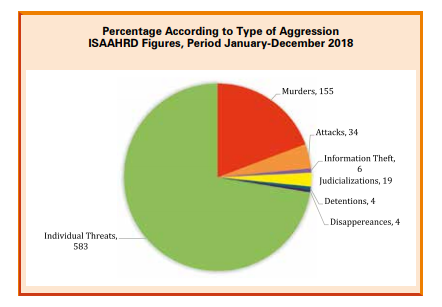
On 23 April 2019 the annual report by “Somos Defensores” in Colombia reveals increase in attacks against human rights defenders in 2018

Attacks against HRDs Colombia

Unfortunately, 2018 was the worst year for human rights defenders, as shown by the data. They recorded the highest aggression figures that have been presented since the beginning of the Information System in 2009. [see also: https://humanrightsdefenders.blog/2018/04/28/2018-latin-america-still-the-graveyard-for-environmental-human-rights-defenders/]

That is, not counting the amount of cases that for different reasons are not included, since we start from accepting the existence of underreporting, which means that the level of violence is much higher than we can imagine…Despite the evident crisis of human rights and the urgent need for intervention to protect the lives of everyone, and in particular, human rights defenders, the current Government of Iván Duque has opted to take opposing positions to its duty to offer guarantees and has left aside the difficult situation that defenders are going through; dedicating his efforts, instead, to putting other issues at the center, such as the orange economy…

See also: https://humanrightsdefenders.blog/2019/02/20/human-rights-defenders-in-latin-america-under-constant-attack/

Read the full post here

TrialWatch officially launched by Clooneys

April 25, 2019

As announced earlier this year [https://humanrightsdefenders.blog/2019/03/15/star-power-for-good-george-and-amal-clooney-at-least-try-to-tackle-controversial-issues/] on 25 April 2019 the Clooney Foundation for Justice (CFJ), together with partners Microsoft Corporation, Columbia Law School, the American Bar Association, and the Office of the United Nations High Commissioner for Human Rights (OHCHR), launched their TrialWatch® initiative at an inaugural TrialWatch Conference and launch event.

Clooney Foundation For Justice Logo

Courts around the world are increasingly being used to silence dissidents and target the vulnerable. But so far there has been no systematic response to this,” said Amal Clooney, Co-President, Clooney Foundation for Justice. “The Clooney Foundation for Justice’s TrialWatch program is a global initiative to monitor trials, expose abuses, and advocate for victims, so that injustice can be addressed, one case at a time.”

TrialWatch is an initiative focused on monitoring and responding to trials around the world that pose a high risk of human rights violations. TrialWatch aims to be the first comprehensive global program scrutinizing criminal trials around the world. CFJ will recruit and train trial monitors, including non-lawyers, who can observe and report on criminal trials around the world, and use a specialised app to record the proceedings. The Clooney Foundation for Justice will then work to expose injustice and rally support to secure justice for defendants whose rights have been violated. For each trial monitored, CFJ will work with an eminent legal expert to produce a Fairness Report assessing and grading the fairness of the trial against human rights standards, and, where necessary and possible, will be followed up with legal advocacy to assist a defendant in pursuing remedies in regional or international human rights courts. Ultimately, the data that is gathered will populate a global justice index that measures states’ performance in this area.

TrialWatch will focus on trials involving journalists, LGBTQ persons, women and girls, religious minorities, and human rights defenders. In recent months, TrialWatch monitors have observed proceedings in Africa, Asia, Europe, the Middle East, and Latin America. The cases have involved journalists being prosecuted under a wide variety of laws, including cyber laws, administrative laws, and terrorism laws, in six countries. TrialWatch has covered a trial of individuals being prosecuted under anti-LGBTQ laws in sub-Saharan Africa and proceedings involving a journalist detained under India’s National Security Act for criticizing the government on social media. TrialWatch monitors are also monitoring the trial of a lawyer in Eurasia, who is being prosecuted in connection with his work on behalf of human rights defenders and the trial of a journalist in Nigeria, who is being prosecuted for writing about internal government documents and refusing to reveal his source. Fairness reports are being produced to assess each of these trials, and many more trials will be monitored on an ongoing basis around the world.

CFJ has partnered with the Office of the United Nations High Commissioner for Human Rights (OHCHR) to develop an online training course for monitors. This course was developed by CFJ and approved by OHCHR.

——

https://finance.yahoo.com/news/clooney-foundation-justice-convenes-human-rights-leaders-mark-103100664.html?