On 18 October 2019 the UN High Commissioner for Human Rights urged Egypt to immediately release scores of citizens who have been arrested in connection with recent anti-government demonstrations in several cities. Civil society groups report more than 2,000 people were detained before, during and after the protests on 20 September, which prompted the UN High Commissioner for Human Rights, Michelle Bachelet, to express concern about reports of lack of due process. On Friday her office reported that the arrests are continuing, with a number of well-known and respected civil society figures affected, some of whom have been accused of terrorism. “Once again, we remind the Egyptian Government that under international law people have a right to protest peacefully, and a right to express their opinions, including on social media. They should never be arrested, detained – let alone charged with serious offences such as terrorism – simply for exercising those rights”, spokesperson Ravina Shamdasani told journalists in Geneva.
The abduction, arbitrary detention and torture of human rights defender and journalist Esraa Abdelfattah is another indication that Egyptian authorities are stepping up brutality against human rights defenders in a bid to ‘terrorize’ critics and opponents, said Amnesty International today. Esraa Abdelfattah was assaulted and abducted by security forces in plainclothes on 12 October. The next day she described to the Supreme State Security Prosecution how she was tortured by officers who beat her, attempted to strangle her and forced her to stand for nearly eight hours. “Esraa Abdelfattah’s account of torture, coming just days after the prominent activist and blogger Alaa Abdel Fattah described a similar ordeal in custody, is an alarming indication that Egypt’s authorities are stepping up their use of brutal tactics to crack down on human rights defenders,” said Najia Bounaim, North Africa Campaigns Director at Amnesty International.
Prominent blogger Alaa Abdel Fattah as well as his lawyer, Mohammed El-Baqer are currently being held at the Tora Maximum Security Prison, south of Cairo. Both have been accused of belonging to a terrorist group, funding terrorism, spreading false news that undermines national security and “using social media to commit publishing offices”, the UN human rights office said. [see also: https://humanrightsdefenders.blog/2019/01/08/bloggers-and-technologists-who-were-forced-offline-in-2018/]
On 28 September the High Commissioner had already urged the “authorities to radically change their approach to any future protests’.
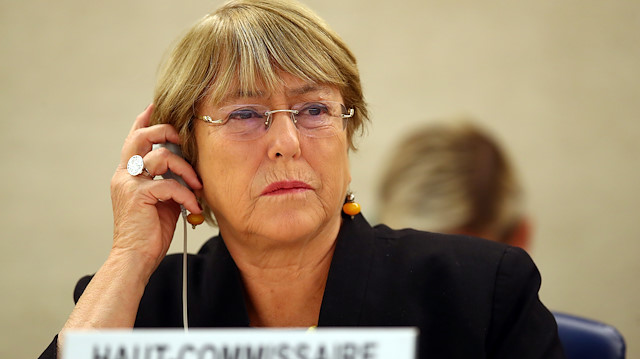
U.N. High Commissioner for Human Rights Michelle Bachelet Photograph: DENIS BALIBOUSE
More than 2,000 people were detained, including lawyers, human rights defenders, political activists, university professors and journalists on 20-21 September, she said. The Egyptian Foreign Ministry spokesperson stressed that there no citizen in Egypt is arrested or prosecuted for carrying out legitimate activities or criticizing the Egyptian government, but for violating the law. He added that the right to peaceful demonstration is guaranteed in accordance with the Constitution and the law. Hafez stressed that the OHCHR report was based on undocumented information, which only leads to falsehoods as the allegations contained in it are based on wrong ideas, and this hasty judgment reflects a lack of professionalism. He added that any actions taken against any person is done in accordance with the law and through sound legal procedures, all carried out with transparency and clarity.
In addition on 3 October 2019 it was reported in the New York Times that a series of sophisticated cyberattacks targeting Egyptian journalists, academics, lawyers, opposition politicians and human rights activists has been traced to Egyptian government offices, a cybersecurity firm has found. The attackers installed software on the targets’ phones that enabled them to read the victims’ files and emails, track their locations, identify who they contacted and when, according to a report to be published Thursday by Check Point Software Technologies, one of the biggest cybersecurity companies in the world, with headquarters just south of San Francisco and in Tel Aviv.
The cyberattack began in 2016, according to the Check Point report. The number of victims is unknown but Check Point identified 33 people, mostly well-known civil society and opposition figures, who had been targeted in one part of the operation. “We discovered a list of victims that included handpicked political and social activists, high-profile journalists and members of nonprofit organizations in Egypt,” said Aseel Kayal, a Check Point analyst.
Several activists targeted by the cyberattack were arrested as part of a crackdown on antigovernment protests. They include Hassan Nafaa, left, a political scientist at Cairo University, and Khaled Dawoud, a former journalist and leader of the secular Constitution Party. CreditAgence France-Presse — Getty Images
“We are witnessing an increase in xenophobia, hate speech, push-backs on women’s equality and the rights of minorities,” warned Michelle Bachelet, United Nations High Commissioner for Human Rights, also highlighting the ever-widening gaps in global wealth and access to resources. Moreover, underfunding has hampered the growing workload of the entire treaty body system, she said. Committees do not have adequate resources to carry out inquiries into grave or systematic violations. This results in a “credibility crisis” for all treaty bodies — and a denial of justice for the victims of human-rights violations.
Among the day’s three other briefers was Obiora Chinedu Okafor, Independent Expert on human rights and international solidarity, who focused on the issue of human-rights based solidarity in global refugee protection. The current refugee “crisis” was not caused by large numbers of refugees, but rather by States’ unwillingness to accept refugees into their countries — evading their responsibilities. Moreover, the rise of extremist political parties is complicating the issue, he said, as the “alternative right” and other racist civil society groups target any kind of solidarity with refugees. Echoing those words, the Russian Federation’s delegate noted that certain extremist political parties are impeding the entry of refugees into the European Union, and that the Independent Expert’s report lay the blame for this squarely at the feet of foreign interference in internal State affairs.
In his presentation, Michel Forst, Special Rapporteur on the situation of human-rights defenders, highlighted that 431 defenders were killed in 2017 and 2018. With that in mind, combating impunity is not only a legal obligation of States, but also a moral one. He further noted that “98 per cent of the killings of rights defenders remain unpunished” and that unless impunity is ended, the violence against them will continue. A zero-tolerance policy towards such attacks must be adopted, and the lack of political will — and of State recognition of rights defenders — addressed. Reacting to those comments, several delegates raised questions about digital attacks on human-rights defenders, with Germany’s representative underscoring that female defenders of human rights often face particular threats, such as the publication of private information. Mr. Forst responded that he has found research by the Special Rapporteur on freedom of association and the Special Rapporteur on freedom of expression helpful in this context, with a particular focus on advocating for social network businesses to provide better protections. To concerns raised by an observer for the State of Palestine and the representative of Georgia, he noted that his subsequent report will make specific proposals to assist defenders living in fragile States, as well as those living in conflict or post-conflict situations. On defenders who live in isolated areas, he said they are often not given sufficient attention by the international community. Ambassadors should leave their capitals and go into these far-flung areas to see where these defenders work, he said. Those who work on sexual and reproductive health and rights often bear the brunt of attacks, while those working on gender identity are harassed and threatened
The Special Rapporteur on the rights to freedom of peaceful assembly and of association, Clément Nyaletsossi Voulé, also presented his report.
..Unfortunately, social media platforms are now a primary tool for coordinated, state-aligned actors to harass, threaten and undermine advocates. Although public shaming, death threats, defamation and disinformation are not unique to the online sphere, the nature of the internet has given them unprecedented potency. Bad actors are able to rapidly deploy their poisoned content on a vast scale. Social media companies have only just begun to recognize, let alone respond, to the problem. Meanwhile, individuals targeted through such coordinated campaigns must painstakingly flag individual pieces of content, navigate opaque corporate structures and attempt to survive the fallout. To address this crisis, companies such as Facebook, Twitter and Youtube must dramatically increase their capacity and will to engage in transparent, context-driven content moderation.
For human rights defenders, the need is urgent. .. Since 2011, the ABA Center for Human Rights (CHR) has ..noted with concern the coordination of “traditional” judicial harassment of defenders by governments, such as frivolous criminal charges or arbitrary detention, with online campaigns of intimidation. State-aligned online disinformation campaigns against individual defenders often precede or coincide with official investigations and criminal charges.
……
While social media companies generally prohibit incitement of violence and hate speech on their platforms, CHR has had to engage in additional advocacy with social media companies requesting the removal of specific pieces of content or accounts that target defenders. This extra advocacy has been required even where the content clearly violates a social media company’s terms of service and despite initial flagging by a defender. The situation is even more difficult where the threatening content is only recognizable with sufficient local and political context. The various platforms all rely on artificial intelligence, to varying degrees, to identify speech that violates their respective community standards. Yet current iterations of artificial intelligence are often unable to adequately evaluate context and intent.
Online intimidation and smear campaigns against defenders often rely on existing societal fault lines to demean and discredit advocates. In Guatemala, CHR recently documented a coordinated social media campaign to defame, harass, intimidate and incite violence against human rights defenders. Several were linked with so-called “net centers,” where users were reportedly paid to amplify hateful content across platforms. Often, the campaigns relied on “coded” language that hark back to Guatemala’s civil war and the genocide of Mayan communities by calling indigenous leaders communists, terrorists and guerrillas.
These terms appear to have largely escaped social media company scrutiny, perhaps because none is a racist slur per se. And yet, the proliferation of these online attacks, as well as the status of those putting out the content, is contributing to a worsening climate of violence and impunity for violence against defenders by specifically alluding to terms used to justify violence against indigenous communities. In 2018 alone, NPR reports that 26 indigenous defenders were murdered in Guatemala. In such a climate, the fear and intimidation felt by those targeted in such campaigns is not hyperbolic but based on their understanding of how violence can be sparked in Guatemala.
In order to address such attacks, social media companies must adopt policies that allow them to designate defenders as temporarily protected groups in countries that are characterized by state-coordinated or state-condoned persecution of activists. This is in line with international law that prohibits states from targeting individuals for serious harm based on their political opinion. To increase their ability to recognize and respond to persecution and online violence against human rights defenders, companies must continue to invest in their context-driven content moderation capacity, including complementing algorithmic monitoring with human content moderators well-versed in local dialects and historical and political context.
Context-driven content moderation should also take into account factors that increase the risk that online behavior will contribute to offline violence by identifying high-risk countries. These factors include a history of intergroup conflict and an overall increase in the number of instances of intergroup violence in the past 12 months; a major national political election in the next 12 months; and significant polarization of political parties along religious, ethnic or racial lines. Countries where these and other risk factors are present call for proactive approaches to identify problematic accounts and coded threats against defenders and marginalized communities, such as those shown in Equality Labs’ “Facebook India” report.
Companies should identify, monitor and be prepared to deplatform key accounts that are consistently putting out denigrating language and targeting human rights defenders. This must go hand in hand with the greater efforts that companies are finally beginning to take to identify coordinated, state-aligned misinformation campaigns. Focusing on the networks of users who abuse the platform, instead of looking solely at how the online abuse affects defenders’ rights online, will also enable companies to more quickly evaluate whether the status of the speaker increases the likelihood that others will take up any implicit call to violence or will be unduly influenced by disinformation.
This abuser-focused approach will also help to decrease the burden on defenders to find and flag individual pieces of content and accounts as problematic. Many of the human rights defenders with whom CHR works are giving up on flagging, a phenomenon we refer to as flagging fatigue. Many have become fatalistic about the level of online harassment they face. This is particularly alarming as advocates targeted online may develop skins so thick that they are no longer able to assess when their actual risk of physical violence has increased.
Finally, it is vital that social media companies pursue, and civil society demand, transparency in content moderation policy and decision-making, in line with the Santa Clara Principles. Put forward in 2018 by a group of academic experts, organizations and advocates committed to freedom of expression online, the principles are meant to guide companies engaged in content moderation and ensure that the enforcement of their policies is “fair, unbiased, proportional and respectful of users’ rights.” In particular, the principles call upon companies to publicly report on the number of posts and accounts taken down or suspended on a regular basis, as well as to provide adequate notice and meaningful appeal to affected users.
CHR routinely supports human rights defenders facing frivolous criminal charges related to their human rights advocacy online or whose accounts and documentation have been taken down absent any clear justification. This contributes to a growing distrust of the companies among the human rights community as apparently arbitrary decisions about content moderation are leaving advocates both over- and under-protected online.
As the U.N. special rapporteur on freedom of expression explained in his 2018 report, content moderation processes must include the ability to appeal the removal, or refusal to remove, content or accounts. Lack of transparency heightens the risk that calls to address the persecution of human rights defenders online will be subverted into justifications for censorship and restrictions on speech that is protected under international human rights law.
A common response when discussing the feasibility of context-driven content moderation is to compare it to reviewing all the grains of sand on a beach. But human rights defenders are not asking for the impossible. We are merely pointing out that some of that sand is radioactive—it glows in the dark, it is lethal, and there is a moral and legal obligation upon those that profit from the beach to deal with it.
Ginna Anderson, senior counsel, joined ABA CHR in 2012. She is responsible for supporting the center’s work to advance the rights of human rights defenders and marginalized dommunities, including lawyers and journalists at risk. She is an expert in health and human rights, media freedom, freedom of expression and fair trial rights. As deputy director of the Justice Defenders Program since 2013, she has managed strategic litigation, fact-finding missions and advocacy campaigns on behalf of human rights defenders facing retaliation for their work in every region of the world
The UN General Assembly’s Third Committee will run for eight weeks from 1 October to 21 November this year. The International Service for Human Rights, which follows the UN human rights bodies diligently, put out an Alert for this 74th Session on 1 October 2019.
The Third Committee brings together a wide array of Special Procedures mandate holders, including Special Rapporteur, independent experts, and chairs of working groups that are mandated by the Human Rights Council to discuss some of the most pressing human rights concerns and present findings and recommendations to the Third Committee. These findings should in turn play a role in shaping the focus of resolutions negotiated at this session.
Third Committee is expected to consider approximately 60 resolutions on a range of topics, including:
the advancement of women
the rights and protection of children
the rights of refugees
the elimination of racism
self-determination
and social development, amongst others.
ISHR will be closely monitoring the work of the Third Committee as well as relevant developments in the plenary of the General Assembly and will report on key developments. Follow them on Twitter at @ISHRglobal using #UNGA74 for the latest updates.
Overview of Key Resolutions
Human Rights Defenders (Lead Sponsor: Norway) – This year Norway will present the biennial resolution on human rights defenders. One year after the twentieth anniversary of the UN Declaration on Human Rights Defenders, implementation of the Declaration unfortunately remains far from adequate in a number of States. ISHR therefore welcomes the resolution’s continued focus on the Declaration’s implementation and urges States to ensure that the resolution includes calls for concrete activities and mechanisms to monitor and facilitate the implementation of the Declaration and previous resolutions on human rights defenders.
Terrorism and Human Rights (Lead Sponsors: Mexico and Egypt) – The Third Committee will consider a resolution relating to Terrorism and Human Rights. Previous resolutions on the topic have condemned terrorist acts as criminal and unjustifiable, and expressed concerns about their detrimental effects on the enjoyment of all human rights. The resolution is the result of the combination of two previously separate resolutions on the “Protection of human rights and fundamental freedoms while countering terrorism” and the “Effects of Terrorism on the Enjoyment of Human Rights” led by Mexico and Egypt, respectively. Civil society remains concerned that the combined resolution compromises language on State obligations to protect human rights by prioritising the impact of terrorism on human rights. ISHR hopes that language in the original resolution led by Mexico is not compromised and that this resolution upholds State responsibility and the rights of victims.
Safety of Journalists (Lead Sponsors: Greece, Argentina, Austria, Costa Rica and France) – A resolution on the safety of journalists is expected to be advanced at this session. ISHR will be watching this negotiation closely and hopes the resolution will be used to expand, rather than restrict, space for civil society and strengthen protections for human rights defenders.
Several country resolutions are expected again this session. For the 17th year, Canada will present a draft resolution on the Situation of human rights in the Islamic Republic of Iran spotlighting the continued dismal human rights situation and lack of progress over the last year. The European Union will again lead on a resolution on the Democratic People’s Republic of Korea, similarly underlining the lack of human rights progress. Ukraine will again present a draft resolution condemning Russia’s activities in Crimea. Resolutions on the human rights situation in Myanmar and Syria are also expected to be led by the Organisation of Islamic Cooperation and Saudi Arabia respectively.
ISHR remains concerned that China will again attempt to insert the seemingly harmless language of ‘win/win’ language in resolutions, which in fact focuses only on intergovernmental dialogue and cooperation, rather than actual human rights violations or accountability. This language risks shrinking space for civil society and roll back human rights norms across a number of resolutions.
Several resolutions are expected to become battle grounds regarding references to gender, and sexual and reproductive health and rights, including resolutions on the Improvement of the situation of women and girls in rural areas, Violence against women migrant workers, Rights of the Child, The girl child, The human rights to safe drinking water and sanitation,
Elections for the Human Rights Council are set to take place in mid-October as part of the General Assembly. ISHR is once again disappointed that this year a number of regions have presented closed slates. ISHR has published ‘scorecards‘ for each of the States seeking membership. These provide a brief overview of their human rights records, cooperation with civil society, past roles in the Council, and past engagement with UN human rights mechanisms.
Overview of Reports and Dialogues with UN Experts:
The UN Special Procedures – Special Rapporteurs, independent experts, and working groups – will report to the Third Committee and hold interactive ‘dialogues’ with member States. Several of this year’s reports reflect concerns about increased attacks on human rights defenders and emphasise the critical importance of creating and maintaining space for civil society. Click here for a list and schedule of dialogues.
Report of the Special Rapporteur on the Situation of Human Rights Defenders – Combatting the currently widespread impunity for human rights violations that target human rights defenders is, according to Special Rapporteur Michel Forst’s report (A/74/159), “an essential prerequisite to guarantee human rights and to advance towards equal societies that are free from fear and violence.” He outlines a regulatory framework on the right to access to justice, including due diligence in investigations and elaborates on the de facto and legal barriers to access to justice. He offers essential guidelines for ensuring due diligence in the investigation of such violations. Good practices implemented by States and civil society are also described. He will present his report and an interactive dialogue will be held on 15 October 2019 at 3pm.
Report of the Special Rapporteur on the situation of human rights in the Islamic Republic of Iran – At least 32 Iranians have been arrested as a result of viral social media campaigns against compulsory veiling laws, such as the #whitewednesdays and “Girls of Revolution Street.” Human rights lawyer and defender Nasrin Sotoudeh was sentenced to 148 lashes and 38 years in prison last March for defending some of these women. BBC Persian staff have suffered reprisals for engaging with UN human rights mechanisms. These are only some of the attacks on human rights defenders that Special Rapporteur Javaid Rehman flags in his report (A/74/188), which calls on Iran to stop violating the rights of human rights defenders through intimidation, harassment, arbitrary arrest, deprivation of liberty, among other arbitrary sanctions. The Special Rapporteur will present and discuss his report on 23 October 2019 at 10am.
Report of the Independent Expert on protection against violence and discrimination based on sexual orientation and gender identity – In his report (A/74/181), Independent Expert Victor Madrigal-Borloz exposes the ways in which socio-cultural norms and discriminatory laws continue to marginalise and exclude LGBTI persons. In order to become fully inclusive of LGBTI individuals, he stresses that States cannot overlook the “vital role” of partnerships with civil society. He cites a number of partnerships in the fight against HIV/AIDS as particularly strong examples of this. Independent Expert Madrigal-Borloz will present his report and hold an interactive dialogue on 24 October 2019 at 10am.
Report of the Special Rapporteur on the promotion and protection of human rights and fundamental freedoms while countering terrorism – How can States truly integrate human rights into the global fight against terrorism that is increasingly shaped by elusive norms of ‘soft law’? According to Special Rapporteur Fionnuala Ní Aoláin’s report (A/74/335), one of the keys is for States to engage with and create space for civil society, non-governmental organisations, and human rights defenders to participate in the shaping of these counter-terrorism norms. Her report maps out how civil society access to these processes can be transformed from “ad hoc and inconsistent” to consistent and meaningful, ensuring that soft-law counter-terrorism norms are not at odds with human rights. The Special Rapporteur’s report will be presented and discussed on 16 October 2019 at 10am.
Report of the Special Rapporteur on the issue of human rights obligations relating to the enjoyment of a safe, clean, healthy and sustainable environment – Special Rapporteur David R. Boyd clarifies the obligations of States and businesses under a human-rights based approach to climate change in his report (A/74/161). These obligations include providing strong protections for environmental and environmental defenders who work on issues relating to climate change. In addition, the report examines how UN human rights mechanisms can be empowered to better address climate change. The Special Rapporteur will present his report and an interactive dialogue will be held on 24 October 2019 at 3pm.
Report of the Special Rapporteur on Freedom of Religion or Belief – Special Rapporteur Ahmed Shaheed expresses alarm in his report (A/74/358) about the rise of anti-Semitism around the world and the ways in which the underreporting of these hate crimes and lack of mechanisms to monitor them enable anti-Semitic hate crimes. The report finds that a lack of Jewish civil society engagement with UN human rights monitors only exacerbates this issue and calls on States to work more closely with Jewish communities and organisations to create mechanisms that fill this void. Special Rapporteur Shaheed ends his report with the recommendation that the Office of the UN Secretary-General appoint a senior-level focal point specifically responsible for monitoring and engaging with Jewish communities on this issue. He will present his report and hold an interactive dialogue on 17 October 2019 at 3pm.
Report of the Special Rapporteur on violence against women, its causes and consequences – In her report (A/74/137), Special Rapporteur Dubravka Šimonović stresses the need to address mistreatment and violence against women in reproductive health services from a human rights perspective. The report therefore calls for the creation of human rights-based accountability mechanisms and greater State collaboration with civil society organisations to address violence and mistreatment in reproductive and obstetric care. The Special Rapporteur will present her report and hold an interactive dialogue with the Third Committee on 4 October 2019 at 10am.
Venezuela on the Brink: The urgency of an appropriate international response to the crisis, where Eleanor Openshaw will be discussing the implications of Venezuela being re-elected to the Human Rights Council. 2 October at 10am in the Church Center, 777 UN Plaza.
Breakfast reception to mark the launch of URG’s new yourHRC.org Guide to the 2019 Human Rights Council Elections, where Madeleine Sinclair will be discussing ISHR’s ‘scorecards’ for each of the States seeking election to the UN Human Rights Council for 2020- 2022. October 10 at 8:30 am in Conference Room 6, UNHQ.
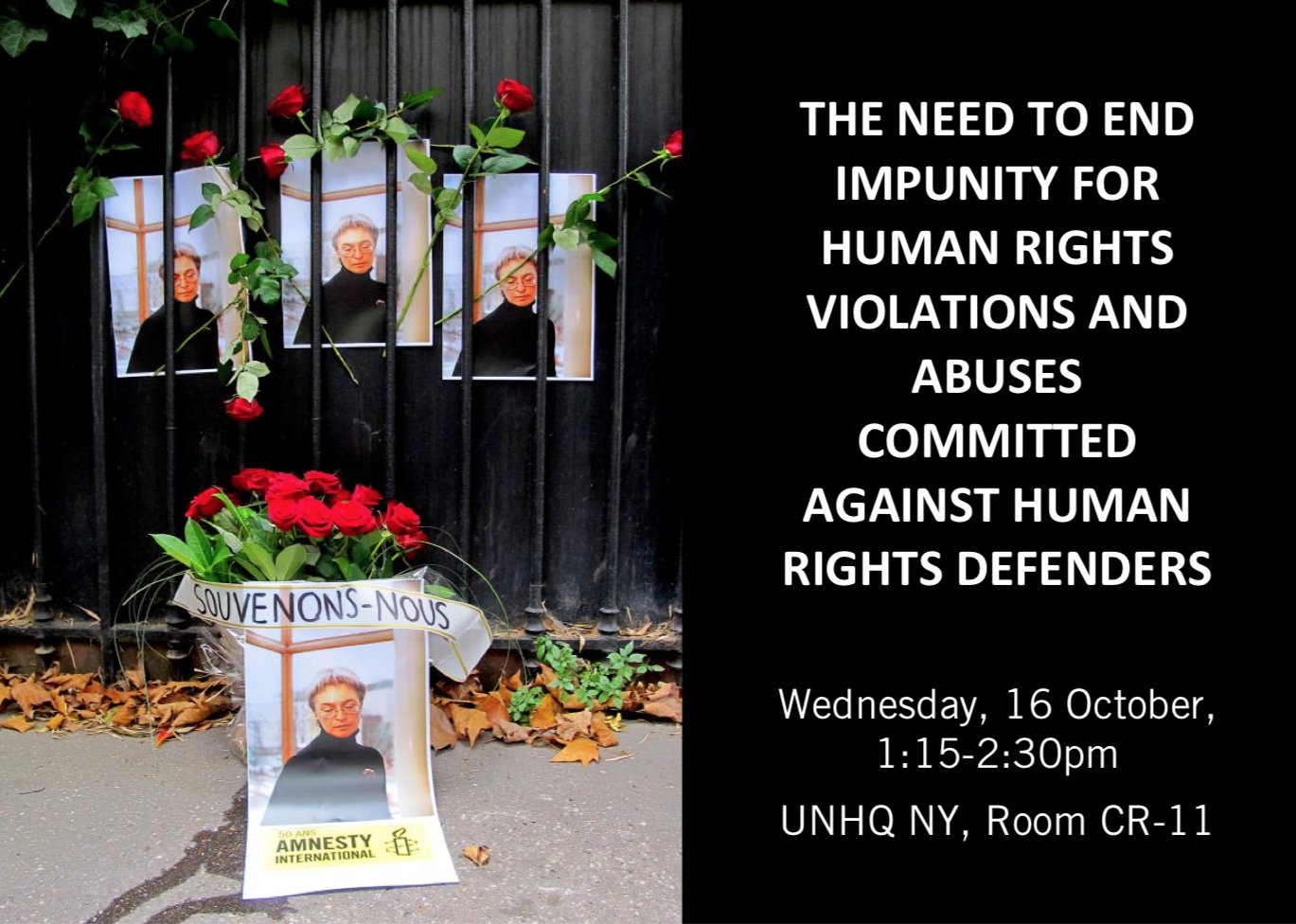
Wednesday, 16 October 2019
1:15 pm – 2:30 pm
UN Headquarters, New York
Room CR-11
This event is organised by Amnesty International and the International Service for Human Rights with the kind sponsorship of the Permanent Mission of Norway to the United Nations.
Event with panellists:
Michel Forst, Special Rapporteur on the situation of human rights defenders
Radya Al-Mutawakel, Mwatana Organization for Human Rights, Yemen
Khin Ohmar, Progressive Voice Myanmar, Myanmar
Moderated by:
Sherine Tadros, Amnesty International
Welcoming remarks by:
Ambassador Mona Juul, Permanent Representative of Norway
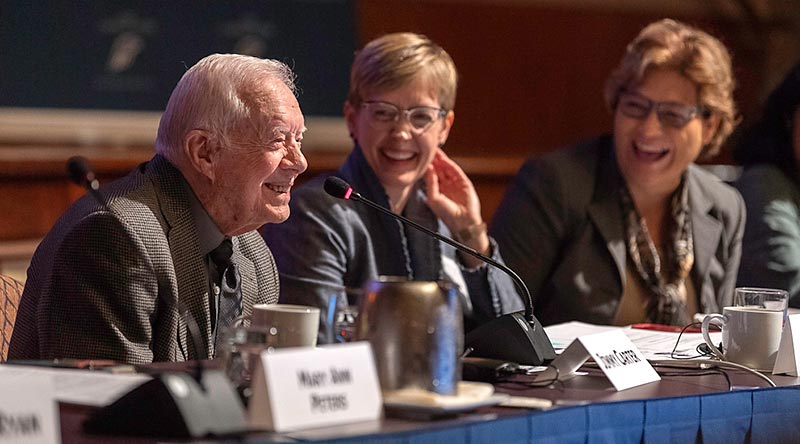
Former U.S. President Jimmy Carter speaks at the 2018 Human Rights Defenders Forum in Atlanta, GA, the theme of which was “Restoring Faith in Freedom.”
“Building Solidarity toward Equality for All” Dozens of activists, peacemakers, and community leaders from 28 countries will come together from 12-15 October for the Carter Center’s 12th Human Rights Defenders Forum. Three sessions, including a 15-minute Q&A with former U.S. President Jimmy Carter, will be livestreamed on Tuesday, 15 October. Session topics include global protection for human rights defenders, challenges for women defenders and peacemakers, and the importance of mutually supporting civil, economic, political, and social rights.
The forum this year include:
Hafida Benchehida, an Algerian senator since 2013 and a founding member of both the Algerian and Arab women parliamentarian networks. She is also a member of Mediterranean Women Mediators and a specialist in women’s roles in peace.
Mohna Ansari, a journalist-turned-attorney and a member of Nepal’s Human Rights Commission. Much of her work involves women’s rights, representation, and protection.
Ijam Alaz Augustine, minister for human rights and minorities affairs in Pakistan’s Lahore province, whose political career has been devoted to protecting the rights of religious minorities.
Fernando Carrillo Flórez, a former ambassador, minister of justice, and minister of the interior from Colombia who has published more than 14 books and 80 articles on democracy, governance, and reform of justice.
Maati Munjib, a journalist, professor, and president of Freedom Now, an organization devoted to protecting journalists and freedom of expression in Morocco. Because of his activism and writings, he faces a possible five years in prison. Amnesty International and other human rights groups have called for charges against him to be dropped.
Tuesday, October 15 webcast:
11:30 a.m. – 12:45 p.m. Remarks by President Carter Summary of the previous days’ workshops
Testimonies by human rights defenders and moderated discussion
2:15 ̶ 3:15 p.m. Discussion: “How Do We Build True Solidarity in the Struggle for Equality?”
3:50 ̶ 5 p.m. Continued: Moderated discussion Livestream Q&A with President Carter (4:35 to 4:50 p.m.)
During the webcast: Twitter @CarterCenter with hashtag #BuildingSolidarity.
The 3-day 2019 Dublin Platform for Human Rights Defenders at Risk was opened on 2 October by Irish Foreign Minister, Simon Coveney, and UN High Commissioner for Human Rights, Michelle Bachelet. Over 120 human rights defenders (HRDs) from more than 80 countries are attending. Front Line Defenders Executive Director, Andrew Anderson, said that five human rights defenders were prevented from traveling to Dublin – Khadija Ismayilova (Azerbaijan), Oyub Titiev (Russia), Said Boudour (Algeria), Michel Matos (Cuba) and Marivic Danyan (Philippines). See more below.
The opening ceremony featured a testimony by Bahraini woman human rights defender (WHRD) Ebtisam Alsaegh, who was finally able to leave Bahrain and attend Dublin Platform years after first being invited. Speaking in Dublin, she called for an immediate end to gendered and sexualized attacks against women human rights defenders around the world.
Over three days, human rights defenders will share tactics and strategies for their protection and security, while learning from each other about their struggles, protests, resistance movements and victories. On Thursday evening, the HRDs will march in a procession to Christchurch Cathedral as part of the “Set Them Free” campaign, calling for the release of HRDs facing multi-decade prison sentences around the world. The campaign includes former Front Line Defenders Protection Coordinator for the Middle East and North Africa, Bahraini HRD Abdulhadi Al-Khawaja, now serving a life sentence for his role in the peaceful pro-democracy uprising of 2011.
On 26 September, Cuban cultural rights defender Michel Matos was banned from travelling from José Martí International Airport in Havana while en route to attend the event in Ireland. Michel is an activist for cultural rights in Cuba. He, along with other artists, musicians and performers, has taken a stand against the controversial Decree 349, signed by Cuba’s President Miguel Díaz-Canel in April 2018, which grants the Ministry of Culture disproportionate power to control, cancel and sanction artistic expression, while containing vague and overly broad restrictions. While being processed at passport control, officials informed him he was not permitted to board the plane as he is on an automatic travel ban list. He was not shown any documents or given any further details on the ban, other than being told that the officials “were following orders”.
Due to his work advocating for the rights of political prisoners in Algeria, Said Boudour has been informed that he is currently being sought by the Algerian authorities. As he prepared to travel to Ireland to attend the Platform, he received advice from his lawyer that should he attempt to leave the country he would almost certainly be arrested at the airport. Said is a member of the Algerian League for Human Rights. He works on a range of civil and political rights in Algeria, with a particular focus on the rights of prisoners in the context of the ongoing anti-government demonstrations, and on democracy in Algeria. The human rights defender has been frequently harassed by the Algerian authorities; he has been previously detained three times and has been under regular police surveillance.
Khadija Ismayilova, a woman human rights defender and journalist from Azerbaijan, was also unable to accept her invite to the Dublin Platform due to a travel ban imposed against her following her release from prison in 2016. In 2018 the Baku Court of Appeal refused for the third time to lift the ban. Khadija is well known for her investigative reports on corruption in Azerbaijan, including the President’s family’s involvement.
Oyub Titiev, a human rights defender from Chechnya, was similarly prevented from travelling due to a travel ban stemming from his conditional release from prison in June 2019. He was detained in January 2018 on fabricated drug charges in retaliation for his work with Human Rights Center Memorial in Chechnya. Both Oyub and Front Line Defenders had written without success to the Russian authorities seeking permission for him to allowed travel to attend the Dublin Platform.
Recent research has shown that many human rights defenders are suffering PTSD, depression, and burnout as a result of the risks and stress of their work. Without adequate mental health support for activists, it could be difficult to sustain the human rights movement at a time when threats and risks of activism are increasing. How can funders take the wellbeing of activists into account through their funding? What are good practices to ensure that funders are doing no harm, and what are the options for actively supporting the resilience of activists to continue their work? Join the Human Rights Funders Network and Ariadne for a webinar on 20 September2019 10:00am EST to learn more about the findings of the research and hear from peer donors about their efforts to integrate an awareness of wellbeing into their work.
Speakers:
Adam Brown, Associate Professor of Psychology, New School for Social Research
Marianne Mollmann, Director of Regional Programs, Fund for Global Human Rights
Magda Adamowicz, Senior Program Specialist, Open Society Foundations
The webinar is co-sponsored by Human Rights Funders Network Ariadne and will be moderated by Julie Broome, Ariadne Director.
On 23 August 2019, 23 NGOs wrote to the United Nations to raise concerns over the alarming pattern of intimidation and reprisals faced by members of civil society during sessions of the Human Rights Council and Treaty Bodies. The letter calls on the ASG to raise this issue during his speech before the HRC on 19 September 2019, and urges the OHCHR to take measures to ensure that such acts of reprisals are not repeated in the future. See: https://humanrightsdefenders.blog/2019/09/05/human-rights-defenders-issues-at-the-42nd-session-of-the-un-human-rights-council/
Below is the original text of the letter, as sent to the UN representatives in question:
To: Mr Andrew Gilmour, Assistant Secretary-General for Human Rights; H.E. Mr Coly Seck, Permanent Representative of Senegal and President of the Human Rights Council; Mr Michel Forst, Special Rapporteur on the situation of human rights defenders
Mr Gilmour,
We, the undersigned organisations, write to raise deep concerns about a consistent pattern of intimidation and reprisals faced by members of civil society from around the world during sessions of the Human Rights Council (HRC) and the Treaty Bodies. We are particularly concerned by acts of intimidation perpetrated by representatives of and individuals affiliated with government parties.
During the 41st session of the HRC, staff of Permanent Missions and individuals wearing non-diplomatic badges, who were later verified as working with UN Member and Observer States, attended our side-events, and blatantly eavesdropped on our conversations, recorded our comments, took photos and videos of the audience, and made threatening gestures and remarks.
We are all the more concerned as this is not the first time that human rights defenders and other individuals engaging with the HRC have faced acts of harassment and intimidation. Rather, these tactics are part of a consistent and systematic pattern of behaviour that we have unfortunately come to anticipate and expect at every session of the HRC.
Furthermore, HRDs engaging with the Treaty Bodies also face intimidation and reprisals perpetrated by representatives of and individuals affiliated with government parties. There have been multiple instances of so-called “GONGOs” – governmental non-governmental organisations – registering for confidential and closed briefings with Treaty Bodies’ members. This allows them to know exactly who among civil society is present during these briefings. There has also been cases of briefings that have been filmed without the permission of NGOs.
What is more, governments’ support given to GONGOs means that they are often granted consultative status with the UN. On the contrary, independent NGOs continue to be denied the ECOSOC status, demonstrating that reprisals against HRDs also occur within the UN system. In addition, the proliferation of GONGOs both at the HRC and Treaty Bodies, allows them to influence the discourse about human rights in a particular state or region, thus minimising the real issues at stake.
The aforementioned acts of harassment and intimidation are concerning not only because they create an atmosphere of fear and self-censorship, but also because numerous human rights defenders who have travelled to Geneva to participate in HRC or Treaty Body sessions have faced reprisals upon their return to their countries as a direct result of this. As such, we take these acts of intimidation very seriously and submit that they may result in further acts of retaliation.
We note with appreciation that the current president of the HRC, his Excellency Mr Coly Seck, Permanent Representative of Senegal, addressed some of the issues raised in this letter during the final meeting of the 41st session of the HRC. He expressed his concern that “civil society organisations continue to face intimidation and reprisals” and pointed out that a number of cases had been reported to him, including of verbal harassment and unauthorised photographs taken during side-events. He emphasised that “any acts of intimidation against any individual or group that attempts to cooperate with the Human Rights Council is unacceptable”, and reminded Member and Observer States of their responsibility to ensure that civil society operate in a safe space.
In addition, in July 2019, Unrepresented Nations and Peoples Organisation, working in conjunction with the University of Oxford, Tibet Justice Centre and the Economic and Social Research Council launched the report “Compromised Space for Unrepresented Peoples at the United Nations”. Based on interviews and testimonies from 77 HRDs working on behalf of minorities, indigenous communities and other unrepresented peoples, it identifies a systematic attack on the UN human rights system by certain governments. This is characterised by “blocking tactics […] including deferring ECOSOC status decisions, and intervening in plenary statements, to more overt instances of harassment, intimidation and outright violence, which constitute state reprisals”. Such challenges are compounded for HRDs from minority, indigenous and marginalised groups.
While we acknowledge that HRC presidents, the Office of the High Commissioner for Human Rights’ (OHCHR) reprisals team, the Treaty Bodies’ focal points for reprisals and yourself have all previously raised awareness on this issue, we strongly believe that there is a need to draw further attention to such acts of intimidation and harassment. We further note that to date, the OHCHR has not developed a systematic and practical response to the practices outlined in this letter.
It is our contention that failure to sanction reprisals on UN premises will only embolden such acts elsewhere. Therefore, we call on you to raise this grave pattern during the presentation of the UNSG annual report on reprisals during the 42nd session of the HRC. We also call on you to urge the OHCHR to take measures to ensure that such acts of intimidation do not happen in the future.
Yours sincerely,
Access Now
ALQST
Association for Victims of Torture in the UAE
Americans for Democracy and Human Rights in Bahrain
Bahrain Institute for Rights and Democracy
CIVICUS: World Alliance for Citizen Participation
CCPR Centre
Committee for Justice
European Saudi Organisation for Human Rights
Global Campaign for Equal Nationality Rights
MENA Rights Group
The Omani Centre for Human Rights
OMCT
Institute on Statelessness and Inclusion
International Campaign for Freedom in the UAE
International Centre for Justice and Human Rights
International Movement Against All Forms of Discrimination and Racism
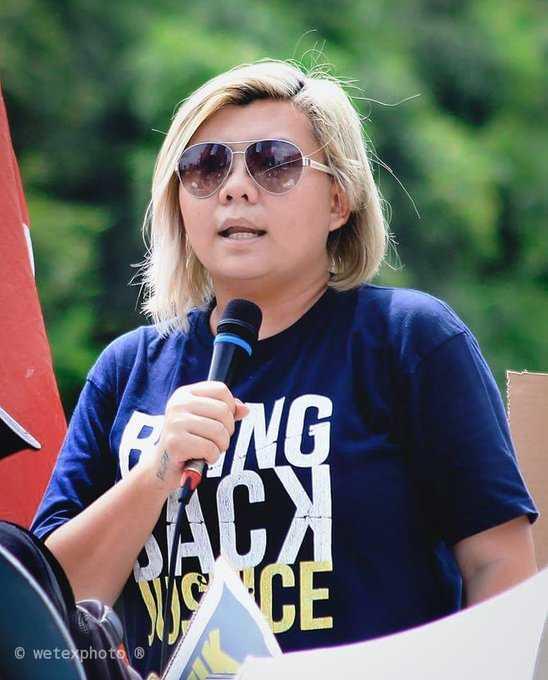
Human rights lawyer Veronica Koman Photo: Whens Tebay
Five UN experts(Mr. Clement Nyaletsossi Voule, Special Rapporteur on the right to peaceful assembly and association; Mr. David Kaye, Special Rapporteur on the promotion and protection of the right to freedom of opinion and expression; Ms Dubravka Šimonović, Special Rapporteur on violence against women; Ms Meskerem Geset Techane, Chair of the Working Group on discrimination against women and girls; Mr. Michel Forst, Special Rapporteur on human rights defenders) have urged Indonesia to protect the rights of lawyer Veronica Koman who advocates for West Papuan rights. They also urged Indonesia to protect people’s rights to peaceful protest and those reporting on protests in West Papua, and to ensure access to the internet
Earlier this month a police warrant was issued for Ms Koman, who is believed to be in Australia, after police claimed she spread fake news online. Indonesian authorities have blamed disinformation and Papuan independence activists for a recent wave of protests in the region
The UN rights experts said Indonesian authorities should address acts of harassment, intimidation and threats against people reporting on the protests. Ms Koman was named as a “suspect” by authorities who accused her of provoking unrest after she published reports on the protests and on a racist attack against Papuan students in Java that triggered the demonstrations. “We welcome actions taken by the Government against the racist incident, but we urge it to take immediate steps to protect Veronica Koman from any forms of retaliation and intimidation and drop all charges against her so that she can continue to report independently on the human rights situation in the country,” the experts said.
They also expressed concerns over reports indicating that the authorities were considering revoking Ms Koman’s passport, blocking her bank accounts and requesting Interpol to issue a Red Notice to locate her. The experts stressed that restrictions on freedom of expression not only undermined discussion of government policies, but also jeopardised the safety of human rights defenders reporting on alleged violations.
Protests have been increasingly taking place in the provinces of Papua and West Papua since mid-August over alleged racism and discrimination and amid calls for independence. “These protests will not be stopped by an excessive use of force or by cracking down on freedom of expression and access to information,” the experts said… The experts welcomed the engagement of the authorities on these matters and said they looked forward to continued dialogue.





 Hans Thoolen on Human Rights Defenders and their awards