One often thinks that indigenous issues play mostly in the Americas but the Webinar on Strengthening the Protection of Indigenous Peoples in Asia: “Situation of Indigenous Human Rights Defenders in the Asian region and the responsibility of Business Enterprises to respect Human Rights” show another picture.
Date and time: 26 November 2020, 14.00 -15.30 ICT Location: Virtual Duration: 1 hour and 30 minutes
“Suppression of the right to freedom of association and attacks against and criminalization of indigenous human rights and environmental defenders across the region are closely linked to large-scale development projects and, in certain subregions, to conservation efforts. Threats against indigenous human rights defenders are exacerbated by the intensifying global competition over natural resources and by increasing militarization where State and non-State actors collude to grab indigenous lands for profit.” – Report of the Special Rapporteur on the rights of indigenous peoples Regional consultation on the rights of indigenous peoples in Asia September 2020
Justice and Peace Netherlands is launching a new call for applications for at risk Human Rights Defenders to participate in Shelter City. The deadline for applications is 10 December 2020.Please be aware that special conditions apply because of the COVID-19 situation.
Shelter City provides temporary safe and inspiring spaces for human rights defenders (HRDs) at risk where they re-energise, receive tailor-made support and engage with allies. Shelter City offers the HRD a shelter for three months, during which they will rest, gain new skills, extend their network and raise awareness about the situation in their country. At the end of the programme, participants are expected to return with new tools and energy to carry out their work at home. From March 2021 onwards, several cities in the Netherlands will receive HRDs for a period of three months.
Participants might be requested to self-quarantine for 10 days upon arrival in the Netherlands (Shelter City programme will be adapted accordingly) and to take other preventive measures due to COVID-19 (including a COVID-19 test before travelling to the Netherlands.
Applicants must fulfil the following conditions in order to be eligible for Shelter City:
They implement a non-violent approach in their work;
They are threatened or otherwise under pressure due to their work;
They should be able to be relocated for a period of maximum 3 months. Limited spots are available for people who are not able to stay for the full 3 months;
They are willing and able to return to their country of origin after 3 months;
They are willing to speak publicly about their experience or about human rights in their country to the extent that their security situation allows;
They have a conversational level* of English (limited spots are available for French or Spanish speaking HRDs);
They are willing and able to come to The Netherlands without accompaniment of family members;
They have a valid passport (with no less than six months of validity) or be willing to carry out the procedures for its issuance. Justice and Peace covers the costs of issuing a passport and / or visa (if applicable);
They are not subjected to any measure or judicial prohibition of leaving the country;
They are willing to begin their stay in The Netherlands around March 2021. To apply or submit the application of a human rights defender: <https://form.jotform.com/JPNL/SC2021-01_EN. An independent commission will select the participants. For more information, please contact us at sheltercityATjusticeandpeace.nl.
Our shared quest for equality, dignity and a healthy planet continues
On 20 October 2020Phil Lynch, who as director of the International Service for Human Rights has enormous experience, reflects on the important role the UN still plays in making the world a better and fairer place:
We are all part of the one human family. We share a common humanity and strive to meet common needs – we all want to learn, to have peace and good health, to provide for our families and loved ones, and to live free and dignified lives, without discrimination on any grounds. We might not always agree on how to achieve these things, but there is far more that unites us than divides us.
That’s why it’s so important that we have places like the United Nations, where we can come together to talk, work through our differences and find solutions to our shared challenges.
This week marks the 75th anniversary of when the UN Charter entered into effect and the United Nations officially came into being.
In the decades that have followed, the UN has played a vital role in maintaining peace and security by helping to resolve conflict and harnessing our collective knowhow to confront everything from health and humanitarian emergencies to gender inequality. The UN has also been a vital space for civil society and communities to testify against injustice, confront power, challenge impunity, demand accountability, and push for change.
It’s by no means a perfect organisation, but without a shadow of a doubt the world today is a far better, fairer, healthier and safer one than it would be without the UN. This is due in no small part to the importance the UN places on the protection and promotion of human rights.
No matter who we are or where we live, our lives are better when we treat each other fairly and with respect. That’s what human rights are all about – making sure that values like freedom, equality and solidarity are at the heart of our decisions and are reflected in behaviours and laws around the world.
Unfortunately, sometimes laws passed by governments are repressive or not sufficiently protecting us, in particular the most vulnerable among us. And companies may act in ways that put their profit first, at the expense of human rights. . Often it takes people and communities to hold powerful politicians and corporations to account and make sure that everyone can benefit from the human rights and freedoms that we are all meant to share.
Human rights defenders are the people that work to make this happen.
These are the people that speak out against injustices like systemic racism, sexism or the climate crisis and who work on the frontlines with communities to find solutions and advocate for better ways of doing things. These are the people who make sure that, as humanity advances, no one is left behind.
It’s of the utmost importance that human rights defenders have a seat at the table so they can give voice to the concerns and ideas of the people impacted by the very policies, practices and objectives being discussed at the UN.
Unfortunately, some governments – concerned about facing criticism – try to lock human rights defenders out of the conversations. Worse still, in some countries, the government or groups with powerful vested interests harass or discredit people who defend human rights. In some countries, they are beaten up, imprisoned and even killed.
As the UN’s Secretary-General, Antonio Guterres, recently told the General Assembly, the UN is only as strong as its members’ commitment to its ideals and each other.
There is no way we can advance the UN’s noble aims if we continue to let members get away with human rights violations and reprisals against people who defend human rights. The duty falls to all member States and their diplomats to uphold the very principles at the heart of the UN’s mission – peace, equality, dignity and healthy planet – and the promise that their country has made to support that mission.
At the International Service for Human Rights, we help human rights defenders access the UN system so their voices are heard. We build their capacity on the frontlines and at the UN. We work to strengthen the UN’s human rights systems and we seek justice and accountability for human rights violations.
As we celebrate 75 years of the UN, we know the world is facing many challenges, but as we’ve done so many times in the past, we can, we must and we will find our way through them – and that is always done best when we do it together acting with care and solidarity.
The pursuit of peace, equality, dignity and a healthy planet continues. Thanks for being a part of it.
Request for Quotes: Attacks Against Human Rights Defender
On 23 November 2020 the ABA published a request for quotes concerning Attacks Against Human Rights Defenders
The American Bar Association Center for Human Rights is seeking a contracting individual to support its work related to attacks against human rights defenders worldwide. The contracting individual will 1) provide comprehensive legal analysis of documents and judgements; 2) draft and file submissions to regional human rights courts and/or U.N. bodies; 3) conduct meetings with governmental bodies.
The Center is looking for cost estimates for each of the four aforementioned tasks (per/deliverable). The contracting individual will hold a law degree (JD or LLM) and also be familiar with basic digital protocols and secure communications platforms. Candidates are asked to submit a resume and proposed budget to sonali.dhawan@americanbar.org by Friday, 4 December 2020.
Candidates are asked to submit a resume and proposed budget to sonali.dhawan@americanbar.org by Friday, December 4, 2020.
The Council has approved conclusions on the EU Action Plan on Human Rights and Democracy 2020-2024. The Action Plan sets out the EU’s level of ambition and priorities in this field in its relations with all third countries.
The conclusions acknowledge that while there have been leaps forward, there has also been a pushback against the universality and indivisibility of human rights. The ongoing COVID-19 pandemic and its socio-economic consequences have had an increasingly negative impact on all human rights, democracy and rule of law, deepening pre-existing inequalities and increasing pressure on persons in vulnerable situations.
In 2012, the EU adopted the Strategic Framework on Human Rights and Democracy which set out the principles, objectives and priorities designed to improve the effectiveness and consistency of EU policy in these areas. To implement the EU Strategic Framework of 2012, the EU has adopted two EU Action Plans (2012-2014 and 2015-2019).
The new Action Plan for 2020-2024 builds on the previous action plans and continues to focus on long-standing priorities such as supporting human rights defenders and the fight against the death penalty.
By identifying five overarching priorities: (1) protecting and empowering individuals; (2) building resilient, inclusive and democratic societies; (3) promoting a global system for human rights and democracy; (4) new technologies: harnessing opportunities and addressing challenges; and (5) delivering by working together, the Action Plan also reflects the changing context with attention to new technologies and to the link between global environmental challenges and human rights.
Voicing concerns over increasing restrictions on civil society in Cambodia, a group of independent UN human rights experts have called for an immediate end to the systematic detention and criminalization of human rights defenders.
In a statement on 16 November 2020 Mary Lawlor, Special Rapporteur on the situation of human rights defenders, said she was “alarmed” by credible reports that at least 21 human rights defenders have been subjected to threats, arbitrary arrests and detentions in the past three months.
“I have reviewed publicly available footage where excessive force has been used by the security forces to prohibit human rights defenders, many of them women, from exercising their rights to peaceful assembly. Promotion and protection of human rights through peaceful means is not a crime,” she said.
Ms. Lawlor referred to several cases in which detention has reportedly been used to punish human rights defenders for carrying out their work.
Rights defender Rong Chhun was arrested on 31 July after taking up the case of farmers in Tbong Khmom province who had their land taken in connection with a border demarcation between Cambodia and Viet Nam.
Subsequently, several other human rights defenders who protested his detention were also arrested. Twelve remain in pre-trial detention, have been denied bail, and are facing charges punishable by up to two years in prison.
“Human rights defenders should never be criminalized for their courageous efforts to protect the rights of others … I am increasingly concerned by the circular pattern of detaining them for advocating against the detention of or violations against fellow defenders,” said Ms. Lawlor.
“There seems to be no limit to who the authorities will target, making their actions in recent months appear as a concerted attempt to erode civic space and stifle the work of human rights defenders,” she added.
The Norwegian Center for Human Rights and the Norwegian Human Rights Fund invite you to a seminar addressing the Norwegian and international support to human rights defenders.
This seminar will focus on the role of human rights defenders in creating sustainable, peaceful and just societies, in accordance with the Sustainable Development Goal 16. It will look at the role and support of the Norwegian government, Oslo Municipality, the University of Oslo and Norwegian civil society in the protection of individuals and organisations working for human rights and peaceful and just societies. How can these institutions collectively – and individually – meet the needs of the day, both during and after COVID-19?
Program
13:00-13:10: Welcome by the Rector of the University of Oslo, Svein Stølen.
Welcome by the organizers: NHRF (Executive Director Sandra Petersen) and NCHR (Head of Department Gentian Zyberi).
Short introduction of the panels by the facilitators.
13:10-14:25: Panel 1: The current situation of Human Rights Defenders and protection work.
• Luciana Peri, Coordinator of Shelter Initiatives, ProtectDefenders.eu
• John Peder Egenæs, Director of Amnesty International Norway
Moderator:Nora Sveaass, Professor Emeritus (University of Oslo), member of the UN Subcommittee on Prevention of Torture (SPT) and member of NHRF’s Advisory Board.
14:25 – 14:45: BREAK.
14:45 – 16:00: Panel 2: The role of international, national and local support to Human Rights Defenders
Short video messages from human rights defenders from different countries with recommendations to Norwegian and international actors supporting human rights defenders.
Key note: Mary Lawlor, UN Special Rapporteur on the Situation of Human Rights Defenders (digital participation)
Panel:
• Ine Eriksen Søreide, Norway’s Minister of Foreign Affairs
• Raymond Johansen, Governing Mayor of Oslo
• Mary Lawlor, UN Special Rapporteur on the Situation of Human Rights Defenders
Moderator: Sandra Petersen, Executive Director of the NHRF.
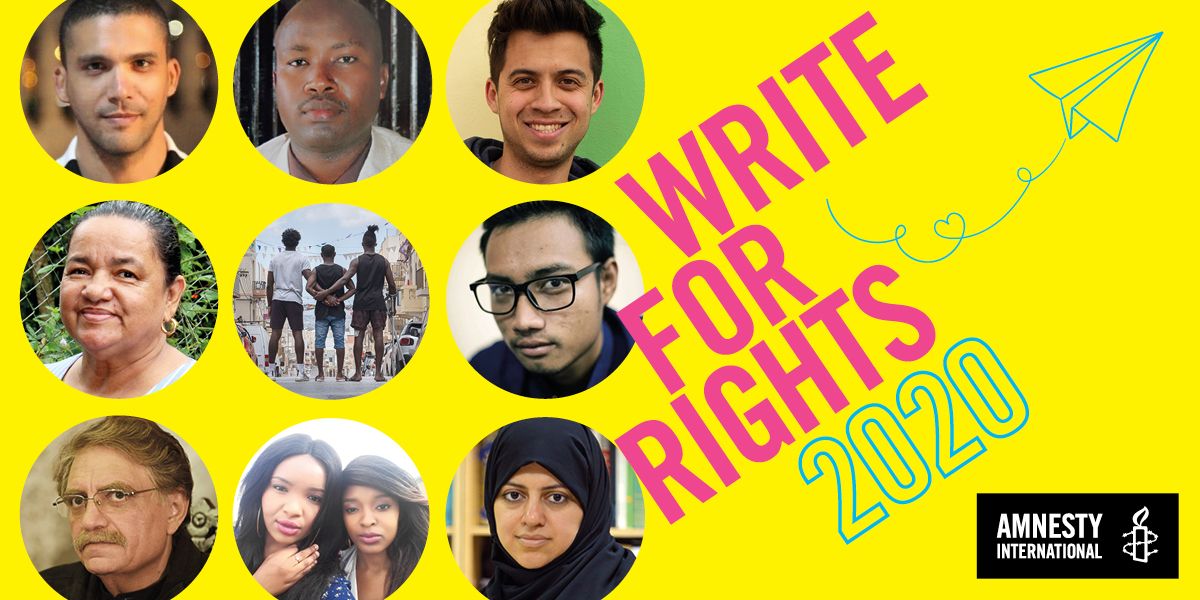
On 2 November 2020 Amnesty International has launched its flagship annual letter-writing campaign, Write for Rights, to help change the lives of people around the world who have been attacked, jailed, harassed or disappeared for standing up for their rights.
During Write for Rights – which takes place between November and December each year – people around the world will send millions of cards, emails and tweets of solidarity to individuals or groups of people whose freedoms are being denied, or write letters putting pressure on those in power to stop the abuses being committed against them.
This year, the campaign will support ten individuals who are suffering abuses, including:
Chilean Gustavo Gatica, a 22-year-old psychology student who was protesting against rising prices and inequality when he was struck in both eyes and blinded by police firing rubber and metal ammunition;
A group of Turkish university students known as the ‘METU Pride Defenders’, who are facing trail and a prison sentence for organising a peaceful sit in to protest the cancellation of their annual LGBTI+ pride march on campus.
Write for Rights goes back to the very roots of Amnesty International, which was founded in 1961, with Amnesty’s early campaigners writing letters of support to those affected by human rights abuses, as well as letters of concern to governments around the world.
On 29 October 2020, Amnesty International launched Amnesty Academy, a free human rights learning app which aims to educate the next generation of human rights defenders on a host of topics including freedom of expression, digital security, and Indigenous Peoples’ rights.
Learners around the world will be able to access courses ranging from 15 minutes to 15 hours in over 20 languages, including Urdu, Bangla, Hungarian, Korean, Russian, Thai, Czech and Turkish. All courses can be downloaded within the app, which is available on iOS and Android devices, allowing for offline learning.
“This app has been designed to empower and encourage everyone everywhere to learn about human rights. Sharing knowledge is a vital way to help us stand up for our own and for each other’s rights, and to struggle for justice and equality all over the world,” said Julie Verhaar, Amnesty International’s Acting Secretary General. This app has been designed to empower and encourage everyone everywhere to learn about human rights. Sharing knowledge is a vital way to help us stand up for our own and for each other’s rights, and to struggle for justice and equality all over the world.
Among Amnesty Academy’s key features is a flexible self-paced approach to learning, allowing users to start courses as and when it suits them. Learners who complete some of the longer courses will be awarded an official certificate signed by Amnesty International’s Secretary General.
The courses available on Amnesty Academy have been developed and fine-tuned over the past three years as part of Amnesty International’s human rights learning website. They have now been optimized for mobile use, making human rights learning more accessible than ever.
“Human rights education is the foundation of Amnesty’s work. Our overall goal is to ensure that people worldwide know and can claim their human rights. The Amnesty Academy app brings us closer to this goal by providing a simple and accessible platform for millions of people to access quality human rights education,” said Krittika Vishwanath, Head of Human Rights Education at Amnesty International.
Amnesty Academy will be regularly updated to accommodate learning in many more languages and with new course offerings in the months and years to come.
UN High Commissioner for Human Rights, Michelle Bachelet, has called for the Indian government to protect the rights of human rights defenders and NGOs in India. She praised India for being at the forefront of the fight for human rights but cautioned that vaguely worded laws may put that in jeopardy.
Her Tuesday 20 October 2020 statement comes as a response to worrying uses of the Indian Foreign Contribution Regulation Act (FRCA) which various UN bodies have been worried is overbroad and vague in its objectives. Additionally, it prohibits them from receiving foreign money for “for any activities prejudicial to the public interest.” This can and has had an impact on the right to freedom of association and expression and has prevented foreign NGOs from giving money to Indian causes.
“The FCRA has been invoked over the years to justify an array of highly intrusive measures, ranging from official raids on NGO offices and freezing of bank accounts, to suspension or cancellation of registration, including of civil society organizations that have engaged with UN human rights bodies,” Bachelet said. Most recently it led Amnesty international to close their Indian offices after they were raided and their bank account was frozen. [see: https://humanrightsdefenders.blog/2020/09/29/amnesty-feels-forced-to-shut-sown-its-india-office-amidst-govenment-pressure/]
Bachelet, also called for the Indian government to allow peaceful protest against the Citizenship Amendment Act. More than 1,500 people have been arrested because of their protests to this act and many have been charged with violations of the FCRA.
Finally, Bachelet,called for India to review the arrests of human rights defenders who have been arrested under the Unlawful Activities Prevention Act for exercising their basic human rights.


 Hans Thoolen on Human Rights Defenders and their awards