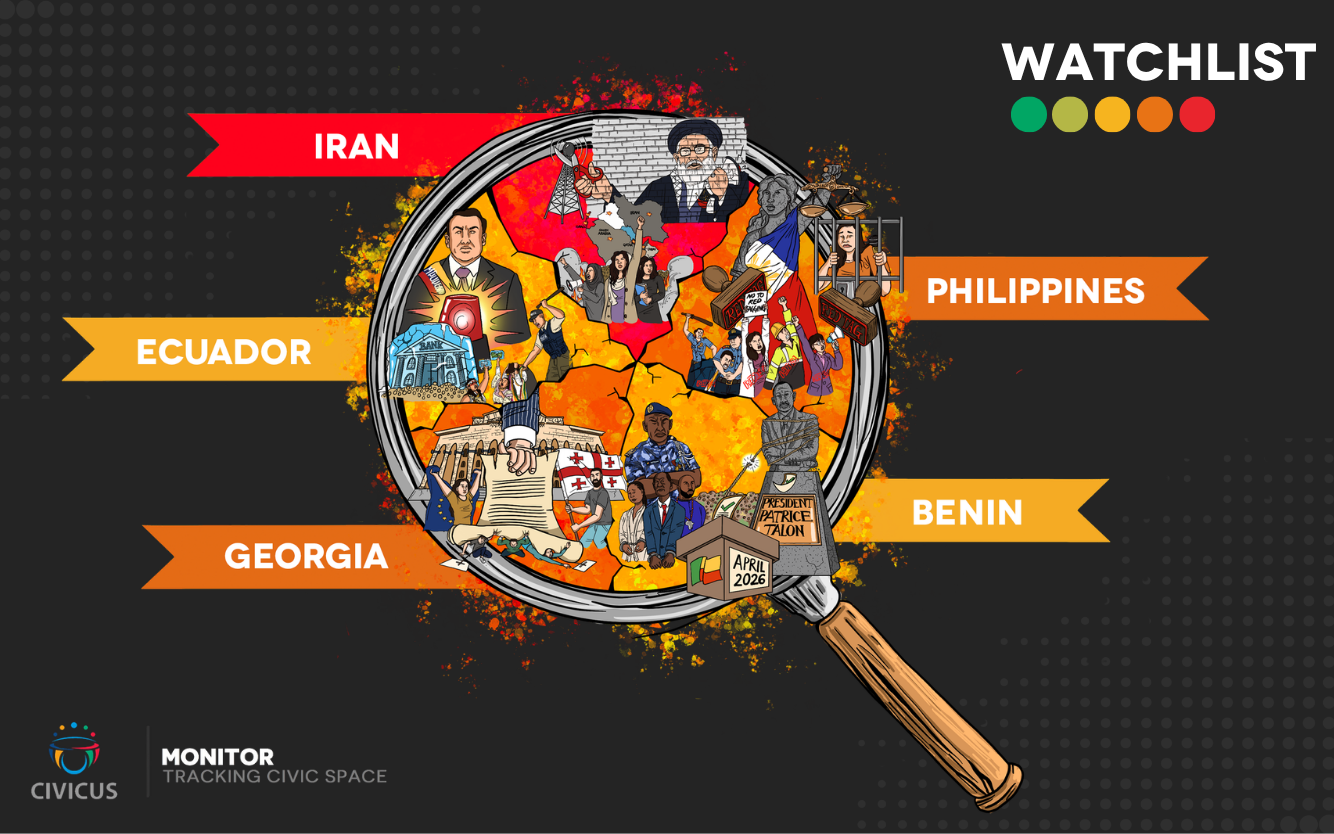
The March 2026 Watchlist from the CIVICUS Monitor highlights five countries where civic freedoms are deteriorating at an alarming pace: Ecuador, Georgia, Iran, the Philippines and Benin. Each faces escalating restrictions on fundamental rights, including freedoms of expression, association and peaceful assembly. The Watchlist draws on research findings, partner input and testimony from activists on the ground, and signals where urgent international attention is needed.
CIVICUS MONITOR CIVIC SPACE RATINGS:
OPEN
NARROWED
OBSTRUCTED
REPRESSED
CLOSED
Ecuador Civic space rating:Obstructed Ecuador’s government has increasingly relied on militarised security measures, invoking an “internal armed conflict” to justify exceptional powers. Indigenous-led protests in 2025 were met with lethal force, arbitrary detentions and internet disruptions. Environmental and Indigenous leaders face criminalisation, with more than 200 social leaders investigated or prosecuted. A 2025 law has expanded state control over civil society organisations, enabling account freezes and burdensome reporting. Journalists face killings, attacks and suspensions of media outlets, all unfolding amid a broader erosion of judicial independence.
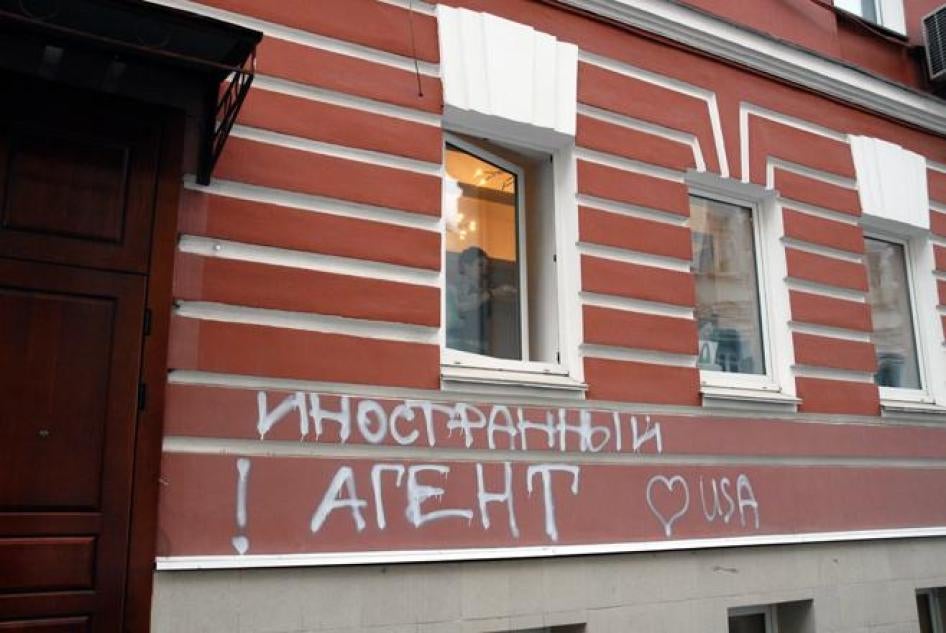
Georgia Civic space rating:Repressed Georgia has seen a dramatic decline in civic space, marked by mass protests since late 2024 and heavy-handed police responses. Hundreds have been detained, tortured or investigated. New laws restrict protests, impose “foreign agent” requirements on civil society and media, and threaten criminal penalties for receiving foreign funding. Opposition parties and leaders face politically motivated charges, and new rules bar many civil society actors from political participation for years.
Iran Civic space rating: Closed Iran’s civic space, already severely restricted, has worsened following mass protests over economic and political grievances. Security forces killed thousands of protesters in January 2026 during a nationwide internet blackout, and tens of thousands were arrested. After regional airstrikes in February 2026, authorities imposed another shutdown and intensified censorship. Journalists and activists face extreme risk, and some detainees now face the death penalty. Despite repression, demonstrations continue following the death of the Supreme Leader.
The Philippines Civic space rating:Repressed Civic space in the Philippines remains under pressure, with police violence and mass arrests during anti-corruption protests in 2025. Dozens of protesters face sedition charges under cybercrime laws. Human rights defenders are frequently targeted, including through fabricated terrorism-financing cases. Red-tagging—accusing critics of communist links—remains widespread. Journalists also face prosecution, including the conviction of reporter Frenchie Mae Cumpio after years of pre-trial detention.
Benin Civic space rating:Obstructed Benin approaches its April 2026 presidential election with shrinking democratic space. Strict electoral rules have limited the field to two approved candidates, and the January 2026 legislative elections produced a parliament without opposition representation. Authorities increasingly use the Digital Code to prosecute journalists and critics, while media outlets face suspensions and mandatory government messaging. Protests are routinely banned or dispersed, and fear of reprisals has led to widespread self-censorship.
Two journalists, one imprisoned in Belarus and the other in Georgia, have won the European Union’s top human rights honor, the Sakharov Prize, European Parliament President Roberta Metsola announced on Wednesday 22 October 2025.
Andrzej Poczobut is a correspondent for the influential Polish newspaper Gazeta Wyborcza. He was convicted of “harming Belarus’ national security” and sentenced to eight years, which he is serving in the Novopolotsk penal colony.
Mzia Amaghlobeli, a prominent journalist who founded two of Georgia’s independent media outlets, was in August convicted of slapping a police chief during an anti-government protest. She was sentenced to two years in prison in a case that was condemned by rights groups as an attempt to curb media freedom.
“Both are journalists currently in prison on trumped up charges simply for doing their work and for speaking out against injustice. Their courage has made them symbols of the struggle for freedom and democracy,” Metsola said at the parliament in Strasbourg, France.
Members of the Foreign Affairs and Development Committees of the European Parliament voted on Thursday for the three finalists for the 2025 Sakharov Prize for Freedom of Thought (in alphabetical order):
-Imprisoned journalists fighting for your freedom and ours, Andrzej Poczobut from Belarus and Mzia Amaglobeli from Georgia
-Journalists and Humanitarian Aid Workers in Palestine and all conflict zones, represented by the Palestinian Journalists Syndicate, the Red Crescent, and UNRWA ;
-Serbian students
Find the biographies of the candidates and finalists by following this link.
The Conference of Presidents, comprising European Parliament President Roberta Metsola and the leaders of the political groups, will choose the 2025 laureate from this shortlist. Their decision will be announced in the Strasbourg Hemicycle during the plenary session on 22 October 2025.
On 2 April 2025 AFP reported that language used by President Donald Trump and his government to slash US-funded foreign aid is being adopted by other governments to attack NGOs and independent media.
Civil society groups in parts of Eastern Europe and beyond — long targeted by discredit-and-defund campaigns because of the light they shone on corruption and lack of transparency — are now also dealing with Trumpian rhetoric, human rights groups said.
Trump administration statements “are being weaponised in real-time by autocrats and dictators across Eastern and Southeastern Europe to justify and deepen their crackdown on independent media, NGOs, and human rights defenders,” Dave Elseroad, of the Human Rights House Foundation, told AFP.
From Hungary to Serbia, to Georgia and Bosnia, non-governmental organisations and independent media outlets working to bolster democratic norms are hearing officials borrow White House phrases to justify officials’ stances against them.
It includes Trump’s claim that the US Agency for International Development (USAID) was “run by radical lunatics”, and his billionaire advisor Elon Musk’s calling the agency a “criminal organisation” that needed to be put “through the woodchipper”.
Such terms are “seriously encouraging language used in Budapest or in Belgrade or in Bratislava or Banja Luka,” said Miklos Ligeti, head of legal affairs at Transparency International’s Hungary chapter.
In some countries, the verbal ammunition comes on top of a sudden funding gap wrought by the dismantling of USAID, which is hitting the NGO sector hard. USAID had been providing funding to a vast array of independent organisations in countries like Hungary where such groups have been “financially suffocated domestically,” Ligeti told AFP.
Hungarian Prime Minister Viktor Orban has hailed the crackdown on USAID by his ally Trump as a “cleansing wind”. Orban has vowed to “eliminate the entire shadow army” he says is made up of his political enemies, judges, the media and NGOs.
The UN rights office in Geneva slammed “escalating attempts worldwide to weaken and harm domestic and international human rights systems, including defunding and delegitimising civil society”. It said that “it is all the more worrying to see these trends also emerging in established democracies”.
In some countries there is a direct line between utterances in Washington and action to undermine civil society. In Georgia, for example, the ruling Georgian Dream party last month called for the country to adopt its own version of the US Foreign Agents Registration Act (FARA) — which observers warn could be turned against NGOs receiving foreign funding.
And in Serbia, which has been rocked by months of protests over government corruption, authorities referred to statements made by Trump and other top US officials to justify raiding a number of NGOs. The Serbian government saw the Trump administration’s labelling of USAID as a “criminal organisation” as “a fantastic opportunity to basically punish civil society”, said Rasa Nedeljkov, programme director at the Center for Research, Transparency and Accountability (CRTA).
CRTA’s offices were raided in February by heavily armed police. The operation took 28 hours because prosecutors had CRTA staff manually copy documents related to USAID-funded projects to hand to them, rather than accepting digital versions.
Serbian authorities have explicitly referred to statements by Trump and other US officials to justify raids on a number of NGOs.
Pavol Szalai, head of the EU-Balkans desk at Reporters Without Borders (RSF), said leaders in a string of countries were using “the suspension of USAID by Trump to attack media which had received USAID funds”. He said such groups were being doubly punished: they “lost their funding from one day to the next” while also increasingly being “targeted by intimidation”…
He warned that, “as these media retreat.. they will be replaced by propaganda”.
Natika Kantaria is a human rights advocate with nearly a decade of experience planning and implementing advocacy campaigns in human rights. She has worked with international organizations and watchdog NGOs and collaborated with the public and private sectors. For the ISHR she wrote a piece on 26 February 2025 about a worrying trend: ‘Foreign agent’ laws have been introduced in various countries, violating international human rights law and threatening to silence human rights defenders. This pattern is particularly evident in Eastern Europe, where NGOs courageously resist and need the support of the international community. See e.g. my earlier posts:
Societies thrive when everyone can work, speak out, and organise freely and safely to ensure justice and equality for all. Legislation requiring NGOs to register as ‘foreign agents’ is a barrier to this virtuous cycle. Despite the European Court of Human Rights’ 2022 ruling that Russia’s 2012 foreign agent law violated freedom of expression and association, the governments of Hungary, Georgia, Slovakia, Serbia, and Bosnia and Herzegovina have proceeded undeterred to introduce similar laws.
These laws specifically target NGOs and not-for-profits that receive foreign funds and require them to register as foreign agents, organisations serving the interests of a foreign power, or agents of foreign influence. By doing so, they restrict the capacity of human rights defenders to organise, participate and exercise their right to defend rights by:
imposing disproportionately high fines and heavy sanctions to NGOs refusing to comply, which may ultimately lead to the termination of their operations
using vague wording, that ultimately gives too much room and power for government interpretation. For instance, the requirement for NGOs to register in official records or identify themselves as ‘agents of foreign influence’ lacks clarity and specificity.
increasing the burden of NGOs by introducing heavy reporting and auditing requirements. The State’s alleged need for transparency as their primary purpose can, therefore, be effectively addressed through existing legislation regulating NGOs.
employing a negative narrative that stigmatises and delegitimises the work of the civil society organisations and human rights defenders. This rhetoric promotes hostility and distrust toward civil society and encourages attacks against defenders.
Furthermore, such laws contradict the commitments of these countries under international human rights law. Article 13 of the 1998 UN Declaration on human rights defenders recognises the right of defenders to solicit, receive and utilise resources.
Article 10 of the Declaration +25, a supplement to the UN Declaration put forward in 2024 by civil society, human rights defenders and legal experts, addresses States’ attempts to prohibit foreign contributions or impose unjustified national security limitations. It stipulates that States should not hinder financial resources for human rights defenders and outlines measures to prevent retaliation based on the source of their funding. These laws violate rights related to freedom of expression, association, and privacy, as outlined in the European Convention on Human Rights (ECHR) and International Covenant on Civil and Political Rights. Foreign agent laws also run counter to commitments made by countries at the regional level as members of the Council of Europe (CoE) and the Organization for Security and Co-operation in Europe (OSCE), including recommendation CM/Rec(2018)11, which emphasizes the protection and promotion of civil society space and OSCE guidelines for protecting human rights defenders.
NGOs are increasingly becoming a primary target for repressive governments. According to the CIVICUS Monitor 2024 report, the countries mentioned above that have introduced ‘foreign agent’ laws have either ‘closed’ or ‘obstructed’ civil society space. In addition, the Trump administration’s rhetoric and its decision to freeze foreign aid have contributed to strengthening hostile narratives already present in ‘foreign agent laws’ in Eastern Europe and have emboldened governments in their efforts to publicly undermine these organisations.
While the silencing of NGOs has become part of the agenda for many governments, and the rise of ‘foreign agent’ laws serves as a step towards establishing authoritarian regimes, civil society actors continue to mobilise in response. Strengthening engagement with international human rights mechanisms, fostering joint global advocacy, and providing support to targeted organisations and groups are essential steps that international NGOs and the international community should take to build resistance, reinforce coalition efforts, and protect the work of human rights defenders.
International and regional human rights mechanisms have called for governments to either repeal these laws, or not to adopt them in their current forms. On 7 February 2025, three UN independent experts issued a statement in relation to Bosnia and Herzegovina, where the government reintroduced the ‘Law on the Special Registry and Publicity of the Work of Non-Profit Organisations’ after its initial withdrawal in May 2024. The statement stressed that creating a register of non-profit organisations receiving foreign funding in one of the entities of Bosnia and Herzegovina will impose severe restrictions on NGOs and would grant government control over their operation, including the introduction of an annual inspection, with further reviews of legality of CSOs receiving foreign funding possible upon requests from citizens or relevant authorities.
In this unsupportive environment, donors have a fundamental role to play. ‘As civil society actors devise strategies to push back against these repressive tactics, private philanthropy and bilateral and multilateral donors have vital support roles to play,’ writes James Savage, who leads the Fund for Global Human Rights’ (FGHR) programme on the Enabling Environment for Human Rights Defenders. ‘They can help civil society prepare for future challenges, so that it is organised not only to respond to evolving forms of repression but also to get ahead of them by tackling their root causes,’ Savage concludes.
The selection panel of the Václav Havel Human Rights Prize, which rewards outstanding civil society action in defence of human rights in Europe and beyond, has announced the shortlist for the 2024 Award.
Meeting in Prague, the panel – made up of independent figures from the world of human rights and chaired by the President of the Parliamentary Assembly of the Council of Europe (PACE) Theodoros Rousopoulos – decided to shortlist the following three nominees, in alphabetical order:
Akif Gurbanov, Azerbaijan
The nominee is a human rights defender, political activist and active member of the Azerbaijani civil society. He is the co-founder of the Institute of Democratic Initiative (IDI) and of the Third Republic Platform. He was arrested in March 2024 in a wave of arrests targeting journalists and activists in the country.
María Corina Machado, Venezuela
The nominee is a leading political figure in Venezuela engaged in denouncing human rights abuses in her country and defending democracy and the rule of law. She is the co-founder of the Venezuelan volunteer civil organisation ‘Súmate’ for civil and political freedom, rights and citizen participation.
Babutsa Pataraia, Georgia
The nominee is a leading feminist activist and human rights lawyer in Georgia. She is the Director of ‘Sapari’, an NGO focusing on women’s rights and providing support for victims of violence since 2013. She has worked for over a decade to fight against feminicide, sexual violence against women, and sexual harassment.
Iskra Kirova, Advocacy Director, Europe and Central Asia Division of HRW, wrote on 4 April 2024: ‘Foreign Agent’ Laws Spread as EU Dithers to Support Civil Society
Georgia’s ruling party plans to reintroduce highly controversial Russia-style “foreign agent” legislation aimed at incapacitating civil society and independent media. If adopted, the laws, which were withdrawn last year in the face of massive protests, would require foreign-funded nongovernmental organizations and media to register as “agents of foreign influence”. That would make them subject to additional scrutiny and sanctions, including administrative penalties up to 25,000 GEL (about 8,600 Euro). Authorities claim the laws promote “transparency”, but their statements make it clear the laws will be used to stigmatize and punish critical voices.
The day before Georgia’s announcement, Kyrgyzstan’s president signed an abusive “foreign representatives” law. Copied almost entirely from the Russian equivalent, the law would apply the stigmatizing designation of “foreign representative” to any nongovernmental organization that receives foreign funding and engages in vaguely defined “political activity”. The bill had been widely criticized after its initial submission in November 2022, including in a urgency resolution by the European Parliament.
The EU had ample opportunity to press the authorities to reject this bill. Kyrgyzstan benefits from privileged access to the EU internal market tied to respect for international human rights conventions: conventions this law clearly contravenes. The country is poised to sign an enhanced partnership agreement with the EU that centers democracy and fundamental rights. The EU has been silent on whether these deals would be imperiled by the bill’s adoption, despite the fact the European Commission’s own assessment highlighted Kyrgyzstan’s dire environment for civil society and the country’s breach of its obligations.
The latest spate of curbs on civil society comes in the wake of the European Commission’s December 2023 legislative proposal for an EU Directive on “transparency of interest representation” that would create a register of organizations which receive foreign funding. European civil society vehemently opposes the proposal because it risks shrinking space for independent organizations at home and diminishing the EU’s credibility in opposing such laws abroad. Yet the Commission forged ahead. On the same day the proposal was adopted, Hungary’s parliament approved a law that gives a government-controlled body broad powers to target civil society and independent media.
With civil society organizations under threat throughout Europe and Central Asia, we need an EU that in words and actions protects civic space and sets the right standards.
Global Voices has released a special coverage called Empowering voices: Women in politics, which explores the state of women’s political participation around the world.
Human Rights First referred to a new report reveals that WHRDs face increasing harassment and threats from a global movement against gender equality and LGBTQI+ rights. The Kvinna till Kvinna Foundation, a leading feminist women’s rights organization, released Hope and Resistance Go Together: The State of Women Human Rights Defenders 2023, a report that found discouraging growth in harassment of WHRDs. The foundation surveyed 458 women’s and queer rights activists and interviewed 25 activists representing WHRDs from 67 countries affected by violence or conflict.
They found that 75% reported facing harassment for their activism, a 15% increase from two years ago, and 25% of respondents have received death threats. Most harassment comes from government authorities, but increased harassment from far-right groups and anti-gender equality actors is also driving these startling statistics. Human Rights Defenders (HRDs) across the world face resistance and violence. In 2022, at least 401 HRDs were killed for their peaceful work. But some of the obstacles facing WHRDs are distinct. https://humanrightsfirst.org/library/recognizing-women-human-rights-defenders-on-international-womens-day/
Human Rights Watch on 7 March carried a piece by Macarena Sáez who says inter alia:
On this International Women’s Day, we march for the one in three women who experience physical or sexual violence in their lifetime. We cheer for countries like Argentina, Colombia, and Ireland that value our autonomy to choose to be pregnant and have legalized access to safe abortion, while protesting that abortion is still or again illegal in many places, including US states like Alabama and Texas. At the same time, we march to honor the women who marched before us, like the Mexican women who organized the first feminist congress in 1916 to push for family law reforms and their right to vote, and the Nigerians who waged their “Women’s War” against colonization and patriarchal laws in 1929. Their struggles sadly mirror the reality of many women around the world today – especially women who belong to historically marginalized groups – who continue to rally against violence and abuse.
Fearing the power of women’s solidarity and collective actions, governments have stifled women’s speech through restrictions on movement, censorship, smear campaigns, and criminal prosecutions. In highly repressive contexts, like Afghanistan and Iran, women suffer arbitrary detention, and even enforced disappearance and torture, for their activism. Meanwhile, social media companies have not done enough to protect women from online violence, chilling women’s freedom of expression on and offline. These barriers make it hard for women’s equality to become reality. Gender justice requires an enabling environment in which women can express themselves, speak and spread their political views, and participate in political and public life. Instead of repressing or tolerating the repression of women, governments should recognize our collective actions – and consequent power – and enshrine our rights in laws, policies, and practice. [https://www.hrw.org/news/2024/03/07/womens-voices-have-power-drive-change]
On 8 March 8, 2024 Almyra Luna Kamilla and Rosalind Ratana opined in IMHO on “Navigating the storms of repression: The resilience of young women rights defenders in Asia”
In recent years, Asia has been witnessing rising authoritarianism and shrinking civic space. Among those in the frontlines of resistance are young women human rights defenders. As we celebrate International Women’s Day, let us demand for an enabling world where women human rights defenders can continue their noble pursuits without fear of reprisals.
In Thailand, the royal defamation law is being excessively used to silence criticisms against the monarchy. Meanwhile in Sri Lanka, economic and political mismanagement has sparked peaceful protests that are met with violence and intimidation. The fate of Asia’s political climate hangs by a thread as elections are held across many countries, including Bangladesh, Indonesia, India, South Korea, and Pakistan. Now more than ever, governments across the region are finding ways to solidify their power, putting an even tighter grip on civil society to the detriment of democracy and people’s fundamental rights and freedoms.
Despite such challenges, many are courageously speaking out and taking collective action to reclaim power for the people. This includes young women human rights defenders – or Youth WHRDs – who are claiming space to call out human rights violations and to demand accountability from oppressive governments. [https://www.rappler.com/voices/imho/young-women-rights-defenders-asia/]
The Alliance for Human Rights in Afghanistan(a coalition of 9 major NGOs) urgently appealed to the international community to significantly bolster its support and actively safeguard the human rights of Afghan women and girls, including Afghan women human rights defenders who face persecution for their peaceful campaigns for rights and basic freedoms.
In 2023, the Taliban further intensified its oppressive policies toward women, girls, the LGBTIQ+ community, and religious minorities. Afghan women and girls have seen their rights and prospects increasingly curtailed, from greater enforcement of restrictions on education – including a ban on girls attending secondary schools and universities – to intensifying exclusion of women from political and public life. Women have been banned from a growing list of forms of paid employment, and economic barriers, such as the ban on women registering organisations and undergoing vocational training, have contributed to a sharp decline in women’s participation in the labour market, impeding their right to make a living. This exacerbates financial insecurity, widens gender disparities, and further confines women to the private sphere. Lesbian, bisexual, and transgender women face severe threats, including torture, sexual violence, forced marriage, and death. Victims of gender violence, including those who identify as such, lack minimal legal and practical support. Obstacles to healthcare and education have exacerbated poverty and vulnerability among women and girls. In 2023, new discriminatory restrictions imposed by the Taliban included the closure of all beauty salons, blocking women from overseas travel for study, mandating female health workers in some areas to have a male chaperone while travelling or at work, and prohibiting women from entering a famous national park.
The oppressive environment extends to female activists, NGO leaders and journalists. Notable cases include the arrests of women’s rights activists Neda Parwani and Zholia Parsi, the enforced disappearance and subsequent discovery of Manizha Seddiqi in Taliban custody to date, the arrest of Matiullah Wesa, founder of an NGO advocating for girls’ education rights, and the arbitrary detainment of Ahmad Fahim Azimi and Seddiqullah Afghan—both dedicated girls’ education activists, among many others. Journalists reporting on the Taliban, facing arrests and threats, equally illustrate the difficulties encountered by the media, particularly women, when covering crimes against women or advocating for women’s rights. Collectively, these cases underscore the near-total denial of freedom of expression, gender equality, or any other internationally recognized right in Afghanistan under the Taliban.
Amid this growing oppression, segregation and fear, Afghan women human rights defenders have urged the international community to exert greater pressure on the Taliban. They call on international bodies to involve Afghan women in all negotiations with the Taliban and to facilitate direct meetings between women and the de facto authorities to address their concerns. Afghan women have also stressed the importance of advocacy for women’s rights by external actors based on the voices and realities of women inside Afghanistan. They call for coordinated efforts between organisations inside and outside the country to defend the rights of Afghan women and girls.
The UN Special Rapporteur on the situation of human rights in Afghanistan, Richard Bennett, called on the Taliban to release women human rights defenders as the world marks International Women’s Day.
I reiterate my appeal to the Taliban to respect all the human rights of women and girls in Afghanistan, including to education, work, freedom of movement and expression, and their cultural rights, and I urge the meaningful and equal participation of Afghan women and girls in all aspects of public life. I call on the Taliban to immediately and unconditionally release all those who have been arbitrarily detained for defending human rights, especially the rights of women and girls.”
On International Women’s Day, the a group of NGOs (ALQST for Human Rights, Amnesty International, CIVICUS, European Saudi Organization for Human Rights (ESOHR), Front Line Defenders, Gulf Centre for Human Rights (GCHR), HuMENA for Human Rights and Civic Engagement, International Service for Human Rights (ISHR),MENA Rights Group, Salam for Democracy and Human Rights) renewed their call on Saudi Arabian authorities to release all women human rights defenders (WHRDs), women’s rights activists and their supporters who are detained in contravention of international human rights standards. The organisations further call on Saudi authorities to lift travel bans imposed on WHRDs and their relatives, and to abolish the male guardianship system. [https://ishr.ch/latest-updates/civil-society-reiterates-their-call-on-saudi-authorities-to-release-jailed-womens-rights-activists/]
The President of Georgia awarded severl with mesla of honor: co-founder of “Safari” organization Babutsa Pataraia, human rights defender Ana Arganashvili, founders of “National Network for Protection from Violence”: Eliso Amirejibi and Nato Shavlakadze and founder of “Vedzeb” organization Tamar Museridze.
Interesting example of enhancing international awards at the local level: Several Dutch embassies have started to issue a local version of the Ministry’s international human rights award, the Tulip [see: https://www.trueheroesfilms.org/thedigest/award/D749DB0F-1B84-4BE1-938B-0230D4E22144]. Here the case of Georgia where the Ambassador, Maaike van Koldam, has awarded 3 Georgian media activists with a Human Rights Tulip prize
Established in 2008 by the Dutch government, the Human Rights Tulip is an annual award intending to support human rights defenders and help them learn from each other. Photo: The Embassy of Netherlands to Georgia.
The winner is Kamilla Mamedova, the founder of Radio Marneuli. The second prize went to Tsabunia Vartagava, an LGBTI and women’s rights activist from Georgia’s western region of Samegrelo, and Manana Qveliashvili, a journalist working on various human rights issues in the Adjara region.
Due to the Covid-19 pandemic, the award ceremony took place virtually. The Tulip prize will remain with the ambassador for now, until she will be able to hand it over to the winner in person.
A portrait of late human rights defender and multiculturalism activist Vitali Safarov was created as part of the mural by artists Karski & Beyond. Photo via Hague University of Applied Sciences.
On 15 May 2020 Agenda.ge reported that a mural portrait of Vitali Safarov, the Jewish-Georgian human rights defender and activist killed in Tbilisi in 2018, now adorns a facade of the Hague University of Applied Sciences alongside faces of student climate movement figure Greta Thunberg and assassinated Honduran indigenous activist Berta Cáceres. Re Safarov see: https://humanrightsdefenders.blog/2019/04/22/vitos-trial-in-georgia-opens-crucial-to-challenge-raising-hate-crimes/. The 25-year-old can be seen on the large work by artist duo Karski & Beyond, painted on an outside wall of the university after the project originated at one of their sessions involving students. Thunberg, a teenage climate activist who has become widely acknowledged for inspiring school student strikes on climate change [see: https://humanrightsdefenders.blog/2019/09/17/greta-thunberg-receives-amnestys-ambassador-of-conscience-award/], and Cáceres, an indigenous leader on environmental concerns who was killed in 2016 [see: https://humanrightsdefenders.blog/tag/berta-caceres/], are the other two personalities seen in the artwork.
Started in an initiative by Justice & Peace Netherlands to commemorate the 70th anniversary of the declaration of universal human rights, the creative project pays tribute to the activists for their commitment to “climate, freedom and equality”, the university said.
“The mural] is a tribute to three people who show that it is really possible to make a difference” – Hague University of Applied Sciences


![[OPINION] Navigating the storms of repression: The resilience of young women rights defenders in Asia](https://www.rappler.com/tachyon/2024/03/women-rights-defenders-asia-mar-7-2024.jpg)


 Hans Thoolen on Human Rights Defenders and their awards