Posts Tagged ‘Geneva’

HURIDOCS: finally new Director and now searching for other staff

February 16, 2017

On 15 February 2017, the chair of HURIDOCS, Gisella Reina announced the appointment of Friedhelm Weinberg as the new Executive Director. She added: “HURIDOCS has a young and energetic director that listens and leads. His experience with our global network, having worked in Asia, Africa and the Former Soviet Union region, gives him the firm understanding of what our community thinks and wants. Friedhelm has proven his capacity to strengthen and motivate our international and distributed team to be creative and effective.”

Friedhelm Weinberg first joined HURIDOCS in 2012. Over the years, he has taken on a variety of roles, including communications and project management and most recently as Deputy Director. Previously, he has worked as a journalist in his native Germany. [https://humanrightsdefenders.blog/2016/09/06/executive-director-of-huridocs-needs-to-have-the-following/]


huridocs-signature-logois also looking to fill two positions: Read the rest of this entry »

International Film Festival and Forum on Human Rights: 10-19 March 2017 in Geneva

February 14, 2017

The International Film Festival and Forum on Human Rights (FIFDH) is an international event dedicated to film and human rights. For the past 15 years, the festival has taken place in the heart of Geneva, the human rights capital, parallel to the main session of the UN Human Rights Council in March. Each evening, the FIFDH provides high-level debates in which human rights violations are denounced and debated, wherever they occur, including those overlooked by the United Nations and not attract international attention. Diplomats, NGOs, victims, artists, philanthropists, activists, journalists, decision makers, and the general public are invited to debate their views in this unique setting. All the discussions are transmitted live online and have their own dedicated hashtags : you can submit questions and engage with the debate directly, wherever you are.

Prominent personalities who have participated in these debates include : Nobel Prize laureates Shirin Ebadi and Joseph Stiglitz, High Commissioners Navi Pillay and Zeid Ra’ad al Hussein, whistleblowers Edward Snowden, Julian Assange and Jesselyn Radack, doctor Denis Mukwege, activists Pussy Riot and the Yes Men, artists JR and Ai Weiwei, lawyers Fatou Bensouda, Carla del Ponte and Baltasar Garzon, diplomats Leila Shahid and Samantha Power, journalist Anna Politkovskaïa, as well as leading human rights thinkers Edgar Morin and Stéphane Hessel.


The FILM FESTIVAL runs two international competitions – fiction and documentary – offering a world class selection of films that challenge the ways in which we see the world, in the presence of filmmakers and artists turned protagonists. Two prestigious Juries award Le Grand Prix de Genève (10’000 €), Le Grand Prix Fiction (10’000 €) and the Prix Sergio Vieira de Mello (5000€).

The FIFDH reaches out to young people: more than half of its audience is younger than 35! We offer an ambitious and exciting programme of films and debates for school students. The Festival also schedules special screenings for students of the University of Geneva, the Graduate Institute and film schools, complete with workshops and dedicated Masterclasses.
Source: International Film Festival and Forum on Human Rights, Geneva

2017 (6): predictions on Trump and the UN – prophets or Cassandras?

January 26, 2017

The U.N. Human Rights Chief Fixes for a Fight with Trump

Photo credit: FABRICE COFFRINI/AFP/Getty Images

Already on 22 November 2016 Colum Lynch posted in “Foreign Policy” an insightful piece entitled: “The U.N. Human Rights Chief Fixes for a Fight with Trump”.  It records the thinking of senior UN staff and NGO leaders who are going to confront a Donald Trump with a hard-line national security team. They fear that a Trump presidency could spur a global retreat from international human rights principles, marking the dawn of American leadership (see long extracts from the piece below) on green. Now – on 26 January 2017 – Daniel Warner in his weekly blog in the Tribune de Geneve wrote a post entitled: “The U.N., Trump and Cassandra” in which he reports that a bill was introduced into the U.S. House of Representatives on January 3 calling for the total disengagement of the United States from the United Nations. The bill, H.R. 193 – known as American Sovereignty Restoration Act of 2017 – has been referred for deliberations to the House Foreign Affairs Committee. The bill – tried before in 2015 – may not pass, but the writer fears it reflects the tenor of the current Trump administration. See his words below marked in blue.

—-

The U.N. high commissioner for human rights, Prince Zeid Ra’ad al-Hussein, informed his staff in the weeks following the U.S. election that they will have to serve as the front line in an international effort to check any excesses on the human rights front. A chief concern, officials say, is that if the U.N. doesn’t call out its most powerful member for straying from universally accepted human rights norms, the rest of the world will be emboldened to ditch them. “We are going to speak up,” one U.N. official told Foreign Policy. “It’ll be rough, but if [Trump] puts any of those ghastly campaign pledges into action we will condemn.”

…..Still, Trump’s campaign pledged to restore waterboarding, deport millions of undocumented migrants, and ban Muslims from traveling to the United States. …

The U.N.’s approach to human rights is particularly tricky for the incoming U.N. secretary-general, António Guterres, a former Portuguese prime minister who headed the U.N. refugee agency for nearly 10 years. Guterres has been an outspoken champion of refugees, pressing European governments, as well as the United States, to resettle far larger numbers of refugees. Two weeks after Trump called for his ban on Muslims last December, Guterres admonished the Security Council, saying, “Those that reject Syrian refugees because they are Muslims are the best allies in the recruitment propaganda of extremist groups.” But Guterres may be constrained as the leader of the United Nations, a job that requires a close relationship with the United States and other big powers. ……

That makes it likely that Zeid will take the lead on human rights. Throughout the U.S. presidential campaign, Zeid, a Muslim prince from the Jordanian royal family, has repeatedly excoriated Trump, telling reporters in December that his threat to ban Muslim travel to the United States is “grossly irresponsible.” In September, Zeid included Trump, along with France’s Marine Le Pen and Dutch far-right politician Geert Wilders, on a list of “populists, demagogues, and political fantasists” who promoted their arguments grounded in “half truths and oversimplification.” [see also: https://humanrightsdefenders.blog/2016/09/14/un-high-commissioner-for-human-rights-states-may-shut-my-office-out-but-they-will-not-shut-us-up/]

Some U.N. officials say Zeid’s criticism of the U.N.’s most powerful country could strengthen his hand in disputes with other U.N. members, particularly those from the developing world who have long accused the United Nations of applying greater pressure on small powers for breaching human rights norms, while letting the United States and other big powers off the hook. Other U.N. officials fear that Zeid may be exposing the organization to a battle with the U.N.’s most powerful players that he can’t win. In September, Russia’s U.N. ambassador Vitaly Churkin formally protested Zeid’s public denunciations of Trump and other European nationalists. “Prince Zeid is overstepping his limits from time to time, and we’re unhappy about it,” Churkin told The Associated Press.

More recently, Zeid tangled with China over his attendance at a ceremony for the Martin Ennals Award for Human Rights Defenders, which honored a Uighur economist, Ilham Tohti, who is serving a life sentence on charges of fomenting separatism and violence. A senior Chinese official appealed to Zeid not to attend the event, according to a U.N. official. But Zeid refused, insisting that he had an independent mandate to shed light on human rights violations wherever they occur, including China.

Even before Trump’s election, U.N. officials believed that human rights were under threat from authoritarian governments, including China, Egypt, Russia, and Turkey, which have been engaged in major crackdowns on civil liberties at home. “They are backsliding on human rights, but from a position of weakness,” said Kenneth Roth, executive director of the New York City-based advocacy group Human Rights Watch. “Both [Vladimir] Putin and Xi Jinping are engaging in the worst crackdowns in their countries in two decades, each driven by the terror as to how their countries will react to a weakening economy; they’re trying to snuff out in advance opposition they anticipate.”

Roth said there is a real danger that Trump and other populist leaders will accelerate the curtailment of human rights. “The entire human rights movement is weary about Trump,” he said. “It’s not clear what his values are. That is why his initial appointees are so important.” Dimitris Christopoulos, president of the International Federation for Human Rights, fears Trump’s controversial positions, including torture and deportation, would embolden smaller countries. When big powers, particularly the United States, tread on human rights the world tends to follow. If smaller countries, such as Burundi and Kenya, hear Trump threatening to cast out foreign refugees they may choose to act in kind, Christopoulos said. Saudi Arabia threatened this year to cut funding to U.N. relief programs and to lead a walkout by Muslim states from the United Nations if the U.N. didn’t lift its name from a list of countries that killed or maimed children in armed conflict, according to a senior U.N. official. In its defense, Saudi officials noted that the United States had shielded its closest Middle East ally, Israel, from being included on the same list in 2015. It was only fair, therefore, that Riyadh be spared the shame of being included on the list...

Rights advocates say the rising tide of nationalism and populism in Europe and the United States represents a potentially existential threat to the human rights movement, as governments that once championed the cause on the international stage head into retreat. Britain’s new prime minister, Theresa May, has railed against “left-wing human rights lawyers” who are seeking the prosecution of British soldiers alleged to have committed war crimes in Afghanistan and Iraq. She has proposed that London withdraw from key provisions of the European Convention on Human Rights that potentially expose British troops to prosecution. A generation of European nationalist leaders, including Le Pen and Wilders, who had been on the fringe of the European political spectrum, have seen their electoral prospects grow in the face of spreading anti-immigrant sentiment. That has left German Chancellor Angela Merkel as one of the “only outspoken leaders on human rights,” Roth said. In her first statement following Trump’s election, Merkel said she would work closely with Trump, but only on the basis of “democracy, freedom, respect for the rule of law, and the dignity of men regardless of origin, skin color, religion, gender, or sexual orientation.”

———-

Daniel Warner further wrote: Fervent supporter of H.R. 193 and prominent Republican Rand Paul (Rep-KY) said in 2015: “I dislike paying for something that two-bit Third World countries with no freedom attack us and complain about the United States… There’s a lot of reasons why I don’t like the U.N., and I think I’d be happy to dissolve it,” added the Kentucky senator. Or, as John Bolton, once U.S. ambassador to the U.N. and now being considered for the number two spot in the State Department famously said: “There’s no such thing as the United Nations. The Secretariat building in New York has 38 stories. If it lost ten stories it wouldn’t make a bit of difference.”
This time, following the election of Donald Trump and the U.S. abstention on a Security Council resolution to condemn the continued construction of illegal Israeli settlements, the bill has a better chance. The mood in Washington of “America First” will try to repeal all multilateral agreements such as the Trans-Pacific Partnership and the North American Free Trade Agreement as well as weakening multilateral organizations like the North Atlantic Treaty Organization.
Does the introduction of the bill matter? For International Geneva, it certainly does. While the United States might not withdraw from the U.N., the negative attitude of the current administration towards multilateralism and multilateral organizations will have obvious negative consequences for Geneva, sometimes called “The Rome of Multilateralism.” Even with U.S. participation, the international system will lack United States leadership during the Trump presidency. The visit of the Chinese President to the U.N. Office in Geneva and his speech at Davos were clear signs of shifting multilateral leadership.
I heard a comment from someone within the Washington bureaucracy that gives some hope.  Her feeling was that career civil servants will slow down if not block radical changes in U.S. foreign policy. The slow wheels of government will crush any unilateral attempts by the Trump leadership. The ship of state will carry on with deep divisions between the political appointments and career civil servants. This would be an indirect check on the incoming politicians.
On January 21, one day after Trump’s inauguration, millions marched against the Trump presidency throughout the United States. Millions more marched around the world for women’s dignity and many against Donald Trump as well. Will anyone march to save multilateralism and the U.N?

——

Sources:

The U.N. Human Rights Chief Fixes for a Fight with Trump | Foreign Policy

The U.N., Trump and Cassandra : Le blog de Daniel Warner

see also:

https://humanrightsdefenders.blog/2017/01/23/2017-4-canadas-year-of-real-human-rights-action/

https://humanrightsdefenders.blog/2017/01/24/2017-5-with-trump-us-president-sweden-must-stand-up-for-human-rights/

THE IMPACT OF COUNTER-TERRORISM LAWS AND POLICIES ON IHL AND HUMANITARIAN ACTION

January 25, 2017

Counter-terrorism is a major concern of many governments today. Since 9/11 and more recently after the attacks in Belgium, France, Germany, Lebanon, Tunisia or Turkey, states have adopted new counter-terrorism measures and legislation intended to address the threat of terrorism.

The steps taken are diverse, ranging from surveillance to emergency legislation as well as the use military force against designated terrorist groups abroad. In some instances, more restrictive conditions of financing and the risk of criminal sanctions in cases of ‘material support’ to listed terrorist organizations – a notion which has been broadly interpreted by US case law- have impacted the implementation of certain IHL rules as well as humanitarian assistance. This has reduced the scope of action of humanitarian agencies and NGOs.

In that context, this third IHL Talk on 26 January 2017 will discuss the legal regime governing terrorism, in particular how IHL addresses acts of terrorism and what is the relationship with other international treaties. More generally, experts will discuss the legal and operational challenges counter-terrorism has created for IHL and humanitarian action.

KEYNOTE SPEAKER

Ambassador Valentin Zellweger, Permanent Representative of Switzerland to the United Nations and the other international organizations in Geneva

MODERATION

Gunilla von Hall, Foreign correspondent in Geneva for the Swedish newspaper Svenska Dagbladet

PANELISTS

Sandra Krähenmann, Research Fellow, Geneva Academy of International Humanitarian Law and Human Rights

Carla Ruta, Legal Adviser, Geneva Call

Where?  Villa Moynier, 120B Rue de Lausanne, Geneva

Source: Upcoming Events – The Geneva Academy of International Humanitarian Law and Human Rights

2017 (1): Are we heading towards a ‘post human rights world’?

January 11, 2017

The start of a new year is often the occasion to make some broader analysis. So it is with the issue of human rights defenders. I have collected some of the more interesting and will report on these in the days to come.

The first is an article (30 December 2016) by ith more states seemingly reluctant to honour human rights treaties – whether we are “heading towards a ‘post human rights world‘?:

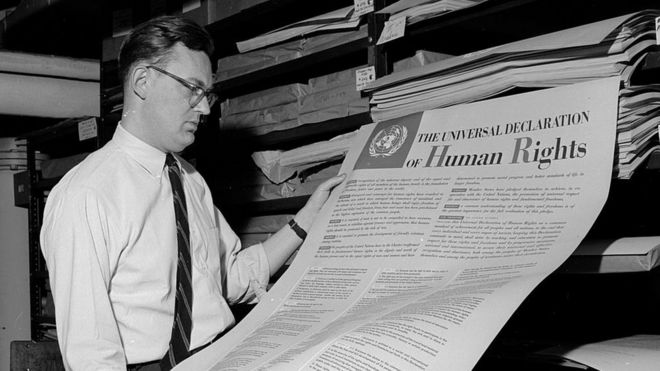
A man looks at one of the first documents published by the United Nations, The Universal Declaration of Human Rights
Image copyright THREE LIONS/GETTY IMAGES

With an increasing number of states seemingly reluctant to honour human rights treaties, is there a future for this type of international agreement? “We stand today at the threshold of a great event both in the life of the UN, and in the life of mankind.” With these words, Eleanor Roosevelt presented the Universal Declaration of Human Rights to the United Nations. It was 1948 and UN member states, determined to prevent a repeat of the horrors of World War Two, were filled with idealism and aspiration…… Mrs Roosevelt’s prophecy that the declaration would become “the international magna carta of all men everywhere” appeared to have been fulfilled.

But fast forward almost 70 years, and the ideals of the 1940s are starting to look a little threadbare. Faced with hundreds of thousands of migrants and asylum seekers at their borders, many European nations appear reluctant to honour their obligations to offer asylum. Instead, their efforts, from Hungary’s fence to the UK’s debate over accepting a few dozen juvenile Afghan asylum seekers, seem focused on keeping people out. Meanwhile across the Atlantic, president-elect Donald Trump, asked during the election campaign whether he would sanction the controversial interrogation technique known as “waterboarding”, answered ‘I’d do much worse… Don’t tell me it doesn’t work, torture works… believe me, it works.” And in Syria, or Yemen, civilians are being bombed and starved, and the doctors and hospitals trying to treat them are being attacked.

Donald Trump
 Image copyrightDREW ANGERER/GETTY IMAGES

 Little wonder then, that in Geneva, home to the UN Human Rights Office, the UN Refugee Agency, and the International Committee of the Red Cross (ICRC), the guardian of the Geneva Conventions, there is talk of a “post human rights” world. “There’s no denying that we face enormous challenges: the roll-back that we see on respect for rights in western Europe, and potentially in the US as well,” says Peggy Hicks, a director at the UN Human Rights Office. Just around the corner, at the ICRC, there is proof that those challenges are real. A survey carried out this summer by the Red Cross shows a growing tolerance of torture. Thirty-six per cent of those responding believed it was acceptable to torture captured enemy fighters in order to gain information. What’s more, less than half of respondents from the five permanent members of the UN Security Council, among them the US and the UK, thought it was wrong to attack densely populated areas, knowing that civilians would be killed. More than a quarter thought that depriving civilians of food, water and medicine was an inevitable part of war.

For ICRC President Peter Maurer these are very worrying figures. “Even in war, everyone deserves to be treated humanely,” he explains. “Using torture only triggers a race to the bottom. It has a devastating impact on the victims, and it brutalises entire societies for generations.” But how many people are listening, outside the Geneva beltway? Peggy Hicks attempts an explanation as to why attitudes to human rights may be changing.

“When confronted with the evil we see in the world today, it doesn’t surprise me that those who might not have thought very deeply about this [torture] might have a visceral idea that this might be a good idea.” But across Europe and the United States, traditional opinion leaders, from politicians to UN officials, have been accused of being out of touch and elitist. Suggesting that some people just haven’t thought deeply enough about torture to understand that it is wrong, could be part of the problem. “I do think the human rights community, myself included, have had a problem with not finding language that connects with people in real dialogue,” admits Ms Hicks. “We need to do that better, I fully acknowledge that.”

What no one in Geneva seems to want to contemplate, however, is that the principles adopted in the 1940s might just not be relevant anymore. They are good, so Geneva thinking goes, just not respected enough. “We aren’t looking for an imaginary fairytale land,” insists Tammam Aloudat, a doctor with the medical charity Medecins sans Frontieres. “We are looking for the sustaining of basic guarantees of protection and assistance for people affected by conflict.” Dr Aloudat is concerned that changing attitudes, in particular towards medical staff working in war zones, will undermine those basic guarantees. He was recently asked why MSF staff do not distinguish between wounded who are civilians, and those who might be fighters, who, if treated, would simply return to the battlefield.

“This is absurd, anyone without a gun deserves to be treated… We have no moral authority to judge their intentions in the future.” Extending the analogy, he suggested that doctors or aid workers could end up being asked not to treat, or feed, children, in case they grew up to be fighters. “It’s an illegal, unethical and immoral view of the world,” he says. “Accepting torture, or deprivation, or siege, or war crimes as inevitable, or ok if they get things done faster is horrifying, and I wouldn’t want to be in a world where that’s the norm.”

And Peggy Hicks warns against hasty criticism of current human rights law, in the absence of any genuine alternatives. “When we look at the alternatives there really aren’t any,” she said. “Whatever flaws there may be in our current framework, if you don’t have something to replace it with, you better be awfully careful about trying to tear it down.”

Source: Are we heading towards a ‘post human rights world’? – BBC News

International Commission of Jurists appoints five personalities as new Commissioners

January 10, 2017

After giving itself a new Secretary General [https://humanrightsdefenders.blog/2016/11/04/sam-zarifi-new-sg-of-the-international-commission-of-jurists/] the International Commission of Jurists (ICJ) in Geneva has now announced new additions to its main body: the Commission:

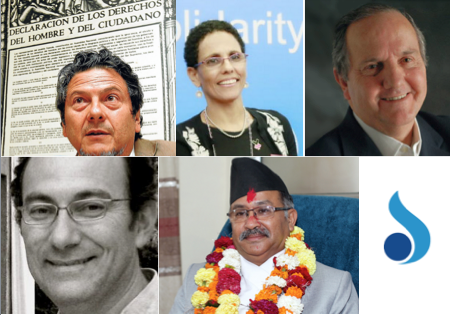
The following five new Commissioners have recently been elected: Mr Reed Brody (United States), Ms Roberta Clarke (Barbados/Canada), Professor Juan Mendez (Argentina), Mr Alejandro Salinas Rivera (Chile) and Justice Kalyan Shrestha (Nepal). It is an impressive list: Read the rest of this entry »

ISHR 2017 training course for human rights defenders now open for applications

November 12, 2016

 The International Service for Human Rights (ISHR) is calling for applications for its flagship Human Rights Defenders Advocacy Program in 2017 – the extensive training programme for human rights defenders. The training will take place in Geneva between 29 May and 9 June 2017 and provides defenders with opportunities to put their advocacy skills directly into action at the 35th session of the UN Human Rights Council.

ISHR’s Human Rights Defender Advocacy Programme (HRDAP) equips defenders with the knowledge and skills to make strategic use of the international human rights system. It also provides an opportunity for participants to directly engage in lobbying and advocacy activities at the UN level to effect change on the ground back home. As well as receiving training modules on all the UN human rights mechanisms from a range of experts, participants will also have the opportunity to build networks in Geneva and around the world, carry out lobbying of UN member States and UN staff, and learn from peers from a range of regions working on a range of human rights issues.

Participants will take part in:

  1. A short online learning component, prior to face-to-face training, to enable you to consolidate your existing knowledge and develop your advocacy objectives;
  2. Intensive training in Geneva during June, to coincide with the 35th session of the Human Rights Council. The training will focus on ways to effectively use international human rights mechanisms and to influence outcomes;
  3. Specific advocacy at Human Rights Council sessions and other relevant meetings, with regular feedback and peer education to learn from the experiences, including expert input from leading human rights advocates.

This programme is directed at experienced human rights defenders in non governmental organisations and national human rights institutions, with existing advocacy experience at the national level and some prior knowledge of the international human rights system. If you are interested in applying for ISHR’s training programme, please read the call for applications to check that you comply with the requirements. The link to the online application form can be found under point 5 of the call for applications.

The call for applicants can be found here. For more information, write to hrdap2017@ishr.ch.

Source: ISHR 2017 training for human rights defenders: now open for applicants! | ISHR

FORUM-ASIA 25th Anniversary Event in Geneva on 16 November 2016

November 7, 2016


flyer-web-geneva

The Asian Forum for Human Rights and Development (FORUM-ASIA), together with the Martin Ennals Award and the Right Livelihood Award, will host a panel discussion on the 25th Anniversary of its founding and 10th Anniversary of its presence in Geneva, entitled 50 Years of the International Bill of Human Rights and 10 Years of the UN Human Rights Council – What does this mean for Asia?’,  on 16 November 2016 at 18:30 at the Ivan Pictet Auditorium, Maison de la Paix, in Geneva, Switzerland.

The panelists are:

– Jose Ramos-Horta (Laureate, Nobel Peace Prize)

– Ruth Manorama (Laureate, Right Livelihood Award) [http://www.rightlivelihoodaward.org/laureates/ruth-manorama/]

– Adilur Rahman Khan (Finalist, Martin Ennals Award) [https://thoolen.wordpress.com/2014/10/29/bangladesh-human-rights-defender-adilur-accorded-more-awards/]

The panel discussion will be followed by a reception.

If you’re interested in attending, please register on l.forum-asia.org/GenevaRegistration

Source: FORUM-ASIA 25th Anniversary Event in Geneva, Switzerland (16 November 2016) « FORUM-ASIA

Sam Zarifi new SG of the International Commission of Jurists

November 4, 2016


Sam Zarifi has been appointed to serve as ICJ’s next Secretary General when the current Secretary-General retires next spring. Wilder Tayler will continue to work as SG until the end of March 2017 and Sam will begin in April 2017, although there will be some overlap to ensure a smooth transition in the Geneva based HQ.

Sam is a veteran of the human rights movement, with a most impressive array of experience and contacts, and has done phenomenal work as Director of the ICJ’s Asia and Pacific Regional Programme over the last four years. Prior to joining the ICJ Sam served as Amnesty International’s Director for Asia and the Pacific from 2008 to 2012. He was at Human Rights Watch from 2000, where he was Deputy Director of the Asia division. He was Senior Research Fellow at Erasmus University Rotterdam from 1997 to 2000, where he co-edited Liability of Multinational Corporations under International Law (Kluwer 2000) as well as several other publications on the subject. Sam was born and raised in Tehran, Iran and moved to the United States to complete his education. He received his Bachelor of Arts degree from Cornell University and his Juris Doctor from Cornell Law School in 1993. After practicing as a corporate litigator for several years, he obtained an LL.M in Public International Law from New York University School of Law in 1997.

Source: ICJ Newsletter – November 2016

Martin Ennals Award 2016: relive the ceremony in 13 minutes or in full

October 15, 2016

For those who missed the amazing Martin Ennals Award ceremony in Geneva on 11 October here is the 13-minute summary

For those who would like to relive the whole event please go to: new MEA_logo with text

http://www.ustream.tv/channel/ueCvkmTf59u

Summary and streaming are courtesy of THF