Posts Tagged ‘France’

Applications are now open for the 2025 French Government “Liberty, Equality, Fraternity” Human Rights Prize

September 2, 2025

Applications are now open for the 2025 French Government “Liberty, Equality, Fraternity” Human Rights Prize. More on this and similar prizes: see: https://www.trueheroesfilms.org/thedigest/awards/A652E9E2-1E82-4D59-AE11-74DF73E0DFED

This year’s theme is Exploitation and trafficking of children
Applications are open to individuals or non-governmental organisations involved in one or
more field projects based on a human rights approach and aimed at preventing and combating
child trafficking and exploitation. Preference will be given to applications that, in accordance with children’s rights, aim to:

  • provide comprehensive support for young people;
  • implement transformative and restorative actions;
  • ensure the active participation of the children themselves in the project.

    The projects submitted will focus on defending and protecting children against trafficking and
    exploitation through programmes such as:
  • raising awareness among the general public and the authorities;
  • identifying and referring victims;
  • receiving, supporting and rehabilitating child victims;
  • training for stakeholders (police, justice, medical and social services, education, etc.);
  • advocacy for the implementation of legal tools or the development of public policies to
    combat and prevent trafficking;
  • access to justice and reparations.

Award

  • The five prize winners will be invited to Paris for the official ceremony. They will receive a
    medal and share a total sum of 70.000 €, awarded by the CNCDH, to be used to implement
    their projects. They may introduce themselves as 2025 laureates of the Human Rights Prize
    of the French Republic.
  • Five runners-up will be awarded a “special mention” medal by the French ambassador in their
    country of origin. Runners-up will not receive any financial endowment.

The application must be written in French and include:

  • a) A letter of application presented and signed by the president or legal representative of the NGO concerned, or by the individual candidate;
  • b) The application form, which is attached to this call for applications and can be
  • downloaded from the CNCDH website: https://www.cncdh.fr/edition-2025-du-prix-desdroits-de-lhomme
  • c) A presentation of the NGO (statutes, operations, etc.), where appropriate.
  • d) The postal address and bank details (included IBAN and SWIFT Code) of the NGO or individual candidate.
  • Candidates must send their complete application by the deadline of 14 September 2025 to the Secretariat-General of the CNCDH:CNCDH – for the attention of Cécile RIOU-BATISTA, TSA 40 720 – 20 avenue de Ségur, 75 007 PARIS – France or by email to: prixdesdroitsdelhomme@cncdh.fr
  • Once the panel has announced the results, the 2025 Prize will be awarded in Paris by the Prime Minister, or another French minister, around 10 December 2025.

https://www.opportunitiesforafricans.com/french-government-2025-liberty-equality-fraternity-human-rights-prize/

The 2026 Marianne Initiative for Human Rights Defenders open for applications

June 26, 2025
marianne-initiative-2023
Opportunities For Africans

Applications are now open for the 2026 Marianne Initiative for Human Rights Defenders. The Marianne Initiative for Human Rights Defenders aims to better help Human Rights Defenders in their fight


As part of the organization of the 9th World Congress against the Death Penalty in Paris in the summer of 2026, particular attention will be paid to applications relating to this theme. However, the other areas of human rights covered by this call for applications remain fully eligible.

You are committed to the promotion and defence of human rights in your country:

  • You are a human rights defender in the sense recognised by the United Nations, adult and of non-French nationality, regardless of your placeof residence;
  • You can provide document(s)/evidence, produced by others (recommendations, press articles, etc.), attesting to your commitment/action in favour of human rights;
  • You can justify that participation in the Marianne Initiative’s French aid programme will strengthen your capacity for human rights action in your country and internationally, and that it will enable you to create or develop existing or planned links or projects with French organisations;
  • You possess a valid passport (with a validity of at least six months) or you are willing to follow the procedures to obtain one;
  • You are not subject to any legal ban on leaving your territory;
  • You are willing to travel to France from February to June 2026.

Benefits

  • The program in France provides individual accommodation near Paris, a monthly grant to meet daily needs, a training program, individualized support and networking with human rights players for a period of 4 months (from February to June 2026). The program does not provide support beyond the 4-month period.

Application Deadline:  6th July 2025. You can apply online to be part of the 2026 class of the Marianne initiative through the link below:

Application form – Marianne Initiative for Human Rights Defenders – Class of 2026 (February-June)

Applications do not need to be sent to the Embassy, but should be submitted directly using the procedure indicated above. However, if you have any questions, you may send an email to: amelle.abdallahi@diplomatie.gouv.fr.

see also: https://humanrightsdefenders.blog/2024/06/04/the-marianne-initiative-for-human-rights-defenders/

Your application will include the documents listed in the application form. It will be in either French or English.

Visit the Official Webpage of the Marianne Initiative for Human Rights Defenders

Anna Politkovskaya-Arman Soldin Prize for Courage in Journalism 2023 and 2024

November 12, 2024

Established jointly by the Ministry and Nobel Peace Prize laureate Dmitry Muratov in 2023 this prize honors the work of reporters and photojournalists who are continuing their vital mission of spreading free, reliable, quality information in crisis and conflict areas. Journalist Anna Politkovskaya was working in Russia for Novaya Gazeta, whose investigations into corruption, attacks on human rights and the war in Chechnya cost the lives of six of its reporters. Despite the threats she received, she never stopped working to inform the public. Despite the risk to his life, AFP reporter and photojournalist Arman Soldin helped inform the entire world about the reality of the Russian aggression in Ukraine through the photos he took on the front lines of the conflict, starting in February 2022.

PLEASE NOTE: the new award [https://www.trueheroesfilms.org/thedigest/awards/63b130ab-84e4-41c0-aa9c-3bed6254deb3 ] shares in part the name with the older: [https://www.trueheroesfilms.org/thedigest/awards/1599D542-7B24-47EF-8D55-CE248EE07356]

The second Anna Politkovskaya-Arman Soldin Prize in 2024 has been awarded to Israeli journalist Yuval Abraham and Palestinian journalist Basel Adra for their whole body of work on the Israeli occupation and settlement-building in the West Bank and in Palestinian territories.

Yuval Abraham and Basel Adra belong to an Israeli-Palestinian collective that made the documentary, No Other Land, which won an award at the 2024 Berlinale. In it, the Palestinian journalist Basel Adra filmed evictions of Palestinians in the West Bank over five years and meets the Israeli journalist Yuval Abraham. The film tells the story of their friendship that was built over the years of their collaboration.

The first 2023 Anna Politkovskaya-Arman Soldin Prize for Courage in Journalism, was awarded to the Mexican journalist Marcela Turati for her commitment to reporting on violence related to drug trafficking and the social consequences of the war waged against cartels, despite the risks that have often cost Mexican journalists their lives.

https://www.diplomatie.gouv.fr/en/french-foreign-policy/human-rights/freedom-of-expression/article/anna-politkovskaya-arman-soldin-prize-for-courage-in-journalism

The Marianne Initiative for human rights defenders

June 4, 2024

On 3 June, 2024 Ifeoma Chuks wrote about the Marianne Initiative 2025 for human rights defenders

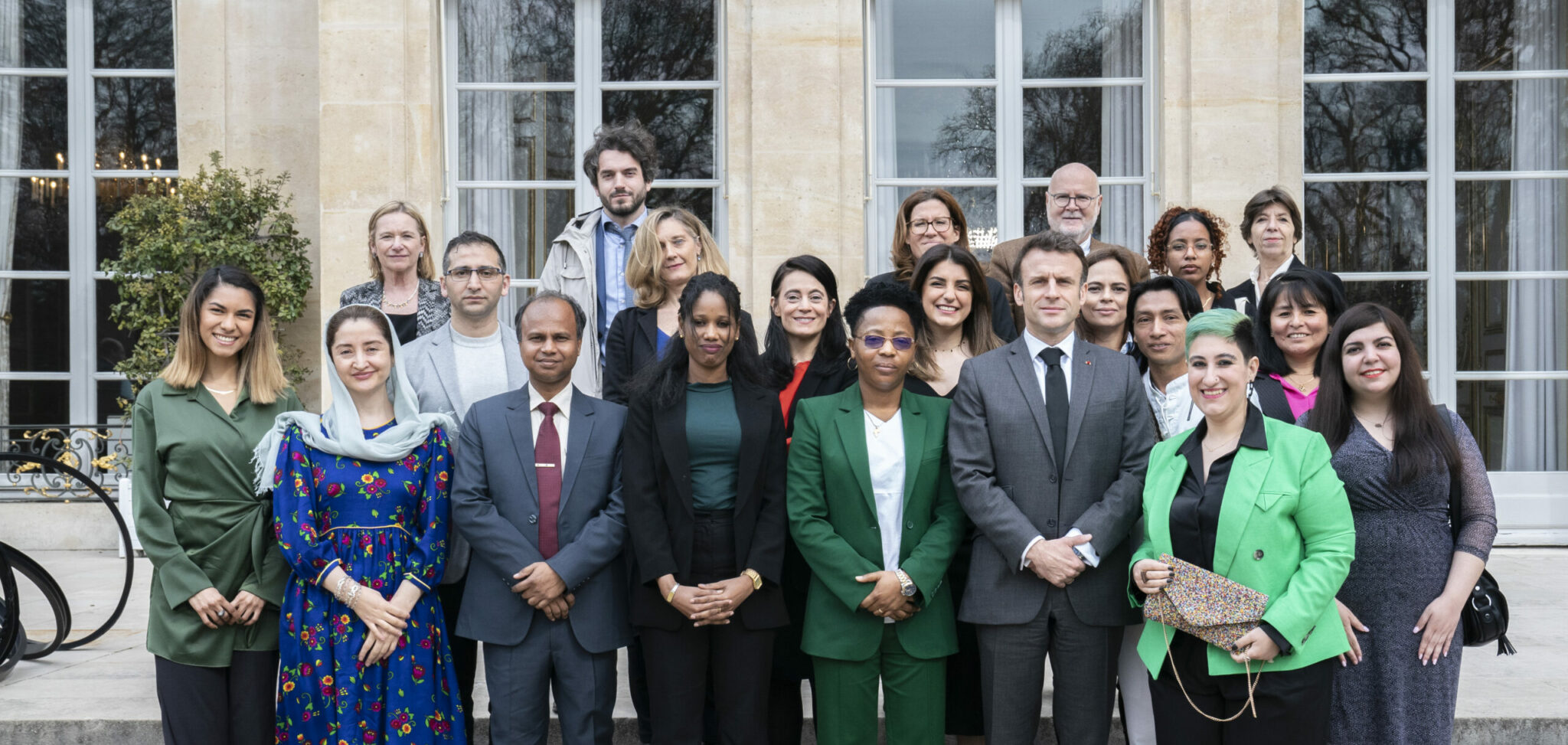
©Sarah Steck/ Présidence de la République

In 2021, French President Emmanuel Macron announced the launch of the Marianne Initiative for human rights defenders, aimed at better supporting them in their fight, both abroad and in France. The Marianne Association for Human Rights Defenders was created to federate the actors involved in our country (State, organisations and associations for the promotion of human rights and reception, local authorities, qualified personalities, etc.) and to carry the initiative’s support pillar in France, for the benefit of about fifteen laureates per year (reception, personalised support, networking, etc.).

After receiving the first all-female class in 2022 and a mixed class in 2023, the third class was officially launched now.

Some fifteen men and women from every continent have been welcomed to France for six months as part of the Initiative. The winners benefit from a training program designed to strengthen their skills and commitment in their home country or in France, whether in favour of civil and political rights, women’s rights, minority rights or environmental rights.

Recipients complete a comprehensive program consisting of:

  • Training in negotiation, leadership, advocacy, physical and digital security, project management, etc. ;
  • Courses from the School of International Affairs of Sciences Po Paris and French language;
  • Contact with French or international personalities involved in human rights and development issues;
  • Meetings with inspiring personalities and potential partner organizations (NGOs, foundations, institutions, etc.);
  • Conferences and cultural activities ;
  • Individual interviews to support the activist project;
  • Visits to international institutions and organizations;
  • Exchanges with members of the program’s alumni network.

The hosting programme in France provides for accommodation near Paris, the payment of a monthly grant to cover daily needs, a training programme, support, and networking with Human Rights Defenders for a period of 6 months. After the 6 months, participants no longer benefit from the grant, the accommodation and the support provided in the programme. Participation is individual and does not provide for the laureate to be accompanied by their family.

Class of 2025 runs from January-July 2025. The Application Deadline: 17th June 2024

Apply here

Visit Award Webpage for Details

https://www.afterschoolafrica.com/83981/marianne-initiative-2025-for-human-rights-defenders/

AFD: How to link human rights and development

July 13, 2022

The French Development Agency (AFD) organised an international conference to consider new ideas and approaches to linking human rights and development

Report by Marc Limon, Executive Director of the Universal Rights Group on July 8, 2022

Against a background of the retreat of human rights worldwide, growing doubts about the ability of the international community to achieve the Sustainable Development Goals (SDGs) by 2030, growing inequalities, and the ecological and climate crises, on Human Rights Day 2021 (10 December) the French Development Agency (AFD) organised an international conference on ‘Human Rights and Development.’ It brought together 500 actors from the development community, covering both the global North and South, and considered how development actors can play a key role in securing improvements in the enjoyment of human rights while at the same time recharging progress towards the achievement of the SDGs ‘leaving no one behind.’

Key conclusions

Warning of the risk of failure of the 2030 Agenda if development actors do not promote a development model based on human rights, participants unanimously recommended moving away from both a solely economic vision of development and a purely normative approach to human rights. In that regard, they called for more concerted action to enhance development actors’ contribution to the realisation of human rights on the ground, and to develop more robust indicators for measuring the impact of the human rights based approaches (HRBA).

Notwithstanding, several recalled the challenges involved in convincing partners of the value-added of integrating human rights with the development agenda, and recommended undertaking research actions to provide evidence.

Panellists further emphasised that human rights constitute a universal framework that goes beyond the North/South divide and is applicable to all. They noted a strong demand for improvements in the enjoyment of human rights in the global South as evidenced by growing social movements often led by young people. The universal nature of human rights makes it possible to fight against arbitrariness by guaranteeing a minimum essential base for everyone without discrimination. The international corpus of human rights contributes, in this sense, to reducing inequalities, so that everyone can lead a decent and dignified life. This must be reflected in the fiscal resource mobilisation policies of States, but also in their budgetary policies for social investment in health, education and social protection. States and development actors must also address the structural causes of inequality, which include discrimination based on gender, sexual orientation, economic status, and minority status, all of which are prohibited under international human rights law. For this reason, development actors are invited to contribute to the collection of reliable data on vulnerable population groups, in order to design projects with a non-discriminatory and inclusive approach.

Speakers also agreed on the need to support civil society and preserve its space. Its role in observing, documenting, and monitoring the implementation of States’ human rights obligations is essential. It is therefore crucial to establish a culture of dialogue between a State/government and civil society when elaborating public policies, and to strengthen the capacity of CSOs to participate effectively. ‘Power should be fluid, distributed throughout society, shared and exercised collectively,’ argued one speaker.

In terms of business and human rights, participants recalled companies’ duty of care to prevent and remedy human rights violations in the course of their activities. At the international level, this duty is based on a voluntary approach which, it was argued, showing signs of strain – few companies actually mobilise vigilance mechanisms in their value chains. Nevertheless, there is a progressive movement towards the adoption of national legislation in countries where multinational companies are headquartered to make it compulsory to draw up and implement vigilance plans that cover the impact of their activities, and those of the actors integrated into their supply or value chains, and covering both human rights and the environment. In this way, the objective is to spread human rights throughout the value chain, starting ‘from the top,’ and to contribute to guaranteeing the enjoyment of human rights of those affected by business activities. However, this raises the challenge of the cost and capacity to implement the principles of the duty of care by all actors in the value chain, in particular those in the Global South. Development actors have a role to play in supporting them. A need was also identified to strengthen the dialogue between legislators in the countries where companies are headquartered and those in which they operate in order to build coherent and complementary legislative frameworks.

Beyond companies’ duty of care, the private sector also plays a key role in contributing to development. Speakers called for multinational companies to be held accountable so that, in addition to respecting human rights, they contribute more directly to reducing inequalities and poverty.

Throughout the conference, the discussions have also highlighted the inseparable links between the realisation of human rights and the protection of the environment. These two goals are not mutually exclusive, as the rights of nature guarantee the enjoyment of human rights. It is thus crucial to promote an approach to development that is not based solely on human rights, but include the rights of all living things. This is especially important, it was noted, for young people and future generations.

In this context, the panellists made several recommendations, including the need to develop and disseminate knowledge about human mobility due to climate change. They recommended supporting climate change mitigation and adaptation projects, and called for investment in social protection and parametric insurance mechanisms to mitigate shocks from loss and damage that are already unavoidable. Development actors were also called upon to finance restoration and rehabilitation mechanisms to remedy non-economic damages such as the loss of cultural heritage or biodiversity.

Finally, participants unanimously agreed that indigenous peoples are key actors in sustainable development. They represent 5% of the world’s population but are the custodians of 80% of the world’s biodiversity. They play a vital role on all continents – in the Amazon alone, they directly influence 48% of the land surface. The protection of the environment cannot and must not be done without them. They should be treated as true co-decision-makers in the management of these spaces and resources, in order to fully respect their free, prior and informed consent, as required under international law. Development actors should therefore seek to empower indigenous peoples by supporting the full enjoyment of their rights.


Synthesis: Conference: “Human Rights and Development” | AFD – Agence Française de Développement

The conference proceedings from the meeting were recently released in both French and English

No end to NSO’s Pegasus trouble

April 5, 2022

TechCrunch of 5 April 2022 reports that Investigators say they have found evidence that a Jordanian journalist and human rights defender’s iPhone was hacked with the Pegasus spyware just weeks after Apple sued the spyware’s maker NSO Group to stop it from targeting Apple’s customers.

Award-winning journalist Suhair Jaradat’s phone was hacked with the notorious spyware as recently as December 5, 2021, according to an analysis of her phone by Front Line Defenders and Citizen Lab that was shared with TechCrunch ahead of its publication. Jaradat was sent a WhatsApp message from someone impersonating a popular anti-government critic with links to the Pegasus spyware, compromising her phone. According to the forensic analysis, Jaradat’s iPhone was hacked several times in the preceding months and as far back as February 2021.

Apple had filed a lawsuit against Israeli spyware maker NSO Group in November 2021, seeking a court-issued injunction aimed at banning NSO from using Apple’s products and services to develop and deploy hacks against its customers. See also: https://humanrightsdefenders.blog/2021/07/21/nsos-pegasus-spyware-now-really-in-the-firing-line/…But so far the case has gotten off to a slow start after the first judge assigned to the case recused herself, with no decision on the case likely to be made any time before June.

Jaradat is one of several Jordanians, including human rights defenders, lawyers and fellow journalists whose phones were compromised likely by agencies of the Jordanian government, according to Front Line Defenders and Citizen Lab’s findings out Tuesday.

Among the others targeted include Malik Abu Orabi, a human rights lawyer whose work has included defending the teachers’ union, which in 2019 led the longest public sector strike in the country’s history. Abu Orabi’s phone was targeted as early as August 2019 until June 2021. Also, the phone of Ahmed Al-Neimat, a human rights defender and anti-corruption activist, was targeted by the ForcedEntry exploit in February 2021. The researchers said the hacking of Al-Neimat’s phone is believed to be the earliest suspected use of ForcedEntry.

Another Jordanian journalist and human rights defender’s phone was targeted, according to the researchers, but who asked for her identity not to be disclosed.

Meanwhile, on 5 April 2022, AFP reported that Palestinian lawyer Salah Hamouri, who is in Israeli detention, filed a complaint in France Tuesday against surveillance firm NSO Group for having “illegally infiltrated” his mobile phone with the spyware Pegasus.

Hamouri, who also holds French citizenship, is serving a four-month term of administrative detention ordered by an Israeli military court in March on the claim he is a “threat to security”.

He is one of several Palestinian activists whose phones were hacked using the Pegasus malware made by the Israeli company NSO, according to a report in November by human rights groups. See: https://humanrightsdefenders.blog/2021/11/10/palestinian-ngos-dubbed-terrorist-were-hacked-with-pegasus-spyware/

On Tuesday, the International Federation for Human Rights (FIDH), the Human Rights League (LDH) and Hamouri filed a complaint with the Paris prosecutor.  It accused NSO of “having illegally infiltrated the telephone of rights defender Salah Hamouri,” they said in a statement sent to the AFP bureau in Jerusalem. 

Obviously, this is an operation that is part of a largely political framework given the harassment Hamouri has been subjected to for years and the attacks on human rights defenders in Israel,” attorney Patrick Baudouin, honorary president of the FIDH, told AFP.

https://www.securityweek.com/palestinian-lawyer-sues-pegasus-spyware-maker-france

https://citizenlab.ca/2022/04/peace-through-pegasus-jordanian-human-rights-defenders-and-journalists-hacked-with-pegasus-spyware/

then

https://cybersecuritynews.com/whatsapp-wins-nso-pegasus-spyware-hacking-case/

Guide to 49th session of Human Rights Council – with human rights defenders focus

February 21, 2022

The 49th session of the UN Human Rights Council, from 28 February – 1 April 2022, will consider issues including the protection of human rights defenders, freedom of religion or belief, protection and promotion of human rights while countering terrorism, the right to food and adequate housing, among others. It will also present an opportunity to address grave human rights situations in States including Nicaragua, Venezuela, China, Syria, South Sudan, Sri Lanka, Iran, the Democratic People’s Republic of Korea, Myanmar, Eritrea, among many others. Here’s an overview of some of the key issues on the agenda. The ISHR has issued again its excellent Guide to the upcoming session and I have extracted from it the issues most directly related to human rights defenders:

Protection of human rights defenders

On 11 March 2022, the UN Special Rapporteur will present her report on the work of human rights defenders to address corruption. At the 49th session of the HRC, Norway will present a thematic resolution on human rights defenders in conflict and post-conflict situations. A group of NGOs have produced a list of 25 recommendations related to key concerns that should be addressed in the resolution. These include recommendations related to the removal of legislation that impinges upon the ability of defenders to do their work, including counter-terrorism legislation; the development of protection measures that take into account the specific needs of particular groups of defenders and the precarious nature of their situation in conflict and post-conflict contexts, and specific measures to support human rights defenders in such contexts, including in regard to the provision of cloud-based solutions for storage of documentation, flexible and reliable funding and swift responses in the case of the need for relocation of human rights defenders and their families. ISHR joins these calls and to impress upon the Council the need for a strong commitment to acknowledging and taking action to protect human rights defenders working in such contexts.  In addition, we call on all UN members to monitor and report on their implementation of the resolution in a comprehensive way, sharing updates on challenges faced and progress made during relevant UN dialogues and debates.   

Reprisals

Reports of cases of intimidation and reprisal against those cooperating or seeking to cooperate with the UN not only continue, but grow. Intimidation and reprisals violate the rights of the individuals concerned, they constitute violations of international human rights law and undermine the UN human rights system.

The UN has taken some action towards addressing this critical issue including:

  • an annual report by the Secretary General;
  • a dedicated dialogue under item 5 to take place every September;
  • The appointment of the UN Assistant Secretary General on Human Rights as the Senior Official on addressing reprisals.

Despite this, ISHR remains deeply concerned about reprisals against civil society actors who try to engage with UN mechanisms, and consistent in its calls for all States and the Council to do more to address the situation. See also: https://humanrightsdefenders.blog/tag/reprisals/

During the 48th session, the Council adopted a resolution on reprisals. The text was adopted by consensus for the first time since 2009 and invites the UN Secretary General to submit his annual report on reprisals and intimidation to the UN General Assembly. Once again the resolution listed key trends including that acts of intimidation and reprisals can signal patterns, increasing self-censorship, and the use of national security arguments and counter-terrorism strategies by States as justification for blocking access to the UN. The resolution also acknowledged the specific risks to individuals in vulnerable situations or belonging to marginalised groups, and called on the UN to implement gender-responsive policies to end reprisals. The Council called on States to combat impunity by conducting prompt, impartial and independent investigations and ensuring accountability for all acts of intimidation or reprisal, both online and offline, by condemning all such acts publicly, providing access to effective remedies for victims, and preventing any recurrence.

Item 5 of the Human Rights Council’s agenda provides a key opportunity for States to raise concerns about specific cases of reprisals, and for governments involved in existing cases to provide an update to the Council on any investigation or action taken toward accountability to be carried out. The President should also update the Council on actions taken by the President and Bureau to follow up on cases and promote accountability under this item.

Other thematic debates

At this 49th session, the Council will discuss a range of topics in depth through dedicated debates with mandate holders. The debates with mandate holders include: 

  • The Special Rapporteur in the field of cultural rights 
  • The Special Rapporteur on freedom of religion or belief
  • The Special Rapporteur on torture
  • The Special Rapporteur on the right to privacy

In addition, the Council will hold dedicated debates on the rights of specific groups including the Special Rapporteur on minority issues

In addition, the Council will hold dedicated debates on interrelation of human rights and human rights thematic issues including:

  • The Special Rapporteur on the promotion and protection of human rights while countering terrorism
  • The Special Rapporteur on human rights and the environment

Country-specific developments

China: High Commissioner Bachelet has still not released her Office’s report on grave human rights violations in the Uyghur region, six months after announcing its upcoming publication, and three months since her spokesperson indicated it would only be a matter of ‘weeks’. Further delays risk entrenching the Chinese government’s sense of impunity, and will harm the credibility of, and confidence in her Office’s capacity to address grave violations, some of which could amount to atrocity crimes. States should urge the High Commissioner to promptly publish her report, and present it to the Human Rights Council as a matter of utmost priority.  This includes ensuring sustained pressure around China’s abuse of national security in discourse and law, and on the widespread and systematic use of enforced disappearance under ‘Residential Surveillance at a Designated Location’ (RSDL). See also: https://humanrightsdefenders.blog/2022/02/05/chinas-residential-surveillance-at-a-designated-location-needs-to-disappear/

Burundi: The Commission of Inquiry on Burundi (CoI) concluded its work at the 48th HRC session in October 2021 while a new resolution establishing a mandate of UN Special Rapporteur on Burundi was adopted, resolution 48/16. The resolution tasks the mandate with monitoring the human rights situation in the country, making recommendations for its imp­ro­ve­ment, and re­por­ting to the Human Rights Council. While the Spe­cial Rapporteur will be unable to continue the entirety of the investigative work carried out by the CoI, they will “collect, examine and assess” information on human rights deve­lop­ments. Ahead of HRC48 more than 40 organisations, including ISHR, urged the Council to continue its scrutiny and further work towards justice and accountability in Burundi. See also: https://humanrightsdefenders.blog/2021/07/03/germain-rukuki-burundi-human-rights-defender-out-of-jail/

The UN Human Rights Office (OHCHR) will ensure that evidence col­lec­ted by the CoI is “consolidated, preserved, accessible and usable in support of ongoing and future accountability efforts” including efforts to hold Bu­rundian officials responsible for atrocities in front of the International Criminal Court (ICC). The Burundian government should resume its engagement with the Council and grant the Special Rap­porteur, who will be appointed in March 2022, access to the country for an official visit.

France: Following an urgent call by ISHR and the Comité Adama, UN experts sent two communications to the French government on 15 and 26 November 2021 asking for measures to ensure that human rights defenders, including people of African descent, enjoy a safe environment in which to carry out their legitimate work for human rights and justice. The lack of investigation in the case of Adama Traoré’s death and the judicial harassment against his sister Assa Traoré for her activism is a sign of broader systemic racism against Black people in policing and criminal justice in France. 

ISHR urges the HRC to continue its scrutiny and calls on France to ensure a prompt, transparent, and impartial investigation into the case of Adama Traoré; end the judicial harassment of Assa Traoré for her activism; accept the requests of the UN Special Rapporteur on Racism and the Working Group on People of African Descent to visit the country; end impunity for police violence; and ensure truly free and impartial investigations into the death or injury of anyone at the hands of the police, especially people of African descent.

Egypt: The joint statement delivered by States in March 2021 at the 46th session of the HRC played a critical role in securing the conditional release of several human rights defenders and journalists arbitrarily detained throughout 2021 and 2022. Regrettably, these releases do not reflect any significant change in Egypt’s systematic attacks on civic space and human rights defenders, including arbitrary detention, torture, ill-treatment, enforced disappearances and criminalisation of the exercise of the rights to freedom of expression, association, assembly or public participation. On 3 February 2022, 175 parliamentarians from across Europe urged the HRC to establish a “long overdue monitoring and reporting mechanism on Egypt”. ISHR joined more than 100 NGOs from around the world in urging the HRC to create a monitoring and reporting mechanism on the ever-deteriorating human rights situation in Egypt. Continued, sustained and coordinated action on Egypt at the HRC is more necessary than ever. The HRC should follow up on the 2021 State joint statement and heed the calls of civil society and parliamentarians. See also: https://humanrightsdefenders.blog/2022/01/11/the-arabic-network-for-human-rights-information-has-shut-down/

Nicaragua: A year after Council resolution 46/2, civil society reporting indicates no meaningful action has been taken by Nicaragua to implement any of the Council’s recommendations to the government. Instead, it has deepened its crackdown on human rights defenders and any form of dissent, and further closed civil society space ahead of the November 2021 electoral process. The government’s absolute disregard for cooperation with international and regional mechanisms, including the treaty bodies, is an additional sign that the government does not intend to revert course on the country’s human rights crisis. ISHR, jointly with the Colectivo 18/2, urges the Human Rights Council to establish an independent mechanism to investigate grave human rights violations since April 2018 in Nicaragua, as well as their root causes. The mechanism should verify alleged grave violations, identify perpetrators, and preserve evidence, with a view to long-term accountability processesSee also my post of today: https://humanrightsdefenders.blog/2022/02/21/nicaragua-death-in-detention-and-sham-trial/

Saudi Arabia: According to ALQST’s 2021 annual report, for a short time in early 2021, intense global pressure on Saudi Arabia’s leaders to improve their dismal human rights record resulted in some minor reforms and concessions, yet, when the pressure eased, the Saudi authorities resumed their habitual pattern of abuses with renewed intensity. A number of high-profile women human rights defenders and prisoners of conscience were conditionally released, but they remain under severe restrictions which means that while they are released, they are not yet free. Saudi authorities continue to crackdown on freedom of expression and hand down lengthy prison sentences to human rights defenders. Saudi Arabia is sensitive regarding its reputation and susceptible to international pressure.

Sudan: On 5 November 2021, the Human Rights Council held a special session to address the ongoing situation in the Republic of Sudan and mandated an Expert on human rights in Sudan to monitor and report on the situation until the restoration of its civilian-led Government. The HRC must extend the reporting mandate of the Expert as the human rights situation is deteriorating. The military is closing the civic space for women’s rights groups and women human rights defenders, including by stigmatising women’s rights groups as terrorists or drug abusers. The recent arrests of women human rights defenders are part of a systemic attack against WHRDs in Sudan. The military and security forces are using social media and traditional media to defame women protesters. Women’s rights groups and WHRDs are facing a new wave of attacks that include framing charges to prolong the detention of WHRDs and defame the women’s rights movement. The military reinstated the authorities of the former regime’s security forces in December 2021 in the emergency order number 3. The new emergency order gave Sudanese security complete impunity and protection from accountability for any form of violations on duty.  Sudanese security forces have a well-documented history of sexual abuse and torture of women detainees. WHRDs in detention are at risk of maltreatment, torture, and sexual violence. 

Venezuela is back under the microscope with updates from the Office of the High Commissioner and from the Council’s fact-finding mission on the country both scheduled for 17th March. Attention on the human rights situation in the country follows hot on the heels of the Universal Periodic Review of Venezuela that took place at the end of January.  The Council session is taking place at a time that Venezuelan civil society continues facing restrictions and attacks on their work. The head of human rights organisation, Fundaredes, has now been arbitrarily detained for 224 days. The Council session is an opportunity for States to express concern about the restrictions on civil society, and to enquire about the implementation of prior recommendations made to Venezuela by both OHCHR and the Mission. Despite being a Council member, Venezuela has yet to allow the Council’s own fact-finding mission access to the country, something the Council as a whole should denounce. 

The High Commissioner will provide an oral update to the Council on 7 March. The Council will consider updates, reports on and is expected to consider resolutions addressing a range of country situations, in some instances involving the renewal of the relevant expert mandates. These include:

  • Oral update and interactive dialogue with the Special Rapporteur on Eritrea
  • Oral update and interactive dialogue with the High Commissioner on the Tigray region of Ethiopia 
  • Interactive Dialogue on the High Commissioner’s written update on Sri Lanka
  • Interactive dialogue on the High Commissioner’s report on  Nicaragua
  • Interactive dialogue on the High Commissioner’s report on Afghanistan
  • Interactive Dialogue on the High Commissioner’s report on ensuring accountability and justice in the Occupied Palestinian Territory, including East Jerusalem
  • Oral updates and interactive dialogues with the High Commissioner and fact-finding mission on Venezuela 
  • Oral update bv the High Commissioner and interactive Dialogue with the Special Rapporteur on the Democratic People’s Republic of Korea
  • Enhanced Interactive Dialogue on the OHCHR’s report on Belarus
  • Interactive Dialogue on the High Commissioner’s report, enhanced interactive dialogue on the Secretary-General’s report, and interactive dialogue on the Special Rapporteur’s report on Myanmar
  • Interactive Dialogue on the Special Rapporteur’s report on Iran
  • Interactive Dialogue on the Commission of Inquiry’s report on Syria 
  • Interactive Dialogue on the Special Rapporteur’s report on the Palestinian territories occupied since 1967
  • Interactive Dialogues on the High Commissioner’s report and Commission on Human Rights’ report on South Sudan
  • Interactive Dialogue with the High Commissioner on Ukraine
  • High-level Interactive Dialogue with the Independent Expert on Central African Republic
  • Oral updates and enhanced interactive dialogue with the High Commissioner and the team of international experts on the Democratic Republic of the Congo
  • Oral update by the Special Rapporteur on Cambodia 
  • Interactive Dialogue on the Independent Expert’s report on Mali 
  • Interactive Dialogue on the fact-finding mission’s report on Libya

Appointment of mandate holders

The President of the Human Rights Council will propose candidates for the following mandates: 

  1. Three members of the Expert Mechanism on the Rights of Indigenous Peoples (one from the Pacific, one from Central and South America and the Caribbean, and one from Central and Eastern Europe, the Russian Federation, Central Asia and Transcaucasia); 
  2. The Special Rapporteur on the promotion and protection of human rights in the context of climate change; 
  3. The Special Rapporteur on the situation of human rights in Afghanistan; 
  4. The Special Rapporteur on the situation of human rights in Burundi; 
  5. The Special Rapporteur on the situation of human rights in the Palestinian territories occupied since 1967; 
  6. A member of the Working Group on Arbitrary Detention, from Western European and other States; 
  7. A member of the Working Group on Enforced or Involuntary Disappearances, from Asia-Pacific States; 
  8. A member of the Working Group on the issue of human rights and transnational corporations and other business enterprises, from Asia-Pacific States;
  9. A member of the Working Group on the use of mercenaries as a means of violating human rights and impeding the exercise of the right of peoples to self-determination, from Latin American and Caribbean States (an unforeseen vacancy that has arisen due to a resignation).

Resolutions to be presented to the Council’s 49th session

At the organisational meeting on 14 February the following resolutions were announced (States leading the resolution in brackets):

  1. Human rights of persons belonging to minorities (Austria, Mexico, Slovenia)
  2. Combating intolerance, negative stereotyping and stigmatization of, and discrimination, incitement to violence and violence against, persons based on religion or belief (Pakistan on behalf of the OIC) 
  3. Human rights situation in the Occupied Palestinian Territory, including East Jerusalem, and the obligation to ensure accountability and justice (Pakistan on behalf of the OIC) 
  4. Cultural rights (Cuba)
  5. The negative impact of unilateral coercive measures on the enjoyment of human rights (Azerbaijan on behalf of NAM)
  6. Right to work (Egypt, Greece, Indonesia, Mexico, Romania)
  7.  Situation of human rights in the Islamic Republic of Iran – mandate renewal (Iceland, Moldova, North Macedonia, UK) 
  8. Rights of the child (GRULAC and EU)
  9. Human rights defenders (Norway)
  10. Adequate housing as a component of the right to an adequate standard of living, and the right to non-discrimination in this context (Germany, Brazil, Finland, Namibia)
  11. Situation of human rights in the Syrian Arab Republic – mandate renewal (France, Germany, Italy, Jordan, Kuwait, Netherlands, Qatar, Turkey, UK, USA)
  12. Situation of human rights in South Sudan – mandate renewal (Albania, Norway, USA, UK)
  13. Mandate of the Special Rapporteur on the promotion and protection of human rights and fundamental freedoms while countering terrorism – mandate renewal (Mexico)
  14. Prevention of genocide (Armenia)
  15. Situation of human rights in Belarus – mandate renewal (EU)
  16. Situation of human rights in the Democratic People’s Republic of Korea (DPRK)- mandate renewal (EU) 
  17. Situation of human rights in Myanmar – mandate renewal (EU)
  18. Freedom of religion or belief (EU)
  19. Technical assistance and capacity-building for Mali in the field of human rights (Africa Group)
  20. Technical assistance and capacity-building for South Sudan (Africa Group) 
  21. Role of states in countering the negative impact of disinformation on human rights (Ukraine)

During this session, the Council will adopt the UPR working group reports on Myanmar, Greece, Suriname, Samoa, Hungary, Saint Vincent and the Grenadines, Papua New Guinea, Tajikistan, United Republic of Tanzania, Eswatini, Antigua and Barbuda, Trinidad and Tobago, Thailand and Ireland.

During each Council session, panel discussions are held to provide member States and NGOs with opportunities to hear from subject-matter experts and raise questions. 7 panel discussions and 1 thematic meeting are scheduled for this upcoming session:

To stay up-to-date: Follow @ISHRglobal and #HRC49 on Twitter, and look out for our Human Rights Council Monitor.

See also: https://humanrightsdefenders.blog/2021/10/19/48th-session-of-the-human-rights-council-outcomes/

https://ishr.ch/latest-updates/hrc49-key-issues-on-agenda-of-march-2022-session/

New SG for Amnesty International: Agnès Callamard

March 30, 2021

On 29 March 2021 Amnesty International announced the appointment of Dr. Agnès Callamard, a leading international human rights expert, as its new Secretary General, effective immediately. 

Dr. Callamard has recently been the United Nations Special Rapporteur on extrajudicial, summary or arbitrary executions. In that role, she led ground-breaking investigations including into the murder of Saudi journalist Jamal Khashoggi. [see: https://humanrightsdefenders.blog/2020/09/09/agnes-callamard-calls-overturned-verdict-in-khashoggi-case-parody-of-justice/]

As Secretary General, Dr. Callamard will be the Chief Executive of Amnesty’s International Secretariat and the principal spokesperson of the global Amnesty movement, which has some 10 million supporters, and offices in more than 70 countries.

At a time when human rights are under unprecedented threat around the world, Dr. Callamard will lead, excite and rally the entire Amnesty movement to meet these challenges head-on,” said Sarah Beamish, Chair of the International Board, in announcing the appointment.  “The combination of her intellectual acuity, her deep global human rights experience, and her courageous voice makes her highly qualified to front our movement. We are delighted she has accepted this challenge to take us boldly into our next phase.

Where governments and corporations seek to silence those who speak out against their abuses, to obfuscate the truth, and to undermine or reject human rights norms, the rigorous investigations and uncompromising campaigns of Amnesty International are more vital than ever.” Agnès Callamard

  “I am honoured to take up the post of Secretary General and work alongside Amnesty’s supporters around the world so that together we defend and demand respect for all human rights for all,” Dr Callamard said. 

Dr. Callamard, a French national, has built a highly distinguished career in the international human rights and humanitarian sectors, working across NGOs, academia, and the United Nations. Alongside her role as a United Nations independent human rights expert, she held the role of Director of the Global Freedom of Expression Project at Columbia University. Previously, she has been the Executive Director of the Freedom of Expression organization ARTICLE 19 and was the founder and Executive Director of HAP International (the Humanitarian Accountability Partnership).

Dr. Callamard worked with Amnesty International from 1995-2001, including as Chef de Cabinet for then-Secretary General Pierre Sané.  She has led human rights investigations in more than 30 countries and published extensively on human rights, women’s rights, freedom of expression, refugee movements, and the methodology of human rights investigations.

See also 7 April interview: https://www.aljazeera.com/news/2021/4/7/leaders-of-the-world-have-failed-us-qa-with-agnes-callamard

https://www.amnesty.org/en/latest/news/2021/03/dr-agnes-callamard-appointed-as-secretary-general-of-amnesty-international/

Two Italians don’t want a French Legion d’Honneur if el-Sissi has one

December 15, 2020

PAOLO SANTALUCIA and NICOLE WINFIELD – based on an Associated Press item of 14 December 2020 – report that two prominent Italians announced they were returning their Legion of Honor awards to France to protest that Egyptian President Abdel-Fattah el-Sissi was given the prize despite his government’s human rights abuses.

Corrado Augias, a long-time journalist for La Repubblica daily and one-time European Parliamentarian for Italy’s center-left, returned his prize to the French Embassy on Monday. Giovanna Melandri, a former Italian culture minister and the president of Rome’s Maxxi contemporary art museum, announced she would follow suit.

Both cited Egypt’s role in the 2016 kidnapping, torture and killing of an Italian doctoral research student in Cairo, as well as the regime’s other human rights violations.

French President Emmanuel Macron last week awarded the Egyptian President the highest French honor during a closed-door ceremony Sept. 7 that only became public after the Egyptian presidency published photos of it.

Also last week, Rome prosecutors formally placed four high-ranking members of Egypt’s security forces under investigation over the death of Giulio Regeni, whose 2016 killing strained relations between Rome and Cairo and galvanized Italy’s human rights community. [see also: https://humanrightsdefenders.blog/2016/04/25/monday-25-april-what-will-happen-in-egypt/]

Speaking outside the French Embassy, Augias said he returned his 2007 prize out of “a sense of indignation,” given that the award was bestowed on el-Sissi at the same time that Rome prosecutors were detailing the torture that Regeni suffered to a parliamentary committee. “The two things together were too strong,” he told reporters. “I couldn’t refrain from reacting.

Melandri said in a Facebook post Monday that she too would return the honor she received in 2003, saying it was sad but necessary to make clear that “honor” should mean something.

I hope that this gesture can help open a frank and friendly confrontation in our two countries on which values ​​should be that we want to defend, strengthen and continue to ‘honor’ in a democratic Europe and a globalized world,” she wrote.

El-Sissi’s state visit had sparked protests by human rights activists incensed that France was welcoming el-Sissi despite the heaviest crackdown on dissent in Egypt’s modern history. At the time, it wasn’t known that Macron had awarded el-Sissi the highest distinction of the Legion of Honor order of merit, the Grand-Croix, or Grand-Cross. The award ceremony was held without the press before dinner at the Elysee presidential palace in Paris. The event was not listed on Macron’s official agenda. The French presidency said such a ceremony is usually part of the protocol during state visits.

The French ambassador to Italy, Christian Masset, said he respected Augias and defended the government’s human rights record.

France is on the front lines for human rights and makes no compromises,” he tweeted after Augias returned his prize. “Many cases were discussed during President el-Sissi’s visit to Paris, in the most appropriate and efficient way.

The Legion of Honor has been given to French war heroes, writers, artists and businessmen. But it has also been given to leaders with questionable human rights records, including Syrian President Bashar Assad (though he returned it in 2018) and Russian President Vladimir Putin.

France has on occasion also stripped people of the honor, including Harvey Weinstein in 2017, in the wake of the #MeToo sexual misconduct accusations against him.

https://www.startribune.com/italians-return-french-legion-awards-after-el-sissi-gets-one/600001488/

European Court of Human Rights finds France violated freedom of expression of Boycott, Divestment and Sanctions (BDS) activists

June 13, 2020

The European Court of Human Rights (ECHR) ruled that France violated the freedom of expression of pro-Palestinian activists who were convicted of campaigning for a boycott of Israeli products and pressuring that country to end the occupation of Palestine.

The ruling refers to a 2009 French justice conviction against 11 activists from the BDS (Boycott, Divestment and Sanctions) movement for “economic discrimination” for protesting and distributing leaflets against Israeli products in a supermarket in eastern France.

BDS has called for boycotts against Israeli companies, universities and cultural institutions in what it says is a non-violent campaign against Israeli abuses in Palestine, while Israel claims that the movement masks attempts to delegitimize or destroy the Jewish state.

This important court ruling is a decisive victory for freedom of expression, for human rights defenders and for the BDS movement for Palestinian freedom, justice and equality,” said Rita Ahmad of the Palestinian-led movement. Most of the international community considers Israeli settlement in the West Bank illegal.

The ECHR ruling orders the French government to pay € 101,000 in general damages to the activists, as the criminal conviction “had no relevant and sufficient basis” and violated the freedom of expression of the protesters. The French government has three months to appeal the decision

Israel promotes a number of legislative initiatives against BDS abroad, particularly in the United States and Europe. The United States House of Representatives passed a bipartisan resolution last year condemning the boycott of Israel as detrimental to peace efforts. The German Parliament passed a resolution last year describing the movement’s methods as “anti-Semitic” and reminiscent of Nazi-era calls to boycott Jews. BDS activists deny the charges of anti-Semitism and say discrimination laws have been used to unfairly attack them. See also: https://humanrightsdefenders.blog/2019/09/25/revoking-of-kamila-shamsies-dortmund-book-award-is-fiercely-contested/

Amnesty International expressed hope that the ruling “will send a clear message to all European states that they must stop the prosecution of peaceful activists.

https://www.explica.co/europes-top-human-rights-court-supports-boycott-movement-against-israel/

https://www.israelhayom.com/2020/06/12/european-court-rules-against-france-in-israel-boycott-activist-case/