Posts Tagged ‘Education’

The North-South Centre celebrates young people’s contributions to Human Rights

December 17, 2024
The North-South Centre celebrates young people's contributions to Human Rights

On Human Rights Day 2024, in the year of its 35th anniversary, the North-South Centre celebrated the invaluable contributions of young people to the promotion and protection of Human Rights. Over the years, youth have played important roles as experts, multipliers, representatives, and active participants in our initiatives.

Young people are essential stakeholders in any meaningful effort to protect and strengthen Human Rights. The new Human Rights Education for Youth (HEY) programme is a reflection of that approach. It seeks to contribute to an increased youth capacity to engage in Human Rights protection through further awareness about European and International standards, and how they can be used by young people to protect themselves and their communities. 

HEY joins a series of initiatives by the North South Centre where young people lead the way in championing Human Rights. These include the Rule of Law Youth Network, and the many activities in the field of Global Education and Youth Cooperation, such as the Youth Summer Universities that have engaged thousands of young people from all over the world. The youth focus was also present at the 2024 North-South intercultural conference, which resulted in the Kotor Declaration, with recommendations on youth initiatives to combat racist and xenophobic acts through computer systems.

https://www.coe.int/en/web/north-south-centre/-/the-north-south-centre-celebrates-young-people-s-contributions-to-human-rights

ISHR’s training for human rights defenders 2025:

November 27, 2024

Are you a human rights defender keen to use the UN to push for change at home? If so, apply for the 2025 edition of ISHR’s flagship training, the Human Rights Defender Advocacy Programme (HRDAP)!

After a successful edition in 2024, [https://humanrightsdefenders.blog/2023/11/07/human-rights-defender-advocacy-programme-2024-applications-now-open/] ISHR launches the call for applications for the 2025 Human Rights Defender Advocacy Programme (HRDAP25), which will take place both remotely and in Geneva! Below are some important dates to consider before applying:

  • Mandatory distance learning course: 14 April – 8 June 2025 (part time)
  • In-person course in Geneva: 10- 20 June 2025 (full time) 
  • Deadline to apply: 10 January 2025, midnight CET (Geneva Time)
  • Programme description with all the information can be downloaded here.
  • Application form can be found here. 

Learn more about why you should apply for HRDAP by watching this video!

What is the Human Rights Defender Advocacy Programme 2025 (HRDAP25)?

The course equips human rights defenders with the knowledge and skills to integrate the UN human rights system into their existing work at the national level in a strategic manner and provides an opportunity for participants to prepare for and engage in advocacy activities at the UN with the aim to effect change back home.  

Online course topics – ISHR

Defenders will complete a 10-week hybrid learning programme, online and offline, which will include: 

  • Accessing the HRDAP Platform, where they can complete e-learning courses on each key UN human rights mechanism and on advocacy strategies, and access interactive learning materials and case studies on the ISHR Academy 
  • Taking part in live Q&A sessions with human rights experts 
  • Receiving a continuous personalised advocacy support and coaching in order to develop concrete advocacy objectives to make strategic use of the international human rights system taking into account the local context
  • Building networks around the world, and learning from peers from a range of regions working on a range of human rights issues 
  • Applying their knowledge to case-studies scenarios and enhancing their advocacy toolbox according to their specific needs (elevator pitch, SMART recommendations…)
  • Receiving support and advocacy accompaniment to conduct activities during the 59th and 60th Human Rights Council sessions and other relevant opportunities. 

Participants will have the unique opportunity to apply their knowledge and skills while being in Geneva as well as to meet and share with their peers and experts (UN staff, diplomats, supporting NGOs…). The blended format of the course allows defenders to continue their vital work on the ground, while diving into the inner workings of each key UN human rights mechanism and gaining first-hand experience from advocates and UN staff on how civil society can strategically engage in the international human rights space.  The methodology we use is interactive and learner-centred and encourage participation of everyone.

By participating in HRDAP, defenders:

  1. Gain knowledge and tools, which they can use to ensure their voice is central in international human rights decision-making 
  2. Explore and compare the benefits of engagement with the Human Rights Council, the Special Procedures, the OHCHR, the Universal Periodic Review and the Treaty Bodies, and examine how they can use them to bolster their work at the national level 
  3. Develop strategies and advocacy techniques to increase the potential of their national and regional advocacy work 

This programme is directed at experienced human rights defenders working in non-governmental organisations, with existing advocacy experience at the national level and some prior knowledge of the international human rights system. 

ISHR supports, and promotes solidarity with and between, defenders working in the following areas or contexts, which we recognise as intersectional and interdependent: 

  1. Equality, dignity and non-discrimination
  2. Environmental justice and sustainability 
  3. International accountability for the repression of human rights defenders 
  4. Transparency and rule of law 

The hybrid programme will bring together around 16 committed human rights defenders from different backgrounds, who work on a wide range of areas that are linked with our programmes to ensure a sustainable collaboration. This can include, but is not limited to, defenders working on the following thematics: women rights; Indigenous people’s rights; the human rights of LGBTIQ+ persons; anti-racism; reclaiming civil society space and increasing protection of human rights defenders.  

What do former HRDAPers say? 

16 human rights defenders from 15 countries took part in the last edition, HRDAP24. At the end of the training, 98% of the participants were either extremely satisfied or very satisfied with the programme and felt that they would be able to apply what they learnt to their own day-to-day work. Find out more about the outcomes of HRDAP24 here. 

More testimonials from HRDAP Alumni here.  

How to apply?

First, download and read carefully the HRDAP 2025 Programme Description to find out more about modalities, requirements and funding. If you meet the criteria, take some time to apply using this online form before midnight Geneva time on Friday 10 January 2025! 

As only a limited number of human rights defenders are able to participate in HRDAP each year, in addition to our range of guides and handbooks, ISHR has developed an e-learning space in English, French and Spanish to help human rights defenders strengthen their advocacy skills with the UN for greater impact on the ground: the ISHR Academy. The learning modules demystify the UN human rights system and build capacity to push for change. Discover new tools, insider tips, defender stories, and more! 

For more information, please contact us: training@ishr.ch

https://ishr.ch/latest-updates/hrdap-2025-apply-now-for-ishrs-hybrid-training-for-human-rights-defenders

Hope and defiance abound as Dublin event hosts 100 human rights defenders

October 27, 2024

At a time of unprecedented backlash against them, dozens of the most at-risk human rights defenders (HRDs) from all regions of the world will come together with dignitaries and civil society leaders in Dublin for three days from 23-25 October at Front Line Defenders’ flagship event, the Dublin Platform. This is Front Line Defenders’ 12th Platform, bringing together around 100 HRDs from close to 100 different countries.

First held in 2002, previous Dublin Platforms have given HRDs from almost every country the opportunity to share strategies for advocacy and protection, build solidarity with colleagues around the world, and network with high-level decision makers.

Human rights defenders represent the best of the human spirit. They steadfastly champion the human rights of others, often at great personal risk, to push for fairer, more just societies,” said Alan Glasgow, Executive Director of Front Line Defenders.

“But the challenges they face are enormous. For their courageous work, human rights defenders are often targeted with the worst forms of violence, surveillance, criminalisation and other repression.

The dignitaries addressing this year’s Platform will include: Volker Türk, UN High Commissioner for Human Rights; Mary Lawlor, UN Special Rapporteur on the situation of human rights defenders; Michael O’Flaherty, Commissioner for Human Rights of the Council of Europe; and Seán Fleming, Minister of State in Ireland’s Department of Foreign Affairs. https://www.ohchr.org/en/statements-and-speeches/2024/10/human-rights-defenders-are-oxygen-human-rights-ecosystem

Among the HRDs attending the Dublin Platform are LGBTIQ+ rights defenders; Indigenous, land and environmental rights defenders; women human rights defenders; journalists facing threats and persecution; those fighting against corruption and corporate abuse, and those working on a range of other issues.

The HRDs taking part in the Platform face a wide range of risks, from digital surveillance and online harassment, to death threats and violent attacks, to criminalisation and vilification through smear campaigns. Some work in extremely challenging circumstances amid armed conflicts, crackdowns and other large-scale crises. Front Line Defenders documents the wide array of risks faced by HRDs in its Global Analysis, published annually.

The HRDs in attendance will also attend a special tribute at the HRD Memorial monument in Dublin’s Iveagh Gardens, to commemorate the hundreds of their colleagues around the world who are killed every year for their peaceful work. According to the HRD Memorial initiative – which Front Line Defenders coordinates – at least 300 HRDs across 28 countries were killed in 2023

https://www.frontlinedefenders.org/en/statement-report/hope-and-defiance-abound-dublin-event-hosts-around-100-human-rights-defenders

Dejusticia: Fellowship Program for Human Rights Defenders from the Global South

June 26, 2024

On 25 June 2024, Isabel de Brigard and Christy Crouse described this fellowship programme taking place in Bogota:

Dejusticia’s work as part of the human rights movement has always been carried out alongside individuals and partner organizations with whom we have collaborated to advance various agendas. The value of these encounters drives us to constantly seek ways to better articulate our work with leaders, activists, and professionals from different areas of the human rights movement in Colombia and different countries of the Global South. As part of this effort, the Fellowship Program for activists and human rights defenders from the Global South was born. With this program, we seek to generate South-South collaboration ties that are sustained over time and contribute both to building a more coordinated and organized civil society, as well as supporting the individual efforts of those who work for global justice on a daily basis.

What does the program entail? Dejusticia provides fellowships for cohorts of 5 to 8 human rights defenders who come to Bogota, Colombia, to live and work here for periods of 3 to 6 months. They are integrated into one of Dejusticia’s teams to work with its researchers on collaborative projects. The program offers fellows a collaborative and creative space to reflect on various relevant issues, strengthen their work in the struggle for social and environmental justice, and get inspired by new strategies, approaches and possibilities of transformative actions. 

For those who in their places of origin often face risks derived from the work they do, Dejusticia offers a quiet and safe space for research, advocacy, and fellowship with those who share their struggles. The program is a useful opportunity for exchange, in which those who come to Dejusticia can explore our tools and action-research strategies to enrich the work they do in their home countries, while Dejusticia learns from their experience and that of their organizations.  

A new kind of profile for fellows 

The program we designed at Dejusticia takes a slightly different approach. We look for human rights defenders and activists with three key characteristics: (1) people who are at risk due to threats, armed conflict, an authoritarian government, or obstruction of their work; (2) people who may be at risk of burnout from their job; and (3) people linked to a human rights organization in the global south that is interested in working with Dejusticia. 

This approach has allowed us to receive people from Brazil, India, Mexico, Nigeria, Turkey, Venezuela, among other countries. Our fellows are professionals and activists in political science, law, sociology, communications, and more, many with extensive experience, as well as people who are just beginning their careers. Welcoming each of the people who have participated in the program has been an opportunity to add hospitality to the strategies with which we seek to strengthen the human rights movement in the Global South. And in the same vein, programs like this one are a fundamental part of our efforts to strengthen the voice and presence of actors from the Global South in debates, academic production, and the setting of human rights agendas.

Cohort 2023

In the second semester of 2023 we had a cohort of fellows whose time with Dejusticia was enormously enriching. 

Jorge Lule, for example, is a political scientist and public administrator from Mexico, specializing in public security issues and conflict analysis. He has worked on issues of militarization, drug policy, serious human rights violations and international crimes. During his fellowship at Dejusticia, he collaboratively wrote an article, with a researcher of the Transitional Justice line, regarding the serious crisis of disappearances and the search for missing persons faced by both countries. This text was published in Dejusticia’s Global Blog and in the Mexican news portal Animal Político. 

Another fellow, Danielly Rodriguez, comes from Venezuela and is an activist and social documentarian. She has a long history of telling the stories of  Venezuelans, their struggle against authoritarianism and in favor of human rights. She has been working in the field of human rights for more than 11 years, especially through documentary photography. According to her, the fellowship at Dejusticia helped her understand other contexts of human rights situations, both in the countries of the other fellows and in Colombia. It also confirmed her belief that although we are separated by borders, there are situations that affect us in very similar ways.

Miracle Joseph comes from Nigeria and joined the tax justice team. With a background in geography, he specializes in economic, social and behavioral geography, focusing on the connections between government policies and social patterns. His main project at Dejusticia was an investigation that aimed to understand how corruption affects the advancement of human rights and sustainable development in Nigeria, focusing on health, education and climate change.

Finally, Fabian Hernandez is a young activist from the Colombian Caribbean region with campesino roots, linked to the peasant resistance movement in the department of Cesar. He is active in social movements, especially in the struggle for the recovery of land, water and ecosystems. Fabián strengthened his research skills and exchanged tools with Dejusticia’s Land and Peasant Rights team, which he joined during his stay. During this time he wrote a text on autonomy and peasant resistance in the Sumapaz region and organized a discussion with peasant leaders from different parts of Colombia to discuss the challenges and stakes in agroalimentary farming territories.

Having these four talented and committed people be part of our team in 2023 was a great privilege and an opportunity to learn and build valuable partnerships. By the middle of 2024 we will have a new cohort, which will continue to enable us to strengthen the knowledge, experiences, and collaborative networks essential to the work of those of us who fight for global justice.

https://www.dejusticia.org/en/fellowships-program/

https://www.dejusticia.org/en/human-rights-in-the-global-south/
Columbia University’s Human Rights Advocates Program

June 17, 2024

Founded in 1989, the Human Rights Advocates Program (HRAP) is a model of human rights capacity building. HRAP capitalizes on its affiliation with Columbia University and its location in New York City to provide grassroots leaders the tools, knowledge, access, and networks to strengthen their organizations and promote human rights.

HRAP’s comprehensive program of advocacy, networking, skills-building, and academic coursework provides advocates the opportunity to hone practical skills, develop a deeper understanding of human rights, and foster mutually beneficial relationships with organizations and individuals in their fields.

hrap_lespinasse.jpg

Before I came to HRAP, I knew that people were suffering in Bosnia and that people were dying in Sudan. But when I came to HRAP, I met Advocates from Bosnia, Sudan, and other countries – people who are living and making a difference in their countries.

See also: https://www.york.ac.uk/cahr/human-rights-defenders/past/natalia-zviagina/

https://www.york.ac.uk/cahr/human-rights-defenders/past/tewodros/

https://www.humanrightscolumbia.org/hrap

UN Human Rights Office alarmed over repression of student protests in USA

May 2, 2024

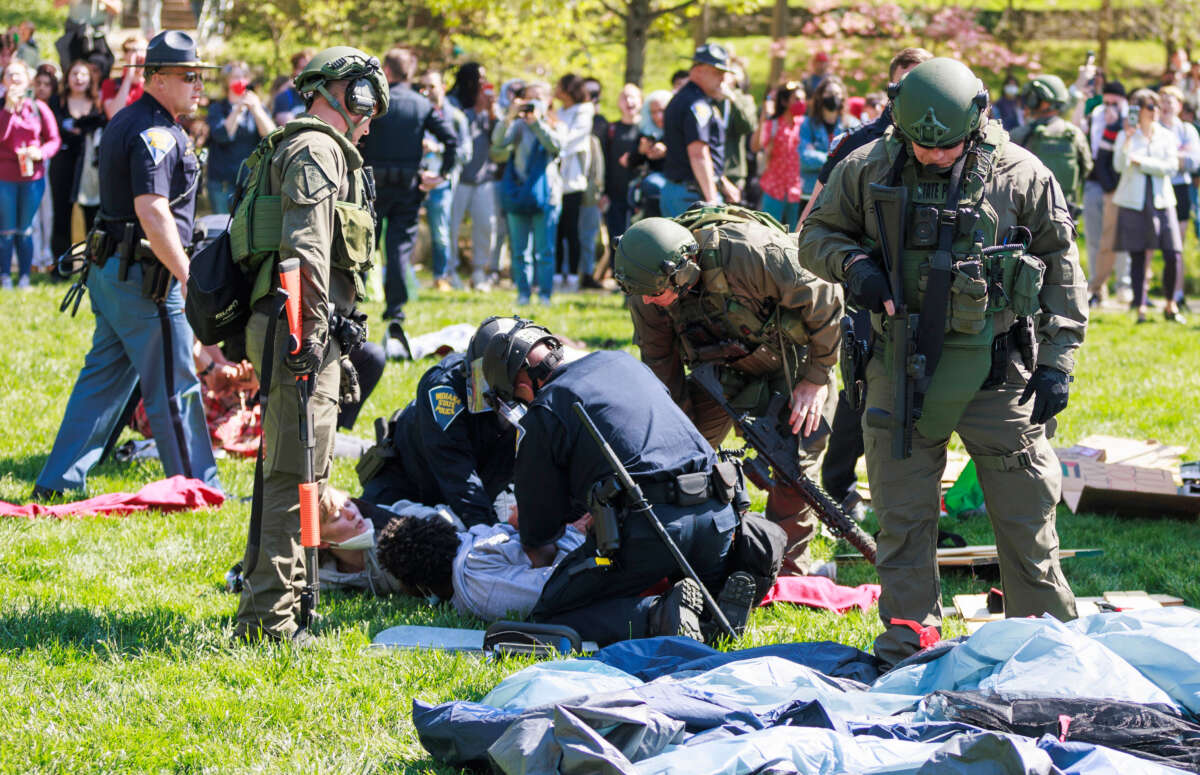
Dozens of people are arrested by the Indiana State Police riot squad during a pro-Palestinian protest on campus in Bloomington, Indiana, on April 25, 2024.

UN human rights officials are expressing alarm over the recent wave of violent repression by university administrators against the student protests for Palestinian liberation that have swept the U.S., raising concerns that protesters’ rights to free speech and assembly are being violated.

A statement on Tuesday said that UN High Commissioner for Human Rights Volker Türk, the UN’s top human rights officer, is “troubled” over a “series of heavy-handed steps taken to disperse and dismantle protests” across U.S. college campuses.

Freedom of expression and the right to peaceful assembly are fundamental to society — particularly when there is sharp disagreement on major issues, as there are in relation to the conflict in the Occupied Palestinian Territory and Israel,” said Türk. “I am concerned that some of the law enforcement actions across a series of universities appear disproportionate in their impacts.

Over the last two weeks, over 1,200 protesters have been arrested across dozens of campuses after university administrators enlisted police to crack down on encampments and other demonstrations set up by students calling for their schools to divest from Israel and supporting corporations, among other demands. At some universities, administrators even allowed law enforcement officers to aim sniper rifles at their students for their peaceful acts of protest.

UN Special Rapporteur on Human Rights Defenders Mary Lawlor said that universities’ crackdowns are an obvious violation of students’ rights.

https://www.ohchr.org/en/statements/2024/02/israelopt-enabling-human-rights-defenders-and-peaceful-protests-vital-achieving

https://www.ohchr.org/en/press-releases/2024/04/united-states-america-un-human-rights-chief-troubled-law-enforcement-actions

see also: the Economist of 30 April: Escalating protests expose three fault lines on American campuses

How to work with the UN and its Rapporteurs: new ISHR guidance for human rights defenders

December 18, 2019

On 18 November 2019 the ISHR launched its new guide to the UN Special Procedures, an essential tool for human rights defenders seeking to engage more strategically with these experts, for greater impact on the ground.

ISHR’s Practical Guide to the UN Special Procedures provides an overview of the system of independent human rights experts known as the Special Procedures, and the different ways human rights defenders can make use of it to further their human rights causes. Often their independence allows them to discuss issues deemed too politically ‘sensitive’ at the international level. It also enables them to act swiftly and react publicly against human rights violations. This handbook is intended to be a practical aid to working with the Special Procedures for non-governmental organisations (NGOs) and human rights defenders. O

Read the Practical Guide to the UN Special Procedures here

You can find more tips and examples of how to engage with Special Procedures in the ISHR Academy, ISHR’s e-learning space for human rights defenders looking to strengthen their advocacy skills with the UN for greater impact on the ground. Helping human rights defenders strengthen their advocacy skills with the UN

Navigating the UN

An overview of the international human rights system and the importance of civil society engagement

Watch the video

Test your knowledge

Learning Modules

Build your advocacy skills

Hand holding a globe in a light bulb

ISHR Academy Introduction

A quick start guide to getting the most out of the learning modules developed by ISHR

People sat around the council debating chamber

UN Human Rights Council

Understand the structure, purpose and mandate of the Human Rights Council and the opportunities for effective engagement

A team of experts

Special Procedures

Explore the purpose and mandates of the Special Procedures and how you can work with them to strengthen your advocacy. For more see: https://academy.ishr.ch/

Annual human rights video contest for students across America opens

January 30, 2017

There is a lot of attention on current and feared loss of human rights attention in Trump-led USA. It is no reason to overlook positive events that continue. E.g. Robert F. Kennedy Human Rights, in partnership with the American Federation of Teachers and the Tribeca Film Institute, has launched on 25 January 2017 the 6th Annual Speak Truth to Power Video Contest. The short-video contest invites middle and high school students from around the country to create a three-minute video examining a human rights issue or violation while profiling human rights defenders fighting to restore justice. The deadline for entries is March 6, 2017. Participants must be in grades 6 through 12. No prior filmmaking experience is required.

The lesson that we all have a responsibility to stand up and speak out against inequality and injustice is so important. This video contest will engage students in what it means to be a defender of human rights.”, said Randi Weingarten, president of the American Federation of Teachers (which is also producing an online webinar to share how teachers can use the contest to help students demonstrate independence, judgment and creativity about key human rights issues).

“Past winners demonstrated the transformative impact this contest has on those who participate,” said John Heffernan, Director of the Speak Truth To Power program. “We are thrilled to be able to expand our reach by partnering with the AFT in key cities throughout the US—inspiring even more students to identify with some of the most courageous people on the planet.

https://humanrightsdefenders.blog/2013/10/12/rfk-center-expands-human-rights-video-contest-to-students-from-the-whole-usa/

Last year’s grand prize went to a filmmaker from Farmingdale, NJ whose satire “How to Be an American Muslim” asks the audience to reflect on the challenges of being a Muslim in America today, and highlights the work of human rights defender Dalia Mogahed. (http://www.ted.com/talks/dalia_mogahed_what_do_you_think_when_you_look_at_me)

Additional details can be found at http://www.speaktruthvideo.com. Winning videos will be featured on the Speak Truth To Power website and the grand prize video will be shown at the 2017 Tribeca Film Festival.

Contact: Eric Duncan, eduncan(at)aft.org

Source: Annual Human Rights Short-Video Contest Open to Students and Schools Across America

Training workshop on Protection of HRDs by Foreign Governments

January 24, 2017

Chris Collier, a well-known human rights consultant based in the  Netherlands (www.chriscollier.nl), will be conducting a one-day, participatory training workshop for human rights defenders and staff of human rights organizations on foreign government protection of HRDs. The course will take place on 27 March 2017 in Brussels.  Participants will gain knowledge of policies and practices of foreign governments in HRD protection, will develop advocacy skills to make full use of these possibilities, and make plans to get foreign governments to take action on specific issues or cases.  The workshop will cover the EU and EU member states as well as other countries with guidelines on HRD protection (Switzerland, Norway and Canada).  The language of the workshop will be English.  The number of participants will be limited to a maximum of 15.  The workshop fee is €300 and participants are asked to arrange their own visa, travel and accommodation.  (An invitation letter to the training can, of course, be provided.)

Please contact Chris Collier if you would you be interested in participating in this training workshop,  tel. +31-(0)6-34936026 mail@chriscollier.nl


Virgin Islands’ Genevieve Whitaker selected for United Nations Human Rights Fellowship

November 30, 2016

I am using this little known country (Virgin Islands) to highlight a little-known programme: the Virgin Islands Consortium reports that Deputy Elections System Supervisor Genevieve Whitaker has been selected as a fellow for the 2016 Fellowship Programme for the People of African Descent of the UN.

Ms. Whitaker has been involved with human rights from an early age. She received her law degree from Stetson University College of Law, serving as a public service fellow and received the Public Service Recognition Award from Stetson’s Advocacy Board for her exemplary service locally and worldwide. She was instrumental in the establishment of Stetson’s Amnesty International Student chapter. She obtained certificates in human rights and humanitarian law during her legal studies at the University of Oxford School of Law and Santa Clara University Law School, respectively. There she joined Amnesty International USA, and United Nations Association of the USA. Ms. Whitaker is also a former board member of the DC-based Partners for Freedom & Democracy, a nonprofit organization for which she organized a human rights-based youth leadership development summit that took place in Abuja, Nigeria in 2008.

In 2009 she co-founded the Virgin Islands Youth Advocacy Coalition, Inc., a nonprofit established to promote the political and civic engagement of the young people of the Virgin Islands. Ms. Whitaker’s human rights work also includes service on the Board of the Caribbean Institute for a New Humanity, which housed the Virgin Islands Reparations Movement (ACRRA). Ms. Whitaker served as an international election observer with the Organization of American States for the February 25, 2016 Jamaican Parliamentary elections.

Ms. Whitaker says she plans on bringing back to the territory the knowledge she gains during her training to promote the important work of decolonization, by obtaining support among the key stakeholders who will be dedicated to the cause for the human right to self-determination, she says. The goal is centered on achieving the political, social, economic and cultural right advancement for people of African descent and all those negatively affected/impacted by the resultant human rights abuses tied to our colonial status, according to Ms. Whitaker.

Source: Genevieve Whitaker Selected For United Nations Human Rights Fellowship –