ISHR is launching two new interactive tools to strengthen diplomatic initiatives to support human rights defenders.
one tool designed for diplomats and
the other for defenders;
The resources provide practical guidance on how to enhance diplomatic support for defenders to prevent risks, respond to threats and better protect those working to promote and defend human rights. The tools will be available in English, French and Spanish.
Human rights defenders (HRDs) play a vital role in promoting accountability and advancing justice. Yet defenders around the world increasingly face harassment, criminalisation, surveillance, detention and reprisals because of their work. Diplomatic missions can play an important role in the overall protection strategy for defenders, including by addressing risks, monitoring cases, engaging authorities, or providing emergency support when defenders face serious threats. Some countries or region have adopted specific ‘Diplomatic Guidelines’ on the protection of human rights defenders (HRDs), including Switzerland, Canada, the European Union, Norway, Finland, and the UK.
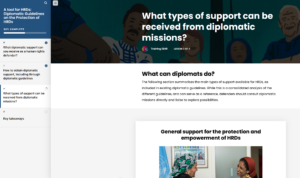
To help strengthen the effective use of diplomatic protection measures, ISHR has developed two new interactive tools aimed at two complementary audiences: diplomats and human rights defenders themselves.
The first tool provides practical guidance for diplomatic and permanent missions on how to better provide quality, consistent and targeted support and protection to defenders including through the implementation of existing ‘diplomatic guidelines’ (40 minutes to complete). It outlines key principles for diplomatic engagement, including applying a “do no harm” approach, consulting closely with defenders, and adopting flexible and context-specific responses. It also highlights forms of diplomatic support, from regular engagement with defenders to trial observation, public advocacy, and emergency measures such as facilitating visas or temporary relocation.
The second tool is designed for human rights defenders and civil society organisations (20 minutes to complete). It is intended to help defenders better leverage diplomatic support by developing understanding of diplomatic guidelines, how they work, and what defenders should consider to safely engage with embassies and diplomatic missions. It also outlines the types of support that may be available, from meetings with diplomats and public advocacy to targeted or emergency assistance in situations of risk.
The content is grounded in the needs and lived experiences of HRDs, as documented by ISHR and other international organisations, and is informed by international human rights norms and standards. It draws in particular from the UN Declaration on Human Rights Defenders and its recent supplement, the Declaration+25.
By enhancing understanding of diplomatic initiatives and making them more accessible, ISHR aims to strengthen collaboration between diplomats and defenders and help ensure that defenders can continue their essential work in safer conditions. We also hope these tools may serve to catalyse action by States that have not yet adopted specific diplomatic guidelines.
The two interactive tools are available on the ISHR Academy in English, French and Spanish.
If you want more information or provide feedback on those initiatives, please contact us at: training@ishr.ch
On 26 February 2026 the Human Rights Foundation (HRF) launched its research project, the Tyranny Tracker, a qualitative index that classifies the world’s countries and territories as democratic, hybrid authoritarian, or fully authoritarian. This political regime assessment tool is now available to the public at a moment when tyranny is on the rise worldwide.
According to HRF’s Tyranny Tracker, 75% of the world’s population lives under authoritarianism despite representing only 92 countries, or less than half of all countries in the world — a number that is partly explained by the hybrid authoritarian regimes of India, Indonesia, Pakistan, and the Philippines, and by the fully authoritarian regimes of China, Ethiopia, Nigeria, Russia, and Vietnam, which rule over some of the world’s most populous countries. The Tyranny Tracker classifies countries using a methodology consisting of 45 indicators categorized into three thematic pillars: electoral competition, freedom of dissent, and institutional accountability. The methodology is informed by academic literature and HRF’s 20 years of experience advocating on behalf of dissidents from countries ruled by authoritarian regimes. The research draws on a range of sources, including media, data collected by HRF’s in-house research team, an extensive human rights network, and expert advice. Published today in the Journal of Democracy, a piece from HRF’s lead researchers Javier El-Hage, Malaak Jamal, and Alvaro Piaggio, explores what sets the Tyranny Tracker apart from other indexes, and how readers can use the tool to inform their work.
“The Tyranny Tracker is a culmination of years of HRF’s internal research to identify patterns of authoritarianism worldwide and decide which regimes to prioritize as targets of our advocacy work,” said Malaak Jamal, HRF’s director of policy and research. The Tyranny Tracker uses three classifications for the governments ruling countries around the world: Democratic governments are characterized by largely free and fair elections, freedom to criticize the government, and an independent judiciary capable of being an effective check on government abuse. While many of these governments currently face real challenges in resisting the autocratic tendencies of democratically elected leaders emboldened by increased political polarization globally, they continue to maintain the mechanisms of self-correction that allow democracies to survive and evolve, as opposing political parties regularly and peacefully transfer power. Hybrid authoritarian regimes are typically the result of the severe erosion of institutions by an initially democratically elected government, and represent a step in the process of authoritarian consolidation. While these authoritarian regimes maintain a façade of democracy through regular elections, their autocratic actions heavily skew elections in favor of the incumbent to the point that an opposition victory and peaceful transfer of power are highly unlikely. Fully authoritarian regimes systematically stifle meaningful electoral competition and the basic freedom to dissent, all the while tightly controlling a judicial branch, which lacks any ability to serve as a check on government abuse. These authoritarian regimes regularly rig elections (when they hold them at all), shut down critical media outlets and organizations, and target political opponents and dissenters with arrests and killings, making the chance of a nonviolent transition to democracy as a result of elections little more than a theoretical possibility.
“HRF’s new tool aims to contribute to the healthy competition and complementarity among existing democracy indexes by great institutions, such as Freedom House, V-Dem, International IDEA, or the Economist Intelligence Unit, that already do a great job documenting the situation of authoritarianism worldwide in a quantitative way. The Tyranny Tracker, on its part, is methodologically different as it follows a simple yet structurally cohesive and qualitative analysis process, carried out by HRF’s regional policy and advocacy researchers and experts, resulting in limited yet materially significant differences in country classifications,” said Javier El-Hage, HRF’s chief legal and policy officer.
In 2024, HURIDOCS continued strengthening partnerships, evolving tools, and expanding its reach.
“I see our contribution not just as code, but as something living—like the root bridges of Northeast India, grown with care and shaped by community. This is how I envision HURIDOCS: building human rights infrastructure that is resilient, collaborative, and deeply rooted in justice.” — Danna Ingleton, HURIDOCS Executive Director
Supporting the global community
This year, HURIDOCS partnered with 73 organisations across 38 countries, helping develop documentation strategies, launch new platforms, and provide targeted support. This means 73 documentation projects were reimagined and refined through bespoke customisation through our flagship tool, Uwazi. From databases mapping attacks on environmental defenders to resources preserving collective memory, our work continues to be shaped by those on the frontlines of human rights struggles.
Uwazi: Built with and for civil society
In 2024, our open-source platform, Uwazi, continued to grow with new machine learning tools for translation and metadata extraction, tighter security, and full integration with the Tella mobile app, making it more responsive, secure, and aligned with the needs of human rights defenders worldwide.
Convening global conversations
In 2024, HURIDOCS engaged in key global events, including a side event at the 56th Human Rights Council, the Geneva Human Rights Platform, the first Google Impact Summit, and a Human Rights Day webinar highlighting four global initiatives powered by Uwazi.
Through these events, we advanced vital discussions on the ethical use of AI, digital monitoring technologies, and the future of technology infrastructure in support of human rights.
Navigating fundraising challenges while building resilience and sustainability
HURIDOCS continued to navigate a complex funding landscape in 2024, strengthening our financial foundations to ensure long-term resilience.
We remain committed to aligning our resource strategies with our mission, providing steadfast support, insight, and partnership to those advancing human rights globally
Strengthening our foundations
2024 marked the second year of Danna Ingleton’s leadership as Executive Director. It was a year of growth and transition, including the appointment of Grace Kwak Danciu as Chair of the HURIDOCS Board, and a heartfelt farewell to Lisa Reinsberg, whose contributions shaped the organisation for more than five years.
To ensure the long-term sustainability of our mission, we launched a new Development and Communications team under the leadership of Yolanda Booyzen. We also welcomed new staff across programmes, tech, and product, each one contributing to a stronger, more agile HURIDOCS.
As our team grows and our documentation tools evolve, we strive to build a fit-for-purpose civil society equipped to achieve justice, accountability, and the protection of human rights.
Looking ahead, we hold hope that the years to come will bring renewed compassion as we work towards a world where human rights are upheld for all.
The Global Torture Index, a pioneering initiative by OMCT and partners, is poised to revolutionize the global fight against torture. It will be launched on 25 June, during the Global Week Against Torture, organized by OMCT and its partners in collaboration with #UnitedAgainstTorture – an EU-funded consortium of six leading anti-torture organizations.
Despite 175 countries ratifying the UN Convention Against Torture, this grave violation of human rights persists in prisons, public assemblies, armed conflicts, and daily police interventions. Torture remains shrouded in secrecy, making it difficult to detect and eradicate.
The Global Torture Index is an innovative tool, developed in collaboration with over 200 local civil society organizations that form the SOS-Torture Network, human rights defenders, and consulted with international experts, provides robust, data-driven insights and trend analysis into the risk of torture and ill-treatment across countries. The Global Torture Index map will serve as a critical resource for policymakers, governments, media, and activists, offering actionable recommendations, measuring progress and regression on human rights compliance, identifying good practices and fostering global awareness.
Follow us on social media to learn how you can take part in the launch of the Global Torture Index and discover how this powerful tool will empower the global anti-torture movement, bring torture out of the shadows, and drive meaningful change.
On Monday 24 June2024, the Human Rights Measurement Initiative (HRMI) launched its landmark human rights tracker tool
Co-sponsored by the International Bar Association’s Human Rights Institute (IBAHRI), HRMI is the first global project to publish a comprehensive, user-friendly database measuring how well countries are meeting their human rights obligations.
HRMI has adopted a co-design approach to ensure the data meets the needs of grassroots human rights defenders and is respected by scholars.Measuring how countries follow human rights laws has always been challenging, and numerous obstacles persist:
no universally agreed upon standards
difficulty of collecting reliable data across diverse contexts
some governments’ reluctance to be transparent or accountable.
These critical gaps prevent us from assessing progress, pinpointing areas of concern, and holding governments accountable. Reliable measurements are the cornerstone of evidence-based policymaking, impactful advocacy, and international cooperation to promote and protect human rights worldwide.
The launch event brought together numerous human rights professionals, academics, and advocates.
Baroness Helena Kennedy LT KC, Director of IBAHRI, opened the event by emphasising the importance of having reliable and openly accessible data on human rights compliance. She highlighted how such data informs reporting and accountability, particularly in the Universal Periodic Review process. Baroness Kennedy expressed gratitude to HRMI for providing this new tool and thanked The City Law School for supporting IBAHRI and other organizations in promoting human rights action.
Left to right: Thalia Kehoe Rowden, Baroness Helena Kennedy LT KC, Yasmine Ahmed
Professor Richard Ashcroft, Executive Dean of the City Law School, welcomed participants and noted the difficulties and importance of developing reliable data on human rights compliance. He reminded the audience not to lose sight of aspects of human rights practice that are not easily measurable.
Thalia Kehoe Rowden , Co-Executive Director of HRMI, shared insights into HRMI’s development. She highlighted the importance of accurate measurement in driving improvements and accountability in human rights practices globally. She discussed the methodologies behind the data and various ways in which the database could be deployed by organisations to enhance governance and hold governments accountable.
Yasmine Ahmed, UK Director of Human Rights Watch (HRW), provided an overview of cases where HRW utilised the HRMI data to strengthen their advocacy efforts.
Thalia Kehoe Rowden
The event concluded with a networking session, allowing attendees to further discuss the presentations and develop connections for future collaboration in the human rights field.
Speaking after the event, co-organiser, Dr Zammit Borda remarked:
Like gadflies, civil society organisations and scholars must take their responsibility of pressuring governments to comply with human rights obligations seriously. Their work is crucial for the vulnerable and voiceless in society, who are more likely to suffer human rights violations. The HRMI offers an important new tool for civil society, lawyers, scholars, and others to effectively carry out their mission.
After more than 10 years, Friedhelm Weinberg will be leaving HURIDOCS in early 2023. Having worked with him in person on many occasions, I can testify that his leadership has been most impressive, for the NGO itself [see e.g. https://humanrightsdefenders.blog/category/organisations/huridocs/] and the in the area of networking with others, such as the MEA and THF [see e.g. his: https://youtu.be/zDxPbd9St9Y]. In his own announcement, he modestly refers to all his colleagues:
It has been an incredible decade with HURIDOCS, working with amazing colleagues and partners at the intersection of human rights and technology. Together, we have drastically increased support to activists to leverage technology for documentation, litigation and advocacy work. We have pioneered flexible, reliable and robust software tools such as Uwazi, while responsibly sunsetting the past generation of open source software.
None of this would have been possible without the team we have built, and that was collaborating remotely across the globe well before 2020. It’s a committed, humorous and professional bunch, and I have learned so much with every single one of them, as we made things happen and as we hit walls and then picked each other up. I am also grateful to our board that brings together wisdom from leading NGOs, technology companies, the financial sector, but, more importantly, people that were generous with guidance, encouragement and critique.
It has also been a decade of many heartbreaks. From partners whose offices have been raided, that have been declared foreign agents, threatened, attacked. From wars and conflicts breaking out, affecting people we work with. From the difficulties of all we’re doing sometimes not being enough. From worrying how to raise the money to sustain and grow a team that can rise to these challenges.
It is a bittersweet departure, because it has been life-affirming – and yet it is for a perspective that fills me with warmth and excitement. For a while, I will be with our children, with the second one due to arrive in early 2023.
As I have made the decision to leave HURIDOCS, I also have felt really down and much of the stress built up over a decade manifested physically. Seeking treatment, I have been diagnosed with burnout and depression, and have been recovering with the support from specialists, friends and family. This is neither a badge of honor nor something I want to be shy about, it’s just the reason you haven’t seen much of me recently in professional circles. It’s getting better and I am grateful to have the time and space for healing.
Currently, Nancy Yu is leading HURIDOCS as Interim Executive Director, as Lisa Reinsberg as the Board Chair holds the space and directs the succession process. I am grateful to both of them to step up and step in, as well as the team, our partners and funders for a decade of working together to advance human rights.
As the search for his successor has started, please have a look at the recruitment announcement and consider applying or sharing it with suitable candidates: https://lnkd.in/e7Y7smqT
HURIDOCS has been working with urgency to meet the needs of our Ukrainian partners to enable effective, comprehensive and safe documentation of human rights violations. The HURIDOCS Team on 19 April 2022 tells how:
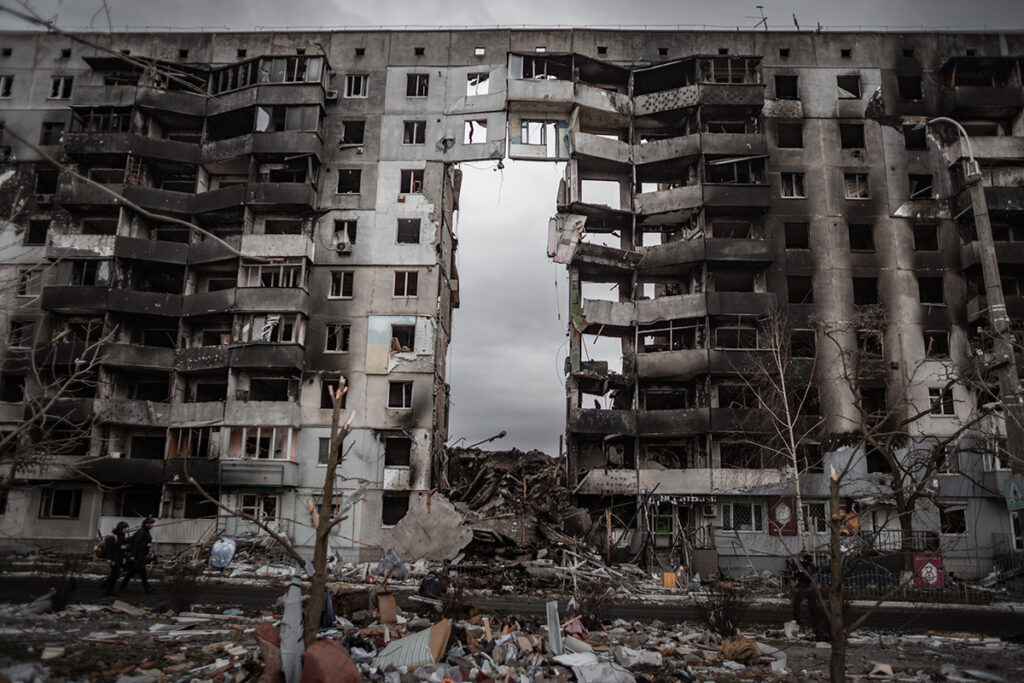
A maternity ward and children’s hospital are hit by an airstrike. Schools and apartment blocks are shelled. A psychiatric facility is attacked. Residential areas are targeted by cluster bombs. Critical infrastructure is struck by missiles. Mass civilian graves are discovered.
These horrendous attacks on civilians in Ukraine, some of them on healthcare facilities, are labelled by the United Nations as ‘acts of unconscionable cruelty’. Russia’s invasion of Ukraine, which started on 24 February 2022, is unfolding as a series of atrocities committed against civilians.
Indiscriminate attacks using missiles, heavy artillery shells, rockets and airstrikes on civilians and non-combatants are in contravention of international humanitarian law and may amount to war crimes. Apart from attacks on civilians, Russia is reported to be shelling agreed-upon humanitarian corridors from conflict zones and therefore halting mass evacuations.
Borodyanka, a Ukrainian commuter town near Kyiv, was among the first places to be hit by Russian airstrikes.
Kyiv Declaration calls for support to groups actively documenting violations
Leaders of more than 100 Ukrainian civil society organisations have published the Kyiv Declaration, which defines the invasion as “a war against the fundamental principles of democracy”. The #KyivDeclaration asks for solidarity and immediate action, and outlines six urgent appeals to the international community. The organisations are collectively calling for the creation of safe zones in Ukraine, military aid, sanctions against Russia, humanitarian aid, freezing assets and revoking visas of prominent Russian families, and providing equipment to track war crimes. This includes technology and support to groups who are actively documenting the events in Ukraine, as well as human rights groups and lawyers who will be supporting accountability efforts in the long run.
An appeal from 100 Ukrainian civil society leaders
HURIDOCS has been working with urgency to meet the needs of our Ukrainian partners to enable effective, comprehensive and safe documentation of human rights violations.
“When Russia started its full-scale invasion in February this year, we revived the work of EuromaidanSOS. We are faced with a large number of war crimes that need to be documented. Among these are indiscriminate attacks on civilians and civilian objects, deliberate killings, torture, cruel and inhumane treatment, enforced disappearances and other crimes listed in the Rome Statute. Such acts are not justified by any circumstances of the war. Russia is simply using war crimes as a way of waging war.
Our volunteers from EuromaidanSOS are based in different parts of the country, and some of them work directly in hot spots, where they face constant connectivity issues. This is why usable technical solutions are indispensable. As this work is undertaken in the context of war, it is important to have qualified technology support. We are very grateful to the organisations, such as HURIDOCS, providing it in this difficult time for us.”– Oleksandra Matviychuk, Head of the Center for Civil Liberties and Board Member of HURIDOCS
Documenting violations is vital for accountability
Four days into the Russian invasion, the International Criminal Court (ICC) Prosecutor opened an investigation into war crimes being committed in Ukraine. In conjunction with the investigation, the ICC launched a contact portal and anyone with relevant information is urged to come forward and share the details with the ICC. The United Nations Human Rights Council expressed that it is gravely concerned about the escalating human rights and humanitarian crisis and passed a resolution to establish a Commission of Inquiry. The Commission will first and foremost collect evidence of violations and those responsible, and subsequently submit reports to the Human Rights Council and General Assembly. The Federal Prosecutor’s Office in Germany has launched an investigation by collecting evidence of suspected crimes on civilians and critical infrastructure. Germany’s probe is based on the principle of universal jurisdiction, which allows countries to prosecute crimes against international law outside of its borders.
The United Nations High Commissioner for Human Rights released a statement where she expressed horror by the images of civilian bodies on the streets and in improvised graves in the town of Bucha. She stated that reports of egregious crimes raise serious questions about possible war crimes and grave breaches of international and humanitarian law. She urged that “it is vital that all efforts are made to ensure there are independent and effective investigations into what happened in Bucha to ensure truth, justice and accountability, as well as reparations and remedy for victims and their families”.
In addition to these and other measures already underway to investigate possible war crimes and breaches of international and humanitarian law, some of the most authoritative civil society organisations in Ukraine have established a global initiative to seek justice and hold perpetrators accountable. The ‘Breaking the Vicious Circle of Russia’s Impunity for Its War Crimes’ initiative was jointly established by the Ukrainian Helsinki Human Rights Union, the Kharkiv Human Rights Protection Group and the Center for Civil Liberties, and is also known as the ‘Tribunal for Putin’.
The Tribunal for Putin aims to document events which can be classified as genocide, crimes against humanity and war crimes under the Rome Statute of the International Criminal Court. The Tribunal for Putin will also collect evidence and facts on the crimes committed and will work with existing international mechanisms of the United Nations, Council of Europe, OSCE, EU and the International Criminal Court. The initiative has called for support from various actors such as international organisations, networks, government agencies, public associations, volunteer initiatives and groups who all share the common goal of restoring peace in Ukraine and ensuring that justice will prevail.
Civil society plays a crucial role in seeking justice
In this context, it is clear that the systematic documentation of human rights violations, irrespective of who is committing the transgression, is critical to achieving justice and accountability. Documentation should not only be undertaken to assist future justice and accountability mechanisms but also to support the process of reckoning and healing.
Civil society plays a key role in efforts to document and monitor violations, and to build and strengthen cases for accountability. Civil society actors are usually the first to respond to crises, have the deepest community reach and can mobilise the people who are living through these experiences. Documenting human rights violations as they happen is imperative in the process of restoring justice. To effectively and safely assist the community there is a need for strong digital tools to gather, process, preserve, manage, protect and analyse the rapidly growing bodies of potential evidence, including large amounts of storage-intensive video. In addition, deterrence against the worst violations can also be established through credible documentation strategies.
HURIDOCS is a longtime supporter of civil society organisations and human rights defenders who use human rights documentation strategies and tools as a means to strengthen accountability and advocate for justice. We are already supporting a number of groups working on documenting human rights violations in Ukraine and HURIDOCS invites other initiatives who need support with their documentation efforts to contact us. We value diverse approaches to documenting violations, as it may strengthen accountability measures and aid in articulating narratives during the process of memorialisation.
Support for documenting violations in Ukraine
With the increased need for support to document violations in Ukraine to strengthen accountability, the Alfred Landecker Foundation has partnered with HURIDOCS to increase our capacity to support civil society-led initiatives where our expertise can be helpful. HURIDOCS is grateful to the Foundation for the support, as it comes at a time when documenting threats to peace, justice and democracy is critical. The support from the Alfred Landecker Foundation will be used to assist groups who are already participating in documentation efforts, and to aid other initiatives related to documenting violations in Ukraine.
HURIDOCS is currently supporting our partners in the following ways:
Training and consultation on information collection, protection and management techniques and associated tools, such as Uwazi;
Setting up digital information repositories to securely store sensitive data;
Refinement and integration of existing technology solutions to document, protect and analyse evidence of human rights violations; and
Hardening and scaling infrastructure to preserve and protect large amounts of information.
There is a significant and growing need to support organisations with their efforts to gather, process, preserve, manage, protect and analyse information on abuses. Reliable documentation of violations is essential for the restoration of justice in the pursuit of upholding democracy and human rights.
Witness stands with the victims of Russia’s unlawful attacks. In a conflict that is rife with disinformation, false narratives, and manipulated media, the importance of capturing and preserving trusted, authentic accounts of human rights crimes cannot be underestimated. They are sharing resources for those on the ground in Ukraine and Russia – who are navigating immense risks as they capture and share video documentation of potential human rights violations and war crimes. And, they are sharing resources for those of us witnessing from a distance, so that we amplify grassroots truths and decrease the spread of mis/disinformation.
Guidance for Frontline Documenters working with and learning from activists documenting and preserving visual evidence of war crimes and human rights violations from Syria and Yemen to Brazil, it developed its peer-reviewed and field tested Video As Evidence Field Guide. Earlier they also worked with Ukrainian civil society and human rights groups during the 2014-15 conflict to prepare versions in Ukrainian and Russian
In Ukrainian: ПОЛЬОВИЙ ПОСІБНИК “ВІДЕО ЯК ДОКАЗ” Field Guide: Video as Evidence wit.to/VAE-UA
In Russian: ПОЛЕВОЕ ПОСОБИЕ «ВИДЕО КАК ДОКАЗАТЕЛЬСТВО» Field Guide: Video as Evidence wit.to/VAE-RU
On 25 June 2021 the FIDH issued a press release announcing a new website on Belarus. Since May 2020, the administration of Aliaksandr Lukashenka, the de facto president of Belarus, has intensified repression, aiming to crush the country’s democratic movement. A new website launched by the International Federation for Human Rights (FIDH) tracks, compiles, and presents detailed information on the human rights situation in the country, including on political prisoners, violations against vulnerable groups, and efforts to advance accountability for the regime’s crimes.
FIDH and its member organisation in Belarus, Viasna Human Rights Center, have been closely monitoring and documenting the human rights situation in Belarus over the past year. The website launched today is intended as a comprehensive resource compiling up-to-date data and statistics, and offering analysis and insight into violations, including from our local partners such as Viasna. The website tracks and provides detailed information on political prisoners—particularly human rights activists, lawyers, journalists, and other human rights defenders, describes violations against vulnerable groups currently imprisoned by the regime—and details ongoing efforts to further accountability for the regime’s crimes.
The website has four main sections, updated daily, reflecting the most recent developments in four key areas: monitoring events and reactions, exposing crimes and furthering justice, defending human rights activists, and supporting vulnerable groups.
Monitoring events and reactions
On Monday, the EU approved new sanctions against 78 individuals and eight companies believed to support the crackdowns on the democratic movement and the forced landing of Ryanair flight with Raman Pratasevich on board late last month. The same day, the UK, Canada, and the US joined this initiative and introduced new sanctions. At the European Council yesterday, the EU also approved economic sanctions against parts of Belarus’ potash, oil, and tobacco exports, as well as telecommunication and banking sectors. We are monitoring this situation and will publish updates as soon as further information is available.
Exposing crimes and furthering justice
On 19 June, the law “On Amendments to the Laws on Ensuring the National Security of the Republic of Belarus” came into force. Among other provisions, it grants law enforcement the right to use military and special equipment to suppress riots and stipulates that officers not be liable for harm caused as a result of the use of force and weapons. This is one of a series of recent laws—including one that expands the definition of extremism—that threaten protesters’ lives and liberties, under the guise of ensuring public order and national security, and that violate the International Covenant on Civil and Political Rights. FIDH, which is on the Advisory Council of the International Accountability Platform for Belarus, regularly issues statements analysing such laws, as well as communications to the UN Special Procedures, in order to further justice in the country.
Defending human rights activists
Many human rights defenders (HRDs) in Belarus face persecution due to their professional activity. To date, at least 21 of them have been charged with supposed crimes in an attempt to thwart their human rights activities. Most recently, on 18 June, lawyer Andrei Machalau, who was a defense attorney in many criminal cases against protests activists and HRDs, including TUT.by journalist Katsiaryna Barysevich, was disbarred for alleged violation of professional ethics. Machalau is one of at least 17 lawyers whose licenses have been revoked since May 2020. We endeavour to defend each and every one of them and gather the available information in a dedicated section of our website.
Supporting vulnerable groups
The current regime demonstrates a blatant disregard for human rights of children, women, pensioners, persons with disabilities, and other vulnerable groups. Despite the overwhelmingly peaceful nature of the protest movement, hundreds of representatives of these groups have been detained, and sometimes beaten, for simply displaying the white-red-white flag: the main symbol of the democratic movement. On Monday, the Belarusian Ministry of Interior proposed that the KGB add the white-red-white flag and slogan Zhyve Belarus (Long live Belarus) to the list of banned Nazi symbols. Should this initiative be approved, public use of such symbols could lead to administrative or even criminal liability—potentially devastating news for many minors, women, and other Belarusians who have galvanised the protest movement using these symbols. We will be following the situation and supporting those who may suffer restrictions on freedom of speech due to this and other legislation.







 SIARHEI LESKIEC / AFP
 Hans Thoolen on Human Rights Defenders and their awards