On 15 August 2017, Jatupat Boonpattararaksa received a two and a half years jail sentence after pleading guilty to violating the lèse majesté law. The human rights defender – also known as Pai Dao Din – has been detained since 3 December 2016 in connection with his sharing of a BBC article on the life of King Vajiralongkorn on social media. Pai Dao Din, is leader of a student activist group called Dao Din based in Khon Kaen University. (https://www.frontlinedefenders.org/en/profile/jatupat-boonpattararaksa). The group advocates for community rights, social justice and democracy. He is also a member of New Democracy Movement (NDM), which opposes the military dictatorship in Thailand, a regime in place since the coup d’etat in May 2014. In May 2017, Jatupat Boonpattararaksa was awarded the Gwangju Prize for Human Rights [https://humanrightsdefenders.blog/2017/05/10/gwangju-award-for-human-rights-defender-pai-dao-din-upsets-thai-government/]The defender was originally sentenced to five years in jail, however this sentence was reduced after he pleaded guilty to sharing material deemed insulting towards the country’s monarchy.
{While authorities did not file charges or even a complaint against the London-based BBC for publishing the article, only Jatupat was arrested. His bail requests were consistently rejected as authorities regarded lèse majesté as a serious charge possibly entailing severe punishment. Domestic and international campaigns over recent months have failed to free him on bail. Prior to the court judgment, Jatupat, who had maintained his innocence for months, agreed to plead guilty after consulting with his family and legal team to get a more lenient sentence.}
“It appears that Jatupat was singled out, from thousands of people who shared the BBC article, and prosecuted for his strong opposition to military rule rather than any harm incurred by the monarchy,” said Brad Adams, Asia Director at Human Rights Watch. “His guilty verdict and jail sentence show yet again how Thailand’s draconian ‘insulting the monarchy’ law has been misused to punish dissenters.”
Having reported in 2014 on the fate that had befallen Gulnara Karimova, daughter of the former Uzbek dictator [https://humanrightsdefenders.blog/2014/08/22/how-the-mighty-fall-in-uzbekistan-gulnara-karimova-asks-human-rights-protection/], I now feel that I should follow-up by referring to media reports (Reuters Almaty) that she is in fact being detained over fraud claims. Uzbek Prosecutors have revealed that Gulnara Karimova, who has not been seen in public for three years, was convicted of embezzlement already back in 2015. Gulnara Karimova’s lawyer has raised concerns about the welfare of the socialite.
Photograph: Yves Forestier/Getty Images for Style.Uz Art Week
The prosecutor general’s office said it was seeking to freeze about $1.5bn (£1.15bn) in assets held by Karimova in countries including Switzerland, Sweden, Britain, France, Latvia, Ireland, Malta, Germany, Spain, Russia, Hong Kong and the United Arab Emirates. Karimova could not be contacted for comment. Her Swiss lawyer Gregoire Mangeat said he did not know where she was being held and revealed that he had been forced to cancel a visit to see her this month. “The methods and behaviour adopted by the Republic of Uzbekistan thereby constitute a serious violation of the most fundamental human rights guarantees,” Mangeat said.
On 31 May 2017 ALQSTreported that Qatar has extradited the prominent Saudi human rights defender Mohammed bin Abdullah al-Otaibi to Saudi Arabia, even after Norway accepted his application for political asylum. Otaibi was arrested at Doha International Airport on Wednesday 24 May, 2017 as he was about to travel with his wife to Norway, on travel documents provided by the Norwegians. Days later, on Sunday, 28 May 28 3 a.m., Otaibi was deported overland to Saudi Arabia via the Salwa border crossing and delivered to the Saudi authorities, who sent him with an escort of Saudi security vehicles to the Dammam Prisons Department.
The Thai Ministry of Foreign Affairs gets upset easily as shown by the reaction to the granting of the 2017 Gwangju Prize for Human Rights (South Korea) to detained student activist Jatupat Boonpattararaksa, better known as Pai Dao Din. He has been in prison in Khon Kaen on lese majeste and computer crime charges since 22 December 2015, when 10 Khon Kaen University’s students from “Dao Din” group were arrested at the Khon Kaen Democracy Monument.
Pai Dao Din a day after the Khon Kaen court denied him bail again (FB/Jom Petchpradab)
Now the Thai ambassador to Seoul has written to the human rights award giver in South Korea asking it to ‘reconsider ‘ honouring jailed activist Jatupat Boonpattararaksa.
In a copy of the letter was acquired by the Bangkok Post (copy below):
The detained defender had been hoping to make bail so he could attend the award presentation ceremony in person, but his request was denied. In refusing Mr Jatupat’s bail requests, the Region 4 court and Khon Kaen Provincial Court described him as a flight risk who could tamper with evidence. The laureate is thus unlikely to be abel to travel on 18 May to the award ceremony in Gwangju and Mr Jatupat’s mother Prim Boonpattararaksa and her husband Viboon will represent their son and receive the award on his behalf.
National Human Rights commissioner Angkhana Neelapaijit, who won the Gwangju Award for Human Rights in 2006, described it as a prestigious accolade.
Dawit Isaak, an imprisoned Eritrean-Swedish journalist, has been chosen to receive the 2017 UNESCO/Guillermo Cano World Press Freedom Prize. Mr. Isaak was arrested in a crackdown on the media that occurred in September 2001. The last time he was heard from was in 2005. His present location is unknown. An independent international jury of media professionals recommended unanimously Mr. Isaak in recognition of his courage, resistance and commitment to freedom of expression, and the recommendation was endorsed by the UNESCO Director-General Irina Bokova.
“Defending fundamental freedoms calls for determination and courage – it calls for fearless advocates,” said Irina Bokova. “This is the legacy of Guillermo Cano, and the message we send today with this decision to highlight the work of Dawit Isaak.” “Dawit Isaak joins a long list of courageous journalists who have persevered to shed light in the dark spaces; keeping their communities informed against all odds,” said Cilla Benkö, President of the UNESCO/Guillermo Cano World Press Freedom Prize 2017 Jury. “Some have given their lives in the pursuit of truth. Many have been imprisoned. Dawit Isaak has spent nearly 16 years in jail, without charge or trial. I sincerely hope that with this award the world will say, ‘Free Dawit Isaak Now.’”
Dawit Isaak, a playwright, journalist and writer, moved to Sweden in 1987, where he later became a citizen. After the independence of Eritrea, he returned to his homeland to become one of the founders and reporters of Setit, the first independent newspaper in the country. He was known for his critical and insightful reporting. Mr. Isaak was arrested in September 2001 during a political crackdown on the so-called G-15, a group of politicians, and journalists critical of Government policies. Some were detained and tortured, others disappeared. The last known sighting of Mr. Isaak was in 2005. His whereabouts now are unknown.
The UN Special Rapporteur on the situation of human rights in Eritrea, Sheila B. Keetharuth, said: “The Eritrean authorities should stop the practice of arrests and detention carried out without legal basis instantly,” welcoming the award of the UNESCO/Guillermo Cano World Press Freedom Prize 2017 to Mr. Isaak.
The Prize was awarded during the celebration of World Press Freedom Day, 3 May, hosted in Jakarta, Indonesia this year in the presence of the Director General of UNESCO, Irina Bokova, and the President of Indonesia, Joko Widodo.
Created by UNESCO’s Executive Board in 1997, the annual UNESCO/Guillermo Cano World Press Freedom Prize honours a person, organization or institution that has made an outstanding contribution to the defence and, or promotion of press freedom anywhere in the world, and especially when this has been achieved in the face of danger.
The $25,000 Prize is named in honour of Guillermo Cano Isaza, a Colombian journalist who was assassinated in front of the offices of his newspaper, El Espectador, in Bogotá, on 17 December 1986. It is funded by the Cano Foundation (Colombia) and the Helsingin Sanomat Foundation (Finland).
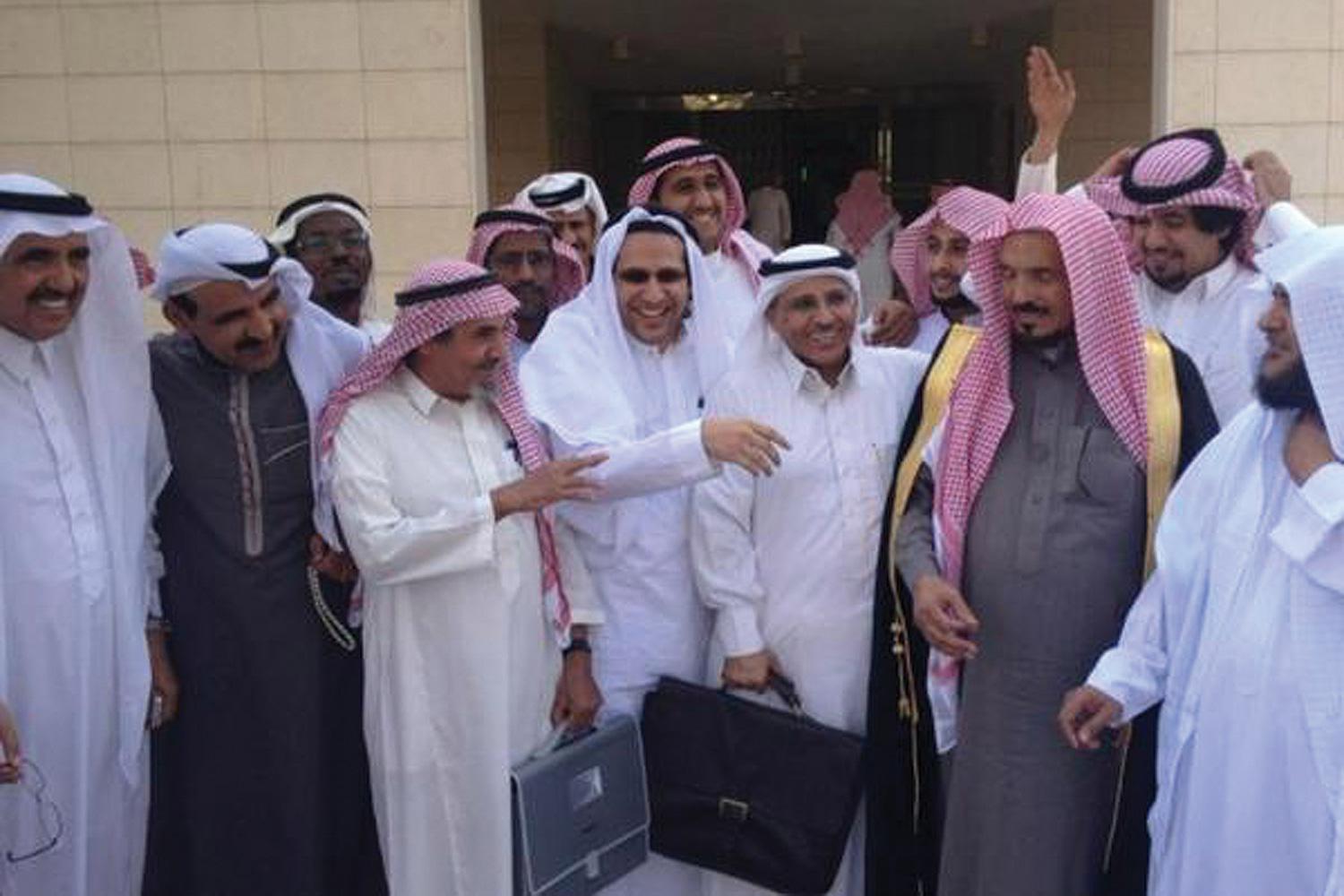
Waleed Abu al-Khair, prominent lawyer and human rights activist, speaks to Human Rights Watch over Skype from Jeddah, Saudi Arabia on September 19, 2013.
Saudi courts have convicted at least 20 prominent peaceful activists and dissidents since 2011. Many, like Abu al-Khair, have faced sentences as long as 10 or 15 years on broad, catch-all charges – such as “breaking allegiance with the ruler” or “participating in protests” – that do not constitute recognizable crimes. “Every day Waleed Abu al-Khair spends in prison compounds the injustice Saudi Arabia has imposed on him and his family,” said Sarah Leah Whitson, Middle East director at Human Rights Watch.
[Abu al-Khair has been one of Saudi Arabia’s leading human rights advocates for years. In July 2014, the Specialized Criminal Court (SCC), Saudi Arabia’s terrorism tribunal, convicted him on a number of broad and vaguely worded charges, including for comments to news outlets and on Twitter criticizing Saudi human rights violations. In addition to sentencing him to prison, the court banned him from traveling abroad for another 15 years. Abu al-Khair played no active part in his trial. He refused to recognize the legitimacy of the court or to defend himself. He also refused to sign a copy of the trial judgment or to appeal either his conviction or sentence. In January 2015, an appeals tribunal within the SCC overturned part of the earlier ruling following a prosecution appeal of the court’s suspension of five years of his term, and ruled instead that Abu al-Khair should serve all 15 years in prison.]
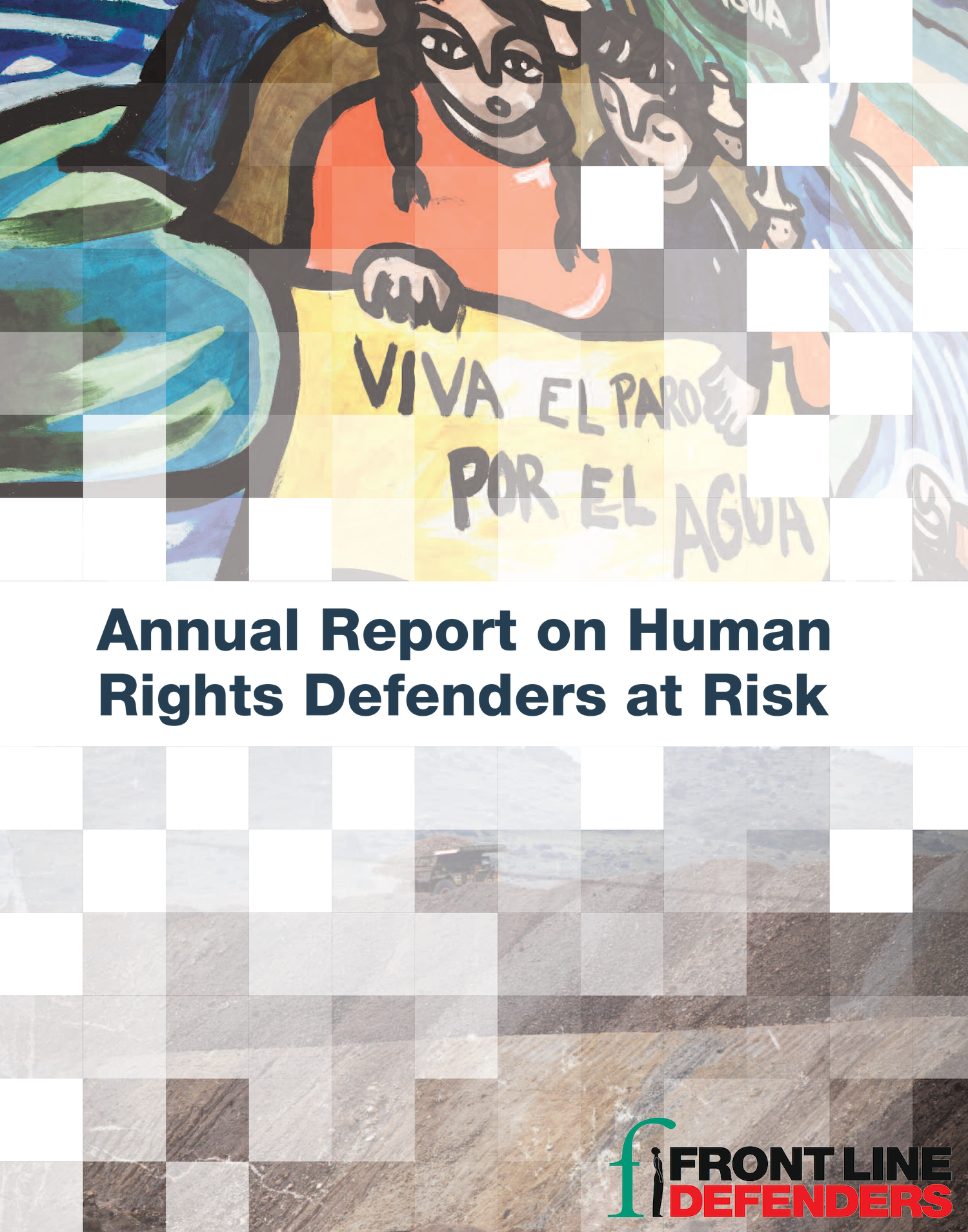
After a short break, this blog resumes its job of selecting and summarizing events related to Human Rights Defenders. 2016 was a horrible year for HRDs and the launch of the annual report of Front Line Defendersconfirms this by reporting that “more than 1000 human rights defenders were killed, harassed, detained, or subjected to smear campaigns and other violations in 2016″.
According to the report, 281 human rights defenders were murdered in 25 countries, 49 percent of whom were defending land, indigenous and environmental rights. Front Line Defenders found that in the vast majority of cases, killings were preceded by warnings, death threats and intimidation which, when reported to police, were routinely ignored. In addition to killings, over half of the cases reported by Front Line Defenders in 2016 concerned criminalisation, a tactic which the organisation calls “the first choice of governments to silence defenders and to dissuade others”.
The Hong Kong Free Press (HKFP) of 12 November 2016 carried a fascinating report on the work of the Chinese “64 Tianwang citizen news site” which has continued to operate despite the continued arrest and detention of its reporters. Reporters Without Borders (RSF) awarded ’64 Tianwang’ its Press Freedom Prize 2016. The piece by Catherine Lai is richly illustrated by pictures. Tianwang founder Huang Qi throughout the interview remains remarkably optimistic about freedom of expression in China in the long-term.
China‘s use of ‘video confessions’ would be almost comical if it was not so serious for the individuals concerned [see e.g. https://thoolen.wordpress.com/2016/01/21/confessions-abound-on-chinese-television-first-gui-minhai-and-now-peter-dahlin/]. Now it is the turn of Wang Yu, a well-known Chinese human rights lawyer who was released on bail after she purportedly “confessed” to some wrongdoings. Wang Yu, 45, who was arrested by mainland police in July last year on charges of political subversion [https://thoolen.wordpress.com/tag/wang-yu/], appeared in a video expressing “deep remorse” for her actions. In the televised confession, Wang is shown rebuking her profession and accusing “foreign forces” of using her law firm to smear the Chinese government.
Chan Kit-man, secretary-general of the Hong Kong-based Chinese Human Rights Lawyers Concern Group, noted that the Wang case is similar to that of another human rights lawyer, Zhao Wei, who was also set free after a videotaped confession.
The Chinese lawyer has handled several politically sensitive lawsuits, including the case of Cao Shunli, who was detained for months for staging sit-ins at the foreign ministry and later died. She also defended Ilham Tohti, a Uyghur economist who was handed a life sentence on separatism-related charges. Tohti is one of 3 final nominees for the MEA 2016. She also provided legal assistance to the families of six schoolgirls who were sexually abused by their teachers in Hainan province and to practitioners of Falun Gong, a spiritual movement banned in China.
(Wang appeared on Phoenix TV on July 31 in an interview apparently conducted at a restaurant in Tianjin. She said she is physically well after recovering from a mammary gland tumor in February and March this year. Wang said arrangements had been made for her to undergo surgery. The action made her realize the “human touch and care” of Chinese authorities.)
“In her confession released on 1 August, Wang Yu criticised fellow human rights lawyers, saying that they were motivated by money and fame and blamed overseas activists for using human rights defenders as tools to tarnish the reputation of the Chinese government. Wang Yu’s confession is the most recent in a series of televised confessions of human rights defenders which have been broadcast in an attempt to undermine human rights work in the country. At least two of those who had previously appeared in such videos later said that their confessions were scripted and that they were pressured to participate”. … Wang Yu had been held incommunicado since 9 July 2015 and her husband, Bao Longjun , remains in detention, having been seized on the same day. Their 16 year old son, Bao Zhuoxuan, is under tight surveillance at the home of his grandparents following an unsuccessful attempt to flee China last year with the help of two human rights defender friends of his parents.”
A day later a court in Tianjin Tuesday handed down a guilty verdict for Chinese rights defender Zhai Yanmin, who was given a three-year jail term with a four-year probation period after being found guilty of “state subversion.”
That reprisals also take place in a regional human rights context is made clear by a report on 21 June 2016 by the New-York based Human Rights Foundation (HRF). It condemns the arbitrary arrest of activists Oscar Luis Milian and Yoandrys Gutiérrez, members of the Cuba-based youth movementMesa de Diálogo de la Juventud Cubana. Both activists were detained for six hours last week at José Martí Airport in Havana when returning to the country after taking part in meetings with the Secretary General of the Organization of American States (OAS), Luis Almagro. The meetings — organized by the Latin American Youth Network for Democracy within the framework of the 46th General Assembly of the OAS in Santo Domingo — brought together human rights and democracy activists from all over the hemisphere.
“Bringing notepads and pens with slogans in favor of democracy and human rights into Cuba has always been considered a ‘subversive’ activity by Cuba’s 57-year-old dictatorship,” said Javier El-Hage, HRF’s chief legal officer. “Oscar and Yoandrys join an endless list of brave activists who are treated like criminals for daring to bring information from the outside world to ordinary citizens in Cuba. If Raúl Castro really wants to show tolerance and openness, he should begin by dismantling the regime’s repressive structure that prohibits people to think for themselves.”
Milian and Gutiérrez were released six hours after their arrival in the Cuban capital and were never informed of the reason for their arrest.





 Hans Thoolen on Human Rights Defenders and their awards