During the current session of the Human Rights Council there will again many side events in Geneva. I will refer to some of them not only in the hope that you may able to attend, but also to illustrate the concerns of the NGO movement:
On Tuesday 9 September from 12.00 to 13.30 (Palais des Nations, Room XXI) there will be a side-event organised jointly by Amnesty International, CIVICUS, Human Rights Watch, FIDH, ISHR and the International Bar Association. Speakers are:
Kenneth Roth, Executive Director, Human Rights Watch
Souhayr Belhassen, Honourary President, International Federation for Human Rights FIDH
Philip Luther, Middle East and North Africa Program, Amnesty International
Phillip Tahmindjis, Director, International Bar Association Human Rights Institute
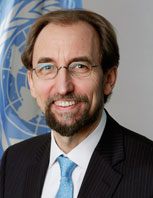
On 8 September 2014 the new UN High Commissioner for Human Rights, Zeid Ra’ad Al Hussein, addressed for the first time the Human Rights Council, and many will have been listening for clues about where he stands on key issues, how ‘activist’ he is likely to be etc. As the speech was rather long and covered a huge variety of issues, it is not easy to draw any conclusions yet. The fist half addressed issues of war and violence and in particular the humanitarian crises of today.
The role of the individual is beautifully worded: “courage is the first human virtue, revered the world over, the very virtue we value the most as human beings. The courageous individual is not he or she who wields great political power or points a gun at those who do not – that is not courage. The courageous individual is he or she who has nothing to wield but common sense, reason and the law, and is prepared to forfeit future, family, friends and even life in defence of others, or to end injustice. In its most magnificent form, the courageous individual undertakes this exertion, without ever threatening or taking the life of someone else, and certainly not someone defenceless.”..”the Takfiris [IS] who recently murdered James Foley and hundreds of other defenceless victims in Iraq and Syria – do they believe they are acting courageously? “…
“Navi Pillay was one of the greatest senior officials the UN has ever had, and one of the most able, formidable High Commissioners for Human Rights. That she could annoy many Governments – and she did – was clear; but she believed deeply and movingly in the centrality of victims, and of those who are discriminated against. They needed her vocal chords, her lungs and her pen, and she made everyone listen. I pledge to continue along the same path: to be as firm, yet always fair; critical of states when necessary, and full of praise when they deserve it.”
“A ministerial-level meeting will be held in New York on 25 September, on the need for a code of conduct to be adopted by the permanent members of the UN Security Council regarding use of veto, in situations where atrocities are ongoing and where those facts are well founded. This is not a call to have the UN Charter rewritten, but a call for the permanent members to exercise a moratorium in very specific circumstances involving atrocity crimes. I applaud the Government of France for taking the lead over this, and thank it for inviting me to participate on the 25th. When the veto is exercised for the sole purpose of blocking action by the Security Council, with no alternative course of action offered, and when people are suffering so grievously – that is also a form of cruelty.”
After briefly describing his priorities:
halt the increasingly conjoined conflicts in Iraq and Syria. In particular, dedicated efforts are urgently needed to protect religious and ethnic groups, children – who are at risk of forcible recruitment and sexual violence – and women, who have been the targets of severe restrictions.
ensure accountability and stop impunity
to take a step back and look at how and why these crises erupted,
the UN High Commissioner touched on a number of current situations and mentioned the importance of the different mechanisms and bodies. Finally he came to the civil society with the following words:
“But the work done by OHCHR, by the Special Procedures, by Treaty Bodies, this Council itself, and indeed, by Member States, could never be achieved without the greater efforts of civil society actors. We need their continuing support and contributions to realise progress. I encourage the Council to strengthen its constructive engagement with civil society actors, and to ensure that their voices can be raised safely and without reprisals. Freedoms of expression, association and peaceful assembly are rights that enable people to share ideas, form new thinking, and join together with others to claim their rights. It is through the exercise of these public freedoms that we make informed, considered and intelligent decisions about our development. To restrict them undermines progress. We must acknowledge the value of civic contribution, build the capacity of marginalised voices, ensure a place at the table for civil society actors, and safeguard their activities – including the activities of those who cooperate with this Council, its Special Procedures and Commissions of Inquiry. I take this opportunity to echo the Secretary-General’s condemnation of acts of reprisal against individuals by reason of their engagement with the United Nations.”
At the end of this speech, he paid significant attention to the issue of migration: “The treatment of non-nationals must observe the minimum standards set by international law. Human rights are not reserved for citizens only, or for people with visas. They are the inalienable rights of every individual, regardless of his or her location and migration status. A tendency to promote law enforcement and security paradigms at the expense of human rights frameworks dehumanises irregular migrants, enabling a climate of violence against them and further depriving them of the full protection of the law.”
comes with the worrying news that on 29 August 2014, Russia added two more prominent human rights groups, the Institute for Freedom of Information and Soldiers’ Mothers of Saint-Petersburg to the list of ‘foreign agents’, which now includes 13 NGOs operating in the Russia. Both human rights groups were previously inspected by the authorities and received official notices from the Prosecutor of illegal activity, for carrying out “political activities” and receiving foreign funding without being registered as foreign agents. Read the rest of this entry »
As a result of this condemnation, the Ministry of External Affairs has issued another letter, attempting to explain away the earlier one. The Ministry for External Affairs’ letter attempts to create the impression that the work of NGOs are restricted by several laws under the Voluntary Social Service Organizations Act Number 31 of 1980, by amendments to the Act, by regulations issued under an Extraordinary Gazette, as well as by a Circular Letter of the Secretary to the President. This letter from the External Affairs’ Ministry is a complete misrepresentation of the law in Sri Lanka.Read the rest of this entry »
Bangladesh is trying to restrict human rights defenders such as Adilur of the NGO ODHIKAR, final nominee of the MEA 2014. The cabinet has approved the “Foreign Donations (Voluntary Activities) Regulations Bill, 2014”, which will likely become law soon. The Bill empowers bureaucrats to decide the fate of NGOs. All individuals or collectives, from NGO’s to volunteer groups, receiving foreign funds for implementing projects will be under constant surveillance under this law.
In a statement of 13 June the Asian Legal Resource Centre says that the law will usher even more arbitrary executive actions in Bangladesh. Read the rest of this entry »
The Observatory for the Protection of Human Rights Defenders, an FIDH-OMCT joint programme, expressed its concern that the Hungarian government is alarmingly shrinking the space of civil society by hindering their access to funding, conducting unexpected inspections and blacklisting prominent human rights organizations. The Observatory – not by accident – did so on 12 June 2014, the day the Hungarian Government was meeting representatives from a group of donor Governments including Norway.
In TransConflict of 4 June 2014, Edgar Khachatryan writes a thoughtful piece on the “foreign agents” law and especially how Russia tries to expert this tool to silence human rights defenders to other countries, such as Armenia.
“I am sure that Russia should declare its presence in the information sphere of Armenia more actively. There is no doubt about it. However, other methods should be used to neutralize the NGOs which stick a wedge in the Armenian-Russian relations. By the way, Russia has adopted a law which clearly defines the activities of NGOs” – announced Russian ambassador to Armenia, Ivan Volinkin. Earlier this year, on 12 April, the same Volinkin announced in Yerevan that Russia will halt any attempts at aggressive intervention of third parties in the domestic affairs of its friendly states “in an effort to instil ideas alien to their mind soul”.
After briefly analyzing the Russian law and its application (at least 3 NGOs have already been affected: ‘Women of the Don’ ‘Memorial Anti-Discrimination Centre’ and the ‘Center for Social Policy and Gender Studies’), the author draws the conclusion that it is clear what effective interference the Russian Ambassador to Armenia is referring to. There is no doubt that human rights, democracy and peacebuilding seem alien and dangerous to the Russian authorities. By presenting the activities of human rights defenders as a betrayal of the nation and its values, the authorities are trying to silence those who think differently.
Ambassador Volinkin has called upon the Armenian authorities to use the ‘Russian experience’ in order to appease civil groups in Armenia. Moreover, the Ambassador warns that Russia itself will prevent the spread of such ‘alien’ ideologies in partner countries. A number of NGOs in Armenia qualified Volinkin’s announcements as a violation of accepted diplomatic norms and gross interference in the internal affairs of Armenia.
Claims made by NGOs the Armenian authorities to hold the Russian Ambassador to account fell on a deaf ear: the Ministry of Foreign Affairs announced that they do not see any validity to the claims. Thus, the threat that the civil groups opposed by the authorities will be silenced with the ‘power of law’ is becoming more tangible. The phrase “keep silent or confess that you are a foreign agent!” may soon become an acceptable idea in Armenia too.
On the eve of celebrations to mark the 70th anniversary of the Normandy landings, MEA Laureate 2008 Mutabar Tadjibayeva speaks out through her exile-based NGO “Fiery Hearts Club”. She passionately appeals to Western politicians invited to the ceremony not to sit next to Russian President Vladimir Putin on the honor podium. The text is below is reproduced as is (it exists also in Russian):
We see the following solid arguments that have pushed us to make this appeal. Firstly, it is continuing policy of Putin’s intervention in the internal affairs of Ukraine that has given rise to the so-called “Ukrainian events”, has led to increased ethnic strife between the fraternal Slavic peoples of Ukraine and escalation of the armed conflict, has resulted in many casualties on both sides of the incomprehensible, artificially stirred up conflict, has led to separatism and threat of the collapse of the independent, sovereign nation. One of these days the Ukrainian people democratically elected their new president. Despite this, the situation in Ukraine causes serious concerns and is far from stability. Putin’s policy of interference and provoking conflicts continues and poses a serious threat to achievement of the peacebuilding process and stabilization of the situation in the country. Western leaders should make it clear to Putin that such interference in the internal affairs of Ukraine is intolerable. They must refuse sitting next to him during the celebrations in Normandy, which is an excellent diplomatic opportunity to express such a stance. Secondly, the major concern is the situation with the civil society in Russia under Putin. Following overall Putin’s “hunt for foreign agents” represented by Russian human rights organizations, the government put the “foreign agent” label on any independent public activity. Russian human rights activists argue that the sign “foreign agent” is offensive for human rights, environmental and social organizations. Their goal is to deliver assistance to people, defend generally valid, legal and democratic principles. This way they serve the country and the peoples of Russia. Human rights activities are not possible without an appeal to the government and the public opinion, without involvement of activists into civic campaigns. The “foreign agent” label in the current social atmosphere of xenophobia and hatred towards the West undermines the very idea of the civilian control because it makes any public activities of non-governmental organizations senseless and first of all their appeals to officials for the sake of interests of individuals and the society. With such a label, work of human rights organizations has no sense, provokes and justifies public hatred towards human rights defenders, and pushes human rights organizations to liquidation or disbandment. How can Putin, the initiator of all-out struggle against “foreign agents” among Russian human rights activists and the oppressor of free activities the of Russian civil society, sit on the podium next to the honorable leaders of democratic countries during the celebrations of the 70th anniversary of the Allied landings in Normandy? It is beyond our understanding. Thirdly, the next reason, which pushed us to make this appeal, is associated with the recent tragic deaths of well-known Russian human rights activist Andrei Mironov and Italian journalist Andrea Roccella in Ukraine during armed conflicts. Italian journalist Andrea Roccella and his translator Andrei Mironov were killed on the night of May 25 in the village of Andreevkaunder Slavyansk. According to preliminary data, their car came under a mortar attack. During the accident, French correspondent William Rogulon was wounded. Although both sides of the conflict, the official Ukrainian armed forces and the separatist armed groups supported by Russia, blame each other for the tragedy, it has been widely discussed in the Internet the version according to which the group of journalists could be attacked by separatists. OSCE has called the death of Roccella and Mironov a terrible reminder of how little is done in the east of Ukraine to protect journalists risking their lives in the conflict zone. This and all other deaths of innocent victims of the Ukrainian conflict require immediate and thorough investigation and punishment of those responsible for casualties. We believe that Russian President Vladimir Putin is personally responsible for what is happening in Ukraine, including the tragic deaths of the Italian journalist and the Russian human rights activist. The solemn events in Normandy is also dedicated to the memory of million victims of World War II, and Putin as one of the main perpetrators of human casualties occurring in Ukraine, is just not worthy to take part in the celebrations in Normandy. Fourthly, it is under Putin’s ruling that numerous cases of kidnapping and illegal extraditions of Uzbek citizens temporarily residing on the territory of Russia occur as well as those who seek asylum from persecution of the Uzbek authorities in third countries, including Uzbek labor migrants, whom the Uzbek authorities want to describe as “religious extremists and terrorists”. It is Putin that allows the Uzbek authorities increase their unauthorized surveillance and monitoring of millions of Uzbek labor migrants working in Russia through their agent intelligence networks. Cases of unauthorized detention and abduction of Uzbek labor migrants in Russia by the Uzbek security services have increased. Sometimes the Uzbek security services work through official channels, make official requests to the Russian authorities, for instance, they make requests for extradition of those, who are suspected of religious extremism in Uzbekistan. The Russian authorities arrest Uzbek labor migrants and extradite them to Uzbekistan, very often even when their complaints are under consideration of the European Court of Human Rights in Strasbourg and/or the Court ordered the Russian authorities not to extradite Uzbek citizens. It is under Putin’s regime that ethnic nationalism is growing in Russia against immigrants or non-indigenous ethnic groups of Russia and numerous fascist and ultranationalist groups conduct their activities with impunity. Every year, these groups murder with impunity and physically maim over a hundred representatives of other ethnic groups residing in Russia. The Russian enforcement agencies do not investigate most of such cases and do not punish those responsible for such crimes. Websites of fascist groups openly promote violence and methods of punishment, torture against “visitors”, and majority of materials of the Russian media are full of discriminatory, one-sided approach to coverage of events related to non-indigenous residents of Russia. Rights of migrant workers from the former Soviet countries are grossly violated in Russia not only by fascist groups, but also by employers, government and administrative bodies and officials. Most of such cases are not investigated and perpetrators remain unpunished. We call Western politicians to refuse sitting next to Putin during the celebrations in Normandy. The U.S.A. President Barack Obama and President of France Francois Hollande will meet with Russian President Vladimir Putin on June 5, 2014 on the eve of the celebrations in Normandy. We call the Presidents of the United States and France to take it seriously and demand that Putin provides clarifications on the above-described human rights violations. Western politicians should pay special attention to the issue of violation of human rights in post-Soviet countries, who are under the influence of Moscow’s policy and the role of Putin’s government in these offenses against citizens of post-Soviet countries, like, for instance, cases of abductions and extraditions. Fiery Hearts Club International Human Rights Organization also intends to organize a protest near the venue of the celebrations to mark the 70th anniversary of the Allied landings in Normandy and in the French capital. We also invite to participate in the planned protest actions those, who will support our appeal. We also call our partners, international organizations, non-profit organizations, ordinary citizens, including citizens of France and other democratic countries of the world, young people in these countries to support our appeal and express their support by signing this appeal. In order to support our appeal, by signing it and/or taking part in the protest, please contact us by email mutabartadjibaeva[at]gmail.com Thank you in advance for your support! Sincerely,
Mutabar Tadjibayeva,
Head of “Fiery Hearts Club”
International Human Rights Organization 28 may 2014
France, Paris
The Democratic Republic of Congo remains a terrible place for human rights defenders. These two recent events reported by Front Line make it abundantly clear:
1. Attempted murder of human rights defender Mr Leonard Lusimba
On 22 May 2014, human rights defender Mr Leonard Lusimba was shot in an attempted killing by a member of the Forces Armées de la République Démocratique du Congo – FARDC (Armed Forces of the Democratic Republic of Congo). He underwent surgery on 25 May, and a second operation will be necessary in the coming days. Leonard Lusimba is the regional representative of Collectif d’Actions pour la Défense des Droits de l’Homme– CADDHOM, an organisation which, since the 1990s, has worked to promote human rights and peace education in different regions of the DRC, in particular in the Eastern provinces of the country where a number of armed groups are still active.
[Over recent years, numerous Congolese human rights defenders have been killed as a result of targeted attacks. In the rare cases where serious investigations have been undertaken, they have often failed to lead to results, favouring impunity.]
2. Closure of the office of human rights organisation Solidarity for Social Advancement and Peace
On 21 May 2014, the Congolese human rights organisation Solidarité pour la Promotion Sociale et la Paix – SOPROP (Solidarity for Social Development and Peace) was closed by the Direction Générale des Impôts – DGI in relation to an investigation into allegations of tax fraud. The DGI declared that it needed time to reach a compromise with SOPROP, and proposed a settlement to SOPROP of 20% of the amount it allegedly owed in unpaid taxes. SOPROP rejected the proposal on the grounds that there was no basis for the amount originally demanded. The same day, SOPROP brought a complaint to the local Prosecutor’s Office, which identified irregularities in the procedure and ordered that the medical centre be reopened. The office, however, remains sealed, and it is unknown when it will be reopened
[SOPROP is an organisation which, since its foundation in 1994, has supported victims of torture and other violence through medical, social and legal assistance. The organisation is also known for its activities in human rights education, particularly in schools, as well as for its investigations into human rights violations and corruption. In 2011, SOPROP had published a report on the corrupt practices of state companies in Kinshasa, which highlighted agencies of the DGI, amongst others.]
It is late in the weekend but perhaps you still find time for an interesting long read by Suzanne Nossel, the Executive Director of the PEN American Center. She wrote this for Foreign Policy and it was reprinted in the Pittsburgh Post of 25 May. The article is a good overview with what has gone wrong recently with an increasing number of world leaders showing not to care much about human rights (accusations), an attitude which she dubs “imperviousness”. I am personally not convinced that this is an unstoppable tendency but we seem indeed to be in quite a dip compared to say a decade ago when it comes to the restraining power of the human rights movement. So the depressive conclusion of this relatively long piece is not too unexpected: “The traditional tools of human rights activism — exposes, media attention and pressure from mostly credible Western governments — are falling short when it comes to some of the major challenges of the day. It is as if an expanding group of leaders has built up antibodies and these leaders can now resist where they previously would have succumbed. While it’s not time to give up on the traditional treatments, human-rights defenders need to get into the lab quickly and develop some new tactics before the virus of imperviousness spreads even further.” It would be interesting to get views from others on this question.


 Hans Thoolen on Human Rights Defenders and their awards