Posts Tagged ‘China’

Chinese approach to international human rights

April 4, 2022

China appears regularly in this blog, usually in a less than flattering role. For some recent examples, see: https://humanrightsdefenders.blog/tag/china/. So, it could be useful to see the official ‘view’ from a country that is so sensitive on the issue of human rights [see also: https://humanrightsdefenders.blog/2012/12/06/china-and-its-amazing-sensitivity-on-human-rights-defenders/]. You will not see a reference to the Russian invasion of Ukraine, of course:

On 28 February, 2022 the Chinese foreign Minister urged “sound development of global human rights” Wang issued his call at the high-level segment of the 49th session of the United Nations Human Rights Council, which he attended via video link.

Chinese State Councillor and Foreign Minister Wang Yi delivered a speech calling on the international community to uphold equity and justice to promote the sound development of the global human rights cause.

He said that ensuring the full enjoyment of human rights by all is an unremitting pursuit of humanity, while protecting human rights is the shared cause of all countries.

China believes that all parties should act as true practitioners of human rights, staunch guardians of people’s interests, positive contributors to common development, and firm defenders of equity and justice, said Wang.

Wang noted that respecting and protecting human rights is the unremitting pursuit of the Communist Party of China (CPC), and China will continue to steadfastly pursue a human rights development path that meets the trend of the times and suits its national conditions.

We will continue to uphold a human rights philosophy that puts people front and center, develop the whole-process people’s democracy, promote common prosperity for all, and safeguard the human rights of the Chinese people at a higher level,” said Wang.

China will continue to take an active part in UN human rights endeavours by making China’s voice heard and contributing China’s part to this worthy cause, he added.

Wang refuted false information about the affairs of China’s Xinjiang and Hong Kong, saying they had been hyped up with ulterior motives, and adding that China is ready to engage in human rights exchanges and cooperation with all countries on the basis of equality and mutual respect.

We do not accept self-styled ‘lecturers’ on human rights and reject stoking bloc confrontation in the name of human rights,” said the foreign minister.

http://www.china.org.cn/china/node_7076505.htm

EU – China Summit on 1 April should not be a joke

March 30, 2022

European Union leaders should announce specific policy responses to the Chinese government’s atrocity crimes, Human Rights Watch said today, 30 March 2022. A virtual summit between the EU and China is scheduled for April 1, 2022.

The summit takes place at a time of heightened tensions between the EU and the Chinese government, which retaliated against Lithuania for its relations with Taiwan, baselessly sanctioned EU bodies and European research institutions, and has not condemned Russian war crimes in Ukraine. The Chinese government’s disregard for international human rights norms mirrors its domestic track record of grave abuses without accountability.

The EU’s foreign policy chief has pointed with alarm to the Chinese government’s ‘revisionist campaign’ against universal human rights and institutions,” said Sophie Richardson, China director at Human Rights Watch. “Brussels should revise its approach to match the magnitude of that threat.”

In a March 18 joint letter from 10 nongovernmental organizations to Ursula von der Leyen, president of the European Commission, and Charles Michel, president of the European Council, Human Rights Watch cited Chinese authorities’ deepening assault on human rights, including crimes against humanity targeting Uyghurs and other Turkic communities in Xinjiang, and heightened repression in Tibet and Hong Kong. Human rights defenders across the country – including the citizen journalist Zhang Zhan, the Uyghur intellectual and Sakharov Prize laureate Ilham Tohti, the Swedish publisher Gui Minhai, and many others – remain arbitrarily detained. {see https://www.trueheroesfilms.org/thedigest/laureates/37AE7DC4-16DB-51E9-4CF8-AB0828AEF491, and https://humanrightsdefenders.blog/2020/02/25/gui-minhai-10-years-jail-sentence-in-china/

While the EU has taken important steps in reaction to these developments, including some targeted sanctions and strong condemnations of Beijing’s abuses at the United Nations, these efforts lack the consequences to bring significant change. The rights groups urged Michel and von der Leyen to use their time with the Chinese leaders to announce further steps to counter Beijing’s abuses, and cautioned them against calling for yet another round of the bilateral human rights dialogue, which after 37 rounds has proven unable to secure concrete progress.

Stronger, better coordinated action is also supported by the European Parliament, which has remained a staunch critic of the Chinese government’s crackdown and has repeatedly denounced its abuses. Beijing responded by sanctioning several members of the European Parliament. In response, the European Parliament froze consideration of a bilateral trade deal and called for a new, and more assertive, EU strategy on China, including further targeted sanctions and closer coordination with like-minded partners. [see: https://humanrightsdefenders.blog/2021/05/21/china-eu-investment-deal-off-the-rail/]

Presidents Michel and von der Leyen should go beyond words of condemnation at the summit if they want to deter Chinese government violations now and in the future,” said Claudio Francavilla, EU advocate at Human Rights Watch. “Bolder steps are needed to counter Beijing’s crimes against humanity and anti-rights agenda, and EU leaders should announce their determination to pursue them.”

https://www.hrw.org/news/2022/03/18/joint-ngo-letter-ahead-eu-china-summit

https://www.hrw.org/news/2022/03/30/eu-no-business-usual-china-summit

China now badgers Ireland about its human rights stand

February 24, 2022
Dolkun Isa, President of the World Uyghur Congress, was labelled a "terrorist" by the Chinese Embassy in Ireland on Monday. Photo: REUTERS/Denis Balibouse.

Dolkun Isa, President of the World Uyghur Congress, was labelled a “terrorist” by the Chinese Embassy in Ireland on Monday. Photo: REUTERS/Denis Balibouse.

Eoghan Moloney in the Irish Independent of 22 February 2022 describes another case of undue pressure by the Chinese authorities on a nation that differs from their view on human rights. For other such behaviour, see my earlier post;

  • Ireland has been urged to “respect China’s sovereignty” and to “stop interfering in China’s internal affairs” after an Uyghur leader attended a meeting in the Department of Foreign Affairs on Monday.

Dolkun Isa, President of the World Uyghur Congress (WUC), urged Ireland to “take action on Uyghur genocide” when he met with UN Special Rapporteur on Human Rights Defenders Mary Lawlor and with officials from the Department of Foreign Affairs.

In response, the Chinese Embassy in Dublin said they “strongly condemn the anti-China separatist activities of the so-called ‘World Uyghur Congress’ in Ireland, and firmly oppose Irish government officials’ meeting with Dolkun Isa”.

The Embassy also accused “a few” Irish politicians of spreading “lies on Xinjiang and support for terrorist and separatist activities” and jumping “on the bandwagon of dirty political farce against China”.

The Chinese Embassy labelled the WUC as an “extremist organisation” and said its leader Dolkun Isa is a “terrorist” who is suspected of “organising and committing a series of violent terrorist activities and serious crimes in China”.

“The issues concerning Xinjiang are not about human rights, nationality or religion, but about fighting terrorism, separatism and religious extremism. The so-called “genocide”, “cultural extermination” or “forced labour” in Xinjiang, which are based on flat lies and disinformation, are political manipulations with hidden motives,” a statement from the Chinese Embassy said.

“We urge the Irish side to respect China’s sovereignty and territorial integrity, and stop interfering in China’s internal affairs under the guise of “human rights”. For those Irish politicians who have jumped on the bandwagon of dirty political farce against China, we urge them to stop parroting disinformation,” the statement continued.

https://www.independent.ie/world-news/asia-pacific/china-warns-ireland-to-stop-interfering-as-leader-of-persecuted-uyghurs-attends-meeting-with-irish-officials-in-dublin-41370665.html

Guide to 49th session of Human Rights Council – with human rights defenders focus

February 21, 2022

The 49th session of the UN Human Rights Council, from 28 February – 1 April 2022, will consider issues including the protection of human rights defenders, freedom of religion or belief, protection and promotion of human rights while countering terrorism, the right to food and adequate housing, among others. It will also present an opportunity to address grave human rights situations in States including Nicaragua, Venezuela, China, Syria, South Sudan, Sri Lanka, Iran, the Democratic People’s Republic of Korea, Myanmar, Eritrea, among many others. Here’s an overview of some of the key issues on the agenda. The ISHR has issued again its excellent Guide to the upcoming session and I have extracted from it the issues most directly related to human rights defenders:

Protection of human rights defenders

On 11 March 2022, the UN Special Rapporteur will present her report on the work of human rights defenders to address corruption. At the 49th session of the HRC, Norway will present a thematic resolution on human rights defenders in conflict and post-conflict situations. A group of NGOs have produced a list of 25 recommendations related to key concerns that should be addressed in the resolution. These include recommendations related to the removal of legislation that impinges upon the ability of defenders to do their work, including counter-terrorism legislation; the development of protection measures that take into account the specific needs of particular groups of defenders and the precarious nature of their situation in conflict and post-conflict contexts, and specific measures to support human rights defenders in such contexts, including in regard to the provision of cloud-based solutions for storage of documentation, flexible and reliable funding and swift responses in the case of the need for relocation of human rights defenders and their families. ISHR joins these calls and to impress upon the Council the need for a strong commitment to acknowledging and taking action to protect human rights defenders working in such contexts.  In addition, we call on all UN members to monitor and report on their implementation of the resolution in a comprehensive way, sharing updates on challenges faced and progress made during relevant UN dialogues and debates.   

Reprisals

Reports of cases of intimidation and reprisal against those cooperating or seeking to cooperate with the UN not only continue, but grow. Intimidation and reprisals violate the rights of the individuals concerned, they constitute violations of international human rights law and undermine the UN human rights system.

The UN has taken some action towards addressing this critical issue including:

  • an annual report by the Secretary General;
  • a dedicated dialogue under item 5 to take place every September;
  • The appointment of the UN Assistant Secretary General on Human Rights as the Senior Official on addressing reprisals.

Despite this, ISHR remains deeply concerned about reprisals against civil society actors who try to engage with UN mechanisms, and consistent in its calls for all States and the Council to do more to address the situation. See also: https://humanrightsdefenders.blog/tag/reprisals/

During the 48th session, the Council adopted a resolution on reprisals. The text was adopted by consensus for the first time since 2009 and invites the UN Secretary General to submit his annual report on reprisals and intimidation to the UN General Assembly. Once again the resolution listed key trends including that acts of intimidation and reprisals can signal patterns, increasing self-censorship, and the use of national security arguments and counter-terrorism strategies by States as justification for blocking access to the UN. The resolution also acknowledged the specific risks to individuals in vulnerable situations or belonging to marginalised groups, and called on the UN to implement gender-responsive policies to end reprisals. The Council called on States to combat impunity by conducting prompt, impartial and independent investigations and ensuring accountability for all acts of intimidation or reprisal, both online and offline, by condemning all such acts publicly, providing access to effective remedies for victims, and preventing any recurrence.

Item 5 of the Human Rights Council’s agenda provides a key opportunity for States to raise concerns about specific cases of reprisals, and for governments involved in existing cases to provide an update to the Council on any investigation or action taken toward accountability to be carried out. The President should also update the Council on actions taken by the President and Bureau to follow up on cases and promote accountability under this item.

Other thematic debates

At this 49th session, the Council will discuss a range of topics in depth through dedicated debates with mandate holders. The debates with mandate holders include: 

  • The Special Rapporteur in the field of cultural rights 
  • The Special Rapporteur on freedom of religion or belief
  • The Special Rapporteur on torture
  • The Special Rapporteur on the right to privacy

In addition, the Council will hold dedicated debates on the rights of specific groups including the Special Rapporteur on minority issues

In addition, the Council will hold dedicated debates on interrelation of human rights and human rights thematic issues including:

  • The Special Rapporteur on the promotion and protection of human rights while countering terrorism
  • The Special Rapporteur on human rights and the environment

Country-specific developments

China: High Commissioner Bachelet has still not released her Office’s report on grave human rights violations in the Uyghur region, six months after announcing its upcoming publication, and three months since her spokesperson indicated it would only be a matter of ‘weeks’. Further delays risk entrenching the Chinese government’s sense of impunity, and will harm the credibility of, and confidence in her Office’s capacity to address grave violations, some of which could amount to atrocity crimes. States should urge the High Commissioner to promptly publish her report, and present it to the Human Rights Council as a matter of utmost priority.  This includes ensuring sustained pressure around China’s abuse of national security in discourse and law, and on the widespread and systematic use of enforced disappearance under ‘Residential Surveillance at a Designated Location’ (RSDL). See also: https://humanrightsdefenders.blog/2022/02/05/chinas-residential-surveillance-at-a-designated-location-needs-to-disappear/

Burundi: The Commission of Inquiry on Burundi (CoI) concluded its work at the 48th HRC session in October 2021 while a new resolution establishing a mandate of UN Special Rapporteur on Burundi was adopted, resolution 48/16. The resolution tasks the mandate with monitoring the human rights situation in the country, making recommendations for its imp­ro­ve­ment, and re­por­ting to the Human Rights Council. While the Spe­cial Rapporteur will be unable to continue the entirety of the investigative work carried out by the CoI, they will “collect, examine and assess” information on human rights deve­lop­ments. Ahead of HRC48 more than 40 organisations, including ISHR, urged the Council to continue its scrutiny and further work towards justice and accountability in Burundi. See also: https://humanrightsdefenders.blog/2021/07/03/germain-rukuki-burundi-human-rights-defender-out-of-jail/

The UN Human Rights Office (OHCHR) will ensure that evidence col­lec­ted by the CoI is “consolidated, preserved, accessible and usable in support of ongoing and future accountability efforts” including efforts to hold Bu­rundian officials responsible for atrocities in front of the International Criminal Court (ICC). The Burundian government should resume its engagement with the Council and grant the Special Rap­porteur, who will be appointed in March 2022, access to the country for an official visit.

France: Following an urgent call by ISHR and the Comité Adama, UN experts sent two communications to the French government on 15 and 26 November 2021 asking for measures to ensure that human rights defenders, including people of African descent, enjoy a safe environment in which to carry out their legitimate work for human rights and justice. The lack of investigation in the case of Adama Traoré’s death and the judicial harassment against his sister Assa Traoré for her activism is a sign of broader systemic racism against Black people in policing and criminal justice in France. 

ISHR urges the HRC to continue its scrutiny and calls on France to ensure a prompt, transparent, and impartial investigation into the case of Adama Traoré; end the judicial harassment of Assa Traoré for her activism; accept the requests of the UN Special Rapporteur on Racism and the Working Group on People of African Descent to visit the country; end impunity for police violence; and ensure truly free and impartial investigations into the death or injury of anyone at the hands of the police, especially people of African descent.

Egypt: The joint statement delivered by States in March 2021 at the 46th session of the HRC played a critical role in securing the conditional release of several human rights defenders and journalists arbitrarily detained throughout 2021 and 2022. Regrettably, these releases do not reflect any significant change in Egypt’s systematic attacks on civic space and human rights defenders, including arbitrary detention, torture, ill-treatment, enforced disappearances and criminalisation of the exercise of the rights to freedom of expression, association, assembly or public participation. On 3 February 2022, 175 parliamentarians from across Europe urged the HRC to establish a “long overdue monitoring and reporting mechanism on Egypt”. ISHR joined more than 100 NGOs from around the world in urging the HRC to create a monitoring and reporting mechanism on the ever-deteriorating human rights situation in Egypt. Continued, sustained and coordinated action on Egypt at the HRC is more necessary than ever. The HRC should follow up on the 2021 State joint statement and heed the calls of civil society and parliamentarians. See also: https://humanrightsdefenders.blog/2022/01/11/the-arabic-network-for-human-rights-information-has-shut-down/

Nicaragua: A year after Council resolution 46/2, civil society reporting indicates no meaningful action has been taken by Nicaragua to implement any of the Council’s recommendations to the government. Instead, it has deepened its crackdown on human rights defenders and any form of dissent, and further closed civil society space ahead of the November 2021 electoral process. The government’s absolute disregard for cooperation with international and regional mechanisms, including the treaty bodies, is an additional sign that the government does not intend to revert course on the country’s human rights crisis. ISHR, jointly with the Colectivo 18/2, urges the Human Rights Council to establish an independent mechanism to investigate grave human rights violations since April 2018 in Nicaragua, as well as their root causes. The mechanism should verify alleged grave violations, identify perpetrators, and preserve evidence, with a view to long-term accountability processesSee also my post of today: https://humanrightsdefenders.blog/2022/02/21/nicaragua-death-in-detention-and-sham-trial/

Saudi Arabia: According to ALQST’s 2021 annual report, for a short time in early 2021, intense global pressure on Saudi Arabia’s leaders to improve their dismal human rights record resulted in some minor reforms and concessions, yet, when the pressure eased, the Saudi authorities resumed their habitual pattern of abuses with renewed intensity. A number of high-profile women human rights defenders and prisoners of conscience were conditionally released, but they remain under severe restrictions which means that while they are released, they are not yet free. Saudi authorities continue to crackdown on freedom of expression and hand down lengthy prison sentences to human rights defenders. Saudi Arabia is sensitive regarding its reputation and susceptible to international pressure.

Sudan: On 5 November 2021, the Human Rights Council held a special session to address the ongoing situation in the Republic of Sudan and mandated an Expert on human rights in Sudan to monitor and report on the situation until the restoration of its civilian-led Government. The HRC must extend the reporting mandate of the Expert as the human rights situation is deteriorating. The military is closing the civic space for women’s rights groups and women human rights defenders, including by stigmatising women’s rights groups as terrorists or drug abusers. The recent arrests of women human rights defenders are part of a systemic attack against WHRDs in Sudan. The military and security forces are using social media and traditional media to defame women protesters. Women’s rights groups and WHRDs are facing a new wave of attacks that include framing charges to prolong the detention of WHRDs and defame the women’s rights movement. The military reinstated the authorities of the former regime’s security forces in December 2021 in the emergency order number 3. The new emergency order gave Sudanese security complete impunity and protection from accountability for any form of violations on duty.  Sudanese security forces have a well-documented history of sexual abuse and torture of women detainees. WHRDs in detention are at risk of maltreatment, torture, and sexual violence. 

Venezuela is back under the microscope with updates from the Office of the High Commissioner and from the Council’s fact-finding mission on the country both scheduled for 17th March. Attention on the human rights situation in the country follows hot on the heels of the Universal Periodic Review of Venezuela that took place at the end of January.  The Council session is taking place at a time that Venezuelan civil society continues facing restrictions and attacks on their work. The head of human rights organisation, Fundaredes, has now been arbitrarily detained for 224 days. The Council session is an opportunity for States to express concern about the restrictions on civil society, and to enquire about the implementation of prior recommendations made to Venezuela by both OHCHR and the Mission. Despite being a Council member, Venezuela has yet to allow the Council’s own fact-finding mission access to the country, something the Council as a whole should denounce. 

The High Commissioner will provide an oral update to the Council on 7 March. The Council will consider updates, reports on and is expected to consider resolutions addressing a range of country situations, in some instances involving the renewal of the relevant expert mandates. These include:

  • Oral update and interactive dialogue with the Special Rapporteur on Eritrea
  • Oral update and interactive dialogue with the High Commissioner on the Tigray region of Ethiopia 
  • Interactive Dialogue on the High Commissioner’s written update on Sri Lanka
  • Interactive dialogue on the High Commissioner’s report on  Nicaragua
  • Interactive dialogue on the High Commissioner’s report on Afghanistan
  • Interactive Dialogue on the High Commissioner’s report on ensuring accountability and justice in the Occupied Palestinian Territory, including East Jerusalem
  • Oral updates and interactive dialogues with the High Commissioner and fact-finding mission on Venezuela 
  • Oral update bv the High Commissioner and interactive Dialogue with the Special Rapporteur on the Democratic People’s Republic of Korea
  • Enhanced Interactive Dialogue on the OHCHR’s report on Belarus
  • Interactive Dialogue on the High Commissioner’s report, enhanced interactive dialogue on the Secretary-General’s report, and interactive dialogue on the Special Rapporteur’s report on Myanmar
  • Interactive Dialogue on the Special Rapporteur’s report on Iran
  • Interactive Dialogue on the Commission of Inquiry’s report on Syria 
  • Interactive Dialogue on the Special Rapporteur’s report on the Palestinian territories occupied since 1967
  • Interactive Dialogues on the High Commissioner’s report and Commission on Human Rights’ report on South Sudan
  • Interactive Dialogue with the High Commissioner on Ukraine
  • High-level Interactive Dialogue with the Independent Expert on Central African Republic
  • Oral updates and enhanced interactive dialogue with the High Commissioner and the team of international experts on the Democratic Republic of the Congo
  • Oral update by the Special Rapporteur on Cambodia 
  • Interactive Dialogue on the Independent Expert’s report on Mali 
  • Interactive Dialogue on the fact-finding mission’s report on Libya

Appointment of mandate holders

The President of the Human Rights Council will propose candidates for the following mandates: 

  1. Three members of the Expert Mechanism on the Rights of Indigenous Peoples (one from the Pacific, one from Central and South America and the Caribbean, and one from Central and Eastern Europe, the Russian Federation, Central Asia and Transcaucasia); 
  2. The Special Rapporteur on the promotion and protection of human rights in the context of climate change; 
  3. The Special Rapporteur on the situation of human rights in Afghanistan; 
  4. The Special Rapporteur on the situation of human rights in Burundi; 
  5. The Special Rapporteur on the situation of human rights in the Palestinian territories occupied since 1967; 
  6. A member of the Working Group on Arbitrary Detention, from Western European and other States; 
  7. A member of the Working Group on Enforced or Involuntary Disappearances, from Asia-Pacific States; 
  8. A member of the Working Group on the issue of human rights and transnational corporations and other business enterprises, from Asia-Pacific States;
  9. A member of the Working Group on the use of mercenaries as a means of violating human rights and impeding the exercise of the right of peoples to self-determination, from Latin American and Caribbean States (an unforeseen vacancy that has arisen due to a resignation).

Resolutions to be presented to the Council’s 49th session

At the organisational meeting on 14 February the following resolutions were announced (States leading the resolution in brackets):

  1. Human rights of persons belonging to minorities (Austria, Mexico, Slovenia)
  2. Combating intolerance, negative stereotyping and stigmatization of, and discrimination, incitement to violence and violence against, persons based on religion or belief (Pakistan on behalf of the OIC) 
  3. Human rights situation in the Occupied Palestinian Territory, including East Jerusalem, and the obligation to ensure accountability and justice (Pakistan on behalf of the OIC) 
  4. Cultural rights (Cuba)
  5. The negative impact of unilateral coercive measures on the enjoyment of human rights (Azerbaijan on behalf of NAM)
  6. Right to work (Egypt, Greece, Indonesia, Mexico, Romania)
  7.  Situation of human rights in the Islamic Republic of Iran – mandate renewal (Iceland, Moldova, North Macedonia, UK) 
  8. Rights of the child (GRULAC and EU)
  9. Human rights defenders (Norway)
  10. Adequate housing as a component of the right to an adequate standard of living, and the right to non-discrimination in this context (Germany, Brazil, Finland, Namibia)
  11. Situation of human rights in the Syrian Arab Republic – mandate renewal (France, Germany, Italy, Jordan, Kuwait, Netherlands, Qatar, Turkey, UK, USA)
  12. Situation of human rights in South Sudan – mandate renewal (Albania, Norway, USA, UK)
  13. Mandate of the Special Rapporteur on the promotion and protection of human rights and fundamental freedoms while countering terrorism – mandate renewal (Mexico)
  14. Prevention of genocide (Armenia)
  15. Situation of human rights in Belarus – mandate renewal (EU)
  16. Situation of human rights in the Democratic People’s Republic of Korea (DPRK)- mandate renewal (EU) 
  17. Situation of human rights in Myanmar – mandate renewal (EU)
  18. Freedom of religion or belief (EU)
  19. Technical assistance and capacity-building for Mali in the field of human rights (Africa Group)
  20. Technical assistance and capacity-building for South Sudan (Africa Group) 
  21. Role of states in countering the negative impact of disinformation on human rights (Ukraine)

During this session, the Council will adopt the UPR working group reports on Myanmar, Greece, Suriname, Samoa, Hungary, Saint Vincent and the Grenadines, Papua New Guinea, Tajikistan, United Republic of Tanzania, Eswatini, Antigua and Barbuda, Trinidad and Tobago, Thailand and Ireland.

During each Council session, panel discussions are held to provide member States and NGOs with opportunities to hear from subject-matter experts and raise questions. 7 panel discussions and 1 thematic meeting are scheduled for this upcoming session:

To stay up-to-date: Follow @ISHRglobal and #HRC49 on Twitter, and look out for our Human Rights Council Monitor.

See also: https://humanrightsdefenders.blog/2021/10/19/48th-session-of-the-human-rights-council-outcomes/

https://ishr.ch/latest-updates/hrc49-key-issues-on-agenda-of-march-2022-session/

Campaign to free Chinese human rights lawyer Yu Wensheng

February 17, 2022

ISHR, the Martin Ennals Foundation and eight other major human rights groups urge in a joint statement the Chinese government to ensure lawyer Yu Wensheng is able to leave Nanjing Prison on March 1st, and freely reunite with his family in Beijing.

The signatory organisations also called in the joint statement for sustained attention on the growing risks and threats his wife, Xu Yan, faces for advocating for his rights and release. 

A Laureate of the 2021 Martin Ennals Award, Yu Wensheng is a leading figure among human rights lawyers in China. He has fearlessly taken on a number of sensitive cases and issues, joining litigations on air pollution advocating for a constitutional government. See also: https://www.trueheroesfilms.org/thedigest/laureates/69fc7057-b583-40c3-b6fa-b8603531248e

For this, the authorities revoked his legal license on 16 January, 2018. Three days later, he was forcibly disappeared, a day after publishing an open letter calling for constitutional reform. He was put on trial in secret on 9 May 2019, but his wife, Xu Yan, was only informed of his four-years jail sentence in June 2020.

Yu Wensheng is expected to leave prison in Nanjing on 1 March 2022, after being detained for 50 months, which should mark the end of his sentence for ‘inciting subversion of State power’. As early as May 2019, UN experts concluded his detention was arbitrary and called on the government to release him. Ever since, a number of government and UN experts have called for his release.

The signatories of the joint statement express grave concern that Yu Wensheng may be put under a de facto home arrest, severely restricted in his movements and communication, and unable to reunite with his family in Beijing.

Human rights lawyers have endured such restrictions upon leaving prison on grounds of a supplemental sentence of ‘deprivation of political rights’, in a phenomenon known as ‘non-release release’. In September 2019, UN experts condemned the use of this practice against lawyer Jiang Tianyong as ‘gratuitously punitive and legally unjustified’.

IThe signatory organisations urge the Chinese authorities to: 

  • Ensure that Yu Wensheng is able to reunite with his family in Beijing on 1 March, to exercise his rights to move and communicate freely, and that he is not subjected to surveillance and harassment. He must also be able to resume his legal work without restrictions;
  • Put an end to the surveillance and harassment of Yu Wensheng’s family; 
  • Guarantee in all circumstances that all lawyers in China, including human rights lawyers, are able to carry out their legitimate professional duties without fear of reprisals and free of restrictions.

You can add your own voice by filling out the form in: https://ishr.ch/latest-updates/on-march-1st-chinese-lawyer-yu-wensheng-must-be-fully-free/

Read the full statement https://ishr.ch/wp-content/uploads/2022/02/Joint-NGO-statement-on-YWS_English-1.pdf

https://mailchi.mp/ishr/749qlxejj6-33409?e=d1945ebb90

China’s “Residential Surveillance at a Designated Location” needs to disappear!

February 5, 2022

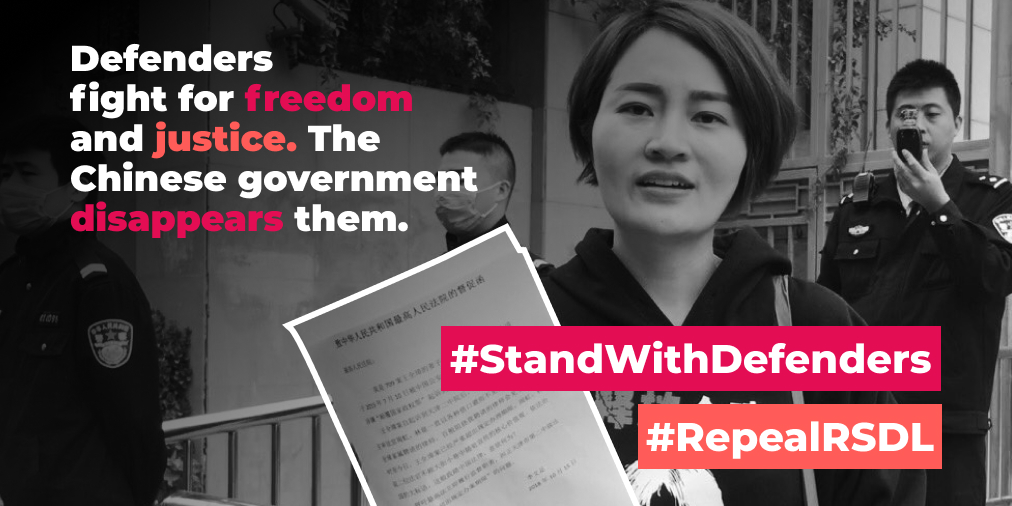
In China, brave activists are trying to improve the daily life of their fellow citizens and defend their rights to speak freely, to be treated on an equal footing with others, to protest peacefully, or to practice a religion. But the Chinese government fears that their actions will challenge its power and that their criticisms will undermine it. Like the Uyghur and Tibetan peoples, many who stand up for human rights are repressed and silenced, and the authorities have found a very effective way to do that: they disappear them.

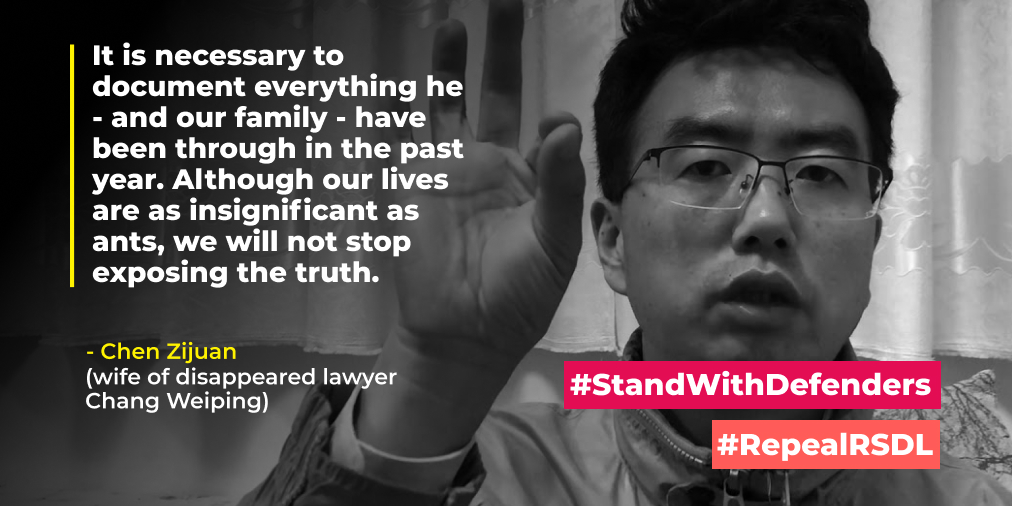
On 22 October 2020, exactly a year ago, lawyer Chang Weiping was disappeared under ‘Residential Surveillance at a Designated Location’ (or ‘RSDL’) for ‘inciting subversion of State power.’ Lawyer Chang is a human rights lawyer, who has bravely defended sensitive cases of victims of sexual harassment during China’s ‘Me Too’. He has also worked with victims of discriminatory practices due to their sexual orientation or HIV status, or targeted for speaking freely or practicing their religion. Ten days before his disappearance, he had published a video denouncing torture he had endured when he was first held under RSDL in January 2020, after attending a meeting with other activists a month earlier. UN experts have publicly called for his release. No one knows where he is held. [see also: https://www.trueheroesfilms.org/thedigest/laureates/2e6ec951-79e7-4a36-b077-76bfe05e3817]

Since 2012, China’s rubber-stamp legislative body passed and amended several articles in its Criminal Procedure Law that give police the power to take people into custody without disclosing where they will be held: this is called ‘Residential Surveillance at a Designated Location’. When this happens, people are denied all contact with the outside world, even with their family or a lawyer, for up to six months. No one knows where they are. They are interrogated and often tortured to extract confessions. Meanwhile, despite the barriers and risks they have to overcome, their families persist in seeking knowledge about their loved one’s fate and justice for what they suffered.

United Nations experts are clear: RSDL is a form of enforced disappearance. With estimations of up to 57.000 individuals under RSDL, enforced disappearances are endemic in China. RSDL tears families apart, and is intended to instill fear into China’s human rights movement. See also: https://humanrightsdefenders.blog/2018/01/10/more-on-residential-surveillance-in-a-designated-location-rsdl-in-china/

Many human rights activists have stopped promoting dignity, peace and justice in their communities because they fear to be disappeared by the police. This practice – enforced disappearance – is absolutely wrong and prohibited under international law. Everyone should be able to speak their mind and participate in the life of their communities. 

ISHR, Safeguard Defenders, The Rights Practice and The 29 Principles are mobilising the international community to put pressure on China to #RepealRSDL and end enforced disappearances against human rights defenders.

They want the Chinese government to repeal RSDL (articles 74 to 79 of China’s Criminal Procedure Law), and to bring truth and justice to victims.

RSDL should be high on the agenda of any human rights exchange with the Chinese government. We want governments worldwide to speak out and use all bilateral and multilateral channels to press the Chinese government to #RepealRSDL. We want the UN to amplify its monitoring of RSDL in China, and to sustain its pressure on the authorities to respect international law and to #RepealRSDL.

Feeling supported is vital for disappeared defenders and their relatives. We want the media, human rights groups and activists across the world to pay closer attention to RSDL, to raise awareness around them, and to stand in solidarity with disappeared Chinese human rights defenders and their relatives.

How do we achieve this? 

We are working hard to: 

  • Increase the awareness and legal understanding of government officials and diplomats, UN experts, journalists, and human rights groups, there is a short document that explains clearly what UN experts have said about RSDL, and are spreading the word online and offline.
  • Mobilise diplomatic missions, through meetings and letters, and encourage them to speak out on RSDL at the UN and in other spaces; 
  • Push UN experts to take up individual cases and pay a closer look at the use and impact of RSDL in light of China’s obligations under international human rights law ;
  • Encourage governments, activists, and concerned individuals to stand in solidarity with disappeared human rights defenders and their relatives

What can you do? 

Stand in solidarity! Feeling supported is vital for disappeared defenders and their relatives. Send a solidarity message with Chen Zijuan, lawyer Chang’s wife: write a postcard, and share it with her on your social media by clicking on the image below. Don’t hesitate to personalise it before tweeting. Alternatively you can copy paste this link in your browser: https://ctt.ac/477cf

You can also raise awareness! Check out the informational and communication material in our ‘Campaign Toolbox’, and share it with your country’s ministry of foreign affairs, a journalist you know, your friends or your social media followers – and remember to tag @ISHRglobal, and #StandWithDefenders #RepealRSDL.

https://ishr.ch/action/campaigns/call-on-china-to-free-defenders-and-repealrsdl/

Dutch university closes human rights centre funded by China

January 29, 2022

The Scholars at Risk Media Review of January 2022, carries an in-depth article about a university funding row which has raised fears of Chinese influence, written by Yojana Sharma on 26 January 2022:

The Free University of Amsterdam (Vrije Universiteit Amsterdam or VU Amsterdam) in the Netherlands has said it will return Chinese funding for its Cross Cultural Human Rights Centre (CCHRC) after an embarrassing row over Chinese influence on academia when it emerged that several of the centre’s academics publicly denied China oppresses Uyghur peoples. See also: https://chinachange.org/2020/04/30/one-chinese-gongos-war-against-global-human-rights/

But the row in the Netherlands amid other recent controversies over Chinese funding of university centres and Confucius Institutes in Germany and the United Kingdom has also made university disclosure of foreign funding more urgent, academics said. In 2018, 2019 and 2020, the CCHRC at VU Amsterdam received a subsidy of between €250,000 (US$282,000) and €300,000 (US$339,000) from the Southwest University of Political Science and Law in Chongqing, China.

According to documents obtained by Dutch broadcaster NOS, the Chinese university was the sole financial contributor to the CCHRC during those years, which has raised eyebrows.

VU Amsterdam has said it would return the money it had already received from China for this year, NOS revealed last week. But the university only backed down after the damaging revelations prompted a public outcry and strong statements by the Dutch education minister and others condemning the activities of the centre.

On Wednesday NOS said the activities of the Centre were being suspended, with all its lectures for students cancelled, ascribing the decision to the executive board and deans of the university. The Centre’s activities were already in doubt after the return of funds, making it dependent on the university or other donors for its continued survival.

The row blew up just as the Dutch education ministry is due to present its National Guidelines on Knowledge Security on 31 January and to announce its ‘Government-wide knowledge security front-office’, which is expected to have an advisory role and support universities in identifying risks.

It also followed the publication last week of the European Commission ‘toolkit’ for universities on how to deal with foreign interference.

Dutch Education Minister Robbert Dijkgraaf responded swiftly and unequivocally to the report, saying he was “very shocked” that the funding arrangement signalled possible academic dependence.

“It is urgent and sensible that the Free University now takes action quickly. Scientific core values such as academic freedom, integrity and independence must always be guaranteed,” he said in a statement.

The minister added: “It is important that Dutch knowledge institutions are and remain alert to possible risks of undesired influence by other countries and that they take adequate measures to safeguard academic core values, especially when it comes to universal values like human rights.”

The centre runs an academic journal and organises conferences. Its mission, laid down in the financing agreement with the Chinese university, is to draw attention to a “global view of human rights”, and specifically to the way in which non-Western countries such as China view human rights.

University’s lukewarm initial response

After a lukewarm initial response when the university merely underlined that “as befits the Free University, the research of the CCHRC is independent, interdisciplinary, dialogical and socially relevant”, it added to its statement just hours later, saying “even the appearance of dependence is unacceptable” and announced that it was “taking appropriate measures”, including halting the funding from China.

The university said it has not yet decided whether it will also refund subsidies from previous years, but it said it would first conduct an investigation to determine “whether the independence of the institute’s research has been safeguarded on all fronts”.

The CCHRC website noted in October 2020 that a delegation of people affiliated to the centre ‘recently’ visited the western Chinese region of Xinjiang… the CCHRC website noted: “The situation we encountered in the four cities in this trip did not reflect the grim situation as depicted in the Western reports. There is definitely no discrimination of Uyghurs or other minorities in the region.”

CCHRC Director Tom Zwart, professor at Utrecht University, who is also a frequent guest at Chinese state events and on Chinese state television, told NOS any similarities between the centre’s positions online and those of the Communist Party were “coincidental” and were not steered by any direct influence. Zwart described the CCHRC website as a place for “uncensored free thought”, ascribing the comments on its webpages to individuals “who do not represent the organisation as a whole”.

On 26 January CCHRC released a new statement on its website saying the website would be “temporarily taken offline” in order “to check whether a sufficiently clear distinction is made between statements made on behalf of the Centre and opinions and observations made in a personal capacity.”

It added: “[The] Centre explicitly endorses the conclusions of the United Nations regarding the systematic violation of the Uyghur human rights. In this vein, the Centre’s director, in the presence of members of the Chinese State Council and the Politburo, called on 8 April 2021 to respect and protect the rights of Uyghurs and stop repressive anti-terrorism policies.”

Ingrid d’Hooghe, an expert on China-Europe relations and senior research fellow at the Leiden Asia Centre, Leiden University in the Netherlands, said: “The director of the Centre said in an interview which was also on TV that they were fully independent, there was nothing that made them say what they were saying. But apparently it did not cross their mind that even if they are independent, it doesn’t look like it.

Dutch academic Lokman Tsui, a researcher on digital freedoms and a former assistant professor at the Chinese University of Hong Kong, said via Twitter: “Important to note: until this year, they [the university in Chongqing] were the only funder. Problematic, because it’s hard to be independent if your research centre relies on one single funder. Problematic also, because public universities in China are closely affiliated with the Chinese Communist Party.”

Tsui added: “But whether the research centre is independent or not is also beside the question. The more important question is: Why is the university allowing its integrity and its reputation to be compromised by accepting money meant to validate China’s atrocious human rights record?”

Need for disclosure legislation

“We need legislation that universities have to make funding public,” Fulda said, pointing to Section 117 of the United States Higher Education Act which requires universities that receive foreign gifts of US$250,000 or more within a calendar year to file a disclosure report to the government.

Other draft foreign influence bills, including the Senate Bill S.1169 in the US, are currently attempting to tighten those rules, including reducing the amount that has to be declared by institutions and individuals if the funding comes from certain countries such as China, after a number of universities failed to report substantial foreign gifts under Section 117.

An amendment to the UK Higher Education Bill tabled on 12 January in the House of Commons would require disclosures of foreign funds of £50,000 (US$68,000) going back 10 years.

“The question is, if the Dutch government or other governments in Europe issued new regulations where universities were forced to make these contracts public, whether it would change things, and I think it would,” said Fulda.

Leiden Asia Centre’s d’Hooghe said: “There is no regulation that forces people to register somewhere what kind of collaboration they have. With new regulations in Australia and, to a certain extent, in the US and Canada, you have to become public with that kind of information. Not so in the Netherlands.”

“It’s not necessarily that people want to keep it a secret, it’s just not something that is done routinely. So at top levels in the university, but often even at the faculty level, the departments don’t have a good overview of exactly what kind of research is being done with whom, and how this is financed,” she said

The Association of Universities in the Netherlands (VSNU) published a “Framework for Knowledge Security” in July 2021 that outlined risks and the need for monitoring research collaboration, as well as recommending that universities set up their own internal ‘knowledge security advisory team’ to include experts such as cybersecurity specialists.

The focus is on building risk awareness but does not go as far as requiring disclosure of foreign funding. Some universities have pointed out that they cannot ‘police’ research or researchers on behalf of the government.

Who will investigate?

The Netherlands Inspectorate of Education has not indicated that it will carry out a broader investigation into China influence at universities in the country, saying in a statement following the VU Amsterdam row: “No other signals about Chinese influence are known to the inspectorate.”

Sophie Richardson, China director at Human Rights Watch, said in a statement that the Inspectorate of Education “would be wise to do more homework in this area”.

“In a decade of documenting Chinese government threats to academic freedom around the world, Human Rights Watch has found threats at universities from Australia to the United States, and proposed a code of conduct to help mitigate these risks.

“One key step: universities should publicly disclose all direct and indirect Chinese government funding and a list of projects and exchanges with Chinese government counterparts on an annual basis,” she said.

“In showing its permeability to Chinese government influence, the Free University shouldn’t limit its response simply to returning the funding. It should urgently assess whether students and scholars of and from China on its campus are subjected to harassment or surveillance,” which she noted had been well documented elsewhere, notably in Australia, Canada, the UK and the US.

“University leadership and scholars should assess whether censorship and self-censorship have eroded the curriculum or classroom debate,” Richardson added.

“The Free University should also join forces with counterparts across Europe – from Berlin to Cambridge to Budapest – who have faced similar problems, and agree to share information and adopt common standards with the goal of collectively resisting Beijing’s efforts to curtail academic freedom. The list of potential participants – supposedly ‘free’ universities – is disturbingly long.”

EU toolkit for universities: will it make a difference?

The EU issued a toolkit for universities on 18 January. Although it is comprehensive, d’Hooghe noted that “these rules are not binding because the EU has no competence in the area of education”. Universities are outside Brussels’ remit.

She saw it more as a “service to EU member states who still don’t have national rules, who find it very difficult to develop them or don’t have the capacity to develop them”.

While many ongoing collaboration projects with Chinese universities continue, despite academics and researchers being unable to travel due to pandemic restrictions, d’Hooghe said she knew of many who “are staying away” from starting new projects with China, in part due to risks, including reputational risks.

But she noted that legislation on a national level regarding foreign influence could be tricky. “University autonomy is regarded as an important value and very important for science to advance, so universities are very reluctant to be limited by binding regulations.”

https://www.hrw.org/news/2022/01/20/dutch-university-hit-chinese-government-funding-scandal

seehttps://www.theguardian.com/education/2025/nov/03/uk-university-halted-human-rights-research-after-pressure-from-china

Some rich and famous people favour money over rights

January 24, 2022

Tara Everton and Jenny Wang posted in the human Rights Foundation a diatribe “Ignorance and Reluctance of the Rich and the Famous” which is well worth reading in full:

In a recent episode of the podcast “All-In,” Chamath Palihapitiya, billionaire venture capitalist, stakeholder of the Golden State Warriors, and Chairman of Virgin Galactic, commented that “nobody cares about what’s happening to the Uyghurs… Of all the things that I care about, it is below my line.” 

Palihapitiya has joined the growing list of wealthy Western elites, including Elon Musk, Ray Dalio, Craig Smith, and more, who have openly turned a blind eye to the suffering of millions of people living under the Chinese Communist Party (CCP)’s repression. 

The reason for doing so is simple: to remain in the good graces of the CCP to line their own pockets.

The world is witnessing the Chinese government’s belligerence and disregard for human dignity. In the past several decades, China’s authoritarian regime has tightened its grip on power by conducting mass crackdowns on Chinese human rights defenders, spearheading an unprecedented 21st century genocide against the Uyghur Muslims in Xinjiang, and implementing incessant policing in Tibet and Hong Kong. Despite the regime’s ongoing abysmal human rights record, highly influential entrepreneurs, business tycoons, and elites have all too willingly stayed silent.

Greed and lust for access to the Chinese market have made profit-driven elites eager to acquiesce to the CCP’s authoritarian ideals. When these figures harbor these types of views – and express them so casually on prominent platforms – human rights are in grave danger. 

The blatant ignorance of Western elites and billionaires is stunning. For example, founder of Tesla, Elon Musk, brazenly disregarded the testimonies and evidence coming out of Xinjiang about the genocide, and recently opened a Tesla showroom in the region. Similarly, Ray Dalio, founder of Bridgewater Associates, has shamelessly fawned over the Chinese government’s mass crackdowns toward achieving “common prosperity,” and even claimed that the United States should follow suit — a stance that has garnered him praise from Chinese state media. Most recently, Craig Smith, CEO of Burton Snowboards’ China subsidiary, showed concerning indifference to the Uyghur genocide by stating that he has no problem doing business in Xinjiang  — even after sharing that he is well-aware of the reports about genocide.

Palihapitiya’s recent brazen remarks are just one example out of far too many. 

Palihapitiya and his fellow tycoons are trained in social combat. Palihapitiya, in response to the resulting backlash, “recognized” he came across “lacking empathy,” citing his personal experience as a refugee and concern for all human rights. The Golden State Warriors subsequently tried to publicly distance themselves from Palihapitiya – while still dancing around using direct verbiage about China and the Uyghur genocide. All too similarly, Dalio took to social media soon after his fumble to admit he “answered sloppily” to questions about China. Elites are quick to undergo damage control – yet the real damage has already been done.

With the power of celebrity and money comes responsibility. Businessmen and elites could undoubtedly make a dent in the CCP’s growing control just as corporate divestment campaigns did to help bring an end to apartheid in South Africa. These individuals can speak up, but egregiously, they are reluctant and choose not to. Driven instead by financial gain, they uncritically whitewash the Chinese regime’s abuses and in turn, act as agents of influence for Xi Jinping. 

They choose money over morals. However, you do not have to – and you should not. Connect with your government officials. Policymakers and legislators need to engage with civil society groups and independent experts to ensure their foreign policies and economic negotiations are not complicit to the Chinese government’s crimes. Call your elected officials to stress their moral and legal obligation to respect, protect, and fulfil fundamental human rights. Shop responsibly. There’s a 1 in 5 chance that your clothes are linked to Uyghur forced labor. Consider supporting brands that have publicly committed to ending such forced labor, and urge your favorite brands to disclose not only how products are made but also who makes them. Support activists. The CCP actively intimidates and pressures brave individuals outside of China who stand up for human rights. Follow them on social media, donate to their campaigns, and support organizations that provide platforms for their activism. 
Human rights are not a “luxury belief,” and complicity is not “below [your] line.” As a concerned global citizen, do what you can to stand up to the Chinese regime. We can do better than the billionaires. Full stop.

That it can be done differently is shown inter alia by: https://humanrightsdefenders.blog/2021/02/08/celebrities-who-risked-their-careers-for-human-rights-you-always-have-a-choice/

https://mailchi.mp/hrf.org/the-ignorance-and-reluctance-of-the-rich-and-the-famous?e=f80cec329e

China goes after dissidents abroad

January 18, 2022

On 18 January 2022 a new report by Safeguard Defenders, inspired Al-Jazeera (Erin Hale) to write about how the Chinese authorities are trying to coerce critics thousands of miles from home into returning.

Wang Jingyou was living in Turkey last year when he found that the 7,000 kilometres (4350 miles) between him and his homeland was no obstacle to an offended Chinese state. Wang had left China after voicing his support on TikTok for Hong Kong’s democracy protests, but after he questioned the outcome of an Indian-Chinese border clash on social media in February 2021, mainland authorities sprung into action.

Within half an hour of the post, police in his hometown of Chongqing had visited his parents. Then they detained them. They said Wang, who is in his early twenties, had “slandered and belittled heroes” while also “picking quarrels”, two charges that in China are often used to silence government critics.

“I’m not in China, I’m in Europe,” Wang told Al Jazeera. “I just said something. I didn’t do anything and they put my (name) on a wanted (list) in the government website, in the official media, also in the Ministry of Foreign Affairs too.”

Wang soon found himself on a months-long journey of harassment that saw him detained while flying through Dubai in April 2021 and threatened with deportation to China – which he narrowly avoided when his story became international news. Wang and his fiancée travelled through several countries before they eventually claimed asylum in the Netherlands, but not before China had cancelled their passports.

“We are in the Netherlands, but they also have many, many ways to find us,” Wang said, alleging that even with a Dutch phone number he continues to receive threatening text messages and phone calls.

Chinese paramilitary police in summer unoforms march outside a new museum to the Chinese Commuist Party

Wang’s story may sound dramatic, but it is far from extraordinary in Xi Jinping’s China, according to human rights watchdog Safeguard Defenders, which released a new report on Tuesday on the country’s widespread practice of “involuntary returns”. Such pressure has been used on more than 10,000 alleged Chinese “fugitives” who since 2014 have been coerced into returning from abroad to face detention or prosecution for alleged corruption and other crimes, the report said citing official data.

Methods to “encourage” return can vary from harassment and coercion of friends and family online, to approaching a citizen overseas through Chinese or domestic security agents, and more “irregular” methods like state-sponsored kidnapping, Safeguard Defenders said. In some cases, authorities may freeze family assets or even threaten to remove children from families.

Kidnappings typically occur in countries with a strong relationship with China, like Thailand or Myanmar, but Safeguard Defenders said as many as 10 people may have been kidnapped from among Australia’s large Chinese diaspora in recent years.

The list also includes the 2015 disappearance of five staff members associated with a Hong Kong book store specialising in books banned in China. One bookseller, Gui Minhai, disappeared in Thailand while the others went missing on trips to China, only to later emerge in Chinese detention

China has also made use of Interpol “red notices“, which flag a citizen to police and immigration departments around the world so they can be deported back home, where they face a 99 percent conviction rate if prosecuted, the watchdog said.

“Involuntary returns” have become increasingly common since China first launched an ambitious anti-corruption campaign in 2012, followed by Operation Foxhunt in 2014 to repatriate Communist Party officials facing corruption charges who have fled abroad, and the broader Operation Sky Net in 2015 to target money laundering.

While nominally law-enforcement based, Operation Foxhunt has been described as a “campaign to enforce political loyalty, avoid in-Party factionalism and to more generally instil Party discipline”, Safeguard Defenders said in the report.

Both campaigns have corresponded to a 700 percent jump in Chinese people seeking asylum abroad between 2012 and 2020 as China’s already limited civil and political rights have been curtailed even further under President Xi, the rights group said.

That number does not include the 88,000 Hong Kong people who applied to resettle in the UK in 2021 under a new immigration scheme, after the imposition of a national security law for the Chinese territory that Amnesty says has “decimated” freedoms and rights that Beijing had promised to respect until at least 2047.

More than 175,000 people have been officially recognised as refugees, but that has not kept Chinese authorities from orchestrating “involuntary returns” whether they are government defectors, Falun Gong practitioners, human rights defenders, political dissidents, or even ordinary citizens like Wang who have fallen afoul of increasingly strict authorities.

Wang says he was just doing what millions of other people do everyday — sharing his views on social media.

“We didn’t do anything against China,” he said. “I wrote something. I never thought they would (begin to) watch me.”

https://safeguarddefenders.com/en/blog/involuntary-returns-report-exposes-long-arm-policing-overseas

https://www.aljazeera.com/news/2022/1/18/china-critics-overseas-feel-the-long-reach-of-beijing-report

https://www.theguardian.com/world/2022/jan/18/china-forced-2500-fugitives-back-from-overseas-during-pandemic-report-finds

Human Rights Watch advises new German Government

December 22, 2021
A man wearing a suit raises his right hand
Germany’s new Chancellor Olaf Scholz (left) and Baerbel Bas, President of the Bundestag, during the swearing-in of the new Federal Government in Berlin, December 8, 2021.  © 2021 Florian Gaertner/picture-alliance/dpa/AP Images

On 10 December 2021, David Fischer, HRW’s Media Coordinator, Germany published “A Human Rights Roadmap for Germany’s New Government

…The climate crisis threatens catastrophic impacts on human rights, and ambitious climate action by the government to reduce greenhouse gas emissions is critical if Germany – the European Union’s biggest greenhouse gas emitter – is to help prevent the worst of those impacts.  The new government’s coalition agreement, a non-binding roadmap for legislative action, calls for elimination of coal energy “ideally” by 2030, promises a roll-back of subsidies for fossil fuels and legislation to deal with climate change adaptation planning. These are positive steps but insufficient to reach Germany’s contribution toward the global goal in the Paris Agreement of limiting global warming to 1.5°C above pre-industrial levels.

In addition to the climate crisis, the new coalition between the Social Democrat Party (SPD), the Free Democrats (FDP) and the Greens (Die Grünen) will have to tackle challenges to the rule of law within the EU, stand up for human rights against autocrats in China and Russia, and address the many challenges arising from the pandemic.

The coalition agreement makes promising commitments to advance the rights of lesbian, gay, bisexual, and transgender (LGBT) people, including to change the law on legal gender recognition for transgender people so that it is based on self-determination. The coalition also commits to protecting human rights in supply chains in line with the UN Guiding Principles on Business and Human Rights that include the right to a remedy for victims. It proposes to increase the capacity of German courts to prosecute universal jurisdiction cases such as the trial on state-sponsored torture in Syria.

Within Europe, the new government intends to push for judgements of the European Court of Human Rights to have greater impact and “be implemented in all member states”. It supports the use of mechanisms and sanctions to enforce the rule of law in European Union member states. It also calls for shared responsibility for migrants and refugees among member states, an end to pushbacks at EU borders and for the border agency Frontex to respect human rights.

Scholz’s new government will now need to live up to expectations on human rights and prove that what the coalition dubbed “Germany’s responsibility for Europe and the World” is expressed in actions and not just words.

See also: https://www.justsecurity.org/79618/how-germanys-new-government-might-pursue-its-values-based-foreign-policy-in-europe/

https://www.hrw.org/news/2021/12/08/human-rights-roadmap-germanys-new-government