Posts Tagged ‘Brazil’
January 9, 2019
Posted in human rights, Human Rights Defenders | 4 Comments »
Tags: annual report 2018, Berta Carceres, Brazil, environmental activists, Global Witness, Indigenous rights, Jair Bolsonaro, Mongabay, Muhammad Yusuf, Philippines, Taran Volckhausen, Victoria Tauli-Corpuz
November 25, 2018
These are cases of human rights defenders featuring in the 2018 Write for Rights campaign that I referred to yesterday [https://humanrightsdefenders.blog/2018/11/24/amnesty-starts-again-its-write-for-rights-campaign/]:
Marielle Franco, Brazil
Killed for defending the people of Rio [see also: https://humanrightsdefenders.blog/2018/03/16/marielle-franco-38-year-old-human-rights-defender-and-city-councilor-of-rio-assassinated/]
Geraldine Chacón, Venezuela
Persecuted for her youth work
Atena Daemi, Iran
Jailed for opposing the death penalty
#NowForNI campaigners, UK
Fighting for basic healthcare
Seyi Akiwowo, UK
Abused online for defending women’s rights
Death threats for protecting her community
Gulzar Duishenova, Kyrgyzstan
Speaking up for disability rights
The Sengwer People, Kenya
Forced from their ancestral land
Pavitri Manjhi, India
Threatened for standing up to big business
Vitalina Koval, Ukraine
LGBTI rights activist attacked by the far right
Nawal Benaissa, Morocco
Hounded for demanding change
Posted in AI, Human Rights Defenders | 1 Comment »
Tags: Atena Daemi, Brazil, Geraldine Chacón, Gulzar Duishenova, Human Rights Defenders, India, Iran, Kyrgyzstan, Marielle Franco, Morocco, Nawal Benaissa, Nonhle Mbuthuma, Pavitri Manjhi, Seyi Akiwowo, South Africa, UK, Ukraine, Venezuela, Vitalina Koval, Write for Rights campaign
October 26, 2018
On Friday 26 October 2018 the President of the UN General Assembly announced – in a rather summary and informal tweet:
“Today I announced the 2018 winners of the Human Rights Prize. I am proud to recognise the contributions of individuals & organizations that promote & protect human rights Joênia Wapichana Your work is an inspiration to us all “.
This is the tenth time that these awards were since the prize was established in 1968, coinciding this year with the 70th anniversary of the Universal Declaration of Human Rights and the 20th anniversary of the UN Declaration on Human Rights Defenders. For more on this award: http://trueheroesfilms.org/thedigest/awards/united-nations-prizes-in-the-field-of-human-rights
It is probably for that reason that one of the winners is the outstanding Ireland based NGO Front Line Defenders (regularly quoted in the blog, see e.g. https://humanrightsdefenders.blog/tag/front-line-ngo/). The Director Andrew Anderson promptly replies with: “Profoundly honoured that @FrontLineHRD has been named as one of 4 winners of the UN Human Rights Prize. We dedicate this to the courageous & dedicated human rights defenders we work to support.”
Three other winners of the prize are
——–
https://www.newstalk.com/Irish-organisation-wins-United-Nations-Human-Rights-Prize
https://www.girlsnotbrides.org/high-court-tanzania-child-marriage/
https://en.wikipedia.org/wiki/Joênia_Wapixana
Posted in awards, Human Rights Defenders, UN | 2 Comments »
Tags: Asma Jahangir, Brazil, digest of human rights awards, Front Line (NGO), Front Line Defenders, human rights awards, Ireland, Joênia Batista de Carvalho, Joênia Wapichana, Pakistan, Rebeca Gyumi, Tanzania, UN General Assembly, UN human rights prizes, Wapixana
July 30, 2018
Russian President Vladimir Putin (L) Indian Prime Minister Narendra Modi (C) and Turkish President Recep Erdogan (R) interact during a family photo during the BRICS summit meeting in Johannesburg, South Africa, 27 July 2018. EPA-EFE/GIANLUIGI GUERCIA / POO
As they met in Johannesburg last week, BRICS leaders focused on the economy, development, peacekeeping, health and industrialisation issues within the bloc (accounting for 40% of the world’s population). However, equally important issues such as the protection and realisation of human rights in the respective countries remained off the agenda. Jennifer Wells, an intern with AI South Africa, on 30 July 2018, gave a useful reminder of what could and should have been also addressed:
Brazil
Brazil has one of the highest murder rates in the world, with around 60,000 people murdered each year…Brazil’s failure to protect black Brazilians from police violence remains critical as this year marks the 25th anniversary of the Candelaria killings. The tragedy, in which eight young black boys were killed by off-duty police officers in Rio de Janeiro in 1993, represents the endemic racism within the Brazilian security forces. The situation was aggravated by the murder of Rio de Janeiro human rights defender and councilwoman Marielle Franco on 14 March 2018. [https://humanrightsdefenders.blog/2018/03/16/marielle-franco-38-year-old-human-rights-defender-and-city-councilor-of-rio-assassinated/]
Russia
…human rights defenders and civil society activists continued to face harassment, intimidation and arbitrary arrests across the country. The trial of human rights defender Oyub Titiev started in Chechnya. He, like several other human rights defenders, is being prosecuted on trumped-up criminal charges. Law enforcement agencies continue to launch cases on fabricated “extremism” and “terrorism” charges. [https://humanrightsdefenders.blog/2018/01/15/chechen-human-rights-defender-oyub-titiev-arrested-on-trumped-up-charges/] The Ukrainian film director Oleg Sentsov, serving 20 years on “terrorism” charges, is on day 75 of a hunger strike demanding the release of “64 political prisoners from Ukraine”. The right to freedom of peaceful assembly has been increasingly restricted in Russia since 2012 and remains under severe clampdown. …. The rights of LGBTI people are trampled upon daily and the authorities continue to refuse to investigate the horrific gay purge in Chechnya. The World Cup has come and gone, but the suppression of freedoms and shrinking of civil liberties continues unabated.
India
It’s a similar story in India where human rights defenders are consistently under threat, attacked and threatened, often from security forces. India has witnessed horrific instances of alleged extrajudicial executions by security forces for years as police and federal forces have effective immunity from prosecution. In the North-Eastern state of Manipur, human rights defenders who have lost their loved ones in alleged extrajudicial executions and are now campaigning for justice, face unprecedented attacks. Salima Memcha, a widow who lost her husband to an alleged extrajudicial execution, was verbally threatened by security personnel. Her house was also vandalised by them. Three other human rights defenders in Manipur have faced similar reprisals for campaigning for justice for their loved ones.
China
In China, the government continues to enact repressive laws under the guise of “national security” that present serious threats to human rights. Nobel Peace Prize laureate Liu Xiaobodied in custody whilst other human rights defenders are detained, prosecuted and sentenced on vague charges such as “subverting state power”, “separatism” and “picking quarrels and provoking trouble”. Controls on the internet have been strengthened and freedom of expression and freedom of association are under attack.[see also:https://humanrightsdefenders.blog/2018/04/12/how-china-extracts-televised-confessions-from-human-rights-defenders/]
South Africa
In the host nation, nearly a quarter of century after adopting arguably one of the most progressive constitutions in the world, the country is bedevilled by profound inequalities, which persistently undermine economic, social and cultural rights. Failures in the criminal justice system continue to present barriers to justice for victims of human rights abuses and violations, including the state’s failure to hold perpetrators accountable for the killing of 34 striking mineworkers in Marikana in 2012 by the South African Police Service. Access to sexual and reproductive health services remain a human rights issue as does the provision of quality education.
https://www.dailymaverick.co.za/article/2018-07-30-what-brics-leaders-should-have-talked-about/
Posted in AI, Human Rights Defenders | Leave a Comment »
Tags: AI South Africa, Brazil, BRICS, China, Human Rights Defenders, India, Jennifer Wells, Marielle Franco, Oyub Titiev, Russia, Salima Memcha, South Africa
March 16, 2018
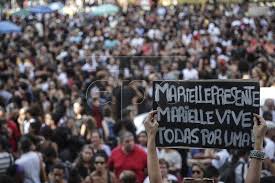
The targeted assassination of Marielle Franco, a 38-year-old human rights defender and Rio de Janeiro city councilor known for denouncing police abuses and extrajudicial executions, is a sickening development that must be fully investigated, said Amnesty International 0n 15 March. Marielle was shot dead in Rio de Janeiro’s Estacio neighborhood on Wednesday 14 March 2018. Her driver was also killed and a press officer was injured in the attack.
“This a chilling development and is yet another example of the dangers that human rights defenders face in Brazil. As a member of Rio de Janeiro’s State Human Rights Commission, Marielle worked tirelessly to defend the rights of black women and young people in the favelas and other marginalized communities,” said Jurema Werneck, Amnesty International’s Brazil director.
In 2016, Marielle was elected to the Rio de Janeiro city council. Two weeks ago, she was appointed rapporteur for a special commission that the city council created to monitor the ongoing federal intervention in Rio de Janeiro and the militarization of public security.
Gunmen riding in another vehicle carried out the attack, shooting indiscriminately before fleeing the scene without stealing anything, the Civil Police of Rio de Janeiro State said. The attack came a day after the 38-year-old city councilor had posted a message on social media criticizing the deployment of army soldiers to Rio’s sprawling “favelas”.
https://www.amnesty.org/en/latest/news/2018/03/brazil-authorities-must-investigate-the-killing-of-human-rights-defender-marielle-franco/
http://www.laht.com/article.asp?ArticleId=2452754&CategoryId=14090
Posted in AI, Human Rights Defenders | 4 Comments »
Tags: Amnesty International, assassination, Brazil, city council, favelas, Human rights defender, killing, Marielle Franco, police violence, Rio de Janeiro, woman human rights defender
February 2, 2018
This weekend I would like to share some new research on issues of civic space and human rights defenders (HRDs). The Fund for Global Human Rights has collaborated with Conectas to produce Sur 26: Reclaiming Civic Space, the 26th edition of Sur – International Journal on Human Rights. This is a special edition of the journal, authored predominantly by activists for activists. It documents the resistance of human rights groups during a time of increasing repression and restrictions on civil society, and offers key insights on the strategies frontline activists are using to reclaim civic space.
As you know, research about the global crackdown on civil society often focuses on how the crisis has manifested and its impacts. Little has been documented about the ways national-level civil society groups are responding to closing civic space, or the effectiveness of these responses. Moreover, international actors conduct much of the current research, and when frontline activists do produce analysis, it is often to inform the work of larger groups or to feature as case studies. Sur 26: Reclaiming Civic Space helps change this. The research documents the learning of activists from 15 countries, how they have evolved their strategies to reclaim civic space, and the challenges they experienced along the way.
A letter to readers http://sur.conectas.org/en/sur-26-letter-to-the-readers/, authored by Juana Kweitel (Executive Director, Conectas Human Rights), Oliver Hudson (Editor, Sur Journal) and James Savage Program Officer of the Fund for Global Human Rights, provides insight into the special issue.
This collaboration with Conectas is a component of the Fund’s Enabling Environment for Human Rights Defenders Program <http://globalhumanrights.org/issues/activism-under-threat/> , a global initiative that supports human rights activists to resist the crackdown on civic space. A cornerstone of the program is to support documentation by and learning between activists.
Prior to the publication of Sur 26, with support from the Fund, Conectas brought together a dozen of the Sur 26 author-activists at a writers’ retreat in Sao Paulo. This opportunity helped the author-activists examine global and regional trends in closing space, discuss and share their strategies, review and provide feedback on each other’s texts, and reflect together on the importance of writing and documentation. The retreat enhanced and helped shape the final texts of Sur 26 while also providing a valuable space for frontline human rights defenders to collaborate on their work.
A video essay <https://youtu.be/fou-M3tb7WQ> , which was produced at the writers’ retreat, and offers a glimpse into the work explored throughout the 26th edition of Sur. Sur 26 is published in English, Spanish and Portuguese.
[see also: https://humanrightsdefenders.blog/2017/12/04/the-new-normal-rising-attacks-on-human-rights-defenders/]
http://sur.conectas.org/en/strategies-to-resist/
http://globalhumanrights.org/sur-international-journal-human-rights-issue-26/
Posted in books, human rights, Human Rights Defenders | Leave a Comment »
Tags: Brazil, civil society activists, Conectas, environmental activists, Fund for Global Human Rights, Human Rights Defenders, James Savage, Juana Kweitel, research, Sur – International Journal on Human Rights.
January 5, 2018
There were 312 human rights defenders killed in 27 countries last year, according to the new report. Two-thirds of those killed were activists working on issues of land, environmental and indigenous peoples’ rights, while 80 per cent of killings took place in just four countries – Brazil, Colombia, Mexico and the Philippines. Front Line Defenders said the number of killings remained “truly shocking”, while the “weak response of both national governments and the international community gives little hope that this will change in the short term”. The report outlined that in 84 per cent of killings the defender had previously received a threat.
Andrew Anderson, executive director of Front Line Defenders, said “we know that those killings, in many cases were preventable”. “When we analyse those killings, in 84 per cent, the defendant had previously received a threat, and that highlights if there had been effective action taken by the police or other authorities, there could have been something done to prevent that killing happening.” Mr Anderson added: “These are not random killings of people in crossfire – This is the targeted elimination of people who are working to defend the rights of the most vulnerable.
Front Line Defenders said female human rights defenders in particular are increasingly reporting “hyper-sexualised smear campaigns and defamation” which aim to limit their activism by eroding local support networks.
https://www.frontlinedefenders.org/en/resource-publication/annual-report-human-rights-defenders-risk-2017
https://www.irishtimes.com/news/ireland/irish-news/over-300-human-rights-activists-killed-in-2017-says-report-1.3345060
Posted in Front Line, Human Rights Defenders | 6 Comments »
Tags: annual report 2017, Brazil, Colombia, environmental activists, Front Line (NGO), Human Rights Defenders, killings, land rights defender, Mexico, Philippines, prevention, threats, women human rights defenders
November 22, 2017
Brazil’s “Piripkura” has won the Amsterdam Human Rights Award at this year’s International Documentary Film Festival Amsterdam (IDFA). Recognition for a devastating chronicle, the award comes with a cash prize of €25,000. The jury said of the film: “With this poignant, exceptional story, the filmmakers tackle a broad series of issues that should be high up on the international human rights agenda. The filmic quality of this documentary left us no choice but to award the Amsterdam Human Rights Award to ‘Piripkura.’”The film was produced by Brazil’s Zeza Filmes with Maria Farinha Filmes and Grifa Filmes as associate producers.
“Piripkura,” is a a modern-day ethnographic documentary with distinct differences from its scholarly predecessors. Ethnographic filmmaking started with voyeuristic or educational intentions, as an attempt to show the world something it had never seen. Perhaps it says something about the modern world that these films are now made in the spirit of conservation.
[The film follows Jair Candor, an official with Brazil’s indigenous affairs agency FUNAI, as he ventures into one of the Amazon’s protected indigenous lands, Piripkura. Only three Piripkura tribe-members are still alive today, and only two in their native land. The third, Rita, was forced to flee the lands when logging companies sent in mercenaries to kill the tribespeople, and thus lift government protections of the area. Rita accompanies Candor on his initial visits to confirm the continued existence of Pakyî and Tamandua, the last remaining Piripkura, an undertaking which must be done to sustain the areas protected status. Beyond the inherent dangers of living in the Amazon; corporate farms, fires, logging companies and massive budget cuts to aid agencies are constant threats to the two men.]
More information, and ways to help, can be found at: https://www.survivalinternational.org/about/funai
http://variety.com/2017/film/festivals/idfa-brazilian-doc-piripkura-amsterdam-human-rights-award-1202619003/
Posted in awards, films, human rights | Leave a Comment »
Tags: Amsterdam Human Rights Award, awards, Brazil, human rights film, IDFA, indigenous peoples, Piripkura (film), Zeza Filmes
March 2, 2017
One of the side events in Geneva during the UN Human Rights Council that is of special importance for human rights defenders is held tomorrow, 3 March 2017, from 13:00 – 14:00, in Room XXI, Palais Des Nations, Geneva.
Across the world, well-established principles and standards fundamental to maintaining a safe and enabling environment for civil society are being questioned and threatened in mature and consolidated democracies. In both the global North and global South, governments with vibrant civil societies and constitutional and historical commitments based on their struggles for democracy and freedom are adopting increasingly hostile and corrosive policies and practices to suppress independent civil society voices. The event will provide an opportunity for the UN Special Rapporteur on human rights defenders and civil society leaders to reflect on the global climate for civil society operating in mature democracies and articulate key measures these states must take to ensure an enabling environment for civil society and human rights defenders both at home and at the UN Human Rights Council. In advance of their examination under the Universal Periodic Review in May 2017, the event will also bring together civil society leaders from India, Brazil, Poland, and South Africa to examine state backsliding on civic space norms.[see also: https://humanrightsdefenders.blog/2017/02/24/2017-10-need-to-reset-for-h…]
Panelists:
- Michel Forst, UN Special Rapporteur on the situation of human rights defenders
- Camila Asano, Conectas – Brazil
- Henri Tiphagne, Human Rights Defenders Association – India
- Maciej Kozłowski, Committee for the Defence of Democracy (KOD) – Poland
- Corlett Letlojane, HURISA- South Africa
Moderator: Mandeep Tiwana, Head of Policy and Research, CIVICUS
The event is co-sponsored by key international NGOs: –Amnesty International, CIVICUS, Asian Forum for Human Rights and Development (FORUM-ASIA), International Society for Human Rights (ISHR), Human Rights Watch (HRW), Human Rights Defenders Alert India (HRDA), The Observatory for the Protection of Human Rights Defenders (OBS)
https://www.forum-asia.org/?p=23168
Posted in AI, HRW, human rights, Human Rights Defenders, ISHR, Observatory for the Protection of Human Rights Defenders | Leave a Comment »
Tags: Brazil, Camila Asano, CIVICUS, Corlett Letlojane, Forum Asia, Geneva, Henri Tiphagne, India, Maciej Kozłowski, Mandeep Tiwana, Michel Forst, Poland, side event, South Africa, Special Rapporteur on the situation of human rights defenders, UPR
September 1, 2016
The chilling trend of attacking human rights defenders working on environment and land rights continues. The help keep an overview here a summary of a number of relevant items:
On 26 August 2016
Patricia Schaefer of the
Center for International Environmental Law posted a blog in the NonProfitQuarterly website under the Title “
International Collaboration Reports on Violence against Environmental Activists”, summarizing two recent reports (
On Dangerous Ground by
Global Witness and a more recent “
Deadly Shade of Green” by Center for International Environmental Law (CIEL), British NGO Article 19, and Vermont Law School).
Global Witness stated that worldwide, in 2015, there were 185 individuals killed in 16 countries while defending their land, forests, and rivers against industrial encroachment. At the top of the list were Brazil (50 killings), the Philippines (33), and Colombia (26). Global Witness recounts, “Conflicts over mining were the number one cause of killings in 2015, with agribusiness, hydroelectric dams and logging also key drivers of violence. In 2015, almost 40 percent of victims were from indigenous groups.” [Global Witness’ earlier report: https://thoolen.wordpress.com/2014/04/16/environment-deadly-for-human-rights-defenders-says-global-witness/].
Read the rest of this entry »
Posted in Front Line, HRW, human rights, Human Rights Defenders, UN | 4 Comments »
Tags: Berta Cáceres, Brazil, Center for International Environmental Law, Deadly Shade of Green, Ecuador, environmental activists, Front Line (NGO), Global Witness, Gloria Capitan, HRW, Human Rights Defenders, killings, land rights defender, Latin America, Nilce de Souza Magalhães, Patricia Schaefer, Philippines, resource extraction, World Bank


 Hans Thoolen on Human Rights Defenders and their awards